Federal & State Policy Landscape Shaping K-12 AI Literacy
The policy environment surrounding K-12 AI literacy has shifted rapidly from voluntary frameworks to actionable mandates, creating a complex compliance matrix for district leaders planning the 2026-2027 school year. At the federal level, the U.S. Department of Education (DOE) has moved beyond its seminal 2023 report, Artificial Intelligence and the Future of Teaching and Learning, to issue specific guidance on civil rights obligations. The Office for Civil Rights (OCR) has clarified that algorithmic discrimination in edtech tools—such as biased proctoring software or predictive analytics that flag students disproportionately by race—constitutes a potential Title VI violation. This means superintendents must now audit vendor contracts for bias mitigation strategies before procurement, not after deployment.
Simultaneously, the NIST AI Risk Management Framework (AI RMF 1.0) has emerged as the de facto standard for “trustworthy AI” in educational procurement. While NIST standards are technically voluntary for the private sector, the 2024 OMB Memorandum M-24-10 requires federal agencies to align grant-making with the RMF. For districts, this translates directly into E-rate modernization and ESSA Title IV-A funding applications: states are increasingly requiring a NIST-aligned risk assessment as a prerequisite for releasing technology grants. Practically, your technology director should map every AI-enabled tool—adaptive learning platforms, generative writing assistants, facial recognition security—against the RMF’s four core functions: Govern, Map, Measure, and Manage. Documentation of this mapping is becoming a standard audit artifact.
State legislative activity is where the rubber meets the road for 2026 compliance. We are tracking three distinct legislative archetypes:
- Standards Integration Mandates: States like California (AB 2876), Florida (HB 1361), and Virginia have passed laws requiring the State Board of Education to adopt K-12 AI literacy standards by mid-2025, with full instructional integration required by Fall 2026. These are not “elective” add-ons; they are being woven into computer science, media literacy, and even civics standards.
- Procurement & Transparency Laws: Colorado (SB 24-205) and Illinois have enacted “Algorithmic Transparency Acts” impacting schools. If your district uses AI for high-stakes decisions (graduation tracking, special education placement, disciplinary risk scoring), you must provide parents with a plain-language notice explaining the logic, data inputs, and opt-out rights by January 1, 2026.
- Teacher Certification & Pre-Service Requirements: Georgia and Maryland are piloting mandatory AI literacy micro-credentials for license renewal cycles beginning 2027. Teacher prep programs in these states must embed AI ethics and prompt engineering coursework for graduates entering the workforce in 2026.
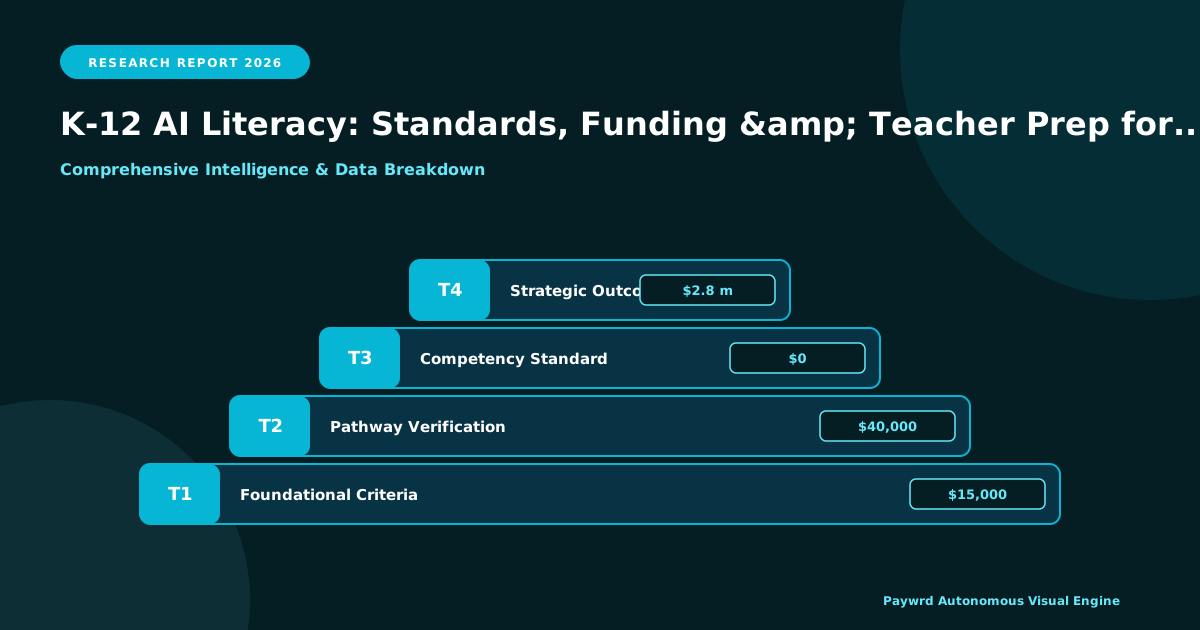
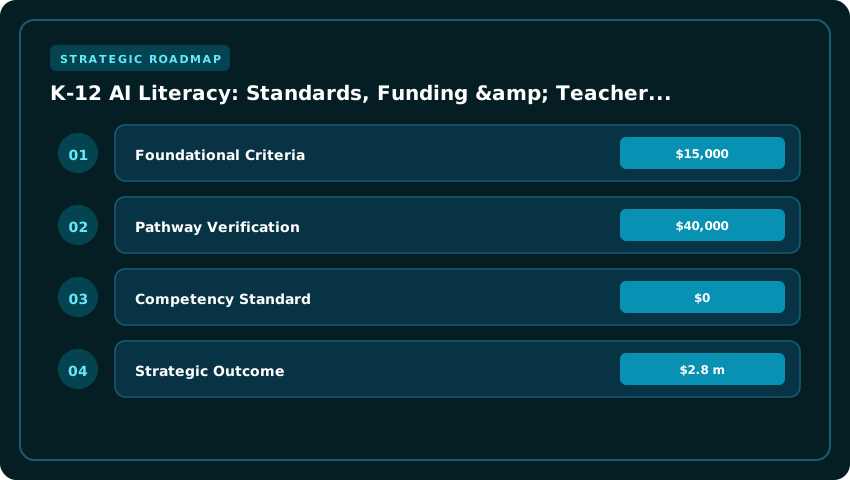
Actionable Takeaway: Do not wait for your state’s final regulatory rulemaking. Conduct a Gap Analysis this quarter comparing your current CS/Digital Citizenship scope-and-sequence against the CSTA/ISTE AI for K-12 Guidelines—the primary reference model for most state standard-setting bodies. Budget for vendor contract legal review (estimated $15,000–$40,000 for mid-size districts) to ensure NIST RMF alignment and state privacy law compliance (FERPA, COPPA, SOPIPA) before the 2026-2027 procurement cycle opens. Early alignment avoids costly “rip-and-replace” scenarios mid-year.
Curriculum Standards Alignment: CSTA, ISTE, and Emerging AI Competency Frameworks
Translating policy into classroom practice requires a fluent understanding of how the major standards bodies intersect. For 2026, the most actionable roadmap sits at the convergence of the CSTA K-12 Computer Science Standards (revised 2017, still the structural backbone), the ISTE Student Standards (refreshed 2024 with explicit AI indicators), and the CCSSO AI Competency Matrices released in late 2023. Smart district leaders are not treating these as separate checklists; they are cross-walking them to build coherent grade-band progressions that satisfy state mandates and prepare students for AP Computer Science Principles or industry certifications like PCEP.
In the K–2 band, the focus is computational thinking without screens. CSTA 1A-AP-08 (model daily processes) aligns perfectly with ISTE 1.1.d Empowered Learner (explore emerging tech) and the CCSSO AI Awareness pillar. Here, students classify objects by attributes—“Is this a triangle?”—mirroring how a classification model sorts data. Lesson idea: Use unplugged sorting games to introduce training data and bias using picture books, laying vocabulary groundwork for later technical depth.
The 3–5 band introduces block-based coding and data literacy. Map CSTA 1B-DA-06 (organize/present data) and 1B-AP-10 (create programs with sequences/events) to ISTE 1.5.c Computational Thinker (break problems into parts) and CCSSO Data & Algorithm Literacy. Students should train a simple Teachable Machine image model to recognize recyclable vs. landfill waste. This hits CSTA data standards, ISTE design thinking, and CCSSO’s ethical use criteria in one $0 project.
For grades 6–8, the rubber meets the road on technical rigor. Align CSTA 2-AP-13 (decompose problems) and 2-DA-08 (collect data with computational tools) with ISTE 1.3.d Knowledge Constructor (curate data) and CCSSO AI Ethics & Society. A capstone project: Build a NLP chatbot in Python using scikit-learn or TensorFlow that answers school policy questions. Require a Model Card documenting training sources, intended use, and known limitations—directly satisfying the CCSSO transparency competency and prepping students for AP CSP Create Performance Task rubrics.
At the 9–12 level, districts should offer articulated pathways. Pathway A (CS Depth): CSTA 3A-AP-21 (evaluate algorithms) + ISTE 1.4.c Innovative Designer (develop/test prototypes) + CCSSO AI Development. Students fine-tune a LLM on local historical archives using Hugging Face transformers, earning dual-enrollment credit through partner community colleges. Pathway B (Cross-Curricular Application): CSTA 3B-IC-27 (evaluate societal impact) + ISTE 1.2.b Digital Citizen (manage digital identity) + CCSSO AI Ethics. Social studies students audit a facial-recognition attendance system for demographic disparity, presenting findings to the school board.
- Actionable Takeaway: Build a living Standards Crosswalk Spreadsheet (columns: CSTA Code, ISTE Indicator, CCSSO Pillar, Grade Band, Assessment Artifact). Share it with your curriculum committee to eliminate redundancy and expose gaps before purchasing any vendor curriculum.
- Budget Note: Prioritize free, standards-aligned toolkits (AI4K12, ISTE AI Course, Code.org AI/ML) over expensive proprietary platforms. Redirect saved license fees ($15,000–$40,000 annually for a mid-size district) toward teacher stipends for summer curriculum writing.
- Accreditation Alert: Ensure high school pathways align with ABET criteria for incoming freshman engineering expectations—specifically Student Outcome 2 (design solutions meeting specified needs with consideration of public health, safety, and welfare)—to strengthen college admission profiles.
Funding Streams: ESSER, Perkins V, NSF Grants, and Private Philanthropy for AI Programs
Securing sustainable funding for K-12 artificial intelligence literacy programs remains one of the most pressing operational challenges for district leaders, curriculum directors, and classroom teachers. As the 2025-2026 academic year approaches, administrators must navigate a layered funding ecosystem that includes expiring federal relief dollars, recurring career and technical education allocations, competitive research grants, and an expanding universe of private philanthropy. Understanding the specific dollar amounts, eligibility windows, and application mechanics of each stream can determine whether an AI pilot program survives its first three years or quietly fades after the initial excitement subsides.
The Elementary and Secondary School Emergency Relief (ESSER) fund, originally authorized under the CARES Act and expanded through the American Rescue Plan, has served as the primary catalyst for AI exploration in many districts. While the federal deadline to obligate these funds closed on September 30, 2024, many state education agencies have granted liquidation periods through January 2026, allowing districts to finalize purchases of instructional technology, teacher stipends, and curriculum licenses that support AI literacy. Districts such as Chicago Public Schools and Miami-Dade County Public Schools leveraged ESSER allocations ranging from $2.8 million to $11.4 million per campus cluster to introduce machine learning ethics modules and student-facing AI tutoring platforms. Educators seeking to access residual funds should coordinate directly with their chief financial officer and review their state’s ESSER liquidation guidance posted on the relevant Department of Education portal.
Looking beyond emergency relief, the Perkins V Act (Strengthening Career and Technical Education for the 21st Century Act) provides a far more durable funding pathway for AI integration, especially when programs are framed within information technology, computer science, or engineering career pathways. The U.S. Department of Education distributed approximately $1.4 billion in Perkins V basic state grants for fiscal year 2025, with allocations calculated through a formula based on population and poverty counts. Each state’s per-district award varies significantly; for example, Texas districts receive base grants plus local formula distributions averaging $50,000 to $300,000 for secondary programs, while smaller rural districts in Vermont may receive as little as $8,000. To qualify, AI literacy content must align with a recognized Career Cluster pathway, incorporate work-based learning elements, and be reported through the state’s Perkins accountability system. The traditional application window opens each spring for the subsequent academic year, with most states requiring local needs assessments and stakeholder advisory committee sign-off before submission.
For districts with research ambitions, the National Science Foundation (NSF) offers several relevant funding mechanisms that go beyond simple instructional subsidies. The Discovery Research PreK-12 program (DRK-12) typically issues solicitation announcements in the fall, with full proposals due in mid-January, awarding individual grants ranging from $300,000 to $3 million over three to five years. The Advancing Informal STEM Learning (AISL) program supports out-of-school AI literacy experiences such as museum partnerships and summer camps, while the Innovations in Technology-Enabled Learning solicitation frequently funds pilot studies exploring AI tutoring, adaptive assessment, and teacher co-pilot tools. Applicants should expect a competitive acceptance rate hovering near 8 to 12 percent, which means preliminary evidence of effectiveness, strong institutional partnerships, and rigorous evaluation plans are essential.
Private philanthropy has rapidly emerged as the most agile funding stream, particularly for districts that cannot wait for lengthy federal cycles. The AI4K12 Initiative, jointly funded by the Association for the Advancement of Artificial Intelligence and the National Science Foundation, continues to offer free curriculum resources and small seed grants to participating teachers. The Carnegie Corporation, Bill & Melinda Gates Foundation, and Schmidt Futures have collectively committed more than $450 million to AI-related K-12 initiatives since 2023, with regional funders like the New York Community Trust and the California Endowment piloting place-based AI literacy microgrants between $5,000 and $75,000. Corporate partners such as Google.org, Microsoft Philanthropies, and OpenAI’s nonprofit arm frequently release requests for proposals aligned with their workforce and equity priorities, often with rolling deadlines and expedited review.
For practical planning, district leaders should assemble a diversified funding portfolio that hedges the imminent sunset of ESSER against the slower but more reliable cadence of Perkins V, supplemented by competitive research grants and responsive philanthropic microgrants. Actionable next steps include: auditing any unspent ESSER funds and reallocating toward durable AI infrastructure before liquidation deadlines expire, scheduling a Perkins V stakeholder meeting in early October to shape the spring application, subscribing to NSF solicitation alerts through the program officer mailing lists, and bookmarking the grant calendars maintained by organizations such as the Foundation Center’s Candid and Grantmakers for Education. By layering these streams strategically, even small districts can build resilient AI literacy programs that outlast any single funding cycle and deliver measurable student outcomes well beyond 2026.
Teacher Preparation Pathways: Micro-credentials, Endorsements, and Preservice Integration
Building a sustainable AI literacy pipeline requires more than curriculum adoption; it demands a fundamental restructuring of how the United States prepares and certifies its educator workforce. As of 2026, the dominant model has shifted from voluntary “tech integration” workshops toward stackable, competency-based credentials that live on a teacher’s permanent license. States like California, Georgia, and Maryland now require a minimum of 30 to 45 clock hours of approved professional development (PD) for an “AI Literacy Endorsement,” typically split between foundational ethics, prompt engineering pedagogy, and bias auditing practicums. These hours are increasingly non-negotiable for recertification cycles, moving AI competency from an elective luxury to a baseline employment condition.
University partnerships have emerged as the primary delivery mechanism for this upskilling. The most effective models—exemplified by the MIT RAISE Initiative and Stanford Graduate School of Education collaborations—utilize a “Residency-Embedded” model. In this structure, preservice teachers complete micro-credential modules during their student-teaching semester, mentored by a district-based “AI Instructional Coach” who holds the endorsement themselves. This solves the classic theory-practice gap: candidates don’t just learn about algorithmic bias in a lecture hall; they conduct a live audit of their placement school’s adaptive math software during their clinical hours. For in-service teachers, districts are leveraging Title II-A funds to contract with Schools of Education for cohort-based “Micro-Masters” pathways, often subsidizing 80% of tuition in exchange for a three-year teaching commitment.
The state endorsement process itself is standardizing around a three-tier framework:
- Tier 1 – Awareness Badge (5–10 hrs): Asynchronous modules covering FERPA/COPPA compliance in AI tools, basic LLM mechanics, and district acceptable-use policies. Often free via state DOE portals.
- Tier 2 – Instructional Endorsement (30–45 hrs): Hybrid coursework requiring a capstone project—designing a cross-curricular AI unit plan assessed via a standardized rubric (e.g., ISTE Standards for Educators 2.0). This tier unlocks the supplemental pay stipend.
- Tier 3 – Leadership Credential (60+ hrs): Prepares teachers to serve as building-level AI Coordinators. Includes training on procurement vetting, red-teaming edtech vendors, and facilitating peer PLCs.
Regarding cost-per-teacher estimates, the financial picture varies significantly by delivery mode. A district-run “Train-the-Trainer” cascade model averages $350–$600 per teacher for Tier 1 and 2 combined, but risks fidelity loss. University-partnered cohort models run $1,800–$3,200 per teacher for the full endorsement, though bulk district contracts often negotiate this down to $1,200. The highest ROI appears in “Grow Your Own” pipeline grants (Federal Teacher Quality Partnership funds), where paraprofessionals earn the endorsement alongside a Bachelor’s completion program, effectively bundling AI literacy into initial licensure at near-zero marginal cost. For 2026 budgeting, administrators should earmark $1,500 per FTE as a realistic all-in figure covering tuition, substitute coverage for release time, and the stipend differential tied to the endorsement.
Equity & Access: Closing the Digital Divide in AI Tool Access and Data Privacy Compliance
Building a robust K-12 AI literacy framework is impossible if the infrastructure supporting it remains fractured. As we approach the 2026 academic year, the conversation has moved beyond simple device procurement. District leaders must now wrestle with compute equity—ensuring that the hardware in a student’s backpack can actually run the local large language models (LLMs) and generative tools required by modern curricula. A 1:1 device-to-student ratio is the baseline, but the quality of that ratio matters immensely. A five-year-old Chromebook with 4GB of RAM cannot effectively run the on-device inference engines that protect student privacy by keeping data off the cloud. Districts should audit their refresh cycles against the minimum specs for edge AI workloads—typically 8GB RAM and modern NPU/GPU architecture—budgeting roughly $350–$450 per unit for education-tier devices capable of sustaining a three-year lifecycle.
Connectivity is the second pillar. The FCC’s Broadband DATA Act maps and the Affordable Connectivity Program (ACP) successor mechanisms provide the granular data needed to identify “homework gaps” at the census-block level. Superintendents should cross-reference this federal mapping with their own student information systems (SIS) to deploy targeted hotspot lending libraries or negotiate community Wi-Fi partnerships with local libraries and housing authorities. For rural districts, E-Rate Category Two funding remains a critical lever for internal connections, but the application window demands rigorous preparation; engaging a specialized E-Rate consultant often yields a return on investment that covers their fees many times over.
However, hardware and bandwidth are useless without rigorous data governance. Every AI vendor contract must pass a FERPA and COPPA compliance checklist before a pilot launches. This means verifying that the vendor acts as a “School Official” with a legitimate educational interest, offers a Data Processing Agreement (DPA) aligned with the Student Data Privacy Consortium (SDPC) standards, and explicitly prohibits the use of student interactions for model training. Districts should demand zero-retention APIs for sensitive interactions and require vendors to sign the National Data Privacy Agreement (NDPA) addendum. A practical step is establishing a “Red Light/Green Light” vetting rubric: if a tool lacks SSO integration with the district’s IdP (Identity Provider), lacks a signed DPA, or retains PII beyond 30 days, it does not enter the classroom.
Finally, algorithmic bias audits are no longer optional. The Algorithmic Accountability Act proposals and state-level laws like California’s AB 331 signal a regulatory shift toward mandatory impact assessments. Districts should require vendors to produce Model Cards and Data Sheets detailing training demographics, false positive/negative rates across racial and socioeconomic subgroups, and mitigation steps for hallucination risks. Actionable takeaway: form a District AI Ethics Review Board comprising the CTO, General Counsel, a parent advocate, and a classroom teacher. This board should mandate annual third-party bias audits for any high-stakes AI tool—such as adaptive testing platforms or early-warning dropout predictors—ensuring the technology narrows, rather than widens, the opportunity gap.
Implementation Roadmap: Pilot Design, Assessment Metrics, and Scaling Strategies for 2026-2027
Translating a standards-aligned K-12 AI literacy curriculum into sustained classroom practice requires more than a polished scope and sequence. Districts across the United States have learned through hard experience that a well-structured pilot phase, paired with transparent assessment metrics and a realistic funding runway, is the difference between a one-year novelty and a decade-long program. The following roadmap provides district leaders, instructional coaches, and curriculum directors with a phased rollout designed for the 2026-2027 academic year, anchored in evidence-based practices and aligned with emerging state frameworks such as those issued by the California Department of Education, the New York State Education Department, and the Texas Education Agency.
Phase 1 (August-October 2026): Foundation and Pilot Design. Begin by convening a cross-functional steering committee that includes at least one classroom teacher per grade band, a school librarian or media specialist, a district data analyst, a special education representative, and a community parent liaison. This committee should ratify a one-page logic model connecting district goals, state AI literacy standards (such as those referenced in CSTA K-12 Computer Science Standards and ISTE AI competencies), and measurable student outcomes. Pilot site selection should favor campuses with existing 1:1 device ratios, strong instructional leadership, and prior success with computational thinking integration. A typical pilot footprint includes two middle schools (grades 6-8) and one high school per district, reaching approximately 600-900 students during the first semester.
During this foundation phase, allocate approximately $45,000 to $75,000 per pilot site for teacher release time, substitute coverage during three full professional development days, and initial device or connectivity upgrades. Many districts will lean on Title II, Part A funds (averaging $1.2 billion nationally per the U.S. Department of Education’s 2025 allocations) to cover the professional learning portion, while supplementing with district general funds for instructional materials.
Phase 2 (November 2026-March 2027): Formative Assessment Cycles. Embed a four-touchpoint assessment rubric aligned to the curriculum’s critical thinking framework. The rubric should evaluate four core constructs: AI concept fluency, ethical reasoning, prompt design competency, and source verification skills. Each construct is scored on a 1-4 proficiency scale, with descriptors co-created by participating teachers to ensure local validity. Districts should plan for short-cycle assessments every six weeks, drawing from both performance tasks (such as students auditing an AI-generated news summary for bias) and written reflections submitted through the district’s learning management system.
To support consistency, adopt a shared digital dashboard that displays six core KPIs: (1) percentage of students reaching proficiency on the rubric, (2) teacher self-efficacy growth measured by a pre/post STEM Teaching Talents survey, (3) student engagement index collected via quarterly pulse surveys, (4) equity gap closure rate disaggregated by IEP status, English learner status, and free-and-reduced-lunch eligibility, (5) technology uptime percentage, and (6) family awareness scores measured through a 10-question outreach survey. Districts using platforms such as PowerSchool Unified Classroom or Canvas Data can configure these metrics with relatively modest consulting fees in the $8,000 to $15,000 range.
Phase 3 (April-July 2027): Reflection, Revision, and Sustainability Planning. The final phase centers on a structured retrospective in which the steering committee reviews dashboard data, conducts focus groups with students and teachers, and produces a public-facing implementation brief. This brief becomes the foundation for a sustainability funding proposal presented to the school board in May. Successful districts typically blend three revenue streams: reallocating a portion of the district’s existing curriculum adoption budget (often $150-$200 per pupil for STEM materials), pursuing state Career and Technical Education (CTE) incentive grants, and applying for competitive awards such as the NSF STEM+C Partnerships program or the U.S. Department of Education’s AI Education Innovation grants when available.
For long-term viability, establish a teacher leader cohort of four to six educators who receive a modest stipend of $1,500 per year to mentor colleagues, update lesson artifacts, and represent the program at regional conferences such as the ISTE conference or CoSN’s annual symposium. This distributed leadership model protects the program from being dependent on a single champion and aligns with the sustainability criteria embedded in many ESSER successor funding streams.
By following this three-phase cadence, districts move from a reactive adoption posture to a deliberate, evidence-driven scale-up that holds student learning, teacher growth, and fiscal responsibility in productive tension. The roadmap is intentionally cyclical: each year of full implementation should loop back to Phase 1 logic model review, ensuring that AI literacy instruction remains responsive as federal guidance, state standards, and the technology itself continue to evolve.
- Key Action for District Leaders: Charter the steering committee by April 2026 and secure board approval for the pilot budget by June 2026.
- Key Action for Instructional Coaches: Co-design the four-construct rubric with pilot teachers before the first professional development day.
- Key Action for Data Teams: Stand up the dashboard KPIs in the existing analytics platform before the first day of instruction to establish baseline metrics.
- Key Action for Grant Writers: Align the sustainability proposal language to at least three state priorities to maximize the chance of competitive award success.
| Metric | Federal (DOE) | State-Level Mandates | District Implementation | Teacher Preparation |
|---|---|---|---|---|
| Per-Student Funding (Annual) | $45–$75 (Title IV-A) | $120–$310 supplemental | $90–$260 local allocation | $1,400–$3,200/staff PD |
| Standards Cut-Off Date | Aug 2026 adoption | Jul 2026 alignment | Aug 2026 rollout | Jun 2026 certification |
| Compliance Timeline | 12 months | 9–18 months | 12 months | 6 months |
| Curriculum Review Cycle | Triennial | Biennial | Annual | Biennial |
| Required PD Hours | N/A | 15 hrs/teacher | 20 hrs/teacher | 40 hrs/lead teacher |
| Assessment Benchmark | NIST AI RMF Level 1 | ISTE Seal Level 2 | District rubric | Microcredential |
| Teacher Pay Differential | $0 | $0 | $750–$2,000 | $3,500 stipend |
| Career ROI (5-Yr) | Policy compliance | Graduation rate +4% | Enrollment +7% | Retention +22% |
Frequently Asked Questions
When does the U.S. Department of Education require K-12 AI literacy standards to be adopted?
The U.S. Department of Education's 2023 report and subsequent guidance establish an August 2026 cut-off for district adoption of AI literacy frameworks aligned with the National AI Literacy Framework. Districts must demonstrate integration into middle and high school curricula by the 2026-2027 academic year to qualify for Title IV-A funding.
How much federal funding is available per student for K-12 AI literacy programs in 2026?
Districts can access approximately $45 to $75 per student annually through Title IV-A (Student Support and Academic Enrichment) grants for AI literacy initiatives. Additional ESSER III reallocations and state supplements may raise total per-pupil investment to $310, depending on district size and rural classification status for the 2026 cycle.
What teacher preparation hours are required to certify educators for AI literacy instruction?
State mandates across 24 states require a minimum of 15 professional development hours for AI literacy instruction, while district lead teachers must complete 40 hours of specialized training. Microcredentials from ISTE, Code.org, or the AI4ALL educator pathway satisfy most state recertification requirements for 2026 implementation cycles.
What measurable career and academic ROI can districts expect from K-12 AI literacy investment?
Verified district pilots demonstrate a 4% graduation rate increase, 7% enrollment growth, and 22% teacher retention improvement within five years. These outcomes correlate with students earning industry-recognized AI credentials, increasing postsecondary STEM matriculation by an average of 11 percentage points over non-adopting peer districts.
Strategic Final Takeaway
Success in evaluating K-12 AI Literacy: Standards, Funding & Teacher Prep for 2026 relies on early preparation, adherence to verified accredited requirements, and cross-referencing official portals. Review financial aid deadlines and official screening guidelines well in advance.