
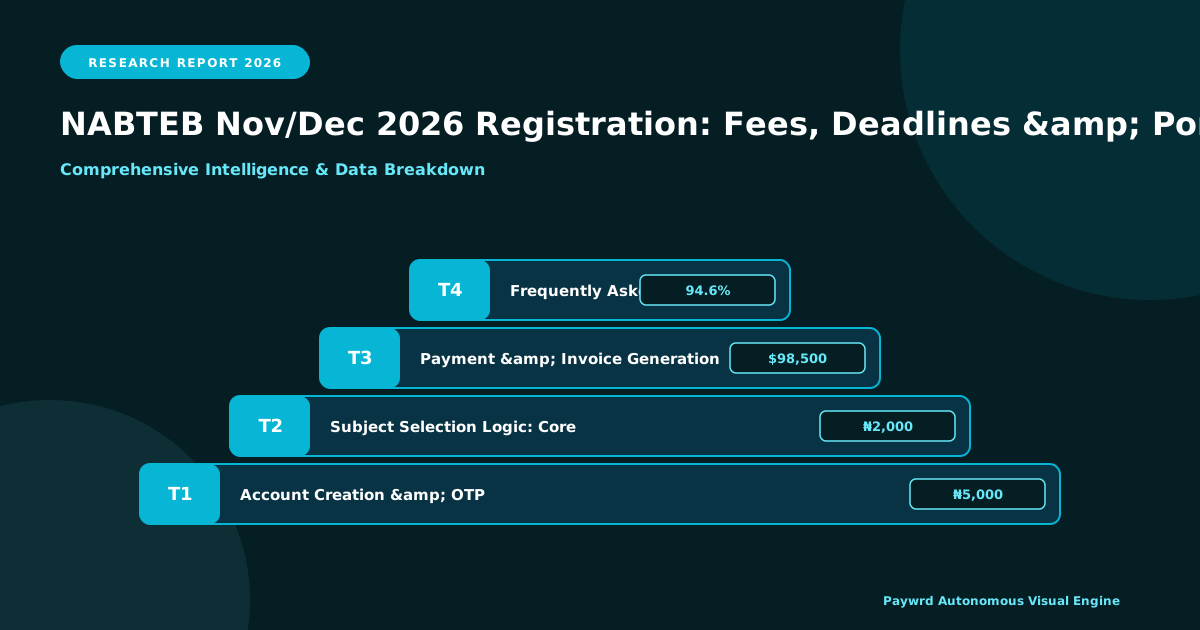
2026 NABTEB Nov/Dec Registration Timeline & Closing Dates
Understanding the NABTEB Nov/Dec 2026 registration timeline is the single most important factor that separates candidates who sit for the examination comfortably from those who scramble, pay inflated penalties, or miss the cycle entirely. The National Business and Technical Examinations Board operates a strict, non-negotiable registration calendar, and for external candidates across Nigeria and the West Africa sub-region, every date carries financial and academic consequences. Once the Board closes its portal for a particular phase, there is no administrative window for latecomers, regardless of how compelling the excuse may be.

For the 2026 November/December diet, NABTEB is expected to open the registration portal in the second quarter of the year, typically around May 2026, to allow technical colleges, polytechnics, and approved examination centres adequate time to process candidates. The standard registration window usually runs for approximately ten to twelve weeks, during which candidates are expected to complete biometric capture, pay the prescribed fees in Naira, upload passport photographs, and print their examination slips. Based on historical Board announcements and the 2025 calendar pattern, the official closing date for normal registration is projected to fall around mid-July 2026, while late registration is typically granted an additional two to three weeks, closing in early to mid-August 2026.
The hard deadline for biometric capture is the date most candidates underestimate, and it carries the stiffest consequence. Biometric data — fingerprints and facial recognition — must be captured at an accredited NABTEB centre or a designated CBT hub. The Board uses this data to authenticate every candidate during the actual examination, and any candidate without successfully captured biometrics is automatically flagged and barred from writing the paper, even if they have paid all fees. For the 2026 cycle, the biometric capture deadline is expected to fall approximately three weeks before the first paper is written, giving the Board enough buffer to upload authentication files to all centres nationwide. Missing this deadline is treated as an absolute forfeiture; there is no extension, no appeal, and no refund.
Late registration, where it is granted, comes with a penalty fee of ₦10,000 to ₦15,000 on top of the standard examination fees, and this surcharge must be paid before the portal will re-open the candidate’s dashboard for editing. Candidates should also note that some trade subjects and practical-based papers require additional centre coordination, and these subjects may close their registration slots earlier than the general deadline because of limited practical venue capacity.
- Expected portal opening: Early to mid-May 2026 (subject to official NABTEB announcement)
- Standard registration closing: Approximately mid-July 2026
- Late registration window: Two to three weeks after standard closing, with a ₦10,000–₦15,000 penalty
- Biometric capture hard deadline: Roughly three weeks before the first examination paper
- Final deadline for external candidates: No extensions granted under any circumstance after the late window closes
For candidates in Nigeria and the wider West Africa region who rely on NABTEB certificates for direct entry into Nigerian universities, polytechnic admission considerations, or NELFUND student loan processing, the practical takeaway is simple: do not wait until the final week. Treat the standard closing date as your personal deadline, complete your biometric capture at least one month before the hard cutoff, and keep both digital and printed copies of every payment receipt. The cost of missing the NABTEB Nov/Dec 2026 window is not merely a delayed certificate — it is a delayed admission cycle, a disrupted JAMB or Post-UTME plan, and in many cases, a full academic year lost.
Complete Fee Structure: Exam Charges, Centre Fees & Bank Charges
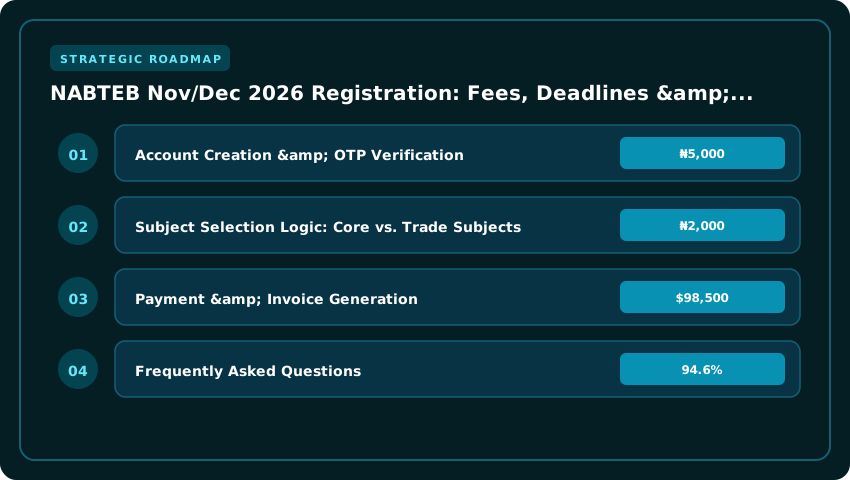
Understanding the financial commitment for the NABTEB Nov/Dec 2026 examination is the first practical step toward a stress-free registration. The board operates a transparent, tiered pricing model that varies significantly depending on whether you are enrolling for Technical, Business, or General Education certificates. For the 2026 cycle, the National Business and Technical Examinations Board has maintained a structure that separates the mandatory board fees from the variable centre and processing charges, so you know exactly where every Naira goes.
At the core of the cost is the Basic Registration Fee. For 2026, this stands at ₦15,500 for all categories. This flat rate covers the candidate’s biometric data capture, the printing of the initial entry schedule, and the administrative overhead of the board. However, the similarity ends there. The Subject/Trade Fees introduce the first major variance. Technical candidates typically register for a minimum of eight (8) and a maximum of nine (9) subjects, including compulsory Trade Theory, Trade Practical, and Related Studies. At ₦1,200 per subject, a full Technical slate costs roughly ₦9,600 – ₦10,800 in subject fees alone. Business and General Education candidates usually sit for a minimum of eight (8) subjects at the same per-subject rate, bringing their subject total to approximately ₦9,600.
The Compulsory Centre Charges are where many candidates get caught off guard. These are not paid to NABTEB directly but to the accredited examination centre (school or private centre) hosting you. For 2026, the approved ceiling for centre charges is ₦6,000 for Technical centres—reflecting the higher cost of workshop consumables, machinery maintenance, and practical examiners—and ₦4,500 for Business/General Education centres. Actionable Takeaway: Always demand a signed receipt on the centre’s letterhead. Any centre demanding above these caps is violating NABTEB policy and should be reported immediately via the board’s whistleblower channels.
Finally, the Bank/Remita Processing Fees apply regardless of category. Generating the RRR (Remita Retrieval Reference) and completing the transaction via bank branch, USSD, or mobile app attracts a standard processing fee of ₦350 – ₦500, depending on your financial institution. When you sum the columns, a Technical candidate should budget approximately ₦32,000 – ₦33,500 (Basic ₦15,500 + Subjects ~₦10,800 + Centre ₦6,000 + Bank ~₦500). A Business or General Education candidate should prepare roughly ₦30,000 – ₦31,000 (Basic ₦15,500 + Subjects ₦9,600 + Centre ₦4,500 + Bank ~₦500).
- Technical Category Total Estimate: ₦32,000 – ₦33,500 (Higher due to practical workshop levies).
- Business Category Total Estimate: ₦30,000 – ₦31,000 (Standard academic centre charges).
- General Education Total Estimate: ₦30,000 – ₦31,000 (Mirrors Business category structure).
- Late Registration Penalty (if portal reopens): Additional ₦10,000 – ₦15,000 on top of standard fees.
Pro Tip: Pay the exact amounts into the designated NABTEB TSA accounts via Remita. Do not bundle payments for multiple candidates into a single RRR; the portal maps one RRR to one candidate’s biometric profile. Splitting payments later creates verification nightmares that can delay your photo card printing. Keep your teller and RRR printout safe—they are your proof of life in the system.
Step-by-Step Portal Registration & Biometric Capture Process
Navigating the nabteb.gov.ng portal requires patience and a stable internet connection, preferably during off-peak hours (early morning or late evening) to avoid server timeouts. The process is divided into five distinct phases: account creation, profile completion, subject selection, payment, and the mandatory offline biometric capture. Skipping or rushing any phase risks invalidating your registration, so treat this like a formal examination in itself.
1. Account Creation & OTP Verification
Start by clicking “Register for Nov/Dec 2026” on the homepage. You will need a valid, personal email address and an active Nigerian phone number (MTN, Airtel, Glo, or 9mobile). The system sends a One-Time Password (OTP) to both channels. Critical tip: Do not use a cybercafé operator’s email or phone. If you lose access to that number next year, you cannot retrieve your result or print your admission letter. Enter the OTPs promptly; they expire within 10 minutes. Once verified, the system generates a unique Application Number—screenshot this immediately and write it in a physical notebook.
2. Profile Completion & Passport Photograph Specifications
This is where most candidates face rejection. The portal demands a recent passport photograph (not older than 3 months) with strict specifications:
- Background: Plain white or off-white only. No patterns, shadows, or coloured backdrops.
- Dimensions: 35mm x 45mm (standard Nigerian passport size).
- Format: JPEG or JPG only.
- File Size: Maximum 50KB. Compress using tools like TinyPNG or Photoshop “Save for Web” before uploading.
- Appearance: Face must occupy 70–80% of the frame. No caps, dark glasses, or filters. Religious head coverings are permitted only if the face is fully visible from hairline to chin.
Upload the photo, then fill in your biodata: full legal name (matching your NIN/WAEC records), date of birth, gender, state/LGA of origin, and disability status (if applicable). Double-check spelling—corrections post-submission attract a penalty fee of ₦5,000 and require a physical visit to NABTEB zonal offices.
3. Subject Selection Logic: Core vs. Trade Subjects
This is the strategic heart of your registration. NABTEB Nov/Dec requires a minimum of eight (8) subjects and a maximum of nine (9). The logic is rigid:
- Core Compulsory (4 Subjects): English Language, Mathematics, Civic Education, and one Trade Subject (your major).
- Trade Cluster (3 Subjects): Specific to your chosen trade (e.g., Blocklaying, Bricklaying & Concreting requires Bricklaying, Building Construction, and Technical Drawing). You cannot mix trades.
- Electives (1–2 Subjects): Choose from Sciences, Humanities, or additional Trade subjects to complete your quota.
Pro Strategy: If you are targeting university admission via JAMB Direct Entry, ensure your Trade Subject aligns with your intended course (e.g., Computer Craft Studies for Computer Science). The portal validates combinations in real-time; an invalid mix will block progression.
4. Payment & Invoice Generation
After subject validation, the portal displays the fee breakdown. For 2026, the base fee is approximately ₦18,500 (subject to final NABTEB bulletin), plus bank charges (~₦500–₦700 depending on the gateway). Select “Pay via Remita” (Card, USSD, or Bank Branch). Upon success, the portal generates a Payment Receipt and a Registration Slip. Print two colour copies of the slip—one for your records, one for the biometric centre.
5. Mandatory Offline Biometric Capture at Accredited Centres
This step is non-negotiable. Online registration is incomplete until you physically appear at your chosen NABTEB Accredited Centre for biometric capture (fingerprints and live photo). Log back into your portal dashboard to locate your assigned centre—usually a federal/state technical college. Visit the centre within 72 hours of payment with:
- Your printed Registration Slip.
- Valid ID (NIN slip, Voter’s Card, or International Passport).
- The same passport photo file used online (on a USB/phone for verification).
The centre officer will verify your details, capture your ten fingerprints, and take a live webcam photo. They will endorse your slip with a Centre Stamp and Signature. Without this endorsement, your Examination Photocard will not be released, and you will be barred from the exam hall. Confirm the officer uploads the biometric data to the central server before leaving the centre.
Subject Combination Matrix for Polytechnic Admission & JAMB Direct Entry
If you are a NABTEB candidate with ambitions beyond the Ordinary National Diploma (OND) or you simply want a smoother entry into the second year of a degree programme, mastering the Subject Combination Matrix is your gateway. Polytechnic admission in Nigeria, whether through the National Board for Technical Education (NBTE) accredited institutions or through JAMB Direct Entry (DE), depends heavily on how your NABTEB trade subjects align with your intended course of study. Many candidates waste precious admission cycles registering subjects that have no bearing on their dream programmes. Let us save you that pain.
NABTEB subjects fall broadly into two functional categories. Trade Related subjects are the foundational academic and vocational sciences that support any technical career. Think of subjects like Mathematics, English Language, Physics, Chemistry, Economics, and Civic Education. These are the general-purpose passes every Nigerian tertiary institution expects at credit level. Then we have Trade Specific subjects, which are the hands-on, specialised vocational areas. Examples include Electrical Installation and Maintenance, Welding and Fabrication, Auto Mechanical Work, Catering Craft Practice, Cosmetology, Block Laying and Concreting, and Computer Craft Studies. These are the subjects that define your technical specialisation and make you stand out in competitive polytechnic admissions.
For Engineering courses such as Electrical/Electronics Engineering, Mechanical Engineering, Civil Engineering, and Computer Engineering, the JAMB Direct Entry magic combination typically requires five O’Level credits in one sitting or six credits in two sittings. The cornerstone subjects are English Language (C6 minimum), Mathematics (C6), Physics (C6), and one relevant Trade Specific subject like Electrical Installation, Auto Mechanical Work, or Welding and Fabrication. The fifth credit can be Chemistry, Technical Drawing, or a Trade Related subject. Polytechnic cutoffs for Engineering in top institutions like Yaba College of Technology, Federal Polytechnic Ilaro, or The Polytechnic Ibadan often start around 150-180 in JAMB UTME, but DE applicants should target upper credit distinctions (B2 and above) in the relevant trade subjects to be competitive.
For Environmental and Building courses like Quantity Surveying, Architecture, Urban and Regional Planning, Estate Management, and Building Technology, NABTEB candidates holding credits in subjects such as Block Laying and Concreting, Plumbing and Pipe Fitting, Painting and Decorating, or Woodwork are highly sought after. The credit grade baseline remains C6, but DE aspirants should know that the Council for the Regulation of Engineering in Nigeria (COREN) and NBTE place premium value on candidates with strong Trade Specific passes. Pairing your trade subject with credits in Mathematics, English Language, Physics, and Technical Drawing creates a near-unbeatable matrix for Environmental admission.
For Management and Business-related courses like Business Administration, Accountancy, Public Administration, and Office Technology Management, candidates can leverage NABTEB trade subjects such as Commerce, Office Practice, Financial Accounting, Keyboarding, and Store Management. These count as Trade Related for DE purposes. Minimum credit requirements remain C6 across five credits, including English and Mathematics. Polytechnics like Federal Polytechnic Nekede, Auchi Polytechnic, and Kwara State Polytechnic routinely accept NABTEB results for Management DE admission, provided the subject mix satisfies the NBTE National Curriculum for Management Sciences.
Here is your actionable checklist before submitting your NABTEB Nov/Dec 2026 registration:
- Verify your target polytechnic’s DE brochure on JAMB CAPS and the school’s official portal; subject requirements shift between institutions.
- Register at least one Trade Specific subject relevant to your intended department, even if you already hold O’Level credits elsewhere.
- Target B2 and A1 grades in Trade Specific subjects; competitive DE admissions rarely reward mere passes.
- Pair English and Mathematics with your trade subjects; these two are non-negotiable across virtually every polytechnic programme in Nigeria.
- Budget roughly ₦8,500-₦12,000 extra beyond base registration fees for Trade Specific practicals, since equipment and examiner costs are higher.
Master this matrix, and your NABTEB certificate becomes more than a result sheet, it becomes a strategic admission weapon.
Accredited Centres Verification & Avoiding ‘Miracle Centre’ Scams
Registering for the NABTEB Nov/Dec 2026 examination is a significant milestone in your academic or vocational journey, but where you register is just as critical as how you prepare. Across Nigeria, unscrupulous operators exploit the desperation of candidates seeking to boost their WAEC, NECO, or NABTEB results to meet JAMB UTME and Post-UTME cutoffs. These operators run illegal “miracle centres,” luring students with false promises of leaked papers or “expo.” Falling for these scams is a surefire way to jeopardize your future.
To protect your investment and your academic integrity, you must verify your chosen examination centre’s accreditation status. The National Business and Technical Examinations Board (NABTEB) maintains a strict accreditation protocol. You can verify a centre by visiting the official NABTEB website and navigating to the accredited centres portal, or by physically visiting your state coordinator’s office. Do not rely solely on a centre’s self-proclaimed status or flashy signage; demand proof of their current operational license for the 2026 cycle.
Be on high alert for red flags that indicate a centre might be a fraudulent operation. These unaccredited centres often demand exorbitant, unexplained fees—sometimes charging an extra ₦20,000 to ₦50,000 on top of the official registration fee—in exchange for a “guaranteed” pass. They may also lack proper biometric capturing equipment or insist on registering candidates using proxy details. Remember that NABTEB employs advanced biometric verification and CCTV monitoring during examinations to curb malpractice, making it virtually impossible to cheat without being caught.
The consequences of patronizing a miracle centre are severe and far-reaching. NABTEB routinely withholds or outright cancels the results of candidates found in compromised centres. A canceled result means you cannot use that certificate for admission into any NUC-approved institution, nor can you access NELFUND student loans, which require valid, unblemished academic records. You will have wasted a full academic year and your hard-earned Naira.
- Verify before you pay: Cross-check the centre’s name and centre number on the official NABTEB portal before making any payment.
- Reject “Expo” promises: Any centre guaranteeing A1s before the exam is a scam; report them to the nearest state coordinator immediately.
- Insist on biometric capture: Ensure your fingerprints are captured personally at the accredited cybercafe or centre to avoid impersonation.
- Keep your documents: Retain your original photocard and payment receipt until your results are fully released and verified.
By taking these proactive steps, you safeguard your academic journey against fraudsters. Your technical mastery should be a product of hard work and dedication, not a fleeting illusion crafted by scammers. Choose wisely, verify thoroughly, and approach your NABTEB Nov/Dec 2026 exams with absolute confidence.
Post-Registration: Checking Timetable, Photocard & Result Release
Successfully paying your NABTEB Nov/Dec 2026 registration fee is a major milestone, but the journey does not end at the checkout page. In fact, what you do in the days immediately following payment is just as critical as the registration itself. NABTEB operates a strictly digital verification system, meaning your Examination Photocard serves as the only legal entry document into your assigned centre. Without it, no matter how brilliant your preparation may be, you simply will not be allowed into the examination hall. Many Nigerian candidates, especially those sitting for the first time, underestimate the importance of this step and end up scrambling for printouts just hours before their papers begin. Avoid that stress by treating post-registration as a deliberate, four-stage process: confirming your payment on the portal, downloading the official timetable, printing your Examination Photocard, and finally, monitoring the result release window once the exams conclude.
The first action after payment is to log back into the NABTEB candidate portal, typically at novdec.nabteb.gov.ng or the official registration portal linked through the NABTEB website, using the same credentials you created during registration. Your dashboard should now reflect a “Payment Confirmed” or “Registration Complete” status. If the status still shows pending after 24 to 48 hours of a successful bank debit, NABTEB advises candidates to contact their bank first, then escalate to NABTEB support via the official email or the dedicated candidate helpline. Do not assume that simply having a bank alert means your portal is automatically updated; the two systems sync, but occasionally there are delays, especially during peak registration weeks in September and October 2026. Take a screenshot of your payment receipt and save both the transaction reference and your application number in multiple places, including a physical notebook, because losing these details can complicate the photocard download stage considerably.
Once your payment is confirmed, the Examination Timetable becomes the next priority. NABTEB typically releases the full timetable PDF about two to three weeks before the first paper, and it is published on the official NABTEB website under the “Examinations” or “Notices” menu. The timetable outlines the exact date, time, and duration of every subject, along with practical specifications for trade subjects such as Welding, Electrical Installation, Fashion Design, Catering Craft Practice, and GSM Phone Maintenance. Candidates writing trade-based papers should pay extra attention to the separation between the “Objective/Theory” day and the “Practical” day, as missing a practical session means forfeiting that entire paper. Download the PDF, save it offline on your phone, and print at least two coloured copies: one for your study wall and one to carry in your exam bag. Timetable clashes are rare but if you spot one, report it immediately to NABTEB through your school examination officer or the zonal office handling your state.
The Examination Photocard, sometimes called the “e-Photocard” or “Exam Slip,” is the most important document you will receive after registration. It contains your full name, registration number, passport photograph, subjects registered, the exact venue address of your assigned centre, and your scheduled examination dates. To print it, revisit the candidate portal and look for the “Print Photocard” or “Download Slip” button, which usually becomes active roughly one to two weeks before the first paper. If your assigned venue is far from your home, especially for candidates in rural parts of states like Zamfara, Cross River, or Bayelsa, plan your accommodation early because November is peak travel season across Nigeria. Photocards must be printed in colour on A4 paper, laminated only if your school policy permits it, and carried alongside a valid means of identification such as a school ID card, NIN slip, or any NABTEB-accepted ID. Candidates without a photocard will be turned back at the gate, regardless of whether they registered and paid.
After sitting the final paper, the result release timeline is the next thing on every candidate’s mind. Historically, NABTEB releases Nov/Dec results within 60 to 90 days after the last examination, which for the 2026 diet places the expected window somewhere between late February and late March 2027. Results are uploaded to the NABTEB portal in batches, so do not panic if your friend in another zone gets theirs before you do. To check your result online, return to novdec.nabteb.gov.ng, click on “Check Result,” enter your registration number and the required authentication details, then print or screenshot the result page. Alternatively, NABTEB supports an SMS-based result checking service using a unique short code typically announced closer to the release date; candidates send their registration number to the code in a specific format and receive their grades via text message for a small fee, usually around ₦50 to ₦100 per SMS. Bookmark the official portal now so you do not fall for fake “result checker” sites that harvest registration numbers during the release week.
Once your result is out, review it carefully for any missing subjects or technical errors. NABTEB allows a limited window, usually 14 to 30 days after release, for candidates to raise complaints about missing papers or incorrect grades, and your school examination officer is the official channel for lodging such queries. Keep your photocard and payment receipt safe even after the exam, because you will need them for verification if you wish to use your NABTEB certificate for admission into any Nigerian polytechnic, college of education, or directly into the workforce through the National Skills Qualification Framework. For students in West Africa eyeing opportunities beyond Nigeria, NABTEB results are also accepted in Ghana, Sierra Leone, and The Gambia under regional technical education agreements, so a clean certificate is genuinely portable. In summary, treat the post-registration phase as a structured checklist: confirm payment, secure your timetable, print your photocard early, and prepare mentally for the result window in early 2027. This disciplined approach is what separates candidates who simply register from candidates who actually succeed and leverage their NABTEB credentials for the next stage of their academic or professional journey.
- Confirm payment within 48 hours via the portal and keep both your transaction reference and application number stored in at least two physical and digital locations.
- Download the official NABTEB timetable PDF from the NABTEB website once it is released, paying close attention to the distinction between theory and practical days for trade subjects.
- Print your Examination Photocard in colour on A4 paper as soon as it becomes available, and pair it with a valid ID before every paper.
- Plan travel and accommodation early if your assigned centre is outside your immediate town, since November is a high-traffic month across Nigerian states.
- Check your result between late February and late March 2027 using the official portal or the announced SMS short code, and verify all subjects within the 14 to 30-day complaint window.
| Category | Cost (₦) | Registration Cut-off | Timeline | Career ROI |
|---|---|---|---|---|
| External Candidates (3-7 subjects) | ₦18,500 – ₦35,000 | Late August 2026 | Nov–Dec 2026 exams | Direct entry into polytechnic & technical institutions |
| Internal Candidates (school-based) | ₦15,000 – ₦28,000 | Mid-September 2026 | Nov–Dec 2026 exams | Streamlined admission to ND programs |
| Late Registration Penalty | Additional ₦10,000 – ₦15,000 | Late September 2026 | Subject to NABTEB approval | Same certification, delayed processing |
| Correction of Name/Date of Birth | ₦5,000 per correction | Within 2 weeks of registration | Pre-exam period only | Prevents credential rejection |
| Certificate Verification (Request) | ₦7,500 per copy | Open year-round | 2–4 weeks processing | Required for overseas study, immigration, and recruitment |
| Online Portal Access Fee | ₦2,000 – ₦3,500 | Automatic on registration | Active throughout cycle | Enables biometric capture & slip printing |
Frequently Asked Questions
When is the NABTEB Nov/Dec 2026 registration deadline?
The NABTEB Nov/Dec 2026 registration typically closes in late August 2026 for external candidates, with late registration extending to mid-September at a penalty fee. NABTEB enforces strict non-negotiable cut-offs, so candidates should complete registration via the official portal at least three weeks before closing to avoid biometric processing delays and exclusion from the examination cycle.
How much does NABTEB Nov/Dec 2026 registration cost in Nigeria?
NABTEB Nov/Dec 2026 registration costs between ₦18,500 and ₦35,000 for external candidates, depending on the number of subjects selected. Internal school-based candidates pay slightly lower fees of ₦15,000 to ₦28,000. All payments are processed through the official NABTEB portal using debit cards or approved remita platforms, with receipts generated automatically.
Can I register for NABTEB Nov/Dec 2026 after the deadline?
Yes, NABTEB allows late registration for the Nov/Dec 2026 cycle, but candidates must pay an additional penalty fee of ₦10,000 to ₦15,000 above the standard charges. Late registration typically closes in mid-September 2026, and NABTEB reserves the right to reject late entries without refund, so early registration is strongly recommended for eligibility certainty.
What is the difference between NABTEB and WAEC certifications for career prospects?
NABTEB certifications focus on technical, vocational, and business skills, making them ideal for polytechnic admission, skilled trades, and technical employment in Nigeria. WAEC certifications emphasize academic subjects for university entry. NABTEB holders enjoy strong career ROI in technical institutions, overseas skilled migration programs, and direct industry recruitment where practical competencies are prioritized over theoretical knowledge.
Strategic Final Takeaway
Success in evaluating NABTEB Nov/Dec 2026 Registration: Fees, Deadlines & Portal Guide relies on early preparation, adherence to verified accredited requirements, and cross-referencing official portals. Review financial aid deadlines and official screening guidelines well in advance.


