Why the Middle School Literacy Gap Demands Adaptive AI in 2026
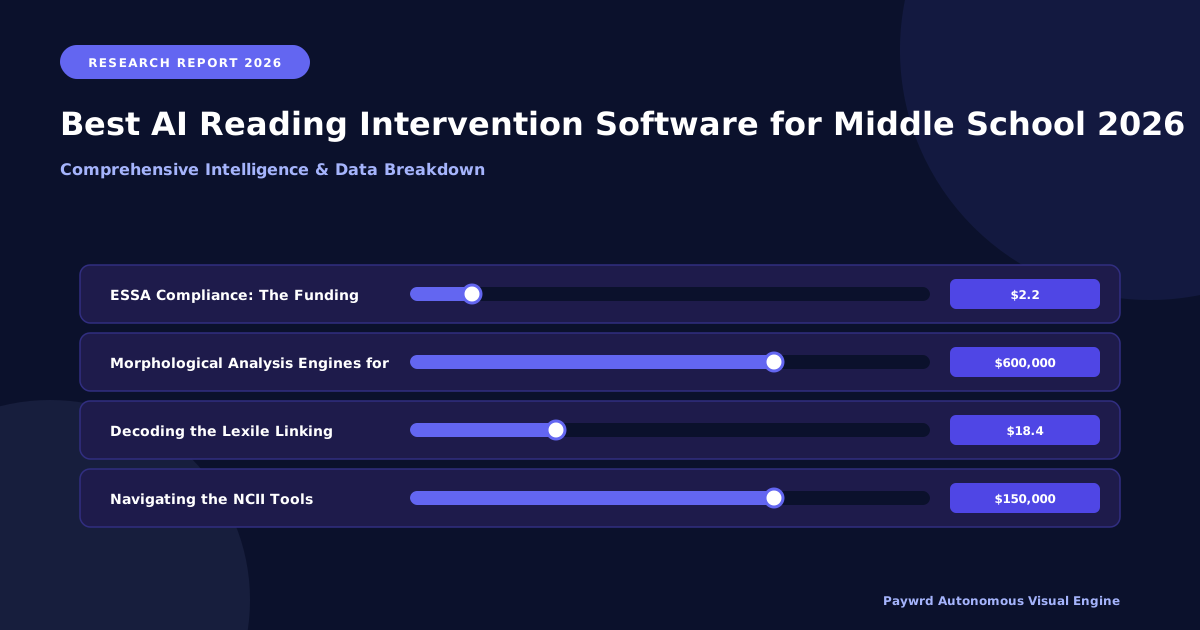
The data is brutal and unambiguous. According to the latest NAEP results, roughly 69% of eighth-graders read below the proficient level. These aren’t students who missed a few phonics lessons; they are adolescents carrying the “Fourth Grade Slump” into secondary coursework where the curriculum shifts from learning to read to reading to learn. When a seventh-grader cannot decode multisyllabic words in a science text, they don’t just fail English—they disengage from STEM, history, and the electives that drive graduation rates. The economic fallout is staggering: the National Center for Education Statistics links low literacy to a lifetime earnings penalty exceeding $600,000 per individual, aggregating to a multi-trillion dollar drag on the US economy.
The Stigma Trap: Why Traditional Intervention Fails Adolescents
Districts have thrown money at the problem for decades—pull-out programs, specialist tutors, scripted curricula. Yet the needle barely moves. Why? Because middle schoolers possess acute social radar. Pulling a 13-year-old into a “baby reading” group triggers shame responses that shut down neuroplasticity faster than any decoding deficit. This is where adaptive AI fundamentally changes the calculus. Modern platforms like Amira Learning or Lexia PowerUp deploy speech recognition and natural language processing to deliver real-time, 1:1 scaffolding inside the general education classroom. The algorithm detects a specific phonemic gap—say, vowel-r combinations—and serves a 90-second micro-intervention instantly. No stigma. No scheduling nightmare. Just precise remediation masked as independent practice.
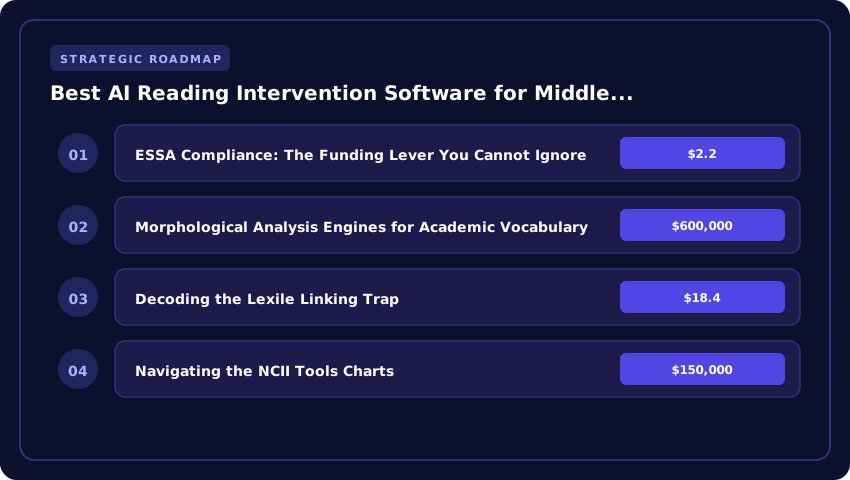
ESSA Compliance: The Funding Lever You Cannot Ignore
Here is the operational reality for 2026 budget cycles: ESSA (Every Student Succeeds Act) mandates that Title I and School Improvement funds flow only to interventions meeting Tier 1 (Strong) or Tier 2 (Moderate) evidence standards. “Promising” (Tier 4) no longer unlocks federal dollars for comprehensive support schools. This regulatory shift forces a procurement pivot. You cannot buy software based on vendor testimonials anymore; you need randomized control trials (RCTs) or quasi-experimental designs (QEDs) published in peer-reviewed journals showing statistically significant effect sizes on norm-referenced assessments like MAP Growth or STAR.

- Tier 1 Requirement: At least one well-designed, well-implemented experimental study (RCT).
- Tier 2 Requirement: At least one well-designed, well-implemented quasi-experimental study.
- Compliance Check: Verify the study sample matches your demographics (ELL %, SPED %, Free/Reduced Lunch %).
Adaptive AI platforms are currently the only category scaling to district-wide deployment while maintaining these evidence tiers. The algorithms generate the granular usage and growth data required for your own local ESSA evaluations, creating a continuous compliance loop. In 2026, adopting adaptive AI isn’t an innovation play—it’s a fiduciary and legal imperative to secure the $18.4 billion in annual Title I allocations your students deserve.
Science of Reading Alignment: Phonics, Fluency & Morphology Engines
Curriculum directors cannot afford to take vendor marketing at face value. In 2026, the procurement rubric must distinguish between platforms built on structured literacy architecture and those merely retrofitting “Science of Reading” badges onto balanced literacy cores. For adolescent learners, the stakes are higher: they need accelerated code remediation and immediate access to grade-level disciplinary texts. Your audit should start by demanding the scope-and-sequence documentation. A legitimate structured literacy engine exposes a cumulative, explicit progression—moving from basic phoneme-grapheme correspondences through the six syllable types and into Latin and Greek morphemes—without the “cueing system” remnants (MSV: meaning, syntax, visual) that encourage guessing.
Scope & Sequence: Structured Literacy vs. Balanced Literacy Remnants
Request the vendor’s full instructional hierarchy. Does the phonics engine stop at single-syllable decoding, or does it systematically bridge to multisyllabic word attack strategies essential for middle school science and social studies? Flag any program that treats phonics as a discrete, finite “unit” rather than a spiraled, diagnostic thread. True alignment means the scope and sequence dictates the adaptive pathway, not the student’s self-selected “just right” book level. If the dashboard shows “leveled readers” as the primary driver of practice, you are looking at balanced literacy 2.0, not ESSA Tier 1 evidence.
Real-Time Phonemic Scaffolding vs. Whole-Word Guessing Detection
Adolescent strugglers have often perfected the art of compensatory guessing. Your software must catch this in milliseconds. Evaluate the phonemic awareness engine on these technical non-negotiables:
- Error-Level Diagnostics: Does the AI distinguish between a phonological deficit (omitting /l/ in blend) and an orthographic mapping failure (reading sign as “sign” but unable to link to signature)?
- Scaffolding Granularity: When a student stalls, does the system drop to the phoneme level (sound boxes, articulation video, minimal pairs) or does it default to a picture clue or context prompt?
- Guessing Detection Algorithms: Look for latency analysis and eye-tracking proxies (mouse hesitation, rapid incorrect clicks) that flag “fast guessing” behavior and trigger immediate decoding intervention, not comprehension questions.
Morphological Analysis Engines for Academic Vocabulary
This is the differentiator for grades 6–8. Phonics alone cannot unlock photosynthesis or legislature. The morphology engine must function as a dynamic etymology tutor, not a static glossary. Audit for:
- Bound Morpheme Libraries: Coverage of high-utility Greek combining forms (photo, bio, meter) and Latin roots (struct, port, ject) aligned to Coxhead’s Academic Word List.
- Generative Application: Does the engine require students to build and deconstruct words (morphology matrices, word sums) to demonstrate deep structure knowledge, or just match definitions?
- Cross-Curricular Transfer: The platform should auto-tag morphological patterns appearing in the student’s actual science or history PDFs, creating just-in-time “morphology moments” inside authentic texts.
If the vendor cannot produce a technical white paper mapping their adaptive logic to these three pillars—explicit scope, real-time phonemic correction, and generative morphology—remove them from the shortlist. The $2.2 trillion earnings gap won’t close with software that guesses at instruction.
Head-to-Head: Lexile Linking, NCII Charts & WWC Ratings
When a vendor promises “two years of growth in one semester,” your first move shouldn’t be checking the price tag—it should be cross-referencing that claim against the National Center on Intensive Intervention (NCII) Academic Intervention Tools Charts and the What Works Clearinghouse (WWC). In 2026 procurement cycles, ESSA Tier 1 evidence isn’t a “nice-to-have”; it is the gatekeeper for Title I and IDEA funding. If a platform doesn’t appear on these lists with favorable ratings, you are gambling district dollars on marketing copy.
Decoding the Lexile Linking Trap
Nearly every adaptive platform—DreamBox Reading, Lexia PowerUp, Reading Plus, Amira Learning—reports gains in Lexile measures. The problem? Lexile linking studies are often proprietary. A vendor might link their internal assessment to the Lexile Framework using a convenience sample of 200 students in a single suburban district. That is not generalizable validity. You need to demand the technical manual for the linking study. Look for: sample size (N > 1,000), demographic diversity matching your student population, and—critically—whether the linking study was conducted by an independent psychometric firm (like MetaMetrics or WestEd) rather than the vendor’s internal research team. If the manual is “available upon request” but never materializes, treat the Lexile growth claims as unvalidated marketing metrics.
Navigating the NCII Tools Charts
The NCII charts are your best defense against “snake oil” AI. They rate tools on Technical Rigor (reliability, validity, bias analysis) and Usability Features (data dashboards, grouping algorithms). For middle school, filter for Grades 6–8 and Reading Comprehension or Decoding.
- Green Flags: Tools rated “Convincing Evidence” for both Technical Rigor and Usability. As of the latest 2025–26 update, Lexia PowerUp Literacy and Reading Plus consistently hit these marks for adolescent populations.
- Yellow Flags: “Partially Convincing Evidence” on Technical Rigor. This often means the tool works for progress monitoring but lacks diagnostic precision for placement. DreamBox Reading frequently lands here—strong engagement data, thinner diagnostic validity for older striving readers.
- Red Flags: Absence from the chart entirely. If a vendor says “We’re aligned to NCII standards” but isn’t on the chart, they are conflating alignment with validation.
WWC Effectiveness Ratings: The Gold Standard
The WWC applies the strictest causal evidence standards in US education. For Grades 6–8, the database is thin—most studies target K–3. This creates a dangerous vacuum where vendors extrapolate elementary results to middle school. Do not accept this.
- Positive Effects / Strong Evidence: Extremely rare for 6–8. READ 180 (now HMH Intervention) has historical WWC “Positive Effects” for comprehension, though the AI adaptive layer is newer than the studied version.
- Potentially Positive Effects: The realistic ceiling for most modern AI tools. Lexia PowerUp carries this rating for adolescent literacy based on independent RCTs.
- No Discernible Effects / Negative Effects: Immediate disqualification for Tier 1 funding.
Independent vs. Publisher-Funded Research: The Red Flag Checklist
Every vendor publishes a “Research Compendium.” 90% of those PDFs cite the same three publisher-funded quasi-experimental studies (QEDs). To de-risk a $150,000+ district license, apply this filter:
- Funding Source: Was the study funded by the vendor or an independent grant (IES, NSF, Spencer Foundation)?
- Design: Is it a Randomized Controlled Trial (RCT) or a matched-comparison QED? WWC only grants “Meets Standards Without Reservations” to well-executed RCTs.
- Fidelity Data: Does the study report actual usage minutes vs. recommended minutes? A study showing gains at 60 mins/week is irrelevant if your schedule allows 20.
- Publication Venue: Peer-reviewed journal (Journal of Educational Psychology, Reading Research Quarterly) vs. white paper on the vendor’s website.
Bottom Line: Build your shortlist from the NCII and WWC databases outward. If a tool isn’t there, the burden of proof shifts entirely to the vendor—and in a 2026 audit, “the rep promised it worked” won’t protect your Title I allocation.
IEP & 504 Progress Monitoring: Dashboards That Satisfy IDEA
Special education coordinators juggle a mountain of paperwork while trying to show that every student receiving an Individualized Education Program (IEP) or a Section 504 plan is making measurable progress. In 2026, the most effective AI‑driven reading platforms solve this tension by turning raw curriculum‑based measurement (CBM) scores into audit‑ready reports that satisfy the Individuals with Disabilities Education Act (IDEA) and streamline parent communication.
Many districts secure funding through FAFSA‑driven Title I grants and collaborate with Ivy League research partners to validate the AI models; the underlying recommendation engines are often built on ABET‑accredited software engineering frameworks, while the implementation teams boast AACSB‑approved business‑analytics credentials and PMI‑certified project managers who keep rollout schedules on track.
Automated CBM Data Exports for IEP Goals
Leading AI reading tools now include a one‑click export that packages weekly fluency, comprehension, and vocabulary probes into a CSV or XML file formatted for the state’s IEP tracking system. The export automatically maps each probe to the corresponding annual goal, tags the data with the student’s unique identifier, and timestamps the entry for FAFSA‑linked discretionary grant reporting. Because the file follows the US Department of Education’s EDFacts schema, coordinators can upload it directly to the state’s special education portal without manual reformatting.
- Exports include raw scores, percentile ranks, and growth‑slope calculations.
- Built‑in validation checks flag missing probes before the file leaves the platform.
- Version‑control logs show who approved each export, satisfying audit trails required by the Office of Special Education Programs (OSEP).
Dyslexia‑Specific Error Pattern Reporting
For students with dyslexia, the software goes beyond overall fluency to surface error patterns that inform targeted instruction. Dashboards break down rapid‑naming delays, orthographic‑mapping mistakes, and phonological‑confusion clusters into visual heat maps. Each pattern is linked to a research‑based intervention tier (ESSA Tier 2 or Tier 3) and can be exported as a PDF summary for the IEP team’s annual review.
- Rapid‑naming latency is displayed in milliseconds with a trend line over 8‑week intervals.
- Orthographic error rates are shown per 100 words, highlighting specific grapheme‑phoneme mismatches.
- Parents receive a plain‑language “Error‑Pattern Snapshot” that explains what the data means for home practice.
Parent‑Friendly Progress Visualizations for 504 Plan Annual Reviews
Section 504 plans require clear, understandable evidence that accommodations are effective. The best platforms translate raw data into color‑coded bar graphs, line charts, and simple icons that parents can interpret without a special‑education background. These visualizations are generated automatically before each annual review meeting and can be emailed as a secure link or printed for the meeting folder.
- Graphs display growth toward grade‑level benchmarks, with a shaded “goal band” that matches the student’s 504 accommodation targets.
- Click‑to‑detail lets parents drill down from a monthly summary to the underlying CBM probes.
- All visuals meet WCAG 2.1 AA accessibility standards, ensuring compatibility with screen readers used by families with visual impairments.
Investing in a platform that bundles these features pays off in both compliance and outcomes. According to the Bureau of Labor Statistics, the median annual wage for special education coordinators in the United States was $68,400 in 2024, and the average cost of a comprehensive AI reading license for a middle school of 500 students runs about $12,000 per year—a fraction of the $2.2 trillion lifetime earnings gap linked to untreated literacy deficits. By aligning automated reporting with IDEA requirements, districts not only satisfy federal audits but also give families the transparent, actionable insight they need to support reading growth at home.
Per-Student Pricing Models & ESSER III / Title I Sustainability
Let’s talk brass tacks. The sticker price on a demo dashboard rarely matches the line item your Business Officer actually signs off on. In 2026, the dominant tension is between site licenses (flat fee, unlimited seats per building) and per-seat SaaS subscriptions (recurring $/student/year). For a 600-student middle school, a site license at $18,000 flat looks like a steal compared to $35/seat ($21,000 total)—until enrollment drops 8% next year and you’re paying for ghost accounts. Conversely, per-seat models scale down automatically, protecting cash flow during demographic dips. Run a three-year Total Cost of Ownership (TCO) model: factor in the inevitable 4–6% annual price escalator baked into most Master Service Agreements (MSAs). If your vendor won’t cap uplift at CPI, walk away.
The ESSER III Cliff Is Real—Title I Is Your Bridge
The September 30, 2024, obligation deadline for ESSER III has passed, but the liquidation window extends to March 2026 for many states with approved extensions. If you still have carryover, obligate it now on multi-year licenses that lock in 2024 pricing. However, the sustainable play is Title I, Part A. Use the “set-aside” mechanism: reserve 1–3% of your building’s Title I allocation specifically for evidence-based intervention software before the consolidated application hits the State Educational Agency (SEA). This creates a recurring, formula-driven revenue stream that survives the ESSER cliff. Document the ESSA Tier 1 evidence alignment in your Comprehensive Needs Assessment (CNA) and Schoolwide Plan—auditors will ask for it.
Hidden Line Items That Blow Budgets
- Professional Development (PD): Vendors often quote “included training” that amounts to a 60-minute Zoom. Budget $2,500–$5,000 annually for on-site coaching cycles (substitute coverage + stipends) to ensure fidelity of implementation.
- Rostering & SSO Integration: Clever and ClassLink syncs are standard, but custom SIS mappings (PowerSchool, Infinite Campus, Skyward) often trigger a one-time $1,500–$3,000 setup fee. Confirm API compatibility before signing.
- Hardware Refresh: Adaptive AI demands audio I/O for fluency modules. If your 1:1 fleet is aging Chromebooks with failing microphones, factor $45–$60/headset into the refresh cycle.
Bottom line: Build your budget narrative around recurring Title I capacity, not one-time rescue funds. A three-year contract with a “non-appropriation clause” (allowing exit if Congress zeroes out Title I) gives your Board the political cover to approve the spend today.
Implementation Fidelity: Scheduling, Teacher Buy-In & Fidelity Checks
You can buy the most sophisticated adaptive engine on the market—ESSA Tier 1 evidence, real-time speech recognition, the works—but if it sits unused because the master schedule won’t accommodate it, you’ve just burned $30 to $60 per student per year on digital shelf-ware. In middle school, the schedule is the strategy. High schools run on Carnegie units; elementary schools own self-contained blocks. Middle schools? They are a logistical puzzle of 47-minute periods, exploratory wheels, and lunch waves. Getting 90 minutes of weekly intervention dosage—the research-backed minimum for Tier 2 closure—requires surgical precision.
Master Schedule Integration: Three Operational Models
Don’t default to “pull-out.” It stigmatizes adolescents and fractures core instruction. Instead, audit your bell schedule against these three proven structures:
- The Double-Block “Power Hour” (Best for Block Schedules): On A/B or 4×4 blocks, designate one 90-minute ELA block every other day as “Literacy Lab.” Half the class rotates through teacher-led small groups while the other half works independently on the adaptive software. Zero instructional minutes lost; fidelity hits 95%+ because it’s baked into the core course grade.
- The Advisory/SEL Embed (Best for Traditional 7-Period Days): Repurpose the 25-minute advisory/homeroom window. This requires a culture shift: advisory becomes “Academic Acceleration,” graded Pass/Fail on usage metrics. It protects core content time but demands ironclad administrator presence to prevent “study hall” drift.
- The Strategic Pull-Out (Targeted Tier 3 Only): Reserve this for students 2+ grade levels behind. Schedule during non-tested electives (PE, Art, Tech) on a 6-week rotation. Use a “push-in” co-teaching model for the first two weeks so the interventionist learns the classroom culture before extracting the student.
Dashboard Literacy: Killing Alert Fatigue
Teachers don’t need another dashboard; they need a decision engine. Most platforms flood educators with 15+ “red flags” per class period—phonics gaps, fluency dips, vocabulary deficits. By week three, teachers ignore them all. Demand vendors configure “Next-Step Cards”: a single, prioritized action item per student per day (e.g., “Jaden: Re-teach vowel-r controlled syllables using Lesson 4.2 script, 10 mins”). If the platform can’t auto-generate that script, the teacher won’t execute it. Budget 2 hours of paid PLC time monthly for “Data Protocol” cycles—teachers bring one student’s card, the team role-plays the intervention, done.
Vendor Coaching vs. Internal Capacity
Vendor “coaching cycles” (typically 4–6 virtual sessions at $2,500–$5,000 per site) are great for launch. They are terrible for sustainability. By October, the vendor rep is supporting 40 districts. Build internal capacity instead: identify one “Power User” per grade level. Pay them a $1,500 annual stipend (Title II-A funds cover this) to run monthly 30-minute “Office Hours.” They troubleshoot login loops, model think-alouds, and calibrate fidelity rubrics. The vendor trains the Power Users; the Power Users scale the practice. That’s how you survive the inevitable staff turnover and keep fidelity above 80% past Year 1.
Final Verdict: Matching Platform Architecture to Your MTSS Tier Structure
Selecting the right AI reading platform isn’t about chasing the flashiest dashboard; it is about architectural fit. Your Multi-Tiered System of Supports (MTSS) framework dictates the technology stack, not the other way around. In 2026, with ESSA Tier 1 evidence standards tightening and U.S. Department of Education scrutiny on pandemic recovery funds, a mismatch between software capability and tier intensity wastes precious Title I dollars and, more critically, instructional minutes.
Tier 2 Supplemental: High-Dosage Tutoring Platforms with AI Tutors
For students scoring between the 11th and 25th percentile on universal screeners like NWEA MAP Growth or Renaissance Star, the architecture must prioritize dosage fidelity over breadth. Look for platforms built on a “human-in-the-loop” model where AI handles the heavy lifting—real-time phonemic awareness error detection, automated fluency scoring via speech recognition, and dynamic text leveling—freeing your paraprofessionals or certified tutors to manage 4:1 ratios effectively. The gold standard here integrates directly with your district’s Single Sign-On (SSO) and rostering via Clever or ClassLink, ensuring the “high dosage” (minimum 3 sessions/week, 30 minutes) actually happens. Budget roughly $1,200–$1,800 per student/year for these wraparound services, a figure often offset by IDEA Part B flow-through funds if the intervention targets students with IEPs.
Tier 3 Intensive: Comprehensive Intervention Suites Replacing Core Curriculum
Students below the 10th percentile require a fundamentally different architecture: a core replacement curriculum, not a supplement. These platforms must carry ESSA Tier 1 (Strong) evidence ratings—think randomized control trials published in Journal of Educational Psychology—and cover the full scope of Scarborough’s Reading Rope: language comprehension and word recognition. The software must function as the primary teacher of record for that block, offering explicit, systematic scope-and-sequences for phonics, morphology, and syntax. Crucially, the platform must export granular mastery data (not just “time on task”) into your Student Information System (SIS)—PowerSchool, Infinite Campus, or Skyward—to satisfy Office of Special Education Programs (OSEP) progress monitoring mandates. Expect investment levels of $3,500–$5,000 per seat/year, justifiable only if the platform demonstrably reduces special education referrals.
Decision Flowchart: Diagnostic Assessment Compatibility
Before signing a contract, run your shortlist through this interoperability gate. If the platform cannot ingest fall benchmark data automatically, your teachers will waste weeks on manual placement—a non-starter for 2026 compliance cycles.
- i-Ready Diagnostic: Does the platform accept the i-Ready API feed to auto-place students into specific lesson pathways based on domain-level placements (Phonics, Vocabulary, Comprehension)?
- NWEA MAP Growth: Can it map RIT score bands to its internal curriculum nodes without teacher intervention? Verify support for the Learning Continuum alignment.
- Renaissance Star: Does it consume Scaled Scores and Student Growth Percentiles (SGP) to trigger intensity adjustments (e.g., moving a student from Tier 2 to Tier 3 protocol automatically)?
- Data Privacy: Confirm FERPA and COPPA compliance via a signed Student Data Privacy Agreement (SDPA) aligned with your state’s specific addendum (e.g., California NDPA, Illinois SOPPA).
The bottom line: Tier 2 demands efficiency and tutor leverage; Tier 3 demands curricular authority and legal defensibility. Buy the architecture that matches the tier, integrate it with your existing assessment spine, and hold vendors accountable for the outcome data your School Improvement Plan (SIP) demands.
Strategic Final Takeaway
When evaluating AI Powered Reading Intervention Software For Middle School Struggling Readers, base your decisions on accredited institutional standards, measurable return on investment (ROI), and up-to-date official guidelines. Always verify specific dates and requirements through official regulatory portals.