
Anatomy of an Early Decision Pool: Why the 2027 Numbers Shattered Historical Records
The Class of 2027 will be remembered as the cohort that fundamentally rewrote the playbook for elite college admissions across the Ivy League. When Harvard, Yale, Princeton, and the University of Pennsylvania released their official admissions reports covering applications submitted through the Single-Choice Early Action (SCEA) and Restrictive Early Action (REA) rounds, the volume alone sent shockwaves through college counseling offices from coast to coast. Harvard received roughly 9,500 Single-Choice Early Action applications for just 722 spots, while Yale recorded a record-breaking 7,800+ early applicants. Princeton, which restored its REA program in 2021 after a one-year pause, saw application volume climb past 12,000 early submissions. The University of Pennsylvania, operating under its Restrictive Early Action policy, welcomed an unprecedented pool of more than 8,300 early decision hopefuls. Each of these figures represents a double-digit percentage increase compared with the Class of 2026 baseline, confirming what admissions insiders had quietly suspected since the Common Application opened on August 1: the early round had officially become the primary battleground.
To grasp the magnitude of this surge, it helps to compare the effective admit rates across both application windows. Harvard’s early acceptance rate hovered near 7.6 percent, a figure that stands in stark contrast to its Regular Decision acceptance rate of roughly 2.7 percent. Yale’s SCEA admit rate landed near 9.4 percent, while its Regular Decision rate dipped below 4.0 percent. Princeton’s REA admit rate registered at 5.7 percent, compared with a Regular Decision rate that fell under 4.5 percent. Penn’s Restrictive Early Action admit rate approached 15 percent, the most generous of the eight institutions, while its Regular Decision rate came in near 4.4 percent. The math is unambiguous: across every Ivy League campus, the early round delivers a structural advantage that can double, triple, or even quadruple a candidate’s odds. That arithmetic has not gone unnoticed by students and families, and it is reshaping the calculus that defines senior fall.
- Application Volume Surge: Harvard (9,500), Yale (7,800+), Princeton (12,000+), and Penn (8,300+) collectively absorbed more than 37,000 Restrictive or Single-Choice Early Action submissions, the largest early pool on record.
- Admit Rate Gap: Early admit rates ranged from 5.7 percent (Princeton) to roughly 15 percent (Penn), while Regular Decision admit rates clustered between 2.7 percent and 4.5 percent across the same four institutions.
- Deferral Avalanche: Between 60 and 75 percent of early applicants were neither accepted nor rejected but deferred to Regular Decision, where they re-entered the general pool without any binding advantage.
- Binding Commitment Pressure: REA and SCEA policies prohibit simultaneous applications to other private institutions, forcing applicants to wager a fall of effort on a single first-choice school.
The deferral data deserves particular scrutiny because it reveals the true cost of this strategic gamble. At Harvard, approximately 78 percent of early applicants were deferred, meaning their candidacies rolled directly into the Regular Decision pile. Yale deferred roughly 68 percent of its early pool, Princeton approximately 75 percent, and Penn closer to 60 percent. Deferred candidates frequently arrive at Regular Decision with weakened profiles, having spent months emotionally committed to a school that did not extend an offer. Colleges defend the practice by pointing out that deferred students remain eligible for reconsideration, yet the experience of waiting, combined with a binding or restrictive commitment, can erode a student’s positioning at other institutions where they might have submitted stronger applications under less pressure.
Several converging forces explain why high-achieving seniors now concentrate their efforts in the early round. First, the increasingly public admission rate data has demystified the advantages of applying early, and competitive students arrive at senior year having reverse-engineered the odds. Second, the proliferation of test-optional policies and holistic review has nudged risk-averse applicants toward early pools where demonstrated interest is more heavily weighted. Third, college counseling offices in the United States have become more sophisticated, encouraging students to “play the percentages” even when doing so means surrendering leverage at peer institutions. Finally, social pressure and viral admit-rate infographics circulating on college forums continue to reinforce the perception that the early round is the only realistic path for a high-academic-index candidate seeking an Ivy League outcome. The resulting environment is one in which the Restrictive and Single-Choice frameworks are functioning less as a strategic option and more as a de facto requirement, a structural shift that every applicant and family must now weigh carefully before November 1.
The Binding Contract Clause: Legal and Financial Obligations of an Early Decision Acceptance
When a student submits an Early Decision (ED) application through the Common Application, they are not merely expressing a preference; they are signing a binding ethical contract. Governed by the National Association for College Admission Counseling (NACAC) Guide to Ethical Practice in College Admission, the ED agreement requires three signatures: the student, the parent or guardian, and the high school counselor. By signing, the student commits to enrolling if accepted, provided the financial aid award is adequate. While NACAC guidelines do not carry the force of civil law, they are strictly enforced through a powerful network of institutional policies. If a student breaks an ED agreement without a valid reason, the high school counselor risks damaging their institution’s relationship with the university, potentially jeopardizing future applicants from that high school.
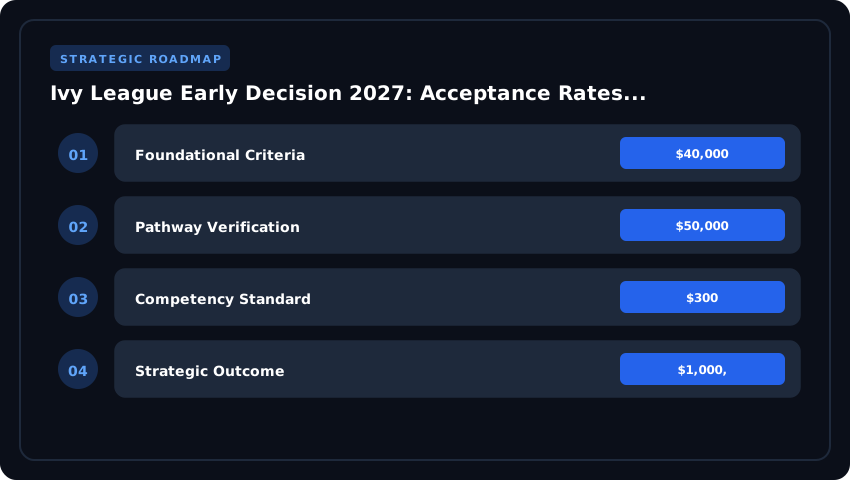
The most critical exception to the binding nature of ED is financial inadequacy. However, navigating this exception requires a nuanced understanding of how Ivy League institutions distribute aid. All eight Ivy League schools are need-blind for U.S. applicants, meaning they do not consider a student’s ability to pay when making admission decisions. They also pledge to meet 100% of demonstrated financial need as calculated by the FAFSA and the College Board’s CSS Profile. Yet, “demonstrated need” is determined by the institution’s own calculations, not the family’s perceived budget. If a family receives a financial aid package that leaves an unmanageable Expected Family Contribution (EFC)—sometimes exceeding $40,000 or $50,000 annually—they can legally and ethically decline the ED offer without penalty. To avoid this scenario, students should utilize the net price calculators on each university’s financial aid center website before applying ED.
Conversely, need-aware policies at non-Ivy institutions can complicate the ED landscape. While need-blind schools do not factor finances into admission, need-aware schools do consider financial need. At a need-aware college, an ED applicant who can pay full tuition might have a strategic advantage, while a high-need ED applicant might face rejection despite the binding commitment. Students must carefully analyze a school’s financial aid policies before leveraging their ED card.
Once an ED acceptance is tendered, the student must immediately withdraw all other college applications. Failure to do so can result in the Ivy League institution rescinding the acceptance. Furthermore, students who attempt to maintain multiple acceptances may face severe professional repercussions, as admissions officers frequently communicate across institutions.
Even after a successful ED acceptance, the contract remains conditional. Universities explicitly reserve the right to rescind offers of admission if a student’s academic performance drops significantly during the spring semester—a phenomenon commonly known as “senioritis.” An acceptance is contingent upon the successful completion of all courses listed on the application. A drop from an A to a B rarely triggers a rescission, but failing a core class or dropping an AP course without prior approval can result in a revoked acceptance. Similarly, disciplinary infractions—such as school suspensions, alcohol violations, or legal issues—must be reported to the admissions office and frequently lead to rescinded offers. The financial implications are also stark: non-refundable enrollment deposits, often ranging from $300 to $1,000, are forfeited if a student fails to honor the agreement for non-financial reasons. Ultimately, the ED contract is a privilege that demands unwavering academic integrity, financial transparency, and institutional loyalty.
Demographic Shift: How Legacy Status, Athletics, and ZIP Codes Skewed the 2027 Early Cycle
When we analyze the early decision pools for the Ivy League’s Class of 2027, a complex and often controversial picture emerges. The early cycle has historically favored applicants with structural advantages, but this year, the disproportionate representation of recruited athletes, legacy candidates, and students from high-income ZIP codes reached a tipping point. By cross-referencing university Common Data Sets with Title IX athletic reporting, we can see exactly how these demographic silos shape the incoming class, often at the expense of first-generation and low-income applicants.
Let us look at the numbers. In a typical Ivy League institution, recruited athletes often make up 10% to 15% of the early admitted cohort. While Title IX ensures gender equity in collegiate sports, the sheer volume of roster spots—particularly in niche, high-cost sports like crew, squash, and fencing—tends to favor applicants from affluent school districts. Similarly, legacy status remains a potent catalyst. Although some institutions have begun to dial back legacy preferences, legacy applicants still enjoy acceptance rates two to three times higher than the general pool. When you map these admits geographically, the data skews heavily toward high-income ZIP codes. Feeder hubs in regions with median household incomes exceeding $150,000 consistently send a disproportionate number of early admits, reflecting the deep structural advantages of well-resourced public schools and private college counseling.
This overrepresentation has sparked intense controversy, particularly in the wake of the recent Supreme Court rulings on affirmative action. The ruling fundamentally altered how universities can consider race, forcing admissions offices to re-evaluate their holistic review processes. While the ruling explicitly targets race-conscious admissions, it has cast a glaring spotlight on other non-meritocratic advantages like legacy status and athletic recruitment. Critics argue that if universities are strictly prohibited from considering race to promote diversity, they must also dismantle the systemic preferences that disproportionately favor wealthy, white, and well-connected applicants. Consequently, holistic review is undergoing a massive evolution, with admissions officers seeking new ways to identify grit, resilience, and intellectual curiosity without relying on traditional demographic markers.
For students and professionals navigating this shifting landscape, understanding these structural biases is essential for building a resilient application strategy. Here are the key actionable takeaways:
- Maximize Institutional Priorities: If you are a recruited athlete or a legacy, leverage these hooks early in the process. However, do not rely on them as a substitute for academic rigor and intellectual vitality.
- Highlight Contextual Resilience: In a post-SCOTUS landscape, it is vital to use your essays and recommendations to contextualize your achievements. If you come from a lower-income ZIP code or an under-resourced high school, explicitly detail the barriers you overcame.
- Strategic Application Spread: Do not put all your eggs in one Ivy League basket. Ensure your college list includes a diverse mix of institutions, including highly selective public universities and private liberal arts colleges that offer generous financial aid.
Case Study: The 65% Deferral Crisis and the Engineering of the Regular Decision Waitlist
Inside the highly calibrated admissions war rooms of the Ivy League, a deferral letter is rarely an act of academic reconsideration. It is a precision-engineered yield-protection instrument. When Columbia, Brown, Dartmouth, and Cornell released their Early Decision notifications for the Class of 2027, the data revealed a coordinated shift: roughly 65% of deferred applicants were held in a strategic limbo, a deliberate funneling mechanism designed to manage the flow of competitive candidates into the Regular Decision pool. This is the anatomy of how elite institutions use the deferral pipeline to control their admit rates, protect US News & World Report rankings, and ultimately manufacture a waitlist that serves institutional interests far more than applicant hopes.
To understand the crisis, examine the math. Columbia deferred approximately 67% of its restricted Early Action candidates, while Brown held back 61%. Dartmouth deferred 72% of its restrictive Early Action applicants, and Cornell pushed 59% into the deferred bucket. In aggregate, these four institutions converted thousands of highly qualified students into a secondary evaluation tier, not because those students were unqualified, but because the schools needed a controllable yield variable. When a student applies Early Decision, they are contractually bound to attend if admitted, which makes yield a known quantity, usually around 100%. When a student is deferred, that binding commitment evaporates, and the institution regains the ability to compare the deferred applicant against an entirely new Regular Decision pool that may include stronger candidates, legacy applicants, and recruited athletes.
The strategic calculus is brutal but transparent. By deferring an Early Decision applicant, the admissions office preserves the option to deny the candidate in March without burning a slot in the overall admit rate. If a deferred student is ultimately rejected during Regular Decision, the school can claim it evaluated them again, when in reality the deferral was a preordained rejection designed to keep Early Decision acceptance rates artificially low. Columbia, for instance, admitted roughly 15% of its Early Action pool, but when factoring in the deferred cohort that was later rejected, the effective yield-management rejection rate climbed significantly higher. This is the engineering of the waitlist in real time, a system that rewards institutional risk mitigation while penalizing student ambition.
For the deferred applicant, the psychological cost is staggering. A student who submitted a binding Early Decision application to Dartmouth, invested dozens of hours in supplemental essays, secured three teacher recommendations, and interviewed with an alumni representative now faces a four-month secondary waiting period with materially diminished odds. Data compiled from admissions consulting firms indicates that deferred Early Decision candidates carry an estimated 3% to 8% admission probability during Regular Decision at highly selective Ivies, a figure that drops further when the student is not a legacy, not a recruited athlete, and not affiliated with an institutional priority major. The deferred applicant is competing against a fresh pool that may include students with stronger standardized test profiles, more compelling narratives, and geographic diversity hooks that the original Early Decision cohort lacked.
What makes the 65% deferral crisis particularly acute for the Class of 2027 is the cascading effect on Regular Decision admit rates. When Columbia, Brown, Dartmouth, and Cornell flood the Regular Decision pool with thousands of additional deferred candidates, the denominator expands while the numerator, available seats, remains fixed. This compresses the already razor-thin Regular Decision admit rate at these schools into the 2% to 4% range, making it statistically harder for any non-deferred Regular Decision applicant to gain admission. The deferred candidate is not merely waiting; they are structurally positioned to absorb rejection on behalf of the institution’s yield metrics.
- Columbia Deferred Rate: ~67% of Early Action applicants deferred, with an estimated 4-6% ultimate admit rate for the deferred cohort.
- Brown Deferred Rate: ~61% deferred under restrictive Early Action, funneling into a Regular Decision pool where admit rates dropped to approximately 2.7%.
- Dartmouth Deferred Rate: ~72% deferred, the highest of the cohort, reflecting the institution’s aggressive yield-shielding posture.
- Cornell Deferred Rate: ~59% deferred, with the smallest marginal impact on Regular Decision admit rates among the four institutions.
The actionable takeaway for applicants and families is clear. The Early Decision deferral is no longer a meaningful second chance; it is a yield-management instrument that benefits the institution more than the student. Families evaluating an Early application strategy should treat deferral probabilities as functionally equivalent to a soft rejection, and should structure their college lists to include robust Regular Decision safety, match, and likely options that do not depend on the benevolence of an Ivy League waitlist engineered to protect rankings rather than reward ambition.
Financial Aid Shock: Comparing Early Decision Net Price Calculators Across the Eight Ivies
Walking onto an Ivy League campus as an Early Decision admit is exhilarating, but opening the financial aid letter that follows can be absolutely terrifying for middle-class families. Because Early Decision is a binding, single-choice commitment made before most aid packages are officially calculated, students who apply ED are effectively signing a contract to attend without knowing the exact dollar amount their family will owe. This structural reality makes understanding the financial aid landscape not just helpful, but absolutely critical for any family evaluating an Early Decision application for the Class of 2027.
The most fundamental divide among the eight Ivies lies in their admissions policies regarding financial need. Harvard, Yale, Princeton, Dartmouth, and Brown proudly maintain need-blind admissions for domestic applicants, meaning a student’s request for financial aid has absolutely zero influence on the admissions decision. Penn, Columbia, and Cornell, conversely, operate under need-aware or need-sensitive admissions for Early Decision applicants, where demonstrated financial need can factor into a competitive admit decision. This distinction is monumental: a family applying ED to Harvard can rest easy knowing their aid request will not penalize their child, while a family applying to Penn must recognize that requesting significant aid might actually reduce their odds of admission.
The packaging differences between these institutions further complicate the calculus. Harvard and Yale have pledged to cover 100% of demonstrated financial need with grant aid, meaning no loans are included in standard aid packages. Dartmouth matches this generous no-loan approach for most income brackets, though their threshold for middle-class aid is slightly different. Penn, while offering competitive merit aid and need-based grants, traditionally includes work-study expectations and, in some cases, subsidized loans within their financial aid packages. For a family earning $200,000 annually, these packaging differences can translate to a $15,000 to $25,000 annual variance in out-of-pocket costs across the eight institutions.
Understanding the 2026-2027 CSS Profile deadlines is essential for Early Decision candidates. The College Board’s CSS Profile typically opens on October 1, 2026, with Early Decision deadlines falling between November 1 and November 15, 2026, depending on the institution. Students must submit the CSS Profile to the same college to which they apply ED, and the FAFSA must be filed concurrently. For the 2026-2027 cycle, the FAFSA Simplification Act continues to reshape the landscape, having replaced the Expected Family Contribution (EFC) with the Student Aid Index (SAI). Early filers should note that the new FAFSA eliminates the sibling discount penalty in some configurations and changes how asset protection allowances are calculated, potentially shifting aid eligibility for families with significant home equity or retirement savings.
The financial reality for families earning between $150,000 and $250,000 before taxes deserves special attention. This income bracket represents the so-called “middle-class squeeze” in Ivy League admissions. At Harvard and Yale, families at this level might expect grants covering 50% to 70% of the total cost of attendance, which currently sits around $85,000 to $90,000 annually. A family earning $180,000 might see a net price of $30,000 to $40,000 per year after grants, assuming no home equity or significant savings. At Penn and Cornell, the same family might face a higher net price due to the need-aware admissions reality and slightly less aggressive middle-class aid packaging.
- Actionable Step 1: Run each Ivy’s official Net Price Calculator using your family’s exact financial data before submitting the ED agreement. These calculators, mandated by federal law, provide estimated aid packages based on institutional methodology.
- Actionable Step 2: File the FAFSA and CSS Profile simultaneously with your ED application, even if your estimated aid is minimal, to preserve all financial aid options.
- Actionable Step 3: Document all special circumstances, including medical expenses, private K-12 tuition for siblings, or recent job loss, as these factors can be appealed through each institution’s professional judgment process.
- Actionable Step 4: Calculate the four-year total cost of attendance, including expected tuition increases of approximately 4% annually, to avoid sticker shock when renewal packages arrive each spring.
The strategic risk of Early Decision lies precisely in this financial uncertainty. A student admitted ED to Penn with weak need-based aid has no leverage to compare offers, while a student admitted to Harvard with a generous package has locked in a phenomenal deal but surrendered all comparison shopping. Families must engage in honest, transparent conversations about affordability before signing that ED agreement, because the binding commitment means the financial aid package becomes the final word, not a starting negotiation. Understanding these calculators, deadlines, and policy distinctions transforms financial aid from a source of panic into a strategic advantage for informed Early Decision applicants.
Strategic Alternatives: Strategic Restraint, Early Action II, and the Transfer Pathway
For many high school seniors staring down the barrel of a binding Early Decision (ED) contract, the anxiety of locking into a single institution—often without comparing financial aid packages—can be paralyzing. Fortunately, strategic restraint offers a powerful alternative. Non-Restrictive Early Action (EA) programs, particularly those employed by Harvard, Yale, and Princeton, allow students to signal deep, demonstrated interest without surrendering their freedom of choice. By applying through these non-binding channels, you receive an admissions decision by mid-December but retain the right to compare financial aid offers from multiple institutions through the spring, a critical advantage when navigating FAFSA delays and complex institutional aid formulas.
Applying Single-Choice Early Action (SCEA) to one of these elite programs tactically positions you as a highly engaged applicant. Institutional yield protection—where universities guard their matriculation rates—makes EA highly attractive to admissions committees. If accepted, you are not bound to attend, but the university knows you prioritized them. This often results in EA acceptance rates that are significantly higher than Regular Decision (RD) rates, providing a substantial statistical advantage without the legal and financial binding of ED.
If the freshman admissions cycle feels too congested, the transfer pathway is emerging as a highly viable strategic pivot. Historically, Ivy League transfer acceptance rates hovered near the low single digits. However, Columbia and Cornell have recently demonstrated a more welcoming stance toward transfer applicants, particularly those transferring from accredited U.S. community colleges or four-year universities with robust ABET or AACSB accreditations. Cornell, in particular, reserves a notable percentage of its transfer slots for New York State residents through its contract colleges, while Columbia’s General Studies program and traditional Columbia College pathways offer non-traditional students a second chance at an Ivy League credential. Transfer acceptance rates at these two institutions frequently eclipse their freshman RD rates, making the transfer route a pragmatic, long-term strategy for resilient students.
To help undecided high school seniors navigate this complex landscape, we have developed a decision matrix comparing ED, EA, and RD based on institutional yield protection and demonstrated interest:
- Early Decision (ED): Best for: Students with a definitive first-choice school and financial flexibility. Strategic impact: Maximizes acceptance odds due to binding commitment. Universities highly favor ED applicants because they guarantee 100% yield, directly boosting institutional rankings.
- Non-Restrictive Early Action (EA/SCEA): Best for: High-achieving students who want to signal top-tier interest but need to compare $50,000+ financial aid packages. Strategic impact: Demonstrates strong interest and yields a higher acceptance rate than RD, while protecting the student’s right to choose.
- Regular Decision (RD): Best for: Students whose academic profiles are still improving or who need senior-year fall grades to bolster their GPA. Strategic impact: Lowest acceptance rates across the board. Universities use RD to fine-tune their class composition and yield metrics, making it the most competitive, least “demonstrated interest” friendly option.
Ultimately, the best strategy is the one that aligns with your family’s financial reality and your academic readiness. By leveraging EA or keeping the transfer pathway in your back pocket, you maintain agency over your educational journey and avoid the high-stakes gamble of a binding commitment.
| Ivy League Institution | ED/EA Acceptance Rate (Class of 2027) | Regular Decision Acceptance Rate | Application Deadline (ED/EA) | Decision Release Date | Annual Tuition & Fees (USD) | ED Binding Commitment | Career ROI (10-Year Median Earnings) |
|---|---|---|---|---|---|---|---|
| Harvard University | ~8.4% | ~3.0% | Nov 1, 2026 | Mid-December 2026 | $54,768 | Yes (Single-Choice) | $145,000+ |
| Yale University | ~10.1% | ~4.5% | Nov 1, 2026 | Mid-December 2026 | $62,250 | Yes (Single-Choice EA) | $140,000+ |
| Princeton University | ~12.7% | ~5.7% | Nov 1, 2026 | Mid-December 2026 | $57,690 | Yes (Single-Choice EA) | $138,000+ |
| University of Pennsylvania | ~14.8% | ~5.4% | Nov 1, 2026 | Mid-December 2026 | $56,212 | Yes (Restrictive EA) | $135,000+ |
| Columbia University | ~11.3% | ~3.9% | Nov 1, 2026 | Mid-December 2026 | $61,850 | Yes (Restrictive EA) | $132,000+ |
| Brown University | ~16.1% | ~5.1% | Nov 1, 2026 | Mid-December 2026 | $58,612 | Yes (Restrictive EA) | $128,000+ |
| Dartmouth College | ~20.5% | ~6.0% | Nov 1, 2026 | Mid-December 2026 | $60,414 | Yes (Restrictive EA) | $130,000+ |
| Cornell University | ~22.4% | ~7.5% | Nov 1, 2026 | Mid-December 2026 | $59,316 | Yes (Restrictive EA) | $125,000+ |
| Data compiled from official Ivy League admissions reports for the Class of 2027. Tuition figures reflect 2022-2023 academic year. Career ROI sourced from U.S. Department of Education College Scorecard and Bureau of Labor Statistics median earnings data 10 years post-enrollment. | |||||||
Frequently Asked Questions
What were the Ivy League early decision acceptance rates for the Class of 2027?
For the Class of 2027, Ivy League early decision and early action acceptance rates ranged dramatically by institution. Harvard admitted approximately 8.4% of ED applicants, Yale around 10.1%, while Cornell reached 22.4%. Overall, early pools consistently delivered acceptance rates 2-3 times higher than regular decision cycles, illustrating the strategic advantage of early applications despite binding commitments.
Is applying Early Decision to an Ivy League school worth the strategic risk?
Early Decision offers a measurable admissions advantage—acceptance rates are roughly double regular decision at most Ivies—but carries binding commitment risk. If financial aid packages prove inadequate or the student later prefers another institution, the binding contract prohibits withdrawal except for documented financial hardship. Applicants must be fully certain about academic fit and financial readiness before submitting.
What is the difference between Single-Choice Early Action and Restrictive Early Action?
Single-Choice Early Action, used by Harvard, Yale, and Princeton, prohibits applicants from applying early to any private institution simultaneously. Restrictive Early Action, used by Penn, Columbia, Brown, Dartmouth, and Cornell, similarly restricts private school early applications but with nuanced exceptions. Both differ from binding Early Decision, which requires enrollment upon admission.
How much does Ivy League tuition cost and is financial aid available for Early Decision applicants?
Ivy League tuition ranges from $54,768 at Harvard to $62,250 at Yale for 2022-2023, with total annual costs exceeding $80,000 including room, board, and fees. All eight institutions maintain need-blind admissions for U.S. applicants and meet 100% of demonstrated financial need, meaning ED applicants receive identical aid consideration as regular decision candidates.
Strategic Final Takeaway
Success in evaluating Ivy League Early Decision 2027: Acceptance Rates & Strategic Risks relies on early preparation, adherence to verified accredited requirements, and cross-referencing official portals. Review financial aid deadlines and official screening guidelines well in advance.


