What It Actually Costs to Learn Tech Skills in Nigeria Today
Let me walk you through this the way I wish someone had walked me through it years ago, with real numbers, no sugarcoating, and a clear sense of where your money actually goes. The truth is, learning tech in Nigeria in 2025/2026 is far more accessible than most people assume, but it is also far more expensive in the small, hidden places than the headline figures suggest. Whether you choose the university route, a coding bootcamp, or the self-taught path, each pathway carries a distinct cost signature that deserves honest scrutiny in Naira, not vague approximations.
University tuition for Computer Science remains the most misunderstood figure in Nigerian education conversations. At federal universities such as the University of Lagos (UNILAG), University of Ibadan, or Obafemi Awolowo University, annual tuition for a freshly admitted Computer Science student typically falls between ₦100,000 and ₦250,000, depending on the institution and whether you are in the old or new curriculum. Acceptance fees alone can run ₦20,000 to ₦75,000, and most students budget an additional ₦150,000 to ₦300,000 annually for accommodation, books, and departmental dues. State universities like Lagos State University (LASU) or Ekiti State University charge slightly more in tuition, often between ₦150,000 and ₦400,000 per session, but offer comparable quality. The real sticker shock comes with private universities: schools like Covenant University, Babcock, or Pan-Atlantic University charge anywhere from ₦800,000 to ₦2,500,000 per session for Computer Science, with the full four-year degree easily crossing ₦8 million to ₦10 million. These figures align with NUC CCMAS benchmarks and the published fee schedules for the 2025/2026 academic session.
Coding bootcamps have matured into a credible middle pathway. Across Lagos, Abuja, Port Harcourt, and increasingly Ibadan and Enugu, reputable bootcamps charge between ₦150,000 and ₦800,000 for programs lasting 3 to 9 months. Entry-level front-end or data analysis tracks cluster around ₦150,000 to ₦300,000, while full-stack, cloud engineering, or AI/machine learning specialisations push toward ₦500,000 to ₦800,000. Many now offer income-share agreements (ISAs) or NELFUND-compatible payment plans, which is a significant development for 2026. Top-tier programs like those run by Utiva, Semicolon, Decagon, and Zuri include mentorship, internship placement, and sometimes free laptops, which materially changes the value calculation.

The self-taught route is where the headline costs look cheapest but the hidden costs can quietly devour your budget. Here is a realistic 12-month breakdown for a learner in Lagos, Abuja, or PH:
- Data subscription: ₦6,000 to ₦15,000 monthly for a router or hotspot with enough data for video tutorials, documentation, and cloud IDEs. Annually: ₦72,000 to ₦180,000.
- Laptop: A decent refurbished or mid-range laptop (8GB RAM, 512GB SSD) costs ₦250,000 to ₦550,000 in 2025/2026. New mid-range options start around ₦450,000.
- Online courses: Coursera, Udemy, or DataCamp subscriptions range from ₦10,000 to ₦80,000 per course or ₦120,000 to ₦300,000 annually.
- Software subscriptions: GitHub Pro (₦4,000/month), a domain name (₦8,000/year), hosting for portfolio projects (₦12,000 to ₦60,000/year), and tools like Figma or Notion. Realistically, ₦80,000 to ₦180,000 annually.
- Electricity and generator fuel: This is the silent killer. Running a laptop for 4–6 hours daily with poor public power supply translates to ₦15,000 to ₦40,000 monthly in fuel or inverter charging, or roughly ₦180,000 to ₦480,000 per year.
- Transportation to co-working spaces or meetups: If you use a co-working hub like The Co-Creation Hub or Workstation, add ₦30,000 to ₦120,000 monthly for a hot desk. Otherwise, transport to libraries or meetups costs ₦5,000 to ₦15,000 weekly.
Adding it all up, a self-taught learner in Nigeria should budget between ₦700,000 and ₦1.8 million for the first year alone, which is a sobering figure when you remember that this pathway produces many of Nigeria’s most successful developers, including alumni of Andela, Paystack, and Flutterwave. The takeaway is simple: there is no cheap path in absolute terms, but there is a flexible one, and NELFUND student loans, alongside the emerging ISAs at bootcamps like Codar and peers, are increasingly designed to bridge that gap for the 2026 cohort.
JAMB UTME Subject Combinations & Cuttoff Marks for Computer Science Admissions
Gaining admission to study Computer Science in any Nigerian university begins with one critical step: writing the JAMB UTME (Joint Admissions and Matriculation Board Unified Tertiary Matriculation Examination) and selecting the correct subject combination. Getting this wrong, even by one subject, can invalidate your entire application and force you to wait another admission cycle. So let me walk you through exactly what you need, the realistic cutoffs you should be aiming for, and the practical strategies top-scorers use to stay ahead of the competition.
The mandatory JAMB UTME subject combination for Computer Science is four subjects arranged as follows: English Language (compulsory for every candidate), Mathematics (compulsory for all science-based and quantitative courses), Physics, and either Chemistry or Further Mathematics. Most universities list Chemistry as the fourth subject, but institutions like the University of Lagos (UNILAG), Obafemi Awolowo University (OAU), and the University of Ibadan (UI) accept Further Mathematics as a stronger alternative that signals higher quantitative aptitude. If your target school lists Chemistry and Further Mathematics as both acceptable, and you are confident in advanced mathematics topics like calculus, mechanics, and statistics, choosing Further Mathematics can give you an edge in the Post-UTME screening stage where many students shy away from it.
Beyond the four UTME subjects, you must also possess the right O-Level credentials. Universities require a minimum of five credit passes in WAEC, NECO, or NABTEB obtained in no more than two sittings. These credits must include English Language, Mathematics, Physics, and one other science subject (Chemistry or Biology). Most Computer Science departments now prefer candidates with credit in Further Mathematics at O-Level too, though it is rarely a strict requirement. If you are combining WAEC and NECO results, ensure the two sittings clearly cover all required subjects, and sit for the exams early enough that your results are released before the Post-UTME registration window closes.
Now, let’s talk about the typical UTME cut-off marks that actually matter for Computer Science admissions across Nigeria’s top universities. These cut-offs are not fixed nationally, they are set internally by each institution and can shift yearly based on applicant volume, candidate performance, and the school’s carrying capacity. Based on recent admission cycles, here are realistic benchmarks you should target:
- University of Lagos (UNILAG): 250+ UTME score for Computer Science. UNILAG is arguably the most competitive on this list, and scoring 250 does not guarantee admission, it only qualifies you to sit for their Post-UTME screening.
- Obafemi Awolowo University (OAU), Ile-Ife: 240+ UTME score. OAU is famous for testing deep conceptual understanding in their Post-UTME, so a high UTME score alone is insufficient.
- University of Nigeria, Nsukka (UNN): 230+ UTME score. UNN typically combines UTME and Post-UTME scores in a weighted aggregate, and the Computer Science department fills quickly.
- University of Ibadan (UI): 235+ UTME score, with strong preference for candidates who also excel in their aptitude screening.
- Federal University of Technology, Akure (FUTA) and Federal University of Technology, Minna (FUT Minna): 220+ UTME score. These specialized tech-focused institutions offer excellent Computer Science programmes with slightly more accessible cutoffs.
- State and Private Universities (UNILORIN, Covenant, Babcock, BUK, etc.): 200 to 220+ UTME score. These remain solid options, with private universities often placing more weight on Post-UTME performance and O-Level grades.
Understanding the Post-UTME screening stage is essential because the UTME cutoff is only your entry ticket. After scoring above the cut-off, you will be invited to a Post-UTME aptitude test (or a computer-based screening) conducted by your chosen school. Top universities like UNILAG, OAU, UNN, and UI use this stage to filter candidates further, sometimes reducing a pool of 15,000 applicants down to just 150 admitted students. The Post-UTME typically tests Mathematics, English, Physics, and General Knowledge, and the aggregate score is calculated as a weighted blend of your UTME score (usually 50%) and Post-UTME score (usually 50%). This means a 280 UTME score with a poor Post-UTME can be overtaken by a 230 UTME candidate who nails the screening. Treat Post-UTME preparation with the same seriousness you gave UTME.
Here are actionable tips for scoring competitively in both stages. First, start early, ideally six months before your UTME, using past questions from 2015 to 2025 and reputable apps like JAMB CBT Practice, MySchool, or EduNgr. Second, master your calculator usage because JAMB now permits certain scientific calculators, and knowing how to solve simultaneous equations, quadratics, and trigonometric identities quickly saves precious minutes. Third, practice English comprehension passages daily, especially because many candidates underperform in English and lose marks that could have pushed them above the cut-off. Fourth, for the Post-UTME, download your target school’s past aptitude questions if available, join active Telegram and WhatsApp groups where students share verified past questions, and time yourself during practice. Fifth, register for JAMB with accurate bio-data and a working phone number, because UTME results are tied to your registration and mistakes here can cost you an entire admission cycle. Sixth, consider whether you want to apply as a Direct Entry candidate if you already hold an OND, HND, NCE, or IJMB qualification, because Direct Entry often has a less competitive process and lets you start at 200-level instead of 100-level.
One more piece of advice that many candidates overlook: your UTME score determines your eligibility for NELFUND student loan consideration. The Nigerian Education Loan Fund (NELFUND) disburses interest-free loans to admitted students in Nigerian tertiary institutions, and your admission validity is what unlocks your loan application. So a strong UTME and Post-UTME performance is not just about gaining admission, it is your gateway to funding the rest of your university education. Aim high, prepare deliberately, and remember that thousands of students gain admission to Computer Science every year in Nigeria. With the right strategy, you can be one of them.
WAEC/NECO Requirements: The Minimum Academic Baseline for Tech Pathways
If you are aiming to study Computer Science, Software Engineering, Information Technology, Cybersecurity, or any related tech discipline at any Nigerian tertiary institution, your West African Examinations Council (WAEC) or National Examinations Council (NECO) result is your very first gatekeeper. Before JAMB UTME, before Post-UTME, before NELFUND loan disbursement, before you ever write a single line of Python or Java, you must satisfy this baseline. Think of your O’level as the foundation slab of a building. If the slab cracks, nothing you pour on top will hold. Let me walk you through exactly what is required, why each subject matters, and how to position yourself strategically even if your first result did not meet the cut.
Across Nigerian universities, polytechnics, and colleges of education, the standard five-credit O’level requirement for tech-related degrees typically includes the following subjects at Credit (C6) level or better in not more than two sittings:
- English Language – compulsory for every course in every Nigerian institution. Tech is no exception. You will be expected to read documentation, communicate with teams, and write reports. If you have a pass (D7 or E8) here, your admission is dead on arrival regardless of how brilliant you are in Mathematics.
- Mathematics – the most heavily weighted subject for tech pathways. Core Computer Science curricula at NUC-approved universities assume you already understand algebra, trigonometry, basic calculus, and statistics. Without Credit in Mathematics, your Post-UTME aggregate will struggle to clear the cut-off at competitive schools.
- Physics – required because Computer Science evolved from Electrical Engineering and Mathematics. You need Physics to understand how circuits, signals, processors, and hardware actually function. Most universities list Physics as mandatory; very few will accept Biology or Agricultural Science in its place.
- Chemistry – required by a large number of institutions, particularly federal and state universities running NUC CCMAS-compliant curricula. While you may not use chemistry directly when coding, it signals scientific literacy and is often non-negotiable in the JAMB subject combination rule.
- One other relevant science or quantitative subject – commonly Economics, Geography, Further Mathematics, Technical Drawing, or Data Processing. Some institutions accept a third science, while others prefer a commercial or quantitative arts subject.
Now, you are probably asking: does Further Mathematics give me a competitive edge? The honest answer is yes, but with a caveat. Further Mathematics at WAEC level signals strong quantitative reasoning, and admissions officers at competitive schools such as the University of Lagos (UNILAG), University of Ibadan (UI), Obafemi Awolowo University (OAU), Federal University of Technology Akure (FUTA), and Covenant University often treat it as a tie-breaker during Post-UTME screening. However, Further Mathematics is not a substitute for Mathematics. If you have Credit in Further Mathematics but only a Pass in Mathematics, you will still be flagged as deficient. You need both, ideally. The same logic applies to Computer Studies or Data Processing at WAEC level: they are excellent supplements that demonstrate early interest, but they cannot replace Mathematics, English, Physics, or Chemistry in the core requirement set.
For candidates who missed these requirements on their first attempt, please hear this clearly: your dream is not over, but you must act deliberately. The first option is re-sitting the specific subjects you failed. WAEC allows you to re-sit up to nine subjects per examination cycle, and NECO runs two full exam diets annually (June/July and November/December). You do not need to re-write the ones you already passed. The second option is combining two sittings. As long as you have five credits spread across not more than two sittings, you are eligible for JAMB UTME and Post-UTME. The third, less common option is enrolling at a monotechnic, polytechnic, or innovative private institution that accepts a pass grade in certain subjects under NUC flexibility windows or alternative entry pathways such as the IJMB, JUPEB, or NABTEB route into 200-level. These remedial programs typically cost between ₦150,000 and ₦450,000 for the full session, and many of them qualify for NELFUND student loan coverage if you meet the means test criteria.
Before you register for any tech degree in Nigeria, pull out your WAEC or NECO result today and audit it against this checklist. If you are clean, focus your energy on JAMB preparation and Post-UTME past questions. If you are deficient in one or two subjects, calculate the next available exam diet, budget for the registration fee (typically around ₦15,000 to ₦27,000 per subject depending on the body), and clear that hurdle before chasing admission. The students who win this race are not the most talented; they are the ones who close every gap on their checklist early.
NUC CCMS and the State of Computer Science Curriculum in Nigerian Universities
If you have ever wondered why a Computer Science graduate from a Nigerian university can write a perfect Big-O analysis on paper yet freeze when asked to deploy a simple Node.js application on a Linux server, the answer almost always traces back to one document: the NUC Core Curriculum and Minimum Academic Standards (CCMAS). The NUC rolled out this revised benchmark in 2023, replacing the older BMAS framework, and every accredited university in Nigeria was expected to align its Computer Science programmes with the new template by the 2024/2025 academic session. Let me walk you through what CCMAS actually contains, where it falls short, and—most importantly—what you should do about it.
The CCMAS document is, at its core, a regulatory compromise. It tries to balance classical computer science theory (discrete mathematics, compiler construction, theory of computation, operating systems) with what the NUC calls “contemporary computing areas.” In theory, that sounds promising. In practice, the document lists broad topic clusters rather than prescribing specific tools. For example, CCMAS asks universities to expose students to “modern programming paradigms” and “data management technologies,” but it does not mandate Python, does not require Git, and does not specify any cloud platform. Universities therefore have enormous latitude, and that is precisely where the inconsistency you will experience on campus begins.
Take a tour of CS departments across Nigeria and you will find three distinct tiers. Tier 1 (fully aligned) institutions such as the University of Lagos (UNILAG), Obafemi Awolowo University (OAU), the Federal University of Technology Akure (FUTA), and Covenant University have rewritten their course outlines to include Introduction to Machine Learning, Data Structures with Python, and at least one elective in Data Science or Cloud Computing. These schools actively publish their updated syllabi online and partner with platforms like Coursera, Andela Learning Community, or AltSchool Africa. Tier 2 (partially aligned) institutions—many state universities and a few private ones—have added one or two modern courses but still teach Java as the primary language from 100 Level and rarely touch on AI beyond a single lecture in a 400-Level elective. Tier 3 (legacy curriculum) institutions are still teaching Visual Basic, C++ in DOS environments, and outdated database courses centred on Oracle 10g, leaving students to bridge the gap almost entirely on their own.
The gaps between CCMAS-compliant curricula and actual industry demand in Lagos, Abuja, and Port Harcourt tech hubs remain substantial. Employers hiring for roles paying between ₦350,000 and ₦1.2 million monthly consistently report that graduates lack practical exposure to version control workflows, RESTful API design, containerisation with Docker, and cloud services like AWS or Azure. CCMAS mentions “distributed systems” but rarely requires hands-on labs. It references “data analytics” but does not enforce training in SQL beyond basic CRUD operations, let alone modern data warehousing or ETL pipelines. Worse, soft skills such as technical writing, agile collaboration, and remote-work communication—which employers rank above degree classification during Post-UTME-style technical interviews—are entirely absent from the NUC template.
So how should a smart student respond? First, audit your school’s published syllabus before accepting admission. Most universities list course outlines under their departmental pages or on the mySchool portal. Cross-reference that document against the CCMAS checklist available on the NUC website (nuc.edu.ng) and look specifically for courses in Artificial Intelligence, Data Science, Cybersecurity, and Software Engineering. If your department is in Tier 3, you are not doomed—but you must supplement aggressively. Free platforms like freeCodeCamp, CS50P from Harvard, and Google’s Data Analytics Certificate can fill the practical gap without costing you a kobo, while structured paid programmes such as AltSchool Africa (₦250,000–₦400,000 per cohort) or Tech4Dev’s SheCodes initiative provide mentorship, peer accountability, and portfolio projects that employers actually respect.
Here is a practical checklist to act on this week:
- Download your department’s CCMAS-aligned course outline from the official university portal and verify it includes at least one course each in AI/ML, Data Science, and Modern Web Frameworks.
- If your curriculum is outdated, enrol in one free certification (Google, freeCodeCamp, or Microsoft Learn) and one paid mentorship programme before the next semester begins.
- Build a public GitHub portfolio of at least five deployed projects—university grades matter, but recruiters for ₦500k+ roles hire based on what you have actually built.
- Leverage the new NELFUND student loan scheme to finance supplementary tech training rather than relying solely on university infrastructure.
- Attend at least two industry events per semester (e.g., Lagos Tech Fest, Abuja Developers Summit) to benchmark your skills against current hiring standards.
The CCMAS framework is a starting point, not a finishing line. Nigerian universities give you the theoretical backbone and the recognised degree you need for JAMB UTME progression, NYSC mobilisation, and graduate-level job applications. But the modern tech sector in 2026 hires for demonstrable competence in Python, cloud, AI tooling, and collaborative development. Treat your university education as 40% of your learning journey, and invest the remaining 60% in deliberate, self-directed skill acquisition. That is how you turn a CCMAS-aligned degree into a ₦1 million-plus monthly career.
NELFUND Student Loans: Can They Fund Your Tech Education?
Let me be honest with you: when NELFUND (the Nigerian Education Loan Fund) was officially launched under the Student Loans (Access to Higher Education) Act of 2023, many tech-curious students across Lagos, Abuja, Port Harcourt, and even smaller cities like Ilorin and Enugu breathed a sigh of relief. Finally, here was a federal-backed vehicle designed to remove the financial barricades blocking access to tertiary education. But the practical question most aspiring developers, data analysts, and cybersecurity enthusiasts ask me is simple: can this loan actually pay for my tech education? The short answer is yes, with important nuances you need to understand before you apply.
First, let’s talk eligibility because this is where many candidates get filtered out. To qualify for a NELFUND loan, you must be a Nigerian citizen with a valid admission letter from an accredited public tertiary institution. That means universities, polytechnics, and colleges of education under the National Universities Commission (NUC), National Board for Technical Education (NBTE), or National Commission for Colleges of Education (NCCE) oversight. Private universities and unaccredited coding bootcamps typically fall outside NELFUND’s coverage scope, which is a critical distinction if you’re eyeing private tech academies. You also need a valid JAMB UTME registration, meaning your journey technically begins with sitting that exam and securing admission through the Central Admissions Processing System. Your household income and family background are evaluated, and priority is given to indigent students, though the framework is intentionally broad enough to capture the working-class majority.
- Coverage scope: Tuition fees are the primary beneficiary, but NELFUND also covers living stipends, accommodation support, and essential academic materials, which is a game-changer for students relocating to study hubs like Lagos, Ibadan, or Ogun State.
- Loan amounts: Disbursements vary by institution and program level, but typical undergraduate coverage ranges from ₦150,000 to ₦500,000 annually depending on your school’s approved fee structure. For polytechnic programs, amounts are calibrated to match NBTE-approved fee ceilings.
- Tech-specific relevance: Computer Science, Software Engineering, Information Technology, Cybersecurity, Data Science, and related programs at accredited institutions qualify fully. If your chosen school is NUC-accredited and the program appears on the approved CCMAS (Core Curriculum and Minimum Academic Standards) list, your loan is likely eligible.
- Application process: Submit through the NELFUND portal at nelfund.gov.ng, upload your admission letter, JAMB result, means of identification, and bank details. Processing typically takes 4 to 8 weeks once documentation is complete.
- Repayment terms: Loans become repayable two years after completing your program (NYSC service inclusive), at a modest interest rate currently set at around 3-4% annually, with monthly installments structured to match entry-level salary expectations.
Here’s the strategic insight I want you to grasp: NELFUND is most powerful when combined with smart, complementary choices. For example, if you secure admission to study Computer Science at a federal university like UNILAG, OAU, or UNIJOS, your tuition and basic living expenses get covered. Then you can layer in free or low-cost specialized certifications from platforms like freeCodeCamp, Google Developer Student Clubs, or Microsoft Learn to build portfolio-ready skills without straining your loan. Avoid the temptation to use loan funds for non-essential gadgets; instead, prioritize a reliable mid-range laptop (₦250,000-₦400,000) that will serve you through your entire program. Remember, every naira you borrow must be repaid, so treat the loan as a serious financial commitment rather than free money.
For students targeting specialized tech training not covered under NELFUND, such as private coding bootcamps charging ₦500,000 to ₦2 million, you’ll need alternative strategies: payment plans, scholarships, or part-time freelancing. But for traditional degree pathways, NELFUND remains the single most accessible federal funding option available to Nigerian tech aspirants in 2026. Start your application early, keep your documents organized, and verify your institution’s accreditation status before committing to any program. The system is designed to work for you, but only if you navigate it with intention and clarity.
University Degree vs Coding Bootcamp vs Self-Taught: Which Path Makes Sense in Nigeria?
Let me be honest with you, choosing your pathway into Nigeria’s tech industry is one of the most consequential decisions you will make this decade, and the wrong choice can cost you both years of lost income and millions of Naira in either tuition fees or opportunity costs. Having watched hundreds of young Nigerians navigate this exact crossroads, I want to break this down with the kind of clarity I wish someone had given me when I started.
The three pathways, namely a traditional university degree (Computer Science, Software Engineering, or related fields at NUC-accredited institutions), an intensive coding bootcamp (like Codar, Decagon, or Tech4Dev-sponsored programs), and the self-taught route (free YouTube tutorials, freeCodeCamp, The Odin Project, and personal projects), each carry distinct trade-offs in time, money, and outcomes. There is no single “best” path, but there is a best path for your specific situation, and that is what we will uncover.
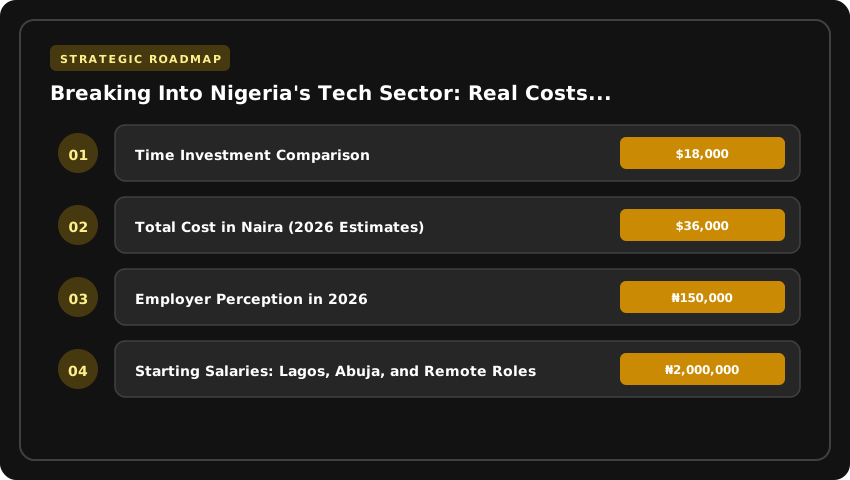
Time Investment Comparison
- University Degree: 4 to 5 years for a full BSc, or 2 years for a direct-entry HND conversion. This is the longest commitment by far.
- Coding Bootcamp: 3 to 9 months of full-time immersive study, or 6 to 18 months part-time. Most reputable programs in Lagos and Abuja now run 16-week full-time tracks.
- Self-Taught: 6 months to 2 years depending on daily consistency. The variance here is enormous because you are entirely accountable to yourself.
Total Cost in Naira (2026 Estimates)
- Federal/State University: ₦150,000 to ₦400,000 per session, totalling roughly ₦600,000 to ₦1,600,000 for a full degree, plus accommodation and living costs in cities like Lagos, Ibadan, or Nsukka.
- Private University (e.g., Covenant, Babcock, Baze): ₦2,000,000 to ₦5,500,000 per session, reaching ₦8,000,000 to ₦22,000,000 total for four years.
- Coding Bootcamp: ₦300,000 to ₦2,500,000 depending on the provider. Codar’s income-share agreement model is changing this conversation dramatically, allowing students to pay nothing upfront and repay only after securing employment.
- Self-Taught: ₦50,000 to ₦250,000 covering a decent laptop, internet data bundles, and occasional paid courses. This is the most financially accessible route.
Employer Perception in 2026
Here is where nuance matters. Traditional employers, including banks like GTBank and Access, established fintech firms like Flutterwave and Paystack, government agencies, and multinational oil & gas companies with tech departments, still heavily weight a BSc or HND from a NUC-accredited institution. Their HR systems often auto-filter candidates without degrees. However, startups, remote-first companies, and product-based tech firms have shifted dramatically. They care about what you can build, your GitHub activity, your portfolio depth, and your performance in technical interviews. I have seen bootcamp graduates and self-taught developers command ₦4.8M to ₦7.2M starting salaries at Lagos startups, while some degree holders from prestigious universities struggle to clear ₦3.6M because their practical skills lag behind.
Starting Salaries: Lagos, Abuja, and Remote Roles
- Lagos (Junior Full-Stack Developer): ₦3,600,000 to ₦7,200,000 annually, with top-tier fintech and product companies reaching ₦8,400,000+.
- Abuja (Junior Developer): ₦2,880,000 to ₦5,400,000 annually, though the market is smaller and more concentrated around government-tech and consulting roles.
- Remote Roles (USD-paid): $18,000 to $36,000 annually (₦27,000,000 to ₦54,000,000 at current rates), accessible primarily through platforms like Toptal, Andela, and direct international hiring.
Job Placement Rates and Practical Verdict
For funding flexibility, remember that NELFUND student loans now cover tuition for public university students, reducing the upfront burden for degree seekers. Bootcamps with strong career support, like Codar with its ISA model, report 70–85% placement rates within six months, while self-taught learners who consistently build in public (open-source contributions, technical blogging, Twitter/X engagement) can achieve similar outcomes, but the dropout rate is brutal, often exceeding 60%.
My actionable takeaway: If you need the credential for regulated industries, want the university experience, or qualify for NELFUND, pursue a CS or Software Engineering degree at a NUC-accredited institution. If you are hungry, disciplined, and need to earn income within 12 months, a quality bootcamp, especially one with ISA payment and job guarantees, is your fastest legitimate route. If you are exceptionally self-motivated, financially constrained, and willing to grind for 6–12 months with no safety net, the self-taught path works, but stack your portfolio aggressively and contribute to open-source. In 2026, skills and portfolio increasingly trump credentials, but the degree still opens doors that are otherwise locked.
| Provider / Pathway | Program Focus | Tuition (₦) | Duration | Admission Cut-off | Starting Salary Range (₦/month) | Career ROI Timeline |
|---|---|---|---|---|---|---|
| ALX Nigeria | Software Engineering, Data | Free – ₦50,000 (registration) | 6–12 months | Online aptitude assessment; no JAMB required | ₦150,000 – ₦350,000 | 3–6 months post-graduation |
| Decagon | Full-Stack Engineering | ₦2,000,000 (Income Share Agreement) | 6 months | Coding test + technical interview | ₦400,000 – ₦800,000 | Immediate placement |
| AltSchool Africa | Frontend, Backend, Data Science | ₦150,000 – ₦400,000 | 9–12 months | Basic online assessment; SSCE minimum | ₦200,000 – ₦500,000 | 4–8 months post-graduation |
| Codar Institute | Software Dev, Product Design | ₦500,000 – ₦1,500,000 | 6–9 months | Entry assessment + interview | ₦300,000 – ₦600,000 | 3–6 months post-graduation |
| Public University (B.Sc CS) | Computer Science Degree | ₦100,000 – ₦300,000 / year | 4–5 years | JAMB UTME 200+; Post-UTME screening | ₦200,000 – ₦400,000 | 6–12 months post-NYSC |
| Private University (B.Sc CS) | Computer Science Degree | ₦1,000,000 – ₦3,000,000 / year | 4–5 years | JAMB UTME 180+; internal screening | ₦200,000 – ₦400,000 | 6–12 months post-NYSC |
Frequently Asked Questions
How much does it cost to learn tech skills in Nigeria in 2026?
Tech training costs in Nigeria range from free programs like ALX (with ₦50,000 registration) to ₦2,000,000 for intensive bootcamps like Decagon. Mid-tier options such as AltSchool Africa and Codar charge between ₦150,000 and ₦1,500,000. Public university CS degrees cost ₦100,000–₦300,000 annually, while private universities charge ₦1,000,000–₦3,000,000 per year.
What is the JAMB cut-off mark for Computer Science in Nigerian universities?
Most Nigerian universities require a JAMB UTME score of 200 and above for Computer Science programs, with some institutions setting departmental cut-offs between 220 and 250. Private universities may accept scores from 180. Candidates must also pass Post-UTME screening. Competitive federal universities like UI, UNILAG, and OAU typically demand higher scores exceeding 250.
Which tech bootcamp offers the highest salary ROI in Nigeria?
Decagon offers the highest immediate salary ROI, with graduates earning ₦400,000–₦800,000 monthly through direct placement partnerships. However, it requires an Income Share Agreement of approximately ₦2,000,000. ALX provides the best cost-to-ROI ratio at near-zero tuition, with graduates earning ₦150,000–₦350,000 monthly within three to six months of completion.
Can I get a tech job in Nigeria without a university degree?
Yes. Nigerian tech employers increasingly prioritize skills over degrees. Bootcamps like ALX, Decagon, AltSchool Africa, and Codar provide industry-recognized certifications and portfolio projects that qualify graduates for roles in software engineering, data science, and product design. Starting salaries range from ₦150,000 to ₦800,000 monthly depending on skill level and specialization.
Strategic Final Takeaway
Success in evaluating Breaking Into Nigeria's Tech Sector: Real Costs & Pathways (2026) relies on early preparation, adherence to verified accredited requirements, and cross-referencing official portals. Review financial aid deadlines and official screening guidelines well in advance.