The 2026 ECE Salary Gap: Degree Holders vs. Non-Degree Staff
For many entering the ECE field, the choice often boils down to a Child Development Associate (CDA) credential versus a formal Associate degree from a community college. While the CDA is a respected entry-level benchmark, the financial trajectory for degree holders is significantly steeper. According to data trends aligned with the Bureau of Labor Statistics (BLS), non-degree staff often hit a “pay ceiling” early in their careers, whereas those with an Associate degree are positioned for administrative roles and higher base pay.
The Hourly Breakdown: CDA vs. Associate Degree
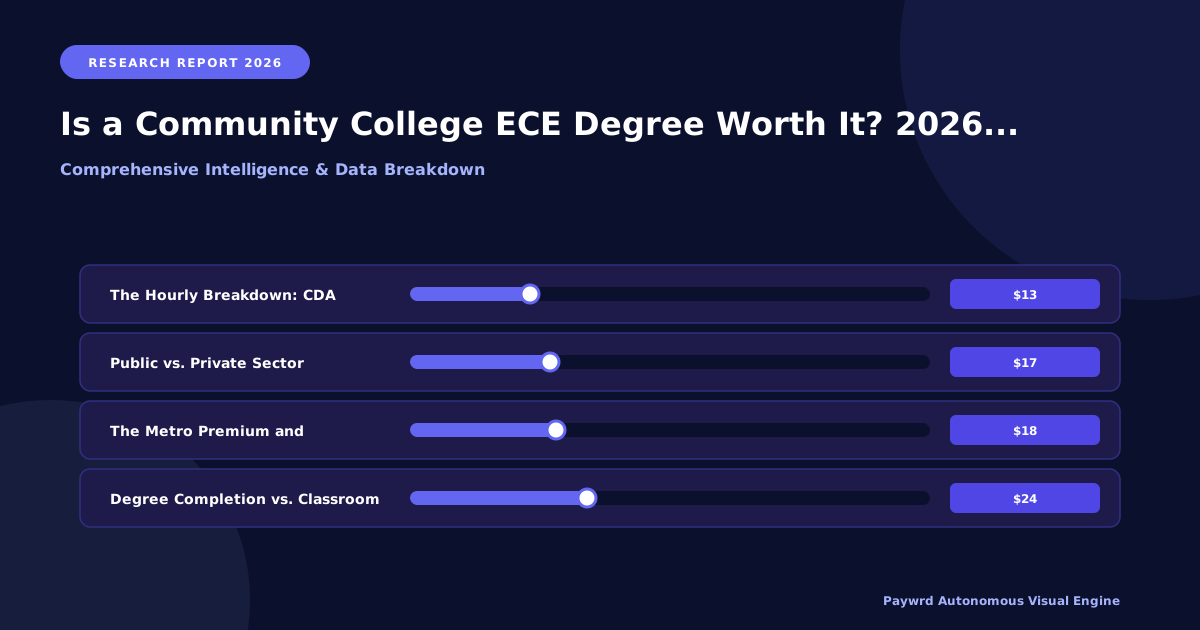
When we analyze the hourly wage gap, the difference is stark. Staff relying solely on a CDA or high school diploma typically earn on the lower end of the spectrum, often ranging from $13 to $17 per hour depending on the state. In contrast, ECE professionals with an Associate degree typically command $18 to $24 per hour. While a $3 to $7 difference may seem modest on a weekly check, it translates to an annual increase of roughly $6,000 to $14,000—a critical margin for those managing student loans or family expenses.
- CDA Holders: Primarily eligible for lead teacher roles in private childcare; limited upward mobility in public school systems.
- Associate Degree Holders: Eligible for “Head Start” positions and state-funded preschools, which often offer superior benefits packages and higher base salaries.
Public vs. Private Sector Ceilings
The 2026 outlook suggests a widening gap between private childcare centers and public education systems. Private centers often operate on tighter margins, capping salaries regardless of credentials. However, public centers and school districts—governed by the US Dept of Education standards—utilize strict salary schedules. In these environments, a degree is a non-negotiable requirement for moving into “Tier 2” or “Tier 3” pay grades, where salaries can reach $45,000 to $55,000 annually for early-career educators.
The Metro Premium and Specializations
In high-cost US metros like New York City, San Francisco, or Chicago, the degree premium is amplified. In these markets, base pay is higher, but competition is fiercer. Educators who pair their community college degree with specialized certifications—such as Montessori or Special Education endorsements—often see an additional 10% to 15% bump in their starting offers. For those utilizing FAFSA to fund their community college journey, the Return on Investment (ROI) is realized rapidly through these localized salary surges.
Employer Acceptance Trends and the Role of NAEYC Accreditation

For years, a lingering myth suggested that top-tier preschools and private childcare centers only valued four-year degrees from prestigious universities. In 2026, the reality is far more pragmatic. Hiring managers across the U.S. have shifted toward a “competency-first” model. They recognize that community college Associate degrees provide a rigorous, localized foundation that often makes a candidate more “classroom-ready” than a theoretical graduate from a distant university.
The gold standard for this legitimacy is NAEYC (National Association for the Education of Young Children) accreditation. When a community college aligns its curriculum with NAEYC standards, it signals to employers that the graduate has mastered evidence-based practices in child development and pedagogy. In the eyes of a hiring director, an NAEYC-aligned degree isn’t just a piece of paper; it is a guarantee that the educator understands the complex regulatory requirements of the US Department of Education and state licensing boards.
Degree Completion vs. Classroom Experience
One of the most frequent questions for those navigating the FAFSA process or choosing a program is whether experience outweighs a degree. While “years in the trenches” are invaluable, the industry trend is moving toward a hybrid requirement. Employers generally categorize candidates into three tiers:
- The Experienced Non-Degree Holder: Highly valued for reliability, but often capped at a lower salary ceiling and ineligible for lead teacher or administrative roles.
- The New Graduate: Possesses the theoretical knowledge and accreditation but may require more mentorship in behavioral management.
- The “Sweet Spot” Candidate: An educator with an Associate degree and 2+ years of experience. These candidates are the most competitive in the 2026 job market, often commanding the highest starting hourly rates in state-funded programs.
Ultimately, the Associate degree acts as a professional “unlock.” While experience gets you the interview, the degree—especially one from an accredited community college—secures the promotion. For those aiming for leadership roles or wanting to eventually transition into a Bachelor’s program at an Ivy League or state university, the community college path is no longer seen as a shortcut; it is viewed as a strategic, fiscally responsible entry point into a professional career.
Funding Your Degree: TEACH Grants and State-Level Scholarships
The most common deterrent for aspiring educators is the “sticker shock” of tuition. However, because the United States is currently facing a critical shortage of qualified early childhood educators, the federal government and state agencies have created aggressive financial pipelines to move students from the classroom to the degree program. You shouldn’t be paying full price for an ECE degree in 2026.
Leveraging the TEACH Grant for High-Need Fields
For those committed to the profession, the Teacher Education Assistance for College and Higher Education (TEACH) Grant is a powerhouse tool. This federal program provides up to $4,000 annually to students who agree to teach in a high-need field in a low-income area for at least four years. Because early childhood education is consistently flagged as a high-need area by the US Department of Education, ECE students are prime candidates.
Pro Tip: Be mindful of the service obligation. If you fail to complete your service commitment, the TEACH Grant converts into a Direct Loan with interest, so ensure your career trajectory aligns with high-need community placements.
FAFSA Optimization and Community College Value
Your first step is always the FAFSA (Free Application for Federal Student Aid). For community college enrollment, the FAFSA is often the key to a “zero-cost” degree. Between the Federal Pell Grant—which provides significant non-repayable funds for low-to-moderate income students—and institutional scholarships, many ECE students find their tuition fully covered.
- Pell Grants: Direct federal funding based on financial need.
- Institutional Aid: Many community colleges offer specific “Workforce Development” scholarships for ECE majors.
- Tax Credits: Look into the American Opportunity Tax Credit (AOTC) to recoup up to $2,500 per year in tuition and fees.
State-Specific Workforce Development Grants
Beyond federal aid, individual states are pouring money into ECE to stabilize the childcare workforce. Many states offer Workforce Innovation and Opportunity Act (WIOA) grants, which are designed to upskill workers in high-demand sectors. These grants often cover not just tuition, but also textbooks and licensing fees.
Additionally, many state-funded preschool programs offer “tuition reimbursement” for current employees. If you are already working in a center, check if your employer has a partnership with the local community college. In many cases, the state will pay for your Associate degree while you continue to earn a salary, effectively removing the financial barrier to your professional advancement.
Bridging the Gap: Transferring Credits to Four-Year Universities
For many educators, an Associate degree in Early Childhood Education (ECE) is not the finish line—it is a strategic launchpad. Rather than viewing community college as a terminal credential, savvy students use it as a high-value bridge to a Bachelor’s degree. By starting at a two-year institution, you effectively slash the cost of your first two years of higher education, avoiding the steep tuition premiums associated with four-year universities while maintaining the same academic rigor.
Leveraging Articulation Agreements
The secret to a seamless transition is the articulation agreement. These are formal contracts between community colleges and state universities that guarantee your credits will transfer without loss. Instead of guessing which classes “count,” these agreements provide a clear roadmap, ensuring that your Associate of Arts (AA) or Associate of Science (AS) aligns perfectly with the requirements of a Bachelor’s program. When selecting a college, always verify their partnerships with regional state universities or Ivy League-adjacent institutions to ensure your hard work isn’t lost in translation.
The Path to a Bachelor’s Degree
Moving from an Associate to a Bachelor’s in ECE typically involves a “2+2” model: two years of general education and core ECE foundations at a community college, followed by two years of specialized upper-division coursework at a university. To maximize this path, students should:
- File the FAFSA early: Ensure federal grants and loans are secured for the transition to a four-year institution.
- Seek AACSB or CAEP accredited programs: This ensures your degree meets the gold standard for professional educator certification.
- Consult an Academic Advisor: Confirm that your specific credits meet the US Department of Education’s standards for teacher licensure in your state.
Analyzing the Long-Term Salary Jump
The financial incentive for completing the jump to a Bachelor’s degree is substantial. According to data trends aligned with the Bureau of Labor Statistics (BLS), the “degree premium” accelerates significantly after the Associate level. While an Associate degree opens doors to lead teacher roles, a Bachelor’s degree is often the prerequisite for administrative positions, center directorships, and public school teaching roles.
In many US markets, the salary jump from an Associate to a Bachelor’s degree can range from $10,000 to $20,000 annually. Furthermore, Bachelor’s holders are eligible for higher-tier state subsidies and federal funding programs, effectively raising their lifetime earning ceiling. By utilizing the community college route, you secure these high-earning credentials without accumulating the crushing student debt often associated with four-year residential programs.
Market Demand Analysis: Where the Jobs Are in 2026
Entering the Early Childhood Education (ECE) workforce in 2026 requires more than just a passion for teaching; it requires a strategic understanding of where the funding is flowing. While the need for childcare is universal, the salary ceilings and job security vary wildly depending on your zip code and the type of institution you choose.
Regional Hotspots and Geographic Demand
Demand is currently peaking in “childcare deserts”—areas where the ratio of children to providers is critically low. While the Ivy League corridors of the Northeast offer high prestige, the most aggressive hiring surges are happening in the Sun Belt. States like Texas, Florida, and Arizona are seeing massive population inflows, leading to a shortage of qualified lead teachers. In these regions, candidates with an Associate degree often find themselves with more leverage to negotiate signing bonuses or tuition reimbursement packages through state-funded grants managed by the US Department of Education.
The Special Education Pivot: Inclusive Classrooms
One of the most significant shifts for 2026 is the move toward inclusive classrooms. There is a critical shortage of ECE professionals trained in neurodiversity and special education. Educators who supplement their community college degree with certifications in behavioral intervention or inclusive pedagogy are seeing a distinct competitive advantage. As federal mandates for early intervention increase, the demand for teachers who can manage diverse learning needs is skyrocketing, often commanding a premium over generalist educators.
Stability Showdown: Head Start vs. Private Boutiques
When analyzing where to plant your roots, you must weigh the stability of government-funded programs against the agility of private enterprises:
- Head Start and State-Funded Programs: These offer the highest level of stability. Because they are tied to federal funding and strict compliance standards, they prioritize degree holders to maintain their grants. You can expect more consistent hours, robust benefits, and a clear salary scale.
- Private Boutique Centers: These “premium” centers often cater to high-net-worth families and can offer higher starting salaries for those with specialized degrees. However, they lack the systemic safety nets of federal programs and are more susceptible to local economic downturns.
For those looking to maximize their ROI, the smartest move is to leverage a community college degree to enter a state-funded system. This path not only secures your baseline income but often provides the bridge to a Bachelor’s degree via FAFSA-funded pathways, ensuring your long-term trajectory remains upward.
Critical FAQ: Degree Value, Timeline, and ROI
How Long Until I See a Return on Investment?
Let’s talk hard numbers. The average in-district tuition for a public two-year college sits around $3,990 per year (College Board, 2024 trends), putting a full Associate degree at roughly $8,000–$10,000 before Pell Grants or employer tuition assistance. Against that, the BLS reports a median annual wage gap of approximately $6,000–$9,000 between childcare workers (often CDA-only) and preschool teachers (typically degree-required) in state-funded slots. Do the math: you’re looking at a break-even point of 12 to 18 months post-graduation if you step into a Head Start or public pre-K role. In high-cost metros like Boston or San Francisco—where degree-holders command $22–$26/hour—that ROI window shrinks to under a year. The “degree premium” isn’t theoretical; it’s a calculable payroll differential.
Can I Actually Work Full-Time While Earning Credits?
Yes, but it requires strategic scheduling, not just optimism. Community colleges have built their ECE pathways around the working professional for decades. Look for these specific structural supports:
- Hybrid/Evening Cohorts: Many programs front-load practicum hours during your existing work shift if your center is an approved lab site—ask your director about “work-based learning” articulation.
- Prior Learning Assessment (PLA): Your CDA credential, CPR certification, and documented on-the-job training often translate to 6–12 credit hours instantly, shaving a full semester off the timeline.
- T.E.A.C.H. Early Childhood® Scholarships: Available in over 20 states, these cover 80–90% of tuition and provide paid release time (usually 3–4 hours/week) for classes. Your employer often shares the cost.
Pro tip: Enroll part-time (6 credits/semester) to maintain Pell Grant eligibility and avoid burnout. You’ll finish in 3 years debt-free, versus 2 years with loans.
Does the Degree Guarantee a Lead Teacher Title?
Here is the unvarnished truth: No credential guarantees a promotion. What the Associate degree does is make you legally eligible for the role. In 2026, 38 states and D.C. require an Associate (or 60 credits with ECE core) for lead teachers in state-funded pre-K; Head Start mandates it for 50% of teachers nationally. Without the degree, your application is legally disqualified in those systems—period. With it, you clear the HR filter and enter the interview pool where your practicum portfolio, CLASS observation scores, and references win the job. Think of the degree as the entry ticket, not the victory lap. The smartest candidates pair the AA with a specialized certificate (Infant/Toddler, Special Needs, or Administration) to negotiate that $2–$3/hour differential immediately.
Strategic Final Takeaway
When evaluating Early Childhood Educators Community College Degree Salary Outlook 2026 Employer Acceptance, base your decisions on accredited institutional standards, measurable return on investment (ROI), and up-to-date official guidelines. Always verify specific dates and requirements through official regulatory portals.