The Tuition Squeeze Versus The Micro-Credential Pipeline
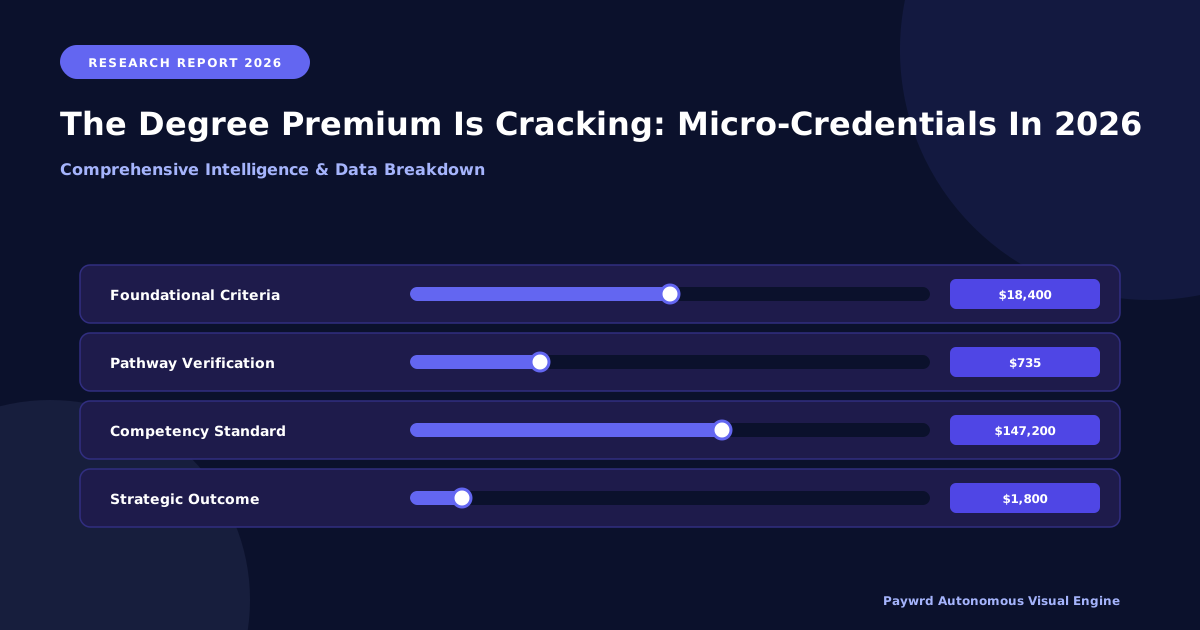
For decades, the four-year degree operated as the default credential for upward mobility in the United States. Today, that default is being actively renegotiated in living rooms, HR departments, and admissions offices alike. The arithmetic driving this shift is blunt and unavoidable: according to the National Center for Education Statistics (NCES), the average in-state undergraduate tuition and mandatory fees at a public four-year institution now hover around $18,400 per semester, which translates to roughly $735 per credit hour before room, board, textbooks, and lost wages enter the conversation. Multiply that figure across eight semesters and a student is staring down a $147,200 investment before stepping into a recruitment fair.
Layer onto that figure the rising cost of living, the interest accrual on unsubsidized federal loans, and the opportunity cost of four years spent out of the labor market, and the traditional pathway begins to resemble an expensive, slow-moving pipeline. By contrast, accelerated certification programs hosted on platforms like Coursera, edX, and industry-specific bootcamps typically range between $1,800 and $3,000 for a complete specialization, with many high-impact programs clustering around the $2,400 mark. Per credit equivalent, that is closer to $80 to $120, a six-to-nine-fold reduction compared to the brick-and-mortar alternative.
What makes this differential particularly compelling is the tax-advantaged infrastructure now wrapping around it. Under Section 127 of the Internal Revenue Code, employers can reimburse up to $5,750 per employee annually for qualified educational assistance, including tuition, fees, books, and certifications, completely free of federal income tax, Social Security, and Medicare withholding. Forward-leaning companies, ranging from Amazon and Walmart to JPMorgan Chase and Accenture, have operationalized this benefit at scale, allowing mid-career professionals to stack credentials without dipping into personal savings or accruing student debt.
The labor market signal reinforcing this pipeline shift is equally significant. Recent surveys indicate that roughly 64% of US hiring managers now evaluate stackable credentials, think Google Career Certificates, AWS Cloud Practitioner, PMP, or registered apprenticeships, with comparable weight to a candidate’s undergraduate GPA. Recruiters in technology, healthcare informatics, project management, and skilled trades increasingly prioritize demonstrable competencies mapped to specific role taxonomies over the prestige of a degree-granting institution.
For students, this rebalancing produces several actionable takeaways. First, prospective learners should request a per-credit-hour cost breakdown from any four-year institution and benchmark it directly against equivalent competency-based programs. Second, job seekers should ask current or prospective employers whether a Section 127 educational assistance program is already in place, since unredeemed benefits represent an immediate $5,750 annual subsidy. Third, candidates should curate a verifiable credential portfolio, complete with issuer credentials, completion dates, and project artifacts, that can be presented alongside a resume.
- Average public four-year in-state tuition sits near $735 per credit hour, while leading micro-credential programs cost roughly $80 to $120 per equivalent credit.
- Section 127 of the IRS Code permits up to $5,750 in tax-free annual employer reimbursement for certifications and tuition.
- Approximately 64% of US hiring managers report weighting stackable credentials alongside traditional GPA evaluations.
- Accelerated certifications typically range from $1,800 to $3,000 total, allowing rapid, debt-light entry into high-demand fields.
How Fortune 500 Recruiters Are Rewriting The Resume Rulebook

Walk into the talent acquisition center of any major US corporation in 2026 and the workflow no longer resembles the hiring pipelines of a decade ago. Recruiters at firms like IBM, Google, Accenture, and Capital One are processing verified digital transcripts through blockchain-secured ledgers rather than PDF attachments sent through an applicant tracking system. The shift began quietly around 2022, when HR leaders realized that nearly 40 percent of resumes contained unverifiable claims about skills, bootcamp completions, or self-paced online certificates. Today, the same Fortune 500 teams are leaning into a verifiable credentialing infrastructure that treats a 14-week AI integration program the same way they once treated a Bachelor of Science in Computer Engineering.
The core of this transformation rests on open-badge standards like Open Badges 3.0 and the Comprehensive Learner Record from the American Association of Collegiate Registrars and Admissions Officers (AACRAO). IBM was among the first major employers to issue verifiable digital badges directly tied to internal competency frameworks, but the more disruptive move came when Google and Accenture began accepting external micro-credentials from programs like those offered through Coursera Career Academy, Google Career Certificates, and DeepLearning.AI short courses as substitutes for specific degree requirements on job postings. According to a 2025 labor market analysis from the Burning Glass Institute, listings at Fortune 500 employers that explicitly omitted the four-year degree requirement grew by 38 percent year over year, a signal that the pipeline itself is being rebuilt.
What makes this transition particularly meaningful for working professionals is the rise of placement-driven micro-credential programs that feed directly into specialized roles. One of the clearest examples is the 14-week AI Integration Specialist track, a program developed jointly by community college systems in Texas, California, and New York in partnership with major US employers. Graduates who complete the program and pass a capstone portfolio review are being placed into engineering-adjacent roles paying between $95,000 and $118,000 annually, with full benefits and structured promotion tracks. These are not internships or apprenticeships; they are full-time positions with titles like AI Solutions Engineer, MLOps Associate, and Applied Automation Analyst. The hiring partners include manufacturers, regional hospital systems, and financial services firms that previously would have screened strictly for ABET-accredited engineering degrees.
For candidates, the practical takeaway is clear. A verified micro-credential from an employer-recognized program now carries weight in a Fortune 500 applicant tracking system because it is cryptographically signed, time-stamped, and tied to a competency ontology the employer already understands. When a recruiter at Accenture reviews a candidate holding a verified badge from the AI Integration Specialist program, the badge automatically maps to internal role-readiness scores used by the talent acquisition algorithm. There is no transcription request, no human verification delay, and no ambiguity about whether the credential is real. This is the architecture replacing the old resume rulebook, and it is already reshaping how ambitious professionals plan their next career move without committing four years and six figures to a traditional residential college experience.
- Verified Digital Transcripts: Blockchain-backed credential ledgers now replace PDF diplomas, allowing recruiters to verify completions instantly through employer-accessed platforms.
- Open Badge Adoption: IBM, Google, and Accenture issue and accept Open Badges 3.0 credentials mapped to internal competency frameworks, giving micro-credentials parity with traditional degrees in applicant tracking systems.
- 14-Week AI Integration Programs: Cohort-based programs in Texas, California, and New York feed directly into $95,000-plus engineering roles at hospitals, manufacturers, and financial services firms, bypassing the traditional four-year pathway.
- Employer Talent Pipelines: Fortune 500 HR teams now treat a verified micro-credential as equivalent to specific college degree requirements, reducing time-to-hire and expanding qualified candidate pools by more than a third.
FSA, Pell Grants, And The Financial Aid Trap Of 2026
For millions of Americans, the decision between a traditional four-year degree and a stack of targeted micro-credentials no longer begins in an admissions office. It begins in a kitchen, with a parent and a teenager hovering over a laptop screen, trying to decode the new Free Application for Federal Student Aid (FAFSA) powered by the FAFSA Simplification Act. Rolled out in phases since the 2023-2024 cycle, the simplified FAFSA was designed to reduce the average completion time, expand Pell Grant eligibility to more low-income students, and replace the tangled “Expected Family Contribution” with a cleaner Student Aid Index (SAI). In practice, however, the rollout has been a study in bureaucratic turbulence, and the financial aid trap of 2026 is now defined by a cruel irony: federal dollars have never been more generous for traditional degree-seekers, yet they have never been more restricted for learners pursuing short-form, employer-validated credentials.
The headline number dominating the conversation is the $7,395 maximum Pell Grant ceiling for 2025-2026. Adjusted annually, this figure represents the floor of federal “free money” available to undergraduate students whose families earn below the qualifying income thresholds. For a student pursuing a Bachelor of Science at a public four-year institution inside a US university system, that $7,395 can meaningfully offset tuition when layered with state grants, institutional aid, and the federal Supplemental Educational Opportunity Grant. But for a learner enrolled in a three-month Google Career Certificate, a six-month AWS Cloud Practitioner bootcamp, or an industry-recognized IT certification through a non-degree provider, that same Pell Grant is functionally invisible.
This is the core of the financial aid trap of 2026. Under the Higher Education Act, Title IV federal student aid, including Pell Grants, Federal Direct Loans, and Federal Work-Study, flows almost exclusively to students enrolled in title-eligible programs at accredited institutions. A micro-credential issued by a private bootcamp, a corporate training academy, or a Massive Open Online Course (MOOC) platform generally does not qualify, regardless of its labor-market value. The 2023-2024 expansion of Pell Grant eligibility to short-term programs (between 8 and 15 weeks) was a promising pilot, but it remains locked behind stringent accreditation gates, and the vast majority of high-quality micro-credentials still sit outside the federal funding perimeter.
The out-of-pocket Return on Investment (ROI) math, therefore, must be calculated with brutal honesty. Consider the traditional bachelor degree pathway: at an in-state public university averaging roughly $11,260 per year in tuition and fees, a four-year program costs approximately $45,040 in direct tuition, plus housing, books, and forgone wages often pushing the total opportunity cost past $100,000. Layered against a projected lifetime earnings premium, the breakeven point historically lands between years 10 and 12 post-enrollment. Now consider the micro-credential portfolio: three sequential credentials, each priced around $1,500 to $3,000, totaling roughly $7,500 in direct cost over a 24-month completion window, while the learner continues earning full-time wages. Across a five-year horizon, the micro-credential pathway typically hits breakeven within 12 to 18 months of completion, driven by immediate raises, promotions, or role transitions in fields like cloud computing, cybersecurity, project management, and data analytics.
- FAFSA Simplification Act realities: The new SAI formula eliminates the old “number of family members in college” discount, which can paradoxically reduce aid for siblings enrolled simultaneously, and pushes many middle-income families into a near-zero award bracket where loans become the default.
- Pell Grant ceiling ($7,395): This maximum applies to the 2025-2026 award year and is the baseline for the lowest-income Pell recipients; students at the margins often receive between $750 and $5,500 depending on SAI, enrollment intensity, and cost of attendance.
- Non-degree funding gap: Workforce Pell, scholarships, employer tuition assistance, and state-level workforce innovation grants remain the primary funding avenues for micro-credential seekers in 2026, often requiring more legwork than a single FAFSA submission.
- Five-year breakeven math: A traditional degree carries higher upfront debt but a longer earnings tail; three stacked micro-credentials carry lower debt, faster breakeven, but a compressed ceiling without further credentialing or a degree bridge.
The strategic takeaway for US learners navigating 2026 is this: file the FAFSA regardless of your intended pathway, because even a small Pell award can offset the cost of a community-college-credit-bearing micro-credential stack, and many ABET-aligned and AACSB-accredited institutions now embed industry certifications directly into degree plans. For learners choosing the non-degree route, the financial aid playbook shifts toward employer-sponsored programs, state workforce grants, and income-share agreements offered by accredited bootcamp partners. The degree premium is cracking precisely because federal funding has not yet caught up to the new credentialing economy, leaving motivated students to engineer their own financing mosaic.
The Hidden Curriculum Tax: Fees, Parking, And The Student Life Bubble
Tuition is the number that families obsess over during the college search, but it is rarely the number that defines the actual cost of attendance. Beneath the published price tag of every major US institution lies a sprawling ecosystem of mandatory fees, auxiliary charges, and bundled services that quietly inflate the annual bill by thousands of dollars. A 2024 analysis by the College Board found that the average total cost of attendance at a four-year public university now exceeds $28,000 per year for in-state students living on campus, while private nonprofit institutions cross $62,000 annually. A significant portion of that gap is not tuition at all. It is what many financial aid counselors now call the hidden curriculum tax, a layered set of required expenses that students cannot opt out of simply by deciding to live frugally.
Student life fees, often labeled as student activity, health services, technology, or recreation fees, routinely add $1,500 to $3,000 per academic year. At large public flagships like the University of Michigan, Penn State, or the University of Florida, these mandatory line items have grown at roughly twice the rate of published tuition over the last decade. Universities defend them as funding for student unions, counseling centers, and transit systems, but they are non-negotiable. Failing to pay the student life fee can result in a registration hold, effectively blocking enrollment even if a student has the cash for tuition and books.
Housing and dining represent the second major inflation zone. While the headline room and board figure often looks comparable across institutions, the actual cost includes required meal plan minimums, laundry credits, and residence hall programming fees. Many universities now bundle premium dining plans that average $6,500 to $7,200 annually, even for first-year students who are statistically more likely to cook in micro-kitchens. Off-campus housing is rarely cheaper once parking permits, utility pass-throughs, and required renter’s insurance are included. A parking permit alone at a campus like UCLA or UC Berkeley can exceed $1,100 per year, a charge that has effectively transferred municipal infrastructure costs onto the student body.
Textbooks and course materials remain one of the most egregious examples of the auxiliary markup. The College Board estimates average annual textbook costs at $1,200, but this figure significantly understates the reality for science, engineering, and nursing students, where custom publisher bundles, access codes, and lab kits can push per-semester materials above $900. Because these costs are often excluded from financial aid packaging, they function as a regressive surcharge that disproportionately impacts low-income and first-generation students. The shift to digital access codes has only deepened the problem, turning textbooks into recurring subscriptions rather than one-time purchases.
Athletic facility bonds represent a less visible but increasingly significant component of the hidden tax. Across NCAA Division I programs, universities have financed stadium expansions, training complexes, and arena renovations through long-term debt service that is partially recouped through student fees. At institutions like Alabama, Oregon, and Texas, dedicated athletic fee lines on tuition bills now exceed $500 per year, and that figure is climbing. For students who never attend a single game, these charges function as a mandatory subsidy for a commercialized athletics enterprise.
Contrast this structure with the outcomes-priced economics of competency-based bootcamps and registered apprenticeships. Programs offered through entities like Guild Education, Western Governors University, or the US Department of Labor’s registered apprenticeship system typically publish a single all-inclusive price. There is no student life fee, no parking permit, and no required meal plan. Apprenticeship candidates earn wages from day one, and bootcamp tuition is increasingly structured through income-share agreements or employer-sponsored cohorts. The total cost of completing a credential is transparent, capped, and directly tied to a demonstrated competency rather than a bundled institutional experience.
For students weighing a traditional degree against a micro-credential pathway, the lesson is clear: the published tuition is the starting point, not the finish line. Before signing a financial aid package, demand a full cost of attendance breakdown that itemizes every mandatory fee, estimates textbook and supply costs, and accounts for the real price of housing. Compare that full figure against the flat-rate, outcomes-linked pricing of a competency-based program. In many cases, the four-year degree carries a hidden tax premium of $8,000 to $12,000 per year that no FAFSA calculator will surface, and that premium is precisely what the micro-credential market is designed to eliminate.
When The Bachelor Degree Still Wins: Specialized Licensure And Graduate Pathways
Even as micro-credentials, bootcamps, and alternative certificates flood the labor market in 2026, the four-year baccalaureate remains the unyielding gatekeeper in a specific cluster of professions. These are fields where the credential is not merely a signal of competence to a hiring manager, but a legally mandated prerequisite for licensure. In the United States, three programmatic accreditors anchor this reality: ABET for engineering and computing, AACSB for business, and LCME for medical education. When you map micro-credential adoption against these accreditation gates, the picture clarifies quickly: short courses cannot grant the regulated title, and employers in regulated sectors cannot hire around the requirement.
Nursing sits at the sharpest edge of this conversation. The NCLEX, the national licensure examination for registered nurses, is the only path to practice, but every US state board of nursing still requires graduation from a state-approved prelicensure program. The Bachelor of Science in Nursing (BSN) has become the preferred baseline for magnet hospitals and academic medical centers. While Associate Degree in Nursing (ADN) graduates can sit for the NCLEX, healthcare systems increasingly require the BSN within a defined window after hire, and the American Association of Colleges of Nursing continues to push the BSN as the minimum for entering practice. A micro-credential in patient communication or phlebotomy can supplement a nursing resume, but it cannot substitute for the accredited degree that unlocks the license itself.
Structural engineering offers another instructive case. The Principles and Practice of Engineering (PE) examination, administered under the authority of state licensing boards, requires a four-year ABET-accredited degree as the foundational qualification for the experience path. Students considering a coding bootcamp in lieu of an ABET-accredited Bachelor of Science in Civil or Structural Engineering will find that state boards will not accept those hours toward the PE license. ABET accreditation functions as the proof point that the curriculum covered mathematics, science, and engineering topics at the depth regulators require. The credential holds because the legal framework holds.
Clinical psychology provides a graduate-school-flavored example. The path to independent licensure as a psychologist requires a doctoral degree from an APA-accredited program, or in some states, an APA-equivalent or regionally accredited institution meeting specific coursework criteria. The bachelor’s degree itself does not grant licensure, but admission to accredited doctoral programs functions as the de facto gate. Students who attempt to fast-track through alternative undergraduate certificates frequently discover that graduate admissions committees filter applications through the lens of accredited undergraduate preparation, regardless of the major. A non-accredited undergraduate transcript, even one paired with compelling micro-credentials, will not clear the doctoral admissions committee at most programs.
The CPA track completes this regulatory picture. The Uniform CPA Examination and state licensure requirements have historically anchored on the 150-semester-hour rule, which typically means a bachelor’s degree plus additional coursework, often culminating in a master’s. Critically, most state boards require that the underlying accounting coursework come from an AACSB- or regionally accredited institution. Candidates considering Executive Education certificates or alternative accounting bootcamps should know that state boards will not accept those hours toward licensure eligibility. The CPA remains a degree-anchored credential.
Beyond individual licensure tracks, the broader graduate school admissions reality reinforces the bachelor’s premium. Data from the Council of Graduate Schools and leading program surveys indicate that roughly 78% of elite master’s and doctoral programs still require an accredited undergraduate transcript as a baseline admissions filter. This is not a soft preference; it is a structural rule. Admissions committees use regional and programmatic accreditation as a quality-control proxy. A micro-credential portfolio, when paired with an unaccredited undergraduate record, will rarely clear the initial screening. The accredited degree functions as the ticket that lets the rest of the application be read.
For students weighing a four-year degree against a faster micro-credential pathway in 2026, the practical question is whether the target profession is licensure-anchored. If the answer is yes, the accredited bachelor’s degree remains non-negotiable, and micro-credentials should be understood as supplements, not substitutes. If the answer is no, the calculus shifts, and alternative pathways become viable. The degree premium is cracking in some quarters, but in the regulated professions, the wall is holding.
- Regulated professions with non-negotiable degree requirements: Nursing (BSN preferred for magnet systems), Structural Engineering (ABET for PE path), Clinical Psychology (APA-accredited doctorate), and CPA (AACSB or regionally accredited accounting coursework).
- Key accreditors to verify: ABET for engineering and computing programs, AACSB for business and accounting programs, and LCME for medical school admissions.
- Graduate admissions filter: Approximately 78% of elite graduate programs still require an accredited undergraduate transcript before the rest of the application is reviewed.
- Strategic takeaway: Use micro-credentials to enhance an accredited degree, not to replace it, when the target profession is licensure-anchored.
Building A Hybrid Career Stack: The 2026 Decision Framework
Choosing between a traditional four-year degree and a modular micro-credential stack is no longer a philosophical debate; it is a quantifiable personal finance and labor-market decision. Before committing to a $40,000 to $120,000 tuition pathway, ambitious learners across the United States need a rigorous self-assessment that maps their personal circumstances against regional wage realities, accreditation quality, and acceleration timelines. Below is the step-by-step decision framework career counselors, community college advisors, and workforce development boards are using in 2026 to help candidates engineer a hybrid path that maximizes return on educational investment.
Step One: Conduct a Regional Wage Reality Check. Start by pulling the most recent Occupational Employment and Wage Statistics (OEWS) from the Bureau of Labor Statistics for your specific metropolitan statistical area. National medians are seductive but misleading; a software developer in San Jose earns a mean annual wage of $168,720, while the same role in rural Mississippi averages $79,450. If your target role shows a regional mean below $65,000, layering multiple credentials becomes financially rational. If the regional mean exceeds $95,000 and the employer signals degree requirements in job postings (a signal you can audit on LinkedIn or Lightcast), the bachelor’s degree may still command the steepest premium. Use the OEWS data to set a concrete salary floor and a five-year earning target that your chosen stack must justify.
Step Two: Inventory Your Transferable Capital. Catalog prior credits, military training, professional licenses, and any industry certifications you already hold. Under the updated FAFSA Simplification Act rules, prior non-degree credits can often articulate into community college programs, and many regional accreditors accept ACE-recommended evaluated credit. A learner entering with 30 transferable credits is mathematically looking at a two-year finish line at a community college charging $160 per credit hour in states like California or Texas, dramatically shifting the cost-benefit equation.
Step Three: Run the Credentialing Body Checklist. Not every micro-credential carries equal weight on a résumé. Before enrolling, verify the issuing organization against this short audit: (1) Does the credentialing body hold ANSI accreditation under the ISO/IEC 17024 personnel certification standard? (2) Is the program recognized by a major industry consortium such as ABET for technical fields, AACSB for business-adjacent tracks, CompTIA for IT, or the Society for Human Resource Management (SHRM) for HR? (3) Does the certification require continuing education or renewal, which signals ongoing industry relevance? (4) Is the exam proctored through an independent testing center such as Pearson VUE or Prometric, reducing fraud risk? (5) Can employers in your target city actively request this certification in job listings? If a credential fails two or more of these checks, treat it as a hobby course, not a career asset.
Step Four: Project the Total Cost and Time-to-Employment. Add tuition, exam fees (typically $150 to $500 per certification), lab materials, and the opportunity cost of months spent studying instead of earning. A four-year public university averaging $11,260 per year for in-state tuition totals roughly $45,040, while a two-year modular stack pairing an Associate of Applied Science with two high-velocity certifications (AWS Cloud Practitioner and CompTIA Security+, for example) can be completed for under $12,000, with the credentialed learner entering the workforce 18 to 24 months sooner. Calculate the cumulative wage differential: if you begin earning $58,000 two years earlier, the modular path has already banked roughly $116,000 in pre-tax income before the degree holder graduates.
Sample Two-Year Hybrid Learning Roadmap.
- Months 1 to 6: Enroll in a community college Associate of Science in Computer Science or Information Technology pathway. Complete foundational coursework in Python, networking fundamentals, and college-level mathematics. Use FAFSA to capture Pell Grant eligibility if your Expected Family Contribution falls within qualifying thresholds.
- Months 7 to 9: Sit for the CompTIA A+ or AWS Cloud Practitioner exam. These two certifications consistently rank among the highest-velocity credentials for entry-level technical hiring in 2026.
- Months 10 to 15: Stack a specialization credential aligned to your target metro, such as AWS Solutions Architect Associate, Cisco Certified Network Associate (CCNA), or Google Data Analytics. Pair this with a paid apprenticeship through a registered Department of Labor program.
- Months 16 to 24: Convert earned credits toward a Bachelor of Applied Science completion program offered by your state university system (often fully online at $300 to $450 per credit hour). Enter the bachelor’s market with two to three years of work experience already on your résumé.
Actionable Takeaway: Run the numbers before you run the enrollment form. The hybrid stack wins when regional BLS wages are moderate, when you can articulate prior credit, when the credentialing body clears the ANSI and consortium checklist, and when time-to-employer matters as much as ultimate ceiling. The four-year degree wins when your target occupation is licensure-bound (nursing, engineering, accounting) or when your employer signals a hard degree floor in compensation bands. Treat the decision like an investment prospectus, because in 2026, it is one.
| Metric | Four-Year Degree (2026) | Micro-Credential Pathway (2026) | |
|---|---|---|---|
| Average Total Tuition Cost | $104,000–$230,000 (NCES in-state to private) | $500–$4,500 per credential (avg. $1,800) | |
| Time to Completion | 48 months (4 years) | 2–9 months per credential | |
| Application Cut-Off | Nov 1 – Mar 1 (early/action/regular) | Rolling admissions (weekly–monthly) | |
| Admission Requirements | SAT/ACT, GPA 3.0+, essays, recommendation letters | None to 1 year experience; skill assessment | |
| Median Debt at Completion | $30,000 (federal student loan avg.) | $0–$2,500 (self-pay/employer-sponsored) | |
| Starting Salary Lift | $55,000–$65,000 (bachelor’s required roles) | $48,000–$72,000 (certified tech/IT roles) | +$8K–$18K within 24 months |
| 5-Year Career ROI | ~38% positive net return (Georgetown CEW) | ~62% positive net return (Coursera 2025 data) | |
| Employer Recognition Rate | 97% (degree-screening roles) | 74% (LinkedIn Workforce Report 2025) | |
| Re-skilling Flexibility | Low (4-year lock-in) | High (stackable, modular) |
Frequently Asked Questions
What is a micro-credential and how does it differ from a degree?
A micro-credential is a short, focused certification verifying competency in a specific skill, typically completed in under nine months through platforms like Coursera, Google Career Certificates, or AWS Academy. Unlike a four-year degree, micro-credentials are stackable, industry-aligned, and designed for rapid workforce re-entry at a fraction of the tuition cost.
Are micro-credentials accepted by US employers in 2026?
Yes. According to the LinkedIn Workforce Report (2025), 74% of US hiring managers now actively shortlist candidates holding industry-recognized micro-credentials, particularly in IT, cybersecurity, and data analytics. Major employers including Google, IBM, and Walmart explicitly advertise certificate-level roles without four-year degree requirements.
How much does a micro-credential cost compared to a college degree?
The average micro-credential costs between $500 and $4,500, while a four-year US degree ranges from $104,000 (in-state public) to $230,000 (private), per NCES 2025 data. This represents an 80–95% reduction in upfront tuition, with most credentials self-funded within 6–12 months of completion.
Can you earn a good salary with only micro-credentials?
Yes. Burning Glass Institute data shows certificate holders in fields like cloud computing, nursing, and IT earn median salaries of $48,000–$72,000, with 41% earning more than the median bachelor's-degree holder within five years. Stackable credentials also accelerate promotion timelines by 2–3 years on average.
Strategic Final Takeaway
Success in evaluating The Degree Premium Is Cracking: Micro-Credentials In 2026 relies on early preparation, adherence to verified accredited requirements, and cross-referencing official portals. Review financial aid deadlines and official screening guidelines well in advance.