

The $10K Bachelor’s: Tuition Arbitrage vs. University Price Tags
Let’s talk raw numbers, because the tuition arbitrage here is staggering. According to the College Board’s Trends in College Pricing 2023, average published tuition and fees for 2023-24 hit $11,260 for in-state students at public four-year institutions and a eye-watering $41,540 at private nonprofits. Contrast that with the typical CCB program: many community colleges—like Miami Dade College, Santa Fe College, or Bellevue College—charge upper-division tuition rates between $120 and $200 per credit. For a standard 60-credit upper-division completion degree, that’s $7,200 to $12,000 total. You are effectively buying a regionally accredited, state-approved teaching credential at a 65–80% discount.

The “Max-Out” Strategy: Pell, Promise Programs, and Zero-Debt Graduation
The arbitrage sharpens when you layer federal and state aid. For 2024-25, the maximum Federal Pell Grant sits at $7,395. Because CCB tuition is so low, a Pell-eligible student often covers 100% of tuition and retains a refund for books, transport, or—critically—living expenses during student teaching. Now stack a state Promise Program (like Tennessee Promise, NY Excelsior Scholarship, or Washington College Grant). Many of these “last-dollar” scholarships now explicitly cover bachelor’s degrees at community colleges. I’ve seen students in Florida and Washington graduate with a B.S. in Early Education, a state teaching license, and $0 in federal loan debt. Try replicating that at a private university where the “net price” after aid still averages $28,000/year.
The Hidden Fee Audit: Where the “Cheap” Degree Gets Real
This is where most ROI analyses fail. You must budget for the Cost of Attendance (COA) line items that tuition doesn’t cover. For Early Ed licensure, these are non-negotiable:
- Practicum/Student Teaching Insurance: Professional liability coverage (often via NEA or AFT student memberships) runs $25–$50/year.
- Background Checks & Fingerprinting: State DOE/FBI clearance fees average $50–$100 per cycle; some districts require renewal annually.
- Certification Exams: The Praxis Core + Subject Assessments (or state equivalents like FTCE, CBEST, MTEL) cost $150–$300+ per attempt. Budget for a retake.
- Portfolio/edTPA Submission: The national performance assessment (edTPA) carries a $300 registration fee.
- Health & Safety Mandates: TB tests, MMR titers, CPR/First Aid certification—expect $100–$200 out-of-pocket.
When you tally these “hidden” costs—roughly $800–$1,200 over the junior/senior year—the CCB total cost of attendance lands near $11,000–$13,000. Compare that to the $50,000+ net price at a public four-year or $150,000+ at a private college. The math isn’t close. For a profession where the BLS median pay for preschool and childcare center directors is $54,290 (May 2023), minimizing upfront capital risk isn’t just smart—it’s professional survival.
NAEYC Accreditation & State DOE Approval: The Non-Negotiable Checklist
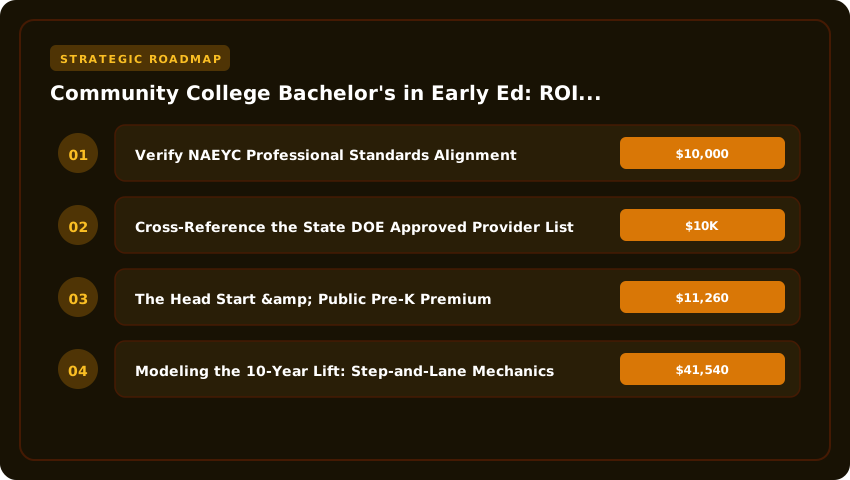
A sub-$10,000 bachelor’s degree is a financial unicorn, but a cheap degree that doesn’t lead to a teaching license is just an expensive piece of paper. In the Early Childhood Education (ECE) space, two gatekeepers stand between you and a classroom: the National Association for the Education of Young Children (NAEYC) and your State Department of Education (DOE). If a Community College Baccalaureate (CCB) program doesn’t satisfy both, walk away—regardless of the price tag.
Verify NAEYC Professional Standards Alignment
NAEYC accreditation is the gold standard for ECE preparation. It confirms the curriculum maps directly to the NAEYC Professional Standards and Competencies for Early Childhood Educators. This isn’t marketing fluff; it’s the rubric states use to design their own licensure exams. When evaluating a CCB program, demand proof of NAEYC Accreditation of Early Childhood Higher Education Programs. Check the NAEYC accredited program directory yourself—don’t rely solely on the college’s website. A program “aligning with standards” is not the same as holding active accreditation. The latter involves rigorous self-studies, site visits, and annual reporting; the former is often just a syllabus claim.
Cross-Reference the State DOE Approved Provider List
This is where the rubber meets the road for licensure. Every State DOE maintains an official list of Approved Educator Preparation Providers (EPPs). A CCB program can be regionally accredited (by HLC, SACSCOC, etc.) and NAEYC-accredited, yet still fail to appear on the state’s EPP list. Without that specific state approval, you cannot be recommended for a teaching license upon graduation. Before you file your FAFSA, go to your target state’s DOE website—search for “Approved Educator Preparation Programs” or “EPP List.” Confirm the specific Community College Baccalaureate program name is listed, not just the college’s associate degree pathway. If you plan to teach in a different state than where the college sits, verify reciprocity agreements via NASDTEC (National Association of State Directors of Teacher Education and Certification) immediately.
Red Flag: Missing Student Teaching Agreements with LEAs
The most overlooked dealbreaker is clinical placement capacity. State licensure requires supervised student teaching in a Local Education Agency (LEA)—typically a public school district or approved Head Start partner. Established university programs have deep, contractual Memoranda of Understanding (MOUs) with dozens of districts. Newer CCB programs often struggle here. Ask the program director point-blank: “Show me the signed MOUs for student teaching placements for the current academic year.” If they offer vague assurances (“we usually place everyone”) or expect you to find your own placement, that is a critical structural failure. You cannot graduate—let alone get licensed—without those clock hours in a verified classroom. A program without locked-in LEA partnerships is a gamble with your career timeline.
- Action Item: Screenshot the NAEYC directory listing and the State DOE EPP listing for your records.
- Action Item: Request the program’s Title II Report (federal reporting on pass rates and clinical hours) for the last three years.
- Action Item: Confirm the program leads to the specific license endorsement you need (e.g., Birth–Grade 3 vs. Pre-K–Grade 3).
Licensure Pathway Mechanics: From AA-T Transfer to Initial Teaching License
The associate degree for transfer (AA-T or AS-T) in Early Childhood Education is the engineered on-ramp for the Community College Baccalaureate (CCB). In states like California, Washington, and Colorado, legislation guarantees that a student holding this degree enters the upper division with junior standing—roughly 60 semester units already satisfied. That means the remaining two years focus exclusively on upper-division pedagogy, advanced child development theory, and the clinical practice hours required for a preliminary credential. You are not repeating general education; you are moving straight into the coursework that the state commission on teacher credentialing actually evaluates.
Testing Gates: Praxis Core, Subject Assessments, and edTPA
Most CCB programs align their curriculum to the specific testing battery your state mandates. For the vast majority of jurisdictions using the Praxis suite, the sequence looks like this:
- Praxis Core (5752): Reading, Writing, and Mathematics. Many CCB programs embed diagnostic prep into the first upper-division semester so you clear this gate before student teaching.
- Praxis Subject Assessments (5025 / 5024): Education of Young Children (5025) or Early Childhood Education (5024). These test pedagogical content knowledge—developmentally appropriate practice, assessment strategies, and family engagement.
- edTPA: The performance-based portfolio submitted during your final clinical placement. CCB faculty typically scaffold this across two semesters: Task 1 (Planning) in the methods course, Tasks 2–3 (Instruction/Assessment) during the 16-week student teaching residency.
Pro tip: Verify whether your state requires a separate Reading Instruction Competence Assessment (RICA) or Foundations of Reading test; some CCBs bundle the required reading coursework into the degree plan, while others treat it as an add-on certificate.
Traditional vs. Alternative Certification: Which Track Does Your CCB Support?
This distinction dictates your timeline to a paycheck. A Traditional Route CCB builds the full 600+ hours of supervised clinical practice and all required coursework into the degree. You graduate with the degree and the institutional recommendation for the Initial License. You apply, pay the state fee (often $100–$200), and you are classroom-legal on Day One.
Alternative Route programs—sometimes labeled “Residency” or “Intern” pathways—allow you to serve as teacher-of-record under a provisional permit while completing the remaining pedagogy coursework at night. Several CCBs in Texas and Florida partner with districts to offer this “earn-while-you-learn” model. The trade-off: you carry a heavier workload during the residency year, but you draw a first-year teacher salary (often $45,000–$55,000 depending on the district) instead of paying for a final semester of unpaid student teaching.
Before enrolling, ask the program director point-blank: “Does this degree confer the institutional recommendation for a standard initial license, or does it require a separate intern credential?” The answer determines whether you spend your final semester mentoring under a master teacher or managing a classroom solo while grading papers at midnight.
Salary Trajectory Analysis: BLS Data vs. District Step-and-Lane Schedules
The tuition savings are real, but the true ROI lives in the paycheck. Bureau of Labor Statistics (BLS) data consistently shows a structural wage floor that penalizes the Associate’s degree. As of May 2023, the median annual wage for preschool teachers—a category heavily populated by Associate’s holders in childcare centers—sat at $37,130. Contrast that with kindergarten and elementary teachers, where a Bachelor’s and state licensure are mandatory, pushing the median to $63,680. That is a $26,550 annual gap at the median, and it widens dramatically in public Pre-K and Head Start settings.
The Head Start & Public Pre-K Premium
Head Start programs now require 50% of teachers to hold a Bachelor’s in ECE or a related field. In practice, most competitive programs hire exclusively at the BA level. Entry-level Head Start BA salaries typically start between $42,000 and $48,000, often with federal benefits packages. Public school Pre-K—funded via state K-12 formulas—locks you directly into the district step-and-lane schedule. Here, a first-year teacher with a BA (Lane 1, Step 1) in a major metro district like Dallas, Atlanta, or Denver earns $52,000–$58,000. An Associate’s holder in the same building, classified as a paraprofessional or aide, tops out near $30,000–$35,000 with zero lane advancement potential.
Modeling the 10-Year Lift: Step-and-Lane Mechanics
District salary schedules operate on two axes: Steps (years of service) and Lanes (credits/degrees). A Community College Baccalaureate (CCB) graduate enters at the BA Lane. The math compounds aggressively:
- Years 1–3 (BA Lane): Base salary + annual step increases (avg 2.5–3%).
- Year 4 Pivot: Most CCB grads complete 15 graduate credits (often subsidized by the district) to jump to the BA+15 Lane, triggering an immediate $2,500–$4,000 annual bump.
- Year 7–10 (MA Lane): Earning a Master’s (frequently paid for via district tuition reimbursement) moves you to the MA Lane, adding another $5,000–$8,000 annually for the remainder of the career.
Running a conservative 10-year model in a mid-cost district (e.g., San Antonio ISD or Gwinnett County GA): The BA-start teacher accumulates roughly $620,000 in gross earnings. The Associate’s-track aide accumulates roughly $340,000. The $280,000 differential dwarfs the sub-$10,000 CCB tuition cost—a 2,800% return on direct educational investment.
Geographic Arbitrage: Stipends & Forgiveness
The numbers above assume a standard contract. High-need districts—rural Title I schools and urban shortage areas—layer on signing bonuses ($3,000–$7,500), annual stipends ($2,000–$5,000) for hard-to-staff certifications (Bilingual, SPED, STEM), and housing incentives. This is where federal forgiveness turns the ROI infinite.
- Teacher Loan Forgiveness (TLF): Five consecutive years in a low-income school forgives $5,000 (or $17,500 for SPED/Math/Science). Since CCB tuition is often under $10k, TLF can wipe the entire debt balance before Year 6.
- Public Service Loan Forgiveness (PSLF): Any remaining balance vanishes tax-free after 120 qualifying payments (10 years) while working for a government or 501(c)(3) employer—covering virtually every public district and Head Start grantee.
Combine a $9,000 degree, district-paid Master’s credits, a $5,000 high-need stipend, and PSLF, and you are effectively being paid to earn the credential. The Associate’s pathway offers none of these levers. The Bachelor’s isn’t just a raise; it unlocks the entire public-sector compensation architecture.
Workforce Integration: ‘Earn-and-Learn’ Models and Apprenticeship Degrees
The financial logic of a sub-$10,000 bachelor’s degree collapses if you have to quit your job to earn it. For the early childhood workforce—where median hourly wages hover around $14.60 per the Bureau of Labor Statistics—income interruption is a non-starter. This is where the Community College Baccalaureate (CCB) model fundamentally diverges from traditional university pathways: it is architected around the reality that you are already in the classroom.
Registered Apprenticeship Programs: The Paid Residency Model
Registered Apprenticeship Programs (RAPs) validated by the U.S. Department of Labor or state agencies are the gold standard here. These are not informal internships; they are structured, wage-progression models. In states like Colorado, Washington, and Pennsylvania, community colleges act as the Related Technical Instruction (RTI) provider while the employer—often a Head Start grantee or a large center chain—serves as the sponsor. You accumulate the 2,000 to 4,000 required on-the-job training hours while drawing a paycheck that typically steps up at defined competency milestones. The tuition for the RTI coursework is frequently covered by the employer or workforce development grants, meaning you progress toward a bachelor’s license and a journeyman-level credential simultaneously without touching FAFSA loan limits.
Converting CCDF Employment into Academic Credit
If you work in a program receiving Child Care and Development Fund (CCDF) subsidies, you are sitting on a hidden asset: your daily shift. Forward-thinking CCBs use Prior Learning Assessment (PLA) and competency-based education (CBE) frameworks to map your verified work experience directly to practicum and field-experience credits. Instead of paying for a semester of unpaid student teaching—a luxury few working parents can afford—you submit a portfolio documented by your director and aligned with NAEYC Professional Standards. Colleges like Dallas College and Miami Dade College have formalized this “credit for work” pipeline, shaving 6 to 12 credits off the degree requirement. That translates to one less semester of tuition and, critically, zero weeks of lost wages.
Stacking ETAP and T.E.A.C.H. for Zero-Debt Completion
The financial engineering gets powerful when you layer Employer Tuition Assistance Programs (ETAP) with the T.E.A.C.H. Early Childhood® Scholarship. T.E.A.C.H. operates in over 20 states and typically covers 80% to 90% of tuition and books, provides a travel stipend, and—crucially—compensates the center for release time so you can attend class during work hours. When an employer matches that with their ETAP benefit (often up to the IRS $5,250 tax-free annual limit), the out-of-pocket cost frequently drops to $0. The coordination lift is real: you need your director to sign the T.E.A.C.H. contract committing to a post-graduation retention bonus (usually a 2% raise or $1,500 stipend), and the college bursar to invoice the split payments correctly. But the operational payoff is a licensed lead teacher with a bachelor’s degree, zero student debt, and uninterrupted seniority.
- Action Item: Ask your HR director if your center participates in a state RAP or holds a T.E.A.C.H. contract; if not, the college’s workforce liaison can often initiate the paperwork.
- Watch Out: Verify that apprenticeship RTI credits articulate directly into the CCB transcript, not just a non-credit certificate.
- Timeline Tip: T.E.A.C.H. applications often have semester deadlines (e.g., May 1 for Fall); start the conversation with your director 90 days out.
Articulation Agreements & Graduate School Bridge Potential
The single biggest myth surrounding the Community College Baccalaureate (CCB) is the “terminal degree” fear—the nagging worry that a $10,000 bachelor’s somehow locks you out of graduate school. Let me be direct: if your CCB comes from a regionally accredited institution, that fear is mathematically unfounded. Regional accreditation—whether it’s HLC in the Midwest, SACSCOC in the South, MSCHE in the Mid-Atlantic, NECHE in New England, WASC (now WSCUC) on the West Coast, or NWCCU in the Northwest—is the gold standard. It is the exact same institutional stamp of approval held by your state flagship, your local private liberal arts college, and the Ivy League. Graduate admissions committees do not sort transcripts by “university vs. community college”; they sort by accreditation status and GPA.
Seamless Transferability & Direct Admit Pathways
Because the accreditation is identical, your credits possess full portability. Most public university systems have formalized this through statewide articulation agreements. In practical terms, a CCB graduate with a 3.0 GPA from a SACSCOC-accredited college in Florida or Texas enjoys guaranteed admission consideration into the M.Ed. in Curriculum & Instruction or Educational Leadership programs at the state’s major research universities. We are seeing a surge in “Direct Admit” or “3+2” pipeline agreements where the community college baccalaureate program aligns its upper-division coursework—specifically action research, assessment design, and instructional leadership modules—directly with the master’s prerequisites. This means you aren’t just “accepted”; you enter the master’s program with zero leveling courses, saving you another $5,000–$8,000 in graduate tuition and a semester of time.
Credit for Prior Learning: Know the Caps
Here is where you need to read the fine print before you enroll. While your CDA credential, military training (via ACE recommendations), or extensive classroom experience can accelerate the bachelor’s degree through Credit for Prior Learning (CPL), graduate schools apply a different ruler.
- CDA Credential: Typically articulates for 6–9 lower-division credits at the CCB level. However, zero of those credits transfer into a master’s program. Grad schools require graduate-level credit.
- Military Training (JST/CCAF): Excellent for knocking out electives or upper-division requirements in your CCB (often capped at 30 credits by institutional policy). Again, these do not count toward a master’s degree.
- The Residency Rule: Most regionally accredited master’s programs enforce a strict residency requirement—usually 27 to 30 semester hours must be taken at the degree-granting university. You cannot “CPL” your way through a master’s.
The strategy? Use CPL aggressively to finish the CCB fast and cheap—preserving your FAFSA lifetime eligibility and GI Bill entitlement for the master’s. Your CCB transcript, backed by HLC, MSCHE, or WSCUC, is your ticket in. The only thing that stops you from the M.Ed. is your GPA, not your alma mater.
Decision Matrix: 5 Questions to Validate Your Specific Program Choice
You’ve spotted the tuition arbitrage. Now you need to stress-test the operational reality. A $10,000 degree that doesn’t lead to a license is an expensive certificate, not a career. Before you sign the enrollment agreement, run your target program through this five-question audit. If the admissions counselor hedges on any answer, treat it as a red flag.
1. Does the college hold Title IV eligibility and regional accreditation simultaneously?
This is the non-negotiable baseline. Regional accreditation (HLC, MSCHE, SACSCOC, etc.) ensures your credits transfer and your degree is recognized by every state licensing board and graduate school in the country. Title IV eligibility means you can use federal FAFSA aid—Pell Grants, Direct Loans, PSLF qualifying payments. Some newer CCB programs operate under national accreditation only; that limits your mobility and kills Public Service Loan Forgiveness eligibility. Verify both on the Department of Education’s DAPIP database before you apply.
2. What is the program’s 3-year completer pass rate on state licensure exams?
Don’t accept “our students do well.” Ask for the official Title II report data submitted to the U.S. Department of Education. You want the first-time pass rate for the Praxis 5025 (or your state’s equivalent) and the edTPA portfolio pass rate over the last three cohorts. A program hovering below 80% suggests curriculum misalignment with the exam. If they don’t publish this voluntarily, request it via FOIA or check your state’s Educator Preparation Provider (EPP) report card.
3. Are clinical placements guaranteed or student-sourced?
This is the single biggest hidden cost driver. “Student-sourced” means you—the working adult—must cold-call principals to find your own student-teaching slot while holding down a job. Guaranteed placement means the college has signed Memoranda of Understanding (MOUs) with local districts. Ask for the list of partner districts. If the list is thin or relies on “virtual simulations” for more than 20% of hours, your license application may hit snags with strict state boards like California CTC or NYSED.
4. Does the curriculum satisfy the ‘Science of Reading’ mandates in target states?
Over 35 states have passed legislation requiring evidence-based reading instruction (phonemic awareness, phonics, fluency, vocabulary, comprehension). If your program still teaches “balanced literacy” or “three-cueing,” you will graduate ineligible for licensure in states like Mississippi, Colorado, or Ohio. Demand the syllabus for the literacy methods sequence. Look for explicit alignment with LETRS units or IDA Knowledge and Practice Standards. This is not optional anymore; it is statutory.
5. What is the median student loan debt at graduation per College Scorecard data?
Cross-reference the sticker price with the College Scorecard “Median Debt” metric for the specific CIP code 13.1210 (Early Childhood Education). The median should be dramatically lower than the national bachelor’s median (~$29,400). If the Scorecard shows $15,000+ for a $10,000 tuition program, students are borrowing for living expenses or the program takes longer than advertised. Calculate your Debt-to-Earnings ratio: at a $45,000 median early-career salary (BLS), you want total debt under $15,000 to stay under a manageable 8% income threshold.
Print this matrix. Take it to the info session. If they can’t answer with data, you have your answer: keep looking.
| Criteria | Community College Baccalaureate (CCB) | Public 4-Year University | Private Nonprofit University |
|---|---|---|---|
| Estimated Total Tuition | Under $10,000 | $45,000 – $60,000 | $120,000 – $200,000+ |
| Average Annual Cost | $120 – $200 per credit | $11,260 (In-state avg) | $41,540 (Avg) |
| ROI Potential | Very High (Low Debt) | Moderate | Low to Moderate |
| Licensure Pathway | State-Approved / Direct | State-Approved / Direct | State-Approved / Direct |
| Prerequisites | Associate Degree (AA/AS) | High School Diploma/GED | High School Diploma/GED |
Frequently Asked Questions
Is a bachelor's degree from a community college valid for teacher licensure?
Yes, Community College Baccalaureate (CCB) degrees in Early Childhood Education are designed to meet state licensure requirements. As long as the program is regionally accredited and approved by the state's Department of Education, graduates are eligible to take licensure exams and apply for professional teaching certifications.
How much does a community college bachelor's degree cost compared to a university?
A CCB degree often costs under $10,000 in total tuition, representing a massive 'tuition arbitrage.' Compared to the average public university's annual cost of $11,260 or private nonprofits averaging $41,540 per year, CCB programs offer the highest ROI for debt-averse educators seeking licensure.
What are the requirements to enter a Community College Baccalaureate program?
Most CCB programs require an Associate degree (AA or AS) from a community college as a prerequisite. Applicants must typically demonstrate a minimum GPA and provide transcripts showing completion of lower-division general education requirements before transitioning into the upper-division bachelor's coursework in Early Childhood Education.
Will a CCB degree in Early Education affect my salary potential?
No, salary potential is generally determined by the degree level and state certification rather than the institution's name. Because public school districts use standardized salary scales based on credits earned and licensure status, a CCB graduate earns the same professional pay as a university graduate.
Strategic Final Takeaway
When evaluating Community College Bachelors Degree Early Childhood Education ROI And State Teacher Licensure Pathways, base your decisions on accredited institutional standards, measurable return on investment (ROI), and up-to-date official guidelines. Always verify specific dates and requirements through official regulatory portals.

