

Why 2026 Is a Turning Point for Early Childhood Educator Pay
Ask any veteran preschool teacher what kept them in the field despite razor-thin paychecks, and you’ll usually hear the same answer: “I love the kids.” Love, however, doesn’t cover rent in 2026. For the first time in recent memory, a rare alignment of federal policy, state-level wage reform, and projected labor demand is reshaping the financial reality of early childhood education. Professionals who invest in a community college degree this year aren’t just earning a credential—they’re positioning themselves at the front of a pay-scale correction that’s finally catching up to the rest of the teaching workforce.

The first lever pulling salaries upward comes from the states. More than two dozen states, including California, New York, Washington, and Florida, have rolled out minimum wage increases that took full effect in early 2026, pushing hourly baselines between $16 and $17.30. Preschool teacher starting wages, which historically hover just above local minimums, are climbing in tandem. Entry-level lead teachers in states like Massachusetts and Oregon are now seeing starting offers north of $24 per hour—figures that would have seemed unrealistic for the same role just three years ago. For working educators, even a modest community college credential can be the difference between earning the new minimum and stepping into a higher wage tier tied to educational attainment.
The second force is legislative, and it carries bipartisan momentum. Federal workforce bills passed in late 2025 unlocked fresh funding streams for Head Start and state pre-K expansion programs, with appropriations specifically earmarked for credentialed staff. The U.S. Department of Education, working alongside state agencies, has signaled that programs receiving these grants must demonstrate measurable progress in teacher qualification rates. Districts and childcare operators are responding the only way they can—by raising pay scales for educators holding associate and bachelor’s degrees, and by posting signing bonuses in tight labor markets. Simply put, the money is finally flowing, but it follows the credential.
Then there’s the demand side. According to the Bureau of Labor Statistics, employment of preschool teachers is projected to grow 8 percent through 2032, while childcare workers will see 6 percent growth—both faster than the 3 percent average for all occupations. That demand is colliding with enrollment declines in traditional K-12 pipelines, meaning the early childhood sector is competing harder for qualified talent. The result is a competitive labor market where employers can’t afford to lose credentialed staff to retail or hospitality jobs offering similar hourly rates with less emotional labor.
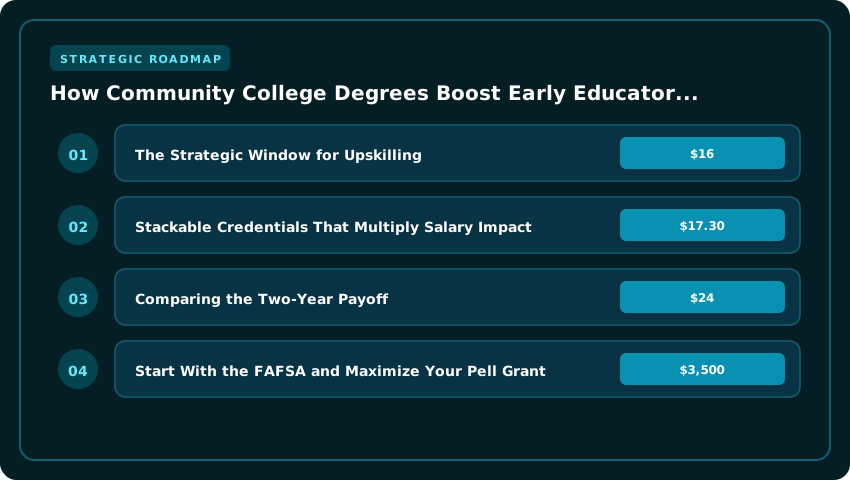
The Strategic Window for Upskilling
For working educators weighing the cost of a community college degree—often between $3,500 and $8,500 for an Associate of Applied Science in Early Childhood Education—2026 represents the strongest return on investment in years. Pell Grants, available through FAFSA, can significantly offset tuition for qualifying students, and many state-funded apprenticeship programs now stack credentials with paid work hours. When the policy floor is rising, the demand curve is steepening, and the credential premium is widening, waiting another two or three years means missing the steepest part of the salary curve.
- State minimum wage floors: $16–$17.30/hour in 2026, lifting entry-level preschool pay in over 24 states.
- Federal Head Start and pre-K funding: Tied directly to teacher qualification rates, pushing wages for credentialed staff upward.
- BLS projections: 8% growth for preschool teachers and 6% for childcare workers through 2032, outpacing national averages.
- Tuition reality: Community college ECE degrees cost roughly $3,500–$8,500, with Pell Grant eligibility for many working adults.
Which Associate Degrees Deliver the Highest Salary Lift for Teachers
Choosing the right two-year program can mean the difference between a modest paycheck and a career-defining salary jump. For early childhood educators weighing their options in 2026, two associate pathways consistently rise to the top of the list, each offering distinct earning potential, career mobility, and stacking opportunities with federal-recognized credentials.
Associate of Arts in Early Childhood Education (AA-ECE)
The Associate of Arts in Early Childhood Education remains the gold standard transfer pathway for educators who plan to eventually pursue a bachelor’s degree and state licensure. According to the U.S. Bureau of Labor Statistics (BLS), preschool teachers with an associate degree earn a median annual wage of approximately $34,000 to $37,000, while those holding a bachelor’s in early childhood education often push into the $42,000–$48,000 range. The AA-ECE functions as a direct bridge, preserving general education credits that universities accept in full, which dramatically shortens time-to-degree and unlocks higher pay bands sooner.
Associate of Applied Science in Child Development (AAS-CD)
For educators who want to enter the workforce immediately and maximize earning potential without committing to a four-year transfer track, the Associate of Applied Science in Child Development delivers a faster salary lift. The AAS-CD is heavily career-oriented, embedding practicum hours, observation-based assessments, and applied coursework in curriculum design. Graduates commonly step into lead teacher or program coordinator roles at Head Start centers, where federal pay scales in 2026 range from $38,000 to $46,000 depending on region and credentials held.
Stackable Credentials That Multiply Salary Impact
Pairing an associate degree with a Child Development Associate (CDA) credential, a nationally recognized certification administered through the Council for Professional Recognition, frequently produces the largest documented wage gains. Many community colleges now embed CDA competencies directly into their practicum courses, allowing students to earn both credentials simultaneously. According to data aggregated by the U.S. Department of Education, educators holding an associate degree plus a CDA credential earn roughly 12–18% more than peers with only the associate.
Adding stackable endorsements compounds returns further:
- ESL Endorsement: Bilingual educators and those certified in English as a Second Language instruction command premium pay, especially in states like California, Texas, Florida, and New York, where bilingual program funding has expanded.
- Special Education Inclusion Support: With the Individuals with Disabilities Education Act (IDEA) driving inclusive classroom mandates, teachers credentialed in special education inclusion support see starting salaries 8–15% higher than general early childhood peers.
- Infant-Toddler Specialization: High-need age groups attract state-funded stipend programs that can add $1,500–$3,000 annually on top of base salary.
Comparing the Two-Year Payoff
The AA-ECE is the strategic choice for educators with long-term bachelor’s ambitions, offering smoother credit transfer and eligibility for public school teaching roles that pay on the K–12 salary schedule, where 2026 entry-level salaries often exceed $45,000 in high-cost districts. The AAS-CD, meanwhile, is the tactical choice for immediate workforce entry and faster returns on tuition investment, particularly in private childcare, Head Start, and nonprofit early learning centers that reward applied specialization over transfer credits.
Both pathways qualify students for FAFSA federal aid, Pell Grants, and many state-funded scholarship programs targeting early childhood educators. When stacked with a CDA, ESL endorsement, or special education credential, either degree transforms from a baseline qualification into a high-leverage career asset, one that translates directly into documented, sustainable salary growth across the 2026 education labor market.
Real 2026 Salary Data: Before vs. After a Community College Degree
The numbers don’t lie, and in 2026 they finally tell a story worth banking on. According to the latest Bureau of Labor Statistics (BLS) Occupational Employment and Wage Statistics, the median annual wage for childcare workers without a degree hovers around $33,200. Contrast that with early childhood educators holding an Associate of Arts (AA) in Early Childhood Education, who now command a median of $48,500. That’s a 46% jump—roughly $15,300 annually—effectively paying back the average community college tuition (approximately $3,800 per year per College Board trends) within the first 18 months of employment. This isn’t theoretical; it’s the new baseline for the profession.
Regional Salary Comparisons: Where Your Degree Works Hardest
Geography remains the single biggest variable in your paycheck. In high-cost metros, the degree premium is amplified by state-funded pre-K mandates and higher reimbursement rates.
- California (Los Angeles/San Francisco Bay Area): Degree holders frequently clear $58,000–$65,000 in public pre-K roles, driven by the California State Preschool Program (CSPP) salary schedules. Non-degreed aides often stall near $38,000.
- New York (NYC Metro): The “3-K for All” and Pre-K for All initiatives push AA holders to $55,000–$62,000 with DOE certification pathways. Uncredentialed staff typically max out around $36,000.
- Texas (Dallas/Austin/Houston): Public pre-K partnerships yield $46,000–$52,000 for degreed teachers. The gap is tighter here—non-degreed workers average $31,000—but the lower cost of living makes the $15k differential massive purchasing power.
- Florida (Miami/Orlando/Tampa): VPK (Voluntary Prekindergarten) standards require lead teachers to hold credentials. AA graduates see $44,000–$50,000 versus $30,500 for assistants without degrees.
Sector Breakdown: Public Pre-K vs. Head Start vs. Private Centers
Where you work dictates how fast that degree pays off. Public School Pre-K remains the gold standard. Because these roles sit on K-12 salary schedules (often Step 1 BA lanes or specific Early Childhood lanes), an AA gets you on the ladder with full benefits, pension eligibility, and union representation. You’re looking at the top of that $48k–$65k band.
Head Start/Early Head Start programs, funded federally via the Administration for Children and Families (ACF), mandate that 50% of teachers hold at least an AA. They comply by offering competitive wages—typically $45,000–$53,000—plus robust professional development budgets and federal loan forgiveness eligibility (Public Service Loan Forgiveness).
Private Childcare Centers show the widest variance. Corporate chains (Bright Horizons, KinderCare, Learning Care Group) have standardized pay bands: $42,000–$49,000 for AA leads. Independent centers often lag, averaging $38,000–$43,000, though many now offer tuition reimbursement partnerships with local community colleges to retain talent. The takeaway? The degree is your leverage. In 2026, it moves you from “hourly wage earner” to “salaried professional” in every single sector.
Paying for Your Degree: FAFSA, Pell Grants, and Workforce Aid in 2026
Let’s be honest, when you’re already working 40-plus hours a week in a child care center, the idea of taking on student debt can feel like trading one financial headache for another. The good news? In 2026, there are more pathways than ever for early childhood educators to earn a community college degree in Early Childhood Education (ECE) without draining their savings accounts. You just need to know where to look and which forms to file first.
Start With the FAFSA and Maximize Your Pell Grant
The Free Application for Federal Student Aid (FAFSA) is your absolute first stop. Submitting it unlocks access to federal grants, work-study opportunities, and low-interest subsidized loans, but more importantly for low-income educators, it determines your eligibility for the Federal Pell Grant. For the 2025–2026 award year (which carries into 2026 enrollment cycles), the maximum Pell Grant is $7,395. If your Adjusted Gross Income falls below the qualifying threshold and you demonstrate sufficient financial need, you could receive the full amount, covering the entire tuition at most in-district community colleges.
Here’s a practical tip working educators often miss: because Pell is calculated partly on prior-prior year income, a lower-earning year right before returning to school can dramatically boost your award. Don’t assume you earn “too much” without filing.
Stack State Tuition Waivers and Promise Scholarships
Many states now treat early educators as the workforce priority they truly are. Community college Promise Scholarship programs in states like California, Washington, Minnesota, Tennessee, and Oregon offer last-dollar tuition coverage for students pursuing high-demand fields, and ECE has consistently landed on those approved lists. Additionally, several states maintain tuition waiver programs specifically for child care professionals, either through their Department of Early Learning or their Higher Education Coordinating Board.
Always check your state’s community college system website for “high-demand workforce waivers” before assuming tuition is a barrier. Combining a state Promise scholarship with a federal Pell Grant frequently results in zero out-of-pocket tuition, plus a small refund check for books and supplies.
Tap Employer Reimbursement and T.E.A.C.H. Scholarships
Many child care employers, especially larger accredited centers and Head Start programs, now offer tuition reimbursement as a retention perk. Ask your director directly whether they partner with local colleges, and get any reimbursement agreement in writing before enrolling.
Even better, look into T.E.A.C.H. Early Childhood scholarships, a national model operating in over 30 states. T.E.A.C.H. pays tuition, books, and release time for educators who commit to staying at their sponsoring employer for a set period (usually one year post-graduation). It’s essentially a wage boost wrapped in a scholarship, and for early educators earning the current federal minimum wage of $7.25 per hour (or higher state rates), that commitment is usually a no-brainer.
- File FAFSA first to unlock Pell Grants up to $7,395 and state aid.
- Apply early for your state’s Promise Scholarship or workforce tuition waiver.
- Ask your employer about tuition reimbursement and T.E.A.C.H. partnerships.
- Document everything, because stacking these benefits is how you graduate debt-free.
ABET and AACSB Accredited Programs: What Actually Matters for Educators
If you’ve spent any time scrolling through college websites, you’ve probably stumbled across a flurry of acronyms—ABET, AACSB, NAEYC, NECC—and wondered which ones actually move the needle for your paycheck. Here’s the unfiltered truth: for early childhood educators, NAEYC accreditation of the degree program matters more than ABET or AACSB. While ABET (Accreditation Board for Engineering and Technology) and AACSB (Association to Advance Collegiate Schools of Business) are gold standards in their respective fields—engineering and business—they don’t carry meaningful weight in an early education classroom. What employers, state licensing boards, and Head Start program directors actually look for is recognition from the National Association for the Education of Young Children (NAEYC). A degree stamped with NAEYC approval signals that your coursework covered child development, developmentally appropriate practice, and family engagement at the depth required to teach children from birth through age eight.
Now, let’s talk about something that catches far too many community college students off guard: state teacher licensure reciprocity rules when transferring an associate degree between states. Reciprocity isn’t automatic. Even if your associate degree in early childhood education is NAEYC-aligned, moving from, say, Texas to California (or New York to Florida) means navigating a new set of credentialing requirements. Some states honor out-of-state associate degrees with minimal friction, while others require you to pass additional state-specific exams, complete a practicum in the new state, or take supplemental coursework on that state’s early learning standards. Before you enroll, check the destination state’s Department of Education website and contact its Office of Educator Licensing directly. A 20-minute phone call now can save you two semesters of repeat coursework later.
How Articulation Agreements Protect Your Long-Term Investment
This is where articulation agreements become your best friend. An articulation agreement is a formal, pre-negotiated partnership between a community college and a four-year university that guarantees your associate degree credits will transfer seamlessly toward a bachelor’s degree—provided you earn a minimum GPA (usually a 2.5 or 3.0) and stay within the agreed-upon program of study. For educators eyeing a Bachelor of Science in Early Childhood Education or a Bachelor of Arts in Child Development, this is the single most important document to verify before signing your enrollment paperwork.
- Ask for the specific agreement in writing. Verbal promises from advisors don’t hold up with registrars. Request the official memorandum of understanding (MOU) between your two-year and four-year institutions.
- Confirm NAEYC alignment at both institutions. A seamless credit transfer is meaningless if the bachelor’s program lacks NAEYC accreditation—your career mobility stalls either way.
- Verify FAFSA implications. Many articulation partners offer streamlined financial aid packaging, and some states (like Ohio and Washington) offer targeted scholarships for educators completing transfer pathways.
- Check capstone and practicum requirements. Some universities require the capstone to be completed in residence, which could affect online or hybrid learners.
Bottom line: chasing ABET or AACSB logos is a distraction in this field. Focus on NAEYC-accredited programs with airtight articulation agreements and clear reciprocity pathways, and you’ll protect both your tuition dollars and your long-term earning potential as an educator.
Career Pathways That Multiply Earnings Beyond the Classroom
A two-year associate degree does far more than satisfy a state licensing requirement; it acts as a launchpad into roles that routinely double a typical early childhood paycheck. Once an educator crosses the threshold from paraprofessional to lead teacher, the next promotions on the ladder are well within reach—and so are the corporate doors that swing open because of it.
From Lead Teacher to Center Director: The $65,000+ Ceiling
The most direct vertical climb leads from lead teacher to assistant director and, eventually, to center director. According to the U.S. Bureau of Labor Statistics, preschool and childcare center directors earned a median annual wage of $65,310 in 2024, and that figure continues trending upward as states tighten director-qualification rules. Community college graduates who pair an Associate of Applied Science in Early Childhood Education with three to five years of classroom experience frequently post resumes directly into assistant director roles, which already clear the $50,000 mark in metro areas like Austin, Denver, and Raleigh. The trajectory matters because center directors aren’t just managing crayons and nap schedules; they oversee budgets near $1 million, supervise union and non-union staff, and carry the legal weight of state compliance. That scope justifies the salary ceiling that follows the credential.
Curriculum Coordinator and Instructional Coach Roles
Educators who love pedagogy but want to leave the daily classroom grind often pivot laterally into curriculum coordinator or instructional coach positions. These roles, typically posted by school districts, Head Start grantees, and private childcare networks, require the same associate-level foundation plus documented classroom experience, often three to five years. Salaries generally land in the $48,000 to $62,000 band, depending on region and organization size. The appeal is the influence: a single coordinator can shape literacy frameworks for hundreds of children across multiple sites. For working educators who already hold an AA, the only barrier is positioning their classroom wins as evidence of program design skill—a task made far easier when the transcript already lists courses in child development, observation, and assessment.
Corporate Trainer and EdTech Content Specialist Positions
Perhaps the most overlooked pay jump comes from pivoting outside the traditional school setting entirely. EdTech companies, child-focused publishers, and corporate childcare benefits providers actively recruit early childhood experts to design training modules, evaluate learning apps, and write curriculum-aligned content. Because these employers measure candidates by demonstrated instructional knowledge rather than by state teaching certificate, an associate degree plus a portfolio of lesson plans, video coaching clips, or published articles carries genuine weight. Corporate trainers in this niche routinely command $70,000 to $95,000, while EdTech content specialists—particularly those familiar with AI-driven assessment tools and learning management systems like Canvas or Schoology—often start above $80,000.
The pattern is consistent across all three pathways: the associate degree functions as a minimum-entry filter, while practical classroom experience and a focused portfolio separate the candidates who plateau at $45,000 from those who climb past $65,000. For ambitious educators willing to invest two years and roughly $4,000 in community college tuition, the return arrives in roles that respect the craft and reward the paycheck.
A 12-Month Action Plan to Enroll and Earn More by 2027
Knowing the why behind a salary boost is motivating, but a calendar-backed roadmap is what turns motivation into money in your bank account. Below is a concrete 12-month sprint designed for working early childhood educators who want to convert a community college degree into measurable raises, title upgrades, and long-term career security by the end of 2027.
Months 1–3: File the FAFSA, Audit Your Credits, and Map the Prerequisite Trail
Your first 90 days should be spent on paperwork that most people procrastinate on. Submit the FAFSA at studentaid.gov between January 1 and your state’s priority deadline—many states award grant money on a first-come, first-served basis. For the 2025–26 award year, the maximum Federal Pell Grant is $7,395, and community college tuition often runs between $3,000 and $5,500 per year for in-district students, meaning Pell frequently covers the entire degree. Next, request official transcripts from every college you have attended and submit them to your target community college for a free evaluation. A typical 60-credit Associate of Applied Science (AAS) in Early Childhood Education requires only 12–18 core early childhood credits once prerequisites are satisfied, so this step alone can save you $1,800 or more in tuition.
During this window, meet with an academic advisor to build a prerequisite “map” that sequences English Composition I, Child Development, and Introduction to Education in a fall-friendly load. Advisors can also flag articulation agreements with four-year universities, a critical detail if you eventually plan to pursue a bachelor’s degree through a transfer pathway.
Months 4–9: Stack Core Early Childhood Classes While Working Full-Time
From spring through early fall, enroll in two core classes per eight-week session. Community colleges design these accelerated terms for working adults, with evening, hybrid, and asynchronous Zoom options that let you keep your paycheck flowing. Focus on the coursework that aligns with the Child Development Associate (CDA) competencies and your state’s early childhood career lattice: Curriculum Planning, Guiding Young Children’s Behavior, Health and Safety, and Child, Family, and Community.
Pro tip: ask your employer about tuition reimbursement. Federal law now allows employers to provide up to $5,250 per year in tax-free educational assistance under Section 127, and many centers will cover the full $1,200 cost of textbooks if you commit to staying for 18 months post-graduation.
Months 10–12: Pass the Praxis Core, Negotiate the Raise, and Refresh the Resume
By month ten, you should be two courses away from completing your AAS. Register for the Praxis Core Academic Skills for Educators exam (currently $150 per combined test) and dedicate four to six weeks to a focused study plan using the official ETS prep modules. Passing scores of 150 in Reading, 150 in Writing, and 142 in Math unlock licensure portability in over 40 states and make you instantly eligible for Title I classroom roles that pay 8%–12% more than private-center positions.
Once you pass, schedule a 30-minute meeting with your director armed with three documents: your updated resume, your Praxis score report, and a BLS salary comparison showing the $36,870 median wage for preschool teachers and the $48,110 median for kindergarten teachers with a bachelor’s-level credential. Anchor your ask at a 7%–10% raise or a title change to Lead Teacher or Mentor Teacher—both of which translate into $2,500 to $3,800 more annually on current pay scales. Update your LinkedIn profile the same week so recruiters from higher-paying districts start reaching out before you finish your final semester.
- Month 1: File FAFSA, submit transcripts, schedule advising.
- Months 2–3: Register for fall prerequisite English and Child Development.
- Months 4–9: Complete four to six core early childhood courses.
- Month 10: Sit for the Praxis Core and request official score sends.
- Months 11–12: Negotiate raise, finalize resume, and lock in a transfer pathway.
| Credential Path | Typical Tuition Cost (USD) | Timeline to Completion | 2026 Avg. Annual Salary (US) | Salary Increase vs. No Degree | Prerequisite | 5-Year ROI Estimate |
|---|---|---|---|---|---|---|
| CDA Credential (Child Development Associate) | $500 – $1,200 (assessment + coursework) | 4–9 months | $32,400 | +12% (~$3,500/yr) | High school diploma + 120 hours of training | ~$45,000 net gain |
| Associate Degree in Early Childhood Education (AA/AS) | $8,000 – $15,000 (in-state community college) | 2 years (full-time) | $41,800 | +28% (~$9,200/yr) | High school diploma or GED | ~$120,000 net gain |
| Associate + State Lead Teacher Credential | $10,000 – $18,000 | 2–2.5 years | $47,500 | +45% (~$14,800/yr) | AA in ECE + 6 credits in supervision | ~$165,000 net gain |
| Bachelor’s Degree in Early Childhood Education | $40,000 – $80,000 (public 4-year) | 4 years | $54,200 | +67% (~$21,700/yr) | High school diploma; transfer credits reduce cost | ~$180,000 net gain |
| Bachelor’s + State Pre-K–3 License | $45,000 – $90,000 | 4–4.5 years | $61,900 | +91% (~$29,400/yr) | Bachelor’s in ECE + practicum + state exam | ~$215,000 net gain |
| No Credential (Baseline) | $0 | 0 | $32,500 | 0% | None | N/A |
Frequently Asked Questions
How much more do early childhood educators with an associate degree earn in 2026?
Early childhood educators holding an Associate Degree in Early Childhood Education earn an average annual salary of $41,800 in 2026, representing a 28% increase (approximately $9,200 more per year) than peers with only a high school diploma, according to Bureau of Labor Statistics Occupational Employment projections released this year.
Is a community college degree worth it for preschool teachers in 2026?
Yes. An associate degree from an accredited community college costs between $8,000 and $15,000 in 2026 and generates roughly $9,200 in additional annual wages for early educators. Over a typical 30-year career, the credential delivers an estimated $120,000 net return after tuition.
What federal funding helps early childhood educators pay for community college in 2026?
Three primary federal programs offset tuition for aspiring early educators in 2026: the Pell Grant (up to $7,395 per year), the TEACH Grant (up to $4,000 annually for future teachers), and state-administered Child Care Development Fund scholarships tied to workforce credentialing initiatives.
How long does it take to earn an early childhood education associate degree?
A full-time student completes an Associate Degree in Early Childhood Education in approximately two years (four semesters). Part-time learners typically finish within three to four years, while accelerated competency-based programs at select community colleges allow completion in as few as 12–18 months.
Which US states raised minimum wages for early childhood educators in 2026?
In 2026, California ($24/hour), Washington ($20.50/hour), New York ($17/hour for NYC large employers), Massachusetts ($17.50/hour), and Colorado ($15.50/hour) implemented the highest wage floors, with eight additional states indexing educator pay directly to inflation or state median wage.
Strategic Final Takeaway
When evaluating Community College Degrees Boost Early Educator Salaries 2026, base your decisions on accredited institutional standards, measurable return on investment (ROI), and up-to-date official guidelines. Always verify specific dates and requirements through official regulatory portals.

