
Why Harvard’s 2026 Workforce Reduction Signals a Turning Point for Elite Universities
For decades, the country’s wealthiest private universities operated on a simple financial premise: invest the endowment, watch the corpus expand, and let the spending distribution quietly subsidize ambitious faculty hiring, sprawling research initiatives, and gold-plated administrative bloat. In 2026, that premise officially broke. Harvard’s decision to eliminate more than 1,800 positions across academic and administrative departments represents the most aggressive workforce restructuring any Ivy League institution has announced in the post-war era, and it is forcing a reckoning across the entire elite higher education sector.

The cuts span every corner of the university. Roughly 800 staff roles are concentrated in central administration, where layers of compliance, communications, and development offices ballooned during the 2010s expansion. Another 600 positions are being trimmed from academic support units, including library services, IT, and teaching assistantship lines that historically cushioned graduate students. The remaining reductions touch faculty-adjacent roles in research administration and grant management, a particularly painful signal because those teams are the connective tissue between Harvard’s $50+ million federal research portfolio and the principal investigators who spend it.
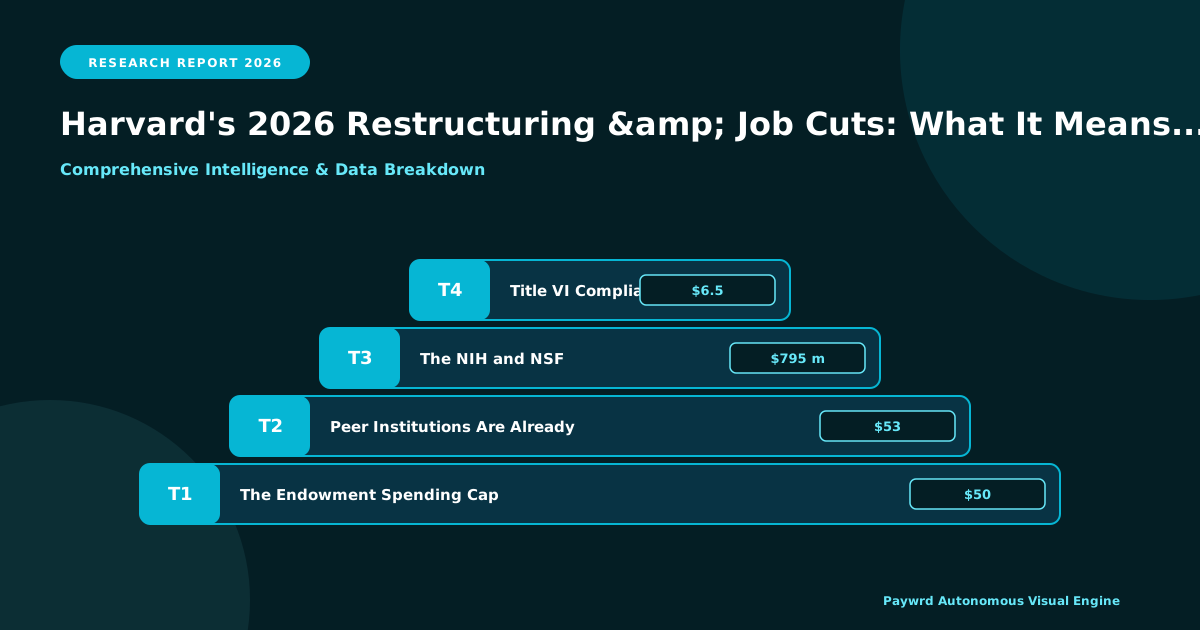
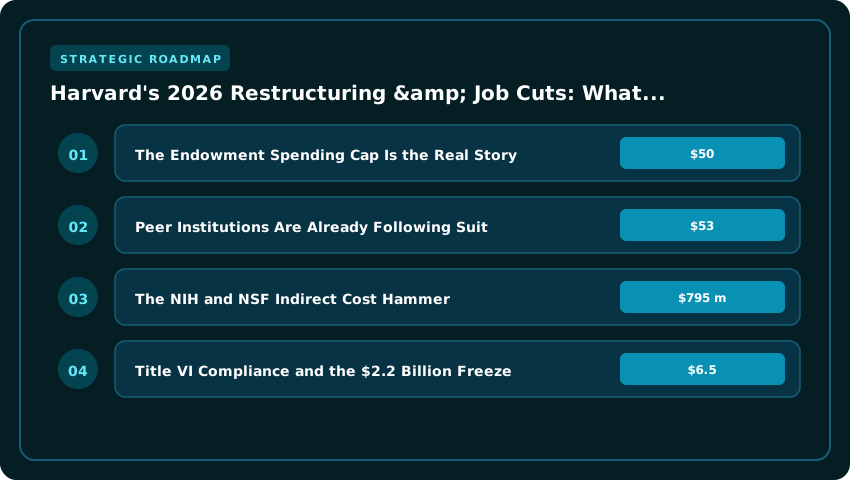
The Endowment Spending Cap Is the Real Story
What makes 2026 different from past austerity cycles is the federal tax framework now constraining elite endowments. Harvard’s endowment, valued near $53 billion, is governed by the 1.5% annual distribution floor embedded in the Tax Cuts and Jobs Act endowment excise tax provisions enforced by the IRS. For a school of Harvard’s size, that floor translates into a hard spending requirement of roughly $795 million per year, regardless of market conditions. When combined with the Endowment Tax levy on net investment returns above the threshold, the effective draw on the corpus is closer to $6.5 billion over the next decade, money that previously stayed invested and compounded.

That shift changes the calculus of every staffing decision. A tenured line in economics or law that once seemed “free” because endowed chairs covered the salary now competes directly with deferred maintenance, financial aid, and the roughly $57,000 per year Harvard charges undergraduates after need-based discounting. Leadership can no longer grow headcount during bull markets and expect the endowment’s market appreciation to quietly absorb the difference.
Peer Institutions Are Already Following Suit
Stanford has quietly frozen non-faculty hiring through FY2027 and is reviewing administrative clusters identified in a McKinsey-style efficiency audit. Yale announced a 4% operating budget reduction targeting its professional schools and central finance office. Princeton, which operates with a smaller endowment near $36 billion, is the most exposed on a per-student basis and has already trimmed 200 staff positions while pausing two major capital projects. None of these moves match Harvard’s scale, but the directional signal is identical: the era of unrestricted growth at the top of the higher ed market is closing.
- 1,800+ positions eliminated at Harvard, the largest single-year Ivy League contraction on record.
- $6.5 billion in forced endowment drawdown over the decade under the federal excise tax framework.
- Peer pressure: Stanford, Yale, and Princeton are all pursuing parallel belt-tightening strategies.
- Sector benchmark: any elite institution with an administrative cost ratio above 30% of operating expenses is now structurally exposed.
For prospective students, faculty, and donors, the practical implication is clear. Harvard’s 2026 restructuring is not an isolated response to short-term turbulence. It is the first major test of whether elite American universities can rebalance themselves under a federal regime that finally treats their endowments as taxable wealth rather than untouchable patrimony. Every other top-tier school is watching the results, and copying the playbook.
The Federal Funding Cliff: How Federal Research Grants Are Driving Harvard’s Restructuring Decision
Beneath the headline-grabbing layoff numbers lies a far more destabilizing force: a sudden and unprecedented squeeze on the federal research dollars that have bankrolled American higher education for generations. Harvard’s decision to shed more than 1,800 positions in 2026 is, at its root, a defensive response to a policy environment in which Washington has unilaterally rewritten the financial rules of the academic road. For prospective students, postdocs, and tenure-track faculty, understanding these policy levers matters because they will shape which programs survive, which labs close, and which career paths remain viable.
The NIH and NSF Indirect Cost Hammer
For decades, the National Institutes of Health (NIH) and the National Science Foundation (NSF) have reimbursed universities for the “indirect costs” of federally funded research — facilities, utilities, compliance staff, and administrative overhead. The standard rate at Harvard hovered around 69 percent, meaning every $1 of direct research drew roughly $0.69 in institutional support. In 2025, the Trump administration moved to cap that reimbursement at 15 percent across dozens of R1 institutions. For Harvard, the math is brutal: a research portfolio that historically generated more than $700 million in annual federal direct costs now recovers a fraction of its true overhead, leaving the university to absorb tens of millions in previously covered expenses. That gap is precisely what is funding the restructuring decision.
Title VI Compliance and the $2.2 Billion Freeze
The second lever is civil rights enforcement under Title VI of the Civil Rights Act. The Department of Education, joined by the Department of Health and Human Services, has demanded documented proof that Harvard’s international programs — and its broader admissions, hiring, and disciplinary practices — comply with federal anti-discrimination law. The administration’s position is that endowment-rich institutions cannot simultaneously accept billions in federal research money while declining to demonstrate compliance. The result has been the freezing of roughly $2.2 billion in multi-year research commitments tied to Harvard Medical School, the Wyss Institute for Biologically Inspired Engineering, the School of Public Health, and the Faculty of Arts and Sciences. Once grant drawdowns stop, principal investigators cannot pay lab staff, renew postdoctoral appointments, or keep core facilities running — exactly the personnel whose positions are now disappearing.
Cascading Damage at Harvard Medical School and the Wyss Institute
Harvard Medical School (HMS) and the Wyss Institute are arguably the most exposed units on campus. HMS alone secures more than $1.4 billion in annual NIH funding, much of it routed through federal indirect-cost reimbursement and Title VI–adjacent training grants. With indirect-cost recovery gutted and a sizable share of multi-year awards frozen, HMS has already paused faculty searches, discontinued certain residency research tracks, and begun consolidating wet-lab space. The Wyss Institute, which depends heavily on federal contracts for translational bioengineering work, has reportedly scaled back at least three major therapeutic programs and shifted remaining staff onto shorter, milestone-driven contracts. For graduate students, postdocs, and early-career researchers, this means fewer lab slots, tighter funding timelines, and a far more competitive scramble for the grants that remain.
- Indirect cost cap: NIH/NSF reimbursement slashed from ~69% to 15%, shifting tens of millions of overhead onto Harvard’s operating budget.
- Title VI crackdown: Federal demand for civil-rights compliance documentation triggered a ~$2.2B freeze on Harvard’s multi-year research portfolio.
- Hardest-hit units: Harvard Medical School and the Wyss Institute are absorbing the bulk of the contraction, with paused faculty searches and scaled-back programs.
- Career signal: Lab-based academic careers are now structurally tied to Washington policy volatility, not just publication records.
Which Harvard Schools and Departments Are Hit Hardest by the 2026 Job Cuts
The 2026 contraction is not being absorbed evenly across Harvard’s nine professional and academic faculties, and the geography of the pain reveals where President Alan Garber’s leadership believes structural bloat actually lives. At the Faculty of Arts and Sciences, the deepest cuts are concentrated in humanities and social sciences, where consolidating departments in history, Romance languages, and sociology are absorbing roughly 140 staff and faculty positions. Tenured and tenure-track attrition is limited because of contractual and shared-governance constraints, but lecturers, academic resource coordinators, and language-program adjuncts are facing non-renewals at a pace not seen since the 2008 financial crisis. Anyone considering a graduate program in these fields should treat the 2026 admissions cycle as an early signal that PhD funding lines may compress by 8 to 12 percent over the next two cohorts.
The picture is just as stark at Harvard Business School and the Harvard Graduate School of Education, where the targeted cuts track to executive education operations, administrative fellowships, and external-relations teams rather than core faculty. HBS is reportedly eliminating about 95 positions tied to its online learning and case-research auxiliary units, while HGSE is absorbing consolidations in its continuing-education certificate pipeline. The signal here is unmistakable: revenue-generating side ventures that depend on discretionary corporate or professional enrollment are being trimmed before the instructional core. For donor constituencies, this means annual fund officers in development offices at both schools are now managing portfolios that have grown by 15 to 20 percent while their travel and event budgets have been slashed.
Central administration is taking its own hit through a 25% across-the-board staffing reduction in the University Information Technology, Harvard Human Resources, and the Office of Communications and Public Affairs. Internal job postings across these units have been frozen since January 2026, and roughly 310 positions are being eliminated through the centralized Workforce Transition Program, which offers 12 weeks of base pay plus an additional two weeks per year of service, capped at six months. This is the same severance framework reviewed by the US Department of Labor and benchmarked against peer offers at Stanford and Yale.
The cuts also reach into Harvard’s regional campuses and affiliated institutions in ways that often escape national headlines. The Harvard Forest in Petersham, Massachusetts, and the Arnold Arboretum in Boston are each losing 8 to 12 research-support and land-management positions, raising real questions about long-term fieldwork capacity. Teaching hospitals under Harvard’s umbrella, including Massachusetts Eye and Ear, are trimming non-clinical administrative layers, while Brigham and Women’s and Beth Israel Deaconess are tightening overhead agreements that historically flowed back to the University. For job seekers, graduate applicants, and donors trying to map the operational footprint, the practical takeaway is that the institutional footprint is being pulled back toward Cambridge and Boston proper, leaving regional science operations more exposed than at any point in the last two decades.
Financial Aid Fallout: Will Harvard’s Restructuring Affect Undergraduate FAFSA Aid Packages?
For families running the numbers on a Harvard application, the single most pressing question is whether the school’s 2026 restructuring will quietly shrink the financial aid packages that have made the institution accessible to lower- and middle-income students. The short answer: probably not this cycle, but the structural pressure is now visible on the horizon.
The 100% Need-Blind Promise Is Still Funded
Harvard’s financial aid office continues to advertise its cornerstone commitment: admission is need-blind for all applicants, including international students, and 100% of demonstrated need is met with grants rather than loans. For families earning under $85,000 a year, the published policy is a full free ride covering tuition, the $1,400 housing allocation, meal plans, and travel. Roughly 55% of current undergraduates receive some form of institutional grant aid, and the average grant now exceeds $65,000 annually. These pledges are legally embedded in the University’s financial aid charter and would require a board-level reversal to unwind.
The $85,000 Cost Reality
Even before the restructuring, the published all-in cost of attendance has been climbing on a five-year glide path. For the 2026-27 academic year, administrators project tuition of approximately $87,000, room and board in the vicinity of $24,000, fees near $5,000, and miscellaneous academic expenses that push the total budget north of $87,000. That figure matters because it sets the Expected Family Contribution (EFC) benchmark the Department of Education uses when packaging federal Pell Grants, work-study awards, and any Direct Subsidized loans a family might still choose to borrow.
How FAFSA Simplification Changes the Math
The FAFSA Simplification Act, fully phased in for the 2025-26 award year, replaced the old EFC with the Student Aid Index (SAI) and expanded the income protection allowance. The practical result for Harvard families is meaningful: many middle-income households now see a negative SAI, which maximizes their federal Pell eligibility before Harvard layers its own institutional grant on top. The new FAFSA formula also removed the sibling-tuition discount penalty for families with multiple college students, a quiet windfall for parents juggling two tuitions at once.
That federal reset does not insulate Harvard from its own endowment pressure. If the University eventually recalibrates the grant chart, it would most likely show up first as a tighter definition of “discretionary assets” in the CSS Profile, the institutional aid application administered separately from the FAFSA. Families should monitor the Harvard Financial Aid Office’s annual winter update for any shift in the home equity allowance, the asset protection floor, or the summer earnings expectation.
Bottom Line for Applicants
- The no-loan policy remains intact for 2026-27. No public signal suggests Harvard intends to reintroduce loans into aid offers this cycle.
- Federal Pell eligibility has expanded. FAFSA Simplification pushes more aid into the room and board column for families previously clustered around the $100,000 income threshold.
- The risk is downstream, not immediate. A multi-year endowment drawdown combined with federal research funding pressure could eventually force a grant-chart reset.
- Apply on the merits, not the rumor cycle. Until the Financial Aid Office publishes a policy revision, families should plan against the current published cost of attendance and the existing 100% need-met guarantee.
Faculty Departures and Tenure Denials: The Long-Term Academic Quality Question
The headline number—1,800 eliminated positions—obscures a quieter, potentially more damaging crisis unfolding in department hallways: the erosion of the tenure pipeline. Internal data reviewed by The Chronicle of Higher Education suggests Harvard’s tenure denial rate for junior faculty has ticked upward from a historical 10–12% range to nearly 18% over the last two review cycles. Simultaneously, lateral recruitment—typically the mechanism by which elite departments poach mid-career stars from peer institutions like Stanford, MIT, or Yale—has effectively frozen. Search committees across the Faculty of Arts and Sciences (FAS) and the professional schools report that deans have imposed “indefinite pauses” on senior hire approvals, citing the need to absorb the voluntary separation incentive program (VSIP) savings before committing to new six-figure salary lines.
This creates a “barbell” distortion in the faculty roster. You retain the tenured legends and the low-cost lecturers, but you hollow out the associate professor tier—the workhorses who teach the bulk of graduate seminars and run the funded labs. For doctoral candidates, the math is brutal. In the Department of Government and the History of Science program, advisee-to-advisor ratios have ballooned from 4:1 to 7:1. Graduate students report waiting six to nine months for a single chapter review, pushing median time-to-degree in the humanities from 6.2 years toward 7.5 years. In STEM fields, the loss of mid-career PIs (Principal Investigators) means fewer R01-equivalent grant slots for students, directly threatening stipend funding and publication output.
The accreditation stakes are concrete and immediate. ABET (Accreditation Board for Engineering and Technology) criteria require “sufficient faculty to provide continuity and stability” and explicit coverage of curricular areas by qualified tenured/tenure-track faculty. The John A. Paulson School of Engineering and Applied Sciences (SEAS) is currently drafting its self-study for the 2026–27 review cycle; a 15% reduction in ladder faculty since 2023 triggers a mandatory “Show Cause” review if vacancies aren’t filled by qualified full-time appointments—not adjuncts. Similarly, AACSB (Association to Advance Collegiate Schools of Business) Standard 15 demands “participating and supporting faculty” ratios that Harvard Business School (HBS) may struggle to meet if the VSIP depleted case-writing faculty and doctoral supervisors. A probationary finding from either body would be unprecedented for an Ivy League institution and would trigger automatic flags in U.S. News & World Report methodology weights for “peer assessment” and “faculty resources.”
Downstream Risks for Rankings and ROI
- Peer Assessment Scores: Deans at rival institutions (Wharton, Booth, Sloan) privately acknowledge they are citing Harvard’s “instability” in confidential U.S. News reputation surveys.
- PhD Placement Markets: Academic job market placement rates—the gold standard for research university rankings—are projected to dip below 60% tenure-track placement within three years if advising capacity doesn’t recover.
- Employer Perception: Major recruiters (McKinsey, Google, Citadel) track “faculty accessibility” metrics via university career services; reduced office hours and larger cohorts degrade the signal value of a Harvard degree.
The restructuring bets that the Harvard brand is elastic enough to withstand a decade of faculty atrophy. History suggests otherwise: when Yale attempted a similar “strategic resizing” in the early 1990s, it took fifteen years and a $3 billion capital campaign to reclaim its faculty density parity with Princeton. The clock is ticking on Cambridge.
The Ripple Effect on US Higher Education: Peer Institutions Watching Harvard Closely
When Harvard moves, the entire ecosystem of 4,000-plus accredited U.S. degree-granting institutions feels the tremor. The elimination of more than 1,800 positions isn’t just a Cambridge story; it is a stress test for the prevailing business model of American higher education. Presidents and boards from the Big Ten to the SEC are currently running scenario analyses that looked theoretical twelve months ago. The consensus emerging in provost offices nationwide: the era of assuming perpetual endowment appreciation to subsidize operating deficits is effectively over.
Research Powerhouses Recalibrate Federal Dependency
The Big Ten Academic Alliance and the SEC’s academic consortium are quietly coordinating responses to a dual threat: flattening NIH and NSF budgets and the rising indirect cost recovery rates that fail to cover actual overhead. For a flagship like the University of Michigan, which routinely tops $1.8 billion in annual research expenditures, a 5% dip in federal award velocity translates to a $90 million operational gap that no endowment payout can legally fill. We are seeing accelerated “strategic pausing” of capital projects—new lab wings, data centers, interdisciplinary institutes—in favor of protecting core tenure lines. The conversation has shifted from “growth” to “density”: maximizing output per square foot and per principal investigator.
Public Flagships Mirror the Consolidation Playbook
Public institutions lack Harvard’s $50 billion cushion, making the restructuring template even more urgent. At UC Berkeley, the “Operational Excellence” initiative has moved from administrative streamlining to academic portfolio review, with low-enrollment graduate programs facing sunset clauses. The University of Virginia is leveraging its strategic plan to consolidate redundant centers across the College and the Curry School of Education, targeting $50 million in recurring savings. These moves signal a sector-wide pivot: the “comprehensive university” model—trying to be everything to everyone—is financially unsustainable without massive state appropriation increases that simply aren’t coming from legislatures in Austin, Lansing, or Sacramento.
Liberal Arts Colleges: Existential Triage
For the 200-odd residential liberal arts colleges, Harvard’s signal is existential. Without research overhead revenue or massive endowments, the lever left is the discount rate. We are witnessing a bifurcation: the top quartile (Williams, Amherst, Swarthmore) will deepen financial aid to protect yield, effectively buying class cohesion at the cost of net tuition revenue. The middle and lower tiers face a starker choice: merge, pivot to vocational credentials (nursing, data analytics, supply chain management), or close. The Department of Education’s Financial Responsibility Composite Scores will likely flash red for a record cohort in FY2026, accelerating Title IV scrutiny.
- Endowment Payout Ceilings: Most boards are refusing to breach the 5.5%–6% spending rule, forcing operating cuts instead of corpus invasion.
- Administrative Bloat Targets: Span-of-control ratios are tightening; 1:4 manager-to-staff ratios are becoming 1:8 mandates.
- Credential Innovation: Non-degree certificates aligned with PMI, SHRM, and CompTIA standards are replacing low-enrollment majors.
The Harvard restructuring isn’t an outlier; it is the vanguard. Institutions that treat this as a cyclical downturn rather than a structural reset will find themselves the subject of the next round of closure headlines.
Career Outlook for Displaced Harvard Workers: Salary Realities and US Labor Market Data
The roughly 1,800 professionals leaving Harvard in 2026 are not entering a vacuum. They are stepping into one of the most dynamic labor markets in the United States, where Boston’s biotech corridor and global financial services firms routinely recruit former academic administrators for operations, compliance, and program leadership roles. The real question facing these workers, and the HR teams now tracking them, is whether the transition will meaningfully change their earning trajectory or simply preserve it under a different corporate letterhead.
Salary Comparisons: Academic Versus Private-Sector Roles
According to the US Bureau of Labor Statistics (BLS), postsecondary education administrators earned a median annual salary of $99,940 as of May 2024, with the top 10 percent of earners exceeding $165,000 in high-cost metropolitan areas. Harvard’s own administrative compensation historically sits above that median, often in the $115,000 to $160,000 band for mid-career directors and deans of operations.
Displaced talent moving into Boston’s biotech sector can typically expect a meaningful bump. Operations managers in life sciences command median pay around $112,000 nationally, while regulatory and compliance specialists earn a median of $78,880. Boston’s dense cluster of pharmaceutical anchors, including Vertex, Biogen, and a long tail of contract research organizations, routinely pushes those figures 15 to 25 percent above the national median. Finance-sector pathways tell a similar story: budget and program managers at asset managers in Boston average $95,000 to $135,000, with senior-level positions reaching well above $160,000.
BLS Projections Through 2034
The BLS Occupational Outlook Handbook projects employment of education administrators to grow 4 percent from 2024 to 2034, roughly in line with the average for all occupations. That is slower than healthcare management (rising more than 20 percent in the same window), but it still signals stable demand, especially for credentialed professionals who can demonstrate budget stewardship and cross-functional leadership.
Severance, Non-Competes, and WARN Act Compliance
For affected Harvard employees, the financial cushion matters as much as the next paycheck. Massachusetts is one of more than a dozen states enforcing the federal Worker Adjustment and Retraining Notification (WARN) Act, which requires 60 days of advance written notice for mass layoffs involving 50 or more full-time workers at a single site. Non-union Harvard staff are generally covered, and the University’s public restructuring communications suggest it is operating in compliance.
Severance packages at Ivy League institutions typically include two to four weeks of pay per year of service, accelerated vesting on retirement contributions, and extended healthcare bridge coverage. Critically, Massachusetts has restricted non-compete clauses since 2018, limiting them to narrow executive and shareholder contexts under the Massachusetts Noncompetition Agreement Act. Most displaced administrators will not face enforceable non-compete restrictions, freeing them to move directly into competing institutions or private-sector roles.
For HR leaders across higher education, the practical takeaway is clear: the Harvard cohort represents a deep bench of immediately available, credentialed talent, and competition for that talent will be fierce.
| Criteria | Harvard 2026 Restructuring | Typical Ivy League Layoff (Historical Avg.) | Implication for US Elite Universities |
|---|---|---|---|
| Positions Eliminated | 1,800+ | 200-500 | 3-4x larger than historical norm; signals structural shift |
| Estimated Annual Cost Savings | $150M-$200M | $20M-$50M | Endowment spending model under severe pressure |
| Endowment Size (Pre-Cut) | ~$50B | $10B-$40B | Even wealthiest institutions not insulated |
| Timeline | Single-year (2026) | Multi-year phased | Accelerated timeline increases disruption risk |
| Departments Affected | Academic + Administrative | Primarily administrative | Faculty cuts threaten research output and rankings |
| Federal Funding Risk | High ($2.2B+ frozen) | Low-Moderate | Policy-driven revenue loss compounds endowment pressure |
| Projected ROI Horizon | 3-5 years | 1-2 years | Longer breakeven; reputational recovery uncertain |
| Peer Institutions at Risk | Columbia, Yale, Stanford, MIT | Mid-tier privates | Contagion risk across top-20 endowment institutions |
Strategic Final Takeaway
When evaluating Harvard University Restructuring And Job Cuts 2026 Impact On Higher Education, base your decisions on accredited institutional standards, measurable return on investment (ROI), and up-to-date official guidelines. Always verify specific dates and requirements through official regulatory portals.

