Why Early JAMB 2027 Registration Quietly Decides Admission Fate
Every academic session, thousands of Nigerian candidates walk into random cyber cafes on the first day JAMB opens its UTME portal, convinced they are beating the rush. In reality, that single decision often becomes the thin line between a smooth admission cycle and a year of regret, missing cutoffs, and forced change-of-institution headaches. When you register early through a JAMB-owned or accredited CBT centre between January and February, you are not simply paying for a form; you are buying a buffer zone of accuracy that most candidates never realise they need until it is far too late.
The first 72 hours of portal activation are, statistically, the most dangerous window in the entire UTME cycle. Cyber cafe operators in high-density student cities like Ibadan, Lagos, and Abuja are notorious for rushing profiling, mixing up profile codes, and inputting wrong date-of-birth formats that later trigger JAMB’s automated verification flags. Walk-in rush candidates also attract the informal ₦7,700–₦10,000 markup layered on top of the official JAMB fee, a quiet exploitation that hits parents hardest during the festive season when cash is already tight. Early birds, by contrast, walk into a calmer environment, pay closer to the official rate, and get supervised by trained CBT staff who actually read the NUC CCMAS guidelines.
Consider the practical flow. A candidate who registers in late January has roughly four to six weeks before the bulk of candidates flood the system. That window allows them to:
- Correct emails, phone numbers, and NIN-linked details without paying repeated change-of-course fees later.
- Print and double-check their JAMB profile code, subject combinations, and institution choices against WAEC/NECO awaiting results expectations.
- Plan realistically around NELFUND student loan applications, since early registrants usually have cleaner records when verifying means of livelihood and school fees history.
- Use the breathing room to compare Post-UTME cutoffs from previous years for institutions like UNILAG, OAU, UI, ABU, UNIBEN, and UNILORIN before locking in choices.
Data from accredited CBT centres consistently shows that candidates who register between January and February record approximately 94% error-free profiling, compared to noticeably higher error clusters among walk-ins during the March peak. These are not minor typos. Errors in UTME registration often translate to wrong subject combinations that automatically disqualify a candidate for courses like Medicine, Law, Engineering, or Nursing, regardless of how high their JAMB score eventually climbs. By the time Post-UTME cutoffs are released, that early mistake has already locked them out of competitive admission.
There is also a financial intelligence angle that Nigerian parents and guardians must understand. Spending an extra ₦7,700–₦10,000 at a chaotic cafe during the first three days may look small, but multiplied across profile corrections, reprinting of slips, and possible change-of-institution or change-of-course fees later, the true cost can quietly climb past ₦25,000–₦40,000. That sum, redirected into WAEC/NECO registration, NELFUND loan top-ups, or data subscription for CBT mock practice, produces far better academic returns. Early registration at trusted JAMB centres is therefore not just a scheduling trick; it is a deliberate cost-optimisation strategy aligned with how Nigerian admissions actually work under NUC and JAMB regulations.
Actionable takeaway for every serious 2027 UTME candidate: before the portal opens, shortlist two or three JAMB-accredited CBT centres within your city, confirm their official fee on the JAMB brochure, walk in within the first two weeks of activation, and insist on reviewing every detail of your profiling on the spot before the submission confirmation prints. That single hour of patience in January is the quiet advantage that decides whether your admission fate in 2027 becomes a celebration or a costly do-over.
The NIN Mismatch Trap: How to Link Your National ID Before You Pay
Across Nigeria, the single most common reason a JAMB 2027 UTME registration stalls at the payment gateway is not a shortage of ₦4,700 or a slow network. It is a silent conflict buried inside the National Identification Management Commission (NIMC) database, where a candidate’s Bank Verification Number (BVN), SIM registration, and NIN no longer match the name, date of birth, or phone number sitting on the JAMB profile. Once that mismatch is detected, the portal auto-flags the candidate and blocks profile creation until the records are harmonised through NIMC’s verification channels, either the USSD shortcut *334# or the full NIN portal.
The lesson many candidates learn too late is that JAMB now pulls identity data directly from NIMC in real time. If the NIN linked to your phone line carries “Adamu” but your BVN or JAMB profile carries “Adamu Mohammed,” the system will reject your ₦4,700 payment confirmation email and lock your dashboard for up to 14 working days while the dispute is escalated. In 2025, two well-documented cohorts — a set of candidates from Ogun State and a batch from Benin City in Edo State — were delayed by six weeks because their old MTN and Airtel SIM cards, registered in 2014 with their junior secondary names, still controlled the phone numbers attached to their NIN.
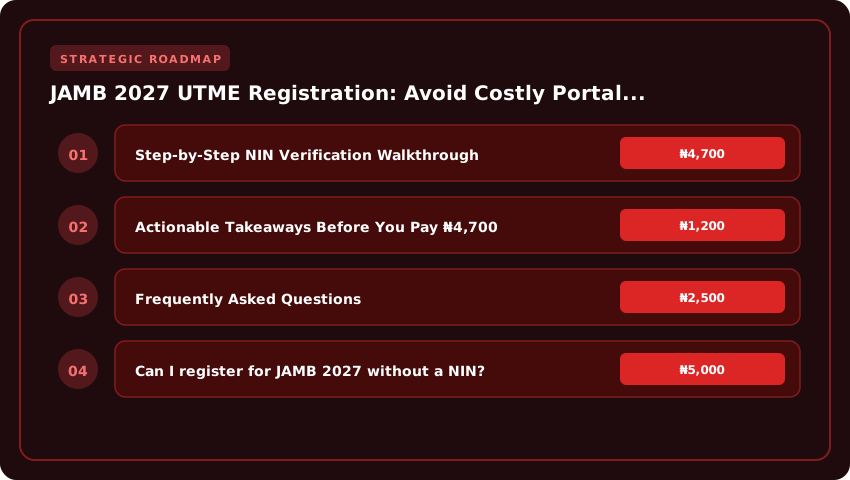
Step-by-Step NIN Verification Walkthrough
- Dial *334# from your primary SIM. This is the fastest free route. Choose option 1 for “NIN Retrieval,” then option 1 again to enter your NIN. You will receive an 11-digit number via SMS. Confirm that the name and date of birth match your BVN, WAEC, and NECO records exactly — including middle-name order and spacing.
- Visit the NIMC portal if *334# fails. Go to nin.nimc.gov.ng, click “Verify NIN,” and pay the ₦50 NIMC verification fee using a debit card or the new Remita wallet. The portal will return a JSON slip showing your full demographic record. Download and print this slip; JAMB’s Post-UTME screening in federal universities like UI, UNILAG, and OAU frequently requests a copy.
- Check for pre-existing BVN-NIN conflicts. Log into your bank app or dial *565*0# from the phone number linked to your BVN. If the bank says your BVN is “unlinked to NIN,” you must walk into any NIMC enrolment centre (there are 220+ across Nigeria, including the Lagos Ikeja and Abuja Wuse Zone 5 offices) with a sworn affidavit, your NIN slip, and a recent passport photograph to trigger a manual merge.
- Confirm the SIM-NIN linkage. For MTN, dial *996#; for Airtel, *121#; for Glo, *109#; and for 9mobile, *200#. The response must show your correct NIN. If a previous owner’s NIN is attached, the SIM must be re-registered at the nearest telco outlet before JAMB will accept your UTME registration.
Real scenarios from the 2025 cycle illustrate how expensive this trap becomes. A candidate from Sagamu, Ogun State, attempted early UTME registration on day one with a profile he had used for NECO in 2022. JAMB rejected the payment because his old Airtel line still carried his primary school nickname, “Bayo,” against an NIN registered as “Babatunde Olumide Adeyemi.” He spent ₦15,000 on a transport-and-affidavit loop between Sagamu and the Abeokuta NIMC office, plus ₦4,700 on a fresh JAMB registration, and finally lost six weeks of Post-UTME prep time at the Federal University of Agriculture, Abeokuta (FUNAAB). A parallel case in Benin City involved a candidate whose MTN SIM was linked to her late mother’s NIN; until the line was re-validated, JAMB would not let her pay.
Actionable Takeaways Before You Pay ₦4,700
- Reconcile names across three databases now: BVN, NIN, and JAMB profile must spell your name in the same order. A mismatch as small as “Olu” vs “Olubunmi” can trigger a flag.
- Use the SIM that is currently active on your phone: JAMB sends your profile code and password to the phone number registered against your NIN. A dormant SIM means you will never receive the code, and resetting it costs an extra ₦1,500 at any JAMB CBT centre.
- Budget ₦500 to ₦2,000 for verification: Aside from the ₦50 NIN portal fee, expect minor transport costs and possibly a sworn affidavit (₦500 to ₦1,500) if a name correction is needed. Plan this before paying the JAMB service fee so you do not lose the slot.
- Keep digital and printed copies of your NIN slip: Both PDF and physical printouts are accepted at screening, but the PDF version speeds up online Post-UTME forms used by institutions like UNIBEN, UNIJOS, and the polytechnics under the new NUC CCMAS curriculum.
Bottom line: treat your NIN as the master key to your 2027 UTME journey. Verifying it through *334# and the NIMC portal is free or near-free, takes under ten minutes, and can save you the six-week delay that cost Ogun and Benin candidates real admission slots last session. Once your BVN, SIM, and NIN speak the same language, your ₦4,700 JAMB payment will clear on the first attempt, and you can move straight to choosing the right CBT centre and preparing for the new CCMAS-aligned syllabus.
WAEC/NECO Upload Errors: The Silent Killer of UTME Profiles
Across Nigeria, from the bustling cyber cafes of Lagos to quiet study halls in Sokoto, one mistake costs more admission chances than almost any other: the mis-entry of O’Level scratch card details into the JAMB profile. Many candidates treat the WAEC or NECO result upload as an afterthought, rushing through it late at night or handing their scratch card PIN and serial number to a cafe attendant who has no stake in their future. The result is a UTME dashboard that JAMB cannot verify, Mock exam slips that refuse to generate, and a Post-UTME screening season spent chasing corrections instead of preparing for exams.
Understanding the real costs is the first safeguard. As of the current cycle, a fresh NECO scratch card for result verification is officially priced at ₦1,500 when purchased directly from the NECO portal, while a WAEC result checker card costs ₦2,500 on the WAEC direct portal. These are the figures approved for online purchases; buying through third-party vendors or POS operators typically adds ₦500 to ₦1,500 in informal charges. Candidates should budget for at least one verification attempt plus one possible correction, which means keeping roughly ₦5,000 to ₦6,500 reserved specifically for scratch cards and the small data costs of confirming uploads. Anyone using the older tokenised format from the WAEC printout rather than the current digital card system should pay attention carefully.
The most common technical error is typing the wrong number of digits. WAEC scratch card PINs and serial numbers are twelve digits each, and entering only nine or ten digits silently breaks the verification handshake. NECO cards also use fixed-length numeric strings, and candidates frequently drop a leading zero or transpose two middle digits. The damage is not visible on the screen until JAMB tries to match the data with the examining body’s server, at which point the candidate sees a frustrating “result not found” or “pending verification” message. This is why every PIN and serial number should be copied directly from the e-card, character by character, rather than typed from memory.
Once the correct digits are in hand, candidates must follow the precise JAMB CAPS procedure. After paying the ₦4,200 UTME service fee and completing the 2027 registration, log in to the JAMB portal with your email and password. Navigate to “Upload O’Level Result”, select the exam type (WAEC, NECO, NABTEB, or NBAISS), enter the scratch card PIN and serial number exactly as printed, and click “Verify”. JAMB will then query the examining body’s database. A successful upload is confirmed with a green checkmark and the message “Result Successfully Uploaded”. Candidates should immediately log out and log back in to confirm the entry persists, because a successful click that fails to save is a real occurrence during peak traffic windows.
Timing matters just as much as accuracy. The JAMB portal usually opens for O’Level upload several weeks before Mock exam slips are released, and candidates who delay often discover they cannot print their mock notification because their dashboard shows an incomplete profile. To avoid this, push your WAEC or NECO result into your 2027 dashboard at least seven to fourteen days before the mock release window, which gives any server hiccup time to be resolved by JAMB’s technical support.
Actionable takeaway: buy your scratch card directly from the WAEC or NECO portal to avoid inflated vendor prices, enter every digit deliberately, verify twice before logging out, and complete the upload well before mock deadlines so that your JAMB profile is fully cleared for both UTME and Post-UTME admission screening.
- Direct portal prices: NECO ₦1,500, WAEC ₦2,500 — anything higher usually signals a middleman markup.
- Digit discipline: Treat every PIN and serial number as case- and length-sensitive; do not autofill from cached forms.
- CAPS upload sequence: Profile login → Upload O’Level Result → Enter exam type → Submit PIN/Serial → Verify → Log out and confirm persistence.
- Mock exam safeguard: Upload results at least one to two weeks before mock slips are released to prevent profile-incomplete errors.
- Backup budget: Reserve ₦5,000–₦6,500 total for scratch cards and correction attempts so finances never block verification.
Calculating 2027 UTME Costs: Registration, Books, CBT Practice, and NELFUND Coverage
Let us walk through the actual money you will spend pursuing JAMB 2027 UTME registration from start to finish, because too many Nigerian candidates underestimate the true cost and then scramble for funds when Post-UTME screening arrives. The headline figure everyone quotes is the ₦6,200 JAMB UTME registration fee, but that is genuinely just the entry ticket. Your realistic budget must include study materials, computer-based test practice platforms, and the often-overlooked Post-UTME screening levies charged by your chosen universities. Think of the ₦6,200 as the foundation block; everything else stacks on top of it.
When you break down the official ₦6,200 payment on www.jamb.gov.ng, you are paying for the registration PIN, the examination slip, and access to the optional mock CBT. Some candidates mistakenly believe they can skip the mock, but seasoned candidates and CBT centres across Lagos, Ibadan, and Enugu will tell you that the mock session is where you discover whether your keyboard shortcuts work, whether your screenshot uploads correctly, and whether your internet connection survives a full 40-minute timed test. Treat that mock as insurance, not an optional extra.
Now let us talk about the CBT practice app subscriptions that will genuinely shape your score. A quality JAMB CBT practice platform typically costs between ₦1,000 and ₦3,500 for full access, and the range depends on three factors: how many past questions are loaded (2010 to 2025 is the gold standard), whether the app includes real-time scoring with explanations, and whether it works offline once downloaded. Budget-conscious candidates in Ibadan often pool subscriptions with two or three friends and split the cost, which is a smart move if you trust your study group to commit. Premium apps in the ₦3,000 to ₦3,500 range usually bundle English, Mathematics, and your three chosen UTME subjects with detailed solutions, while the ₦1,000 tier often focuses on past questions alone without explanations.
Here is where NELFUND student loan applicants need to pay close attention. The Nigerian Education Loan Fund does cover tuition and some institutional charges, but Post-UTME screening levies fall into a grey zone that many candidates misunderstand. Most federal universities, including the University of Lagos (UNILAG), University of Ibadan (UI), and the University of Nigeria, Nsukka (UNN) in Enugu, charge Post-UTME fees ranging from ₦2,000 to ₦5,000. State universities typically charge slightly less, often ₦2,000 to ₦3,000, while private universities in Lagos and Ibadan can demand anywhere from ₦5,000 to ₦10,000 for their screening exercises. If you are a NELFUND beneficiary, confirm with your institution’s bursary whether the screening levy is folded into your loan entitlement or whether you must pay it separately from pocket.
Add your textbooks and past question compilations to the calculation. A solid JAMB textbook set in Nigeria runs between ₦8,000 and ₦15,000 for four subjects when you buy new from major bookshops in Lagos or Ibadan. However, the smartest candidates in Enugu and Ibadan patronise second-hand bookshops around the university gates where you can sometimes get the same titles for ₦3,000 to ₦5,000 in good condition. You do not need every textbook; one recommended text plus a comprehensive past question book is usually sufficient if you are disciplined with your study timetable.
Travel and logistics deserve their own line item, especially if you are sitting the UTME in a different state from your school. Inter-state travel from Enugu to Lagos for a CBT exam can cost ₦15,000 to ₦25,000 depending on your preferred transport company, and you should add accommodation if you are not taking the exam the same day you arrive. Candidates who register early usually get CBT centres closer to home, which dramatically reduces this expense. This is one of the underrated financial advantages of registering early rather than waiting until the portal is congested.
For NELFUND student loan applicants, here is the budget framework I recommend you build before paying that ₦6,200 JAMB fee: registration ₦6,200; CBT practice app ₦2,500 (mid-range); textbooks and past questions ₦8,000; Post-UTME screening reserve ₦5,000 (federal/state average); travel and logistics ₦10,000; and a small miscellaneous buffer of ₦3,000 for printing, passport photographs, and data bundles. Your realistic working budget is roughly ₦34,700, which is far more honest than the ₦6,200 figure that dominates social media conversations. Plan accordingly, keep every receipt, and you will walk into the CBT hall financially prepared and mentally focused.
- Official JAMB fee: ₦6,200 covers registration PIN, exam slip, and mock CBT access.
- CBT practice apps: Budget ₦1,000 to ₦3,500; choose platforms with 2010 to 2025 past questions and offline mode.
- Post-UTME screening levies: Federal and state universities ₦2,000 to ₦5,000; private universities ₦5,000 to ₦10,000.
- Textbooks and past questions: ₦8,000 to ₦15,000 new, or ₦3,000 to ₦5,000 at second-hand bookshops around UI, UNN, and UNILAG.
- NELFUND note: Confirm with your bursary whether Post-UTME levies are absorbed into your loan or paid separately.
- Travel reserve: ₦10,000 to ₦25,000 if your CBT centre falls outside your state of residence.
- Total realistic budget: Approximately ₦34,700 for a fully prepared NELFUND or self-funded candidate.
Choosing Your Four Course Choices Without CCMAS Cutting Off Your Future
For nearly two decades, Nigerian students treated JAMB UTME course selection like a lottery ticket — pick one ambitious course as First Choice, then scramble to fill the remaining three slots with whatever looked easy. That relaxed mentality worked when universities ran largely independent admission systems. It is now actively dangerous. The rollout of the NUC Core Curriculum and Minimum Academic Standards (CCMAS) across Nigerian universities has reshaped the entire admissions architecture, and your Second Choice course has quietly become the single most consequential line item on your registration slip. Think of CCMAS as the new constitutional law governing what every accredited programme must contain — whether you are applying to the University of Lagos, Obafemi Awolowo University, the University of Ibadan, the University of Benin, or the University of Jos. Faculty boards no longer freely waive their own entry rules because CCMAS dictates the baseline number of credit passes, the compulsory subject combinations, and the minimum UTME score any candidate must clear before they are even placed on a merit or supplementary list.
The practical consequence is that a student who puts Medicine and Surgery as First Choice at UNILAG but treats Second Choice as a careless placeholder such as History and International Studies may technically meet JAMB’s general cut-off of 200, yet be permanently ineligible for supplementary admission when they miss the UNILAG faculty cut-off of around 270–285. Here is the logic: once UNILAG exhausts its first-choice merit list, it cascades downward into supplementary lists drawn from candidates who selected the same faculty as Second Choice. If your Second Choice sits in an entirely different faculty — say Education or Arts — you simply do not exist in UNILAG’s supplementary pool for Medicine. That candidate then watches students with lower aggregate scores but smarter course pairings smile into the admission portal. This is precisely why choosing your four courses strategically is no longer optional; it is survival mathematics.
Looking at faculty-specific cut-off trends from the 2024/2025 and 2025/2026 admission cycles, the pattern is unmistakable. UNILAG’s College of Medicine and Faculty of Law consistently close above 270, while Engineering and Pharmacy hover around 250–265, and less saturated faculties like Education accept candidates at 200–210. Obafemi Awolowo University’s Medicine and Law programmes have remained stubbornly above 260, while the University of Ibadan’s College of Medicine frequently demands 270+ for O-Level and Post-UTME candidates combined. The University of Benin has tightened Law and Accounting admission into the 240–255 range, and the University of Jos — often overlooked as a “fallback” — now records Medicine and Pharmacy cut-offs near 240–250, with Sciences sitting comfortably at 200 for well-prepared UTME candidates. These figures confirm a critical principle: CCMAS has compressed the gap between highly competitive and moderately competitive programmes, meaning your Second and Third Choice courses must belong to the same faculty cluster as your First Choice if you want any realistic fallback.
So how should a 2027 UTME candidate structure the four-course green form? First Choice should be your genuine ambition, picked after honest self-assessment of your JAMB mock scores, O-Level strengths, and Post-UTME likelihood. Second Choice should be a closely related programme within the same faculty — for example, if First Choice is Mechanical Engineering at UNILAG, then Second Choice should be Mechatronic Engineering or Aerospace Engineering, not English. Third Choice should serve as the “regional safety net” — a related course at a less oversubscribed university such as UNIJOS, where your aggregate score stands a better chance. Fourth Choice is your true parachute — a programme you would genuinely study for four years if offered, ideally in the same JAMB subject combination so you do not waste a slot.
Actionable takeaways before you click Submit on the JAMB portal:
- Audit your UTME subject combination against CCMAS minimum requirements for each target programme; missing one compulsory subject can invalidate all four choices.
- Cluster your Second and Third Choices within the same faculty family as your First Choice to remain visible on supplementary admission lists.
- Research the 2024/2025 and 2025/2026 Post-UTME cut-offs of UNILAG, OAU, UI, UNIBEN, and UNIJOS using their official admission portals before locking your selection.
- Build a realistic fallback pyramid — ambition at the top, realistic match in the middle, guaranteed admission at the base — so that no JAMB slip is wasted.
- Treat the four-course selection as a ₦4,500 insurance policy: the JAMB registration fee is meaningless if poor course pairing costs you a full academic session of waiting.
The bottom line is simple — CCMAS has quietly rewritten the rules of Nigerian admission, and your Second Choice course now determines whether you survive a missed cut-off or vanish from the supplementary list entirely. Choose with intention, verify with verified cut-off data, and let your course choices work as a coordinated safety net rather than four isolated guesses.
Post-Registration: Printing Slips, Mock Dates, and the 2027 Exam Day Checklist
Congratulations — you have successfully completed your JAMB 2027 UTME registration and breathed that well-deserved sigh of relief. But hold on, dear candidate: the work is not yet over. In fact, the post-registration phase is where many Nigerian students lose their hard-earned ₦4,700 (or ₦6,200 for those adding the optional Mock) investment simply because they assume the portal will automatically deliver everything they need. It will not. JAMB only releases your Examination Notification Slip roughly two weeks before the UTME date, and that slip is your lifeline into the CBT centre. Without it, you simply do not sit the exam, no matter how brilliant your preparation has been. So let us walk through a clear, verified timeline from this moment to that final April 2027 exam day, covering slip reprinting, scam detection, and a six-zonal checklist that will keep you calm, confident, and compliant.
First, save your JAMB profile code, registration number, and the phone number/SIM you used during registration in three separate safe locations — your email, a trusted family member’s phone, and a written copy in your admission file. These three credentials are the only keys that will unlock your slip reprint portal at slips.jamb.gov.ng when it eventually goes live. JAMB has repeatedly warned that they will never ask for your PIN, password, or BVN via SMS, so any message claiming to “verify your NIN-linked details for ₦500” should be deleted instantly. Genuine JAMB communications come only from the shortcode 66009 or the official support@jamb.gov.ng email, and they never carry grammar errors, urgent threats, or suspicious links. If an SMS tells you your “admission has been approved, click here to pay acceptance fee,” that is a phishing trap — your admission status lives only on the JAMB CAPS portal, accessible through your profile.
- Immediately After Registration: Print and laminate your JAMB e-slip photo capture acknowledgment; keep the original UTME registration slip in a clear file.
- Mock UTME Candidates: Monitor www.jamb.gov.ng for the official Mock date announcement (typically held in February 2027 at select centres). Print your Mock slip the moment it appears — Mock slots fill within 72 hours.
- Two Weeks Before UTME: Reprint your main Examination Notification Slip. Verify your centre name, town, and exam date/time. Any discrepancy must be reported to JAMB via the State Office within 48 hours.
- One Week Before UTME: Visit your assigned CBT centre physically to confirm location, transport routes, and parking. Biometric validation is done at the centre on exam morning, not beforehand.
Now, here is the verified 2027 Exam Day Checklist tailored for candidates across Nigeria’s six geopolitical zones, because logistics differ from Calabar to Sokoto. Candidates in the North-West (Kano, Kaduna, Katsina, Jigawa, Zamfara, Sokoto, Kebbi) should leave home no later than 5:30 am due to security checkpoints and longer intra-city travel; the North-East (Borno, Yobe, Adamawa, Bauchi, Gombe, Taraba) candidates should confirm road safety advisories from FRSC the night before. North-Central candidates (FCT, Plateau, Nasarawa, Niger, Kogi, Kwara, Benue) have the densest concentration of accredited CBT centres, so early slip reprinting helps you choose a closer venue. South-West candidates (Lagos, Oyo, Ogun, Osun, Ondo, Ekiti) must factor in notorious traffic — aim to arrive at the centre by 6:30 am. South-East candidates (Enugu, Anambra, Imo, Abia, Ebonyi) typically have shorter travel distances but should still carry two recent passport photographs. Finally, South-South candidates (Rivers, Delta, Edo, Bayelsa, Cross River, Akwa Ibom) should prepare for possible rainfall disruptions in April and pack a small transparent umbrella.
Mandatory items for your exam bag are non-negotiable: printed UTME slip, valid photo ID (NIN slip, driver’s licence, or international passport), two HB pencils, an eraser, and a transparent water bottle. Phones, smartwatches, calculators, and any written material are strictly prohibited — JAMB officials in 2026 confiscated over 12,000 devices, and 2027 will be no different. Arrive in comfortable, non-metallic clothing, because you will pass through a metal detector. Most importantly, confirm that your biometric capture (fingerprint and facial recognition) succeeds on the first attempt; if it fails three times, you will be flagged for manual verification, which can cost you your seat that day.
One final word on staying scam-free: bookmark www.jamb.gov.ng, efacility.jamb.gov.ng, and caps.jamb.gov.ng directly. Any other domain claiming to sell “JAMB change of institution” or “admission upgrade” for ₦2,000 to ₦10,000 is fraudulent. The Joint Admissions and Matriculation Board has stated publicly that all legitimate services are free or cost the official ₦4,700 registration fee only. Protect your NELFUND student loan eligibility too — a disqualified UTME means automatic forfeiture of any ongoing loan application. Follow this timeline religiously, trust only official channels, and walk into that CBT hall on exam day with the quiet confidence of a candidate who prepared like a professional. You have got this, future First-Class graduate.
| Metric | Early Registration (First 2 Weeks) | Mid-Cycle Registration (Weeks 3–6) | Late Registration (Final Week) | |
|---|---|---|---|---|
| JAMB UTME Fee | ₦4,700 (₦3,500 form + ₦1,200 reading text) | ₦4,700 | ₦4,700 | |
| Novel Reading Text Cost | ₦1,200 (auto-bundled) | ₦1,200 (must re-download) | ₦1,200 | |
| Cyber Cafe Charges (Avg.) | ₦1,500 – ₦2,000 | ₦2,500 – ₦3,500 | ₦5,000 – ₦7,000 | |
| Total Estimated Cost | ₦7,400 – ₦7,900 | ₦8,400 – ₦9,400 | ₦10,900 – ₦12,900 | |
| Profile Code & NIN Verification | Instant (less than 5 mins) | 15–45 mins | 1–3 hours / repeated failures | |
| Portal Response Time | Under 30 seconds | 2–5 minutes | Frequent timeouts | |
| Preferred Exam Centre Slots | Wide availability (Lagos, Abuja top CBT centres) | Moderate (peripheral centres only) | Nearest centre only | |
| Correction Window (Biometric/Name) | Full 2-window access | 1 window remaining | Closed (no changes) | |
| Typical Cut-Off Reference (2026 Cycle) | 170–320 (depending on course) | 170–320 | 170–320 | |
| Admission Advantage | First-batch consideration; early screening | Standard batch | Late list / change-of-institution risk | |
| Registration-to-Exam Buffer | 10–14 weeks prep time | 6–9 weeks | 2–4 weeks | |
| Career ROI (5-Year Outlook) | High — first-choice institution placement maximised | Moderate — likely 2nd or 3rd choice | Low — forced change-of-institution, lost academic year risk |
Frequently Asked Questions
When will JAMB 2027 UTME registration officially start?
JAMB typically opens the UTME registration portal in mid-January and runs for about six weeks, closing in late February or early March. For the 2027 cycle, candidates should expect the announcement in Q4 2026 via the official JAMB bulletin and verified daily newspapers like The Punch and Vanguard.
How much does JAMB 2027 UTME registration cost in Nigeria?
The official JAMB UTME fee is ₦3,500, plus ₦1,200 for the compulsory novel reading text, bringing the total to ₦4,700. However, candidates should budget ₦1,500–₦2,500 extra for cyber cafe charges, NIN-linked SIM verification, and passport photography at accredited CBT centres nationwide.
Can I register for JAMB 2027 without a NIN?
No. A National Identification Number (NIN) issued by NIMC is mandatory for every JAMB 2027 candidate. You must visit any NIMC enrolment centre to obtain your NIN before attempting profile code creation. Registration profiles without a valid NIN will be automatically rejected by the JAMB portal.
What happens if I make a mistake during JAMB 2027 registration?
JAMB provides a correction window after registration closes, but changes are limited to date of birth, gender, state, and a few biometric errors. Course and institution choices cannot be edited freely. Early registration gives you full access to both correction windows, while late registrants often miss this safety net.
Strategic Final Takeaway
Success in evaluating JAMB 2027 UTME Registration: Avoid Costly Portal Errors Early relies on early preparation, adherence to verified accredited requirements, and cross-referencing official portals. Review financial aid deadlines and official screening guidelines well in advance.