

2026–2027 Direct Unsubsidized Loan Limits and Interest Rate Projections
For graduate and professional students planning for the 2026–2027 academic year, understanding the precise mechanics of the Direct Unsubsidized Loan program is the foundation of a sound financial strategy. Unlike their undergraduate counterparts, graduate borrowers operate within a separate, distinctly tighter framework of annual and aggregate borrowing caps, fixed-rate interest calculations tied to Treasury yields, and upfront origination fees that quietly shrink every dollar disbursed. Mastery of these three levers — limit, rate, and fee — allows students to project debt service with remarkable accuracy and to choose between federal borrowing and alternative financing with open eyes.
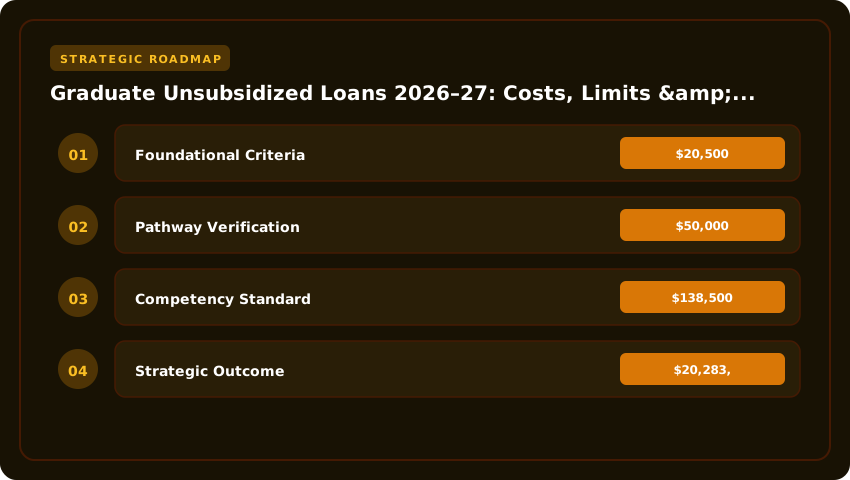
The headline annual cap for the Direct Unsubsidized Loan remains $20,500 per academic year, a figure that has been static since the 2007–2008 award year. This limit applies uniformly across master’s, doctoral, and most professional programs, including law, business, and health sciences. A small group of specialized disciplines — notably Doctor of Medicine (MD), Doctor of Osteopathic Medicine (DO), Doctor of Dental Surgery (DDS), and certain veterinary and pharmacy credentials — qualify for an augmented $50,000 annual cap, recognizing the extraordinary cost structure of these programs. Graduate students at schools participating in the PLUS Loan program can also access the Grad PLUS Loan up to the full cost of attendance minus other aid, but the unsubsidized loan functions as the lower-cost federal backbone of most graduate borrowing plans.
The aggregate ceiling is just as consequential. Graduate borrowers may accumulate up to $138,500 in Direct Unsubsidized Loans, with a critical caveat: this cap includes any undergraduate Direct Loans that remained outstanding when the borrower entered graduate school. For borrowers who carried undergraduate debt into a master’s or PhD program — a common scenario for fast-track scholars, career changers, and stacked-credential professionals — every remaining dollar of principal from prior studies reduces the headroom available at the graduate level. Once the $138,500 ceiling is reached, the only remaining federal option is the Grad PLUS Loan, assuming the borrower can pass the separate credit-based eligibility check.

- Annual limit (most graduate programs): $20,500
- Annual limit (eligible medical and professional programs): $50,000
- Aggregate limit for graduate study: $138,500 (inclusive of any undergraduate Direct Loan balances)
- Loan type: Federal Direct Unsubsidized — no demonstrated financial need required
- Repayment trigger: Begins six months after graduation, withdrawal, or dropping below half-time enrollment
The interest rate calculation for 2026–2027 follows the same statutory formula used for every fixed-rate federal student loan issued since 2013: the high yield of the 10-year Treasury note from the May auction preceding July 1, plus a statutory add-on of 2.05%, rounded up to the nearest one-eighth of one percent (0.125%). Because the Treasury component moves with the bond market, the rate that a 2026–27 first-time borrower locks in will be a direct, arithmetic reflection of macroeconomic conditions in late spring 2026. If 10-year yields settle near 4.25% in May 2026, for example, the resulting unsubsidized rate would compute to roughly 6.30% before the one-eighth rounding convention.
Historical trend data from 2020 through 2025 illustrates the volatility of this formula. The 2020–21 cohort borrowed at 4.30%, followed by 3.73% in 2021–22, 4.99% in 2022–23, 5.50% in 2023–24, and 6.53% in 2024–25 — with the 2025–26 cycle registering approximately 6.86% for new graduate unsubsidized loans, reflecting elevated Treasury yields and stubborn inflation. Because federal student loan rates are fixed at origination for the life of the loan, the rate a borrower secures in 2026–27 will determine their monthly payment for the entire 10-to-25-year repayment horizon. This makes the timing of enrollment, when feasible, a genuine financial variable.
- 2020–21: 4.30%
- 2021–22: 3.73%
- 2022–23: 4.99%
- 2023–24: 5.50%
- 2024–25: 6.53%
- 2025–26: ~6.86%
- 2026–27 (projected): Determined by May 2026 10-year Treasury auction + 2.05% spread
Origination fees represent the third, often underappreciated, cost layer. For loans first disbursed in 2025–26, the Department of Education withholds 1.057% from every dollar borrowed before it reaches the school. That means a student accepting the full $20,500 annual unsubsidized loan does not actually receive $20,500 — they receive approximately $20,283, with the missing $217 retained to offset federal administrative costs. While modest in percentage terms, the fee compounds across multi-year programs: a four-year medical fellowship at the augmented cap could see more than $2,000 in fee drag alone, and that sum immediately capitalizes into the loan principal, generating additional interest over the repayment term.
Actionable takeaway: Before accepting the full unsubsidized loan offer, calculate the net disbursement after the 1.057% fee, confirm the projected 2026–27 rate against the May 2026 Treasury auction result, and verify how much aggregate headroom remains under the $138,500 lifetime cap. Borrowing the precise minimum needed each semester — rather than the maximum allowed — preserves future capacity and limits fee-driven interest capitalization. For borrowers who can demonstrate creditworthiness, comparing the federal unsubsidized rate against current private loan offerings (which may undercut federal rates in declining Treasury environments) is now a standard, financially literate step.
True Cost of Borrowing: Amortization Scenarios Across Program Types
Understanding the true cost of borrowing requires looking far beyond the loan balance listed on your financial aid award letter. Graduate Unsubsidized Loans begin accruing interest the moment funds disburse to your university, and that interest continues to compound during enrollment, the six-month grace period following graduation, and any subsequent deferment or forbearance. Because the Department of Education does not cover interest during school for this loan type, students frequently discover that a $40,000 balance has grown to $48,000 or more before their first payment is due. For borrowers in the 2026–27 academic year, building accurate amortization scenarios is the single most valuable exercise in protecting long-term financial health.
Consider a typical Master of Business Administration (MBA) debt load of $80,000, which is realistic for a two-year program at a AACSB-accredited institution such as a state flagship or well-regarded private school. Under the standard 10-year repayment plan at the projected 2026–27 Direct Unsubsidized Loan rate of approximately 7.5 percent, the monthly payment would land near $948. The total repaid over the life of the loan would reach roughly $113,700, producing $33,700 in interest costs. Switching to the Extended Fixed plan over 25 years drops the monthly obligation to approximately $620, which feels manageable during the early career years, but balloons the lifetime repayment to roughly $186,000. That is a $72,300 premium paid for the privilege of lower monthly cash flow, an expense that often surprises borrowers who never model the long horizon.
STEM master’s programs typically produce different amortization profiles. A 30-credit Master of Science in Computer Science or Data Science from an ABET- or regionally accredited program might involve $55,000 in total borrowing if the student leverages assistantships or in-state tuition. At 7.5 percent over 10 years, the monthly payment is approximately $652, with total interest of about $23,200. The relatively modest principal balance keeps the debt-to-income ratio healthy, particularly when paired with the Bureau of Labor Statistics (BLS) Occupational Outlook Handbook median annual wage of $112,490 for computer and information research scientists in 2024 data. Even before aggressive salary growth, the debt-to-income ratio remains below 0.10, an exceptionally comfortable position.
By contrast, Master of Social Work (MSW) programs tell a different story. Many advanced standing and two-year programs at CSWE-accredited schools carry debt loads between $40,000 and $70,000. Using a midpoint of $60,000 borrowed at 7.5 percent over 10 years, monthly payments settle near $711, generating roughly $25,300 in total interest. The BLS reports a median annual wage of $58,380 for social workers in 2024, which pushes the resulting debt-to-income ratio above 0.18 when full principal is considered. That ratio is still considered manageable by most federal standards, but it leaves far less margin for geographic cost-of-living adjustments, childcare expenses, or Public Service Loan Forgiveness (PSLF) payment count disruptions. Borrowers in this category frequently benefit from income-driven repayment (IDR) plans such as SAVE or IBR, even if the standard 10-year amortization is technically affordable.
Month-by-month capitalization is the hidden engine behind graduate debt growth. Imagine borrowing $20,000 per academic year across two years, with disbursements split evenly between fall and spring. During the first 24 months of enrollment, interest accrues daily on the outstanding principal at roughly 0.0205 percent per day, and any unpaid interest is added to the principal at each disbursement date. By the time a student graduates with $80,000 in original borrowing, accrued and capitalized interest can push the balance to $86,000 or more. Once the six-month grace period concludes, that capitalized balance is what determines the loan’s new principal, and every subsequent amortization calculation is built on the inflated figure.
For a STEM borrower, paying the monthly accrued interest during school rather than allowing it to capitalize can save $7,000 to $10,000 over the life of a $55,000 loan. For an MBA borrower carrying $80,000, the same discipline can reduce total interest by $12,000 to $18,000, a meaningful sum when invested in a retirement account or brokerage portfolio during the repayment years.
- Standard 10-Year Plan: Highest monthly payment, lowest total interest, best choice for borrowers earning above the program median with stable employment.
- Extended 25-Year Plan: Lowest monthly payment, highest lifetime cost, useful for cash-flow management but never as a default.
- Graduated Plan: Payments start low and rise every two years, helpful for fields with predictable salary progression such as medicine and law.
- Income-Driven Repayment (IDR): Caps payments at a percentage of discretionary income, ideal for MSW, MPH, and EdD candidates pursuing PSLF.
- Interest-Capitalization Discipline: Voluntary in-school interest payments can prevent the balance from growing before repayment begins.
The strategic takeaway is clear: amortization modeling is not optional for graduate students borrowing between $40,000 and $120,000. Before accepting an unsubsidized loan offer, project your expected post-graduation salary using the BLS Occupational Outlook Handbook, run both 10-year and 25-year amortization schedules at current interest projections, and calculate your debt-to-income ratio under each scenario. This single exercise converts borrowing from a leap of faith into a quantified, manageable financial decision, which is precisely the mindset the 2026–27 graduate landscape rewards.
Grad PLUS Loans vs Direct Unsubsidized: When Each Makes Strategic Sense
When the Direct Unsubsidized aggregate ceiling leaves a gap between your federal borrowing capacity and the total cost of attendance at your US university, graduate students typically face a pivotal decision: borrow the remainder through the Grad PLUS Loan program, or turn to the private student loan market. Each pathway carries distinct financial consequences that compound significantly across a multi-year professional degree, and the right choice depends heavily on your credit profile, career trajectory, and long-term repayment strategy.
The Grad PLUS Loan offers one structural advantage that no private lender can replicate: federal borrower protections. These include Income-Driven Repayment plans like PAYE, IBR, and the SAVE plan, generous forbearance options, and access to Public Service Loan Forgiveness after 120 qualifying payments while working for a qualifying US employer. The trade-off is cost. For the 2026–27 academic year, Grad PLUS carries a higher interest rate than Direct Unsubsidized and a 4.228% origination fee that is deducted from each disbursement. On a $30,000 annual gap, that origination fee alone removes roughly $1,268 before the funds ever reach your university account, and the higher interest rate compounds against your principal balance every day.
Direct Unsubsidized loans remain the cheaper federal option but cap at $20,500 per academic year for most graduate students, with no aggregate ceiling beyond the lifetime borrowing limits set by the Department of Education. Once you exhaust that $20,500 (or the $33,000 figure available to certain professional program categories), every additional dollar for tuition, required fees, books, and living allowances must come from another source. Grad PLUS technically permits borrowing up to 100% of the school-certified cost of attendance minus other aid, which makes it the default federal bridge for MBA, medical, and law students facing six-figure annual budgets.
- Choose Grad PLUS when: You anticipate working toward PSLF at a qualifying US employer, you have thin or damaged credit, you lack a creditworthy co-signer, or your expected post-graduation salary is modest relative to your debt load and you want IDR flexibility.
- Choose Direct Unsubsidized first, then reassess: Always maximize this lower-rate federal borrowing before considering either Grad PLUS or private loans, since every dollar shifted away from Direct Unsubsidized raises your lifetime interest expense.
- Choose a private lender when: You have a FICO score above roughly 740, a stable income, and either no need for PSLF or a clear refinancing plan to escape federal repayment complexity within five to seven years post-graduation.
Private graduate loans from lenders like SoFi, Earnest, and College Ave have become increasingly competitive for creditworthy borrowers. As of early 2026, top-tier private graduate products advertise variable rates starting near SOFR plus roughly 2% and fixed rates from approximately 5.5% to 6.5% for borrowers with strong credit, often with zero origination fees and interest rate discounts for autopay enrollment. A borrower with excellent credit can routinely secure a private rate that is 1.5 to 2.5 percentage points lower than the Grad PLUS rate, producing thousands of dollars in lifetime savings on a $50,000 to $100,000 program. The catch is the loss of federal protections: no PSLF eligibility, no IDR enrollment if your income drops, and stricter deferment terms during economic hardship.
The decision matrix below summarizes the practical breakpoints based on credit profile and repayment intent:
- FICO under 670 with no co-signer: Grad PLUS is essentially your only viable bridge financing. Private lenders will either decline or price the loan uncompetitively, and federal repayment protections become critical insurance.
- FICO 670–739 with a creditworthy co-signer: Compare offers from SoFi, Earnest, and College Ave against Grad PLUS. If the private rate minus federal benefits still produces meaningful savings, private wins. Run the math using a 10-year amortization horizon.
- FICO 740+ with stable income: Private graduate loans typically beat Grad PLUS on raw cost. Build in an explicit refinancing exit strategy: plan to consolidate any federal loans with new private refis once you secure post-graduation employment, or maintain federal loans for IDR/PSLF while keeping the private loan separate.
- Career trajectory in public service or nonprofit sectors: Default to Grad PLUS for the full gap. The PSLF pathway alone can justify a higher interest rate if you intend to stay in qualifying employment for ten years.
- High-income tracks (consulting, finance, tech): Private loans often outperform, especially when paired with a two- to three-year aggressive repayment plan followed by a cash-out refinance at an even lower rate once your income rises.
Whichever route you select, document your rationale before signing the Master Promissory Note. Treat your borrowing sequence as a strategic portfolio: federal Direct Unsubsidized first as the cheapest flexible foundation, Grad PLUS second if you need federal safety nets, and private graduate loans third as the precision tool for creditworthy borrowers who have a credible plan to refinance, repay quickly, or pursue forgiveness under a clear qualifying employer track.
FAFSA Timeline and Application Strategy for 2026–2027 Graduate Enrollment
Navigating the financial aid process might seem daunting, but for graduate students, the Free Application for Federal Student Aid (FAFSA) is refreshingly streamlined. For the 2026–2027 academic year, the FAFSA is expected to open on October 1, 2025. While the federal deadline extends well into the following year, waiting is a costly mistake. Graduate programs—whether you are targeting an ABET-accredited engineering master’s program or an AACSB-accredited MBA—often have priority deadlines as early as February or March 2026. Missing these institutional deadlines can jeopardize your access to limited institutional grants or work-study funds, even if your federal loan eligibility remains intact.
One of the most liberating aspects of applying for aid as a graduate student is your classification as an independent student. Unlike your undergraduate years, you no longer need to input your parents’ financial data. This independence simplifies the application significantly, requiring only your own tax return information (and your spouse’s, if applicable). This streamlined approach directly impacts how your financial need is calculated and removes the friction of coordinating parental assets.
When the Department of Education processes your application, it calculates your Student Aid Index (SAI). For graduate students, the SAI is based solely on your personal income and assets. Because graduate unsubsidized loans are not need-based, the SAI does not restrict your borrowing power for the base $20,500 limit. Whether you are earning $30,000 a year as a teaching assistant or $120,000 in the corporate sector, you will generally qualify for the full $20,500 Direct Unsubsidized Loan amount, provided you are enrolled at least half-time in an eligible program. The SAI primarily serves as a benchmark for other, need-based aid, leaving your core unsubsidized eligibility untouched.
- October 1, 2025: The FAFSA opens for the 2026–2027 academic year. File as close to this date as possible to maximize state and institutional aid opportunities.
- February–March 2026: Typical priority deadlines for major graduate programs. Always verify exact dates with your specific university’s financial aid center.
- Independent Status: No parent financial data is required, simplifying the application and focusing the Student Aid Index (SAI) solely on your own finances.
- Universal Eligibility: Most graduate students qualify for the full $20,500 unsubsidized loan limit regardless of their income level, as these funds are not subject to SAI restrictions.
By understanding this timeline and leveraging your independent status, you can strategically secure your funding early. Do not let the $20,500 sit on the table while you wait; file early, analyze your program’s specific deadlines, and build a robust financial foundation for your graduate journey. Taking these proactive steps ensures you can focus on your academic and professional growth without the stress of last-minute funding gaps.
Program-Level ROI: When Graduate Debt Is Justified and When It Is Not
Borrowing $50,000 for a graduate degree that lifts your annual earnings by $30,000 is a fundamentally different decision than borrowing the same amount for a degree that adds only $5,000 to your baseline salary. The 2026–27 Direct Unsubsidized Loan landscape gives qualified graduate students access to up to $20,500 per academic year (with additional Grad PLUS eligibility beyond that), which means a two- or three-year program can quietly accumulate six-figure debt before the first paycheck arrives. Determining whether that obligation is reasonable requires comparing cumulative borrowing against post-graduation earnings premiums, a calculation that varies dramatically by discipline, institution, and specialty track.
According to the National Center for Education Statistics (NCES) and Bureau of Labor Statistics (BLS) Occupational Employment and Wage Statistics (OEWS) data, the median annual wage for master’s-level professionals in the United States hovers near $77,000, but that figure masks enormous variance. Graduates of clinical psychology PsyD programs, Master of Fine Arts (MFA) programs, and accredited Master of Social Work (MSW) tracks frequently face debt-to-income ratios that exceed 1.5 to 1 upon entry into the workforce. Conversely, graduates of Master of Science in Computer Science (MS-CS), Doctor of Nursing Practice (DNP) / Nurse Anesthesia (CRNA), and Master of Science in Business Analytics (MSBA) programs regularly achieve debt-to-income ratios well below 0.75 to 1 within two years of graduation.
The practical break-even question becomes: How many years of post-graduation salary premium are required to recoup total borrowing, including accumulated interest at the projected 2026–27 Direct Unsubsidized rate of approximately 7.5 to 8.0 percent? The answer separates strategic borrowing from financial distress.
- High-Debt, Lower-ROI Programs:
- Clinical Psychology (PsyD): Many APA-accredited programs, such as those at Rutgers University or Alliant International University, charge $35,000 to $55,000 per year in tuition and fees. Four- to five-year cumulative borrowing can reach $200,000 to $275,000. Median early-career earnings per the College Scorecard hover near $65,000, producing a break-even timeline of 6 to 8 years against a baseline bachelor’s-level psychology salary ($55,000).
- Master of Fine Arts (MFA): Private institutions such as Columbia University or the California Institute of the Arts report total program costs exceeding $120,000 for a two- to three-year terminal degree. Median graduate earnings five years post-completion average $45,000 to $55,000. Break-even against pre-graduate earnings often extends beyond 10 years, and for many graduates, the debt premium is never fully recouped in dollar terms.
- Master of Social Work (MSW): Programs at the University of Southern California or Washington University in St. Louis can total $80,000 to $100,000. Median earnings for LCSW-track graduates land near $60,000. Break-even against a $48,000 baseline occurs within 4 to 6 years, but PSLF (Public Service Loan Forgiveness) eligibility is often essential to make the math work.
- High-ROI Programs:
- Master of Science in Computer Science (MS-CS): Georgia Institute of Technology’s online OMSCS program totals under $11,000 total, while Stanford University’s on-campus track exceeds $130,000. Even at the high end, median graduate earnings of $145,000+ yield a break-even window of under 3 years against a $90,000 software engineering baseline.
- Nurse Anesthesia (CRNA): Doctor of Nursing Practice programs at Columbia University or Georgetown University may cost $150,000 to $200,000, but BLS-reported median CRNA wages exceed $210,000. Break-even occurs within 2 to 3 years of practice, making debt-to-income ratios exceptionally favorable despite sticker shock.
- Master of Science in Business Analytics (MSBA): AACSB-accredited programs at MIT ($108,000 total) or the University of Texas at Austin ($56,000 in-state) deliver median graduate earnings of $105,000 to $120,000. Break-even against a $70,000 analyst baseline arrives in under 3 years.
The actionable takeaway for 2026–27 borrowers is straightforward: program selection and institutional choice can swing the lifetime cost of a graduate degree by $150,000 or more. Before signing a Master Promissory Note for the maximum $20,500 annual Direct Unsubsidized allotment, model your cumulative borrowing against the College Scorecard median earnings for that specific institution and CIP code. If the resulting break-even timeline exceeds five years without a clear PSLF or loan forgiveness pathway, reconsider program length, employer tuition reimbursement, or a lower-cost accredited alternative. Graduate debt is justified when the credential demonstrably expands your earning capacity within a recoverable window; it is not justified when the degree serves passion without producing a proportional financial return.
Minimizing Borrowing: Assistantships, Fellowships, and Employer Tuition Reimbursement
The single most reliable strategy for reducing reliance on Direct Unsubsidized Loans is to replace borrowed dollars with earned dollars before the first tuition bill arrives. For 2026–27, the graduate unsubsidized rate is projected to land near 7.5 percent, which means every $1,000 you can convert into a non-repayable award saves roughly $75 in lifetime interest over a standard 10-year repayment horizon. Three pathways deserve careful attention: research and teaching assistantships at R1 universities, external fellowship competitions, and employer tuition reimbursement programs administered under IRC Section 127.
Graduate Assistantships at R1 Universities. Most Carnegie-classified R1 institutions—including members of the Association of American Universities (AAU)—bundle assistantship offers into admission packets for master’s and doctoral candidates. A typical 9-month stipend for a PhD student in 2024–25 ranged from $25,000 to $38,000, with 2026–27 figures trending upward to offset inflation in metropolitan housing markets. Beyond the stipend, the award usually includes full tuition remission, subsidized health insurance through the university plan, and a partial fee waiver that can be worth $2,000 to $4,800 annually. Master’s students should specifically request “funded” or “tuition-remission” tracks, because many programs now charge differential tuition for self-paying cohorts.
- Target AAU member institutions (aau.edu) and verify assistantship eligibility before applying, since some departments reserve funding only for doctoral admits.
- Clarify workload expectations—most assistantships require 15 to 20 hours per week, which can extend time-to-degree but dramatically lower cost-of-attendance.
- Ask the admissions office whether the stipend is guaranteed for one year, multi-year, or contingent on satisfactory academic progress; verbal promises should be confirmed in writing.
External Fellowship Databases. National fellowships can stack on top of—or fully replace—institutional funding. The National Science Foundation Graduate Research Fellowship Program (NSF GRFP) provides a $37,000 annual stipend and a $16,000 cost-of-education allowance for up to three years, making it one of the most generous awards available to US citizens and permanent residents. The Fulbright US Student Program covers tuition, airfare, and a living stipend for internationally focused graduate research. The American Association of University Women (AAUW) offers both Dissertation Fellowships and Selected Professions Fellowships, with awards up to $30,000 for women pursuing full-time graduate study. Reliable search engines include Fastweb, the Department of Labor’s CareerOneStop scholarship finder, and the ProFellow database, which curates more than 6,000 external opportunities.
- Build a master spreadsheet tracking deadlines, eligibility filters, essay word counts, and recommendation letter requirements to maximize submission volume.
- Apply even when the win probability looks low—the expected value of a single application is rarely zero, and fellowship committees reward specificity over pedigree.
Employer Tuition Reimbursement (IRC Section 127). Working professionals pursuing an MBA, MS in Data Science, or similar career-aligned credential should evaluate tuition benefits before borrowing. Under IRC Section 127, employers may provide up to $5,250 per calendar year in tax-free educational assistance, covering tuition, fees, books, and supplies. Anything above that threshold is generally treated as taxable wages unless the coursework qualifies as a working-condition fringe benefit. Common structures include:
- Up-front payment, where the employer pays the registrar directly and the student never sees the cash flow.
- Reimbursement models requiring the employee to earn a minimum grade (often a B or higher) or complete the course before submitting receipts.
- Service-bond clauses, which require continued employment for one to three years post-reimbursement; carefully weigh this against your expected job tenure.
Negotiation Tactics for Competing Offers. Admission offers are not always final. Prospective students holding multiple acceptances should write a professional, concise funding appeal to the graduate program director—typically two paragraphs—stating the competing offer, the financial gap, and the institutional preference. Specific tactics include:
- Requesting a meeting with the director of graduate studies rather than emailing a generic inbox.
- Providing a side-by-side comparison of the competing funding packages, framed as decision leverage rather than an ultimatum.
- Asking about Bridge Funding—one-time supplements for incoming students with demonstrated need or external fellowships the department cannot match.
- Negotiating summer research stipends or travel grants for conference attendance, which cost the department less than a tuition waiver but meaningfully expand the package.
The compounding effect of stacking these strategies is significant. A doctoral candidate combining an R1 assistantship with an external fellowship can often graduate with zero Direct Unsubsidized Loan debt, while a working professional leveraging the full $5,250 Section 127 exclusion plus a partial employer match can cut borrowing in half over a two-year master’s program. The objective is not to avoid loans entirely—it is to ensure that every borrowed dollar reflects a deliberate choice, not an avoidable default.
| Metric | 2026–27 Graduate Direct Unsubsidized Loan | 2026–27 Undergraduate Direct Unsubsidized Loan | 2026–27 Graduate PLUS Loan |
|---|---|---|---|
| Annual Loan Limit (Base) | $20,500 | $5,500–$12,500 (by year) | Up to Cost of Attendance (COA) |
| Aggregate Lifetime Limit | $138,500 (includes undergrad) | $31,000 (dependent) | No federal aggregate cap |
| Projected Interest Rate | 7.5%–8.0% (TBD May 2026) | 6.5%–7.0% (TBD May 2026) | 8.5%–9.0% (TBD May 2026) |
| Loan Fee (Origination) | ~1.0% (estimated) | ~1.0% (estimated) | ~4.2% (estimated) |
| Interest Accrual | Unsubsidized: accrues from disbursement | Unsubsidized: accrues from disbursement | Unsubsidized: accrues from disbursement |
| Credit Check Required | No | No | Yes (no adverse history) |
| Repayment Start | 6 months after enrollment drops below half-time | 6 months after enrollment drops below half-time | 6 months after enrollment drops below half-time |
| Standard Repayment Term | 10–25 years (income-driven options) | 10–25 years (income-driven options) | 10–25 years (income-driven options) |
| Typical Career ROI Timeline | 5–8 years (break-even on debt) | 3–5 years (break-even on debt) | 7–10 years (break-even on debt) |
Frequently Asked Questions
What is the Graduate Direct Unsubsidized Loan limit for 2026–27?
The federal Graduate Direct Unsubsidized Loan limit for the 2026–27 academic year is $20,500 per year, with an aggregate lifetime cap of $138,500 including any undergraduate Direct Loans borrowed. Graduate and professional students cannot use this loan to cover remaining cost-of-attendance gaps.
What is the projected interest rate for Graduate Unsubsidized Loans in 2026–27?
The 2026–27 Graduate Direct Unsubsidized Loan interest rate is projected at 7.5%–8.0%, finalized in May 2026 based on the 10-year Treasury auction. Graduate PLUS Loans are projected at 8.5%–9.0%, reflecting the PLUS federal default premium over base rates.
Do Graduate Unsubsidized Loans require a credit check?
No, Graduate Direct Unsubsidized Loans do not require a credit check or cosigner for approval. Eligibility is based solely on enrollment at a participating school and Satisfactory Academic Progress. Borrowers needing funds beyond the $20,500 cap must apply separately for a credit-based Graduate PLUS Loan.
How does career ROI compare for graduate debt borrowers in 2026–27?
Graduate Unsubsidized Loan borrowers typically reach debt break-even within 5–8 years post-graduation, depending on degree field. High-ROI programs (MBA, MD, JD) often recoup costs within 5 years, while master's in education or social work may extend repayment timelines to 10+ years.
Strategic Final Takeaway
Success in evaluating Graduate Unsubsidized Loans 2026–27: Costs, Limits & Strategy relies on early preparation, adherence to verified accredited requirements, and cross-referencing official portals. Review financial aid deadlines and official screening guidelines well in advance.


