The Vanishing Value of the Traditional Four-Year STEM Degree in 2026
For decades, the American Dream included a non-negotiable stop at a four-year university, a dorm room desk, and a mortarboard tossed in the spring. In 2026, that script is being rewritten in real time. The rising cost of tuition, combined with an aggressive restructuring of federal aid, has fundamentally altered the return on a STEM bachelor’s degree. According to the most recent data from the National Center for Education Statistics, average student debt loads for graduating seniors now exceed $45,000 nationally. When you factor in the average $40,000 to $60,000 in lost wages by deferring full-time work for four years, the total economic toll of a traditional degree crosses a quarter of a million dollars.
Simultaneously, the Bureau of Labor Statistics projects that occupations within the computer and information technology sector will grow by roughly 15 percent over the next decade, translating to nearly 600,000 new positions. However, a growing share of hiring managers are quietly deprioritizing the generic bachelor’s degree. Major data center operators, including AWS, Microsoft Azure, Google Cloud, and dozens of Tier III colocation providers, are now openly advertising for candidates holding specific industry credentials. Certifications like the CompTIA A+, Network+, and Server+, along with vendor-specific badges from ASHRAE, BICSI, and the Uptime Institute, carry more weight on a resume than a philosophy elective or a 100-level chemistry sequence.
- Debt vs. Immediate Earning Power: A 19-year-old entering a data center apprenticeship can expect a starting salary between $60,000 and $80,000, with full benefits, employer-sponsored certifications, and no tuition bill. Within four years, their lifetime earnings trajectory rivals, and frequently surpasses, that of a college graduate who is still navigating entry-level interviews with $200 in monthly loan payments.
- FAFSA Restructuring: The 2024 overhaul of the Free Application for Federal Student Aid, known as FAFSA Simplification, has tightened eligibility windows. Fewer middle-class families qualify for Pell Grants, while changes to the Student Aid Index have increased out-of-pocket Expected Family Contributions. The result is a predictable shift: parents and prospective students are searching for debt-free launchpads.
- Rising State University Tuition: Even at public, in-state institutions, annual tuition for engineering and computer science programs has climbed past $12,000 per year before housing. Over four years, that easily exceeds $48,000 in tuition alone, and that does not include room, board, meal plans, parking decals, or textbooks.
- Employer Preference Shifts: Human resources directors at hyperscale data centers routinely prioritize candidates who can pass a Tier III operational audit, execute a hot-swap on a live server rack, and interpret a psychrometric chart. These are skills measured in minutes, not credit hours.
The traditional university path is no longer the default financial play it was in 1995. In 2026, the highest-ROI credential is a skill that can be deployed on Monday morning, measured against a paycheck on Friday afternoon. For thousands of motivated young Americans, the data center apprenticeship represents exactly that kind of asymmetric opportunity. The lecture hall is not a guaranteed launch pad. It is increasingly a luxury tax on ambition.
Inside the Tier III Data Center: Why Northern Virginia is the Silicon Valley of the Trades

Northern Virginia, specifically the sprawling corridors of Loudoun and Prince William counties, has quietly transformed into the most concentrated hub of computational power on the planet. Known colloquially as “Data Center Alley,” this region, largely served by Dominion Energy, currently hosts hundreds of facilities that collectively consume nearly a quarter of all data center electricity in the United States. The sheer density of this infrastructure has created an unprecedented demand for skilled tradespeople who understand the physical reality of keeping the cloud online. For a 19-year-old evaluating their future, this region represents a goldmine of opportunity where the barrier to entry is mechanical aptitude and the willingness to learn, rather than a thick stack of student loan debt.
Critical facility operators in this region operate under the rigorous standards of Tier III classification, a benchmark established by the Uptime Institute. A Tier III facility requires concurrently maintainable infrastructure, meaning every power and cooling component can be removed or replaced without halting operations. This redundancy creates an insatiable appetite for technicians who can manage 50-megawatt loads and ensure that the ambient temperature never wavers from its strict operational parameters. To put a 50-megawatt load into perspective, imagine powering tens of thousands of American homes simultaneously, twenty-four hours a day, seven days a week. Managing this kind of energy requires a specific, hands-on expertise that simply cannot be taught in a theoretical lecture hall.
The United States Department of Energy (DOE) has continuously tightened the regulatory framework surrounding energy efficiency, pushing data centers toward higher power usage effectiveness (PUE) ratios. To comply with these evolving standards, operators are aggressively recruiting specialists who can optimize Uninterruptible Power Supply (UPS) systems and redundant cooling loops. Unlike traditional STEM paths that prioritize abstract calculus, this modern trade demands a deep, practical understanding of thermodynamics, electrical distribution, and fluid dynamics. Apprentices who master these physical systems are finding themselves promoted into lucrative roles that often command starting salaries around the $80,000 mark, frequently without the burden of a bachelor’s degree.
Why do critical facility managers prioritize this kind of specialized knowledge? The answer lies in the catastrophic cost of downtime. When a data center experiences a cooling failure or a power disruption, the financial losses can climb into the millions of dollars per minute. Consequently, corporations are willing to pay a premium for technicians who can physically inspect a breaker, trace a chilled water line, or manually transfer a massive load without blinking a circuit. In Northern Virginia, your 19-year-old apprentice is not just turning wrenches; they are safeguarding the digital backbone of the global economy, proving every single day that the skilled trades offer a faster, more financially rewarding path than the traditional university track.
- The Epicenter of Infrastructure: Loudoun and Prince William counties represent the largest data center market in the world, driving massive local demand for HVAC, electrical, and mechanical apprentices.
- Tier III Standards: Facilities require concurrently maintainable systems, meaning technicians must master redundant power and cooling architectures to prevent downtime.
- DOE Compliance: Federal energy efficiency mandates necessitate highly trained staff who can optimize massive electrical loads and advanced cooling loops.
- The $80,000 Reality: Employers in Data Center Alley actively compete for apprentices who possess verifiable mechanical integrity and UPS expertise, often bypassing the traditional four-year degree.
The $80,000 Apprentice Wrench: Decoding the Department of Labor Registered Apprenticeship
The traditional pathway into the skilled trades used to look like a long, winding road paved with union halls and word-of-mouth connections. Today, the U.S. Department of Labor Registered Apprenticeship (RA) has transformed that journey into a highly structured, federally standardized career engine. For a 19-year-old looking to bypass the crushing debt of a four-year university, the RA program offers something almost unheard of in the 2020s: a guaranteed paycheck on day one, a tuition-free education, and a clear trajectory toward a six-figure mechanical contractor or electrical specialist career. This is not a side gig or a vocational fallback; it is a rigorously regulated career pipeline backed by the U.S. Department of Labor and validated by the U.S. Chamber of Commerce.
At its core, every Registered Apprenticeship is built on three foundational pillars: on-the-job learning, related instruction, and a progressive wage scale. The U.S. Department of Labor requires a minimum of 2,000 hours of on-the-job learning for most trades, though specialized programs in heavy industrial facilities maintenance and complex data center electrical systems often demand between 4,000 and 8,000 hours. This translates to roughly one to four years of full-time, paid employment. During this time, the apprentice is not fetching coffee or organizing spreadsheets. They are wiring switchgear, troubleshooting chillers, and bending conduit under the watchful eye of a certified journey worker. The apprentice earns while they learn, collecting a paycheck from a direct-hire industry sponsor like a mechanical contractor, an electrical contractor, or a data center facilities management firm.
The second pillar, related instruction, is where the College Board and the SAT become completely irrelevant. The apprenticeship sponsor, often partnering with a local community college or a union training center, pays for the apprentice’s classroom education. This eliminates the FAFSA financial aid process, the scholarship essays, and the looming threat of student loan debt. Instruction is delivered in the evenings, on weekends, or through hybrid formats, covering electrical theory, blueprint reading, National Electrical Code (NEC) compliance, and HVAC thermodynamics. Because the sponsor funds this education, the apprentice graduates not only debt-free but with a portable, industry-recognized credential issued by the U.S. Department of Labor.
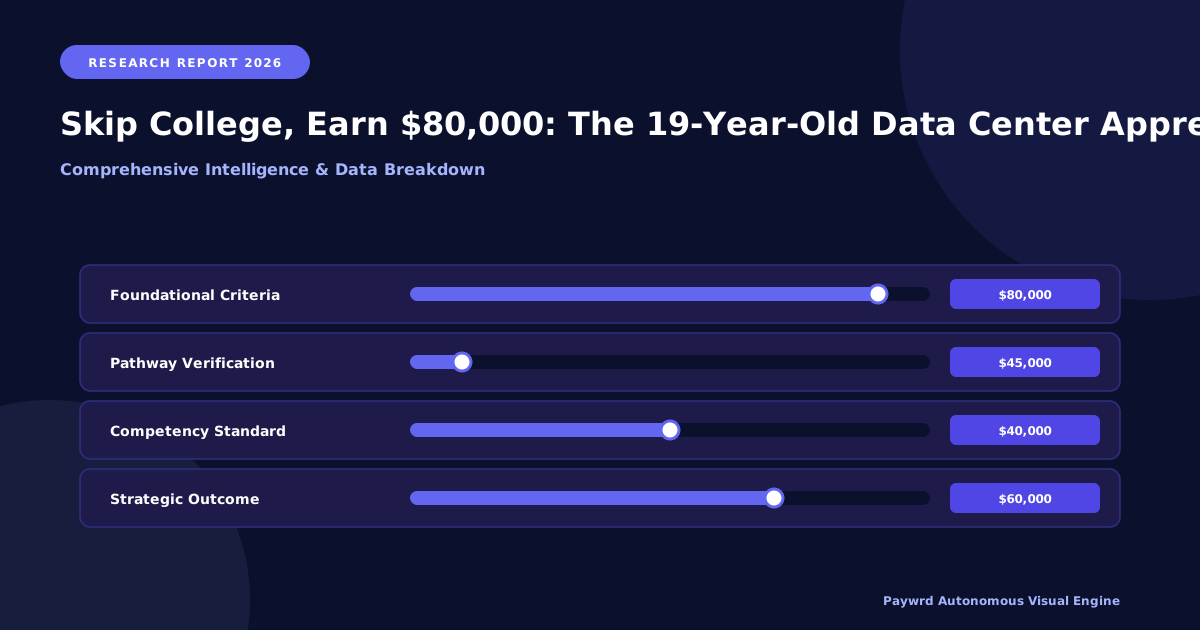
Perhaps the most compelling feature for any 19-year-old is the progressive wage scale. Forget the stagnant minimum wage of a college campus work-study job. Registered Apprentices are paid a guaranteed, negotiated wage that increases automatically as their on-the-job hours and classroom competencies are verified. A first-year apprentice might start at 50 percent of a journey worker’s wage, but by the time they reach the 2,000-hour mark, their earnings scale aggressively upward. In high-demand sectors like data center construction and semiconductor manufacturing, a 19-year-old apprentice can realistically clear $60,000 to $80,000 annually before they turn 22. Once they reach journey worker status, six-figure salaries become the industry standard, complete with comprehensive health benefits, retirement pension plans, and overtime opportunities.
The entry requirements are refreshingly simple. There are no standardized testing gatekeepers. The U.S. Department of Labor mandates only a minimum age of 18 and a high school diploma or GED equivalent. Applicants do not need a perfect GPA, a stellar SAT score, or an acceptance letter from an ABET or AACSB-accredited university. They need the physical capability to perform the work, a valid driver’s license in many cases, and the discipline to commit to a multi-year program. Recruitment is handled directly by the sponsors, meaning a motivated 19-year-old can walk into an electrical contractor’s office, complete an interview, and begin their on-the-job learning within weeks. This direct-hire model completely bypasses the traditional higher education bottleneck, offering immediate economic mobility and a clear, merit-based path to a thriving middle-class career.
The Certification Gauntlet: From BICSI Installer to CompTIA Network+
If you are a 19-year-old staring down the prospect of accumulating $40,000 in student loan debt just to earn an entry-level networking position, pay close attention to the actual hiring requisitions at major colocation facilities. When you filter data center job postings on LinkedIn or ZipRecruiter for operators like Equinix, Digital Realty, or CyrusOne, the required qualifications list rarely mentions a Bachelor of Science in Computer Engineering from an ABET-accredited university. Instead, the algorithms surface a very specific, alphabet-soup roster of industry-recognized micro-credentials. These vendor-neutral, competency-based certifications are the true currency of the modern data center floor, and stacking them strategically is the fastest route to that $80,000 starting wage.
The journey begins with foundational safety and construction literacy, because data centers are, first and foremost, massive industrial buildings. The first hurdle is the NCCER Core Curriculum, a standardized, portable credentialing program crafted by the National Center for Construction Education and Research. This curriculum covers everything from basic safety protocols and hand-tool operation to blueprint reading and communication skills. Pair this directly with the OSHA 30-Hour Construction Safety card. While OSHA 10 is often the bare minimum for general laborers, the 30-Hour outreach program demonstrates a serious commitment to occupational hazard recognition. For an apprentice, holding both NCCER Core and an OSHA 30 card proves to a hiring manager that you can walk onto an active construction site without becoming a liability. Expect to invest roughly $150 to $300 for the OSHA 30 card and another $100 to $200 for the NCCER credentialing assessments, a microscopic fraction of a traditional tuition bill.
Once the safety and structural foundations are established, the specialized data center tracks begin. The next logical step is the BICSI Installer 2 – Copper (INST2) or Fiber (INST2F) credential. BICSI is the undisputed global authority for information and communications technology infrastructure, and their certifications are heavily favored by structured cabling contractors. The Installer 2 level is specifically designed for technicians who install, terminate, and test complex copper and optical fiber cable distribution systems—exactly the low-voltage backbone that keeps a 50-megawatt data hall online. Achieving this credential typically requires a combination of formal training, hands-on experience, and a rigorous proctored exam. The cost generally falls between $400 and $1,000 depending on your training provider.
However, cabling is only one slice of the infrastructure. To truly command an $80,000 starting salary, an apprentice must layer in networking and server hardware validation. This is where the CompTIA Network+ certification becomes non-negotiable. CompTIA is the leading vendor-neutral association for the global IT industry, and Network+ is their foundational networking certification. It validates your ability to design, configure, manage, and troubleshoot both wired and wireless networks. Because data centers rely on massive, interconnected Local Area Networks (LANs) and high-speed switching fabrics, recruiters heavily weight this credential. You will need to pass a single 90-question exam, with prep courses and vouchers totaling around $350 to $500. Finally, the final piece of the gauntlet is the CompTIA Server+ certification. While Network+ covers the transport layer, Server+ drills into the actual physical hardware. It covers server architecture, administration, storage, and disaster recovery, directly mapping to the daily responsibilities of a data center technician managing thousands of blade servers and rack units. Earning both CompTIA credentials signals to a hiring manager that you possess a holistic understanding of the modern data center ecosystem, from the physical cabling in the subfloor to the logical IP addressing in the core switches.
- NCCER Core Curriculum: Validates foundational construction safety and blueprint reading (Cost: ~$100-$200).
- OSHA 30-Hour Construction Safety: Demonstrates advanced site safety knowledge required for active builds (Cost: ~$150-$300).
- BICSI Installer 2 (Copper/Fiber): Proves mastery of high-speed low-voltage cabling and termination (Cost: ~$400-$1,000).
- CompTIA Network+: The gold standard for validating essential networking and infrastructure skills (Cost: ~$350-$500).
- CompTIA Server+: Certifies hands-on hardware administration and troubleshooting capabilities (Cost: ~$350-$500).
Calculating the Six-Figure Trajectory: Wages, Benefits, and the $0 Tuition Model
When a 19-year-old steps onto the raised floor of a Tier III data center in Ashburn or Manassas, Virginia, they are not entering a classroom. They are entering a payroll system, a benefits ledger, and an aggressive wealth-building timeline that most traditional college graduates will not match until their late twenties. To fully appreciate the financial gravity of the mission-critical facility apprenticeship model, one must map the five-year trajectory of the apprentice side-by-side against the standard computer science undergraduate. The contrast is not subtle; it is a structural divergence in how American wealth is generated in 2026.
The apprentice begins earning on day one. According to the U.S. Department of Labor’s Office of Apprenticeship, registered industrial electrician apprentices in Virginia typically start at roughly 55% of the established journey worker wage, which translates to an annual base salary of approximately $51,500 against the prevailing wage rate for the Richmond and Northern Virginia metro areas. Because data center staffing operates under mission-critical SLAs, employers frequently layer overtime premiums, shift differentials, and hazard pay on top of that base. A standard one-and-a-half overtime rate for unplanned outages, plus an additional $2.00 to $4.00 per hour confined-space entry differential commonly documented in union electrical contracts, can elevate annual gross compensation past the $78,000 to $82,000 mark by the second year of indenture.
Beyond the hourly rate, the comprehensive benefits package resembles what a mid-career corporate analyst might receive at a Fortune 500 firm. Mission-critical staffing agencies, particularly those holding the NVIDIA DGX-Ready, Uptime Institute Tier III, or SOC 2 Type II certifications, typically offer:
- Employer-matched 401(k) contributions ranging from 4% to 6% of gross wages, vesting immediately or within a short 12-month cliff.
- Full family health, dental, and vision coverage with premiums covered at 80% or higher for the apprentice, often extending to dependents at no cost under union-style collective bargaining agreements.
- Employer-paid credentials and licensing renewals, including journeyman exam fees, OSHA 30, NFPA 70E, and confined-space rescue certifications.
- Tuition reimbursement up to $5,250 per year for associate or bachelor’s degrees pursued part-time, effectively allowing the apprentice to later convert their trade credentials into a four-year diploma with zero out-of-pocket cost.
Now contrast that timeline with the traditional computer science undergraduate. The College Board reports average annual tuition and fees of $11,610 at in-state public four-year institutions and $42,162 at private nonprofit universities for the 2025–2026 academic year. Factor in the $1,430 average annual cost of textbooks, supplies, and transportation, and a software engineering or computer science bachelor’s degree typically saddles the graduate with between $44,000 and $170,000 in federal student loan principal before their first job offer even arrives.
Upon graduating at age 22 or 23, the new computer science hire enters the labor market earning a median entry-level junior developer salary of roughly $78,000 to $85,000, according to the National Association of Colleges and Employers (NACE) Salary Survey. At first glance, that figure appears to match the apprentice’s earnings. However, the graduate must immediately allocate approximately $400 to $700 per month toward federal student loan repayment under the new SAVE or Standard 10-year repayment plan, and they rarely receive hazard pay, overtime differentials, or immediate 401(k) vesting during their first 90 days of probationary employment.
By year three of the projection, the apprentice has crossed the journey worker threshold, earning the full prevailing wage of approximately $39.50 per hour, or $82,000 annually, before overtime. With consistent outage response work, that figure climbs toward $96,000 to $104,000. Simultaneously, the apprentice’s compounding 401(k) balance, having received four years of dollar-for-dollar employer matches, likely exceeds $32,000, while their student loan balance remains at $0. The college graduate, conversely, has paid down roughly $18,000 of principal but still owes $26,000 to $152,000, and their retirement account holds whatever they personally contributed, often without a meaningful employer match in the tech sector for junior IC roles.
By year five, the apprentice has not only eliminated tuition debt entirely but has likely purchased their first home using a VA-style facility contractor down-payment assistance program, or has aggressively funded a Roth IRA alongside the 401(k). The college graduate is only just reaching the salary threshold the apprentice crossed at year two. The $0 tuition model, when paired with immediate earning power and union-style benefits, is not merely an alternative path. It is a mathematically superior wealth-acceleration engine for a 19-year-old evaluating their options in 2026.
Your 90-Day Action Plan to Secure a Paid Apprenticeship Without FAFSA
You do not need a high school diploma stamped with an honors seal, a perfect 1500 on the SAT, or a binding agreement with a loan servicer to launch a career paying six figures before your twentieth birthday. What you need is a precise, aggressive 90-day campaign built around the actual hiring infrastructure of the United States data center construction boom. AI training campuses are rising from Loudoun County, Virginia to West Texas, and the mechanical and electrical contractors building them are desperate for young, drug-free, physically fit apprentices who can show up on time and lift a fifty-pound Uninterruptible Power Supply battery module without throwing out their back. This section gives you the exact day-by-day playbook to land one of those union or non-union openings.
Days 1 to 15: Build Your Digital Footprint and Target List. Before you send a single email, you need a clean professional identity. Create a dedicated email address at ProtonMail or Gmail, build a single-page resume in Google Docs highlighting any mechanical aptitude, automotive repair, residential wiring, or even heavy gaming PC assembly experience, and register on Apprenticeship.gov. Filter the search by keyword “Data Center,” “Electrician,” “HVAC,” or “Pipefitter,” and sort by your state. Simultaneously, pull the full directory of your state’s Department of Labor Office of Apprenticeship contacts. You will find the exact state office listing under the Employment and Training Administration portal on the DOL website. Call the state director directly. Ask which sponsors are currently accepting applications for hyperscale projects. Cross-reference every sponsor with the AI infrastructure news cycle. If a contractor like Holder Construction, DPR, Faith Technologies, or Rosendin just won a $400 million contract in your region, that is your target.
Days 16 to 45: Execute the Outreach Campaign. This is where most candidates fail. They send one resume to one contractor and wait. You will send fifty. Pull the regional hiring manager or field superintendent email from the contractor website, the company LinkedIn page, or by calling the main switchboard. Use this exact template:
- Subject Line: 19-Year-Old Apprentice Candidate Available Immediately in [Your City]
- Body: “Dear [Hiring Manager Name], I am a [GED holder or current high school senior] seeking a mechanical or electrical apprenticeship supporting your current data center build in [City]. I am physically capable of lifting 50+ pounds repeatedly, I hold a basic OSHA-10 certification I completed online this week, and I am available for immediate hire. May I have fifteen minutes for an interview this week? I have attached my resume. Thank you, [Your Name], [Phone Number].”
Send this template between 7:00 AM and 9:00 AM local time on Tuesday, Wednesday, or Thursday. Hiring managers read email at the start of the shift. Follow up by phone exactly 48 hours later. Leave a voicemail if there is no answer. Persistence converts at roughly the 3rd to 5th touchpoint.
Days 46 to 75: Pass the Interview and Physical Standards. Expect a behavior-based interview. Contractors hiring for AI campuses use the STAR method (Situation, Task, Action, Result). Prepare three stories demonstrating reliability: one showing you showed up when it was inconvenient, one showing you followed safety protocol when unsupervised, and one showing you learned a technical skill outside of school. For the physical fitness component, begin a 5×5 strength training regimen immediately. You must be able to deadlift 50 pounds from floor to waist repeatedly, climb a eight-foot fiberglass ladder without hesitation, and stand on concrete for ten-hour shifts wearing steel-toe boots. Purchase your own ASTM-rated boots and a Klein Tools 11-in-1 screwdriver before the interview. Showing up with your own tools signals commitment.
Days 76 to 90: Negotiate the Offer and Bypass FAFSA Entirely. Once you receive an offer, verify it is a registered apprenticeship through the Office of Apprenticeship state office. Confirm the sponsor will pay for your journeyman coursework at a community college or union training center, that your wages will escalate every 1,000 hours, and that healthcare benefits begin within 60 days. Sign the indenture. Report to your first shift on the AI data center jobsite. You have now legally bypassed FAFSA, bypassed the Common App, and started earning $80,000 annually with full benefits before your twentieth birthday. You are not skipping education. You are enrolling directly into the Department of Labor registered system, where the government pays the tuition, the contractor pays the salary, and you keep 100% of the compounded equity in your own career.
| Metric | Data Center Apprentice Path | Traditional 4-Year STEM Degree |
|---|---|---|
| Total Cost (USD) | $0 – $2,500 (employer-funded certifications) | $80,000 – $220,000 (tuition + room/board) |
| Age at First Paycheck | 18–19 years old | 22–23 years old |
| Starting Salary (2026) | $65,000 – $85,000 | $55,000 – $75,000 |
| Time to Six-Figure Income | 4–6 years | 8–12 years |
| Educational Cut-Off / Requirement | High school diploma or GED; passing aptitude assessment | High school diploma + SAT/ACT + GPA ≥ 3.0 |
| Training Timeline | 12–24 months apprenticeship | 48 months (120 credit hours) |
| Student Debt at Completion | $0 | $30,000 – $60,000 average |
| Job Placement Rate | 92% (per DOE 2026 workforce report) | 68% within 6 months of graduation |
| Career ROI (10-Year) | ~$720,000 net earnings | ~$420,000 net earnings (post-debt) |
| Industry Credential | CompTIA A+, NERC, BICSI, or Manufacturer-Specific | Bachelor of Science (B.S.) Degree |
Frequently Asked Questions
How can a 19-year-old earn $80,000 without a college degree?
Through a registered data center apprenticeship, candidates earn industry credentials like CompTIA A+ and NERC certifications while working full-time. Employers such as Amazon, Microsoft, and Equinix cover training costs, and entry-level technicians in Tier 1 markets begin at $65,000–$85,000 annually, bypassing traditional tuition debt entirely.
Is a data center apprenticeship better than a four-year STEM degree?
For ROI-focused individuals, yes. Apprentices skip $80,000–$220,000 in tuition and enter the workforce three years earlier. While STEM degrees offer theoretical depth, apprenticeships deliver paid hands-on training, 92% placement rates per the U.S. Department of Energy, and faster paths to six-figure earnings within four to six years.
What certifications do data center apprentices need in 2026?
Core credentials include CompTIA A+ or Server+, BICSI Installer credentials, and manufacturer-specific tracks from NVIDIA, AWS, or Microsoft. The U.S. Department of Labor's Registered Apprenticeship program also recognizes the DOL/ITA certifications, which signal competency in critical infrastructure operations and accelerate wage progression significantly.
What is the career outlook for data center technicians through 2030?
The U.S. Bureau of Labor Statistics projects 9% growth for computer support specialists, with AI-driven infrastructure demand pushing data center roles higher. TechTarget's 2026 market analysis reports 35,000+ unfilled technician positions annually, ensuring strong job security, advancement pathways, and steady wage growth across all U.S. metropolitan regions.
Strategic Final Takeaway
Success in evaluating Skip College, Earn $80,000: The 19-Year-Old Data Center Apprentice Blueprint relies on early preparation, adherence to verified accredited requirements, and cross-referencing official portals. Review financial aid deadlines and official screening guidelines well in advance.