2026-27 Federal Grant Landscape: Pell, FSEOG & TEACH Updates
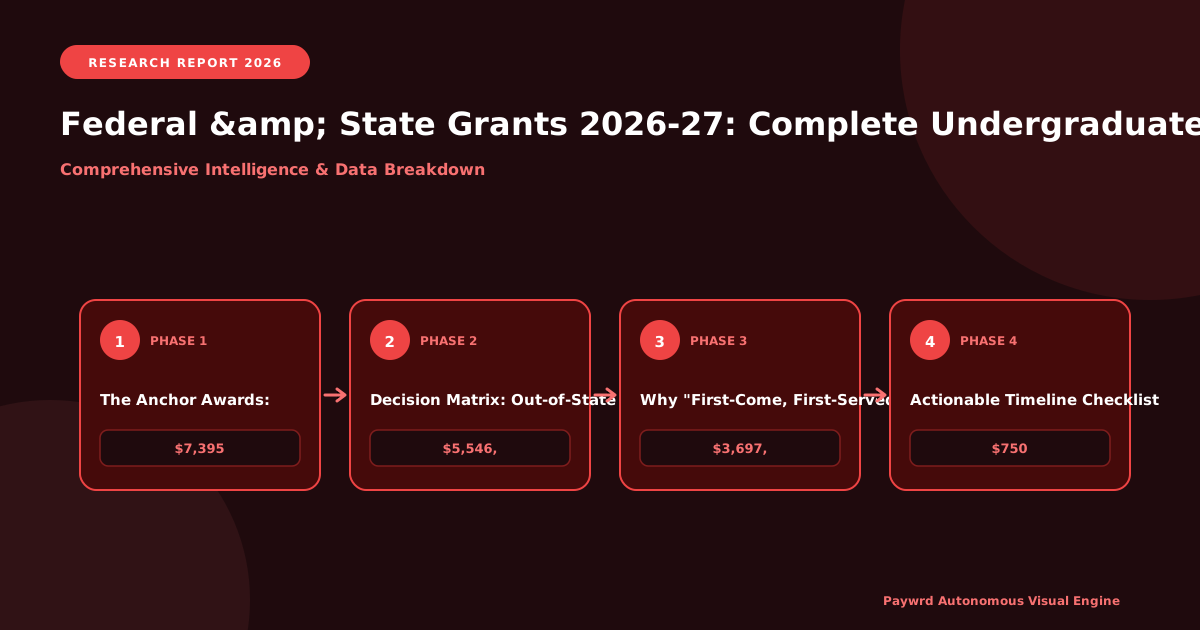
For the 2026-27 award year, the U.S. Department of Education has confirmed a Federal Pell Grant maximum award of $7,395 for students enrolled full-time across the standard academic calendar. This baseline figure represents a modest upward adjustment from prior cycles, reflecting the inflationary indexing provisions embedded in the FAFSA Simplification Act. Students attending less-than-full-time will see their awards prorated according to enrollment intensity, with three-quarter-time awards around $5,546, half-time awards near $3,697, and less-than-half-time recipients receiving the statutory minimum of $750. Because the Pell Grant remains the largest single source of free money for undergraduate learners, understanding how the new Student Aid Index (SAI) interacts with this award is essential for every family planning a college budget.
The shift from the Expected Family Contribution (EFC) to the SAI marks the most consequential eligibility recalculation in two decades. Under the simplified FAFSA, a student qualifies for the maximum Pell award when their SAI falls between -$3,000 and 0. Those with an SAI ranging from 1 to 6,000 still receive partial awards, though the sliding-scale formula deducts roughly 50 percent of the calculated need above zero. For the 2026-27 cycle, the Department estimates that more than 5.2 million undergraduate students will qualify for some Pell funding, with approximately 1.4 million receiving the full $7,395. Notably, the new methodology eliminates the “mini-pell” gap that previously stranded middle-income families whose EFC hovered just above the cutoff but whose actual college costs remained painfully high.
- Federal Supplemental Educational Opportunity Grant (FSEOG): Capped at $4,000 per academic year, with a typical award ranging from $100 to $600 depending on institutional packaging policy. FSEOG funds are first-come, first-served and must be prioritized for students with the lowest SAI who also receive Pell. Schools participating in the campus-based programs receive a fixed federal allocation each year, so early FAFSA submission (ideally by February 1, 2026) dramatically improves selection odds.
- Teacher Education Assistance for College and Higher Education (TEACH) Grant: Provides up to $4,000 annually for students completing coursework necessary to begin a career in teaching. Recipients must sign a service obligation agreement to teach full-time for at least four complete academic years within eight years of completing their program, in a high-need field at a low-income school serving Title I populations.
- Iraq and Afghanistan Service Grants: While not a Pell-equivalent in name, this award provides the same maximum ($7,395) to students whose parent or guardian died in military service post-9/11 and who do not otherwise qualify for Pell due to financial-eligibility non-pell criteria.
The TEACH Grant deserves special attention because its conversion penalty is severe: any failure to complete the four-year teaching obligation transforms the grant into an unsubsidized Direct Loan, with interest capitalized from the original disbursement date. Recipients must maintain a 3.25 GPA, complete annual counseling, and have their service verified by the school’s Chief Academic Officer or TEACH Grant contact. Prospective educators should download the TEACH Grant Counseling Worksheet from the Federal Student Aid portal and document every milestone carefully. As a practical step, students should request a counseling session at the campus financial aid office immediately after receiving their award notification and set calendar reminders for each annual deadline.
Beyond the headline awards, the 2026-27 cycle reinforces three actionable priorities for undergraduate applicants: file the FAFSA as early as possible (the priority deadline for many state grants falls on March 1, 2026), use the IRS Data Retrieval Tool to ensure SAI accuracy and avoid verification delays, and document any special circumstances such as job loss, medical expenses, or homelessness that may justify a professional judgment review. Families should also be aware that the new Pell eligibility matrix allows single parents, independent students, and certain married couples to qualify for the full award with household earnings approaching $70,000 in some states, a meaningful expansion over the legacy EFC era. The bottom line: with disciplined planning, the federal grant ecosystem remains the most reliable foundation for an affordable undergraduate education, especially when layered with state aid, institutional scholarships, and education tax benefits.
State Grant Portability: Which Awards Cross State Lines?

One of the most expensive assumptions a family can make is believing their state grant travels with their student. For the vast majority of programs, it does not. Understanding the difference between portable awards and anchor awards is critical before you finalize that out-of-state acceptance letter. For the 2026-27 cycle, the landscape remains fragmented: roughly 85% of state grant dollars are restricted to in-state institutions, but the remaining 15%—governed by regional compacts—can unlock significant tuition discounts if you know where to look.
The Anchor Awards: Strictly In-State Heavyweights
High-population states with massive merit and need-based programs almost universally restrict funds to residents attending in-state colleges. If you leave the state, you leave the money behind.
- Cal Grant (California): Requires attendance at a qualifying California institution. No portability for out-of-state public or private schools.
- NY TAP (New York): The Tuition Assistance Program is exclusively for New York residents attending approved schools in New York State.
- TX Grant (Texas): The Toward EXcellence, Access, and Success Grant is tied to Texas public universities and select private/independent institutions within Texas.
- Florida Bright Futures / EASE: Both require enrollment at an eligible Florida postsecondary institution.
Actionable Takeaway: If you are a resident of California, New York, Texas, or Florida planning to attend an out-of-state public university, budget $0 from your home state grant. You must rely on federal aid, institutional merit, or the destination state’s non-resident aid (which is rare).
The Portable Powerhouses: Regional Reciprocity Compacts
Regional agreements allow students to pay reduced tuition—often 150% of in-state rates rather than full non-resident sticker price—at public institutions in neighboring states. Crucially, some states allow their need-based grants to follow the student only within these compacts.
- WICHE (Western Interstate Commission for Higher Education) – WUE Program: Covers 16 states/territories (WA, OR, CA, NV, ID, MT, WY, UT, CO, AZ, NM, HI, AK, ND, SD, CNMI). Key Nuance: WUE is a tuition discount, not a grant. However, states like Colorado and Washington allow specific state grants (e.g., Colorado Student Grant, Washington College Grant) to be used at WUE partner institutions.
- MSEP (Midwest Student Exchange Program): Covers 9 states (IL, IN, KS, MI, MN, MO, NE, ND, WI). Public institutions cap tuition at 150% of in-state rates. Portability: Minnesota State Grant and Indiana Frank O’Bannon Grant can travel to MSEP schools, but Illinois MAP Grant cannot.
- NEBHE (New England Board of Higher Education) – RSP (Regional Student Program): Covers CT, ME, MA, NH, RI, VT. Allows tuition break for majors not offered in home state. Portability: Generally no state grant portability (MASSGrant, for example, stays in MA), but the tuition savings act as a de facto grant.
- SREB (Southern Regional Education Board) – Academic Common Market: Covers 15 Southern states. Focuses on graduate/unique undergrad majors. Very limited undergraduate grant portability.
Decision Matrix: Out-of-State Public vs. Private
Use this matrix to estimate your 2026-27 net price before appealing aid packages.
- Scenario A: Out-of-State Public University (Within Compact)
Example: Oregon resident attending University of Utah (WUE).
Tuition: ~150% of Utah resident rate.
Home State Grant: Portable? Check specific agency (OR Opportunity Grant is not portable; WA College Grant is).
Strategy: Apply for destination state’s non-resident scholarships (often automatic with admission). - Scenario B: Out-of-State Public University (No Compact)
Example: Texas resident attending University of Michigan.
Tuition: Full non-resident sticker price (~$58k+).
Home State Grant: Zero portability (TX Grant stays in TX).
Strategy: Only viable with high institutional merit or federal Pell/FSEOG. Negotiate using competing offers. - Scenario C: Out-of-State Private Non-Profit
Example: Massachusetts resident attending Boston College (in-state private) vs. Villanova (out-of-state private).
Tuition: Same sticker price for all.
Home State Grant: MASSGrant works at BC (in-state) but not at Villanova.
Strategy: Private colleges often meet full need regardless of state residency. Prioritize schools with strong institutional need-based aid (CSS Profile required).
Pro Tip: Before depositing, call the financial aid office of the destination school and ask: “Does my [Home State Grant Name] apply here for 2026-27?” Get the answer in writing. State regulations shift annually; the 2026-27 FAFSA cycle includes updated state deadlines (many moved to March 1 or April 1 priority dates) that determine portability eligibility.
FAFSA Submission Timeline: Critical 2026-27 Priority Deadlines
The 2026-27 FAFSA cycle officially opens on October 1, 2025, marking the starting gun for billions of dollars in federal, state, and institutional aid. While the federal deadline technically stretches to June 30, 2027, treating that date as your target is a costly strategic error. The real money—specifically Federal Supplemental Educational Opportunity Grants (FSEOG) and state-specific grant pools—operates on a strict first-come, first-served basis. Once a school’s FSEOG allocation is exhausted or a state’s priority deadline passes, the doors close for that award year, regardless of your eligibility.
Understanding the “priority deadline” distinction is your single highest-leverage action. States like California (March 2, 2026) for Cal Grants, Texas (January 15, 2026) for the TEXAS Grant, and Indiana (April 15, 2026) for the Frank O’Bannon Grant enforce hard cutoffs. Missing these by even a day often means forfeiting thousands in free money that does not need to be repaid. We strongly recommend treating the earliest deadline on your list—whether it is a state priority date or an institutional scholarship cutoff—as your personal “submit by” date.
Why “First-Come, First-Served” Dictates Your Strategy
FSEOG funds are allocated to participating schools in a fixed annual lump sum. Financial aid administrators award these grants—ranging from $100 to $4,000 per year—to students with “exceptional financial need” (typically Pell-eligible students with the lowest Student Aid Index) in the order applications are received. If you file in January but your school exhausted its FSEOG allocation in November, you receive $0 from that pot, even if your need is identical to a student who filed in October. The same mechanic drives state grant pools; Texas and Illinois are notorious for depleting funds months before their published deadlines.
Actionable Timeline Checklist
- September 2025: Create your FSA ID (and a parent FSA ID if dependent) to avoid authentication bottlenecks on opening day.
- October 1, 2025: Submit the FAFSA the moment it opens. Use the IRS Data Retrieval Tool (DRT) to auto-populate 2024 tax data; this reduces verification flags and speeds processing.
- October–November 2025: Complete the CSS Profile if applying to ~250 mostly private institutions. Check each college’s specific priority deadline—many are November 1 or 15 for Early Decision/Action applicants.
- January 15, 2026: Hard deadline for Texas state aid (TEXAS Grant, TEOG).
- March 2, 2026: Hard deadline for California Cal Grants (requires verified GPA submission by this date as well).
- April 15, 2026: Deadline for Indiana state aid.
- Ongoing: Monitor your Student Aid Report (SAR) and college portals weekly for verification requests. Unresolved verification freezes all disbursements.
Pro Tip: If your financial situation has changed drastically since the 2024 tax year (job loss, medical expenses, divorce), submit the FAFSA on time using the required 2024 data, then immediately contact the financial aid offices of your target schools to request a Professional Judgment (Special Circumstances) review. This two-step approach preserves your place in the queue for limited funds while opening the door for an adjusted aid package.
Maximizing Eligibility: Asset Protection & Income Strategies
Understanding how the U.S. Department of Education calculates your Expected Family Contribution (EFC) — soon to be formally replaced by the Student Aid Index (SAI) under the FAFSA Simplification Act — is the single most powerful lever families can use to maximize their undergraduate aid eligibility. For the 2026-27 award year, the financial aid methodology continues to reward families who strategically manage reportable assets and minimize adjusted gross income (AGI). Three core mechanisms drive most of the impact: the Asset Protection Allowance (APA) for parents, the differential treatment of student versus parent assets, and the nuanced rules governing 529 college savings plans.
The Asset Protection Allowance (APA) is a formula-driven shelter that excludes a portion of a family’s net worth from the FAFSA calculation. For parents with one dependent child, the APA for 2026-27 begins shielding assets at approximately $0 and rises incrementally based on the age of the older parent, reaching roughly $11,000 when the older parent is age 45 and climbing to approximately $51,000 by age 65. With two parents, the allowances are higher, and they increase further when multiple children are enrolled in college simultaneously — a critical detail often overlooked by families with more than one undergraduate. Assets held in retirement accounts (401(k), 403(b), traditional and Roth IRAs) are completely excluded from the FAFSA asset calculation, making retirement contributions one of the most powerful aid-eligibility strategies available to middle- and upper-middle-class households.
- 20% Student Asset Assessment: Unlike parent assets, which are assessed at a maximum rate of 5.64%, student-owned assets are assessed at a flat 20%. This means every $1,000 in a custodial account, savings account, or UTMA held in the student’s name reduces aid eligibility by roughly $200 — nearly four times the impact of the same dollars held by a parent.
- 529 Plans Owned by Grandparents: Effective with the 2024-25 FAFSA, 529 accounts owned by grandparents, aunts, uncles, or any non-parent relative are not reported as assets on the FAFSA and will not be assessed until distributed. However, once a distribution is taken, it counts as untaxed income to the student — and student income is assessed at 50% against aid. Strategic families often delay grandparent 529 withdrawals until the junior year or later, when FAFSA renewal requirements cease.
- 529 Plans Owned by Parents: These remain reportable parent assets, subject to the 5.64% assessment rate, but offer meaningful protection compared to taxable brokerage accounts.
Income reduction through tax-advantaged retirement contributions is the most actionable, same-year lever available. Every dollar contributed to a traditional 401(k), 403(b), SEP-IRA, or Traditional IRA directly lowers the AGI reported on the FAFSA, which uses prior-prior year (PPY) tax data. For the 2026-27 FAFSA, the relevant income year is 2024 tax returns. The 2024 IRA contribution limit is $7,000 (under age 50) and $8,000 (age 50+), while 401(k) elective deferrals max out at $23,000 (under 50) and $30,500 (age 50+). A family contributing the maximum $30,500 to a 401(k) reduces reportable income dollar-for-dollar, which can meaningfully shift SAI brackets and Pell Grant eligibility.
Model Scenario: Consider the Martinez family — two parents (ages 47 and 45), one rising freshman, $95,000 combined AGI on the 2024 return, $40,000 in parent-owned brokerage assets, and $12,000 in a student UTMA. If they maximize 401(k) contributions ($23,000 each = $46,000), their reportable AGI drops to roughly $49,000. Combined with the APA shelter of approximately $12,000 (older parent age 47) and the favorable treatment of parent assets at 5.64%, their SAI could fall into a Pell-eligible range, unlocking up to $7,395 in federal grant funding for 2026-27 — funds that would otherwise remain inaccessible.
- Actionable Takeaway 1: Shift student-held UTMA/custodial assets into a parent-owned 529 before filing the FAFSA to convert a 20% assessment rate into a 5.64% rate.
- Actionable Takeaway 2: Accelerate 401(k) contributions in the tax year preceding the FAFSA (PPY logic), not the award year.
- Actionable Takeaway 3: Coordinate with grandparents to time 529 distributions after the student’s junior year, avoiding the 50% student-income penalty.
- Actionable Takeaway 4: Verify state-specific 529 treatment, as states like New York, Illinois, and Indiana offer additional state-tax deductions layered on top of federal asset treatment.
For personalized planning, families should consult a Certified Financial Planner (CFP®) familiar with higher-education funding strategy, ideally cross-referenced with the College Board’s official Financial Aid Handbook and the U.S. Department of Education’s FAFSA Simplification resources before submitting the 2026-27 application.
Institutional Grant Stacking: Leveraging Federal/State Aid for Merit
Understanding how a university packages your aid is just as critical as securing the grants themselves. At most accredited US institutions—particularly those holding AACSB business accreditation or ABET engineering accreditation—financial aid administrators rely heavily on your federal and state grant data to construct your total award package. This process, often called institutional grant stacking, involves layering your Pell Grant, FSEOG, and state scholarship funds with the college’s own institutional grants to meet your demonstrated financial need. For the 2026-27 award year, with the Federal Pell Grant maximum confirmed at $7,395 and the FSEOG offering an additional $100 to $4,000, your institutional award will be calculated after these external sources are applied to your cost of attendance.
The concept of preferential packaging is where elite meets-need institutions—think Ivy League colleges and NESCAC schools like Amherst, Williams, and Bowdoin—differentiate themselves from public flagships. These highly selective institutions pledge to meet 100% of demonstrated financial need through grants, not loans. Crucially, they practice what aid officers call “need-blind admission with need-aware packaging” in reverse: they will not reduce your institutional grant simply because you qualify for a larger Pell Grant or a state merit scholarship. Instead, they stack the federal and state funds on top of their own commitment. If your family has a $0 expected family contribution (EFC) and receives the maximum Pell, the Ivy grant still covers the remaining gap between $85,000 in tuition and your total aid.
- Preferential Packaging (Meets-Need Schools): Federal and state grants supplement institutional aid. Your institutional grant is calculated to cover the full need, then external awards are layered on top, sometimes even triggering a refund check. Schools following this model include Harvard, Yale, Princeton, MIT, and every NESCAC member institution.
- Gap-Filling Packaging (Public Flagships): Many state universities—particularly large public flagships like the University of Michigan, UCLA, or the University of Virginia—treat federal and state grants as the primary funding source, then fill only the remaining gap with smaller institutional awards or merit scholarships. A $7,395 Pell Grant at a $14,000 in-state school dramatically reduces the institutional burden, but at an out-of-state cost of $42,000, a student often faces significant unmet need.
For high-achieving students, this distinction is financially monumental. If you are awarded a state merit scholarship like the Georgia HOPE Scholarship or the Florida Bright Futures program, an Ivy League or NESCAC school will permit you to apply those funds toward living expenses, books, or even a study-abroad term. Conversely, a public flagship may reduce your institutional merit award dollar-for-dollar to offset the state scholarship—a practice called scholarship displacement. Always read the financial aid award letter closely for language such as “this award may be reduced by other scholarships received.”
Actionable takeaway: Before submitting your FAFSA—which opens December 1, 2025, for the 2026-27 cycle—research each target school’s packaging policy directly on their financial aid webpage. Look for keywords like “no-loan packaging,” “need-blind admission,” or “outside scholarship policy.” If you are targeting a public flagship, ask the financial aid office whether merit scholarships are stackable with state awards. The difference in your final out-of-pocket cost could easily exceed $15,000 per academic year.
Post-Submission Verification & Appeal Protocols
After you click submit on the FAFSA form for the 2026-27 award year, your journey toward securing a Federal Pell Grant (currently peaking at $7,395), FSEOG, or state-based aid is not automatically over. Instead, you enter a critical administrative phase that determines whether your financial aid package is finalized, adjusted, or potentially expanded through formal appeal. Understanding the verification protocols, IRS Data Retrieval Tool (DRT) troubleshooting, and Professional Judgment (PJ) options empowers you to act with confidence when the U.S. Department of Education or your university’s financial aid office flags inconsistencies or your family experiences a qualifying life change. This section walks you through each step with clarity, so a technical glitch or unexpected hardship does not derail your educational funding.
Step 1: Monitor Your FAFSA Submission Status and Student Aid Report (SAR). Within 72 hours of submission, log into your Federal Student Aid (FSA) account using your FSA ID and review your SAR carefully. Look for a comment code (numeric codes 001–399) and any asterisk next to your Expected Family Contribution (EFC), which is now transitioning to the Student Aid Index (SAI) for the simplified needs analysis. A flagged SAR often means you have been selected for verification, requiring supporting documentation before your college financial aid administrator can finalize your award letter.
- V1 Verification Group (Standard): Requires tax transcripts, W-2 forms, identity verification, and a Verification Worksheet completed by the student and parent (if dependent). Most state flagship universities and ABET-accredited engineering programs rely heavily on this group.
- V4 Verification Group (Custom): Your school may request additional items beyond the standard set, such as proof of untaxed income, child support documentation, or housing allowance letters.
- V5 Verification Group (Aggregate): Used when the Department of Education issues specific flags related to identity theft, fraud, or unusual enrollment history. This group requires exhaustive third-party documentation.
Step 2: Resolve IRS Data Retrieval Tool (DRT) Failures Immediately. The DRT remains the fastest way to populate FAFSA income data directly from IRS records, but failures remain common for 2026-27 filers. If the tool returns an error message, first confirm that the IRS has processed your return (allow at least 3-4 weeks for e-file and 6-8 weeks for paper). You must also ensure your name, date of birth, and Social Security Number match exactly what the SSA has on file. If the DRT still rejects, request an IRS Tax Return Transcript (available at IRS.gov/Individuals/Get-Transcript) or use the IRS Form 1383-T. Submit these documents to your financial aid office with a signed statement certifying you attempted the DRT. Avoid using fake or estimated tax figures; doing so can trigger automatic rejection and delay disbursement of your Pell Grant and institutional scholarships by 30-60 days.
Step 3: Document Special Circumstances for a Professional Judgment (PJ) Appeal. Under federal law (HEA Section 479A), your school’s financial aid administrator has discretionary authority to adjust your FAFSA data based on documented special circumstances. This is not the same as a dependency override, which addresses your status on the form itself. A PJ appeal adjusts income or asset figures to reflect your family’s true ability to pay. Common qualifying events include:
- Job Loss or Reduction in Income: Provide a termination letter, final pay stubs, and a written employer statement confirming the layoff date. If a parent lost a $65,000-per-year position, your SAI may be recalculated to use current earnings, potentially unlocking an additional $1,500-$3,000 in need-based aid.
- Unreimbursed Medical Expenses: Submit Explanation of Benefits (EOB) statements, paid receipts, and a summary of out-of-pocket costs exceeding 7.5% of Adjusted Gross Income (AGI). Dental, vision, and mental health expenses count, provided they were not paid through a Health Savings Account (HSA) or Flexible Spending Account (FSA).
- Divorce or Separation: Provide the final decree, legal separation papers, or documented household separation with separate addresses. Note that the FAFSA base year for 2026-27 uses 2024 tax information, so a 2025 divorce must be accompanied by documentation of post-divorce income changes.
- Death of a Parent or Spouse: Submit the death certificate and updated Social Security survivor benefit documentation. Many institutions expedite these PJ requests within two weeks.
- Unusual One-Time Income Events: Retirement plan withdrawals, capital gains from a one-time asset sale, or insurance settlements can be excluded from the PJ calculation.
Step 4: Submit a Formal, Written Appeal with a Cover Letter. Most universities require a typed, signed letter addressed to the Director of Financial Aid. The letter should include your full name, Student ID, the specific circumstance, a chronological narrative, and a clear statement of the adjustment you are requesting. Attach supporting documents as labeled exhibits. For example, “Exhibit A: Termination Letter dated March 15, 2025; Exhibit B: Three consecutive pay stubs showing reduced hours.” Keep a complete copy for your records, and request a written response within 14 business days, in accordance with NACAC (National Association for College Admission Counseling) professional standards.
Step 5: Escalate If Necessary. If your school denies the PJ appeal and you believe the decision was inconsistent with federal guidelines, you may file a complaint with the FSA Ombudsman at the U.S. Department of Education (1-877-557-2575). You can also contact your state Attorney General’s higher education consumer protection unit or the relevant regional accreditor (such as the Higher Learning Commission for AACSB-accredited business schools). Maintain a timeline of every email, phone call, and submitted document; this audit trail is invaluable during an escalation.
Actionable Takeaway: Set up FSA account notifications, check your SAR within three days, and proactively prepare a PJ documentation folder before you even submit the FAFSA. When verification is approached with preparation instead of panic, the process becomes a routine administrative step rather than a roadblock, ensuring your 2026-27 award letter arrives accurately and on time.
| Aid Program | Max Award (2026-27) | Eligibility Cut-Off | Application Timeline | Career ROI |
|---|---|---|---|---|
| Federal Pell Grant | $7,395 | SAI ≤ $6,206 (max award) | FAFSA opens Oct 1, 2026; deadline June 30, 2027 | Undergraduate foundation; no repayment |
| FSEOG Grant | $4,000 | SAI ≤ $2,500; exceptional need | FAFSA + institutional award | Supplement to Pell; no repayment |
| TEACH Grant | $4,000/yr | GPA ≥ 3.25; teaching commitment | FAFSA + TEACH Agreement | High ROI: $16,000 max; converts to loan if unmet |
| State Need-Based Grant | $500–$12,000 (varies) | State residency + SAI threshold | State deadlines: Mar–May 2027 | Regional retention; stackable |
| Iraq & Afghanistan Service Grant | Equal to Pell max ($7,395) | Parent death in military service; non-Pell-eligible | FAFSA required | No repayment; targeted benefit |
Frequently Asked Questions
What is the maximum Federal Pell Grant award for 2026-27?
The U.S. Department of Education confirmed the 2026-27 Federal Pell Grant maximum at $7,395 for full-time enrollment. This reflects inflationary indexing under the FAFSA Simplification Act. Actual awards scale downward as Student Aid Index rises, with the minimum SAI cutoff for any Pell eligibility set at $6,206 for the cycle.
How does the FSEOG differ from the Pell Grant in 2026-27?
The FSEOG supplements Pell and awards up to $4,000 annually to undergraduates with exceptional financial need (SAI typically ≤ $2,500). Unlike Pell's universal federal funding, FSEOG is campus-based—limited funds are administered directly by participating schools, so early FAFSA submission dramatically improves award odds.
What GPA is required for the TEACH Grant in 2026-27?
TEACH Grant recipients must maintain a 3.25 cumulative GPA, complete a high-need teaching program, and sign a service agreement to teach four years in a low-income school within eight years of graduation. Failure converts the grant—a $4,000 yearly maximum—into an unsubsidized Stafford loan with retroactive interest.
When should students submit the FAFSA for 2026-27 aid?
The FAFSA for the 2026-27 award year opens October 1, 2026. Submitting within the first three months maximizes eligibility for campus-based aid like FSEOG and many state grants, which often operate on a funds-available basis. Federal deadline is June 30, 2027, but state deadlines fall between January and April.
Strategic Final Takeaway
Success in evaluating Federal & State Grants 2026-27: Complete Undergraduate Aid Guide relies on early preparation, adherence to verified accredited requirements, and cross-referencing official portals. Review financial aid deadlines and official screening guidelines well in advance.