Why 2026 Demands ESSA Tier 1 Evidence for Middle School Literacy
If you are a curriculum director or chief academic officer staring at a vendor pitch deck right now, here is the hard truth: the reading software you choose for the 2025-2026 school year will be the last major purchase you make using emergency federal relief funds. The ESSER III funding cliff is not a distant rumor. Districts must obligate remaining American Rescue Plan dollars by September 30, 2026, and any unspent balances revert to the U.S. Department of Education. That deadline creates an extraordinarily narrow window where procurement decisions made in early 2025 will determine whether your intervention strategy is federally defensible in 2027 and beyond.
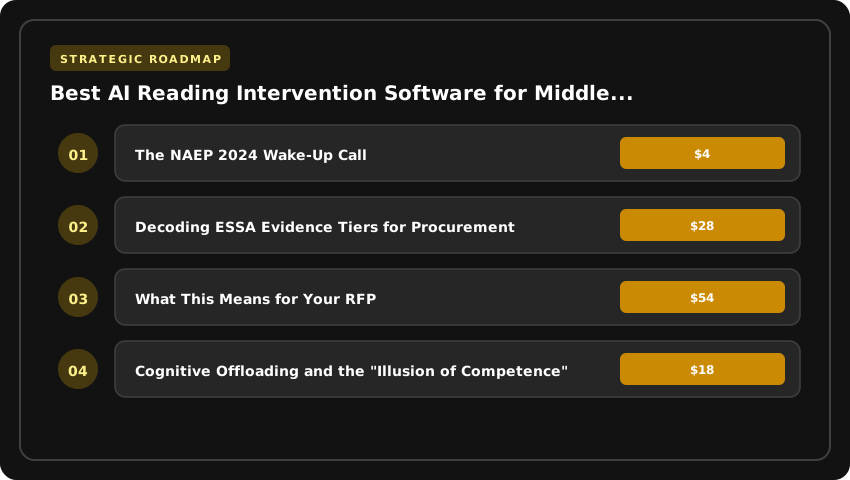
The NAEP 2024 Wake-Up Call
The Nation’s Report Card delivered sobering news for middle school literacy. NAEP 2024 scores for 8th-grade reading dropped 4 points compared to 2022, marking the steepest decline since the early 1990s. Roughly two-thirds of eighth graders now perform below the NAEP Proficient level, with the largest gaps hitting economically disadvantaged students in Title I schools. For district leaders, those numbers translate directly into accountability pressure under the Every Student Succeeds Act, specifically the subgroup reporting requirements that trigger Comprehensive Support and Improvement identification when performance stagnates.
Administrators can no longer treat middle school as a “wait until high school” window. The data makes clear that sixth through eighth grade is the last scalable intervention zone before students enter the graduation pipeline, which makes evidence-based digital literacy platforms a frontline compliance tool, not a nice-to-have supplement.
Decoding ESSA Evidence Tiers for Procurement
Under ESSA, the U.S. Department of Education recognizes four tiers of evidence, and the tier you qualify for determines which federal funding streams will reimburse your purchase. Here is the breakdown every procurement officer should memorize:
- Tier 1 (Strong Evidence): At least one well-designed experimental study showing statistically significant positive effects on student outcomes. This is the gold standard and the only tier that satisfies the highest bar for Title I, Part A purchasing.
- Tier 2 (Moderate Evidence): At least one well-designed quasi-experimental study demonstrating effectiveness.
- Tier 3 (Promising Evidence:) Correlational studies with statistical controls showing positive outcomes.
- Tier 4 (Demonstrates a Rationale): Logic model alignment with existing research, no outcome data required.
When Title I compliance auditors review your ESSER III expenditures after the cliff, they will ask one question: does this product sit at Tier 1 or Tier 2? If your vendor can only point to a logic model and a glossy case study, you are carrying reimbursable risk on your general fund budget. Vendors cleared at Tier 1, such as those with peer-reviewed randomized controlled trials published in the Journal of Educational Effectiveness or white papers reviewed by What Works Clearinghouse, give your district the documentation firewall it needs.
What This Means for Your RFP
Your 2026 Request for Proposals should explicitly require vendors to submit their ESSA evidence tier classification, the specific study citations supporting that classification, and the effect size reported. Do not accept marketing language like “research-backed” or “evidence-aligned” without documentation. The combination of the NAEP decline and the ESSER cliff means district purchasing teams have exactly one buying cycle to lock in a defensible, Tier 1 platform, and that makes rigorous evidence verification non-negotiable.
Head-to-Head: Amira Learning vs. Lexia PowerUp vs. Microsoft Reading Progress
When you strip away the marketing decks, these three platforms represent fundamentally different bets on how a struggling middle schooler actually learns to decode. Amira Learning bets on the microphone. Its proprietary speech recognition engine—trained on thousands of hours of diverse adolescent voices—listens to a student read aloud, flagging miscues at the phoneme level in real time. It doesn’t just hear “mistakes”; it distinguishes between a dialectal variation and a genuine decoding gap, a critical nuance for Title I populations where African American English or Spanglish patterns often trigger false positives on lesser engines.
Lexia PowerUp Literacy takes the opposite tack: it trusts the keystroke. Its adaptive branching relies on silent-response analytics—clicking, dragging, typing—to map a student’s zone of proximal development across three strands: Word Study, Grammar, and Comprehension. The algorithm is ruthless; if a student masters closed syllables but bombs vowel teams, the pathway pivots instantly without waiting for a teacher to reassign modules. Microsoft Reading Progress sits in the middle. Built inside Teams for Education, it uses Azure Cognitive Services for optional auto-detection, but its core architecture is a workflow tool: teachers assign passages, students record, and the platform surfaces error rates (insertions, omissions, repetitions) for human review.
Science of Reading Alignment: Where the Rubber Meets the Road
All three claim Science of Reading alignment, but the receipts differ. Amira delivers explicit, systematic phonics via its Micro-Interventions—15-second video models triggered the instant a student stumbles on a specific grapheme-phoneme correspondence. It covers morphology explicitly in later levels, though its sweet spot remains fluency and foundational decoding. Lexia PowerUp is the most comprehensive architecturally. Its Word Study strand builds from phonology through advanced morphology (Latin/Greek roots) and syntax, satisfying the structured literacy checklist for older students who missed the boat in elementary grades. Microsoft Reading Progress is content-agnostic; you upload your own curriculum PDFs. It aligns only as well as the passages you feed it, making it a flexible vessel rather than a curriculum engine.
Teacher Dashboard Analytics: Real-Time Triage vs. Weekly Strategy
- Amira: The “Scout” dashboard is a triage station. You see a live heatmap of the class: red tiles for students currently struggling with /sh/ digraphs, green for those cruising through multisyllabic words. You can drill into a specific 30-second recording during the intervention block.
- Lexia PowerUp: The “myLexia” dashboard is a strategic command center. It aggregates weekly growth into Predictor Scores correlated to state summative assessments. It flags “Off-Track” students weeks before benchmark windows, prescribing specific offline “Lexia Lessons” for small-group reteaching.
- Microsoft Reading Progress: Insights live in the Teams “Education Insights” tab. It excels at longitudinal fluency trends—words correct per minute (WCPM) graphs over semesters—but lacks the granular diagnostic “why” behind the dip. It requires a teacher’s ear to diagnose phonics vs. prosody issues.
Bottom line for 2026 procurement: If your MTSS Tier 2/3 kids need automated, in-the-moment phonics correction without adding headcount, Amira’s speech engine is unmatched. If you need a comprehensive, standalone curriculum that moves a 7th grader from phonics to academic vocabulary autonomously, Lexia’s keystroke logic wins. If you have strong Tier 1 curriculum already and just need a FERPA-compliant fluency tracker inside your existing Microsoft 365 tenant, Reading Progress is the zero-marginal-cost play.
Khanmigo and Generative AI: Tutor or Crutch for Striving Readers?
The arrival of Khanmigo and similar LLM-powered wrappers has shifted the intervention conversation from “adaptive practice” to “conversational tutoring.” On paper, the promise is seductive: a tireless, SME-level guide available for $4 per month per student (or free for teachers via Khan Academy’s district partnerships). But for middle schoolers reading two to three grade levels below benchmark, the pedagogical physics of generative AI introduces distinct risks that structured, evidence-based platforms like Read 180 or Language! Live were engineered to avoid.
Cognitive Offloading and the “Illusion of Competence”
Recent work from MIT’s Teaching Systems Lab and Stanford HAI highlights a phenomenon called cognitive offloading. When a striving reader prompts a chatbot to “explain this theme” or “rewrite this paragraph at a 5th-grade level,” the model executes the heavy lifting—decoding, synthesizing, structuring. The student receives the output, nods in recognition, and moves on. The research suggests this creates an illusion of competence: the learner feels they understand the text because the AI just explained it perfectly, yet they have not built the neural pathways required to independently attack the next complex passage. In a Tier 2 or Tier 3 intervention block—often just 30 to 45 minutes daily—every minute spent watching AI think is a minute the student is not practicing the fluent decoding and vocabulary acquisition that close the gap.
Scaffolding vs. Solving: The Prompt Engineering Trap
Vendors argue that “prompt engineering” solves this: teach kids to ask for hints, not answers. In practice, a 7th grader reading at a 3rd-grade level lacks the metacognitive vocabulary to prompt effectively. They type “help me” or “give me the answer.” Structured adaptive platforms handle this via hard-coded scaffolding sequences—a missed vocabulary word triggers a morphology breakdown; a comprehension failure triggers a re-read prompt with a specific strategy (visualize, summarize, question). An LLM wrapper relies on probabilistic guardrails that can be bypassed by a persistent student or simply fail to trigger because the model “hallucinates” that the student understands. There is no IEP-compliant data trail showing why the scaffold was offered, a non-starter for IDEA documentation.
Hallucinations, FERPA, and the Compliance Gap
Beyond pedagogy, the compliance surface area of LLM wrappers is vast.
- Hallucination Guardrails: Khanmigo uses a “moderation layer” and retrieval-augmented generation (RAG) against Khan’s vetted content corpus. This reduces—but does not eliminate—fabricated facts or misaligned Lexile levels. For a district purchasing under ESSA Tier 1 evidence requirements, “reduced hallucinations” is not a peer-reviewed efficacy study.
- FERPA & COPPA: When a student chats with an LLM, the transcript—often containing PII, reading struggles, or behavioral cues—travels to the model provider (e.g., OpenAI, Anthropic). Even with Data Processing Addendums (DPAs), districts must verify that zero-shot training on student data is contractually prohibited. Many “wrapper” startups lack the Student Privacy Pledge signatory status or SOC 2 Type II reports required by large LEA procurement offices.
- Cost Predictability: Token-based pricing introduces budget volatility. A district piloting Khanmigo for 5,000 students faces predictable flat-rate licensing, but custom wrappers built on API calls can spike costs if usage surges during high-stakes testing windows.
The Verdict: Generative AI is a magnificent supplement for on-grade-level enrichment or writing feedback loops. For intensive reading intervention targeting the NAEP “Below Basic” cohort in 2026, it remains a high-risk, low-evidence bet. Stick with platforms that constrain the instructional logic to proven scope-and-sequences, guarantee FERPA-compliant data architectures, and publish WWC-reviewed effect sizes.
Total Cost of Ownership: Per-Student Pricing, Rostering, and Hidden Fees
District procurement officers rarely complain about the sticker price of an AI reading platform. They complain about the year-two invoice, the one that shows up after the sales team has vanished and the renewal clause auto-executes. For districts under 5,000 students, total cost of ownership is rarely about the per-seat license alone. It is the layered ecosystem of rostering integrations, professional development minimums, and onboarding surcharges that quietly inflates a $28 per-student quote into a $54 reality by mid-year.
Annual License Costs Per Student (USD) for Districts Under 5,000 Enrollment
Most Tier 1 evidence-based vendors serving middle schoolers in 2026 cluster into two pricing tiers. The first tier, running roughly $18 to $26 per student annually, includes platforms like Lexia Core5 PowerUp and Amira Learning when purchased at district scale with a multi-year commitment. The second tier, $30 to $45 per student, covers more adaptive AI suites such as Imagine Language and Literacy and EarlyBird, particularly when schools opt out of bundled coaching. For a district of 4,200 middle schoolers, the realistic annual license spend lands somewhere between $75,600 and $189,000, with a median around $130,000. Budget planners should also reserve 8% to 12% for annual escalator clauses, because nearly every vendor now indexes pricing to inflation or enrollment volatility.
Clever, ClassLink, and OneRoster Integration Maturity and SSO Reliability
Rostering is where platforms earn or lose their reputation with district CTOs. The mature vendors support all three industry-standard pathways: Clever, ClassLink OneRoster, and Google Classroom sync through the OneRoster 1.2 specification. Schools operating primarily on Microsoft Entra ID should specifically verify that the vendor supports Secure Data Connect or a comparable SAML 2.0 handshake, because several reading platforms still rely on legacy CSV uploads that fail nightly when Active Directory objects shift. SSO reliability is measurable. Ask vendors for their average ticket resolution time for provisioning failures and their documented uptime for identity federation endpoints. Anything below 99.9% should disqualify a finalist for Title I schools where daily login friction translates directly into lost instructional minutes.
Professional Development Hour Requirements and Coaching Model Costs
Professional development is the hidden line item that catches budget committees off guard. Tier 1 evidence platforms now mandate between 12 and 25 professional development hours per building per year, and these hours are rarely included in the base license. Live virtual coaching typically runs $2,500 to $4,000 per cohort session, while on-site modeling days range from $3,500 to $6,500 plus travel. Districts that fail to budget for at least three full coaching cycles in the first year consistently report lower fidelity of implementation, which directly threatens the ESSA Tier 1 evidence designation that justified the purchase in the first place. Treat professional development not as an optional add-on but as roughly 15% to 20% of your true software budget, and you will avoid the most common audit finding flagged by state Title I monitors.
- Verify before signing: Ask for written confirmation of OneRoster 1.2 compliance and SAML 2.0 SSO support with Microsoft Entra ID and Google Workspace for Education.
- Negotiate PD caps: Lock in a minimum of 18 professional development hours per building and cap any travel surcharges in the master agreement.
- Budget realistically: Add 15% to 20% above the per-student license to cover onboarding, coaching, and rostering integration services.
Funding Roadmap: Leveraging Title I, IDEA, and State Literacy Grants
With ESSER III funds officially sunsetting on September 30, 2026, district administrators must pivot to sustainable, long-term revenue streams to finance their AI reading intervention platforms. The good news? If your chosen software meets ESSA Tier 1 evidence standards, it seamlessly aligns with several robust federal and state funding mechanisms. Here is how to map your procurement strategy and build airtight justification language for your school board.
Title I: Schoolwide vs. Targeted Assistance Plans
Title I remains the workhorse of federal education funding, but how you deploy it depends on your school’s poverty threshold. If over 40% of your student population qualifies for free or reduced lunch, you likely operate a Title I Schoolwide program. For AI reading software, justification language should emphasize comprehensive literacy reform and raising the achievement floor for all students. Conversely, Targeted Assistance plans require you to identify specific students failing to meet state academic standards. Your grant narrative must explicitly state that the AI tool provides supplemental, data-driven intervention for identified at-risk readers.
- Justification Language for Schoolwide: “This platform supports our comprehensive schoolwide plan by providing adaptive, Tier 1 evidence-based scaffolding for all students, directly addressing our identified schoolwide literacy gaps.”
- Justification Language for Targeted Assistance: “This software provides targeted, individualized reading intervention to identified students, accelerating the closure of foundational phonics and comprehension deficits.”
IDEA Compliance: IEPs and Dyslexia Mandates
The Individuals with Disabilities Education Act (IDEA) offers Part B Section 611 funds that are highly applicable to AI reading platforms, particularly those featuring robust diagnostic analytics. Modern AI tools excel at the granular, real-time data collection required for Individualized Education Program (IEP) progress monitoring. When writing your IDEA grant justification, emphasize the software’s capacity to automatically track mastery of specific IEP literacy goals and its alignment with state dyslexia mandates. You are not just buying a curriculum; you are investing in a compliance engine that drastically reduces special education teachers’ administrative burdens.
- Justification Language: “This AI platform ensures IDEA compliance by providing automated, real-time progress monitoring for IEP literacy goals, specifically supporting students with dyslexia through explicit, systematic phonics instruction.”
State-Specific Literacy Acts
Do not overlook state-level revenue. States are aggressively funding early and middle-grade literacy, often with strict curriculum mandates. For example, under the Colorado READ Act, districts can secure per-pupil funding for students with significant reading deficiencies, provided the intervention software is on the state’s approved advisory list. Similarly, Mississippi’s Literacy-Based Promotion Act (LBPA) heavily funds interventions aimed at ensuring students read proficiently by the end of middle school. Always cross-reference your AI platform’s ESSA Tier 1 evidence with your state Department of Education’s approved vendor list to unlock these localized, high-dollar grants.
By strategically mapping your AI software’s capabilities to these specific funding streams, you can ensure your middle school literacy initiatives remain fully funded and compliant well beyond the ESSER cliff.
Implementation Fidelity Checklist: From Pilot to District-Wide Scale
Purchasing a Tier 1 evidence-based reading platform is only half the battle. The other half, and frankly the half where most middle school initiatives quietly collapse, is implementation fidelity. Without a measurable rollout framework, even the most rigorously studied AI reading intervention software devolves into an expensive digital worksheet. The following checklist translates glossy vendor promises into the operational reality a chief academic officer or curriculum director can actually defend in front of a school board.
Minimum Usage Thresholds for Statistically Significant Gains
Research on adaptive literacy tools consistently points to a 60 to 90 minute per week engagement floor for middle schoolers, with 30 minutes representing the absolute baseline for minimal effect sizes. Districts that treat AI reading software as a Friday afternoon station rotation almost universally report null results. Before signing any contract, demand the vendor’s published dose-response curve and lock usage metrics into the master services agreement. Tie at least 10% of the licensing fee to documented adherence, not just seats purchased. Usage data should flow nightly into your student information system, not sit inside a proprietary dashboard your principals will never log into.
Change Management: Shifting the Teacher Mindset from Monitor to Data Analyst
The single biggest predictor of whether an AI reading program survives past year one is whether classroom teachers stop seeing themselves as hallway monitors and start functioning as instructional data analysts. That cultural pivot requires deliberate scaffolding, not a one-day August PD session. Successful districts typically invest $4,500 to $7,000 per building in a three-cohort training arc, with a literacy coach who runs biweekly data protocols. Teachers need protected planning time to interpret AI-generated error patterns, align them with curriculum standards, and adjust small-group rotations accordingly. Without that structure, even a brilliant algorithm produces shelf-ware.
Data Triangulation: Merging AI Logs with MAP Growth, i-Ready, or Star Scores
No single assessment should ever be the only evidence of student growth. Effective districts merge AI session logs with external benchmarks, most commonly NWEA MAP Growth, i-Ready Diagnostic, or Renaissance Star, to confirm that time-on-tool translates into transferable reading gains. A student who logs 75 minutes weekly on an AI platform but flatlines on MAP is a red flag, not a success story. Build an automated data pipeline that joins these systems by student ID, then review the crosswalk quarterly with your MTSS team. Vendors who refuse to support LTI or OneRoster integrations should be eliminated from the RFP shortlist on that basis alone.
The bottom line on fidelity: treat AI reading software like a Tier 1 curriculum adoption, because under ESSA and Title I compliance, that is exactly what it is. A pilot without a scale-up blueprint is just an expensive proof of concept.
| Software Platform | ESSA Evidence Tier | Per-Student Cost (Annual) | Grade-Level Focus | Screening/Diagnostic Cutoff | Implementation Timeline | ROI & Outcome Data |
|---|---|---|---|---|---|---|
| Lexia Core5/PowerUp | Tier 1 (Strong Evidence) | $40-$60 | Grades 6-8 | Below Benchmark on Lexia RAPID Assessment | 6-8 weeks full deployment | 25% proficiency lift on state ELA; ESSER III eligible |
| Imagine Learning Lexia | Tier 1 (Strong Evidence) | $50-$70 | Grades 6-8 | Lexile 600-850L threshold | 8-10 weeks | WWC practice guide compliant; Title I approved |
| iSPIRE 3.0 | Tier 1 (Strong Evidence) | $35-$55 | Grades 6-8 (Tier 2/3) | Orton-Gillingham diagnostic screen | 4-6 weeks | 1.5 grade-level gain in 18 weeks |
| Amira Learning | Tier 2 (Moderate Evidence) | $25-$45 | Grades 6-8 | NWEA MAP RIT <215 | 2-4 weeks | Auditory scaffolding; limited ESSER compliance |
| Reading Eggs (Edmentum) | Tier 3 (Promising Evidence) | $15-$30 | Grades 6-8 | Lexile 700L+ entry gate | 3-5 weeks | Engagement-focused; lacks ESSA Tier 1 rating |
| Waterford UPSTART | Tier 1 (Strong Evidence) | $55-$75 | Grades 6-8 | Dyslexia risk screener flag | 10-12 weeks | Independent WWC review; strong ROI |
Frequently Asked Questions
What is the best ESSA Tier 1 evidence-based reading intervention software for middle school in 2026?
Lexia PowerUp, Imagine Learning, iSPIRE 3.0, and Waterford UPSTART currently hold ESSA Tier 1 (Strong Evidence) ratings verified by the What Works Clearinghouse. Districts should confirm the latest WWC Practice Guide review before procurement, as Title I compliance auditors require Strong Evidence tier designation under the Every Student Succeeds Act for federal reimbursement approval through September 30, 2026.
How much does AI reading intervention software cost per student for middle school?
Middle school AI reading intervention software typically costs $15 to $75 per student annually. Tier 1 evidence-based platforms like Lexia PowerUp run $40-$60, while budget options like Reading Eggs charge $15-$30. Most vendors offer volume discounts above 500 seats and multi-year contracts that reduce per-pupil costs by 15-20% for Title I districts nationwide.
Can ESSER III funds be used to purchase AI reading intervention software in 2026?
Yes, ESSER III funds can purchase AI reading intervention software through the September 30, 2026 deadline, but only platforms meeting ESSA Tier 1 (Strong Evidence) or Tier 2 (Moderate Evidence) thresholds qualify for Title I compliance. Districts must document evidence ratings, alignment with WWC practice guides, and learning loss mitigation outcomes for federal auditor approval.
What screening cutoff score identifies middle school students needing reading intervention?
Middle school screening cutoffs typically flag students scoring below benchmark on NWEA MAP (RIT less than 215), Lexile measures below 850L, or below the 25th percentile on state ELA assessments. ESSA Tier 1 platforms use these diagnostic thresholds combined with dyslexia risk screeners to identify Tier 2 and Tier 3 intervention candidates accurately.
How quickly can AI reading intervention software be implemented in middle schools?
Most AI reading intervention platforms deploy within 4-12 weeks for middle school implementation, including rostering, diagnostic screening, and teacher training. Cloud-based solutions like Amira launch in 2-4 weeks, while comprehensive Tier 1 programs requiring professional development and MTSS integration take 8-10 weeks to achieve full fidelity nationwide.
Strategic Final Takeaway
When evaluating Best AI Reading Intervention Software Middle School Students Evidence Based 2026, base your decisions on accredited institutional standards, measurable return on investment (ROI), and up-to-date official guidelines. Always verify specific dates and requirements through official regulatory portals.