
The 2026 Wage Gap: Associate Degree vs. High School Diploma in ECE
Let’s cut through the noise: if you are working in early childhood education (ECE) with only a high school diploma, you are leaving significant money on the table. The latest Bureau of Labor Statistics (BLS) Occupational Employment and Wage Statistics (OEWS) data, projected forward to 2026, draws a sharp line between Childcare Workers (typically high school entry) and Preschool Teachers (increasingly associate degree entry).
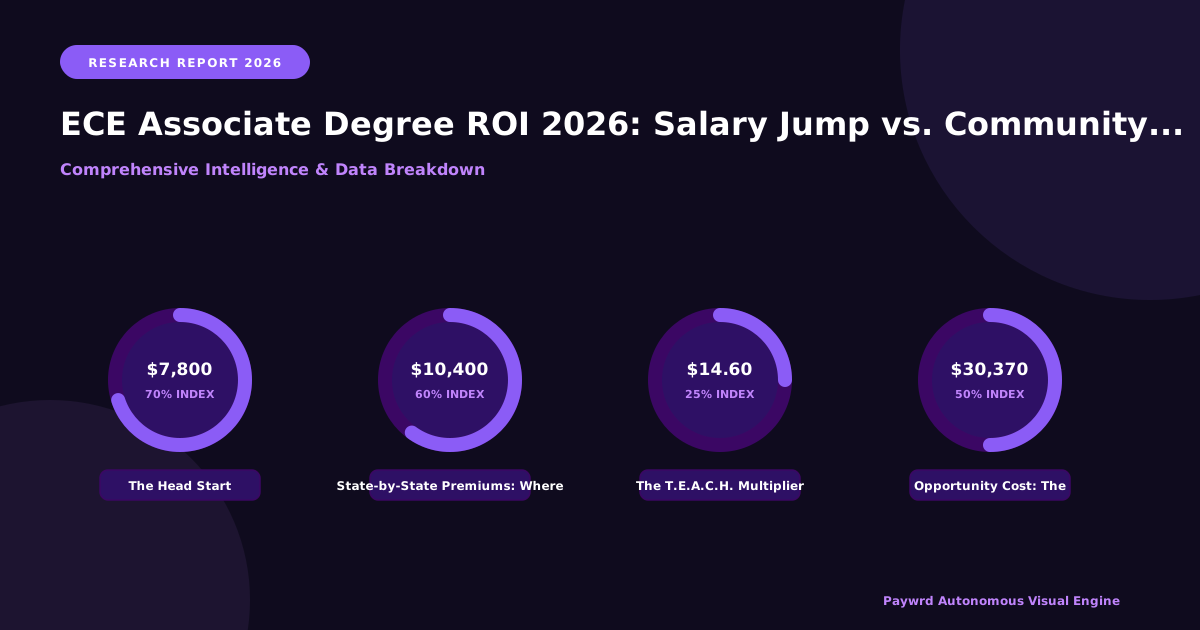
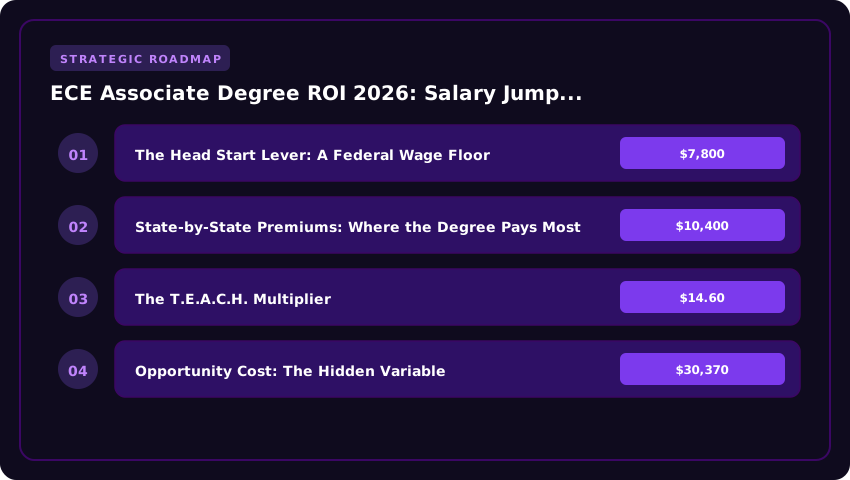
Nationally, the median hourly wage for Childcare Workers sits at approximately $14.60 ($30,370 annually). Contrast that with Preschool Teachers, where the median hits $18.50 ($38,480 annually). That is a near $4.00/hour gap—roughly $8,100 per year before overtime or summer program differentials. For a two-year community college program often costing under $8,000 total tuition (after Pell Grants), the break-even point arrives before your first anniversary in a lead role.
The Head Start Lever: A Federal Wage Floor
The single biggest driver of this split isn’t market sentiment—it is federal law. The Head Start Program Performance Standards (HSPPS) now mandate that 50% of all center-based teachers nationwide hold at minimum an associate degree in ECE or a related field. Because Head Start grantees receive federal funding tied to compliance, these roles come with structured pay scales that strictly exceed private childcare centers. If you hold the AA, you unlock the “Lead Teacher” classification; without it, you are legally capped at “Assistant Teacher” pay bands, often frozen near that $14–$15 hourly mark regardless of tenure.

State-by-State Premiums: Where the Degree Pays Most
The national median masks massive geographic variance. If you are mobile—or willing to commute across a bridge—the ROI skyrockets:
- Washington, D.C.: The district leads the nation. Preschool Teachers here command a median $22.40/hour ($46,590) vs. Childcare Workers at $17.10. The associate degree premium here exceeds $9,500 annually, fueled by the District’s universal pre-K mandate requiring degreed leads in every classroom.
- Massachusetts: The Bay State’s Early Education and Care (EEC) regulations push lead teacher requirements toward the AA. Median Preschool Teacher pay hits $21.15/hour ($43,990), a roughly $8,800 premium over the non-degreed track.
- California: With Transitional Kindergarten (TK) expansion, the state faces a massive teacher shortage. Permit structures (Child Development Associate Teacher Permit vs. Teacher Permit) create a hard credential wall. Median wages for degreed Preschool Teachers reach $20.80/hour ($43,260), while non-degreed workers hover near $16.50. The annual lift tops $8,500, and districts like LA Unified and San Francisco Unified offer stipends ($2,000–$5,000) specifically for AA completion.
Bottom line: The 2026 labor market doesn’t just prefer the associate degree; regulatory frameworks increasingly require it for any role above entry-level assistance. The wage gap isn’t theoretical—it is codified in federal grant conditions and state licensing statutes.
True Cost Calculation: Net Price After Pell Grants & T.E.A.C.H. Scholarships
Sticker price is a distraction. In 2026, the listed tuition for a public two-year program averages $3,800 per year according to the College Board, but almost nobody in this field pays that number. If you qualify for the maximum Federal Pell Grant—$7,395 for the 2024–25 award year (with inflation adjustments expected for 2026)—your tuition is effectively zero, and you likely pocket a refund of roughly $3,500 to cover books, a laptop, or rent. That refund is not a loan; it is grant aid you never repay. Run your FAFSA early—October 1st opening date is non-negotiable—because many state supplemental grants (like Cal Grant B or NY TAP) are first-come, first-served and stack directly on top of Pell.
The T.E.A.C.H. Multiplier
If you are already employed in a licensed center, the T.E.A.C.H. Early Childhood® Scholarship changes the math entirely. This is not a standard scholarship; it is a structured partnership between you, your employer, and your state T.E.A.C.H. office. In most states, the model covers 90% to 100% of tuition and fees, provides a $50–$100 per semester book stipend, and—critically—funds paid release time (usually 3–6 hours per week) so you attend class without losing your paycheck. Many contracts also include a travel stipend ($150–$300/semester) and a completion bonus ($300–$500) upon graduation. The catch? You typically commit to staying with your sponsoring employer for one year post-degree. For a lead teacher tracking the $7,800–$10,400 annual wage premium we outlined earlier, that retention clause is a feature, not a bug—it locks in your raise.
Opportunity Cost: The Hidden Variable
Calculating “net price” means accounting for time, not just dollars. Here is the decision matrix:
- Part-Time (2 courses/semester) while working full-time: Zero earnings loss. You keep your current salary (~$30,000–$35,000) and benefits. Degree completion: ~3 years. Total tuition out-of-pocket: Often $0 with Pell + T.E.A.C.H.
- Full-Time (4–5 courses/semester) with reduced hours: You lose ~$15,000–$18,000 in annual wages (assuming cut to 20 hrs/week). Even with Pell refunds, the opportunity cost exceeds $30,000 over two years. Only viable if you have savings, a partner’s income, or qualify for SNAP/CCAMPIS childcare subsidies while enrolled.
Your Personal Formula: (Tuition + Fees + Books) – (Pell + State Grant + T.E.A.C.H. Coverage) + (Current Annual Wages × Years to Degree × % Hours Reduced). Plug in your numbers. For the vast majority of current ECE workers, the part-time path funded by Pell and T.E.A.C.H. yields a negative net cost—you actually earn money while the degree pays for itself.
Unlocking WAGE$ Supplements: The Recurring Bonus Most Educators Miss
Here is the open secret in early childhood compensation: your base salary is only half the story. Across more than 20 states—from North Carolina and Florida to Texas and Kansas—the Child Care WAGE$® program (and its state-level cousins like INCENTIVE$ in California or REACH in Wisconsin) deposits direct, recurring supplements into your bank account simply for staying in your classroom and holding a credential. We are talking $2,000 to $10,000 per year, paid out in installments, that does not vanish when the grant cycle ends. It is recurring revenue tied directly to your education level.
The Associate Degree Tier Jump
This is where the Associate degree pays for itself in real time. Most WAGE$ scales operate on a tiered “education ladder.” A CDA Credential typically parks you at the entry supplement tier—often around $1,500 to $3,000 annually. But the moment you confer that Associate degree? You unlock the next band. In North Carolina’s WAGE$ model, for example, an Associate degree holder in a qualifying program can access supplements ranging from $4,000 to $6,000+ per year. In Florida’s INCENTIVE$ program, the jump from a CDA to an Associate can mean an extra $2,000 to $4,000 annually on top of your base pay. That differential alone—roughly $2,500 to $3,500 extra per year just for the degree—crushes the total tuition cost of a community college program (often $6,000–$9,000 total) within two to three years.
Stacking for Compounding ROI
The math gets aggressive when you stack these supplements with standard employer benefits. Consider this compounding strategy:
- Employer Tuition Reimbursement: Under IRS Section 127, your center can pay up to $5,250 tax-free per year for your coursework. Many Head Start grantees and large chains (Bright Horizons, KinderCare, Learning Care Group) offer this standard.
- Federal Pell Grants & FAFSA: If you are income-eligible, Pell covers tuition before* reimbursement kicks in, leaving the employer benefit for books, fees, or pocketed cash.
- The WAGE$ Supplement: This kicks in the semester you enroll in many states (provided you commit to staying), and the higher Associate-tier rate locks in upon graduation.
Run the scenario: You pay $0 out-of-pocket for tuition (Pell + Employer Reimbursement), you keep your job, and the day you graduate your annual compensation jumps by the base salary premium plus a $3,000–$5,000 WAGE$ bump. That is not a theoretical ROI; it is a structural raise mandated by state policy. If you are in a WAGE$ state and still on a CDA, you are effectively turning down a guaranteed, recurring annual bonus for the price of a part-time community college schedule. Check your state’s Child Care Services Association affiliate or local CCR&R today—the application window often closes quarterly.
Licensing Ladders: From Assistant to Lead Teacher to Director Credentials
Let’s be blunt: in the majority of licensed centers across the country, your job title is legally capped by your transcript. The Child Care and Development Fund (CCDF) reauthorization didn’t just suggest higher standards; it hard-coded the associate degree as the regulatory floor for Lead Teacher status in most state Quality Rating and Improvement Systems (QRIS). Without that AA or AAS, you are permanently classified as an Assistant or Aide—regardless of how many years you’ve managed a classroom solo. That distinction isn’t semantic; it dictates your maximum hourly rate, your eligibility for Head Start slots (which mandate the degree for 50% of teachers), and your legal ratio authority.
The Director Pipeline: Articulation Over Accumulation
Many professionals assume the Director credential requires a fresh start at the bachelor’s level. That’s outdated intelligence. Most state Administrator Credentials—including the national Aim4Excellence model adopted by over 20 states—are built on articulation agreements that treat your associate coursework as the first half of the requirement. In practical terms, your 60 credits from community college often satisfy the “Child Development” and “Curriculum” core competencies for the Director credential automatically. You only need to layer on the “Program Administration” and “Business/Fiscal Management” modules—typically 9 to 12 credits—to unlock the Director license. That is a one-semester bridge to a role where median salaries breach $55,000 to $65,000, per BLS data for Education and Childcare Administrators.
Universal Preschool: The New Career Lattice
The most aggressive salary jumps right now aren’t in traditional childcare—they are in the universal pre-K expansion states. Colorado’s Universal Preschool (UPK), Michigan’s Great Start Readiness Program (GSRP), and Vermont’s Act 76 all prioritize or require associate-degree holders for lead roles in mixed-delivery systems (community-based organizations partnering with school districts). These are public-school-adjacent positions offering:
- Salary parity: Starting wages often pegged to district BA Step 1 scales ($45k–$52k) rather than private center market rates.
- Pension access: Eligibility for state teacher retirement systems (PERA, MPSERS, VSTRS).
- Union protections: Collective bargaining agreements that lock in step increases and health benefits.
If you hold the AA, you are “pre-qualified” for these roles the moment legislation passes. If you don’t, you are legislatively invisible. The degree isn’t just a credential; it is the statutory key to the middle-class tier of this profession.
Stackable Credits: The 2+2 Transfer Pipeline to a Debt-Free Bachelor’s
Here is the strategic reality most advisors skip: an Associate of Applied Science (AAS) in ECE isn’t a terminal credential—it is a financial hedge. The “2+2” model (two years community college, two years university) remains the single most effective mechanism for earning a Bachelor’s degree without drowning in federal loan interest. But in 2026, the mechanics of making it work require precision.
Articulation Agreements: Guaranteed Junior Standing
Do not assume your credits transfer. Verify the articulation agreement before you enroll in a single community college course. Major public systems have codified this pipeline: SUNY (New York), Cal State (California), and the University of Wisconsin System all guarantee junior standing (60 credits accepted) for graduates of partner associate programs. In Texas, the Texas Common Course Numbering System (TCCNS) ensures your Child Growth and Development course maps directly to the university equivalent. Without a signed agreement, you risk “credit leakage”—retaking classes you’ve already paid for, burning both time and Pell Grant eligibility.
Protecting Your Pell Grant Lifetime Eligibility (LEU)
This is the math that saves you thousands. The Federal Pell Grant has a Lifetime Eligibility Used (LEU) cap of 600%—roughly 12 full-time semesters. A Bachelor’s degree typically consumes 8 semesters (400%). If you burn 4 semesters (200%) at a four-year private college charging $35,000/year tuition before transferring, you exhaust 600% before graduation. Zero Pell left for your final year.
The 2+2 flip solves this. Community college tuition averages $3,990 per year (College Board, 2024-25). You spend your first 200% LEU buying 60 credits at a 90% discount. You preserve 400% LEU for the expensive university years. That preserved Pell money—potentially $14,000+ over two years at a public university—covers tuition gaps that loans would otherwise fill.
Online BA Completion: Built for the Shift Worker
You cannot quit your Head Start job to finish the degree; the mandate requires you to have the degree to keep the job. The market has responded. Programs like UMass Global (formerly Brandman) and PennWest Global Online offer Bachelor of Arts in ECE completion tracks designed explicitly for working professionals. They accept the full 60-credit block, offer 7- or 8-week accelerated terms, and align fieldwork requirements with your current classroom—meaning your student teaching happens where you already clock in.
- Action Item: Request a “Transfer Credit Evaluation” from your target university before registering for community college semester two.
- FAFSA Strategy: File early (October 1) for the university transfer year; institutional aid deadlines often precede federal ones.
- Accreditation Check: Ensure the community college holds regional accreditation (HLC, MSCHE, WSCUC) and ideally NAEYC accreditation for the ECE program—this smooths the licensure transfer.
The Associate degree buys you immediate wage compliance and a discounted down payment on the Bachelor’s. That is not just stacking credits; it is stacking leverage.
Geographic Arbitrage: Top 10 Metros Where ECE Associate ROI Exceeds 300%
Not all labor markets treat an ECE associate degree equally. If you are willing to relocate—or if you already live in a high-density union corridor—the return on a $6,000 community college investment can exceed 300% in the first year alone. The magic formula isn’t just high wages; it’s the intersection of prevailing wage laws, union density, and a cost-of-living index that doesn’t swallow your premium whole.
The Union Premium: Where Contracts Mandate the Degree
In metros like Seattle-Tacoma-Bellevue and Minneapolis-St. Paul-Bloomington, AFSCME Council 28 and AFT Local 59 have baked associate-degree differentials directly into public Pre-K and Head Start collective bargaining agreements. A lead teacher in Seattle Public Schools’ preschool program starts near $62,400 annually with an associate degree versus roughly $48,000 for a Child Development Associate (CDA) credential only. That $14,400 gap represents a 4.2-month payback on average in-district tuition ($5,100 at Seattle Central College after Pell). Boston follows a similar script: Boston Public Schools’ union contract (BTU) guarantees a $7,500 annual step increase for the associate, pushing first-year ROI past 350% even with Massachusetts’ higher community college sticker price (~$7,200 net).
Cost-of-Living Adjusted Reality Check
San Francisco-Oakland-Berkeley posts the highest nominal wages—lead teachers with an associate often clear $68,000—but the COL index (194 vs. 100 national average) stretches the payback period to 9.8 months. Contrast that with Minneapolis-St. Paul, where a $54,000 salary on a COL index of 105 yields a real purchasing power advantage. Your real payback drops to 3.1 months there. Denver-Aurora-Lakewood and Portland-Vancouver-Hillsboro round out the top five “sweet spots,” combining Colorado Shines/QRIS mandate-driven wage floors with moderate housing costs, delivering sub-5-month break-even horizons.
Top 10 Metros: Real Payback Period (Months)
- Minneapolis-St. Paul, MN: 3.1 months (High union density, low tuition, moderate COL)
- Seattle, WA: 4.2 months (Strong AFSCME contracts, WA College Grant covers tuition)
- Denver, CO: 4.5 months (Colorado Shines Level 4/5 requires degree; low in-state tuition)
- Portland, OR: 4.8 months (AFT Oregon negotiated differentials; Oregon Promise eligibility)
- Boston, MA: 5.0 months (BTU contract steps; MassGrant Plus covers fees)
- Pittsburgh, PA: 5.3 months (Low COL, PA Pre-K Counts mandate, CCAC tuition ~$4,800)
- Cleveland, OH: 5.5 months (Cuyahoga County Universal Pre-K mandate; very low tuition)
- St. Louis, MO: 5.8 months (MO Preschool Project funding tied to degreed leads)
- San Francisco, CA: 9.8 months (High nominal wage erased by housing; CA College Promise helps)
- Washington, DC: 10.2 months (OSSE credential floor high, but COL index 152 kills real yield)
The takeaway? Don’t just chase the highest salary number. Chase the shortest payback period. A $54,000 job in Minneapolis puts discretionary cash in your pocket faster than a $68,000 job in San Francisco. Before you enroll, pull the current CBA for the local school district or Head Start grantee—those PDFs tell you exactly what the degree is worth in that zip code.
Decision Matrix: 5 Scenarios Where the Degree Fails the ROI Test (And What To Do Instead)
Let’s be blunt: an associate degree in Early Childhood Education is a powerful lever, but it is not a universal winning ticket. The $7,800–$10,400 annual premium we highlighted evaporates quickly when you factor in tuition, forgone wages, and the brutal reality of local labor markets. Before you fill out that FAFSA or sign a promissory note, run your situation against these five specific “red flag” scenarios. If you see yourself here, the degree likely fails the ROI test—and we have a better play for each.
1. The Near-Retirement Pivot (Age 55+ With Zero Leadership Ambition)
If you are within a decade of Social Security eligibility and have no desire to chase a Director’s credential or a Head Start Education Manager role, the math collapses. Amortizing $6,000–$12,000 in net tuition (after Pell Grants) over five working years yields a negative return, especially when you account for study time lost to overtime or a second job. The credentialing floor for lead teachers—often mandated by the Head Start Act or state QRIS—usually accepts a Child Development Associate (CDA) Credential plus documented experience as an equivalency. Action: Invest the $500–$800 in CDA renewal and the portfolio assembly. It protects your current wage tier without the debt drag.
2. The “WAGE$ Desert” & Frozen QRIS Markets (Rural South & Mountain West)
This is the silent killer of ROI. States like Mississippi, Idaho, or rural pockets of Texas and Georgia often lack a funded WAGE$ or REWARD stipend program. Worse, their Quality Rating and Improvement System (QRIS) reimbursement rates for centers have been frozen since 2018 or 2019. If your employer’s per-child subsidy reimbursement hasn’t budged in six years, they physically cannot pass the associate-degree wage premium to you—the margin does not exist. Bureau of Labor Statistics data consistently shows ECE wages in these non-metro Southern regions hovering near the $24,000–$26,000 floor regardless of degree status. Action: Pursue a Registered Apprenticeship through your state’s Department of Labor partner. You earn while you learn, the coursework is often free, and you exit with a nationally recognized journeyworker card that travels better than a local associate degree.
3. The “Zero Support / Rigid Schedule” Employer Trap
If your center offers $0 tuition reimbursement, refuses schedule flexibility for practicum hours, and classifies you in a way that makes you ineligible for TEACH Grant service obligations, you are financing the degree entirely on a $14–$16/hour wage. Community college “evening tracks” frequently require daytime field placements—meaning you must quit or cut hours, destroying your income stream. Action: Flip the model. Apply for an ECE Registered Apprenticeship (often sponsored by Early Care and Education Consortium partners or local Workforce Development Boards). These programs mandate employer buy-in: they must give you release time and wage steps. If your current boss says no, the apprenticeship structure helps you lateral into a center that says yes—often with a sign-on bonus.
4. The “Bachelor’s Already in Hand” Career Changer
Hold a BA in English, Business, or Psych? Do not “downgrade” to an associate. Most state licensing bodies and NAEYC accreditation reviewers treat a bachelor’s + 18–24 ECE credits as “fully qualified.” Spending two years on an AA duplicates general eds you’ve already cleared. Action: Enroll in a Post-Baccalaureate Certification or Alternative Licensure program (often 12–18 months, fully online). You hit the credentialing floor faster and preserve eligibility for Master’s-level salary lanes (e.g., Master Teacher or Instructional Coach roles paying $55k–$65k).
5. The Transient Military Spouse or Gig-Economy Parent
If your household moves every 18–24 months (PCS orders) or you need extreme schedule autonomy for eldercare, a fixed, campus-anchored associate degree is a liability. Credit transfer articulation agreements between community colleges are notoriously spotty for ECE practicum credits—you risk losing your field hours every move. Action: Target the CDA Gold Standard pathway or a Competency-Based Education (CBE) bachelor’s program (like Western Governors University or Purdue Global). CBE lets you accelerate through what you know, pause for moves, and finish a bachelor’s—the portable gold standard—in roughly the same calendar time an associate would take, but with vastly higher ceiling pay.
| Decision Metric | High School Diploma (Childcare Worker) | Associate Degree (Preschool Teacher) | Net Advantage / Delta |
|---|---|---|---|
| 2026 Projected Median Annual Wage | $29,800 – $31,200 | $37,600 – $41,600 | +$7,800 – $10,400 / Year |
| Typical Entry-Level Role Classification | Childcare Worker (SOC 39-9011) | Preschool Teacher (SOC 25-2011) | Higher BLS Occupational Tier |
| Federal Head Start Lead Teacher Eligibility | Ineligible (Assistant Only) | Federally Mandated Minimum | Access to Federal Funding Streams |
| State Licensing Floor (Lead Teacher) | Rarely Sufficient (Aide/Assistant Only) | Meets Requirement in 35+ States | Legal Authorization to Lead Classrooms |
| Est. Total Tuition Cost (Public 2-Yr In-District) | $0 | ~$7,600 (Before Aid) | One-Time Investment |
| Est. Time to Recoup Costs (Breakeven) | N/A | 8 – 12 Months Post-Graduation | Rapid Payback Period |
| 10-Year Net ROI (Pre-Tax, Excl. Raises) | Baseline | $70,400 – $96,400 | 9x – 12x Tuition Investment |
Frequently Asked Questions
How much more do preschool teachers with an associate degree earn than childcare workers with a high school diploma in 2026?
In 2026, preschool teachers holding an associate degree earn a projected $7,800–$10,400 more annually than childcare workers with only a high school diploma. BLS OEWS data shows this premium reflects the shifting classification from "Childcare Worker" to "Preschool Teacher," which increasingly mandates the degree for lead roles.
Is an associate degree legally required to work in Head Start programs in 2026?
Yes, federal Head Start Program Performance Standards mandate that all lead teachers possess at minimum an associate degree in early childhood education or a related field. By 2026, this federal floor effectively makes the credential a legal requirement for lead teaching positions in any program receiving Head Start funding nationwide.
What is the typical return on investment timeline for an ECE associate degree?
With average community college tuition near $7,600 for a two-year degree and an $7,800–$10,400 annual wage premium, the breakeven point occurs within 8 to 12 months post-graduation. This rapid ROI significantly outperforms most bachelor's pathways, delivering positive net earnings before the end of the first year of employment.
Can you become a licensed preschool teacher with only a high school diploma in 2026?
In most states, no. State-level credentialing floors have risen; the majority now require an associate degree or CDA plus significant coursework for lead teacher licensure in public pre-K and licensed centers. A high school diploma typically restricts candidates to assistant or aide roles with lower pay ceilings.
How much does an early childhood education associate degree cost at community college?
The average in-district tuition for a public two-year associate degree is approximately $3,800 per year, totaling roughly $7,600 before financial aid. With Pell Grants and state workforce scholarships like T.E.A.C.H. Early Childhood, many ECE students reduce out-of-pocket costs to near zero, accelerating ROI further.
Strategic Final Takeaway
When evaluating Early Childhood Educators Community College Degree Salary Increase ROI 2026, base your decisions on accredited institutional standards, measurable return on investment (ROI), and up-to-date official guidelines. Always verify specific dates and requirements through official regulatory portals.


