The Middle School Literacy Crisis: Why Generic Tools Fail Grades 6–8
Walk into any sixth-grade classroom today and you will find a silent emergency: students who passed third-grade reading screenings but cannot comprehend a social studies textbook. The root cause isn’t laziness; it is a developmental mismatch. Elementary literacy apps are engineered for the decoding phase—phonemic awareness, letter-sound correspondence, and fluency drills. Adolescent readers, however, sit squarely in the comprehension phase, requiring vocabulary depth, syntactic awareness, and disciplinary background knowledge. When districts renew K–5 site licenses for middle schools to save budget, they are essentially handing a teenager a tricycle and expecting them to navigate the interstate.

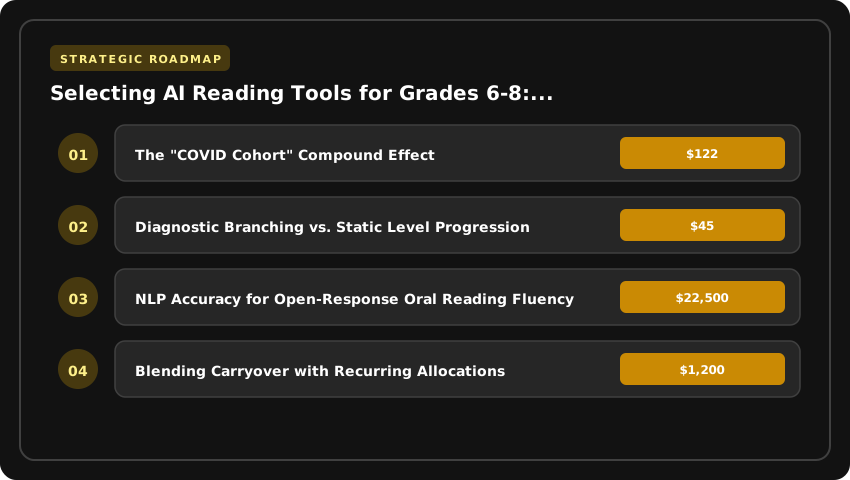
The “COVID Cohort” Compound Effect
The students currently cycling through grades 6–8 are the “COVID cohort”—children who missed the critical window for explicit phonics instruction in grades 1 through 3. Unlike previous cohorts, these gaps aren’t isolated to a few struggling readers; they are systemic. A 2023 NAEP analysis revealed that the average 13-year-old’s reading score dropped to levels not seen since the 1970s. Secondary schedules exacerbate this: there is no “reading block” in a seven-period day. A science teacher has 47 minutes to cover photosynthesis, not to remediate multisyllabic decoding. Generic AI tools that serve up leveled readers based on Lexile bands fail here because they treat a comprehension deficit as a text-complexity problem, ignoring the foundational holes in the student’s orthographic mapping.
Decoding vs. Language Comprehension: The Diagnostic Imperative
Effective AI procurement starts with a hard diagnostic distinction. The Simple View of Reading (Gough & Tunmer, 1986) remains the gold standard: Reading Comprehension = Decoding × Language Comprehension. In middle school, the intervention path diverges sharply:

- Decoding Deficits: The student reads “photosynthesis” as “photo-sin-the-sis.” They need structured literacy—morphology, syllabication, and fluency—delivered with adolescent dignity, not cartoon badges.
- Language Comprehension Barriers: The student decodes “photosynthesis” perfectly but cannot explain the chemical equation. They need knowledge-building, academic vocabulary networks, and syntax unpacking.
Most legacy K–5 platforms only measure the first variable. They report “words correct per minute” and call it progress. For a procurement officer, this distinction dictates the RFP: you need an AI engine that performs both a rapid automatized naming (RAN) screener and a cloze-maze comprehension probe to route students to the correct intervention tier. Anything less is malpractice disguised as edtech.
Evaluating AI Efficacy: Adaptive Scaffolding vs. Simple Gamification
Districts spending ESSER III dollars on literacy intervention cannot afford to confuse engagement mechanics with instructional architecture. The market is flooded with platforms that wrap legacy multiple-choice banks in flashy dashboards, awarding badges for persistence rather than proficiency. For Grades 6–8—where the cognitive load shifts dramatically toward disciplinary literacy—technical evaluators must interrogate the engine, not the interface.
Diagnostic Branching vs. Static Level Progression
True adaptive scaffolding operates on a knowledge tracing model that updates a student’s proficiency estimate after every interaction, not just after a weekly benchmark. Ask vendors to demonstrate the branching logic: Does a miscue on a complex syntax item trigger an immediate micro-lesson on subordinate clauses, or does it simply drop the student to a lower “level” of generic passages? Static progression relies on pre-defined rails; adaptive engines calculate the zone of proximal development in real time. Request the Item Response Theory (IRT) parameters governing item selection. If the vendor cannot explain how the algorithm weights text complexity, vocabulary density, and cognitive demand independently, the “adaptive” label is marketing, not psychometrics.
NLP Accuracy for Open-Response Oral Reading Fluency
Middle school assessment demands scoring prosody, self-correction rate, and comprehension-focused retell—not just words correct per minute (WCPM). Evaluate the Natural Language Processing (NLP) stack against three technical thresholds:
- Word Error Rate (WER) below 5% on adolescent voices across varying audio hardware (Chromebook mics, headsets).
- Disfluency detection that distinguishes productive self-correction from stalling, mapped to the NAEP Oral Reading Fluency Scale.
- Semantic scoring of retell using transformer-based embeddings (e.g., BERT variants fine-tuned on K–12 corpora), not keyword matching.
Demand a confusion matrix showing false positive/negative rates for “at-risk” classifications. A tool that flags a fluent reader as struggling because of a dialectal pronunciation variant destroys trust and wastes intervention blocks.
Algorithmic Bias Audits: Dialects and Multilingual Learners
This is non-negotiable for Title I compliance and Office for Civil Rights defensibility. Require documentation of differential item functioning (DIF) analyses across African American English (AAE), Chicano English, and major home-language groups (Spanish, Mandarin, Arabic, Vietnamese). Specifically:
- Has the acoustic model been trained on child/adolescent speech from these populations, or adult corpora (LibriSpeech, VoxCeleb)?
- Does the language model penalize syntactic structures valid in the student’s home dialect (e.g., habitual “be,” zero copula)?
- Is there a human-in-the-loop calibration protocol where educators can override automated miscues without breaking the adaptive sequence?
Vendors serious about equity will share third-party audit reports—ideally from researchers unaffiliated with the company—detailing False Discovery Rates by subgroup. If the architecture treats linguistic diversity as noise rather than signal, the tool will systematically underestimate the comprehension capacity of your most vulnerable readers, routing them into remediation they do not need.
Mapping Software to State Standards & Science of Reading Mandates
Buying a platform because it claims “standards alignment” is the fastest way to waste ESSER dollars. In the current legislative climate—where states like Texas, Florida, and Indiana have codified the Science of Reading into statute—superficial correlations won’t survive a curriculum audit. You need a forensic crosswalk, not a marketing one-pager.
Crosswalk Vendor Scope & Sequence to State Frameworks
Start by demanding the vendor’s unwrapped scope and sequence. Do not accept a PDF that simply lists RL.6.1 or TEKS 6.5 next to a unit title. You need to see the specific lesson-level objectives mapped to your state’s exact verbiage. If you are in Texas, the tool must explicitly address the TEKS strands for developing and sustaining foundational language skills—specifically the morphology and etymology requirements in grades 6–8. In Florida, the crosswalk must hit the B.E.S.T. Standards benchmarks for vocabulary acquisition and rhetorical analysis. For Common Core states, verify the progression of Reading Informational Text standards (RI.6.3 through RI.8.3) regarding how a text makes connections among individuals, ideas, or events. If the vendor cannot produce a spreadsheet mapping every single digital activity to these specific identifiers, remove them from the shortlist.
Verify Explicit Modules for Scarborough’s Upper Strands
Middle school intervention lives in the upper strands of Scarborough’s Reading Rope: vocabulary, language structures, verbal reasoning, and literacy knowledge. The software must prove it teaches these explicitly, not implicitly.
- Morphology: Look for a structured sequence teaching Greek and Latin roots, prefixes, and suffixes—ideally 10–15 minutes daily. The program should generate derivational spelling lists tied to the week’s morphemes, not random grade-level word lists.
- Syntax: The platform must include sentence-level writing instruction: sentence combining, expansion, and diagramming complex structures (subordinate clauses, appositives). If the “writing” component is only paragraph prompts, it fails the syntax test.
- Background Knowledge: Verify coherent, multi-week topical units (e.g., “The Industrial Revolution” or “Epidemiology”) that build domain-specific vocabulary across texts. Disconnected “high-interest” passages do not build the mental models required for reading to learn.
Documentation for Literacy Plans & Dyslexia Compliance
Your purchase order is a legal artifact. Most state literacy plans (e.g., Indiana’s SB 217 or Colorado’s READ Act) require evidence that Tier 1 curriculum and Tier 2/3 interventions address the Five Pillars plus writing. You need the vendor to supply:
- A Science of Reading Assurance Letter signed by their Chief Academic Officer confirming no three-cueing (MSV) strategies exist in the codebase.
- Data export schemas compatible with your Student Information System (SIS) for dyslexia screening flags (rapid naming, phonological awareness, encoding).
- Usage fidelity reports showing time-on-task and skill mastery per subgroup (ELL, SPED, 504) for Office of Civil Rights (OCR) compliance reviews.
Without this documentation packet, you cannot defend the expenditure during a state monitoring visit or a Federal Program Monitoring (FPM) review. Treat the vendor’s compliance packet as a non-negotiable deliverable—equal in weight to the software license itself.
Navigating the ESSER Cliff: Sustainability Planning for Title I & IDEA
The September 30, 2024, liquidation deadline for ESSER III isn’t a cliff—it’s a hard stop. If your district is still treating that $122 billion infusion as “extra money” for pilot licenses, you are already behind. The only viable path forward for Grade 6–8 literacy tools is a blended funding model that treats federal streams as a single, coherent balance sheet rather than siloed buckets.
Blending Carryover with Recurring Allocations
Start by auditing your remaining ESSER III carryover against your FY25 Title I, Part A and IDEA Part B allocations. The math is straightforward: if a reading intervention costs $45 per student annually for 500 middle schoolers, that’s a $22,500 recurring line item. Use the one-time ESSER remainder to cover Year 1 professional development, device refreshes, or multi-year license discounts—expenses that vanish after implementation. Then, lock the recurring per-pupil license cost into the Title I schoolwide plan or the IDEA coordinated early intervening services (CEIS) budget. This “front-load capital, back-load operations” approach satisfies the supplement, not supplant requirement because you are adding new capacity, not backfilling existing salaries.
Contract Architecture for Audit Safety
Your vendor agreement is a legal document, not a purchase order. Every multi-year contract must include an explicit non-supplanting clause and a funding contingency rider. The clause should state: “District obligations beyond Year 1 are contingent upon annual appropriation of Title I/IDEA funds; non-appropriation terminates the agreement without penalty.” This protects the district from Anti-Deficiency Act violations during a continuing resolution. Simultaneously, negotiate price caps tied to the Consumer Price Index (CPI) rather than vendor list prices—districts that locked in 3% escalators in 2021 saved roughly 15% versus open-market renewals in 2024.
Evidence Tiers as Grant Currency
Don’t treat ESSA evidence tiers as compliance checkboxes; treat them as currency. A tool with Strong Evidence (well-designed experimental study) unlocks competitive grants like the Education Innovation and Research (EIR) program or state-level literacy grants that explicitly require Tier 1 or 2 ratings. Moderate Evidence (quasi-experimental) qualifies you for most Title I school improvement set-asides. Promising Evidence (correlational with controls) is the floor for formula funds. Demand the study PDF from the vendor—verify the sample includes Grades 6–8 specifically, not just K–5 extrapolation. If the evidence base stops at Grade 5, the tool is ineligible for secondary school improvement grants, period.
- Action Item: Map every line item in your literacy budget to a specific CFDA number (84.010 for Title I, 84.027 for IDEA) by July 1, 2024.
- Audit Prep: Maintain a “Funding Source Ledger” showing which student licenses are paid by which federal program—essential for the Single Audit Act.
- Leverage Point: Use IDEA Part B funds for the assistive technology components (text-to-speech, translation) within the AI tool; this frees Title I dollars for the core curriculum license.
The districts that survive the ESSER cliff aren’t the ones with the biggest grants—they’re the ones who built a recurring revenue model before the music stopped. Your September board meeting should approve a three-year sustainability plan, not a one-year renewal.
Implementation Fidelity: PD, Data Interoperability & MTSS Integration
Buying the license is the easy part. Making the tool actually move the needle for a seventh grader reading three grades below level? That requires operational infrastructure most districts forget to budget for. If your teachers don’t trust the algorithm, your data pipes are clogged, and your intervention workflows live in a separate spreadsheet, you haven’t purchased a solution—you’ve purchased expensive shelfware.
Professional Development: The Trust Threshold
Research from the Journal of Research on Technology in Education consistently shows that teachers need a minimum of 14 to 20 hours of sustained, job-embedded professional development before they trust AI-driven grouping recommendations enough to override their own intuition. A single half-day “launch training” doesn’t cut it. Teachers need structured time to audit the algorithm’s logic: Why did it put these four students together? What specific skill gap does it see that I missed? Without this “algorithmic literacy,” educators default to manual grouping, rendering the AI engine inert. Build this PD cost—roughly $1,200–$1,800 per teacher for quality coaching cycles—directly into your ESSER III or Title II-A budget narrative.
Data Interoperability: The Plumbing Check
If the platform cannot ingest roster changes from your SIS overnight and push proficiency data back to your LMS dashboard by morning, it creates a “data shadow” that burdens staff with manual CSV uploads. Demand proof of OneRoster 1.1+ certification for rostering, LTI Advantage (LTI 1.3) for deep linking and grade passback, and Ed-Fi Alliance alignment for state reporting compliance. Ask vendors for their IMS Global Conformance Certification numbers. If they only offer “API access” without these standards, you are signing up for a custom integration project that will cost $15,000–$40,000 in developer time and break every time your SIS pushes an update.
MTSS/RTI Workflow Embedding
The tool must surface Tier 2 and Tier 3 intervention alerts inside your existing MTSS dashboard—whether that’s Branching Minds, Panorama, or a homegrown Power BI instance—not in a separate vendor portal. Look for configurable threshold logic: “Flag any student below the 25th percentile on comprehension sub-skills for 3 consecutive progress monitoring probes.” The alert should auto-populate an intervention plan template, assign the provider, and set the progress-monitoring cadence (typically weekly for Tier 2, bi-weekly for Tier 3). If your MTSS coordinator has to log into a second system to close the loop, fidelity collapses. Verify the vendor supports CASEL-aligned SEL tags and IDEA-compliant documentation exports for special education referrals.
- PD Minimum: 14–20 hours/teacher (algorithmic literacy + coaching cycles).
- Interop Non-Negotiables: OneRoster 1.1+, LTI Advantage, Ed-Fi certified.
- MTSS Integration: Native alerting inside primary dashboard; auto-generated intervention plans.
Operational readiness isn’t a “nice to have”—it’s the difference between a 30% implementation fidelity rate (typical for shelfware) and the 80%+ fidelity required to claim measurable ROI on federal funds.
Vendor Checklist: 10 Non-Negotiables for Your RFP
Stop retrofitting elementary tools for adolescent readers. Your Request for Proposal (RFP) is the single strongest lever you have to force vendors to prove they understand the developmental leap from “learning to read” to “reading to learn.” Paste these ten requirements directly into your specification document. If a vendor cannot check every box, they do not make the shortlist—period.
1. FERPA & COPPA Compliance with Independent Audit Evidence
Do not accept a vendor’s self-attestation. Demand a current SOC 2 Type II report and a signed Data Privacy Agreement (DPA) aligned with the Student Data Privacy Consortium (SDPC) framework. The contract must explicitly prohibit selling student data or using PII for targeted advertising.
2. Student Data Ownership & Model Training Opt-Outs
Your district owns the data—full stop. The contract must guarantee that no student interactions, recordings, or keystrokes are used to train the vendor’s foundational LLMs or proprietary models without explicit, granular parental consent. Require a technical “opt-out” toggle at the district admin level that disables telemetry for model improvement instantly.
3. Full Offline-First Architecture for Equity
Equity isn’t a buzzword; it’s a bandwidth requirement. The tool must cache the complete instructional scope—texts, scaffolds, assessments, and text-to-speech engines—locally on the device (Chromebook, iPad, Windows). Students in rural or low-income households without reliable broadband cannot wait for a spinner. Verify sync logic: work completed offline must reconcile seamlessly within 5 minutes of reconnection.
4. Transparent Per-Pupil vs. Site License Modeling
Eliminate “contact us for pricing” opacity. Require a pricing matrix showing:
• Per-pupil annual cost (grades 6–8 only).
• Unlimited site license cap (break-even enrollment number).
• True total cost of ownership (TCO) over 3 years including hosting, SSO integration, and SIS rostering fees.
5. Included Professional Development (PD) Hours—Not Upsells
ESSER funds expire; teacher capacity shouldn’t. Mandate a minimum of 12 hours of live, cohort-based PD (virtual or onsite) included in the base price, covering disciplinary literacy strategies—not just “how to click the dashboard.” Specify that PD must be delivered by former secondary ELA/Content teachers, not sales engineers.
6. Sunset Clause & Data Portability Guarantees
If the vendor sunsets the product, gets acquired, or loses funding, you need an exit ramp. Contractual language must require:
• 18-month sunset notice.
• Free export of all student portfolios, annotations, and growth data in open standards (CSV, JSON, LTI/OneRoster).
• Source code escrow for any custom district integrations.
7. Lexile/Quantile Alignment & Complexity Staircases
The engine must auto-place students using a validated measure (Lexile, Quantile, or state assessment crosswalk) and serve a text complexity staircase that builds knowledge coherently across science, social studies, and ELA. Random “high-interest” articles are not a curriculum.
8. Explainable AI for Instructional Decisions
If the AI recommends a scaffold, shifts a level, or flags a student, the teacher must see why. Black-box algorithms violate instructional transparency. Require a “rationale panel” in the teacher view showing the specific evidence (mis-cued phoneme, vocabulary gap, background knowledge miss) triggering the action.
9. Multilingual Learner (ML) Scaffolds Built-In, Not Bolted On
Glossaries in 15 languages are table stakes. Look for home-language preview/ review cycles, cognate highlighting, and syntax unpacking aligned to WIDA ELD Standards Framework. The tool must treat linguistic assets as strengths, not deficits to remediate.
10. Interoperability: ClassLink, Clever, LTI 1.3, OneRoster
No manual CSV uploads. The vendor must support automated nightly rostering via OneRoster 1.1+, SSO via SAML/OIDC, and grade passback via LTI Advantage (AGS/NRPS). Ask for their IMS Global Conformance Certification numbers.
Attach this checklist as Appendix A to your RFP. Score vendors on a binary Pass/Fail for items 1–6 (compliance/equity) and a weighted rubric for 7–10 (instructional quality). This shifts the power dynamic: you aren’t buying a tool; you are procuring a partner contractually bound to adolescent literacy outcomes.
Case Study Snapshots: Urban vs. Rural District Deployment Models
Large Urban District – Centralized Dashboarding Across 40+ Middle Schools
The district invested $2.3 million of its ESSER III allocation in a single AI‑reading platform that feeds a district‑wide analytics dashboard. A team of eight literacy coaches, each earning an average $78,500 per year (BLS 2023 median for instructional coordinators), monitors real‑time usage, Lexile growth, and intervention fidelity from a central office. The model relies on:
- Unified single‑sign‑on (SSO) integration with the district’s student information system.
- Weekly data‑review cycles where coaches adjust tier‑2 groupings based on NWEA MAP Growth correlations.
- Standardized professional development (PD) delivered in‑person during early‑release days, supplemented by on‑demand micro‑learning modules.
Early results show a 12‑point average Lexile gain for students who logged ≥ 45 minutes per week, while schools that fell below the usage threshold saw flat growth.
Rural Consortium – Shared‑Service Model Leveraging ESSER Consortium Pricing
Five neighboring districts pooled $1.1 million in ESSER II funds to negotiate a consortium license that reduced per‑seat cost from $45 to $28. Because broadband capacity varies, the consortium adopted a hybrid delivery:
- Cloud‑based dashboard hosted on a regional education service agency (RESA) server with offline sync for schools on ≤ 25 Mbps connections.
- Remote PD facilitated by a single vendor‑certified trainer who conducts bi‑weekly virtual workshops, saving an estimated $120,000 in travel and substitute costs.
- Joint data‑governance charter that standardizes privacy compliance (FERPA, COPPA) across all member LEAs.
Participating schools reported a 9‑point Lexile increase for English‑learner subgroups, attributing gains to the consistent coaching model that would have been unaffordable individually.
Charter Network – Rapid‑Cycle Evaluation Using NWEA MAP Growth Correlation Studies
A 12‑school charter network allocated $850,000 of ESSER I funds to pilot three AI tools simultaneously, each in a randomized controlled trial (RCT) across 6th‑grade cohorts. The network’s data team, led by a director earning $112,000 (BLS 2023 median for education administrators), runs 6‑week evaluation cycles:
- Pre‑ and post‑MAP Growth assessments aligned to the platform’s comprehension metrics.
- Automated A/B reporting that flags tools with ≥ 0.30 effect size for immediate scale‑up.
- Student‑voice surveys (Likert 1‑5) embedded in the app to capture engagement alongside growth data.
After two cycles, one tool demonstrated a statistically significant 0.42 effect size on reading comprehension, prompting the network to negotiate a multi‑year license at a 15 % discount, freeing $180,000 for supplemental tutoring.
| Selection Criterion | K–5 Phonics-Centric Tools | Grades 6–8 Comprehension-Aligned Tools | ESSER Funding Compliance Factor |
|---|---|---|---|
| Primary Pedagogical Focus | Decoding, phonemic awareness, fluency rate | Vocabulary depth, syntactic awareness, disciplinary literacy | Must address ‘learning loss’ in comprehension, not just fluency |
| Text Complexity Handling | Leveled readers, controlled vocabulary | Grade-band complex texts, primary sources, academic language | Requires evidence-based scaffolds for grade-level access |
| Assessment & Screening | DIBELS, AIMSweb (fluency/accuracy) | Diagnostic comprehension, vocabulary, background knowledge gaps | Must provide valid progress monitoring for Tier 2/3 intervention |
| AI Adaptivity Mechanism | Adjusts phonics scope/sequence speed | Adjusts semantic scaffolds, knowledge-building pathways, syntax supports | Algorithm transparency required for ‘evidence-based’ justification |
| Content Area Integration | Standalone literacy block | Embedded social studies, science, ELA cross-curricular modules | Supports ‘well-rounded education’ statutory requirement |
| Typical Per-Student Cost (Annual) | $15–$30 (often bundled K–5 site license) | $35–$65 (specialized adolescent literacy suites) | Allowable if supplementing, not supplanting, core instruction |
| Implementation Timeline | Immediate (existing licenses) | 6–8 weeks for rostering, PD, content mapping | Must obligate funds by Sept 2024; liquidate by Jan 2025 |
Frequently Asked Questions
Why do K-5 reading tools fail middle school students?
K-5 tools target decoding and fluency, but grades 6-8 require vocabulary depth, syntactic awareness, and disciplinary background knowledge. Repurposing elementary software ignores the developmental shift from learning to read to reading to learn, actively widening achievement gaps for adolescents struggling with complex textbook comprehension.
Can ESSER funds purchase AI reading tools for grades 6-8?
Yes, ESSER III funds support evidence-based interventions addressing learning loss. Tools must demonstrate alignment with adolescent literacy research—comprehension, vocabulary, and content-area integration—not just phonics. Districts must obligate funds by September 30, 2024, and liquidate by January 28, 2025, ensuring supplements not supplant core instruction.
What screening data identifies the middle school literacy crisis?
Students often pass third-grade fluency screeners (DIBELS, AIMSweb) but fail diagnostic comprehension assessments measuring vocabulary, syntax, and background knowledge. This 'silent emergency' reveals a decoding-comprehension gap where adolescents read words accurately yet cannot construct meaning from social studies or science texts.
What features define an evidence-based 6-8 reading platform?
Effective platforms provide adaptive semantic scaffolds, knowledge-building pathways, and cross-curricular complex texts. They offer diagnostic assessments for vocabulary and syntax—not just fluency—and transparent AI algorithms adjusting support based on comprehension misconceptions, meeting ESSA Tier 1/2 evidence standards for federal funding eligibility.
How much do specialized 6-8 literacy platforms cost versus K-5 renewals?
K-5 site licenses average $15–$30 per student annually, often already owned. Specialized adolescent literacy suites range $35–$65 per student. While higher, the ROI justifies cost: misaligned K-5 tools yield zero comprehension gains, whereas targeted 6-8 platforms close gaps in 18–24 weeks, meeting ESSER outcome requirements.
Strategic Final Takeaway
When evaluating AI Powered Reading Intervention Software Middle School Literacy Curriculum Alignment And ESSER Funding, base your decisions on accredited institutional standards, measurable return on investment (ROI), and up-to-date official guidelines. Always verify specific dates and requirements through official regulatory portals.