How a Registered Teaching Apprenticeship Actually Works in the US
If you have spent the last few years wondering whether you can pivot into teaching without surrendering your paycheck, the Registered Teaching Apprenticeship (RTA) model deserves your full attention. It is not a watered-down substitute for a degree; it is a structured, US Department of Labor (DOL) framework that combines paid on-the-job learning with classroom instruction and wraps both around a state teaching license.
The DOL Framework vs. Traditional Alternative Certification
Most career changers are familiar with alternative certification (alt-cert) routes run by universities or private providers: you take a few methods courses, pass a state exam, and student-teach for 12 to 16 weeks, often unpaid. A Registered Teaching Apprenticeship flips that script. Because it is registered with the DOL (and increasingly aligned with the US Department of Education’s teacher quality priorities), every hour you spend in a mentor teacher’s classroom counts as both paid employment and clinical practice. That dual credit is the real innovation. Apprentices are hired as paid district employees—commonly earning between $25,000 and $35,000 during the one-to-two-year program—while completing the same competency benchmarks the state would otherwise require through an unpaid internship.
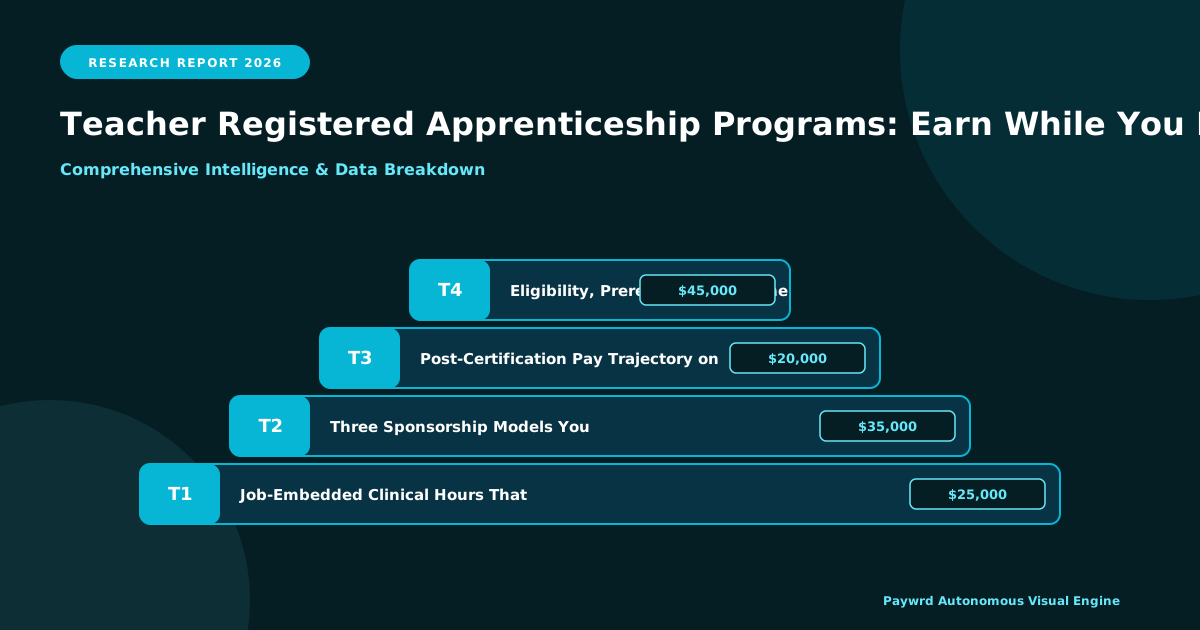
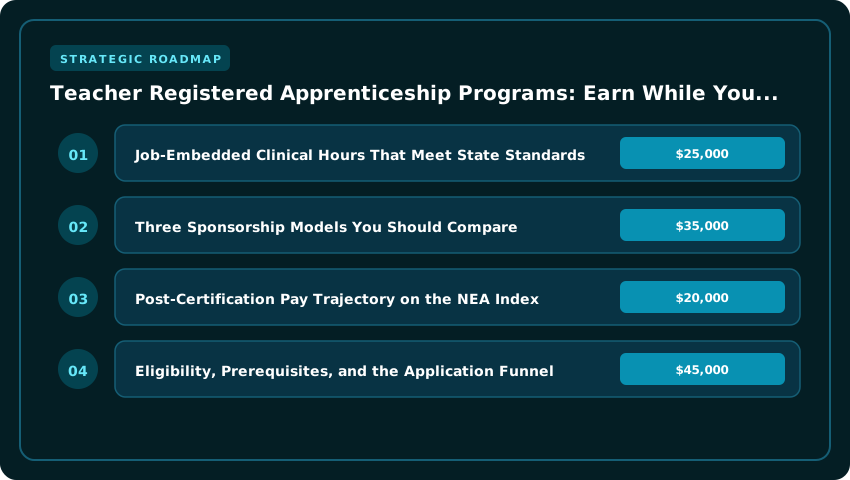
Job-Embedded Clinical Hours That Meet State Standards
Every state apprenticeship standard spells out a minimum number of job-embedded clinical hours, generally ranging from 1,000 to 1,500 hours over 12 to 24 months. Those hours are tracked through the state’s apprenticeship council, not a university registrar, which is why graduates walk away with two credentials: a DOL Certificate of Completion and an initial teaching license. This structure aligns closely with what the Interstate Teacher Assessment and Support Consortium (InTASC) calls “practice-based preparation,” and it gives hiring principals verifiable evidence that an apprentice has actually run a classroom long before stepping in solo.
Three Sponsorship Models You Should Compare
- School District Sponsored: Large districts like Houston ISD and Indianapolis Public Schools act as the apprenticeship sponsor, hiring apprentices directly into paraprofessional or “teacher-in-residence” roles. Tuition is often covered by district Title II funds, and apprentices stay on payroll with full benefits from day one.
- University Sponsored: Institutions such as Tennessee State University and the University of Central Florida partner with local districts. Apprentices enroll as graduate students, earning credit that ladders into an MAT, but the employer-of-record remains the school district.
- Labor Union or Consortium Sponsored: In states like Oregon and Washington, the American Federation of Teachers (AFT) and the National Education Association (NEA) affiliates register as sponsors, negotiating wage scales and mentor ratios that often exceed state minimums.
Comparing this to a traditional MAT (tuition typically $20,000–$45,000 out of pocket) or a Teach For America placement (a two-year commitment with a $50,000–$60,000 education award and lower initial salary), an RTA trades prestige signaling for immediate earnings, employer-paid benefits, and a license that costs little to nothing. For career changers who already carry student debt or a mortgage, that math usually decides the question.
State-by-State Certification Pathways Through Apprenticeship (CA, TX, NY, NC and Beyond)
Not every state treats a Registered Teaching Apprenticeship as a one-stop ticket to licensure, but the map is changing fast. As of early 2026, the U.S. Department of Labor’s Office of Apprenticeship lists approved teacher apprenticeship sponsors in roughly two dozen states, with the densest pipelines running through Tennessee, Kentucky, Texas, North Carolina, California, and New York. Tennessee alone has scaled through the Tennessee Department of Education’s Tennessee Apprenticeship for Para-Educators and Substitute Teachers, while Kentucky partners with the Kentucky Education and Workforce Development Cabinet on the Kentucky Teacher Apprenticeship Program (KTAP). Texas funds several sponsors through the Texas Education Agency’s Innovative Teacher Pipeline grants, with Dallas College and Houston-area ISDs among the most active.
California routes apprentices through the Commission on Teacher Credentialing (CTC), which issues an Internship Credential—effectively the state’s Initial certificate—once the apprentice finishes the required 600+ clinical hours and partner-university coursework. New York’s State Education Department (NYSED) issues a Level I Transitional certificate after apprenticeship completion, valid for five years and renewable with a master’s. Texas’s State Board for Educator Certification (SBEC) issues a one-year Probationary Certificate through approved Educator Preparation Programs (EPPs) that also serve as apprenticeship sponsors. North Carolina’s Department of Public Instruction (NCDPI) issues a Class A Professional Educator’s License via the state’s NC Teaching Fellows and APprenticeNC sponsors.
Here is the reality job seekers need: a credential earned in one state does not automatically transfer to another. Reciprocity is governed by the receiving state’s standards board, not by USDOL. California requires a CTC Out-of-State Application with a transcript review and typically a one-semester supervised practicum if coursework was not completed through a CTC-approved program. New York’s Reciprocity for Educators from Other States pathway can be faster if your apprenticeship was aligned to a NYSED-approved EPP, but the state still requires the Educating All Learners Test (EAS) and a content-specific exam. Texas’s SBEC offers a Standard Certificate reciprocity path, yet most out-of-state apprentices must complete a Texas-aligned clinical placement before the switch.
- California (CTC): Internship Credential → Clear Credential after 2 years and induction.
- Texas (SBEC): Probationary Certificate (1 yr) → Standard Certificate via EPP completion.
- New York (NYSED): Level I Transitional (5 yr) → Level II Professional after master’s and 3 years.
- North Carolina (NCDPI): Class A Professional → Class G (10-year) after 3 years of effective evaluations.
- Tennessee: Practitioner License (3 yr) → Professional License with 30 credit hours and 3 years of service.
The bottom line: verify your state has a USDOL-approved sponsor and that the corresponding standards board has formally aligned its certificate code to the apprenticeship framework. Skipping either step risks months of stalled paperwork when you try to teach in a new state.
Salary Expectations and Tuition Sponsorship While You Apprentice
If you are weighing a Registered Teaching Apprenticeship against a traditional Master of Arts in Teaching (MAT), the deciding factor is almost always money. How much do you actually take home during the apprenticeship? Who pays the tuition? And what does your paycheck look like the moment you finish? Let’s run the real American dollar numbers.
First-Year Apprentice Pay vs. a First-Year Classroom Salary
Apprentice stipends are not glamorous, but they beat unpaid student teaching every single time. Most state-registered programs currently place first-year apprentices in the $18,000 to $28,000 annual stipend range, which translates to roughly $15 to $22 per hour during the paid classroom residency portion of the program. Districts are free to pay more, and competitive urban sponsors in Texas, Ohio, and North Carolina are pushing toward $30,000 to $35,000 to compete with warehouse and healthcare wages.
Compare that to a first-year teacher on a district scale. According to the National Education Association (NEA), the average starting teacher salary for the 2024-25 school year sits at approximately $46,526, with several large districts (Houston ISD, Dallas ISD, Chicago Public Schools) advertising starting bands between $54,000 and $65,000. So yes, an apprentice earns less during year one, but the gap shrinks fast because the apprentice is also earning instead of paying tuition.
How Sponsoring Districts Cover Tuition, Testing, and Mentor Costs
This is where the Registered Teaching Apprenticeship model separates itself from a self-funded MAT. Sponsoring districts typically absorb every major cost through a blend of federal, state, and local dollars:
- Tuition: Covered in full or in part by the district, often routed through Workforce Innovation and Opportunity Act (WIOA) Title I funds, state apprenticeship grants, or the district’s own educator pipeline budget. Out-of-pocket tuition for apprentices frequently lands at $0 to $1,500 total, versus $20,000 to $60,000 for a comparable university MAT.
- Praxis and edTPA testing fees: Usually reimbursed (roughly $150 to $300 per test).
- Mentor and supervisor costs: Paid entirely by the sponsor. The Department of Labor’s Registered Apprenticeship framework reimburses mentor stipends at roughly $1,000 to $2,000 per apprentice, so candidates are never billed for clinical supervision.
Post-Certification Pay Trajectory on the NEA Index
The finish line is where the math gets exciting. Once you pass your state certification exam and convert to a full classroom contract, your salary snaps onto the district scale as if you had walked straight out of a traditional program. The NEA’s 2024 Rank-and-File Salary Index shows average teacher pay climbing from $46,526 (year one) to roughly $54,000 (year three), $63,000 (year five), and $72,000 (year ten), with master’s degree lane bumps adding another $3,000 to $8,000. Because most RTAs already include the master’s-level coursework, apprentices frequently reach the higher lane within two years of certification, accelerating lifetime earnings by tens of thousands of dollars compared to the unpaid student-teaching MAT route.
Bottom line: a one-year stipend of roughly $24,000 minus zero tuition debt is a dramatically stronger financial outcome than two years of zero income plus $40,000 in student loans, even before you count the earlier entry onto the NEA salary scale.
Eligibility, Prerequisites, and the Application Funnel
Before you invest weeks of effort polishing essays and scheduling interviews, it pays to know exactly where you stand on the qualifying checklist. Registered Teaching Apprenticeship (RTA) sponsors in the United States follow a remarkably consistent screening framework, even though each state department of education adds its own flavor. Think of the funnel below as your personal self-screening tool: if you can tick every box, you are ready to submit a competitive application with confidence.
Minimum Academic Foundation
The first gate every apprentice must clear is a bachelor’s degree from a regionally accredited institution. Most RTAs do not require the degree to be in education—in fact, career-changers with a bachelor’s in mathematics, computer science, bilingual studies, or special education are heavily recruited because they bring real-world subject depth. What sponsors do require is documented subject-matter competency, which is typically demonstrated through one of three testing pathways:
- Praxis Core Academic Skills for Educators: The most widely used option, accepted in 42 states. Expect three subtests (Reading, Writing, Mathematics) and a combined passing score around 468, though individual cut scores vary.
- GRE: Some RTAs accept a competitive GRE score (usually 150+ verbal and 150+ quantitative) in lieu of Praxis, especially programs affiliated with university-based MAT partners.
- State Equivalent: States such as Texas (TExES), Illinois (ILTS), and California (CSET) often require their own content batteries. Always verify with your target state’s Department of Education portal before registering for any exam.
Classroom-Ready Clearance Standards
Because you will be physically present in K–12 classrooms from week one, every RTA sponsor mandates a standard trio of background safeguards. Plan both your budget and your calendar around these non-negotiables:
- Fingerprinting: Conducted via state-approved vendors like Identogo or Fieldprint, with fees typically ranging from $45 to $85. Results are usually returned within 7–14 business days.
- Criminal Background Check: A multi-state FBI and state repository check. Felony convictions involving children or violent offenses will disqualify candidates, while older misdemeanors are reviewed case by case.
- TB Clearance: A current tuberculosis skin test or Quantiferon Gold blood draw, often required within the last 12 months. Expect to pay $20 to $60 at a clinic or county health department.
Navigating the Application Funnel
Once your documents and clearances are in order, the recruitment calendar usually runs in three concentrated waves tied to academic pay periods: January (spring cohort), June (summer intensive), and August (fall start). A typical funnel unfolds over 6–10 weeks and includes the following milestones:
- Weeks 1–2: Online application, résumé screen, and transcript verification.
- Weeks 3–5: Phone or video screens with the program coordinator, often followed by a written response to an instructional case study.
- Weeks 6–8: Panel interviews with district hiring managers, mentor teachers, and sometimes a university faculty observer from a partner school of education.
- Weeks 9–10: Final selection, offer letter, and onboarding paperwork, including stipend agreements and benefits enrollment.
Pro tip: candidates who apply 90 days before a cohort start consistently report the smoothest experience, while last-minute submissions often land on waitlists. Use this funnel as your working calendar, and you will walk into your first paid classroom day with zero surprises.
Comparing Apprenticeship to Traditional and Alternative Certification Routes
Candidates weighing their entry into the classroom have more non-traditional pathways than ever before, but not all of them carry the same financial weight, clinical depth, or long-term staying power. A federally registered apprenticeship stands apart because it bundles a paycheck, a mentor of record, and a state-issued credential into a single, time-bound commitment. Understanding how this stacks up against the most popular alternatives helps future teachers pick the route that matches both their budget and their tolerance for risk.
Apprenticeship vs. Teach For America (TFA)
Teach For America corps members typically commit to a two-year placement in a high-need school, but the cost-benefit math has shifted considerably. TFA provides a modest living stipend rather than a full apprentice wage, and participants pay for a teaching credential or master’s degree on their own timeline, which can run anywhere from $10,000 to $35,000 depending on the partner program. The exit requirement is also notable: roughly 60% of the 2021 TFA cohort left the classroom after their commitment ended, according to Learning Policy Institute (LPI) data. Registered apprentices, by contrast, are paid at least the prevailing state wage while completing a minimum of 1,000 mentored clinical hours, and LPI retention studies show that teachers who finish an apprenticeship remain in the profession at rates 15 to 20 percentage points higher than alternative-route peers after year three.
Apprenticeship vs. Private Alternative Certification (Relay, iTeach, etc.)
Private providers like Relay Graduate School of Education and iTeach Texas have grown popular because they advertise fast timelines and online flexibility. The tuition, however, can reach $15,000 to $25,000 for a certification track, and many candidates absorb that cost with private loans while substituting a short residency for true yearlong mentoring. An RTA flips that equation: the sponsoring district or state apprenticeship agency covers tuition and books, the apprentice earns a salary of roughly $35,000 to $45,000 during the training year, and the mentor component meets the U.S. Department of Education’s clinical-practice benchmark that many private programs only approximate.
Retention and Effectiveness: What the Data Actually Shows
Independent research from the Learning Policy Institute consistently finds that alternative certification pathways that include a yearlong, paid, mentored residency produce five-year retention rates near 85%, while short-staffed alternative programs hover around 50 to 60%. The U.S. Department of Education’s Registered Apprenticeship dashboard echoes the trend, reporting apprenticeship completion rates above 90% in participating states. In other words, the earn-while-you-learn model is not just friendlier to the candidate’s checking account; it produces teachers who stay in the profession long enough for their investment of time to compound.
Funding, Grants, and Who Pays for the Apprenticeship
Let’s be honest about the biggest question on every prospective teacher’s mind: “If I’m not paying for this with a traditional student loan, who exactly is writing the checks?” The good news is that Registered Teaching Apprenticeships are one of the most heavily subsidized entry points into the American workforce right now. Because the federal Department of Labor (DOL) recognizes teaching as a high-demand profession, public dollars are actively chasing candidates rather than the reverse.
District Funding and ESSER Carryover Dollars
Most school districts footing the bill for an apprenticeship stipend are tapping into two primary buckets. First, many are leveraging their ESSER carryover funds from the American Rescue Plan. Districts were given until January 2025 to obligate these federal dollars, and teacher pipeline development remains a perfectly compliant use-case. Second, state-level apprenticeship expansion grants—administered through the Department of Education in partnership with state Apprenticeship Agencies—are pouring millions into K-12 workforce development. These grants often cover the apprentice’s full salary, the cost of mentor teacher release time, and tuition reimbursement.
Pell Grants, GI Bill, and State Scholarships
Apprentices are not treated like traditional graduate students in this model. If you are pursuing the related instruction (the university coursework) through an affiliated school, you may still be eligible for federal Pell Grants—which, as of the 2024-2025 award year, max out at $7,395 per academic year for qualifying low-income candidates. Veterans can frequently draw down their Post-9/11 GI Bill benefits as well, and many states layer their own teacher scholarship programs on top. The general rule of thumb: if the district or state is calling the program an “earn-and-learn” apprenticeship, your tuition and fees should not be costing you out of pocket.
Employer-Paid Tuition vs. Candidate Cost-Share
You will occasionally run into cost-share models, where a candidate pays a nominal registration fee or buys their own background check, but true employer-paid tuition structures dominate the landscape. Districts realize that absorbing the $8,000 to $15,000 price tag of certification coursework is a bargain compared to the $20,000-plus recruitment costs of hiring a fully credentialed lateral entry teacher. Always ask the program coordinator point-blank: “Beyond the cost of my fingerprinting and any required textbooks, will I ever owe a bill?” In a properly funded Registered Apprenticeship, the answer is almost always no.
- ESSER carryover and state apprenticeship grants usually cover apprentice stipends and tuition.
- Pell Grants ($7,395 max) and GI Bill benefits remain accessible for qualifying related instruction.
- State teacher scholarships often stack on top of federal aid to eliminate out-of-pocket costs.
- Employer-paid tuition models dominate; cost-share arrangements are the exception, not the rule.
Career Advancement and Long-Term Credentialing After Apprenticeship
Finishing your registered apprenticeship is genuinely just the starting line, not the finish line, of a teaching career that can stretch forty years or more. Because the U.S. Department of Labor has formally recognized this pathway, your apprenticeship clock keeps ticking toward higher certifications, master’s-level pay, and even principal credentials without forcing you back into a traditional dorm-and-diploma model.
From Apprentice Teacher to Professional State License
Most candidates enter an apprenticeship holding an Initial or Provisional license tied to a specific district and a mentor requirement. Over the typical 12 to 24 months of paid residency, you satisfy the same clinical hours and performance assessments that a student teacher in a Master of Arts in Teaching (MAT) program would, while collecting a paycheck that often starts around $35,000 to $42,000 depending on the state cost-of-living index. Once your state Department of Education verifies your apprenticeship completion, you advance to a Professional or Level II certificate, which removes the annual renewal cycle and unlocks tenure-track protections under most collective bargaining agreements.
- Apprentice Year 1: Initial license, mentor-supported, salary typically set at 80–90% of the first-year teacher scale.
- Year 2 Completion: Professional certification awarded, full base salary unlocked (national median around $47,670 for 2023, per the Bureau of Labor Statistics).
- Year 3 and Beyond: Eligible for tenure decisions, advanced lane placements, and pension vesting.
Stackable Credentials Toward a Master’s Degree Pay Bump
Virtually every public school salary schedule published by a U.S. district rewards graduate credit hours with horizontal lane movements, often worth $1,500 to $3,500 per lane annually. Apprenticeship programs affiliated with state universities typically roll your clinical year into 18 to 24 graduate credits, which can already push you one or two lanes up the schedule. From there, continuing part-time at the partner institution lets you stack a Master of Education, Curriculum and Instruction, or Educational Leadership degree directly onto the apprenticeship foundation, generally for a fraction of what a traditional residential MAT costs because your tuition is frequently subsidized by district tuition reimbursement or state Grow-Your-Own grants.
Long-Term Mobility Into Coaching, Curriculum, and Leadership
The professional certificate is the launchpad to roles that command meaningful salary jumps. Instructional coaches in large districts often earn between $65,000 and $85,000 once you add stipend and lane credits, while curriculum specialists and district-level coordinators frequently break into the low $90,000s. For those drawn to administration, an apprenticeship-completion record plus a master’s degree satisfies the prerequisite coursework for state principal licenses, opening the door to assistant principal postings (median around $73,000 nationally) and eventually superintendent or director of instruction tracks where six-figure salaries become standard.
What makes the apprenticeship model so durable is that each credential stacks cleanly into the next: a state license feeds salary lanes, salary lanes fund a master’s, and a master’s unlocks the specialist or leadership endorsement. Five to ten years out, many apprentices who started at the bottom of a pay scale find themselves coaching peers, designing curriculum, or leading buildings, all while having earned rather than borrowed through every transition.
| Decision Criterion | Registered Teaching Apprenticeship (RTA) | Traditional Master of Arts in Teaching (MAT) | Alternative Certification Program (ACP) |
|---|---|---|---|
| Total Cost (USD) | $0 – $8,000 (employer/state subsidized) | $20,000 – $55,000+ | $3,000 – $10,000 |
| Duration | 12 – 24 months | 18 – 36 months | 6 – 18 months |
| Paid During Training? | Yes (DOL-registered apprentice wage) | No (student loans typical) | No (unpaid student teaching) |
| Earned Salary Year 1 (US Avg.) | $32,000 – $48,000 | $0 – $15,000 stipend | $0 – $10,000 stipend |
| Federal Credential | DOL Registered Apprenticeship + State License | State License + Master’s Degree | State License only |
| Top Salary Ceiling (10-yr) | $65,000 – $90,000 | $75,000 – $105,000 | $60,000 – $85,000 |
| Prerequisites | HS Diploma/GED + employer hire + state content exam | Bachelor’s degree + Praxis/GRE + student teaching | Bachelor’s degree + state content exam |
| ROI Timeline | 2 – 4 years to break even | 6 – 10 years to break even | 3 – 5 years to break even |
Frequently Asked Questions
How much does a registered teaching apprenticeship pay in the US?
A US Department of Labor Registered Teaching Apprenticeship pays apprentices a progressive wage typically starting between $14–$18 per hour ($29,000–$37,000 annually) during training. Year-one classroom apprentices earn $32,000–$48,000 nationally, with full-time licensed teacher salaries reaching $65,000–$90,000 within a decade.
Can you get a teaching license without a master's degree?
Yes, US states issue initial teaching licenses through alternative pathways without a master's degree. Registered Teaching Apprenticeships, Alternative Certification Programs (ACPs), and Teach for America routes qualify candidates with a bachelor's degree, state content exam passage, and supervised clinical practice for full state certification.
Which states offer registered teaching apprenticeship programs?
As of 2025, over 35 US states operate DOL-registered teaching apprenticeships, including Texas, Tennessee, Kentucky, Ohio, North Carolina, Virginia, Florida, Georgia, Illinois, and California. Apprenticeship availability varies by district partnership; candidates should verify listings on apprenticeship.gov and their state Department of Education site.
What is the difference between a teaching apprenticeship and student teaching?
A Registered Teaching Apprenticeship is a paid, multi-year DOL-credentialed role where apprentices co-teach alongside a mentor while earning wages and benefits. Traditional student teaching is unpaid, semester-long clinical observation required by MAT programs. Apprenticeships blend clinical practice, coursework, and salary; student teaching offers only academic credit.
Is a registered teaching apprenticeship worth it financially?
Yes, an RTA delivers superior ROI versus traditional MAT degrees. Apprentices graduate with $0–$8,000 in costs versus $20,000–$55,000 in student loans, earn $32,000–$48,000 during training, and reach break-even in 2–4 years. Licensed RTA completers achieve $65,000–$90,000 salaries within a decade.
Strategic Final Takeaway
When evaluating Teacher Registered Apprenticeship Programs Earn While You Learn State Certification Pathway, base your decisions on accredited institutional standards, measurable return on investment (ROI), and up-to-date official guidelines. Always verify specific dates and requirements through official regulatory portals.