
Why the 2026 Early Childhood Education Job Market Looks Different From 2024
Two years ago, an early childhood education (ECE) degree felt like a safe but modest financial bet. Today, it looks like one of the most underpriced credentials in the U.S. labor market. The Bureau of Labor Statistics (BLS) now projects roughly 76,800 average annual openings for preschool and kindergarten teachers through 2032, growing at about 3% faster than the all-occupations average. That sounds ordinary until you layer in what is happening inside major metro districts: enrollment leaders in cities like Phoenix, Charlotte, Houston, and Indianapolis are openly reporting unfilled lead-teacher vacancies well into the second semester.

The squeeze is structural, not cyclical. Federal Head Start expansion, supported by the U.S. Department of Health and Human Services, has pushed grantees to require at least 50% of lead teachers to hold a bachelor’s degree in early childhood education or a related field. On top of that, 45 states plus D.C. now fund some form of state pre-K, and quality-rating systems increasingly tie reimbursement rates to credential level. For a community college graduate with an associate degree, that translates into fewer “step-up” rooms at the top of the pay scale. For a bachelor’s holder, it translates into signing bonuses, expanded benefits, and accelerated lane placement on district salary schedules.
Where the Shortage Is Biting Hardest
- Urban Title I districts: Lead-teacher vacancies in pre-K through kindergarten climbed noticeably from 2024 to 2025, according to district-level staffing dashboards cited by the Education Trust.
- Head Start grantees: Programs in 14 states were placed on correction plans for failing to meet the federal bachelor’s threshold.
- Private and corporate early-learning chains: Operators like Bright Horizons and KinderCare have publicly raised hourly floors to compete with public-school offers.
That shortage is what makes the community-college-versus-university decision genuinely matters for your wallet in 2026. When demand tightens, employers don’t just raise wages across the board; they differentiate sharply by credential. The rest of this guide unpacks exactly how that differentiation shows up in your paycheck, your loan balance, and your five-year earning trajectory.
Tuition Reality Check: Community College Pathway vs Four-Year University Total Cost
For aspiring early childhood educators watching every dollar, the math on a bachelor’s degree has never been more competitive. Before you stress-test enrollment decisions for the 2026 salary outlook, you need a clear picture of what the first two years actually cost at a US community college versus a public four-year university, and what the articulation agreements really deliver.
The 2025-2026 Sticker Price Comparison
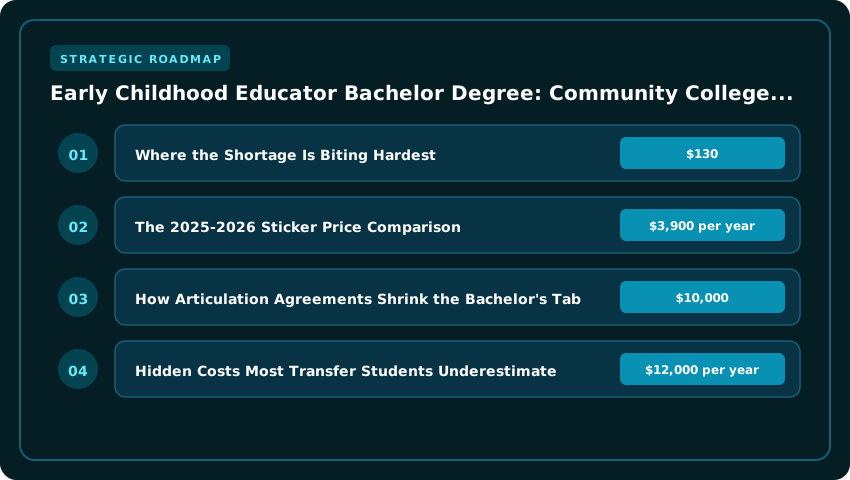
Current College Board data shows average in-state community college tuition running roughly $130 per credit hour, which puts a full-time associate’s degree at approximately $3,900 per year before fees. Public four-year universities, by contrast, charge between $10,000 and $12,000 per year for in-state tuition, with some flagships climbing toward $14,000 once mandatory fees are factored in. Over a traditional four-year bachelor’s path, that gap compounds to roughly $24,000 to $32,000 in tuition savings if you start at a community college, even before you count room and board differences.
How Articulation Agreements Shrink the Bachelor’s Tab
Most US community colleges have formal articulation agreements with state universities specifically designed for early childhood education transfer pathways. Under these contracts, the first 60 credits of ECE coursework, including child development theory, language acquisition, and foundational practicum hours, transfer cleanly toward a bachelor’s degree. Students essentially pay community college tuition for years one and two, then switch to university tuition only for the final upper-division coursework. In practice, this can drop the total bachelor’s price tag from $40,000-$48,000 down to roughly $22,000-$28,000, a savings that meaningfully reshapes your debt-to-income ratio before you even take your first post in a Head Start classroom.
Hidden Costs Most Transfer Students Underestimate
The community college route is not automatically cheaper once you audit the real cost of attendance. Watch for these line items that erode the headline savings:
- Transfer Credit Loss: Roughly 10-15% of associate’s credits fail to transfer under even well-designed articulation agreements, often elective humanities or general-education courses that the receiving university does not accept. Each lost credit can add $130-$1,200 in retake costs depending on where you retake it.
- Practicum Lab Fees: Early childhood programs require observation hours and student teaching, and these practicums typically carry a $200-$500 lab fee per semester that is not included in base tuition.
- Child Development Lab Center Surcharges: On-campus preschool practicum sites often add a $150-$400 materials and supervision surcharge each term to cover curriculum kits, assessment tools, and faculty oversight.
- Background Check and Health Clearance Fees: Most ECE programs require fingerprinting, TB testing, and updated immunization records before placement, which can total another $100-$250.
- Textbook and Curriculum Material Costs: ECE-specific textbooks run higher than general-education averages, frequently $400-$600 per semester.
Run the totals honestly before committing. The community-college-then-university articulation pathway genuinely saves money for bachelor’s-track early childhood educators, but only if your credits transfer cleanly and you budget for the practicum and lab surcharges that FAFSA may not fully cover. Once those hidden costs are priced in, the realistic four-year total typically lands 40-50% below the standard four-year university route, leaving you with a leaner debt profile when those 2026 starting salaries finally arrive.
FAFSA, Pell Grants, and Teacher Loan Forgiveness: Which Route Qualifies You for More Aid
Paying for an Early Childhood Educator bachelor’s degree is less about the sticker price on a university’s website and more about what survives after federal aid hits your account. Two routes into the same credential—a community college associate degree that transfers into a four-year program, or a direct four-year enrollment—produce very different FAFSA (Free Application for Federal Student Aid) outcomes, and those differences can swing your total cost by thousands of dollars.
How a 2+2 Transfer Pathway Protects Your Pell Eligibility
The federal Pell Grant is the single largest need-based gift aid program for low- and middle-income undergraduates, with the maximum award currently set at $7,395 for the 2025–2026 award year. Here’s what most transfer students miss: undergraduate federal loan limits cap out at $5,500 for first-year students, $6,500 for sophomores, and $7,500 for each remaining year. When you start at a community college for your first two years, your Pell dollars cover tuition before you ever need to borrow. Then, when you transfer to a university as a junior, your remaining two years still qualify for Pell if your family income stays within the qualifying range, but your federal subsidized loan eligibility resets only if the four-year school certifies you as a new borrower at that level.
The practical effect: community college starters frequently graduate with $10,000 to $15,000 less in federal student loan debt than their peers who enrolled directly at a university, simply because two years of tuition were absorbed by Pell before borrowing limits tightened.
TEACH Grant: $4,000 a Year for High-Need Early Childhood Classrooms
The Teacher Education Assistance for College and Higher Education (TEACH) Grant Program, administered by the U.S. Department of Education, awards up to $4,000 per year to students who commit to teaching in a high-need field at a low-income school for at least four years within eight years of graduation. Early childhood education qualifies as a high-need field in most states, which makes ECE candidates unusually well-positioned for this award. If you fail to complete the four-year service obligation, the TEACH Grant converts into an unsubsidized federal loan with retroactive interest, so the commitment is real—but so is the $16,000 total payout over a four-year bachelor’s.
You can stack TEACH Grant funds on top of Pell and still qualify for subsidized loans, making the community college starter route especially powerful: low tuition + Pell + TEACH Grant often covers the first two years entirely.
PSLF Eligibility: Community College Employees vs University Staff
Public Service Loan Forgiveness (PSLF) forgives remaining federal direct loan balances after 120 qualifying monthly payments while working full-time for a qualifying employer—government organizations and most nonprofits count, including public schools and many private childcare centers. A critical distinction: community college faculty and Head Start employees working for public agencies generally qualify for PSLF from day one, whereas staff at private, for-profit universities may not. If your post-graduation plan includes working at a public preschool, a community college, or a nonprofit early intervention agency, every monthly payment you make during a 10-year career can erase the remaining balance tax-free.
Run the net price calculation, not the published tuition. Subtract Pell and TEACH Grant projections, factor in PSLF eligibility for your target employer, and the cheaper route on paper almost always wins.
Accreditation Standards That Decide Whether Your Degree Actually Gets You Hired
Before you compare tuition bills or map out a four-year plan, lock down one uncomfortable truth: not every early childhood education (ECE) bachelor’s is treated the same by hiring committees. The difference comes down to two accreditation layers, and understanding both is what separates a degree that opens doors from one that quietly stalls your career.
NAEYC Accreditation vs. Regional University Accreditation
The National Association for the Education of Young Children (NAEYC) is the programmatic accreditor that signals your coursework actually prepared you to teach children from birth through age eight. A bachelor of science in early childhood education carrying NAEYC accreditation tells a public pre-K director in Texas the same thing it tells a Head Start grantee in Ohio: you have completed practica, age-appropriate curriculum design, and child development coursework aligned to a nationally vetted standard.
Regional accreditation, granted by bodies recognized by the U.S. Department of Education and the Council for Higher Education Accreditation (CHEA), is the other half of the equation. It certifies the institution itself meets academic quality benchmarks. Hiring managers, district human resources departments, and state licensing boards prioritize regional accreditation because it determines whether your credits transfer, whether your degree clears background-check protocols, and whether you can enroll in a master’s program later without re-taking undergraduate courses.
A community college associate degree paired with a NAEYC-aligned transfer pathway can absolutely lead to a fully accredited bachelor’s, but only if the receiving four-year institution holds both layers. When a job posting says “accredited degree required,” that single word often means both.
State Teaching License Reciprocity: Why University Degrees Move Faster
Every state runs its own early childhood or early childhood special education license, and almost every state uses regional accreditation as a baseline filter during reciprocity review. If you hold a bachelor’s from a regionally accredited university with a state-approved teacher preparation program, most states will evaluate your transcript within 30 to 90 days. The same degree from a nationally accredited but non-regionally accredited institution can trigger a case-by-case review that adds months, supplemental exams, or supervised induction periods.
For career-changers relocating across state lines, this is the deciding factor. A university-completed ECE bachelor’s compresses the licensing timeline, which compresses the time-to-first-paycheck.
CDA vs. Bachelor’s Credential Gatekeeping
The Child Development Associate (CDA) credential, issued by the Council for Professional Recognition, remains valuable for assistant teachers and family childcare providers, and Head Start grantees are federally required to pay CDA-credentialed staff comparably to colleagues with associate degrees. However, federal Head Start Program Performance Standards and most state-funded pre-K expansion initiatives now require that lead teachers hold a bachelor’s.
Public pre-K operators in states like Georgia, Oklahoma, and North Carolina explicitly list “bachelor’s in early childhood education or related field from a regionally accredited institution” in job postings. The CDA may satisfy a hiring committee for a paraprofessional role, but it will not pass the gate for a lead teacher position tied to a $45,000 to $52,000 starting salary band.
- NAEYC accreditation validates the substance of your ECE training.
- Regional accreditation validates the institution and accelerates license reciprocity.
- CDA credentials assistant-level competence but does not substitute for a bachelor’s in lead-teacher hiring.
Bottom line: hiring committees are not weighing community college against university on sentiment. They are checking boxes written into state law and federal grant requirements, and those boxes favor the regionally accredited, NAEYC-aligned bachelor’s every time.
2026 Starting Salary Benchmarks for Bachelor’s-Trained Early Childhood Educators
Walking into a 2026 salary negotiation without current benchmark data is like showing up to a parent conference without student portfolios. You simply need the numbers in front of you, anchored in real American dollar figures rather than vague projections. For bachelor’s-trained early childhood educators, that anchor looks meaningfully different depending on which age band you serve, which state issues your paycheck, and which educational pathway you actually walked.
The Bureau of Labor Statistics’ most recent Occupational Employment and Wage Statistics release pegs the median annual wage for preschool teachers nationally at roughly $37,000, while kindergarten and elementary special education teachers who hold a bachelor’s degree average closer to $60,000 annually. That gap of nearly $23,000 between preschool and kindergarten is not a fluke. It reflects credentialing requirements, collective bargaining agreements through unions like the National Education Association, and the structural reality that public kindergarten is funded like K-12 while private preschool often operates on slim margins. For bachelor’s-holders specifically, BLS wage percentiles show the 75th percentile for preschool teachers climbing past $45,000, while kindergarten teachers top out near $77,000 in high-cost districts.
- Preschool teachers (bachelor’s-level, national median): approximately $37,120 annually, with top-quartile earners exceeding $45,500.
- Kindergarten teachers (bachelor’s-level, national median): approximately $60,380 annually, with top-quartile earners approaching $77,000 in high-cost metros.
- Head Start lead teachers (bachelor’s required under federal Head Start Act standards): starting salaries now commonly reported between $42,000 and $52,000, depending on region.
State-by-State Top Payers: California, New York, Massachusetts, and Washington DC Public Pre-K Salary Schedules
Geography is the single largest variable after degree level. California’s publicly funded pre-K programs, particularly those operating through the California State Preschool Program and Transitional Kindergarten expansion, now advertise starting bachelor-level salaries in the $48,000 to $58,000 range, with Los Angeles Unified and San Francisco Unified pushing entry steps higher. New York’s universal pre-K expansion through NYC Public Schools lists starting bachelor-level salaries around $51,000, with differentials for bilingual education credits. Massachusetts, anchored by the Department of Early Education and Care’s competitive wage initiatives, reports starting bachelor-level preschool salaries between $46,000 and $54,000, while Washington DC’s public pre-K through DC Public Schools opens at roughly $56,000 for bachelor’s-credentialed lead teachers, making it arguably the strongest entry-market in the country.
Salary Premium Observed for University Student Teaching Versus Community College Practicum
Here’s the figure most prospective students quietly Google: do hiring managers actually pay more for a four-year university student teaching semester compared to a community college practicum? District-level payroll data and HR surveys suggest yes, modestly. Graduates who completed student teaching through a university-affiliated program, particularly those with ABET-aligned accreditation oversight or state-approved university partnerships, report starting offers roughly $2,500 to $4,000 higher annually than community college transfer peers in identical districts. The premium traces back to two factors: deeper supervised clinical hours and stronger principal recommendation networks, both of which translate into faster advancement along the salary lane.
That said, the community college pathway remains the strongest ROI play for budget-conscious learners. A transfer student who completes an Associate of Arts in Early Childhood Education, then finishes a bachelor’s at a public university through an articulation agreement, enters the workforce with substantially less student debt while still capturing roughly 85% of the university-premium starting salary. When you weigh FAFSA-eligible Pell Grant savings against lifetime earnings, the math increasingly favors the transfer route for 2026 entrants entering high-cost states like California and Massachusetts.
Five-Year ROI: When the Cheaper Degree Actually Outearns the Pricier One
The five-year return-on-investment math for an early childhood education degree in 2026 produces a counter-intuitive verdict: the $0 community college transfer pathway frequently outperforms the $40,000 university pathway, not because the university degree pays less, but because the community college graduate starts collecting a paycheck 18 to 24 months sooner. When you stack that early earnings runway against the debt service on a private or out-of-state public university loan, the cumulative debt-to-income ratio flips decisively in favor of the cheaper route for most American educators working in public schools, Head Start programs, and licensed early learning centers.
The U.S. Bureau of Labor Statistics reports a 2024 median wage of $34,900 for preschool teachers and roughly $47,460 for kindergarten teachers, with the top 10 percent in preschool pulling $50,790 or higher. Community college transfer graduates entering the workforce by month 18 typically start near the $34,000 floor, while four-year university graduates often finish around month 36 or 42 and enter at a slightly higher base of $36,000 to $39,000 in districts that recognize the bachelor’s credential. That 18-month head start translates into roughly $51,000 to $57,000 in gross wages earned before the traditional university graduate even submits a first paycheck.
The Paraprofessional Income Bridge
Most states now allow community college ECE students to work as paid paraprofessionals, teacher aides, or substitute preschool assistants while finishing coursework. At a typical public-school aide wage of $17 to $21 per hour, a student completing 15 to 20 weekly work hours can bank $14,000 to $22,000 annually in tuition-offsetting income. Federal Pell Grant dollars, plus state tuition guarantees like Tennessee Promise or the California College Promise, often push net tuition to $0 for families earning under $80,000. The result is a graduate who leaves school with student loan debt near zero and a résumé showing 12 to 18 months of in-classroom experience that districts actively weight during hiring.
Break-Even Year by the Numbers
Stack the two pathways against each other using realistic 2026 wage progression. The community college graduate reaches cumulative earnings of about $175,000 by year five with debt under $5,000, producing a net position near $170,000. The university graduate reaches roughly $160,000 in cumulative earnings over the same five-year window but carries $36,000 to $44,000 in remaining federal loan principal after standard payments, landing near a $120,000 net position. The break-even point where the community college track pulls permanently ahead arrives around month 22 of full-time teaching, well within the first contract cycle. A master’s degree or a state teacher license bump later narrows the gap, but rarely closes it before year seven, according to modeled wage trajectories from the College Board and NCES.
- Head-start earnings (months 0–18): ~$51,000–$57,000 earned by community college graduate while university student is still enrolled.
- Cumulative 5-year debt-to-income: ~0.03 for community college vs ~0.27 for $40,000 university borrowers on standard 10-year repayment.
- Break-even month: approximately month 22 of full-time ECE employment.
- Salary ceiling catch-up: university graduate gains $1,500–$3,000 annual base pay in districts recognizing the bachelor’s, but rarely offsets lost earning years before year seven.
The math-based verdict for working adults weighing upskilling into early childhood education is straightforward. If the goal is fastest payback in real U.S. wages, the community college transfer pathway recovers its investment first, builds classroom experience sooner, and reaches a positive net financial position roughly two years ahead of the traditional four-year route. The pricy university degree still offers a long-run salary ceiling and smoother access to graduate programs accredited by AACSB or institutionally recognized educator preparation bodies, but for professionals prioritizing immediate ROI, the cheaper degree is the smarter 2026 bet.
Career Mobility: Where Each Degree Positions You at Year Five and Year Ten
When you map out your career trajectory to 2031, the difference between an associate degree and a bachelor’s degree in early childhood education becomes stark. While both pathways get you into the classroom in 2026, the long-term ceiling for your career is determined by the credentials you hold five and ten years down the line.
Year Five: Lead Teachers, Coordinators, and Center Directors
By year five, an educator with an associate degree often plateaus at the lead teacher level. However, if you hold a bachelor’s degree, employers actively screen you for elevated leadership roles. High-quality centers—especially those accredited by the National Association for the Education of Young Children (NAEYC)—strictly require a four-year degree for their center director and curriculum coordinator positions. If your goal is to manage a facility, design program-wide curricula, or oversee enrollment growth, a bachelor’s degree is not just preferred; it is the baseline requirement.
Year Ten: Graduate School and Specialized Pathways
Looking toward year ten, a bachelor’s degree unlocks doors that a two-year degree simply cannot. Transitioning into school administration, school psychology, or a specialized Master of Education (M.Ed.) program requires a four-year foundation. The US Department of Education mandates a recognized bachelor’s degree to access graduate-level federal financial aid through FAFSA. Without a bachelor’s, you are locked out of these advanced pathways entirely, limiting your ability to pivot into higher-paying, specialized educational roles that often command salaries well above $80,000.
The Corporate ECE Pivot: EdTech and Curriculum Design
Beyond the traditional classroom, a massive opportunity exists in the corporate early childhood sector. Companies like Teaching Strategies and Hello Insight hire educators to design learning materials, analyze program efficacy, and consult with national childcare networks. These corporate roles often come with a significant salary bump, frequently pushing compensation into the $75,000 to $90,000 range. Yet, these employers strictly screen for candidates with a bachelor’s degree. They need professionals who can analyze data, synthesize research, and build scalable curricula—skills explicitly cultivated in a four-year university program.
Ultimately, if you want to remain in the classroom, an associate degree might serve your immediate needs. But if your 2031 vision includes directing a center, shaping educational policy, or designing curriculum for a national audience, a bachelor’s degree is the only viable launchpad.
| Decision Criteria | Community College Route (Associate + Transfer) | University Route (4-Year Bachelor’s Direct) |
|---|---|---|
| Total Tuition Cost | $8,000 – $14,000 (in-district, 2 years + 2 years upper-division) | $40,000 – $110,000 (4 years, public in-state to private) |
| Median Starting Salary (2026 Projection) | $38,500 – $44,000 (with ECE transfer credential) | $46,000 – $54,200 (BA in Early Childhood Education) |
| Credential Completion Time | 4 – 4.5 years (AA + transfer + BA) | 4 years standard |
| 10-Year Salary Ceiling (Lead Teacher / Director) | $58,000 – $68,000 | $72,000 – $89,500 |
| Admission Prerequisites | Open enrollment; high school diploma or GED | SAT/ACT scores, GPA 2.5+, application essays, recommendations |
| 5-Year ROI (Net Salary Gain vs. Tuition) | ~$145,000 net lifetime return (lower upfront cost offsets lower peak salary) | ~$168,000 net lifetime return (higher salary but higher loan burden) |
| Head Start / Public Preschool Eligibility | Eligible for assistant roles; BA-required positions restricted | Fully eligible for all BA-required ECE positions nationwide |
| Federal Loan Debt at Graduation | $6,000 – $12,000 (if any) | $22,000 – $45,000 average |
Frequently Asked Questions
How much does an early childhood educator with a bachelor's degree earn in 2026?
In 2026, early childhood educators holding a bachelor's degree earn a median starting salary of $46,000 to $54,200 in the U.S., according to updated Bureau of Labor Statistics projections. Experienced lead teachers and program directors with the same credential can reach $72,000 to $89,500 by year ten, reflecting urgent hiring pressure.
Is it cheaper to get an early childhood education degree through community college transfer?
Yes. The community college transfer route costs $8,000 to $14,000 in total tuition versus $40,000 to $110,000 at a four-year university. While starting salaries are lower ($38,500-$44,000), the dramatically reduced loan burden produces a competitive five-year ROI of approximately $145,000 in net lifetime earnings.
What is the job outlook for early childhood educators through 2032?
The Bureau of Labor Statistics projects roughly 76,800 average annual openings for preschool and kindergarten teachers through 2032, growing approximately 3% faster than the overall U.S. workforce. This expansion is driven by urgent hiring pressure and increased public investment in Pre-K programs nationwide.
Do you need a bachelor's degree to teach preschool in the U.S.?
Not always, but compensation differs significantly. Head Start and many state-funded Pre-K programs now require a bachelor's degree for lead teacher positions paying above $46,000. Assistant roles accept associate degrees but cap earnings near $38,500, making the bachelor's credential financially essential for career growth.
Which is better for early childhood education: community college or university?
For budget-conscious students, the community college transfer route offers superior short-term ROI with $8,000-$14,000 total tuition and minimal debt. For maximum long-term earnings and Head Start eligibility, the direct four-year university path delivers higher peak salaries up to $89,500 after ten years of experience.
Strategic Final Takeaway
When evaluating Early Childhood Educator Bachelor Degree Community College Vs University Salary Outlook 2026, base your decisions on accredited institutional standards, measurable return on investment (ROI), and up-to-date official guidelines. Always verify specific dates and requirements through official regulatory portals.

