Why Stackable Tech Credentials Matter Under the 2026 Perkins V Framework
If you are a high school administrator, CTE director, or district superintendent building a tech pathway for the 2026 school year, Perkins V is no longer background policy. It is the engine driving your budget, your accountability metrics, and your curriculum choices. The Strengthening Career and Technical Education for the 21st Century Act reshaped how the US Department of Education distributes money, and the 2026 implementation cycle is tightening the screws on what counts as a “quality credential.”
Federal Dollars Now Follow Work-Based Learning Coordinators
Under the current Perkins V framework, states must allocate a meaningful portion of their federal CTE dollars toward Work-Based Learning (WBL) coordinators. These are the professionals who build the bridge between a CompTIA A+ lab in a high school classroom and a paid internship at a local managed services provider. School districts that can show a documented, stackable credential pathway paired with WBL coordination are positioned to capture larger Perkins V grants. Districts that cannot, risk losing roughly $50,000 to $150,000 per high school in supplemental funding each year, based on FY 2025 state allocation patterns.
Mapping Credentials to the Advance CTE National Career Clusters
Stackable tech credentials only count if they map cleanly to the Advance CTE National Career Clusters framework, specifically the Information Technology cluster and its sub-pathways in Network Systems, Programming, and Information Support & Services. A high school student who earns an entry-level certificate in ninth grade, an intermediate credential by eleventh grade, and an industry-recognized certification by graduation is following the stackable model Congress envisioned when it passed Perkins V.
This stacking logic is what unlocks the federal dollars. A single certification, no matter how prestigious, does not demonstrate the sequential, career-connected learning the legislation was designed to incentivize. Three credentials, mapped to a defined cluster and validated by employer partners, does.
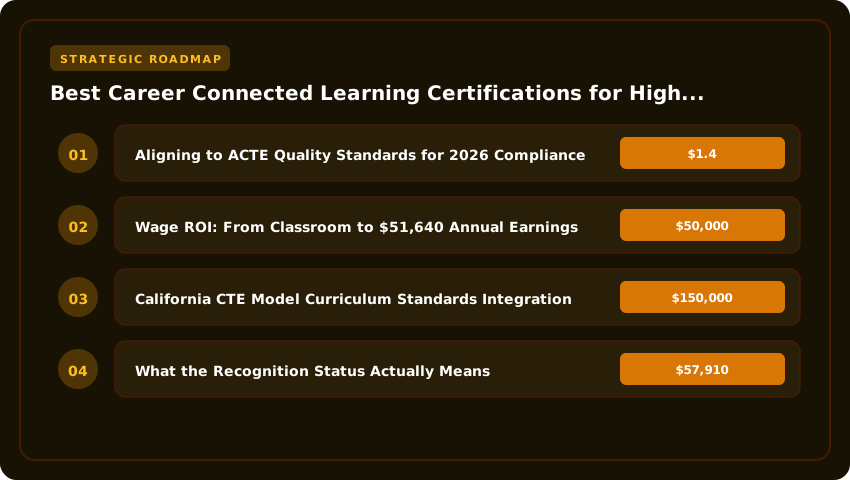
Aligning to ACTE Quality Standards for 2026 Compliance
The Association for Career and Technical Education (ACTE) quality standards now function as the unofficial compliance checklist for Perkins V reviewers. High school programs seeking strong performance indicators must show:
- Sequential, standards-aligned curriculum tied to the Information Technology career cluster
- Industry-validated certifications from recognized bodies such as CompTIA, Cisco, AWS Academy, or PMI
- Documented WBL experiences including job shadowing, apprenticeships, and paid internships
- Employability skills rubrics aligned to ACTE’s Career Ready Practices framework
- Data tracking for credential attainment, concentrator status, and postsecondary placement
For districts navigating the 2026 reporting cycle, stackable tech credentials are the cleanest path to satisfying these standards while giving students a recognized entry point into a tech workforce where entry-level IT support roles already pay a median of $57,910 annually according to the Bureau of Labor Statistics. The policy rationale and the economic rationale have finally converged, and the Perkins V framework is the mechanism that connects them.
CompTIA A+ as the Foundational IT Credential for Career Launch Programs
For districts looking to anchor a high-value tech pathway in stackable credentials, the CompTIA A+ stands as the most strategically relevant entry point in the secondary CTE landscape. Recognized across federal and state workforce frameworks, this vendor-neutral certification validates baseline competencies in hardware, networking, mobile devices, and operating systems, the exact skill stack demanded by entry-level IT support roles. When aligned with SkillsUSA student organization chapters and integrated into the curriculum frameworks published by NASDMEec (the National Association of State Directors of Career and Technical Education Consortium), CompTIA A+ transforms from a standalone exam into a high-engagement, work-based learning experience that maps directly to postsecondary credit.
Wage ROI: From Classroom to $51,640 Annual Earnings
The economic case for CompTIA A+ is concrete and verifiable. According to the U.S. Bureau of Labor Statistics Occupational Employment Statistics survey, Computer User Support Specialists (O*NET-SOC 51-4041) earned a mean annual wage of $51,640 as of the most recent reporting cycle. Because CompTIA A+ aligns tightly with this occupation code, districts can credibly communicate to students and parents that the credential has direct wage-earning potential within months of high school graduation. This positions CompTIA A+ as a rare asset for CTE programs that must demonstrate measurable return on investment to school boards, state accountability systems, and Perkins V federal compliance officers. When a high school senior passes both Core 1 and Core 2 exams, they have already cleared the technical gate to start earning above the national median for all occupations.
Educational Mobility: Dual Enrollment and Articulation Agreements
Perhaps the most underappreciated advantage of CompTIA A+ in high school CTE pathways is its capacity to unlock dual enrollment credit through formal articulation agreements. Districts in California, Texas, and Indiana have negotiated statewide frameworks that allow students who pass CompTIA A+ to bypass introductory IT courses at participating community and technical colleges. In California, this often translates to 3–6 college credits toward an Associate of Science in Information Technology. In Texas, Tech-Prep and P-TECH-style partnerships link CompTIA A+ completion to credit at Lone Star College, Alamo Colleges, and Tarrant County College. Indiana’s Next Level Programs of Study embed CompTIA A+ as the recognized industry certification for the IT pathway, giving students direct access to Ivy Tech Community College credit. For a high school student, this is transformative: they exit grade 12 with both an industry credential and a head start on an associate degree, shaving a full semester or more off the cost of postsecondary education.
Curriculum Integration Through SkillsUSA and NASDMEec Frameworks
Embedding CompTIA A+ into a CTE program is not simply a matter of pointing students toward a voucher-funded exam seat. The most successful pathways in 2026 use the SkillsUSA chapter structure to anchor technical instruction in competitive, career-ready practice. SkillsUSA’s IT pathway competitions reinforce the A+ domains while giving students leadership experience that hiring managers notice. Simultaneously, alignment with NASDMEec standards ensures that instruction meets national curriculum benchmarks, which simplifies state approval for articulation credit and strengthens FAFSA-eligible financial aid pathways for postsecondary enrollment. Administrators who leverage both student organization participation and national standards build programs that withstand leadership turnover, funding shifts, and accreditation review.
For high school students entering the 2026 tech workforce, CompTIA A+ delivers what most other credentials cannot: immediate wage ROI, transferable college credit, and a credential recognized by federal, state, and employer stakeholders alike.
Google Career Certificates Bridging High School Career Academies to Cloud Roles
For high school administrators evaluating which credentials will actually move the needle for graduating seniors entering the tech workforce, Google Career Certificates have rapidly become a top contender. Designed by Google employees and hosted on the Coursera platform, these self-paced programs deliver job-ready training in under six months, costing roughly $49 per month (often fully subsidized through Pell Grants or district CTE funding). What separates these certificates from traditional four-year degrees is their direct tie to an employer consortium that actively recruits candidates who are 18 and older, regardless of college enrollment status.
Employer Consortium Recognition by Walmart, Target, and Verizon
The most significant validation of Google Career Certificates is the Employer Consortium, a coalition of over 150 U.S. companies committed to considering certified graduates for open roles. Major corporate partners like Walmart, Target, Verizon, T-Mobile, and American Express have publicly committed to reviewing resumes from certificate holders for entry-level tech positions. For high school graduates stepping directly into the workforce, this consortium functions as a built-in talent pipeline, bypassing the traditional degree-screening filters that often exclude 18-year-olds without a bachelor’s degree.
Walmart has specifically integrated Google Career Certificates into its upskilling initiative, allowing store associates to earn certifications and transition into IT support roles with internal pay bumps. Verizon has likewise built bridge programs connecting certificate completion to its field technician and network operations career tracks. This kind of direct industry endorsement makes these credentials extraordinarily portable for students exiting career academies.
IT Support and IT Automation Alignment to O*NET SOC 15-1232
For CTE directors mapping curriculum to labor market data, the alignment is precise. The Google IT Support Certificate and the newer IT Automation with Python Certificate map directly to O*NET SOC 15-1232, the classification for Computer Network Support Specialists. According to the U.S. Bureau of Labor Statistics, this occupation carries a mean annual wage of $62,760, with a median pay of $62,550 and projected job growth that significantly outpaces the all-occupations average through the next decade.
This wage data is critical when counseling high school students and their families. A graduate who completes an IT Support Certificate before age 19 can realistically enter a Computer Network Support Specialist role earning more than $60,000 annually, often with full benefits and tuition reimbursement for further education. The IT Automation certificate builds on this foundation, layering in Python scripting skills that open doors to higher-paying DevOps and Site Reliability Engineering pathways.
California CTE Model Curriculum Standards Integration
Districts operating in California have a particularly clear pathway for adoption. The California Department of Education’s CTE Model Curriculum Standards for the Information and Communication Technologies sector explicitly recognize industry-aligned certifications, and Google Career Certificates fit squarely within the “Information Support and Services” pathway. California high schools can embed these certificates into their career academy frameworks, satisfying both the state’s CTE standards and the federal Perkins V accountability requirements around stackable credentials.
For districts in other states, similar integration is achievable through state-level CTE frameworks and local articulation agreements with community colleges. The key administrative insight is that Google Career Certificates are not a standalone product. They function as a labor-market-validated bridge between secondary CTE completion and immediate employment in IT support, cloud administration, and network operations roles across the U.S. economy.
AWS Cloud Practitioner Certification and the Rising Demand for Cloud Literacy
Walk into any Houston Independent School District career institute today and you will find teenagers deploying their first virtual servers before they have a driver’s license. That shift did not happen by accident. When the Texas Education Agency approved AWS Cloud Practitioner as a statewide CTE capstone credit in 2022, the decision quietly rewired what “computer science” means in a public high school transcript.
The certification costs high school academies roughly $150 per learner through the AWS Academy bulk-license program, and districts recoup that cost almost immediately. Houston ISD career institutes now bundle the credential inside Next Gen Personal Finance and computer science dual credit pathways, meaning a junior at Kinder High School for the Performing and Visual Arts can walk into AP Computer Science Principles already holding an industry-recognized cloud badge.
The earnings math behind that badge is what makes administrators pay attention. According to O*NET, the 2024 mean annual wage for Computer and Information Systems Managers (SOC 11-3021) reached $99,720 nationally, and the upper quartile clears $169,000. Cloud literacy sits at the foundation of every one of those roles. Even an entry-level cloud support associate earning $58,000 outpaces the national median wage of $47,000, which is why Texas counselors now steer STEM-track students toward AWS before they consider a four-year computer science degree.
- Statewide adoption: Texas Education Agency lists AWS Cloud Practitioner as an approved CTE industry certification, unlocking weighted funding under the state career and technology education allotment.
- District footprint: Houston Independent School District career institutes offer the credential at no cost to students, with coursework taught by AWS Academy-trained instructors.
- Dual credit alignment: The certification maps directly to computer science dual credit courses at Houston Community College, compressing what used to be two semesters of college IT into a single high school year.
- Salary ceiling: The $99,720 mean wage for Computer and Information Systems Managers (O*NET SOC 11-3021) reflects the value employers place on stackable cloud credentials earned early.
That sequence, free credential in high school, dual credit on a college transcript, and a labor market that pays a six-figure premium for cloud-fluent managers, explains why AWS Cloud Practitioner has become the centerpiece of career-connected learning blueprints in 2026. The credential is not a finishing line. It is the launchpad that lets a seventeen-year-old in Texas step onto a career lattice where the next rung, AWS Solutions Architect Associate or Microsoft Azure Administrator, doubles their earning potential before age twenty-two.
Swift App Development Certification for Mobile-First Career Pathways
Walk into any Apple Distinguished School in Indiana and you will see something remarkable: high school freshmen building functional iOS apps before they have a driver’s license. Districts like Perry Township, Pike Township, and North Central High School have spent the last five years weaving Swift certification directly into their CTE pathways, and the results are turning heads across the Midwest. These schools did not just add another elective. They rebuilt entire academies around the Apple Developer curriculum, pairing it with industry-recognized credentials so students leave high school with college credits, a portfolio on the App Store, and an interview-ready resume.
The economics behind this push are hard to ignore. According to O*NET data tracking SOC 15-1252, the median annual wage for Software Developers reached $108,970 as of the most recent BLS Occupational Employment and Wage Statistics release. iOS specialists consistently sit at the upper tier of that band, with senior mobile engineers in metropolitan markets like San Francisco, Austin, and Boston regularly clearing $165,000 before equity. For a high schooler weighing a four-year computer science degree against a direct-to-workforce pipeline, the Swift credential changes the math entirely.
How PLTW Computer Science Bridges High School and the App Economy
Project Lead the Way (PLTW) has become the connective tissue between classroom instruction and industry certification. The PLTW Computer Science pathway, offered in more than 5,200 US high schools, includes a dedicated Mobile Application Development course that aligns directly with Swift certification standards. Students who complete the PLTW sequence and pass the associated credentialing exam earn stackable credits that articulate into programs at Purdue, Ivy Tech, and a growing roster of ABET-accredited engineering schools.
For CTE concentrators, the alignment matters because it satisfies two federal priorities simultaneously. First, it maps to a high-skill, high-wage occupation as defined by the US Department of Education’s Perkins V criteria. Second, it qualifies under Work-Based Learning (WBL) frameworks, meaning districts can braid funding from Perkins, WIOA youth programs, and local employer partnerships without violating supplement-not-supplant rules.
What the Recognition Status Actually Means
Apple Distinguished School recognition is not a marketing badge. Schools must demonstrate measurable student outcomes, faculty certification rates, and community impact before Apple approves the designation. Indiana districts that hold this status report:
- Portfolio-driven assessment: Every Swift student ships a functioning app to TestFlight before graduation, giving them tangible evidence of competency for hiring managers.
- Industry mentorship pipelines: Apple connects recognized schools with regional developer relations teams, opening doors to paid summer internships at firms like Infosys, Salesforce, and local Indianapolis-based app studios.
- Stackable credential stacking: Swift certification pairs cleanly with CompTIA IT Fundamentals and CIW certifications, letting students graduate with two or three industry-recognized badges instead of one.
- Direct articulation agreements: Several Indiana universities now grant 3-6 credit hours for verified Swift competency, trimming a semester off a bachelor’s degree and roughly $8,000 in tuition.
For high school students mapping out a 2026 tech career pathway, Swift certification has become one of the cleanest on-ramps into the software development labor market. The combination of BLS-backed salary data, PLTW curricular alignment, and Apple-verified instructional quality gives students something most high school credentials cannot: a credible, employer-recognized signal that they can ship production code on day one.
State-by-State CTE Pathway Variations in California, Texas, and Indiana
While Perkins V sets the national floor for Career Connected Learning, the three states leading tech-workforce preparation interpret that funding through wildly different policy lenses. For Work-Based Learning coordinators mapping stackable credentials across district boundaries, understanding how California, Texas, and Indiana operationalize their CTE pathways is the difference between a smooth credit-transfer pipeline and a compliance headache.
California: Strong Workforce Program Dollars and ICT-DMF Alignment
California funnels the bulk of its Perkins allocation through the Strong Workforce Program (SWP), which delivered approximately $248 million in 2025 across 73 community college districts. High school Information and Communication Technology (ICT) pathways increasingly co-enroll students with community colleges under the ICT-Digital Media and IT pathways (CSU and UC-aligned), allowing learners to exit grade twelve with 9 to 15 free college credits already posted. SWP dollars now prioritize dual enrollment and apprenticeship-linked programs, meaning districts chasing these grants should align their certifications to industry-recognized credentials like CompTIA A+, AWS Cloud Practitioner, or Cisco CCST. The California Department of Education’s CTE Incentive Grant adds another layer, paying roughly $3,000 per completer when students finish a sequenced pathway tied to a regional labor-market priority.
Texas: HB5 Endorsements and Industry-Based Certification Accountability
Texas trades flexibility for accountability. Under House Bill 5 (HB5), every high school student must select an endorsement, and districts are measured on the percentage of graduates earning an Industry-Based Certification (IBC) before crossing the stage. In 2026, the Texas Education Agency continues to publish a state-approved IBC list where only certifications on that list count toward public accountability ratings and Perkins performance indicators. For tech pathways, popular IBCs include IT Fundamentals (ITF+), Microsoft Office Specialist, and Oracle Java. Crucially, Texas ties school accountability grades directly to IBC attainment, which means a coordinator choosing the wrong certification vendor can literally hurt a campus rating. IBC reimbursements under the state allocation frequently reach $1,000 to $1,500 per tested student, providing a meaningful budget offset for districts.
Indiana: Next Level Programs of Study and the Employability Skills Benchmark
Indiana’s Next Level Programs of Study framework represents the most prescriptive of the three. Rather than leaving pathway design to districts, the Indiana Department of Education has codified 12 statewide programs of study, each with required coursework, dual credit thresholds, and stackable credential targets. Every CTE concentrator must additionally clear the state’s Employability Skills Benchmarks, which assess critical thinking, communication, and self-management before graduation. Indiana also pioneered state-funded reimbursement for certifications like ITF+, IC3 Digital Literacy, and Google IT Support, providing up to $500 per credential earned.
- California rewards dual enrollment and credit accumulation through SWP dollars.
- Texas demands IBC accountability tied to campus ratings under HB5.
- Indiana requires mastery of statewide Employability Skills Benchmarks alongside credentialing.
For Work-Based Learning coordinators operating across state lines, the practical takeaway is straightforward: the certification itself matters less than whether it appears on the state’s approved accountability list and pairs with reimbursable dual-credit coursework. Map credentials to the state framework first, then build the apprenticeship and Work-Based Learning components around that foundation.
BLS Wage Projections and O*NET Labor Market Data for 2026 Tech Entry Points
When you sit down with a school board or a skeptical parent to justify a new cybersecurity pathway, anecdotes do not move the needle—labor economics do. The Bureau of Labor Statistics (BLS) currently projects employment for Information Security Analysts to surge 33 percent through 2033, a rate that dwarfs the 4 percent average for all occupations. That translates to roughly 16,800 openings annually, driven largely by the relentless cadence of ransomware incidents and the migration of legacy systems to zero-trust architectures. For a high school senior graduating in 2026, this is not a distant forecast; it is their immediate hiring window.
Translating O*NET Bright Outlook Classifications into Curriculum
The BLS headline number gets the press, but O*NET Online gives you the granular taxonomy required to build a competency map. Both Information Security Analysts (15-1212.00) and Computer Network Architects (15-1241.00) carry the Bright Outlook designation, flagging them for rapid growth and high replacement needs. Critically, O*NET breaks these roles into specific Knowledge, Skills, and Abilities (KSAs)—things like SIEM monitoring, vulnerability assessment, and cloud security posture management. If your CTE program maps its CompTIA Security+ or (ISC)² CC objectives directly to these KSAs, you create a transparent line of sight from classroom competency to occupational readiness that administrators can defend and employers can trust.
Calculating ROI: The Stackable Credential Multiplier
Return on Investment (ROI) for Career and Technical Education (CTE) programs is no longer a theoretical exercise. Under the 2026 Perkins V accountability framework, states report stackable credential completion metrics as a core performance indicator. The math is straightforward but powerful: a student who exits high school with a Google IT Support Professional Certificate and a CompTIA Network+ badge enters the labor market at a median entry wage approaching $55,000 (BLS 2023 median for Computer Support Specialists), often with zero student debt. Contrast that with the average four-year graduate carrying $37,000 in loans entering a saturated generalist market.
- Credential Stacking: Each additional certification (e.g., adding AWS Cloud Practitioner to Network+) correlates with a 10–15 percent wage premium in O*NET Job Zone 3 roles.
- Work-Based Learning Credit: Perkins V now weights WBL hours heavily; a 120-hour cybersecurity internship converts directly into postsecondary articulation agreements at community colleges partnered with ABET-accredited programs.
- Perkins Funding Leverage: Districts demonstrating high stackable credential attainment rates unlock supplemental reserve grants, effectively lowering the per-pupil cost of the program.
Bottom line: The labor market has already voted. The 33 percent growth projection is a floor, not a ceiling, especially as AI-driven threat hunting creates hybrid roles that did not exist three years ago. Aligning your 2026 pathway to O*NET KSAs and BLS wage bands isn’t just compliance—it is the strongest enrollment pitch you have.
| Certification | Provider | Est. Cost (USD) | Prerequisites | Stackability Level | Perkins V Alignment | Median Entry Salary (US) | Exam Duration |
|---|---|---|---|---|---|---|---|
| CompTIA A+ (Core 1 & 2) | CompTIA | $506 (2 exams @ $253) | None (9-12 mos exp recommended) | Foundation / Core Stackable | High (Infrastructure Pathway) | $55,000 | 90 mins each |
| Google IT Support Professional Certificate | Google / Coursera | $49/mo subscription | None | High (Stacks to IT Automation, Cloud) | High (WBL Curriculum Aligned) | $50,000 | Self-paced (~6 months) |
| AWS Certified Cloud Practitioner (CLF-C02) | Amazon Web Services | $100 | None (6 mos cloud exp recommended) | Foundation / Associate Stackable | High (Cloud Computing Pathway) | $65,000 | 90 mins |
| Microsoft Azure Fundamentals (AZ-900) | Microsoft | $99 | None | Foundation / Role-Based Stackable | High (Cloud/AI Pathway) | $60,000 | 65 mins |
| Cisco Certified Support Technician (CCST) Networking | Cisco | $125 | None | Entry / Stacks to CCNA | High (Networking Pathway) | $52,000 | 50 mins |
| Python Institute PCEP | Python Institute | $59 | None | Entry / Stacks to PCAP/PCPP | Medium (Programming Pathway) | $58,000 | 45 mins |
Frequently Asked Questions
Which tech certifications qualify for Perkins V funding in 2026?
Perkins V 2026 funding prioritizes stackable, industry-recognized credentials aligned with state CTE plans. Top qualifying certs include CompTIA A+, AWS Cloud Practitioner, Google IT Support, Cisco CCST, and Microsoft AZ-900. Districts must verify each credential appears on their state’s Eligible Training Provider List (ETPL) or approved industry credential list to access the $1.4B federal allocation.
What is the average cost for a high school to implement a stackable tech credential program?
Implementation costs range $5,000–$25,000 per pathway annually. This covers site licenses (e.g., Coursera $49/student/mo), exam vouchers ($59–$506), lab hardware/virtual environments, and teacher externship PD. Perkins V Reserve Funds and State Leadership Funds typically cover 60–100% of these costs for approved programs serving special populations.
Which entry-level tech certification offers the highest ROI for 2026 high school graduates?
AWS Cloud Practitioner delivers the highest immediate ROI: $100 exam fee, no prerequisites, 90-minute test, and $65K median entry salary. CompTIA A+ follows closely at $506 cost for $55K roles but requires two exams. Google IT Support offers lowest barrier ($49/mo) but lower starting median ($50K) unless stacked with automation credentials.
Can high school students earn college credit through stackable tech certifications in 2026?
Yes. ACE Learning Evaluations recommend college credit for CompTIA A+ (6 credits), AWS Cloud Practitioner (3 credits), Google IT Support (12 credits), and Microsoft AZ-900 (3 credits). Over 2,000 US colleges accept ACE credits. Districts should articulate dual-enrollment agreements with local community colleges to transcript these credentials automatically upon passage.
What distinguishes an Industry-Recognized Credential (IRC) from a Certificate of Completion under Perkins V?
An IRC (e.g., CompTIA A+, AWS CP) is third-party validated, psychometrically sound, expires/requires renewal, and maps to labor market demand. A Certificate of Completion (e.g., local Python course finish) lacks external validation, expiration, or standardized assessment. Only IRCs count toward Perkins V Core Indicator 3 (Recognized Postsecondary Credential) accountability metrics for federal reporting.
Strategic Final Takeaway
When evaluating Best Career Connected Learning Certifications For High School Students Entering Tech Workforce 2026, base your decisions on accredited institutional standards, measurable return on investment (ROI), and up-to-date official guidelines. Always verify specific dates and requirements through official regulatory portals.