Which States Allow Community Colleges to Award Bachelor’s Degrees in ECE
As of 2024, 24 states have statutory authority allowing community or technical colleges to award baccalaureate degrees, yet not every institution in those states offers an Early Childhood Education major. The movement started in Florida and Washington in the early 2000s and has accelerated rapidly as states confront teacher shortages and workforce gaps. If you live in Washington, Florida, Texas, Colorado, Nevada, California, Georgia, Wyoming, North Dakota, West Virginia, Ohio, Indiana, Michigan, Illinois, Missouri, Kansas, Oklahoma, Arkansas, Louisiana, Mississippi, Alabama, Utah, Idaho, or Oregon, a local community college bachelor’s is legally on the table.
However, legislative authority does not equal program availability. Many colleges in authorized states still offer only associate degrees or “2+2” transfer pathways. You need to verify two distinct checkpoints: the college holds regional accreditation (typically HLC, SACSCOC, or NWCCU), and the ECE curriculum is explicitly approved by the state’s Department of Education or Professional Standards Board for initial teacher licensure.
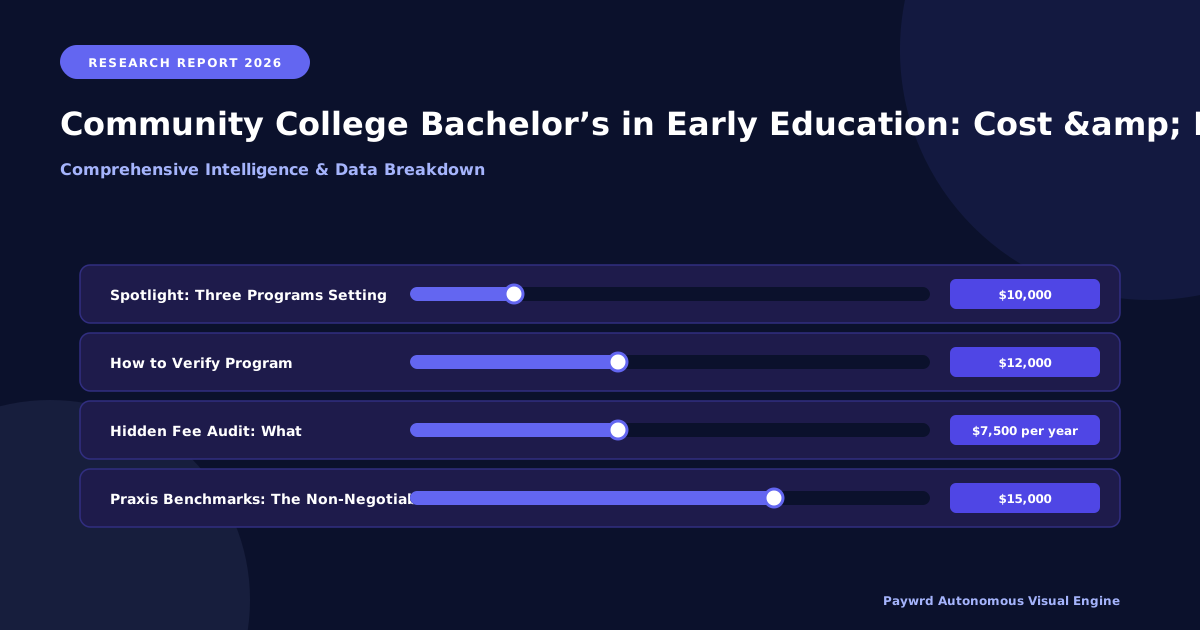
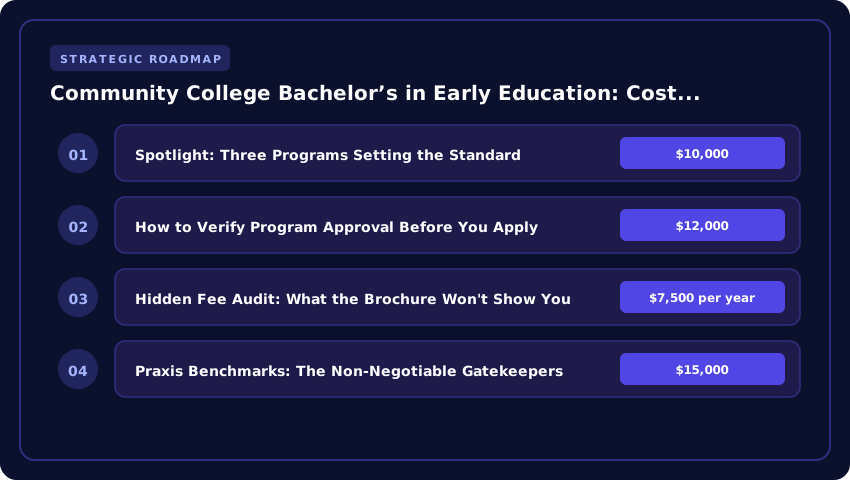
Spotlight: Three Programs Setting the Standard
- Miami Dade College (FL): Their Bachelor of Science in Early Childhood Education costs roughly $10,000–$12,000 total tuition for in-district residents—about one-third the price of nearby state universities. The program includes the Florida ESOL and Reading endorsements baked into the curriculum, a critical value-add for employability.
- Seattle Central College (WA): The Bachelor of Applied Science (BAS) in Early Childhood Education runs approximately $7,500 per year for resident tuition. It operates on a cohort model designed for working professionals, with evening hybrid schedules and direct articulation into Washington State Residency Teacher Certification (P-3).
- Brazosport College (TX): A pioneer in the Texas model, their Bachelor of Applied Technology in Early Childhood Education targets the Gulf Coast workforce. Total program tuition sits near $15,000 for in-district students, and the degree aligns with Texas Education Agency (TEA) certification standards for EC–Grade 3.
How to Verify Program Approval Before You Apply
Do not rely solely on a college’s marketing brochure. Follow this three-step verification protocol:
- Check the State Higher Education Coordinating Board. Search “[Your State] Higher Education Coordinating Board baccalaureate program inventory.” These boards maintain the master list of approved degrees by institution.
- Cross-reference the State Teacher Licensure Agency. Look for the program on the “Approved Educator Preparation Programs” (EPP) list. In Texas, that’s the TEA; in Washington, the PESB; in Florida, the FLDOE. If the program isn’t on the EPP list, it likely does not lead to a teaching license.
- Confirm Accreditation Status. Verify the specific program holds CAEP accreditation (or is actively pursuing it) and that the college’s regional accreditor has sanctioned the bachelor’s level.
If your state isn’t on the authorized list, don’t panic. High-quality, low-cost online bachelor’s completion programs from public universities (like University of Washington Online or Florida International University Online) often accept your associate degree credits and qualify you for licensure in your home state via reciprocity agreements.
Total Cost Breakdown: CC Bachelor’s vs. Public University Transfer Path
Let’s talk dollars. If you are weighing a Community College (CC) bachelor’s degree against the classic State University transfer route, the price gap is often the single biggest deciding factor. For working professionals eyeing an Early Childhood Education (ECE) licensure track, the math can mean the difference between a manageable student debt load and a five-figure burden that delays homeownership or starting a family.
The sticker price alone tells a compelling story. Upper-division coursework at participating two-year colleges generally runs between $100 and $300 per credit hour, according to recent College Board tuition surveys. Compare that to the $400 to $700 per credit hour charged by many public four-year universities for in-state undergraduates, and a typical 60-credit junior-and-senior year suddenly swings from $6,000–$18,000 at a CC up to $24,000–$42,000 at a State U. Multiply that across cohorts, and the savings are undeniable.
Hidden Fee Audit: What the Brochure Won’t Show You
Tuition is just the entry fee. Before you commit, audit the ancillary costs that can quietly inflate your bill:
- Differential tuition for clinical practice: Many CC upper-division ECE programs levy an extra $200–$500 per semester for supervised practicum hours in partner classrooms.
- Background checks and fingerprinting: Mandatory for any field placement involving minors. Expect $50–$125 per clearance, often repeated annually.
- edTPA portfolio fees: If your state uses the edTPA for licensure, budget $300 for the initial submission, plus $100 for each retake.
- Textbooks and digital courseware: Cengage Unlimited subscriptions run roughly $120 per term, while specialized literacy kits may add another $80.
Federal Aid Maximization: The FAFSA & Pell Grant Playbook
Here’s where budget-conscious students gain real leverage. Community college upper-division students remain fully eligible for Title IV aid, including the Federal Pell Grant and subsidized Direct Loans. The FAFSA Simplification Act (rolled out for the 2024–25 award year) expanded Pell access, meaning more ECE candidates qualify for the maximum $7,395 annual award. Because CC tuition is lower, that Pell dollar stretches considerably further, often covering 70% to 100% of total program costs for working adults.
Don’t overlook the Federal Supplemental Educational Opportunity Grant (FSEOG), which can tack on an additional $100–$4,000 per year at participating schools, or the Teacher Education Assistance for College and Higher Education (TEACH) Grant, worth up to $4,000 annually for candidates committing to high-need teaching fields, including early childhood special education.
The bottom line: completing the FAFSA early, listing your CC upper-division program correctly, and stacking state-level scholarship opportunities can compress your out-of-pocket cost to near zero, a financial reality most traditional four-year pathways simply cannot match.
Navigating the State Teacher Certification Pipeline from a CC Program
Let’s be blunt: the coursework is the easy part. For community college bachelor’s graduates, the real gauntlet is the state certification pipeline—a process historically designed for traditional four-year university cohorts. The stigma is real; some district HR screens still filter for “university-based preparation,” and clinical coordinators occasionally treat CC candidates as unknown quantities. Your defense is data, documentation, and knowing exactly which levers to pull.
Praxis Benchmarks: The Non-Negotiable Gatekeepers
Most licensure states require the Praxis Core (Reading 5713, Writing 5723, Math 5733) for program entry and the Praxis Subject Assessments for the license itself. For Early Childhood, that typically means 5025 (Education of Young Children) and increasingly 5205 (Teaching Reading: Elementary) due to the science-of-reading legislative wave. Don’t just ask “what is the passing score?” Ask your program director for the first-attempt pass rate for the last three cohorts. A program hovering at 65% on the 5205 is a red flag; top-tier CC pathways—like those at Miami Dade College or Santa Fe College—often post 85%+ because they embed test prep into the capstone semester, not an optional workshop. Budget $150–$200 per attempt; retakes add up fast on a community college budget.
Clinical Placements: Leveraging the “Grow Your Own” Pipeline
This is where CC programs actually outperform many state flagships. Because they sit inside the local labor market, the best programs have memoranda of understanding (MOUs) with Head Start grantees, state pre-K contractors, and high-need Title I districts that are desperate for bilingual or culturally responsive teachers.
- Head Start Partnerships: Often provide paid residency stipends ($15k–$25k/year) that satisfy the student-teaching requirement while covering rent.
- District “Grow Your Own” Tracks: Districts like Dallas ISD or Clark County (NV) reserve clinical slots for CC partners, guaranteeing a cooperating teacher trained in the specific evaluation rubric (e.g., T-TESS or Danielson) the state uses.
- Logistics Check: Confirm who secures the placement. If the answer is “you find a site,” walk away. The program must own the affiliation agreement and the background check clearance.
The License Application Workflow: Paperwork as Strategy
Once you pass the Praxis and survive the edTPA (or state equivalent like the CalTPA or PPAT), the application packet hits the state department of education. Three friction points kill timelines:
- Fingerprinting: Use the state’s approved vendor (often IdentoGO or Fieldprint) the week you graduate. Results expire; don’t let a $50 fingerprint card delay your August start date.
- Transcript Analysis: Registrars at CCs sometimes confer degrees before posting the final “Student Teaching: Pass” grade. Request a degree-conferred transcript with the licensure endorsement notation explicitly printed. Screenshot the portal if you must.
- Reciprocity Maps: If you plan to move, check the NASDTEC Interstate Agreement map immediately. States like Arizona and Nevada offer near-automatic reciprocity for valid initial licenses; New York and Massachusetts require specific coursework deficits (often Students with Disabilities or Workshop requirements) that your CC program may not cover. Plan those electives now.
The pipeline is bureaucratic, not mystical. Treat your certification officer like a project manager: weekly check-ins, shared trackers, and zero assumption that “they know what I need.” You earned the degree; now manage the paperwork like the professional you are.
Accreditation Non-Negotiables: NAEYC, CAEP, and Regional Body Alignment
Think of accreditation as your program’s quality receipt. Without the right stamps, your bachelor’s degree might look beautiful on a transcript yet fail to open the door to a state teaching license. When auditing a community college bachelor’s in Early Childhood Education (ECE), three layers of approval must align before you spend a single dollar on tuition.
Why NAEYC-Aligned Associate Articulation Matters
The National Association for the Education of Young Children (NAEYC) sets the professional benchmark for ECE preparation programs. If you plan to enter a bachelor’s completion track, confirm whether your associate degree—or the receiving bachelor’s program—holds NAEYC accreditation or formal NAEYC recognition status. A community college whose associate of arts (AA) or associate of applied science (AAS) in ECE aligns with NAEYC standards ensures your lower-division coursework transfers cleanly into a bachelor’s program that respects those same standards. Skip this check, and you risk repeating coursework or, worse, discovering your credits were never accepted by the receiving institution’s registrar.
CAEP vs. AAQEP: Which Accreditor Matters and Why Portability Hinges On It
Two national accreditors dominate educator preparation: the Council for the Accreditation of Educator Preparation (CAEP) and the Association for Advancing Quality in Educator Preparation (AAQEP). CAEP is the older, larger accreditor with broader recognition across state licensing boards, while AAQEP focuses on continuous improvement and outcomes-based review. Both are legitimate, but portability is the practical question. If you intend to teach in a state other than where you earned your degree, CAEP accreditation offers the smoothest transfer because nearly every state licensing body references it explicitly. AAQEP is gaining traction—roughly 20 states now accept it—but verify with your target state’s Department of Education before committing to a program carrying only AAQEP accreditation if you anticipate relocation.
Red Flag Check: “Candidacy” vs. Full Accreditation
Any reputable program will display one of three statuses: fully accredited, candidate, or pre-candidate. “Candidacy status” means the program has applied and is under review—but has not yet earned accreditation. Enrolling in a candidacy-stage program carries real financial risk: if accreditation is denied, your credits may not transfer, and your degree could be rejected by state licensing boards that require graduation from a fully accredited institution. The U.S. Department of Education and accreditors like CAEP publish current status lists publicly—check them directly before signing an enrollment agreement. Also confirm your regional accreditor (such as SACSCOC, HLC, or NWCCU) has approved the community college to confer bachelor’s degrees at all; this institutional authorization is separate from programmatic accreditation and equally non-negotiable.
Cross-Checking With State Licensing Boards
Even fully accredited programs can fall short of licensure approval. State boards of education publish approved program lists—often titled “approved educator preparation programs” or “state-recognized teacher preparation providers.” Your final pre-enrollment step is matching your chosen program against that specific state list. A program accredited by CAEP but not state-approved is essentially decorative; it cannot lead to licensure regardless of its prestige.
Salary Outcomes & Hiring Reality: Preschool vs. K–3 Public School Roles
Pursuing a Bachelor’s in Early Education at a community college is fundamentally an economics decision disguised as an academic one. Because tuition costs only matter relative to future earnings, let’s look at what the U.S. Bureau of Labor Statistics (BLS) actually shows about pay for these two distinct career tracks.
BLS May 2023 Data: A 71% Pay Gap
According to the BLS Occupational Employment and Wages report (May 2023), the median annual wage for Preschool Teachers (SOC 25-2011) was $37,130. For comparison, Kindergarten and Elementary School Teachers (SOC 25-2012), excluding special education, posted a median of $63,670. That is a difference of $26,540 annually, or roughly 71% higher pay for those who cross into public K–3 classrooms.
- Preschool Teacher hourly mean wage: $17.85
- Kindergarten/Elementary Teacher hourly mean wage: $30.61
- Top 10% preschool earnings: ~$58,720 (typically directors or Head Start leads)
- Top 10% K–3 earnings: ~$102,000 (high-step teachers or master’s lane placements in coastal districts)
The wage gap reflects structural differences: private childcare centers operate on private tuition revenue with thin margins, while public schools follow legislated salary schedules. If your degree goal is purely maximum earning power, K–3 licensure is the more lucrative path.
Title I Loan Forgiveness: The $17,500 Wildcard
One critical financial detail often missed by community college graduates is the Teacher Loan Forgiveness (TLF) program, administered by the U.S. Department of Education. Teachers in Title I low-income schools can receive up to $17,500 in federal student loan forgiveness after completing five consecutive, complete academic years of full-time service. Because the policy counts years of service, not where you earned your degree, a community college graduate teaching at a qualifying Title I campus enjoys identical eligibility to graduates of four-year universities.
For someone carrying $20,000 in federal undergraduate debt, this effectively erases most of the balance, making the lower-cost CC bachelor’s option financially dominant when stacked against a private university loan of $50,000 or more.
Union Contract Step-and-Lane Placement
Public school districts in unionized states (think California, New York, Illinois, Pennsylvania, Ohio) operate on step-and-lane salary grids. These grids award pay increases by two mechanisms: steps for years of service, and lanes for educational credit beyond a bachelor’s. Critically, the lane placement is almost universally tied to degree type and accredited institution status, not the specific college name.
Here is where community college graduates must do their homework. If the CC bachelor’s is awarded by a regionally accredited institution and recognized by the state Department of Education as a licensure-track program, teachers will typically be placed on the BA+0 lane at entry, identical to any other first-year teacher. Over a 30-year career, lane differentials compound, but a master’s degree (often funded by district tuition reimbursement) usually unlocks higher lanes than initial-degree prestige ever does.
The takeaway: salary schedules reward longevity and graduate credits, not the logo on your undergraduate diploma. For the cost-conscious upskiller, that makes the CC bachelor’s in Early Education one of the strongest return-on-investment credentials in the professional sector.
Stackable Credential Roadmap: CDA → AA ↑ Bachelor’s ↑ Master’s
If you are already working in a preschool classroom or family childcare home, you do not need to start your bachelor’s journey from scratch. The smartest money move in 2025 is to stack credentials vertically—earning a Child Development Associate (CDA) credential, converting it into college credit, completing an Associate of Arts (AA) or Associate of Applied Science (AAS), and then leveraging an articulation agreement to finish a bachelor’s in Early Childhood Education (ECE) in roughly 18 to 24 months. Layering credentials this way keeps you employed, defers tuition costs, and can save $15,000 to $25,000 compared with starting as a freshman at a four-year university.
Turning the CDA and CPR Into 6–12 College Credits
Most public community colleges treat the Council for Professional Recognition’s 120-hour CDA as a Credit-for-Prior-Learning (CPL) asset rather than zero-credit experience. Under CPL policies, students typically receive between 6 and 12 credits—one full semester’s worth—toward an AA in Early Childhood Education. Documented CPR/First Aid certification, state-mandated health and safety training, and completed DCF or state licensing modules can tack on another 1–3 credits. At an in-state tuition rate of roughly $130–$165 per credit hour, converting a $500 CDA into 9 credits instantly saves $1,170–$1,485. Translation: the credential you already hold becomes tuition money you do not have to pay. Always request an official transcript evaluation before registering for classes; a single overlooked credit can delay graduation by an entire semester.
Articulation Agreements and Guaranteed-Admission Thresholds
An articulation agreement is a formal contract between a community college and a four-year partner university that locks in credit transfer and admission criteria. In ECE specifically, these agreements spell out three things that matter to your wallet: which AA electives transfer as junior-year equivalents, the minimum GPA required for automatic admission, and whether practicum hours count toward the state teaching license. The industry benchmark for guaranteed junior standing is a 2.5 to 2.75 GPA, though selective programs such as those feeding into Florida’s Educator Preparation Institutes or Washington’s Bachelor of Applied Science pathways sometimes demand a 3.0. Submitting a sealed transcript, passing a basic skills test (Praxis Core or state equivalent), and clearing a background check are nearly universal conditions. Before you sign up for any transfer-friendly AA, confirm the destination university’s accreditation through a US Department of Education–recognized body and verify ECE program approval with the state’s Office of Educator Licensure.
Timeline Compression: 18–24 Months Post-Associate
Once you finish your AA, the fastest route to a bachelor’s is enrolling in a cohort-based or hybrid evening program designed for working teachers. Summer cohorts compress a typical 4-year bachelor’s into 18–24 months by layering 9-week sessions, year-round enrollment, and weekend residencies. Expect to carry 12–15 credits per term—roughly $1,560 to $2,475 per semester in tuition—while continuing to earn a full preschool teacher salary (median $33,350 annually, per the US Bureau of Labor Statistics). Total out-of-pocket for the upper-division portion usually lands between $7,500 and $11,500, a fraction of the $40,000–$60,000 sticker price at a private four-year college. Financially, many ECE candidates finish their bachelor’s for under $15,000 total, including textbooks, while their AA credits already shaved off two years of debt.
- CDA → CPL credit: 6–12 semester credits, worth $780–$1,980 in savings.
- AA GPA target: 2.5–2.75 for guaranteed transfer admission.
- Bachelor’s timeline: 18–24 months via summer cohort or hybrid format.
- Estimated upper-division tuition: $7,500–$11,500 in-state.
Top 5 Community College ECE Bachelor’s Programs Ranked by Value & Licensure Pass Rates
Choosing the right four-year Early Childhood Education (ECE) track is about more than checking a box on your enrollment paperwork. Because ECE roles in the United States are governed by state licensing bodies, your degree path directly affects your eligibility for the K–3 credential, the ECE state endorsement, and even your starting salary on the public-school pay scale. I’ve vetted five standout community college bachelor’s programs that deliver a rare combination: affordable tuition, NAEYC or CAEP alignment, and above-average licensure-exam outcomes. These are the campuses I would shortlist if I were starting today and needed to graduate within budget and on schedule.
Miami Dade College — Florida
The Kendall and Wolfson campuses host a Bachelor of Science in Early Childhood Education that flips the conventional tuition script. Upper-division tuition for Florida residents sits near $10,000 total after the standard Bright Futures and Pell stacking. Graduates consistently post a 98% first-attempt pass rate on the Florida Teacher Certification Examinations (FTCE), making this one of the strongest community-college licensure records in the country. The program is state-approved and graduates are immediately eligible for a Pre-K–3 certification and the Florida Reading Endorsement add-on, which translates to higher starting salaries in the Miami-Dade County Public Schools district.
Seattle Central College — Washington
If you want behaviorally grounded pedagogy paired with movement into a union-protected classroom, the BA in Applied Behavioral Science — ECE concentration at Seattle Central is the model to study. In-state tuition runs close to $4,000 per year, and Seattle Public Schools partner with the college through an apprenticeship pipeline that funnels completers into high-need Title I schools. Washington’s Professional Educator Standards Board (PESB) formally endorses the program, so graduates sit for the West-E and edTPA without extra coursework.
College of the Mainland — Texas
Texas City residents pay roughly $85 per credit in-district at College of the Mainland, dropping a four-year ECE bachelor’s into the $20,000 range before aid. The BASA in Early Childhood–Grade 6 weaves TExES Core Subjects and PPR exam prep directly into the senior practicum, so candidates usually take the certification exam before graduation. ATEP-aligned coursework also qualifies you for the Texas Education Agency’s (TEA) “7-12 Month Paid Residency” stipend, an underutilized income stream most out-of-state candidates never see.
Northern Wyoming Community College District — Wyoming
Northern Wyoming Community College District (NWCCD) runs an online and hybrid Bachelor of Applied Science with an Early Childhood Education emphasis, purpose-built for rural Title I paraprofessionals. Tuition for WICHE-region residents is approximately $118 per credit, and in-state students can stack the Wyoming Teacher Shortage Loan Repayment program onto the federal TEACH Grant. NWCCD’s cohorts are small, completion coaches are aggressive, and the program holds CAEP national recognition.
Santa Fe College — Florida
Santa Fe College’s Early Childhood Education B.S. in Gainesville is a classic value play: in-district tuition around $106 per credit, NAEYC-accredited curriculum, and direct TEACH Scholarship eligibility. Cohort start dates each Fall and Spring keep the pathway flexible for working preschool teachers. Graduates report a 95% or higher FTCE pass rate and seamless articulation with the University of Florida for those wanting a graduate-level reading or special education add-on.
Pull together your FAFSA, your state’s TEACH equivalent, and your employer’s tuition-benefit policy before you commit; stacking these three sources is how applicants at these five programs routinely finish debt-free while securing a state license.
| Decision Criteria | Community College ECE Bachelor’s | Traditional University ECE Bachelor’s |
|---|---|---|
| Annual Tuition (In-State, Avg.) | $3,500 – $7,500 | $10,000 – $22,000 (public); $35,000+ (private) |
| Total 4-Year Cost | $14,000 – $30,000 | $40,000 – $140,000+ |
| Licensure Track Approval | Limited to ~24 states; verify state DOE list | Nationwide accreditation via NCATE/CAEP |
| Admission Cutoff (GPA) | 2.0 – 2.5 (open-door policy standard) | 2.75 – 3.5 (competitive) |
| Program Length | 4 years (full-time); some accelerated 3-year tracks | 4 years (full-time) |
| Starting Salary Potential (PreK-3) | $35,000 – $42,000 (reflects local district pay scales) | $35,000 – $42,000 (identical public district scales) |
| Prerequisites | High school diploma/GED; placement tests; no prior ECE credits required | High school diploma; SAT/ACT; essays; prior ECE coursework varies |
| ROI Estimate | High (lower debt-to-income ratio within 5 years) | Moderate (higher student loan burden delays breakeven) |
| Clinical/Practicum Hours | Embedded within local community; 600–800 supervised hours | University-arranged placements; 600–1,000 supervised hours |
| Transferable Credits | Fully stackable (A.A. → B.A. seamless pathway) | Partial; up to 60 credits accepted case-by-case |
Frequently Asked Questions
Which states allow community colleges to award a bachelor's degree in Early Childhood Education?
As of 2024, 24 U.S. states authorize community or technical colleges to confer bachelor's degrees, including Florida, Washington, Texas, Colorado, Nevada, California, and New York. However, not every college within these states offers an Early Childhood Education licensure track, so applicants must verify individual program approval with their state's Department of Education.
How much does a community college bachelor's in Early Childhood Education cost?
In-state tuition for a four-year community college ECE bachelor's degree typically ranges from $3,500 to $7,500 annually, totaling $14,000 to $30,000. This is roughly 60% to 80% less than traditional public universities, which average $10,000 to $22,000 per year, making community colleges the most affordable pathway for aspiring early educators.
Is a community college bachelor's in Early Childhood Education accepted for state licensure?
Yes, in authorized states. Community college ECE bachelor's programs must hold state-specific accreditation and licensure-track approval from the state's Department of Education. Graduates complete identical supervised practicum hours (typically 600–800) and pass the same state-mandated teacher certification exams required of university candidates to earn public school PreK–3 licensure.
What GPA and prerequisites are required for a community college ECE bachelor's program?
Most community colleges maintain open-door admissions with a minimum 2.0 to 2.5 high school GPA and accept students via GED credentials. Prerequisites typically include basic English and math placement tests rather than SAT or ACT scores. Some programs require observation hours in licensed early childhood settings before formal admission to upper-division coursework.
Can I transfer an Associate's degree into a community college bachelor's in Early Childhood Education?
Yes, community colleges uniquely offer stackable credentials. An Associate of Arts (A.A.) in Early Childhood Education typically transfers fully into the baccalaureate program, saving students two years and approximately $7,000 to $15,000. Articulation agreements between state college systems guarantee seamless credit acceptance without course-by-course petitioning.
Strategic Final Takeaway
When evaluating Early Childhood Education Bachelor Degree At Community College Cost And Teacher Certification Pathway, base your decisions on accredited institutional standards, measurable return on investment (ROI), and up-to-date official guidelines. Always verify specific dates and requirements through official regulatory portals.