Decoding the Teacher Registered Apprenticeship Salary Structure in 2024
Money matters, and for anyone considering a career pivot into K-12 education, the financial mechanics of a teacher registered apprenticeship are arguably the most compelling feature of the modern pathway. Forget the stereotype of the starving education student living on ramen; today’s apprenticeship model is built on federal labor standards that protect apprentice wages while allowing school districts to invest in a structured earn-while-you-learn pipeline.
According to the U.S. Department of Labor’s Office of Apprenticeship, every registered program must follow a progressive wage schedule that rewards skill acquisition rather than tenure alone. For teaching apprentices, this means your paycheck directly reflects how many competency milestones you have cleared, ranging from classroom management to lesson plan mastery to student assessment literacy.
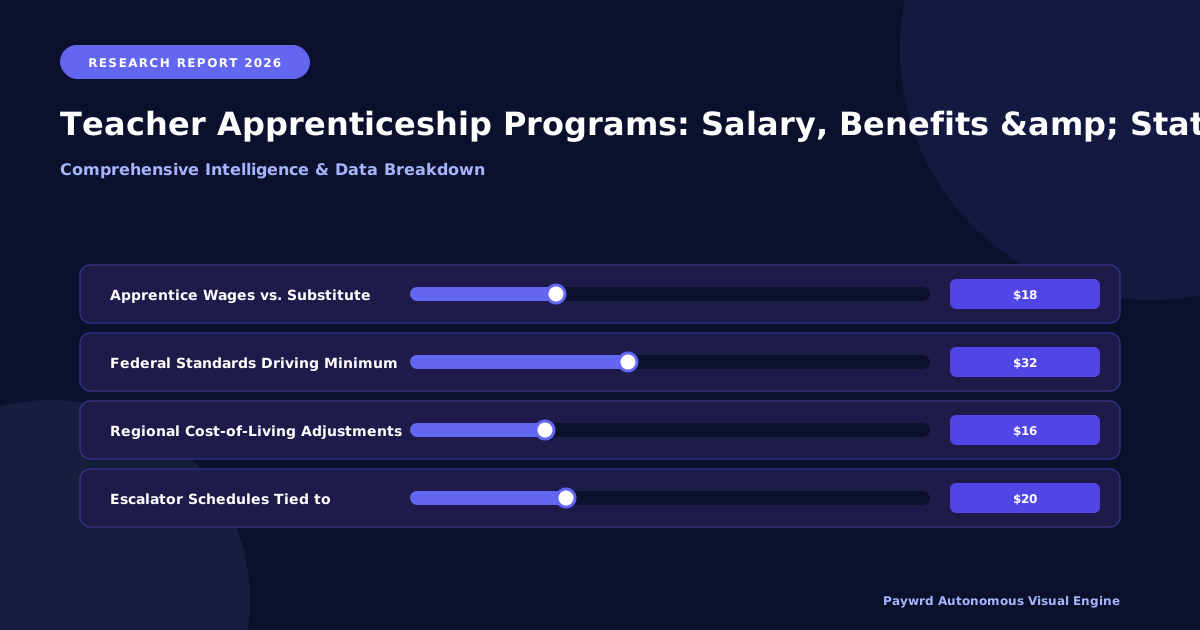
Apprentice Wages vs. Substitute Teacher Pay
The contrast with standard substitute teacher pay is striking. The average substitute teacher in the United States earns roughly $16 to $20 per hour with no guaranteed hours, no health benefits, and no pathway to full certification, according to district payroll data aggregated by EdWeek. A registered apprentice, by contrast, is classified as a W-2 employee from day one, drawing a baseline hourly wage that often starts at the local prevailing wage rate but climbs predictably over an 18 to 24 month cycle.
- Apprentice starting wage (Year 1): approximately $18 to $22 per hour in most states
- Substitute teacher daily rate: roughly $110 to $180 per day, equating to $14 to $22 hourly with no benefits
- Apprentice Year 2 completion rate: typically $26 to $32 per hour before benefits
Federal Standards Driving Minimum Hourly Rates
The Registered Apprenticeship program, governed under the National Apprenticeship Act and administered through the U.S. Department of Labor, enforces strict minimum wage progressions. Apprentices must see a raise at least once per year, and the final journeyman wage must align with the prevailing wage for fully certified teachers in that locality. This federal floor is why apprenticeship salaries are not arbitrary; they are anchored to real labor market data from the Bureau of Labor Statistics (BLS), which reports a median K-5 elementary teacher salary of $63,670 annually as of May 2023 data. Your apprentice wage is essentially a glide path toward that target.
Regional Cost-of-Living Adjustments
Geography dramatically shifts the numbers. An apprentice in San Francisco Unified might start at $28 per hour to keep pace with Bay Area housing costs, while a comparable program in rural Mississippi may begin at $17. State apprenticeship councils, often housed under state departments of education or labor, publish region-specific wage schedules that participating districts must honor.
Escalator Schedules Tied to Competency Milestones
Wage increases are not automatic; they are earned. Apprentices advance through structured benchmarks such as passing the Praxis Core, completing a mentor co-teaching cycle, or mastering differentiated instruction strategies. Each milestone triggers a documented wage escalation, creating a transparent roadmap that allows candidates to forecast their earnings with precision rather than guesswork.
Comprehensive Benefits Packages Beyond the Paycheck

Hourly wages often dominate the conversation around teacher apprenticeships, but the full compensation picture stretches far beyond the base pay stub. For apprentices earning $18 to $32 per hour in 2024, the layered benefits package can effectively push total economic value well above what the hourly figure suggests, especially when stacking employer-sponsored insurance, retirement contributions, and tuition support.
Employer-Sponsored Health, Dental, and Vision Coverage
Most registered apprenticeship programs affiliated with public school districts, charter networks, and participating intermediaries extend the same group health benefits available to tenured faculty, scaled to apprentice status. According to the U.S. Department of Labor’s registered apprenticeship framework, sponsors are required to outline progressive benefit schedules in their Standards of Registration, which means apprentices typically gain medical eligibility within their first 30 to 90 days on the job. Vision and dental riders frequently follow the medical plan, with average employer contributions covering roughly 70 to 80 percent of premium costs. That matters financially: a family health plan on the ACA marketplace can easily run $1,200 to $1,800 per month without employer subsidies, so capturing this benefit as an apprentice translates into thousands of dollars in annualized savings.
Tuition Reimbursement and Tuition-Free Certification Pathways
Perhaps the most powerful non-cash advantage is the tuition component. Apprentices pursuing an alternative teaching certificate or a bachelor’s in education through partner universities such as Western Governors, Southern New Hampshire University, or community college consortia frequently pay zero out-of-pocket for coursework. Programs like the Texas Education Agency’s Grow Your Own initiative and Tennessee’s ApprenticeshipTN pathway route federal Workforce Innovation and Opportunity Act (WIOA) Title I funds directly to the apprentice’s tuition bill, while district sponsors often add reimbursement stipends of $3,000 to $7,500 annually for textbooks, testing fees, and certification exams like Praxis Core or edTPA.
Pension Contributions and 401(k) Matching
Public school apprentices usually participate in the state teacher retirement system, with employer contributions often set between 7 and 10 percent of gross wages, fully vested after a five-year vesting window in states like California (CalSTRS), New York (NYSTRS), or Illinois (TRS). For apprentices working in private or charter environments where pension plans are absent, sponsors increasingly offer a 403(b) or 401(k) match ranging from 3 to 6 percent. Compounding those contributions at a 7 percent annual return across a 30-year career produces a retirement nest egg that can exceed $400,000 above and beyond the matched dollars themselves.
Paid Leave Entitlements
Finally, apprentices accumulate paid sick leave, holiday pay for federal and school calendar closures, and access to Family and Medical Leave Act (FMLA) protections once they cross the 12-month, 1,250-hour threshold. That includes up to 12 weeks of job-protected, though sometimes unpaid, leave for serious health conditions or new-child bonding, a safeguard that contract substitute teachers rarely receive. Together, these entitlements transform an apprenticeship from a temporary gig into a structurally protected career launchpad.
Navigating the State Certification Pathway Through Apprenticeship
Pursuing a teaching license through an apprenticeship model used to feel like navigating a maze without a map. Fortunately, the Department of Labor (DOL) registered apprenticeship framework now aligns more closely with state pedagogy requirements than ever before, giving aspiring educators a direct route to licensure without the traditional four-year detour. Here is how the mechanics actually work in practice.
How DOL Registered Programs Satisfy State Pedagogy Requirements
When a district or nonprofit sponsors a Registered Apprenticeship Program (RAP) through the DOL Office of Apprenticeship, the Related Instruction outlined in the program standards must map directly to a state’s teacher preparation benchmarks. Sponsors work alongside their State Education Agency (SEA) to verify that coursework in child development, classroom management, and assessment theory satisfies the pedagogy modules a state board normally requires. Once the apprenticeship is registered, candidates earn documented competency milestones that state reviewers treat as equivalent to university practicum hours. This eliminates the redundant coursework that often plagues career-changers.
Mapping Related Instruction Hours to Teaching License Prerequisites
Most states mandate a specific number of clinical observation hours and pedagogy credits, often ranging from 150 to 300 hours depending on the license tier. Apprenticeship sponsors design their curriculum around these exact thresholds. For example, an apprentice in Texas might complete 200 related instruction hours covering instructional design and special education foundations, which the State Board for Educator Certification accepts in lieu of equivalent college credits. Candidates should always request a formal crosswalk document from their sponsor, which itemizes how each module satisfies state standards. This transparency prevents credentialing delays and helps apprentices avoid paying for college courses they have already mastered on the job.
Reciprocity Agreements Across State Lines
Teaching licenses are state-issued, which means moving from Texas to Colorado requires navigating new bureaucracy. However, apprenticeship sponsors operating in multiple states often establish reciprocity compacts. The US Department of Education and the National Association of State Directors of Teacher Education and Certification (NASDTEC) maintain Interstate Agreement frameworks that recognize out-of-state credentials. Apprentices completing a DOL-registered program can typically transfer their journey-level status to a new state by submitting their Apprenticeship Completion Certificate alongside a state-specific application. This portability is especially valuable for military spouses and professionals relocating for district leadership roles.
Alternative Certification Boards and Apprenticeship Acceptance
Alternative certification programs (ACPs), authorized under state law, serve as the official gatekeepers for non-traditional candidates. Boards like the Texas Education Agency, the Pennsylvania Department of Education, and the California Commission on Teacher Credentialing have updated their policies to formally recognize apprenticeship hours as substitutes for student teaching. Where student teaching traditionally required a full semester of unpaid supervision, apprentices now demonstrate equivalent readiness through paid, mentor-guided classroom work. This shift is critical: candidates no longer have to choose between earning a paycheck and earning a credential. Applicants should confirm with their target ACP whether the apprenticeship must be DOL-registered to qualify, as some boards only accept formally registered programs while others accept district-led alternatives with equivalent rigor.
Top High-Demand Subjects and Geographic Hotspots for Apprenticeships
Not every classroom is created equal when it comes to apprenticeship demand, and smart candidates quickly learn to align their subject specialization with the districts desperate for talent. Across the United States, four subject areas consistently dominate registered apprenticeship pipelines: Special Education, Science, Technology, Engineering, and Mathematics (STEM), Bilingual Education, and Career and Technical Education (CTE). According to the US Department of Education’s Teacher Shortage Area report, every single state flagged special education as a critical shortage area in 2024, while STEM and bilingual endorsements followed closely behind in states with shifting demographic profiles. Apprentices who pursue these credentials rarely struggle to find a placement, because districts are actively competing for them before they even finish their practicum hours.
State-by-State Breakdown: Where the Slots Actually Exist
Geographic location dramatically shapes both availability and compensation. Texas leads the nation in registered teacher apprenticeship volume through programs like the Texas Teacher Residency and district partnerships in Houston, Dallas, and Austin, where apprentices routinely earn $26 to $32 per hour plus tuition coverage. California follows closely with its groundbreaking Teacher Apprenticeship Program (TAP), offering subsidized credentials in high-need subjects while apprentices earn a living wage scaled to their competency level. Ohio has aggressively expanded its ApprenticeOhio initiative, with Columbus and Cleveland metropolitan districts offering signing bonuses between $3,000 and $8,000 for STEM and special education pledges. North Carolina routes candidates through its NC Teaching Fellows and district-based Grow Your Own models, particularly strong in rural eastern counties. Virginia, meanwhile, leverages its proximity to federal institutions and offers competitive compensation in Northern Virginia districts where the cost of living justifies premium apprentice wages.
Urban Incentives Versus Rural Realities
Urban districts typically layer signing bonuses, housing stipends, and relocation support onto the base apprentice wage, recognizing that competing with private-sector employers requires aggressive packaging. A special education apprentice in Los Angeles Unified might command $34 per hour plus a $5,000 retention bonus after year one. Rural districts counter with different sweeteners: loan forgiveness partnerships, accelerated certification tracks, and immediate full-time contracts upon program completion. The trade-off usually involves lower hourly wages but substantially lower living expenses, which can stretch a dollar meaningfully further.
Critical Shortage Premiums and Wage Escalators
When a state designates a subject as a critical shortage area through its Department of Education, apprenticeship wage premiums typically increase by 15 to 25 percent above the standard schedule. Bilingual education apprentices in border states like Texas and California often see the highest premiums, sometimes reaching $36 per hour by their second year. STEM-focused apprentices in technology corridors near Austin, Research Triangle, or Northern Virginia also command elevated compensation tied to regional industry competition. These premiums exist because districts cannot fill positions through traditional hiring channels, making the registered apprenticeship pathway their most reliable talent pipeline.
Employer Sponsors, Union Influence, and Workforce Development Boards
Navigating the world of teacher apprenticeship programs means understanding the often-invisible institutional players who actually control your paycheck, your benefits, and your path to state certification. Unlike traditional college routes funded primarily by federal financial aid, registered apprenticeships rely on a complex web of employer sponsors, labor unions, and publicly funded workforce boards. Knowing exactly who pulls these levers helps you avoid predatory programs and identify vetted, high-quality sponsors backed by real labor protections.
The Role of Workforce Development Boards in Funding Your Seat
Local Workforce Development Boards (WDBs) operate under the Workforce Innovation and Opportunity Act (WIOA) and serve as the primary funding conduit for many apprenticeship slots across the United States. These boards receive federal pass-through dollars from the US Department of Labor and the US Department of Education, then distribute them to regional sponsors willing to train new educators. In practice, this means your tuition assistance, textbooks, and even a portion of your stipend may originate from a WDB rather than the school district hiring you.
To find opportunities near you, search your state’s Office of Apprenticeship website or contact your county’s American Job Center. Boards typically prioritize candidates from in-demand communities, so if you live in a region experiencing a documented teacher shortage, you will find significantly more funded slots than saturated metro markets.
Registered Apprenticeship Sponsors: How to Verify Legitimacy
Every legitimate teacher apprenticeship in the United States must be registered with the US Department of Labor’s Office of Apprenticeship or a State Apprenticeship Agency. This registration is non-negotiable; it is the only mechanism that guarantees your program meets federal standards for wage progression, classroom instruction hours, and on-the-job learning benchmarks. Before signing any enrollment agreement, pull up the Department of Labor’s Registered Apprenticeship Finder and confirm your prospective sponsor appears in the database with an active program ID.
Sponsors typically include school districts, community colleges, labor unions, or a consortium of all three. The strongest sponsors maintain tripartite partnerships where the district provides the classroom mentor, the community college delivers the pedagogy coursework, and the union negotiates the apprentice’s working conditions.
How Unions Protect Apprentice Working Conditions
Collective bargaining agreements (CBAs) are the single most important labor document governing your day-to-day experience as an apprentice teacher. In unionized districts, the local affiliate of the National Education Association (NEA) or the American Federation of Teachers (AFT) negotiates specific language covering apprentices, including maximum teaching loads, planning time, evaluation timelines, and grievance procedures. If your sponsoring district is unionized, your apprenticeship wages, benefits eligibility, and even your dismissal protections are contractually bound.
- Wage escalators: CBAs typically lock in predictable hourly increases tied to credit hours completed or competency checkpoints cleared.
- Benefits access: Most negotiated agreements extend health insurance, retirement contributions, and paid leave to apprentices after a defined probationary period.
- Due process: Unlike at-will substitute roles, unionized apprentices gain formal appeal rights if their district attempts early termination.
- Mentorship guarantees: Many CBAs mandate a designated cooperating teacher with released time specifically to coach apprentices, rather than treating mentorship as an informal favor.
Always request a copy of the current collective bargaining agreement from your sponsor before enrolling. If the district is non-union, ask which state labor standards apply to apprentices and verify that your role is classified correctly under your state’s wage and hour laws. Understanding these institutional relationships upfront protects both your certification timeline and your financial stability throughout the program.
Long-Term Career Trajectory: From Apprentice to Tenured Educator
Finishing a registered teacher apprenticeship is not the end of the road; it is the launchpad for a career that can easily span three decades or more. Understanding the multi-year journey from apprentice to tenured professional helps prospective educators map out exactly when the financial and professional rewards begin to compound.
The Licensure Timeline: Year One Through Year Five
Most Department of Labor-approved teacher apprenticeship programs run between 12 and 24 months, blending paid classroom residency with university coursework. Upon completion, apprentices apply for an initial state teaching license, which typically converts to a professional license after three successful years of teaching and a summative evaluation. Tenure decisions are usually made by the end of the fifth year, locking in contract protections that shield educators from non-just-cause termination. According to the Bureau of Labor Statistics, elementary teachers earn a median annual salary of $63,670, but those who reach tenure in high-demand districts often clear the $75,000 mark well before their seventh year.
Salary Bumps Tied to Certification Milestones
Pay scales in public K-12 schools are almost universally step-and-lane systems. Each year of service triggers a step increase, while earning a Master’s degree or a National Board Certification can move teachers to a higher lane with an additional 5% to 15% raise. When an apprentice transitions from an initial license to a professional certificate, many districts automatically grant a salary bump of $1,200 to $3,500 in the next contract cycle. Some states, including Texas and Florida, offer additional stipend programs for educators who complete apprenticeship pathways specifically, adding up to $5,000 per year in high-needs subject areas like special education, mathematics, and bilingual instruction.
Career Laddering Into Coaching and Administration
The apprenticeship model is uniquely positioned to accelerate upward mobility. Because apprentices spend their training years mastering lesson facilitation and data-driven instruction, they often step into lead teacher or instructional coaching roles within three to five years of finishing the program. Instructional coaches in large districts typically earn between $68,000 and $85,000 annually, while a move into school administration, such as becoming an assistant principal, can push earnings above $95,000. A principal’s median salary sits around $103,460 according to BLS data, and superintendents in mid-sized districts frequently exceed $140,000 with benefits.
Master’s Degree Articulation and Stackable Credit
One of the most underrated financial benefits of apprenticeship programs is the credit articulation agreements universities sign with sponsors. Apprentice coursework commonly satisfies 18 to 30 graduate credit hours, cutting the time to a Master’s in Curriculum and Instruction or Educational Leadership nearly in half. At a typical cost of $400 to $700 per credit hour, that translates into $7,200 to $15,000 in saved tuition. Pair this stackable credit with Title II federal funding, TEACH Grant conversions, and state-level loan forgiveness, and the total post-apprenticeship ROI becomes difficult to beat in the professional upskilling market today.
- Years 1-2: Complete apprenticeship, earn initial state license, starting salary $45,000-$55,000.
- Year 3: Convert to professional certification, qualify for step increase and lane bump.
- Years 4-7: Pivot into coaching or administration, crossing the $75,000-$95,000 threshold.
- Years 8-10: Tenure confirmed, Master’s completed, eligibility for National Board Certification stipend.
| Apprenticeship Model | Hourly Wage Range | Annual Salary (Est.) | Benefits Package | Certification Outcome | Program Length |
|---|---|---|---|---|---|
| Registered Teacher Apprentice (Year 1) | $18 – $22 | $37,440 – $45,760 | Full healthcare, retirement match | State Teaching License (Provisional) | 12 months |
| Registered Teacher Apprentice (Year 2) | $24 – $28 | $49,920 – $58,240 | Full healthcare, retirement, tuition covered | State Teaching License (Provisional) | 12 months |
| Registered Teacher Apprentice (Year 3 / Final) | $28 – $32 | $58,240 – $66,560 | Full benefits + signing bonus eligibility | Full State Teaching Certification | 12 months |
| Traditional Substitute Teacher | $15 – $25 (per diem) | $15,600 – $26,000 (part-time) | None or minimal | No certification pathway | Ongoing |
| Post-Apprenticeship (Fully Licensed) | $30 – $45+ | $62,400 – $93,600+ | Union-negotiated full benefits | Renewable Professional License | Career-level |
Frequently Asked Questions
How much do teacher apprentices get paid in 2024?
Registered teacher apprentices in the US typically earn between $18 and $32 per hour during their 1-3 year training period. Year 1 wages start near $18-$22 hourly, scaling to $28-$32 by Year 3 upon competency mastery, translating to annual salaries ranging from $37,440 to $66,560 depending on state and district.
Do teacher apprentices receive health insurance and benefits?
Yes, unlike per diem substitutes, registered teacher apprentices receive a comprehensive benefits package including employer-subsidized health insurance, state retirement system contributions (pension or 401a match), paid sick leave, and often full tuition coverage for their bachelor's or master's degree in education.
Can you get a teaching certificate through an apprenticeship?
Yes, registered teacher apprenticeship programs are approved state and federal earn-and-learn pathways that result in a full, renewable state teaching certification. Apprentices complete required pedagogy coursework, pass state licensure exams, and demonstrate classroom competency, typically finishing fully credentialed within 2 to 3 years.
Which states offer registered teacher apprenticeship programs?
As of 2024, states including Texas, Tennessee, Kentucky, North Carolina, Virginia, Washington, and Colorado operate active USDOL-registered teacher apprenticeship programs. Expansion is rapid through the Department of Labor's ApprenticeshipUSA initiative, targeting high-need subject areas like special education, math, and bilingual education.
Is a teacher apprenticeship better than a traditional education degree?
Teacher apprenticeships offer a debt-free alternative to traditional 4-year education degrees, allowing participants to earn a full salary with benefits while completing certification coursework. Apprentices graduate with 0 to minimal student loan debt, 3 years of paid classroom experience, and immediate full licensure versus typical 4+ years and $30,000+ in tuition.
Strategic Final Takeaway
When evaluating Teacher Registered Apprenticeship Program Salary Benefits State Certification Pathway, base your decisions on accredited institutional standards, measurable return on investment (ROI), and up-to-date official guidelines. Always verify specific dates and requirements through official regulatory portals.