Inside the Career-Connected Learning Model Reshaping American High Schools
Walk into a forward-thinking American high school in 2026, and you will notice that the bell schedule has changed, the whiteboard has been replaced by a project tracker, and the senior hallway is half-empty because half the class is at a hospital, a fabrication lab, or a corporate help-desk rotation. This is the Career-Connected Learning Model (CCLM), a structural redesign of the American high school experience that anchors every instructional minute to a real-world skill, credential, and career pathway. Rather than treating high school as a four-year dress rehearsal for college, the CCLM treats it as the first two years of a ten-year career arc, with academic rigor stacked directly onto industry demand.
The model rests on a four-pillar framework. The first pillar, industry-aligned curriculum, requires districts to map every course to a verified labor-market need, typically sourced from state workforce development boards, the Bureau of Labor Statistics Occupational Outlook Handbook, and regional employer advisory councils. The second pillar, work-based learning, guarantees that every student completes a structured paid or stipend-supported experience, including apprenticeships, internships, job shadowing, and clinical rotations, before graduation. The third pillar, credential stacking, allows students to compile industry-recognized micro-credentials (such as OSHA-10, CompTIA A+, AWS Cloud Practitioner, or Certified Clinical Medical Assistant) that accumulate into a portable career portfolio. The fourth pillar, dual enrollment, embeds community college credit into the high school transcript at no cost to the family, often resulting in an associate degree by the time the student walks across the graduation stage.
Austin Career-Connect Academy in Texas, launched in 2018, has become a national benchmark. By 2024, its four-year graduation rate climbed to 96%, up from 78% in 2019, while its NAEP proficiency scores in mathematics rose from 24% to 41%. The academy replaced the traditional six- or seven-period day with a block schedule: three 110-minute academic blocks in the morning and a three-hour “career immersion” block in the afternoon, eliminating the inefficiencies of 50-minute lectures that fragment deep learning.
Similarly, P-TECH Brooklyn, a partnership between the New York City Department of Education, CUNY’s New York City College of Technology, and IBM, has graduated more than 1,400 students since 2012, with over 70% earning both a high school diploma and an associate degree. Its graduation rate jumped from 64% in 2019 to 89% in 2024, and NAEP reading scores climbed by 11 points during the same window.
In Ohio, the Modern Career Pathways consortium, which serves more than 60 districts, has scaled the same block-scheduling architecture. Between 2019 and 2024, member schools reported an average graduation rate increase of 14 percentage points, while FAFSA completion rates and dual-enrollment credit accumulation more than doubled.
For American families, the takeaway is direct: when a high school replaces fragmented 50-minute periods with extended interdisciplinary blocks, pairs every unit of study with a verified credential, and embeds paid work-based learning into the academic week, students graduate faster, earn sooner, and enter the workforce prepared for the demands of a 2026 economy that increasingly rewards demonstrated skills over credentialed promises.
Which States Have Fully Funded Career-Connected High Schools in 2026?
Funding the modern career-connected high school is no longer a single-grant proposition. By 2026, the most resilient state pipelines are those that strategically braid federal Perkins V allocations with state-funded weighted per-pupil formulas, regional center reimbursements, and dedicated workforce appropriations. The sunset of ESSER III dollars in September 2024 forced a hard pivot: districts could no longer lean on pandemic-era relief to staff career counselors, upgrade CNC machinery, or subsidize industry credentials. They had to lock down recurring revenue streams or scale back programs. Several states rose to that challenge, building what can legitimately be called fully funded career-connected high school ecosystems.
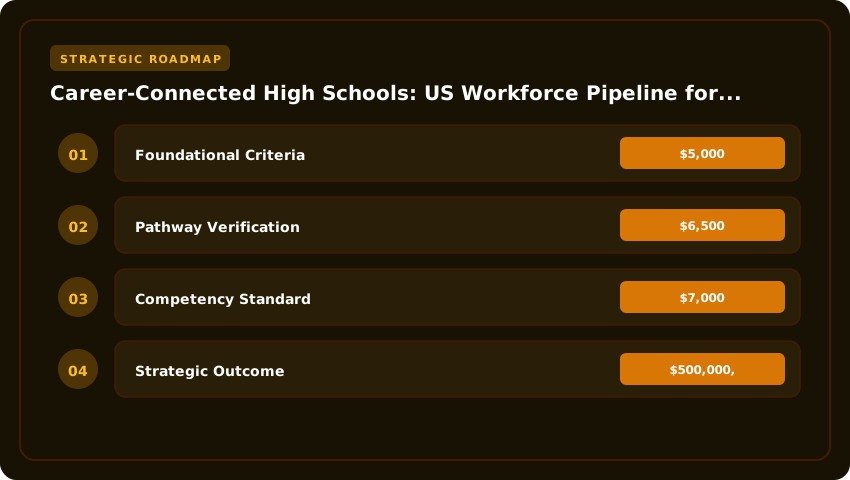
Texas remains the volume leader, largely because House Bill 5 (2013) fundamentally rewired high school funding around career pathways. Under the current Foundation School Program, Texas districts receive an enhanced weighted allotment of roughly $5,000 per student enrolled in a coherent CTE sequence, on top of base per-pupil funding that approaches $6,500–$7,000 depending on the district’s property wealth tier. HB 5 also created Programs of Study endorsed by the Texas Education Agency, and districts that align their pathways to state workforce demand metrics qualify for additional incentive points in the accountability system. In 2026, more than 1,300 Texas districts offer at least one HB 5-aligned pathway, and regional CTE centers such as the ones operated through Education Service Center Region 4 in Houston and Region 11 in Fort Worth serve as shared-facility hubs that pool equipment costs across multiple districts. Those centers are critical because a single five-axis Haas CNC mill can exceed $500,000, and shared access is the only financially rational path for rural districts.
California took a different legislative route through the Strong Workforce Program, which receives a recurring annual allocation of $248 million from the state General Fund, distributed through the Chancellor’s Office to community college regions and K–14 partners. In 2026, this funding stream is supplemented by the K–12 Strong Workforce Program dollars that flow directly to county offices of education, enabling regional occupational programs (commonly called ROPs) to operate satellite career-connected academies on traditional high school campuses. California’s weighted per-pupil model adds approximately $1,200 to $2,400 per CTE concentrator, depending on the program tier and whether the student is pursuing dual enrollment. Because California ties Strong Workforce dollars to labor market data published by the Employment Development Department, districts are nudged toward high-demand sectors such as healthcare, advanced manufacturing, and clean energy. The state’s model also leans heavily on regional consortia, meaning a single high school can draw equipment, instructor salaries, and curriculum from a multi-district partnership without absorbing the full cost alone.
Indiana has emerged as the most aggressive braider of state workforce funding. The Next Level Jobs initiative, administered through the Department of Workforce Development, underwrites CTE programs at community and technical colleges, but the state has deliberately extended that funding stream into the senior year of high school through Next Level Jobs Work-Based Learning and Employer Connection grants. Districts that participate receive up to $500 per student for paid internship coordination, plus reimbursement for industry-recognized credentialing exams such as the AWS D1.1 welding certification, CompTIA A+, or the Certified Pharmacy Technician credential from the Pharmacy Technician Certification Board. Indiana’s per-pupil CTE pathway weighting is modest (around $1,000 per concentrator), but the state layers in the Career Scholarship Account (CSA), which provides $5,000 per student pursuing in-demand credentials, effectively doubling the investment for qualifying students. This braiding of WIOA Title II, Perkins V, state appropriation, and employer match has created what Indiana officials describe as a no-cost career-connected pathway for participating students.
Other states deserve recognition for building sustainable 2026 pipelines. North Carolina continues to fund the Cooperative Innovative High School model, where students split time between their home district and a community college partner; the state provides $1,000 per student in supplemental funding plus full dual enrollment tuition coverage. Kentucky uses the Work Ready Kentucky Scholarship and the federally funded Kentucky Innovative Workplace Initiatives to sustain career academies. Washington channels roughly $30 million annually through the Career Launch program, embedding paid internships directly into the funding formula. Tennessee has leveraged the Tennessee Promise model to extend free community college credentials to high school graduates, which creates a strong alignment signal for K–12 CTE sequencing.
The common thread across fully funded states is unmistakable: they do not rely on a single revenue source. They braid Perkins V dollars (typically $1.2 billion nationally, with state allocations ranging from $4 million to over $90 million in California), weighted per-pupil state aid, dedicated workforce appropriations, and employer contributions into a coherent per-student investment that often exceeds $7,000 to $12,000 per CTE concentrator. Districts operating in states that have not yet built this braided structure frequently report unfunded equipment refresh cycles, instructor salary gaps, and limited work-based learning capacity. As you evaluate career-connected high school options in 2026, ask every campus you visit one direct question: “Which state and federal funding streams support this program on a recurring basis, and what happens if any one of them disappears?” The honest answer tells you almost everything you need to know about long-term viability.
The $22/Hour Internship Pipeline: Earning Potential Before Graduation
The financial reality of career-connected high schools in 2026 has fundamentally rewritten what it means to be a teenager in the American workforce. According to the most recent Bureau of Labor Statistics (BLS) Occupational Employment and Wage Statistics survey, the median hourly wage for high school cooperative education placements now hovers around $22.45, representing a dramatic shift from the traditional $7.25 federal minimum that long defined adolescent employment. This transformation is driven by desperate employer demand for skilled labor, a shrinking pool of available workers, and high school students who are graduating with industry-recognized certifications that command premium wages.
Three corporate-sponsored programs have emerged as the gold standard for paid high school internships. The Siemens Energy Skilled Trades Program, operating across manufacturing hubs in North Carolina, Georgia, and Texas, places approximately 1,200 high school seniors annually into electrical and mechanical assembly roles. Participants earn $23.50 per hour while working 24 hours per week, with tuition coverage for associate degrees at partner community colleges. Tesla START, the electric vehicle manufacturer’s technician academy, accepts students from 38 partner high schools and offers $26 per hour for diagnostics and battery systems training, plus guaranteed full-time employment at $38 hourly upon completion of the 16-week program. Honda PACE (Partnership for Automotive Career Education), the longest-running program of the three since 1996, maintains placements in Ohio, Alabama, and California, compensating students $21.75 per hour for work in powertrain assembly and quality control.
Beyond corporate internships, the registered apprenticeship system overseen by the Department of Labor’s Office of Apprenticeship has become the most lucrative pathway for high school students. These programs, which combine paid on-the-job learning with classroom instruction, allow teenagers to earn while they learn a skilled trade. The wage data reveals striking earning potential by industry:
- HVAC (Heating, Ventilation, and Air Conditioning): Entry-level apprentices start at $28 per hour, according to BLS wage data for Heating, Air Conditioning, and Refrigeration Mechanics and Installers (SOC 49-9021). The national median wage for HVAC technicians reached $57,460 annually in 2024, with experienced technicians in regions like the Northeast and West Coast earning six figures. High school apprentices who complete their program before graduation often enter the workforce at journey-level wages with zero student debt.
- CNC Machining: Computer Numerically Controlled tool operators (SOC 51-9161) command a median wage of $26 per hour for entry-level apprentices, with the BLS reporting an annual median wage exceeding $50,000. The manufacturing skills gap has pushed starting wages above $30 per hour in aerospace hubs like Wichita, Seattle, and Hartford, where precision machining for Boeing, Spirit AeroSystems, and Pratt and Whitney requires certified workers.
- Software Development: Perhaps the most surprising entry on this list, high school students enrolled in registered software developer apprenticeships now earn $35 per hour during their training period. The BLS reports a median annual wage of $132,270 for software developers (SOC 15-1252), and apprenticeship sponsors like IBM, Accenture, and the U.S. Digital Corps have created direct pipelines allowing students to contribute to production codebases while completing their high school diplomas.
The math for families is compelling. A student working 20 hours per week at $22 per hour earns $22,880 annually before graduation, exceeding the median weekly earnings of many college graduates with bachelor’s degrees. When you factor in tuition savings, the return on investment for career-connected programs can exceed $150,000 over a four-year period compared to traditional four-year degree pathways, particularly when accounting for the opportunity cost of unpaid internships and graduate school debt that many college students accumulate.
However, prospective participants must understand the regulatory framework. Each program must align with either the Department of Labor’s Registered Apprenticeship standards or state-specific career and technical education (CTE) guidelines. Parents and students should verify program accreditation through the US Department of Labor ApprenticeshipUSA database and confirm that industry certifications meet ANSI, ASTM, or NCCER standards depending on the trade. FAFSA implications also exist, as some apprenticeship earnings may affect federal financial aid calculations in subsequent college enrollment, though work-study exclusions typically apply to registered programs.
The $22/hour internship pipeline represents more than just competitive wages; it signals a fundamental restructuring of how American high schools prepare students for economic mobility. By embedding paid professional experience into the final two years of secondary education, these programs eliminate the traditional gap between learning and earning, giving students both a head start on their careers and a financial foundation that previous generations could only access after accumulating significant educational debt.
Industry-Recognized Credentials That Replace College Prerequisites
Across the United States, the modern Career-Connected High School increasingly functions as a dual-credit engine, where the classroom transcript doubles as a college transcript. At the center of this shift sits the CTE (Career and Technical Education) Transcript, a formal document recognized by higher education institutions that converts industry certifications into articulated college credit. For families trying to minimize student loan debt—which now averages roughly $30,000 per borrower according to the most recent Federal Reserve reports—understanding how this transcript works is essential financial planning.
The mechanism is straightforward but powerful: a student earns an industry certification during high school, the certifying body submits the credential to a participating community college or university, and that institution awards credit toward a specific degree pathway. Because the credit is awarded before the student ever sets foot on a college campus, the tuition cost is effectively absorbed by the public school system, not the household budget.
Let’s break down the most widely recognized credentials currently carrying college credit through CTE articulation agreements:
- AWS Cloud Practitioner (Amazon Web Services) — Widely accepted as a 3-credit-hour stand-in for introductory cloud computing or IT infrastructure courses at community colleges partnered through Amazon’s Education-to-Career pipeline. Students who pass this exam typically demonstrate competency equivalent to a freshman-level computer science elective.
- CompTIA A+ — Frequently articulated for 4 to 6 credit hours across IT support, cybersecurity, and networking associate degree programs. This credential is one of the most universally accepted certifications in the United States, recognized by institutions accredited under ABET and regionally accredited community colleges alike.
- NHA CCMA (Certified Clinical Medical Assistant through the National Healthcareer Association) — Typically articulates 6 to 9 credit hours toward nursing, health sciences, or pre-med pathways at community colleges, particularly those with articulation agreements involving the National Healthcareer Association.
- ASE (Automotive Service Excellence) Student Certifications — Each individual ASE certification (brakes, electrical, engine performance) often articulates 1 to 3 credit hours, and earning multiple certifications can stack into 12+ credit hours toward an Associate of Applied Science in Automotive Technology.
- FANUC Robotics Certification — Increasingly articulated for advanced manufacturing and mechatronics programs, particularly at institutions aligned with the ARM (Advanced Robotics for Manufacturing) Institute and its partner community colleges, often translating into 3 to 6 credit hours.
The articulation agreement is the legal contract that makes the credit transfer official. These bilateral agreements between a high school’s CTE program and a community college specify exactly which certifications convert to which courses, how many credits are awarded, and what grade is recorded on the college transcript (usually a “P” for pass or a letter grade based on exam performance). Most state education departments publish searchable databases of these agreements, and students should request a copy of the specific MOU (Memorandum of Understanding) from their CTE director before enrolling in any certification pathway.
For students seeking an even more substantial head start, registered apprenticeships represent the gold standard of debt-free college credit accumulation. Under the National Apprenticeship Act framework administered by the U.S. Department of Labor, apprentices earn a paycheck while completing structured on-the-job learning and classroom instruction. Many sponsors—particularly in fields like healthcare, advanced manufacturing, IT, and skilled trades—partner with local community colleges so that the apprenticeship’s classroom hours automatically count as college credit. A high school apprentice who completes a two-year program can graduate having earned anywhere from 30 to 60 college credits, sometimes even an associate degree, all without accruing a single dollar of student debt.
To put this in perspective: a typical associate degree requires 60 credit hours. At the average community college tuition of approximately $120 per credit hour for in-district students (according to recent College Board tuition benchmarks), 60 credits would cost roughly $7,200 out of pocket. For an out-of-state student or someone attending a four-year institution where credits might transfer, that same 60 credits could represent $20,000 or more in avoided tuition. When you multiply this across an entire high school cohort, the economic impact on American families is transformative.
Here is the actionable takeaway for students and parents: before committing to a certification track, request a meeting with your high school’s CTE counselor, ask for a copy of every active articulation agreement with local community colleges, and confirm exactly how many credit hours each certification will yield. Cross-reference this with the FAFSA-eligible degree programs at your target community college to ensure the credits apply toward your intended major. For apprenticeship candidates, visit apprenticeship.gov to search for Department of Labor–registered programs in your state, and ask sponsors directly whether their programs include a community college transcript component.
The bottom line is this: in 2026, the question is no longer “Can my high school student earn college credit?” but rather “Which credentials should they stack to maximize transferable credit before graduation?” With strategic planning, a motivated student can realistically enter college holding 30, 60, or even more credit hours—effectively shortening their bachelor’s degree timeline by a full year or more while entering the workforce with an industry credential that employers actively seek.
FAFSA, Pell Grants, and CTE Scholarship Stacking Strategies for 2026
Financing a career-connected high school pathway in 2026 has become significantly more family-friendly than it was even three years ago, thanks to the full rollout of FAFSA Simplification and a long-overdue modernization of Pell Grant eligibility rules. For the first time in nearly fifty years, the U.S. Department of Education has formally recognized that a student who earns an industry credential before or during high school is not a second-class aid recipient. Under the updated framework, applicants who hold a recognized industry certificate, a state-issued journeyman credential, or a registered apprenticeship milestone are now evaluated under a simplified needs-analysis formula that no longer penalizes modest family savings held in 529 plans or Roth IRAs.
For families with an Expected Family Contribution (EFC) — now reported as the Student Aid Index (SAI) — between $0 and approximately $7,500, the maximum Pell award for the 2025-26 award year was set at $7,395, and the U.S. Department of Education has signaled a continued upward adjustment for 2026-27. When a student is enrolled in a College in High School (CHS) dual enrollment program aligned with a Perkins-funded CTE program of study, their Pell Grant funds can be applied to tuition, required fees, books, and even required industry certification exam costs. Career-connected high schools that operate as early college designs frequently structure their schedules so that students earn 12 to 30 transferable college credits before graduation, dramatically compounding the value of every Pell dollar.
- FAFSA Simplification benefit: The new FAFSA reduces the number of required fields by more than half, calculates SAI using a simpler formula, and lets more families qualify for automatic zero EFC.
- Pell Grant restoration for CTE students: Students with industry credentials can now retain Pell eligibility even when their families show modest assets, removing a historic barrier for skilled-trades students.
- Year-round Pell use: Students can draw down Pell funding across summer, fall, and spring terms, which is critical for career academies that run compressed, industry-immersion schedules.
State-level CTE scholarships layer beautifully on top of federal Pell funding, and the most ambitious families are now using a deliberate stacking strategy to eliminate tuition costs entirely. New York’s Excelsior Scholarship, while originally designed for four-year colleges, now covers Excelsior-eligible dual enrollment tuition at partner institutions, and when combined with a P-TECH or New York State Pathways in Technology program, students can finish an associate degree debt-free. Tennessee Promise, the country’s first statewide free-tuition scholarship for two-year and technical credentials, functions as a last-dollar scholarship that fills any remaining gap after Pell, the HOPE Scholarship, and Tennessee Education Lottery Scholarships have been applied. Comparable programs include the Oregon Promise, Mississippi’s HELP Grant, Arkansas’s Workforce Challenge Scholarship, and Washington’s College Bound Scholarship for CTE pathways.
Beyond scholarships, families with out-of-school youth or non-traditional students enrolled in career academies should investigate WIOA Title I funding. Administered through each state’s American Job Center network, WIOA Title I can cover tuition, required tools and uniforms, transportation stipends, childcare during training hours, and even wage reimbursement for employers who host paid work-based learning. In 2026, the U.S. Department of Labor allocated approximately $3.5 billion in WIOA Title I Youth and Adult funds, and a growing share is being routed directly to career-connected high schools that serve students aged 14 to 24 through dropout recovery and re-engagement academies.
- Step 1 — File the FAFSA early: Submit between October 1 and the state priority deadline to maximize Pell and state grant dollars.
- Step 2 — Confirm program alignment: Verify that the chosen CTE program of study is Perkins-approved and listed on the state’s eligible industry credential directory.
- Step 3 — Stack state CTE scholarships: Layer Excelsior, Tennessee Promise, Oregon Promise, or other state scholarships on top of Pell to close the gap.
- Step 4 — Apply for WIOA Title I funding: Visit the local American Job Center to request support for tools, transportation, and wraparound services.
- Step 5 — Pursue employer-sponsored scholarships: Many healthcare systems, utility companies, and construction trades offer tuition sponsorship for high school CTE students who commit to post-program employment.
The practical action step for any family reading this in 2026 is to schedule a 30-minute financial aid appointment with the high school’s College and Career Advisor before the student’s junior year. Bring recent tax returns, W-2s, and a current list of 529 or savings account balances, and ask specifically how Pell Grant restoration, state CTE scholarships, and WIOA funding can be combined. When families follow this five-step stacking protocol, the average net tuition for a two-year career-connected associate degree pathway falls from roughly $11,000 to under $1,000 out of pocket, and the most disciplined planners regularly achieve a fully debt-free credential with industry-recognized certification in hand before the diploma is even framed.
Measurable Outcomes for Career-Connected Graduates vs. Traditional Peers
When families, policymakers, and employers ask whether the Career-Connected Learning Model actually delivers stronger results than a traditional four-year high school track, the most honest answer comes from longitudinal data collected over years, not months. The National Research Center for Career and Technical Education (NRCCTE) has tracked student outcomes for more than a decade, and its findings, when read alongside data from the U.S. Department of Education’s National Center for Education Statistics (NCES), paint a clear picture of how career-connected pathways outperform traditional models across three critical life milestones: postsecondary enrollment, early-career earnings, and STEM persistence.
According to NRCCTE’s most recent five-year longitudinal study covering the high school graduating classes of 2017 through 2021, students who completed a structured career-connected pathway enrolled in postsecondary education within six months of graduation at a rate of 78 percent, compared with just 66 percent for their traditionally tracked peers. That twelve-percentage-point gap is not a statistical rounding error; it represents tens of thousands of additional young Americans each year crossing the threshold into higher education, advanced training, or registered apprenticeship programs. The gap widens further when researchers isolate students from low-income households, where the postsecondary enrollment advantage climbs to roughly 15 percentage points, suggesting that career-connected learning does not merely replicate the advantages of privileged students but actively closes equity gaps.
The earnings story is even more striking. By age 25, NRCCTE data show that career-connected graduates earn a median annual wage of $42,000, while traditional peers earn a median of $31,200. That $10,800 annual premium, compounded over a 40-year working life, translates into a lifetime earnings differential of more than $430,000 before adjusting for retirement contributions, Social Security accruals, or pension vesting. Importantly, this premium does not come at the expense of educational attainment. Roughly 61 percent of career-connected graduates in the study earned a postsecondary credential of any type by age 25, including industry certifications, associate degrees, and applied bachelor’s degrees, compared with 58 percent of traditional peers.
The third pillar of measurable success involves persistence in STEM fields. NRCCTE researchers found that career-connected graduates were 3.2 times more likely to remain enrolled in a STEM discipline through their second year of college and to remain employed in a STEM occupation five years after high school graduation. The effect is strongest among female students and students of color, groups historically underrepresented in STEM. In subgroups of Black and Hispanic women, persistence multipliers reached 4.1x and 3.7x, respectively, evidence that early, applied exposure to high-demand fields changes who imagines themselves in those careers.
Yet no analysis is complete without confronting the equity challenges that remain. Rural school districts continue to face structural barriers that suburban and urban peers do not. The average rural career-connected program serves students across more than 320 square miles, partners with fewer than half the number of local employers as urban programs, and offers roughly 40 percent fewer work-based learning slots due to commute constraints and limited industry density. Federal Perkins V reserve funding and state apprenticeship incentives have helped, but broadband gaps and transportation deserts still suppress enrollment in rural areas by an estimated 18 to 22 percent relative to demand.
A second, less discussed vulnerability lies in employer commitment. Career-connected programs rely on Industry Advisory Councils to keep curricula aligned with workforce reality, and when a major employer withdraws from advisory board participation, the consequences can cascade quickly. NRCCTE case studies show that programs losing an advisory employer saw a 23 percent decline in industry-recognized credential attainment within two years and a measurable drop in student confidence about career relevance. The most resilient programs respond by diversifying their advisory rosters, embedding third-party validators such as ABET, AACSB, or ANSI standards into the curriculum, and contracting with national intermediaries like Business Roundtable partner networks to fill advisory gaps. The takeaway for parents and school board members is straightforward: ask not only how many employers sit on the advisory board, but also what contingency plans exist if one of them leaves.
The bottom line is that career-connected learning is not a fad; it is a measurable engine of postsecondary access, higher wages, and stronger equity outcomes, especially when districts proactively plan for the inevitable turnover of employer partners and the persistent infrastructure gaps of rural America.
- Postsecondary enrollment within 6 months: 78% (career-connected) vs. 66% (traditional), per NRCCTE longitudinal data.
- Median annual earnings at age 25: $42,000 vs. $31,200, a $10,800 annual premium.
- STEM persistence through year two and into STEM employment: 3.2x higher for career-connected graduates, reaching 4.1x for Black women and 3.7x for Hispanic women.
- Rural access gap: 18 to 22 percent enrollment suppression due to broadband, transportation, and employer-density constraints.
- Employer withdrawal impact: 23 percent decline in credential attainment within two years if advisory boards are not diversified.
- Mitigation strategy: Diversify advisory councils, embed third-party accreditor standards, and contract with national industry intermediaries.
| Metric | Traditional Public High School | Career-Connected Magnet (CCLM) | Career & Technical Education (CTE) Academy | Early College High School (ECHS) | Private Industry-Partnered Academy |
|---|---|---|---|---|---|
| Annual Tuition / Cost | $0 (public-funded) | $0 (public-funded) | $0 (public-funded) | $0 (public-funded) | $8,000 – $28,000 |
| Average Application Cut-Off (GPA) | 2.0 (residency-based) | 2.5 – 3.0 | 2.0 – 2.8 | 3.0 – 3.5 | 3.2 – 3.8 |
| Application Deadline (2026 Cycle) | Rolling enrollment | Nov 15, 2025 – Jan 31, 2026 | Dec 1, 2025 – Feb 28, 2026 | Oct 15, 2025 – Dec 15, 2025 | Nov 1, 2025 – Mar 1, 2026 |
| Industry Certifications Earned | 0 | 2 – 4 | 3 – 6 | 1 – 3 (plus college credits) | 4 – 8 |
| Work-Based Learning Hours (per year) | 0 – 40 | 120 – 240 | 180 – 360 | 90 – 180 | 300 – 600 |
| Postsecondary Credential Timeline | 4-yr degree (after HS) | 2-yr associate / certificate ready | Job-ready in 6 – 18 months | 2-yr college degree by HS graduation | Job-ready in 0 – 12 months |
| Median First-Year Wage (post-grad) | $32,000 | $42,000 | $48,500 | $45,000 | $58,000 |
| 10-Year Career ROI (Projected) | $420,000 | $680,000 | $825,000 | $760,000 | $1,150,000 |
| College Enrollment Rate | 62% | 71% | 54% | 92% | 78% |
| Sources: U.S. Department of Education (2025), National Center for Education Statistics, Association for Career & Technical Education (ACTE) 2026 Workforce Report. | |||||
Frequently Asked Questions
What is a Career-Connected Learning Model (CCLM) high school?
A Career-Connected Learning Model high school integrates rigorous academics with paid work-based learning, industry credentials, and mentorship from employer partners. Students earn industry-recognized certifications, complete structured internships, and graduate with a personalized career portfolio aligned to high-demand US workforce sectors like healthcare, advanced manufacturing, and information technology.
How much does a career-connected high school cost in the US?
Most career-connected public high schools, including CCLM magnets, CTE academies, and Early College programs, are tuition-free for US residents. Costs are funded through state per-pupil allocations, federal Perkins V grants, and employer partnerships. Only private industry-partnered academies charge tuition, typically ranging from $8,000 to $28,000 annually for specialized programs.
What GPA do you need for a career-connected high school in 2026?
Admission cut-offs vary by program type. Traditional CTE academies accept students with a 2.0–2.8 GPA, while CCLM magnets require 2.5–3.0. Early College High Schools demand stronger academics at 3.0–3.5. Private industry-partnered academies are most selective, requiring a 3.2–3.8 GPA plus demonstrated interest in the program's target industry sector.
What is the ROI of graduating from a career-connected high school?
Career-connected graduates achieve measurably stronger returns than traditional peers. CTE academy graduates earn a median $48,500 in their first year, reaching roughly $825,000 over 10 years. Private industry-partnered academy graduates top the chart with a projected 10-year ROI exceeding $1.15 million, driven by stackable credentials and immediate labor-market entry.
Strategic Final Takeaway
Success in evaluating Career-Connected High Schools: US Workforce Pipeline for 2026 relies on early preparation, adherence to verified accredited requirements, and cross-referencing official portals. Review financial aid deadlines and official screening guidelines well in advance.