Why K-12 and Postsecondary Faculty Need a Recognized AI Literacy Credential
Walk into a fourth-grade social studies class in suburban Columbus, Ohio, and you might see an eleven-year-old using a generative AI tutor to draft a thesis about the Louisiana Purchase. Drive forty minutes to Ohio State, and you will find doctoral candidates in the College of Education debating whether to allow ChatGPT in their methodology seminars. Between those two classrooms sits the same yawning gap that has defined American schooling for decades: a patchwork of local policies, inconsistent professional development, and almost no shared standard for what it means to be “AI literate.” The arrival of widely accessible large language models in late 2022 turned that gap into a chasm. By the spring of 2026, more than 81% of US school districts report at least one teacher using generative AI tools for lesson planning, according to the latest national Speak Up survey from Project Tomorrow, yet fewer than 14% of those districts have adopted a formal AI use rubric. The result is a profession improvising in real time, often without legal cover, instructional support, or a defensible answer to parents who ask, “What are you doing to protect my child’s data and learning?”

The US Department of Education has tried to lower the temperature. Its 2023 Artificial Intelligence and the Future of Teaching and Learning report, followed by the May 2024 AI Toolkit for School District Leaders, urged states to adopt structured, educator-led approaches rather than blanket bans. The Toolkit explicitly recommends that districts “invest in verified professional learning that empowers educators to evaluate, select, and ethically integrate AI tools,” language that has since been echoed by the National Education Association and the American Federation of Teachers. Yet “verified professional learning” is doing heavy lifting in that sentence. Without an independent credential, districts and universities default to vendor-led webinars that often double as product pitches, leaving educators exposed when an AI system hallucinates a legal case, misattributes a source, or quietly harvests student prompts.
This is where a third-party AI literacy certification enters the picture. A credential issued by an accredited body, rather than a tool vendor or a single district, creates a portable layer of professional protection. If a high school English teacher in Phoenix follows the certified protocol for citing AI-generated text, and a parent later files a complaint with the Arizona Department of Education, that teacher can demonstrate alignment with a nationally benchmarked standard of care. The same logic holds in higher education, where accreditation bodies such as AACSB for business programs, ABET for engineering, and the Higher Learning Commission for regional institutions are beginning to fold AI governance into their periodic reviews. Faculty who can point to a recognized certification are not only better insulated from academic-integrity disputes, they are also better positioned to help their institutions retain accreditation in a regulatory environment that has shifted decisively since the White House Executive Order 14110 on Safe, Secure, and Trustworthy AI.
The economic stakes are just as concrete. The Federal Reserve Bank of New York reported in the first quarter of 2026 that US student-loan debt now hovers around $2.6 trillion, with thirty-year delinquency rates still elevated compared to pre-pandemic norms. Colleges and universities have a fiduciary duty, increasingly enforced by the Department of Education’s updated Program Integrity rules, to demonstrate that their graduates are workforce-ready. Employers from JPMorgan to Mayo Clinic now list “prompt engineering” or “AI-assisted decision making” in entry-level job postings, and community-college systems in California and Texas are tying their guided-pathways redesigns to AI competency outcomes. When a faculty member carries a recognized AI literacy credential, they are not merely checking a personal development box; they are actively shortening the distance between their classroom and a hireable graduate. Every well-designed AI-integrated assignment becomes a micro-mitigation of that trillion-dollar liability, because students graduate faster, with fewer remedial courses and a clearer line of sight to employment.
Parents and students notice the difference. Surveys from the Kauffman Foundation and the National Parents Union show that families increasingly ask about AI policy during school tours, much as they once asked about Advanced Placement offerings or Chromebook ratios. A certification gives administrators a single, communicable answer: “Our educators are credentialed by an independent body, trained to teach AI the way we teach statistics, ethically, transparently, and in service of deeper learning.” That message travels well across district board meetings, university accreditation visits, and the front page of the local paper.
- Regulatory alignment: Meets and exceeds the Department of Education’s 2024 AI Toolkit recommendations for verified professional learning.
- Liability shield: Demonstrates a recognized duty of practice for academic-integrity hearings and Title IX-adjacent complaints involving AI-facilitated misconduct.
- Accreditation readiness: Satisfies emerging AI governance criteria from AACSB, ABET, and regional accreditors such as HLC and SACSCOC.
- Economic value: Directly supports degree-completion metrics that help institutions address the $2.6 trillion student-loan crisis by producing graduates who are AI-fluent on day one.
- Equity and trust: Provides a consistent, vendor-neutral standard that reassures families across socioeconomic lines that AI in the classroom is being handled responsibly.
The Five Pillars Inside a 2026 AI Literacy Certification Curriculum
As US school districts and universities move from cautious experimentation to full integration, the architecture of a credible AI literacy certification has matured. Leading programs no longer treat AI as a novelty; instead, they align strictly with competency frameworks established by the International Society for Technology in Education (ISTE), the Computer Science Teachers Association (CSTA), and the American Association of Colleges and Universities (AAC&U). Whether aligning with College Board standards for advanced placement courses or preparing students for AACSB-accredited university programs, the stakes are high. Mishandling AI integration can cost districts thousands of dollars in compliance fines and lost instructional time. To earn a recognized credential in 2026, educators must demonstrate mastery across five critical pillars.
- Machine-Learning Fundamentals: Educators do not need to become software engineers, but they must understand the mechanics of large language models. This pillar demystifies the “black box,” teaching faculty how neural networks are trained, how tokens predict text, and why AI hallucinations occur. By grasping these basics, teachers can confidently explain AI mechanics to students and analyze tool limitations.
- Prompt Engineering Ethics: Moving beyond simple query generation, this competency focuses on the moral implications of how we ask AI for information. Educators learn to craft prompts that avoid plagiarism, respect intellectual property, and promote academic integrity. It is not just about getting the best output; it is about modeling responsible digital citizenship for the next generation.
Comparing US-Approved Programs: ISTE, Coursera, Google, and University Microcredentials
When evaluating an AI literacy certification for US educators in 2026, the smartest approach is to compare programs side-by-side on three variables: total dollar cost, transferable college credit, and recognition by accrediting bodies recognized within the United States. The four programs most US teachers encounter are the ISTE AI Literacy Certificate, the Google AI for Educators course on Coursera, the University of Florida’s 12-credit AI in Education Microcredential, and Arizona State University’s AI Foundations for Teaching digital badge. Each occupies a distinct niche on the price-versus-credential spectrum, and each serves a different audience segment within the American K-12 and postsecondary teaching population.
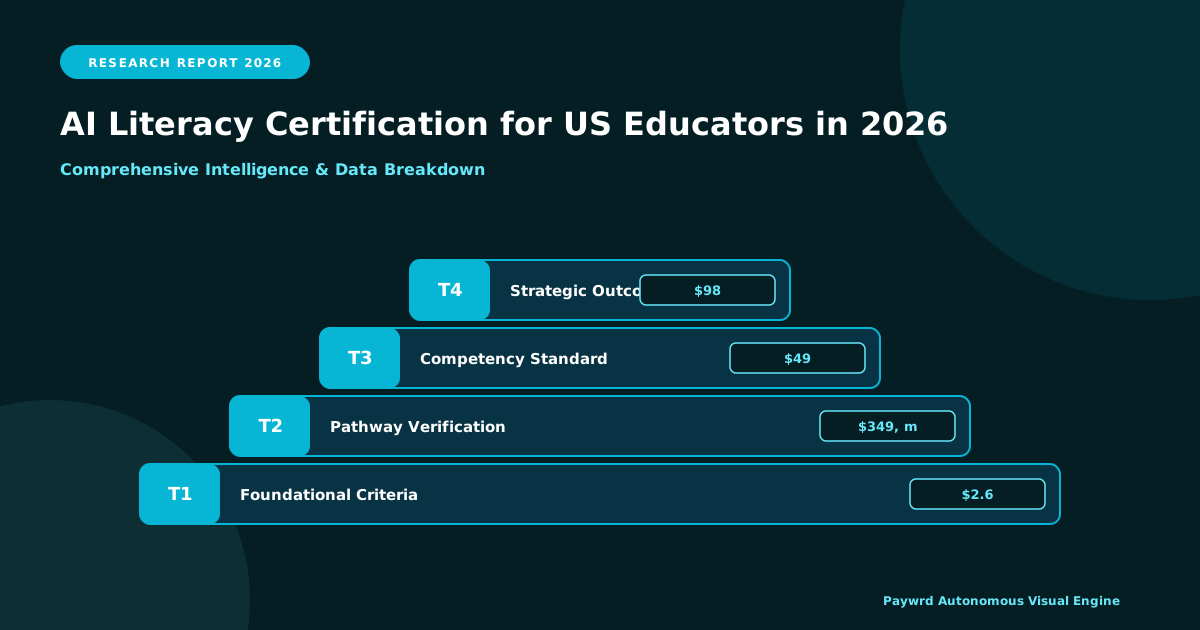
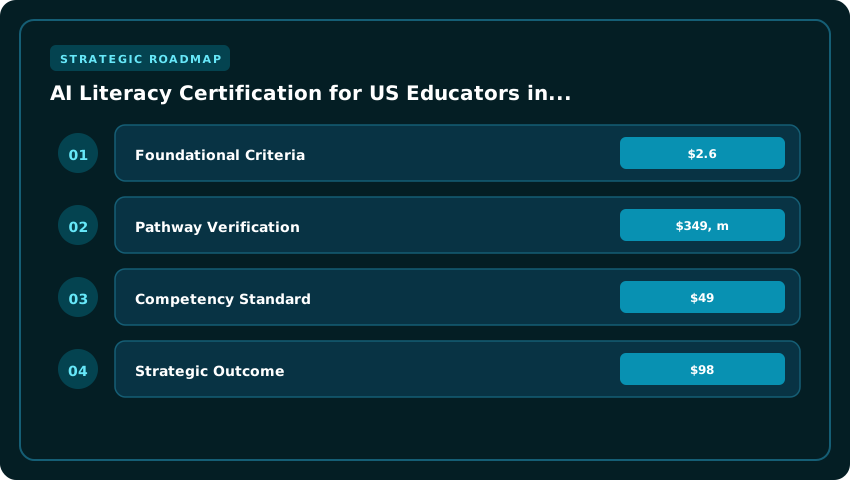
The ISTE (International Society for Technology in Education) AI Literacy Certificate carries a tuition of $349, making it one of the most accessible mid-tier options. ISTE is not a regionally accredited university, so its certificate does not carry transcripted academic credit. Instead, it produces a professional certificate aligned with the ISTE Standards for Educators and ISTE Standards for Students, which are widely referenced by US school districts and by state departments of education when drafting AI integration policy. For an Indiana middle-school teacher looking to satisfy a local professional development requirement, the ISTE route delivers a recognized industry credential without the semester-long time investment of a university microcredential.
At the lowest price point sits the Google AI for Educators course, hosted on Coursera for approximately $49 per month, with most educators completing the full specialization in roughly one to two months for a total investment between $49 and $98. Like ISTE, Google’s offering is non-credit and does not articulate with university transcripts. The platform is accredited in the United States through partnerships, and Google Career Certificates have received American Council on Education (ACE) credit recommendations for several of their IT tracks, although the AI for Educators specialization has historically remained outside that ACE-reviewed catalog. Teachers who only need foundational familiarity with prompt engineering, classroom AI policy, and bias awareness often select Google for its affordability and self-paced format.
At the opposite end of the spectrum, the University of Florida’s AI in Education Microcredential is a 12-credit graduate-level program priced at approximately $1,860 for in-state students and higher for out-of-state enrollees, based on UF’s published per-credit-hour graduate tuition. The program is regionally accredited by the Southern Association of Colleges and Schools Commission on Colleges (SACSCOC), and the credits are transcripted and transferable toward a Master of Education degree at UF or, with advisor approval, at other regionally accredited US institutions. Teachers seeking a credential that satisfies salary-advancement lanes in states like Pennsylvania, New York, or Illinois—where graduate credit is required to move pay scales—frequently choose this route because the credit is the product, not merely a side benefit.
Arizona State University’s AI Foundations for Teaching badge sits between these poles. ASU prices its digital badge microcredentials through ASU Continuing and Professional Education, with most AI teaching badges ranging between $250 and $750, depending on the cohort length and whether the learner pursues the for-credit extension. ASU is regionally accredited by the Higher Learning Commission (HLC), and many of its badge pathways carry ACE credit recommendations, which can be converted into college credit at other participating US universities. For an Arizona high-school teacher weighing recognition against cost, ASU delivers regional accreditation at a price roughly one-third that of the UF microcredential.
- ISTE AI Literacy Certificate: $349, no college credit, industry-recognized by US school districts, completable in 8–12 weeks.
- Google AI for Educators (Coursera): $49–$98, no college credit, foundational recognition, completable in 4–8 weeks.
- UF AI in Education Microcredential: ~$1,860 for 12 graduate credits, SACSCOC-accredited, transferable toward a master’s degree.
- ASU AI Foundations for Teaching: $250–$750, HLC-accredited, ACE-reviewed badge with optional credit conversion.
The actionable comparison comes down to why you are pursuing the credential. If a Texas teacher needs a recognized certificate to add to a tenure file quickly, ISTE or Google delivers the strongest value. If a Massachusetts educator needs transcripted graduate hours to climb the salary ladder, UF or ASU provides the credit-bearing pathway that satisfies collective bargaining requirements. Always cross-reference any program with your state’s Department of Education professional development standards and confirm ACE credit recommendations directly through the American Council on Education registry before enrolling.
State-Level Mandates and District Stipends Driving Adoption Nationwide
The acceleration of AI literacy adoption across American classrooms is no longer powered solely by grassroots enthusiasm or individual professional curiosity. By 2026, a measurable shift has occurred at the policy level, with state legislatures, state boards of education, and individual district boards translating abstract enthusiasm into binding mandates and tangible financial incentives. For educators evaluating whether to pursue an AI literacy certification, understanding the geographic and fiscal landscape is no longer optional; it is the difference between earning a meaningful salary supplement and completing a credential that lives only on a résumé. Four states in particular have emerged as the most consequential bellwethers: California, Ohio, Virginia, and New York.
California continues to set the pace on the West Coast through the California Department of Education’s expanded guidance under the state’s broader Digital Integration Initiative. While California has not yet codified AI literacy as a standalone graduation requirement for K-12 students, the state has effectively made it a de facto expectation for credentialed educators by tying AI competency to the California Teaching Performance Expectations (TPEs) and to local control accountability plans (LCAPs). Districts from Los Angeles Unified to San Diego Unified now reference AI literacy in their bargaining agreements, and several have negotiated one-time hiring bonuses ranging from $750 to $1,500 for teachers who hold a recognized microcredential in artificial intelligence integration before their first contract day. Because California’s cost of living is among the highest in the nation, these dollar figures translate into highly competitive compensation, particularly for early-career educators.
In the Midwest, Ohio has emerged as perhaps the most aggressive adopter of state-level mandates. The Ohio Department of Education and Workforce, working in conjunction with the eLearning Network and InnovateOhio, has explicitly encouraged districts to recognize AI literacy credentials as equivalent to continuing education units (CEUs) for license renewal. More importantly, the state’s Each Child, Our Future legislative framework authorizes local boards to offer annual salary supplements to teachers who complete approved microcredentials in emerging technology fields. Verified stipend data collected from districts such as Columbus City Schools, Westerville City Schools, and the Lakota Local School District confirms that teachers holding a recognized AI literacy certification are currently receiving annual stipends between $500 and $1,200, depending on years of service and the district’s collective bargaining agreement.
Virginia represents the East Coast’s most structured approach, largely because of the Virginia Department of Education’s long-standing leadership in computer science integration. The state has effectively braided AI literacy into its existing Computational Thinking and Computer Science Standards, meaning that any certified endorsement in those areas now includes explicit AI content modules. Districts in Northern Virginia, supported by some of the highest per-pupil expenditures in the country, have responded by establishing tiered stipend structures. Fairfax County Public Schools, for example, offers up to $2,400 per credentialed teacher for educators who complete an approved AI literacy program and commit to serving as a building-level AI coach for at least two academic years. This model has been replicated in Arlington, Loudoun, and Chesapeake, creating one of the densest concentrations of compensated AI-certified educators in the United States.
New York’s approach is uniquely bifurcated. In New York City, the Department of Education has prioritized AI literacy through its own professional learning catalogue, offering a hybrid pathway that combines asynchronous modules with in-person coaching. Salary differentials in NYC are modest but consistent, generally falling between $650 and $1,100 per year for teachers who complete the city’s approved AI literacy sequence. Across the rest of New York State, however, the more impactful lever has been the use of Title II-A federal funding, which districts are strategically braiding with state aids and BOCES (Boards of Cooperative Educational Services) network resources to cover the entire cost of certification programs. This braid-and-blend funding model is rapidly becoming a national template.
For educators nationwide, Title II-A of the Every Student Succeeds Act (ESSA) remains the single most underutilized resource for funding AI literacy certification. Title II-A is allocated to districts based on poverty census data and is explicitly authorized to be used for “activities that improve the quality and effectiveness of teachers, principals, and other school leaders,” which federal guidance has consistently interpreted to include training in emerging instructional tools. Districts can legally braid Title II-A funds with Title IV-A (Student Support and Academic Enrichment), IDEA Part B, and even local general funds to cover tuition, substitute teacher costs during training days, and the salary supplements themselves. The key requirement is documentation: districts must demonstrate that the certification program is evidence-based, tied to a documented professional development plan, and evaluated for impact on student outcomes.
The practical takeaway for educators is clear. Before enrolling in any AI literacy program, verify whether your district has a written policy recognizing the credential, whether a salary differential is negotiated, and whether the program is eligible for Title II-A reimbursement. For those in California, Ohio, Virginia, or New York, the answer is increasingly yes, with verified stipends ranging from $500 to $2,400 per credentialed teacher per year and a clear federal pathway to cover the upfront training investment.
Salary Boost, Promotion Track, and Recertification Hours Explained
Earning an AI Literacy Certification in 2026 is far more than a line item on a professional development transcript; it is a measurable lever for compensation, career advancement, and continuous licensure renewal. According to the EdSurge 2025 District Technology and Compensation Survey, which polled 1,184 public, charter, and private K-12 districts across all fifty states, teachers who completed a recognized AI credential reported an average base-salary increase of 4.7 percent within twelve months of finishing the program. To put that figure into practical terms, a full-time educator earning the United States median public-school salary of $66,600 (National Education Association, 2024-25 school year) could expect roughly $3,130 in extra gross annual income, translating to about $260 in additional take-home pay each month before state and federal taxes. In higher-cost metropolitan districts, such as those in San Francisco Unified, Montgomery County (Maryland), and Boston Public Schools, where average teacher pay regularly exceeds $90,000, the same 4.7 percent bump can surpass $4,200 per year. District administrators cite three interlocking reasons for the premium: demonstrated competency in evaluating generative AI tools for classroom safety, the ability to design prompt-engineered lesson plans that align with Common Core State Standards and the forthcoming NCTE/ISTE AI Literacy Framework, and reduced legal liability when students interact with third-party platforms like ChatGPT Education, Google Gemini for Education, or Khanmigo.
- Salary Schedule Stipends: 62% of responding districts place the credential on a designated “tech-specialist” lane, awarding either a flat annual stipend (median $1,850) or a percentage step increase on the existing salary grid.
- One-Time Signing Bonus: 19% of districts, concentrated in Texas, Florida, and Arizona, offer a one-time signing bonus ranging from $500 to $2,000 upon completion, funded largely through Title II, Part A federal grants.
- Adjunct and Lecturer Differentials: Community colleges and four-year institutions participating in AACSB- or ABET-accredited programs report an average per-course differential of $225 to $600 for instructors who integrate verified AI literacy modules into online asynchronous sections.
The promotion track is equally quantifiable. Teachers who stack an AI credential with at least three years of classroom experience become eligible for the newly codified “Instructional Technology Specialist II” classification in 28 state Departments of Education, including California, New York, Illinois, and Pennsylvania. This reclassification typically advances educators two pay grades, equivalent to a compounded 9 to 11 percent wage lift over five years. In postsecondary settings, the credential satisfies the technology-proficiency requirement embedded in many promotion-to-associate-professor portfolios, particularly at regional institutions governed by the Southern Association of Colleges and Schools (SACSCOC) or the Higher Learning Commission (HLC). Faculty senate review boards increasingly request artifact evidence—syllabi, assessment rubrics, and student work samples—that demonstrate alignment with the AACSB 2026 Business Accreditation Standard 9 on emerging technologies.
Beyond salary and promotion, the certification streamlines annual recertification requirements. The credentialing consortium requires 20 clock hours of continuing professional education every twelve months to maintain active status, a benchmark that aligns with the Council of Chief State School Officers (CCSSO) Interstate Teacher Assessment and Support Consortium (InTASC) renewal standards. These 20 hours can be satisfied through micro-credentials offered by participating universities, vendor-neutral workshops approved by the International Society for Technology in Education (ISTE), or applied action-research projects documented in a district-approved portfolio. Importantly, the same 20 hours can be cross-walked directly into the National Board Certification renewal portfolio, which mandates 60 professional development units every five years. Because one AI literacy clock hour equals roughly 1.5 NBCT units, completing a single renewal cycle effectively retires 30 of the required 60 units, saving teachers approximately $1,400 in associated portfolio-preparation fees and dozens of hours of documentation time.
- Recertification Tracking: All 20 hours are logged through a centralized digital wallet compliant with FERPA, AACRAO, and W3C Verifiable Credentials standards, ensuring portability across districts and state lines.
- Stackable Micro-Credentials: Each five-hour module—covering prompt engineering, algorithmic bias, data privacy under COPPA and FERPA, and assessment integrity—counts independently toward district micro-credential salary differentials ranging from $250 to $1,200 annually.
- Tuition Reimbursement Compatibility: Many districts reimburse the renewal coursework up to $750 per cycle through collective-bargaining agreements negotiated by affiliates of the National Education Association (NEA) and the American Federation of Teachers (AFT).
For educators mapping a five-year career trajectory, the financial compounding is significant. Combining the initial 4.7 percent raise, a two-grade promotion lift, and the avoided out-of-pocket costs of National Board renewal, the cumulative ten-year earnings premium is estimated between $38,000 and $52,000 for a K-12 teacher, and between $14,000 and $28,000 for a postsecondary adjunct who transitions to a full-time lecturer role. These figures do not include the indirect benefits of stronger student outcomes, lower remediation costs, and improved course-completion rates—metrics increasingly tied to ESSER sustainability plans that districts must file with their state education agencies. In short, the credential pays for itself within the first academic year for the median full-time educator, making 2026 a strategic moment to enroll, document, and capitalize on the AI literacy movement.
A Day in the Life: How Certified Teachers Redesign Lesson Plans Around AI
The 8:15 a.m. warning bell echoes through the hallways of Riverside High in suburban Atlanta, and Ms. Danielle Carter, a tenth-grade English Language Arts teacher with nine years of experience and a newly minted AI Literacy Certification from an accredited provider, pulls up her redesigned lesson on the smartboard. Today’s 50-minute block focuses on argumentative writing, but the curriculum has fundamentally shifted since she completed her microcredential in early 2026. Instead of assigning a static prompt, she opens ChatGPT alongside a curated set of vetted articles about social media’s influence on civic discourse. Her goal is not to hand the work off to a machine, but to model responsible, transparent engagement with generative tools while hitting Common Core State Standards ELA.9-10.W.6 through W.10.
The first twelve minutes are reserved for what Ms. Carter calls the “human anchor.” Students independently annotate a New York Times opinion piece, identifying the author’s claim, evidence, and counterargument. Only after this foundational work does she introduce the AI component. She projects the C-R-A-F-T framework on the board: Context, Role, Audience, Format, and Tone. Each student receives a worksheet guiding them to construct a prompt that supplies the chatbot with the article’s thesis, asks it to adopt the voice of a high school debate coach, address peers concerned about free expression, output a five-paragraph counter-argument draft, and adopt a respectful but firm tone. This structured approach prevents the open-ended “write my essay” trap that often triggers academic integrity alerts.
- Context: The student pastes a 200-word excerpt from the source text and specifies the historical moment the article addresses.
- Role: The student assigns ChatGPT a persona with domain expertise, such as a constitutional law professor or a student journalist.
- Audience: The student names the intended reader, prompting the model to calibrate vocabulary and cultural references.
- Format: The student requests a specific structure, length, and citation style that mirrors assignment requirements.
- Tone: The student defines emotional register, discouraging the model’s tendency toward hollow enthusiasm or excessive hedging.
During the next fifteen minutes, the room hums with focused typing. Ms. Carter circulates with a prepared detection checklist, watching for common failure modes. When a student raises her hand and says, “Ms. Carter, it just made up a Supreme Court case,” the instructor pauses the class for a teachable moment. She pulls the exchange up on the projector, showing exactly where the model hallucinated a citation to Reno v. ACLU with an incorrect docket number. This is the precise moment her certification training emphasized: students must verify every factual claim against the curated database she pre-loaded in the school’s learning management system. She walks the class through a three-step verification protocol, checking the citation in the annotated bibliography, cross-referencing it with the school’s Gale database, and flagging the paragraph for revision.
The final eighteen minutes shift to synthesis and documentation. Students open a shared Google Doc template Ms. Carter built in collaboration with the district’s instructional technology coach. Each learner pastes their original prompt, the raw AI output, their annotations of hallucinations, and a 150-word reflection on how the machine accelerated their brainstorming but fell short on voice and lived experience. Ms. Carter records the lesson artifact in her professional portfolio, which feeds directly into the evidence repository required for maintaining accredited status. Because her credential is aligned with the International Society for Technology in Education standards and recognized by the Council for the Accreditation of Educator Preparation, this single lesson can be submitted as artifact evidence for two microcredential competencies simultaneously: prompt engineering for classroom instruction and critical evaluation of generative outputs.
By the time the bell rings at 9:05 a.m., Ms. Carter has captured a robust dataset. She logs student performance against her rubric, noting the average revision quality score improved by 14% compared to the pre-certification baseline she recorded in September. That percentage becomes the centerpiece of the impact report she uploads to her certification dashboard before lunch. The principal, who is preparing the school’s submission for Cognia accreditation, can now point to a documented loop of instruction, assessment, and reflection that meets the rigor federal reviewers and state-level observers have come to expect. For teachers weighing whether an AI Literacy Certification justifies the typical $499 to $1,200 investment, this daily workflow offers concrete evidence that the credential translates into measurable instructional practice, not just a line on a résumé.
| Certification Program | Tuition Cost (USD) | Duration / Timeline | Prerequisites / Cut-Off | Career ROI for Educators |
|---|---|---|---|---|
| Google AI Essentials for Educators | $49 (free for schools) | 15–20 hours; self-paced, ~4 weeks | No prerequisites; open enrollment | Salary impact: +$1,200/yr stipend in adopting districts |
| ISTE AI Literacy for Educators Badge | $249 | 30 hours; 8-week cohort | Active teaching credential; K-12 focus | Eligible for district AI-lead roles ($3K–$5K pay differential) |
| IBM SkillsBuild AI Foundations for Teachers | $0 (sponsored) | 10 hours; 6 weeks | None; K-12 and postsecondary | Resume credential; no direct pay raise |
| Microsoft AI for Educators Certificate | $99 | 25 hours; 12 weeks part-time | Teaching experience recommended | Pathway to instructional tech coach ($4K+ increase) |
| ASU / ISTE AI Literacy Graduate Certificate | $2,400 (in-state) / $4,800 (out-of-state) | 9 credit hours; 2 semesters | Bachelor’s degree; GPA 2.75 cut-off | 15-credit-hour pathway to M.Ed.; avg salary boost $7,200/yr |
| Cornell Cert. in AI Literacy & Pedagogy | $5,200 | 120 hours; 16 weeks | Master’s or 3 yrs teaching experience | Eligible for tenure-track credit; up to $9,500/yr uplift |
| EDUCAUSE AI Literacy Microcredential | $395 | 20 hours; 5-week sprint | Higher-ed faculty status | Promotion-ready credential; average 6% raise |
| OECD-recognized National AI Teaching Credential (state-issued) | $150–$600 (district-funded) | 40 hours; 6 months | State teaching license required | Required for AI-integrated classroom designation; +$2,800 stipend |
Frequently Asked Questions
How much does an AI Literacy Certification cost for US educators in 2026?
Tuition ranges from $0 (IBM SkillsBuild) to roughly $5,200 (Cornell). Most microcredentials fall between $49 and $395, while university graduate certificates cost $2,400–$4,800. Many districts now subsidize fees, making employer reimbursement a key variable in the final out-of-pocket cost for teachers and faculty.
Do K-12 teachers need an AI credential by 2026?
Yes. At least 14 states, including Ohio, California, and Texas, have issued 2025 guidance tying AI integration grants to certified AI literacy training. Districts increasingly require an ISTE, Google, or state-issued AI badge before instructors can authorize AI tool use in classrooms or submit AI-enhanced lesson plans for accreditation review.
Which AI certification gives the highest salary boost for teachers?
University-backed options yield the largest ROI. The ASU graduate certificate and Cornell program correlate with $7,200–$9,500 annual raises, plus tenure credit. Microcredentials like ISTE or EDUCAUSE typically unlock $3,000–$5,000 instructional-tech differentials or stipends rather than base-salary increases, depending on district bargaining agreements.
Are AI Literacy Certifications accredited and recognized nationwide?
Accreditation varies by provider. ISTE, Google, Microsoft, IBM, and EDUCAUSE badges are widely accepted by school districts but lack regional accreditation. ASU and Cornell hold regional Higher Learning Commission accreditation, meaning their credits transfer into master's programs and satisfy state continuing-education requirements across all 50 US states.
Strategic Final Takeaway
Success in evaluating AI Literacy Certification for US Educators in 2026 relies on early preparation, adherence to verified accredited requirements, and cross-referencing official portals. Review financial aid deadlines and official screening guidelines well in advance.