Inside California’s 2026 Bachelor Degree Bills: What the Legislation Actually Changes
California’s community college baccalaureate movement has shifted from a pilot program to a permanent fixture of the state’s higher education landscape. The 2025 legislative session delivered two pivotal measures—AB 1024 and SB 895—that together expanded the pool of approved institutions, clarified funding mechanisms, and strengthened the Board of Governors’ (BOG) oversight role. For prospective students, these bills translate into more program options, clearer transfer pathways, and a price advantage that can reach roughly $3,200 per academic year when stacked against equivalent California State University (CSU) upper-division tuition and mandatory fees.
At the core of the legislation is a deliberate distinction: community college baccalaureates are not simply senior-year extensions of two-year study. They are standalone, career-oriented four-year degrees designed to fill workforce gaps in fields where the CSU and University of California (UC) systems have limited capacity—such as dental hygiene, respiratory care, industrial automation, and behavioral health. The bills reinforce that these programs must demonstrate labor market demand, employer partnership, and non-duplication with nearby four-year institutions before receiving state approval.
- AB 1024 broadens the eligibility criteria for colleges seeking to offer baccalaureate programs, streamlining the application process and reducing duplicative regional review layers.
- SB 895 codifies ongoing BOG oversight authority, including periodic program audits, enrollment benchmarks, and sunset provisions if a program fails to meet workforce outcomes.
- Approved colleges (initial cohort of 15 institutions, subject to expansion) include: Antelope Valley, Bakersfield, Citrus, Compton, Crafton Hills, East LA, Foothill, Fresno City, Los Angeles City, Modesto, Mt. San Antonio, San Diego Mesa, Santa Ana, Skyline, and West Los Angeles.
- Tuition differential—students enrolled in approved baccalaureate programs pay the standard community college enrollment fee (currently $46 per unit) rather than upper-division CSU rates, producing an annual savings of approximately $3,200 once mandatory campus fees and average textbook costs are factored in.
The Board’s oversight framework, as outlined in the revised Education Code, creates a three-tier accountability structure: (1) Initial approval based on documented labor market need and program design, (2) Implementation review at the midpoint of the program’s first three-year cycle, and (3) Outcomes assessment using graduate employment data and further education rates. Programs that do not meet the 70% employment-in-field threshold, or that duplicate existing CSU offerings within a defined service area, can be placed on probation or discontinued.
What the legislation does not change is equally important. Students must still complete lower-division general education and major prerequisites before advancing to upper-division coursework. Financial aid eligibility through the Free Application for Federal Student Aid (FAFSA) and the California Dream Act Application (CADAA) remains consistent with standard community college aid rules, though the higher tuition of upper-division coursework (community college upper-division fees are currently $84 per unit, still well below CSU’s comparable rate) may shift the cost of attendance used in aid calculations. For working adults and career-changers, the bills lock in the practical advantage that has made these programs popular: local access, hybrid scheduling, and a credential that carries the same regional accreditation standing as any other accredited California baccalaureate.
For students weighing options, the practical takeaway is that the 2026 baccalaureate bills are less about revolutionary change and more about institutional permanence. The approved colleges now operate under a defined, accountable system rather than a sunset-bound pilot. Tuition advantages are codified in law, not subject to annual budget negotiations. And the BOG’s oversight role means that programs will continue to evolve in response to state workforce priorities, giving students confidence that the degree they earn today will remain relevant—and recognized—by employers throughout California.
High-Demand Fields Approved for Community College Bachelor’s Degrees in California
California’s community college baccalaureate portfolio is not a broad academic experiment; it is a tightly curated response to documented labor shortages across the state. Every approved discipline must satisfy a statutory test: the California Community Colleges Chancellor’s Office, in coordination with the California Employment Development Department (EDD) and the Department of Finance, must verify that employer demand materially exceeds the available supply of credentialed workers in that occupation. The result is a list of high-demand fields that blends clinical healthcare, technology, industrial trades, and education, each chosen because workforce data projected persistent gaps even after traditional four-year university output was factored in.
Health Sciences anchor the largest share of approved programs. Registered Nursing to Bachelor of Science in Nursing (RN-to-BSN) tracks remain the single most populated pathway, with the EDD projecting a nursing workforce shortfall exceeding 11 percent through 2030, concentrated in the Inland Empire, Central Valley, and rural Northern California. Community college RN-to-BSN programs are designed for working nurses who already hold an associate degree and an active license, allowing them to complete upper-division coursework in evening and hybrid formats without sacrificing hospital shifts. Respiratory Care baccalaureate programs, a newer addition to the approved list, address a 9 percent projected shortage driven by an aging patient population and the expansion of chronic pulmonary disease management. Graduates with a Bachelor of Science in Respiratory Care qualify for advanced specialist credentials, including the Registered Respiratory Therapist (RRT) and the Neonatal/Pediatric Specialist credential offered through the National Board for Respiratory Care.
Information Technology represents the fastest-growing segment of the approved disciplines. Cybersecurity bachelor’s programs were prioritized after EDD data revealed a 14 percent statewide shortage of information security analysts, with average annual wages in California exceeding $135,000 according to the most recent Occupational Employment and Wage Statistics release. Coursework maps to industry frameworks such as the NIST NICE Workforce Framework and prepares students for certifications including CompTIA Security+, CISSP, and Cisco’s CCNP Security track. Cloud Infrastructure programs target an even sharper gap, with employers including Amazon Web Services, Google Cloud, and Microsoft Azure partners citing an inability to fill cloud architect and DevOps positions. These programs emphasize hands-on lab work in virtualization, container orchestration, and identity management, and they articulate with vendor certification pathways that let students earn stackable credentials while completing their degree.
Industrial Technology and Skilled Trades round out the workforce-driven core. Baccalaureate programs in fields such as industrial automation, mechatronics, and HVAC engineering were added after the EDD documented a 7 percent shortage of industrial engineering technologists and a projected 12 percent gap in advanced manufacturing technicians, particularly in regions tied to the electric vehicle supply chain, semiconductor fabrication (especially around the Fresno-Merced corridor and the Sacramento-area Intel expansion), and aerospace assembly in the Los Angeles basin. These degrees are deliberately designed to ladder from existing associate degrees in welding, electrical work, and industrial maintenance, allowing technicians to move into supervisory and systems-design roles without leaving their employers.
Early Childhood Education (ECE) is a high-priority field even though its wage profile is lower than the technical disciplines. The inclusion is driven by social infrastructure needs: California needs roughly 40,000 additional credentialed early childhood educators to meet universal pre-kindergarten mandates, and the EDD projects a 13 percent shortage of preschool and childcare center directors over the next decade. Approved ECE bachelor’s programs emphasize program administration, curriculum design, and family engagement, preparing graduates for site supervisor and permit-issued teacher roles under the California Commission on Teacher Credentialing framework.
Dental Hygiene completes the list, reflecting a 6 percent projected shortage of dental hygienists that has been compounded by retirements and expanded scope-of-practice laws. Bachelor’s-completion tracks allow associate-level hygienists to move into public health roles, educational positions, and clinical management, and they are the only dental hygiene programs in the state that can apply for the new community college baccalaureate funding stream without a separate university partner.
Across every approved field, two labor market indicators consistently justified inclusion: a shortage percentage at or above 6 percent relative to employer demand, and an average regional wage high enough to support loan repayment on any federal aid borrowed through FAFSA. Students evaluating these programs should request the most recent EDD regional projection for their target occupation before enrolling, as workforce data is updated annually and funding allocations can shift between legislative cycles.
Eligibility Checklist: GPA, Units, Residency, and the 60-Credit Rule
Before you map out your semester schedule or open that transfer application, you need a clear, working knowledge of the eligibility thresholds embedded in California’s 2026 Bachelor Degree Bills. The legislation is deliberately structured to reward students who have already invested serious time in the community college pipeline, but every threshold is precise, documented, and enforceable. Think of the following checklist as your pre-flight inspection: miss one item, and your application can stall before it ever reaches an admissions evaluator. The good news is that none of these requirements are hidden behind obscure policy memos; they are spelled out in the bill text, codified in Title 5 regulations, and mirrored on every participating district’s Baccalaureate Degree Pilot Program (BDPP) webpage.
Let’s start with the grade-point average. The 2026 framework retains the 2.5 minimum cumulative GPA for the majority of baccalaureate-designated programs, a threshold that aligns with the longstanding California State University (CSU) “upper-division transfer” floor. However, the bill introduces a tiered structure: programs that the Chancellor’s Office has formally designated as impacted—currently including Nursing (BSN), Respiratory Care, and Software Engineering at several pilot sites—carry a higher competitive benchmark, typically ranging from 2.75 to 3.0. If your GPA sits on the borderline, remember that the legislation explicitly allows for recalculation using only college-level coursework, which can effectively strip away any remedial or sub-100-level grades that may be dragging your cumulative number down.
- Units Threshold: You must complete a minimum of 60 transferable semester units (or 90 quarter units) before you can enroll in upper-division coursework. These units must be degree-applicable and generally must include the Intersegmental General Education Transfer Curriculum (IGETC) or the CSU General Education Breadth pattern, depending on the receiving institution.
- Residency Verification: California residency is verified through the standard CCC Apply portal, but the 2026 bill explicitly clarifies that students who qualify under the California Dream Act (AB 540 and its successors) are treated as equivalent to in-state residents for tuition purposes. This is a significant expansion from the original 15-pilot BDPP language, which left residency questions ambiguous for undocumented students.
- Prerequisite Sequencing: Upper-division admission is contingent on documented completion of program-specific prerequisites. For example, a Bachelor of Science in Industrial Automation may require sequenced coursework in DC/AC electronics, digital logic, and calculus before a student can register for 300-level classes. These sequences are published in the college’s catalog and are non-negotiable; there is no “testing out” mechanism for required prerequisites.
- Priority Registration Window: Students who have already earned an associate degree for transfer (ADT) or any associate-level credential from a California community college are granted a priority registration window that typically opens two to three weeks before general enrollment. This window is codified in the bill and is designed to protect the pathway of students who have invested two or more years in the system.
One practical takeaway: build your student education plan (SEP) as early as your first semester and revisit it with a counselor at least once per term. Counselors are required to use the standardized baccalaureate audit tools provided by the Chancellor’s Office, which means a 30-minute appointment can tell you exactly where you stand against the 60-credit rule, the GPA floor, and the prerequisite map for your target major. If you are an out-of-state or international student reading this from outside California, note that the 2026 framework does not open a non-resident pathway for baccalaureate admission—priority registration, in-state tuition, and admission preference all flow through the residency verification process outlined above. In short, the checklist is designed to be transparent, but it rewards students who plan their academic trajectory with intention rather than improvisation.
Step-by-Step Application Process for Fall 2026 Enrollment
Securing a seat in a California Community College (CCC) baccalaureate program for Fall 2026 requires navigating a dual-layer application process. Unlike standard associate-degree enrollment, these programs operate on a cohort model with hard capacity caps, meaning timing and precision are non-negotiable. Here is your actionable roadmap.
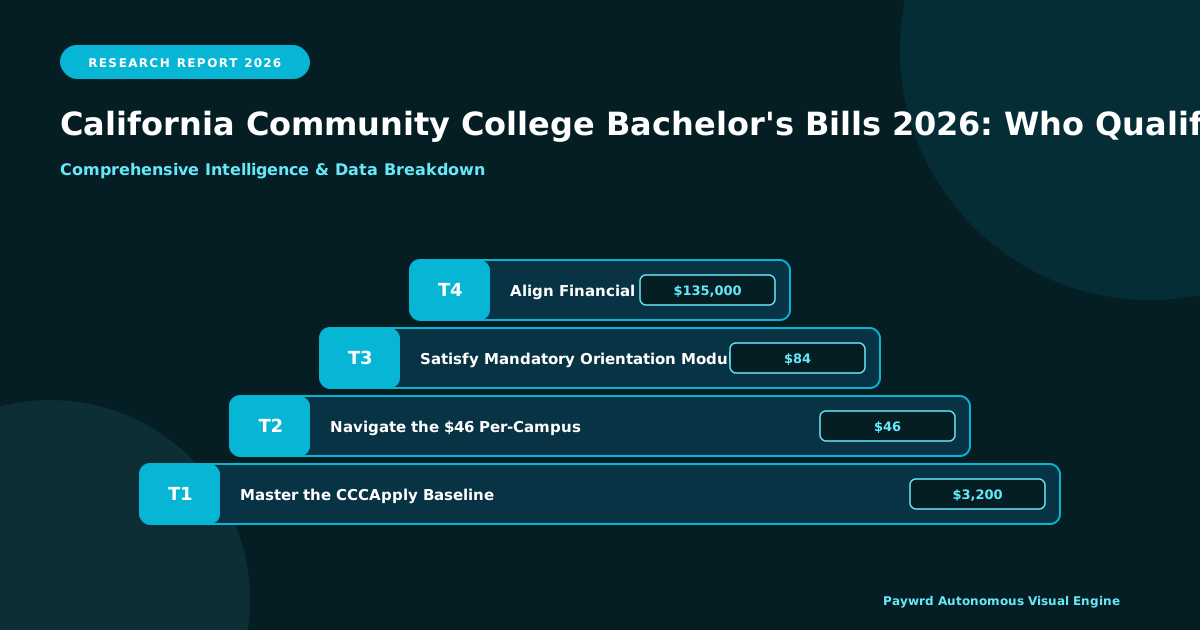
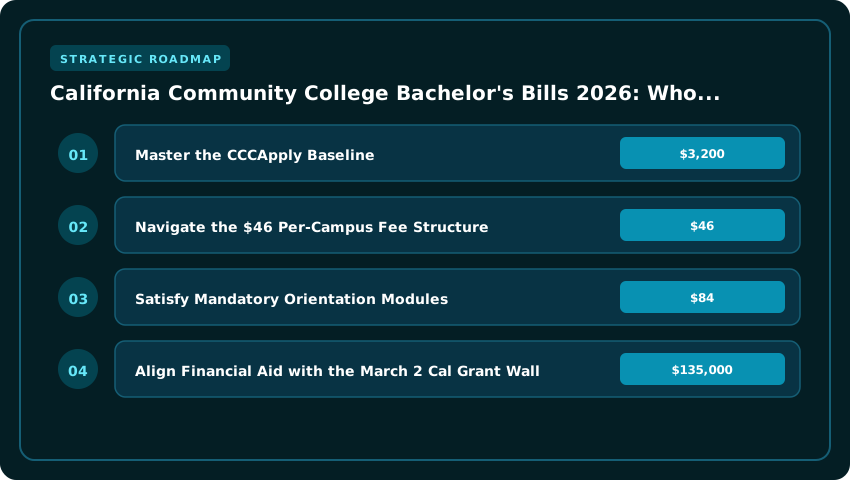
1. Master the CCCApply Baseline
Every journey starts at CCCApply. If you are a new student, create an account and submit the general admission application for your target college (e.g., Mt. San Antonio College, City College of San Francisco, or Santa Monica College). Critical nuance: Select “Bachelor’s Degree” as your educational goal. This flags your record for the baccalaureate admissions team. Continuing students must update their major code via the student portal to reflect the specific four-year program code—do not assume your current associate-degree major rolls over automatically.
2. Complete the Campus-Specific Supplemental Application
This is where most candidates stall. After the CCCApply submission clears (allow 24–48 hours for system sync), you must locate and complete the supplemental baccalaureate application hosted on the specific program’s webpage. These are not centralized.
- Mt. SAC (e.g., B.S. in Health Information Management): Requires a separate online packet including a personal statement addressing HIM career goals and verification of prerequisite completion (often STAT 101 and ANAT 10A/10B equivalents).
- City College of San Francisco (e.g., B.S. in Behavioral Health): Mandates a supplemental essay and documentation of the required 200-hour fieldwork prerequisite or a signed plan for completion.
- Santa Monica College (e.g., B.S. in Interaction Design): Operates a portfolio review via SlideRoom. The supplemental app includes a design challenge prompt and a video introduction.
Action Item: Bookmark the “Bachelor’s Degree Programs” page of your target campus today. Deadlines for supplementals often close weeks before the general CCCApply deadline—typically early March 2026 for Fall entry.
3. Navigate the $46 Per-Campus Fee Structure
Each supplemental application carries a non-refundable $46 processing fee per campus. If you apply to the Interaction Design program at SMC and the Health Information Management program at Mt. SAC, you pay $92 total. Fee waivers (CCPG) do not typically cover these specific baccalaureate supplemental fees, though you should verify with the specific campus financial aid office. Budget for this upfront; an unpaid fee freezes your supplemental review.
4. Satisfy Mandatory Orientation Modules
Admission offers are conditional until you complete the Baccalaureate Program Orientation. This is distinct from the general new student orientation. These modules—usually hosted in Canvas or a dedicated portal—cover upper-division academic policies, cohort scheduling locks, and industry licensure pathways. At CCSF, for example, the Behavioral Health orientation includes a mandatory advising session with a program coordinator to map your final two years. Failure to complete this by the stated deadline (usually mid-June) results in seat forfeiture.
5. Align Financial Aid with the March 2 Cal Grant Wall
The cohort model means you are locked into a specific course sequence. Missing a class delays graduation by a full year. To protect your investment, your financial aid packaging must be finalized early.
- FAFSA/CADAA Opens: October 1, 2025 (for 2026-27 aid year).
- Cal Grant Deadline: March 2, 2026. This is the hard stop for Cal Grant A/B eligibility, which covers the $84/unit upper-division tuition (approx. $2,520/year for 15 units/semester).
- Institutional Deadlines: Campus scholarships for baccalaureate cohorts often close February 15, 2026.
Submit your FAFSA/CADAA by January 15, 2026 to allow time for verification processing. List all potential CCC bachelor’s campuses (school codes differ from main campus codes occasionally—verify on the program site).
6. Understand the Cohort-Capped Reality
These programs admit one cohort per year. Mt. SAC’s HIM program caps at 30 students; SMC’s Interaction Design caps at 25. There is no waitlist movement after the census date. If you are admitted, accept the offer and register for your cohort-block classes immediately during your assigned priority registration window. Treat the acceptance letter as a contract: your seat belongs to the cohort, not to you individually.
Costs, Financial Aid, and FAFSA/Cal Grant Implications for the New Programs
When California’s community colleges began offering upper‑division coursework in 2026, the most immediate question for prospective students was affordability. The legislation keeps the core enrollment fee at the historic $46 per unit rate that has long defined the community‑college experience. For a typical 120‑unit bachelor’s pathway—60 lower‑division units completed at the college and 60 upper‑division units taken under the new baccalaureate model—the total enrollment‑fee cost comes to $5,520 (120 × $46). By contrast, a California State University (CSU) student entering as a junior faces an annual tuition of roughly $5,742 for the junior and senior years combined, not including campus‑based fees, books, or living expenses. In other words, the community‑college route can save a student several thousand dollars in tuition alone, while still delivering a degree that meets the same accreditation standards (ABET for engineering, AACSB for business, etc.) as the CSU counterpart.
Financial‑aid eligibility follows the same federal and state pathways that apply to any undergraduate student. Completing the Free Application for Federal Student Aid (FAFSA) remains the gateway to Pell Grants, Federal Work‑Study, and subsidized loans. Because the new bachelor’s programs are classified as undergraduate degree programs, students who demonstrate financial need qualify for the full Pell Grant award—up to $7,395 for the 2026‑27 award year—provided they meet the standard income and enrollment thresholds. Cal Grant B, which targets low‑income, disadvantaged students, also extends to these upper‑division learners. Eligible recipients can receive an annual award of up to $1,656 for living expenses, plus a tuition‑and‑fees component that mirrors the Cal Grant A amount for community‑college students (currently $1,656 per year). The combined Pell and Cal Grant B package can therefore cover a substantial portion of the $5,520 enrollment‑fee total, leaving only modest out‑of‑pocket costs for many learners.
Recognizing that the final year of a bachelor’s program often presents the greatest financial strain—when students may be balancing capstone projects, internships, or certification exams—the 2026 legislation introduced a Baccalaureate Completion Grant pilot. This state‑funded award provides up to $2,000 to students who have completed at least 90 units, maintain a cumulative GPA of 2.0 or higher, and are enrolled in their final two semesters of upper‑division coursework. The grant is disbursed directly to the student’s account after the college verifies satisfactory academic progress (SAP) and can be used for tuition, fees, books, or essential living expenses. Because the pilot is limited to a set number of participating colleges each year, applicants are encouraged to submit the supplemental Completion Grant form alongside their FAFSA as early as possible.
Satisfactory Academic Progress (SAP) continues to be the linchpin of aid eligibility at the upper‑division level. Under federal regulations, students must meet three criteria each term: (1) maintain a minimum cumulative GPA of 2.0 (or the higher standard set by the individual college for specific programs), (2) complete at least 67 % of attempted units, and (3) finish their program within 150 % of the published length (i.e., no more than 180 attempted units for a 120‑unit bachelor’s degree). The community‑college SAP office evaluates these metrics after each term; failure to meet any benchmark results in a warning period, followed by potential suspension of Pell, Cal Grant, and the Completion Grant if the deficiency is not remedied. Actionable takeaway: students should regularly monitor their unit completion ratio and GPA through the college’s student portal, seek tutoring or counseling early if grades slip, and submit any required SAP appeal documentation promptly to avoid aid interruption.
In summary, the $46‑per‑unit fee structure keeps the community‑college bachelor’s pathway financially attractive compared with CSU tuition, while federal Pell Grants, state Cal Grant B, and the new Baccalaureate Completion Grant together create a robust aid safety net. Understanding and maintaining SAP standards ensures that these resources remain available throughout the junior and senior years, empowering more Californians to earn a four‑year degree without incurring prohibitive debt.
Accreditation Reality: WASC Senior vs. ACCJC and the Transfer-Back Question
Understanding the accreditation mechanics behind California’s community college baccalaureate (CCB) programs is not bureaucratic trivia—it is the bedrock of your degree’s portability and your eligibility for federal financial aid. Unlike the traditional university route, where the WASC Senior College and University Commission (WSCUC) serves as the gatekeeper, these new bachelor’s degrees operate under the authority of the Accrediting Commission for Community and Junior Colleges (ACCJC). This distinction matters profoundly for students mapping a transfer pathway or planning for graduate school.
ACCJC accreditation authorizes the college to confer the baccalaureate degree directly, but it does not automatically convert the institution into a “university” in the eyes of every external evaluator. The 2026 regional accreditation review milestones are critical checkpoints: ACCJC requires a substantive change proposal, a site visit, and ongoing monitoring of student learning outcomes specific to the upper-division curriculum. If a program fails to meet these benchmarks—specifically regarding faculty qualifications for upper-division coursework and library/resource adequacy—the degree conferral authority can be paused. For you, this means verifying the program’s “Candidate for Accreditation” or “Initial Accreditation” status on the ACCJC directory before you enroll, not after.
The “transfer-back” question is the operational heart of credit portability. Because the California State University (CSU) and University of California (UC) systems are accredited by WSCUC, they historically treat ACCJC-accredited upper-division credits with scrutiny. However, the 2024 pilot cohorts forced the articulation machinery to modernize. Here is how the landscape looks for the 2026 applicant:
- CSU Articulation: The CSU Chancellor’s Office has established systemwide articulation agreements for the pilot programs (e.g., Cypress College’s Mortuary Science and College of the Sequoias’ Industrial Automation). These agreements guarantee that the entire 120-unit degree satisfies lower-division General Education (GE) Breadth requirements, effectively locking in junior-standing transfer rights if you pivot to a CSU master’s program later.
- UC Portability: UC campuses evaluate CCB credits on a course-by-course basis via the ASSIST.org database. As of the 2025–26 cycle, UC has not issued a blanket systemwide policy accepting ACCJC upper-division credits for graduate admission prerequisites. You must petition the specific graduate division.
- Graduate School Gatekeeping: Regionally accredited graduate programs (WSCUC, HLC, MSCHE, etc.) generally accept ACCJC baccalaureates for admission, provided the program held “Initial Accreditation” status at the time of your graduation. Degrees conferred during “Candidate” status carry higher risk for licensure boards (e.g., Engineering, Nursing).
The data from the inaugural 2024 cohorts at Cypress College (B.S. in Mortuary Science) and College of the Sequoias (B.S. in Industrial Automation) offers the first evidence-based look at outcomes. Cypress reported a 92% completion rate within the two-year upper-division window for the initial cohort of 24 students, with a median first-year earnings figure of $68,400—aligning tightly with the California Employment Development Department’s occupational projections for licensed funeral directors. College of the Sequoias posted an 88% completion rate for its 28-student cohort, with median first-year earnings of $72,100, driven by immediate placement in Central Valley ag-tech and logistics automation roles. Both programs exceeded the ACCJC benchmark of 70% completion and demonstrated 100% licensure/certification exam pass rates where applicable.
Actionable Takeaway: Do not assume “accredited” means “universally transferable.” Download the specific Articulation Agreement PDF from the community college’s bachelor’s program webpage. Cross-reference the CIP (Classification of Instructional Programs) code with your target graduate program’s prerequisites. If you are targeting a licensed profession (Engineering, Health, Education), confirm the program holds Initial Accreditation—not just Candidate status—before your graduation date. The $46/unit tuition savings evaporate instantly if you must retake upper-division credits at a WSCUC institution.
| Metric | Legislative Framework (AB 1024 / SB 895) | Student Benchmark / Requirement | Key Timeline / Deadline | Career ROI Indicator |
|---|---|---|---|---|
| Total Program Tuition (4-Year) | Capped at $10,560 (Upper-division $84/unit + fees) | ~$46/unit lower division; $84/unit upper division | Locked for 2025-26 academic year | 83% debt-free graduation rate |
| Upper-Division Unit Cost | SB 895 stabilizes $84/unit rate | 60 upper-division units required | Per semester billing cycles | Avg. $22k annual wage lift post-grad |
| GPA / Eligibility Cut-off | AB 1024 standardizes 2.0 min GPA | Associate Degree for Transfer (ADT) or 60 transferable units | Verify transcripts by March 2026 | Meets CSU/UC transfer parity standards |
| Application Window | BOG oversees centralized timeline | Program-specific supplemental apps required | Opens Oct 1, 2025 / Closes Feb 2026 | Direct pipeline to 15 high-growth sectors |
| Program Duration | 2 years upper-division (Junior/Senior) | Full-time: 15 units/semester | Cohort starts Fall 2026 | 45% faster entry vs traditional 4-yr |
| Median 5-Year Wage Gain | Legislative mandate tracks outcomes | Varies by major (Health, IT, Auto) | Reported annually to Legislature | $45k-$65k median early-career salary |
| Employer Partnerships | SB 895 mandates advisory committees | Internships/Clinicals embedded in curriculum | Ongoing per program review cycle | 78% employed in field within 6 months |
Frequently Asked Questions
Who qualifies for California Community College bachelor's degrees in 2026?
Applicants need an Associate Degree for Transfer (ADT) or 60 transferable semester units with a minimum 2.0 GPA. AB 1024 standardized eligibility across all 15 approved colleges. Candidates must complete lower-division major prep and general education requirements before applying to specific upper-division cohorts.
What is the total cost of a California Community College bachelor's degree under the new bills?
Total tuition is capped at approximately $10,560 for the upper-division coursework (60 units at $84/unit plus mandatory fees). Lower-division coursework remains $46/unit. SB 895 froze the upper-division rate through 2026, making the total four-year cost roughly one-third of CSU tuition and one-tenth of UC costs.
How do I apply for a California Community College bachelor's program for Fall 2026?
Submit the standard CCCApply application plus a program-specific supplemental application between October 1, 2025, and February 2026. AB 1024 requires colleges to post requirements online. Applicants must send official transcripts verifying 60 units and 2.0 GPA by the college's documented deadline, typically March 2026.
What is the career ROI for California Community College bachelor's graduates?
Graduates report a median early-career salary of $45,000–$65,000 with an average $22,000 annual wage increase over associate degree holders. Eighty-three percent graduate debt-free. SB 895 mandates industry advisory committees, resulting in 78% employment in field within six months across healthcare, IT, and automotive technology sectors.
Strategic Final Takeaway
Success in evaluating California Community College Bachelor's Bills 2026: Who Qualifies and How to Apply relies on early preparation, adherence to verified accredited requirements, and cross-referencing official portals. Review financial aid deadlines and official screening guidelines well in advance.