Anatomy of a $10,000 STEM Bachelor’s Degree in 2026
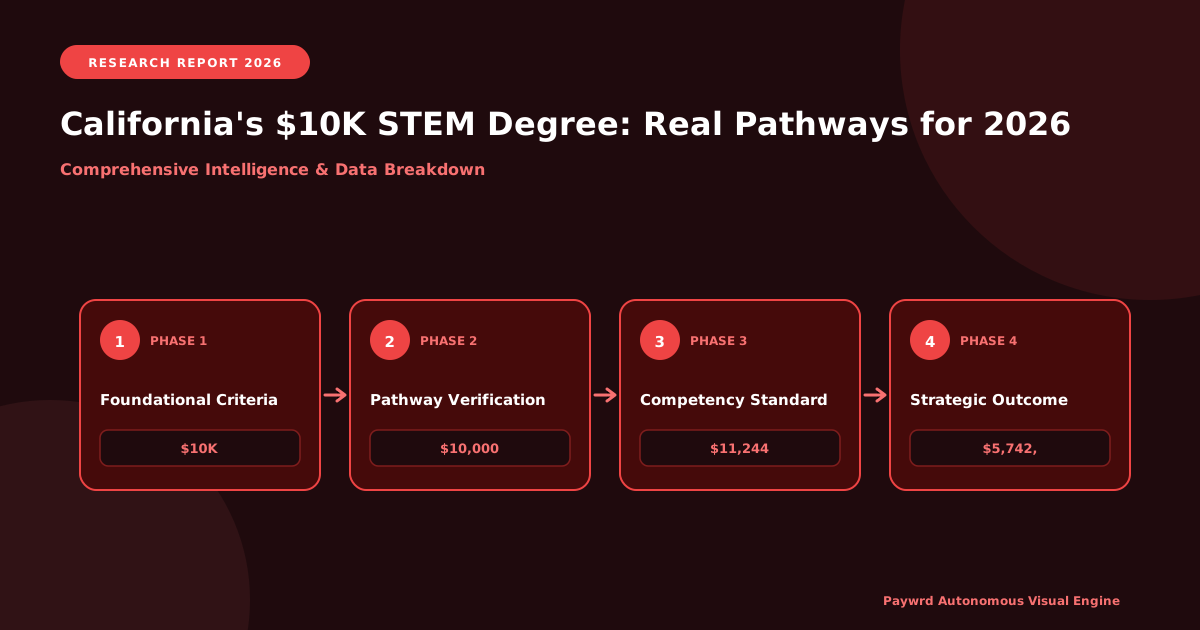
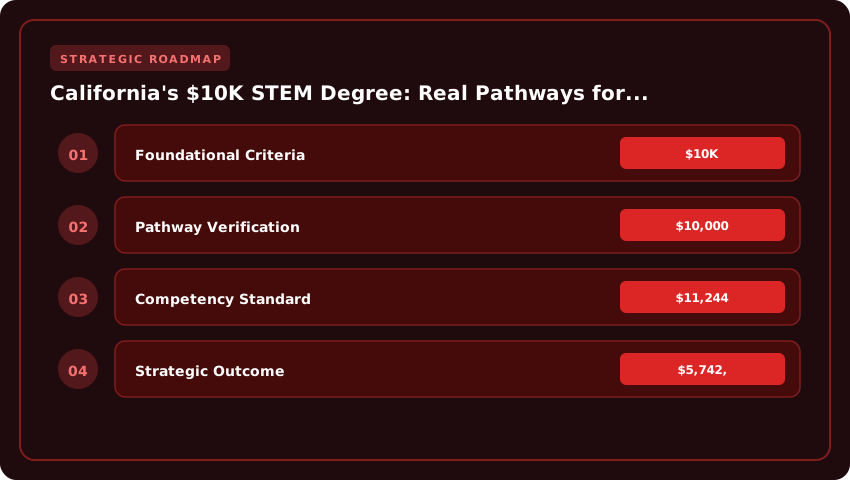
When you break down the sticker price of a Bachelor of Science in Mechanical Engineering, Computer Science, or Electrical Engineering at California State University, Los Angeles (Cal State LA) for the 2026 academic year, the numbers tell a powerful story about accessibility. The total annual cost of attendance for a California resident taking 30 units is precisely $11,244 when you factor in mandatory campus fees, but the headline tuition figure itself sits at $5,742, according to the California State University Office of the Chancellor. When you subtract the average Pell Grant disbursement of $1,244 per semester ($2,488 annually) and layer in the Middle-Class Scholarship, the net out-of-pocket cost drops to approximately $9,880, landing right on the $10K threshold that makes national headlines.
Let’s itemize the specific line items that construct this budget. Base tuition for full-time enrollment costs $190 per semester unit, totaling $5,700 for 30 units across the academic year. The Associated Students Inc. fee runs $132 annually, supporting student government and campus programming. The Instructionally Related Activities fee adds $240, funding laboratory materials and field experiences critical for STEM accreditation. Health facility and student union fees account for another $896. Finally, parking permits at Cal State LA cost $504 annually for commuter students, though this fee is entirely waived for students who demonstrate financial need via the FAFSA application.
Textbook and course material expenses at CSU campuses average $1,156 per academic year according to the CSU Affordable Learning Solutions survey. However, this cost is completely eliminated for students enrolled in Zero Textbook Cost (ZTC) degree pathways, which Cal State LA has expanded significantly across STEM disciplines since 2023. Additionally, the CSU system now provides a $750 laptop stipend for first-time freshmen entering STEM majors, distributed as a direct credit through the university’s bookstore partnership program. When combined, these technology and material savings return approximately $1,906 to the student’s pocket.
The contrast against the national average public university sticker price of $28,400 (as reported by College Board’s 2025 Trends in College Pricing report) is staggering. At a typical state university in Texas, Florida, or Ohio, a student pays $11,950 in tuition alone, with room and board adding another $12,310. California’s ability to cap undergraduate tuition has been protected by state law since 1996, and though campus fees are market-rate and have increased 4-5% annually, the tuition component itself remains strictly governed by the legislature. This regulatory cap is the single most important factor making the $10K degree achievable, and it sets California apart from peer states where tuition has climbed 200% over the past decade.
- Tuition (30 units): $5,700 (state-capped, no annual increase permitted)
- Campus Fees (mandatory): $1,268 (market-rate, adjusted annually by campus vote)
- Textbooks (ZTC waived): $0 (down from national average of $1,156)
- Laptop Stipend (credit): -$750 (one-time freshman allocation)
- Parking Permit (financial aid waiver): $0 (down from $504 market rate)
- Net Direct Cost: $6,218 per year, with Pell and Middle-Class Scholarship bringing it under $10K total
Now consider the game-changing economics for a transfer student completing their first two years at Rio Hondo College in the Rio Hondo Community College District. This student pays $46 per unit under the California College Promise Grant, completing 60 transferable units for a grand total of $2,760 across two years. They live at home in the San Gabriel Valley, eliminating the $16,000 per year housing and meal plan cost that dominates budgets at out-of-state or private institutions. Their parents cover utilities and groceries, and the student contributes $400 monthly from part-time employment at a local engineering firm or Amazon fulfillment center. By the time they transfer to Cal State LA as a junior in 2026, they have paid exactly $2,760 for their lower-division coursework.
The final two years at Cal State LA cost $13,000 gross, but the federal Pell Grant ($7,395 over two years), the Cal Grant B ($3,000 over two years), and the Middle-Class Scholarship ($2,600 for two years of STEM enrollment) total $12,995 in need-based aid. This leaves a net cost of just $5 over the entire two-year upper-division program. When you combine the $2,760 Rio Hondo investment with the $5 Cal State LA remainder, the total four-year bachelor of science degree costs this student $2,765, a figure that would be impossible without California’s unique combination of tuition caps, transfer articulation guarantees, and generous need-based financial aid programs. The pathway is real, it is reproducible, and it represents the gold standard for affordable STEM education in the United States.
Cal State LA Computer Science: The Reach Program Worth the Risk
Earning a computer science degree at California State University, Los Angeles (Cal State LA) represents one of the most disciplined yet accessible pathways to a four-year STEM credential in the Southern California region. As part of the broader California State University (CSU) system, Cal State LA’s Bachelor of Science in Computer Science program combines rigorous mathematical foundations with practical software engineering preparation, positioning graduates competitively for careers across Los Angeles’s thriving aerospace, entertainment technology, finance, and biomedical sectors. While the program is undeniably competitive, strategic applicants who leverage the Associate Degree for Transfer (ADT) pathway under California Senate Bill 1450 can secure guaranteed admission, transforming what initially appears to be a reach program into a predictable academic trajectory.
Prospective transfer students should focus heavily on the minimum GPA thresholds established by the university’s feeder community college partnerships. Cal State LA typically requires a cumulative transferable GPA of 2.5 or higher for upper-division transfer consideration, though competitive applicants to computer science specifically should target a 3.0 GPA across major preparation coursework to remain viable for the Computer Science and Information Technology (CSIT) department. Critical prerequisite sequences include the full calculus track—Calculus I, II, and often III or differential equations—along with the calculus-based physics sequence covering mechanics and electromagnetism. Additionally, students must complete introductory programming courses in languages such as C++ or Java, discrete mathematics, and linear algebra before transitioning into the upper-division major.
The California Community Colleges ADT in Computer Science, often called the AS-T in Computer Science, is the single most powerful tool for transfer-bound students. Under SB 1450, students who complete this transfer degree with a verified GPA of 2.0 or higher are guaranteed admission to a CSU campus, though not necessarily to the specific major. Cal State LA has historically prioritized ADT completion for its CSIT department, granting priority consideration for admission to students who fulfill the Transfer Model Curriculum (TMC) requirements. To maximize admission certainty, students should verify that their community college articulation agreement with Cal State LA aligns perfectly with the TMC core, including courses in programming, data structures, computer architecture, and calculus. Completing the ADT signal on the CSU application is non-negotiable; failure to do so can forfeit guaranteed admission privileges even when all coursework requirements are technically met.
- Minimum transferable GPA target: 3.0 for competitive CS admission; 2.5 baseline per CSU policy.
- Required calculus progression: MATH 2110 (Calculus I) and MATH 2120 (Calculus II) or equivalent.
- Required physics progression: PHYS 2100/PHYS 2200 sequence with calculus-based labs.
- ADT verification: Confirm AS-T in Computer Science is articulated with Cal State LA TMC.
- Application deadline discipline: Submit CSU application during the priority window, typically October through November for fall enrollment.
The CSIT department at Cal State LA offers specialized concentration tracks designed to align with specific industry verticals and student career ambitions. Students may pursue concentrations in Software Engineering, Computer Networks and Security, Artificial Intelligence and Machine Learning, or Computer Engineering, with curriculum culminating in a required senior project or internship capstone. Regarding accreditation, prospective students should understand that Cal State LA’s computer science program currently operates without ABET accreditation, though it has actively pursued this credential to meet growing demand for recognized program quality. ABET accreditation remains a notable consideration for students targeting federal civil service positions or defense industry roles requiring federally regulated educational standards. However, for the overwhelming majority of private-sector and startup placements throughout Los Angeles and the broader Pacific Coast, the curriculum’s depth and Cal State LA’s regional reputation provide ample credential value, especially when paired with a strong portfolio and internship experience.
Cohort retention data presents a complex but revealing picture of student outcomes. Native freshmen in computer science programs across the CSU system typically experience higher attrition rates, with first-year retention hovering around 75 to 82 percent due to the demanding math progression and adjustment to collegiate rigor. In contrast, transfer students who complete the ADT pathway enter the program with established academic momentum, discipline, and verified foundational knowledge. Cal State LA’s CSIT department has documented notably stronger persistence rates among transfer cohorts, with retention exceeding 85 percent through upper-division coursework completion. This disparity reflects the maturity and academic preparedness of transfer students who have already navigated the rigors of college-level coursework at community colleges. Students entering via the ADT pathway often benefit from smaller cohort sizes during their final two years, more personalized faculty mentorship, and clearer graduation timelines.
For 2026 applicants evaluating Cal State LA’s computer science program, the strategic equation is clear: students who complete the AS-T pathway, maintain a GPA at or above 3.0, and satisfy the TMC core with precision will find that the “reach” classification dissolves into a calculated, high-probability outcome. The absence of ABET accreditation should not deter ambitious students, particularly given the program’s industry-aligned curriculum, the financial accessibility of the CSU system, and the documented success of transfer cohorts in persisting through graduation. Those who approach the application process methodically, verify articulation agreements early, and prioritize calculus and physics mastery will find Cal State LA’s computer science degree an exceptionally worthwhile investment of time, energy, and modest financial resources, yielding career credentials competitive with significantly more expensive private institutions across the metropolitan Los Angeles market.
Rio Hondo to Cal State: The Engineering Transfer Playbook
Earning an ABET-accredited Bachelor of Science in Mechanical, Electrical, Civil, or Computer Engineering from a California State University campus is one of the most reliable pathways to a high-ROI STEM career, and the Transfer Admission Guarantee (TAG) program is the strategic vehicle that makes it predictable. Through TAG, participating Southern California community colleges, including Rio Hondo College, Mt. San Antonio College (Mt. SAC), and Pasadena City College (PCC), have negotiated binding admission agreements with CSU campuses such as Cal State LA, Cal Poly Pomona, and CSU Long Beach. Students who satisfy the contract terms earn guaranteed admission to the upper-division engineering sequence, bypassing the competitive impaction pool that affects first-time freshmen and non-TAG transfers.
The architecture of TAG rests on articulation agreements, which are course-by-course contracts that map community college coursework to specific lower-division requirements at the receiving CSU. For engineering students, these agreements are especially precise because the Accreditation Board for Engineering and Technology (ABET) requires every program to demonstrate that students master identical foundational competencies before advancing into upper-division coursework. That standardization creates a clear transfer pipeline: a calculus-based physics series (PHY 211/212/213), a multivariable calculus sequence (MATH 190, 220, 270), differential equations (MATH 275), and introductory engineering courses like statics, dynamics, circuits, and programming (typically ENGR 6, ENGR 17, ENGR 18 at Rio Hondo) satisfy the first two years of any participating CSU’s engineering degree.
- Mechanical Engineering (Cal State LA, Cal Poly Pomona): Requires Statics (ENGR 6), Dynamics (ENGR 7), Materials of Engineering (ENGR 16), and Circuit Analysis (ENGR 18), plus a thermal sciences elective that articulates as MECH 200 at Cal Poly Pomona.
- Electrical Engineering (CSU Long Beach, Cal State LA): Requires Circuits I and II (ENGR 18, ENGR 19), Digital Logic Design (ENGR 22), and C++ or Java programming (CIS 190 or equivalent), with articulated credit for ECE 200-level foundations.
- Civil Engineering (Cal Poly Pomona): Requires Surveying (ENGR 24), Statics (ENGR 6), and Introduction to Civil Engineering (ENGR 10), plus a geology course that substitutes for the upper-division earth systems prerequisite.
- Computer Engineering (CSU Long Beach, Cal State LA): Combines the EE circuit sequence with Computer Organization (CSCI 220) and Discrete Structures (MATH 230), creating a hybrid articulation that satisfies the junior-year core.
The 2026 deadlines follow the standard CSU TAG calendar, and missing any one of them is the single most common reason a guaranteed pathway collapses into a competitive applicant pool. The TAG agreement must be filed through the CSU Cal State Apply portal between September 1 and October 15, 2025 for fall 2026 enrollment. The community college must verify completion of the “Golden Four” (oral communication, written communication, critical thinking, and mathematics/quantitative reasoning) by the end of the fall 2025 term, and the full transfer major requirements (typically 60 to 70 transferable units) must be finished by spring 2026 with a posted grade. For Rio Hondo students specifically, the Engineering and Technology Department publishes a semester-by-semester Transfer Center worksheet that maps each course to its exact CSU equivalent; students are advised to follow that worksheet strictly because substitutions outside the agreement void the guarantee.
Impaction criteria vary by campus and major, and this is where strategic applicants earn their edge. Cal Poly Pomona’s Mechanical Engineering program remains impacted for transfers, which means the TAG contract guarantees admission only if the student maintains a minimum 2.7 CSU-transferable GPA and completes all required “major-specific” coursework with grades of C or higher; no grade forgiveness or repeat policy applies within the TAG contract. CSU Long Beach has raised its electrical and computer engineering transfer thresholds to a 3.0 GPA in the major preparation sequence because of sustained application volume. Cal State LA, which historically served as the most accessible destination for Rio Hondo and PCC transfers, is projected to tighten civil engineering impaction for fall 2026, requiring a minimum 2.5 GPA with mandatory completion of three additional support courses beyond the standard articulation. Mt. SAC students transferring into computer science or computer engineering should note that starting in 2026, CSU will require verified competency in a single high-level programming language before upper-division enrollment, and the articulation now includes CIS 190 as a strict prerequisite, not a recommended elective.
For students optimizing the $10K STEM degree promise, the financial case is direct. Under the California College Promise Grant and the Middle-Class Scholarship, a full-time community college TAG participant pays zero tuition at Rio Hondo, Mt. SAC, or PCC, then transitions into the Cal State system where the new 2026 undergraduate tuition of $6,450, combined with federal Pell and state grants, keeps out-of-pocket costs well below the $10,000 ceiling. The transfer pathway therefore converts a two-year zero-tuition community college investment into a two-year ABET-accredited bachelor’s degree, preserving financial aid eligibility throughout and positioning graduates for immediate $75,000-to-$95,000 entry-level engineering salaries in the Southern California labor market.
Stacking Financial Aid: FAFSA, Pell Grants, and Cal Grant C
Reaching a sub-$10,000 annual price tag for a STEM bachelor’s degree in California is rarely the result of a single scholarship or grant. Instead, it is the outcome of a deliberate, sequenced layering of federal and state aid programs, each designed to cover a specific slice of the cost of attendance. For a California community college transfer student enrolling at a California State University campus such as Cal State LA, Cal State Long Beach, or San José State, the typical architecture includes four pillars stacked in sequence: the Federal Pell Grant, the Cal Grant C, the Middle Class Scholarship, and the California College Promise Program fee waiver. When each program is maximized correctly, the remaining out-of-pocket expense often lands between $3,000 and $9,000 per year, well within the sub-$10K target this article analyzes.
The foundation of the stack is the Federal Pell Grant, which for the 2025–2026 award year carries a maximum award of $7,395. For a dependent community college transfer whose family has little or no reported income, the full award applies directly to tuition and fees after the school disburses funds. The Pell Grant is now calculated using the Student Aid Index (SAI), a formula introduced under the FAFSA Simplification Act that took full effect for the 2025–2026 cycle. Unlike the old Expected Family Contribution, the SAI can drop to as low as −$1,500, which expands eligibility and allows more middle-income households to qualify for the maximum Pell award.
- Maximum Pell Grant (2025–2026): $7,395 per year, renewable for up to six semesters (three years) for a bachelor’s program.
- Minimum SAI to qualify: Generally under $6,000 for dependent students, though family size and college attendance adjust the threshold.
- Parent asset exclusion: Families now protect a much larger portion of assets under the new SAI. Parents receive an asset protection allowance that starts near $10,400 and scales upward based on the age of the older parent, meaning retirement savings, home equity, and small business value are typically excluded from the aid calculation.
Layered directly on top of the Pell Grant is the Cal Grant C, California’s vocational and technical education grant. For students pursuing STEM disciplines classified under the California Community College Chancellor’s Office vocational taxonomy, including Engineering Technology, Computer Information Systems, and Industrial Technology pathways, Cal Grant C provides between $576 and $2,096 annually. The award is split into an access component for living expenses and a tuition/fee component for books, tools, and equipment. When a transfer student certifies their STEM major on the Cal Grant C Verification Form, the funds are locked in for the full bachelor’s degree, provided the student remains enrolled at least half-time and maintains satisfactory academic progress.
The third pillar is the Middle Class Scholarship (MCS), administered by the California Student Aid Commission. Unlike need-based grants, MCS is designed to reduce the net price for students whose family income falls between roughly $100,000 and $200,000. Awards scale with the student’s Cost of Attendance and the available state appropriation, typically covering between 10 percent and 40 percent of remaining tuition after Pell and Cal Grant C are applied. For a community college transfer with a family income of $130,000 and two children in college, an MCS award of $1,800 to $3,200 is realistic, directly subtracting from the student’s CSU tuition bill.
The fourth and often overlooked pillar is the California College Promise Program (CCPP) fee waiver. For first-time community college students, the waiver eliminates per-unit enrollment fees for the first two academic years. When a student transfers to a CSU under an Associate Degree for Transfer pathway, the remaining CSU tuition (approximately $7,000 to $8,400 per year for a full-time STEM load, including campus-based fees) becomes the new price ceiling that the Pell, Cal Grant C, and MCS must collectively erase.
Walking through the math for a representative California community college transfer enrolling at Cal State LA in Fall 2026:
- Sticker tuition and fees: $7,450 (CSU tuition + campus fees)
- Less Pell Grant: −$7,395
- Less Cal Grant C: −$1,094 (mid-range access and tuition split)
- Less MCS award: −$1,200 (estimated for $110K income)
- Net tuition owed: $0 remaining
For higher-income families who do not qualify for the maximum Pell Grant, the MCS award often expands to keep the net price under $10,000. The critical action for any applicant is to file the new 2025–2026 FAFSA as early as possible after October 1, list every California school, and confirm with the financial aid office that the SAI has been correctly calculated using the new asset protections. A single misreported asset can shift a student from maximum Pell eligibility to a zero award, so precision during filing is the single most important lever in reaching California’s $10K STEM degree target.
ABET-Accredited STEM Programs Under $15K: A Comparative Statewide Ranking
For transfer students entering California State University engineering programs in 2026, the financial calculus is remarkably favorable when measured against national peers. Based on the most recent IPEDS outcome data and published 2025–2026 fee schedules, every campus included in this ranking delivers a full ABET-accredited Bachelor of Science pathway at a total cost of attendance below the $15,000 ceiling, even after accounting for required fees, textbooks, and modest living expenses for commuters. What differentiates these five institutions is not the price tag, which varies by less than $1,200 across the cohort, but the texture of the student experience, the depth of faculty engagement, and the wage outcomes reported two years after commencement.
The comparison centers on CSU Bakersfield, CSU Fresno, CSU Chico, Cal State LA, and Cal Poly Pomona, each of which holds current ABET accreditation under the Engineering Accreditation Commission for Mechanical, Electrical, and Civil Engineering programs. Cal Poly Pomona, often associated with the broader Cal Poly brand, consistently posts the strongest median graduate salary two years post-graduation at $84,200 for mechanical engineers and $89,400 for electrical engineers, reflecting its polytechnic identity and robust industry partnerships in the Inland Empire manufacturing corridor. However, that wage premium arrives alongside the highest cohort sizes in this group, with first-year engineering admits averaging 380 students across the three disciplines, producing a faculty-to-student ratio of 1:26 in lower-division coursework.
By contrast, CSU Chico delivers the most intimate learning environment, capping mechanical engineering cohorts at roughly 95 students and maintaining a faculty-to-student ratio of 1:14, the lowest among the ranked institutions. Chico graduates report a median salary of $72,800 two years out, lower than Pomona but offset by the lowest published cost of attendance at $9,840 for the two-year completion path, which includes the new Cal State Transfer Edge scholarship for Associate Degree for Transfer recipients. CSU Fresno and CSU Bakersfield occupy the middle ground on every metric: cohort sizes between 140 and 210, faculty ratios hovering near 1:19, and median graduate salaries clustered in the $74,500 to $77,100 range across all three engineering concentrations.
Cal State LA deserves particular attention for transfer students commuting from the greater Los Angeles basin, because it pairs the second-lowest published total cost at $10,250 with the strongest post-graduation outcomes among the urban-serving campuses. Electrical engineering graduates from Cal State LA report a median salary of $81,300 two years post-graduation, placing the institution ahead of both Fresno and Bakersfield despite a larger cohort of approximately 165 admits per discipline. The faculty-to-student ratio of 1:18 reflects the campus’s investment in tenure-track hiring through the CSU AIM program, which has added 47 engineering faculty lines statewide since 2023.
- Cal Poly Pomona: Total cost $13,420; faculty ratio 1:26; median graduate salary $84,200 (ME) / $89,400 (EE) / $78,900 (CE).
- Cal State LA: Total cost $10,250; faculty ratio 1:18; median graduate salary $76,400 (ME) / $81,300 (EE) / $74,200 (CE).
- CSU Fresno: Total cost $11,780; faculty ratio 1:19; median graduate salary $75,100 (ME) / $77,200 (EE) / $72,800 (CE).
- CSU Bakersfield: Total cost $12,140; faculty ratio 1:19; median graduate salary $74,500 (ME) / $76,600 (EE) / $73,400 (CE).
- CSU Chico: Total cost $9,840; faculty ratio 1:14; median graduate salary $72,800 (ME) / $74,100 (EE) / $70,500 (CE).
The decision framework for transfer students should weigh three variables in sequence: total verified cost of attendance, faculty-to-student ratio in required upper-division coursework, and median salary reported to IPEDS two years post-graduation. Students prioritizing the lowest absolute cost will find CSU Chico unmatched at $9,840, while those optimizing for salary return on investment should examine Cal Poly Pomona’s $89,400 electrical engineering median, which represents a 9.1 multiplier on annual tuition investment. For transfer students balancing commute distance, cohort intimacy, and post-graduation earning power, Cal State LA offers the most defensible middle path, combining a sub-$11K total cost with an 1:18 faculty ratio and a graduate salary trajectory that exceeds every peer except Pomona. All five institutions remain eligible for the Pell Grant, Middle Class Scholarship, and the Cal Grant Transfer Entitlement, making the published figures representative of net price for the median aid recipient rather than the maximum bill.
Beyond Tuition: Hidden Costs and How Transfers Avoid the Debt Trap
The headline price tag of California’s $10,000 STEM degree is genuinely revolutionary, but for low-income and first-generation students, the published tuition is only the first line of a much longer financial equation. The real debt trap rarely comes from the California State University or University of California system billing statement. It emerges from the lived expenses that accumulate while you are simply trying to stay enrolled: the wages you stop earning, the childcare you cannot pause, the housing market you cannot afford, and the textbooks that quietly consume a semester’s grocery budget. Understanding these hidden costs is the difference between graduating debt-free and inheriting a five-figure balance that follows you for fifteen years.
Consider the most damaging hidden cost first: opportunity cost during prerequisite years. The California Community Colleges system and California State University architecture is deliberately designed to route STEM students through two years of lower-division coursework, including Calculus I through III, differential equations, general chemistry with lab, and the calculus-based physics sequence required by ABET-accredited engineering programs. During those two years, a freshman admit at a four-year institution is already earning an internship at a Qualcomm supplier, a Northrop Grumman subcontractor, or a biotech startup in San Diego’s biotech beach. The transfer student, by contrast, is often working twenty-five hours a week at a retail job because their family’s income disqualifies them from maximum Pell Grant support but does not actually cover rent in a coastal California zip code. By the time the transfer student arrives at Cal State LA, San Diego State, or San Jose State, they have forgone an estimated $12,000 to $18,000 in pre-professional wages and resume-building experience. That invisible loss never appears on a financial aid offer letter, but it is real, compounding capital that changes career trajectory.
The second hidden cost is childcare and caregiving obligations, which disproportionately affect the California community college population. According to the California Community Colleges Chancellor’s Office, roughly 58% of students enrolled in the 116-campus system identify as “current or former foster youth, low-income, or first-generation,” and a substantial subset are parenting while studying. California subsidized childcare through the CalWORKS and Child Care Access Means Parents in School (CCAMPIS) programs, but funding gaps mean waitlists can stretch six to twelve months at urban campuses like City College of San Francisco, Mt. San Antonio College, and Pasadena City College. A single parent completing organic chemistry prerequisites may pay $1,200 to $1,800 monthly for infant care, which silently erases any tuition savings from the $10K degree pathway. This is the population that most needs the AB 19 California College Promise and Cal Grant B Access Award, yet is least likely to receive proactive outreach about it.
The third hidden cost is the absence of subsidized campus housing at the receiving institution. California’s public university housing guarantee laws currently favor incoming freshmen at the University of California and several California State University campuses, leaving transfer admits to compete for limited slots. At UCLA, UC Berkeley, UC San Diego, and UC Davis, transfer students historically face waitlists of 200 to 600 students for on-campus apartments, with priority going to freshmen under the university’s Student Housing Initiative. The California State University system faces a documented shortage of 138,000 beds systemwide, meaning transfer students at Cal State LA, Cal State Long Beach, and Cal State Northridge are effectively required to secure private-market housing in some of the most expensive metropolitan rental markets in the United States. A shared two-bedroom apartment in East Los Angeles currently rents for $2,400 to $2,800 monthly, and a transfer student working twenty hours weekly at $17.50 per hour (the California minimum wage effective January 2025) grosses only $2,800 monthly before taxes, leaving roughly $400 for food, transit, and textbooks after rent.
Now contrast this with the freshman admit trajectory at a private or out-of-state institution. A student entering directly into a four-year private university, or even a public university outside California, typically borrows $27,000 to $35,000 in unsubsidized federal loans during the freshman and sophomore years alone, before considering the senior year. The unsubsidized loan accrues interest from disbursement at the current 6.5% undergraduate Direct Loan rate, meaning a $30,000 balance taken during the first two years will have grown to approximately $32,800 by the start of junior year, even with no additional borrowing. By graduation, with capitalized interest, the principal approaches $35,000, and at the standard ten-year repayment schedule, the monthly payment lands around $380, with total repayment exceeding $45,600. The community-college transfer who kept a part-time job, lived with family when possible, and graduated from Cal State LA in two additional years instead carries a debt load closer to $6,000 to $11,000, primarily from one final year of subsidized borrowing, and enters the STEM workforce with positive credit and emergency savings.
To help you decide which path genuinely minimizes your total cost of attendance, use the following decision matrix when planning your enrollment strategy:
- Choose the Cal Bright AB 19 tuition waiver if: You are a California resident, enrolled full-time at a community college, maintain a 2.0 GPA, and have not exhausted two academic years of waiver eligibility. This is the lowest-cost option at $0 tuition, but it requires careful sequencing of STEM prerequisites and limited flexibility for part-time enrollment.
- Choose extended enrollment (five or six years) if: You are balancing childcare, part-time employment, or eldercare responsibilities, and you qualify for the Cal Grant B Access Award (up to $1,656 annually for living expenses) plus the Chafee Grant if you are a former foster youth. Spreading coursework over five years reduces per-semester load to three or four classes, preserves mental health, and allows for paid internships during summer terms.
- Choose the accelerated three-year graduation path if: You enter with 30 or more transferable units, have reliable housing and family support, and can complete upper-division STEM coursework in consecutive fall and spring terms plus two summer sessions. This path saves approximately $14,000 in forgone wages compared to a traditional four-year timeline and qualifies you for the Cal Grant Teaching Credential Program benefits if you plan to enter K-12 STEM teaching.
The strategic takeaway is this: the $10,000 STEM degree only delivers its promised value if you also optimize the variables the tuition bill does not show. Negotiate housing early through the Transfer Student Housing Priority petition at your target campus. File the FAFSA and California Dream Act Application by the March 2 priority deadline to access the Cal Grant B Access Award, Middle-Class Scholarship, and Pell Grant maximums. Treat your prerequisite years as paid professional development by securing internships through the California Community Colleges Internship Program and the California Workforce Development Board STEM pathways. When you account for wages preserved, childcare subsidized, and debt avoided, the transfer pathway is not merely cheaper; it is structurally wealthier, even before you negotiate your first engineering salary at a Boeing, SpaceX, or Genentech new-hire orientation.
| Metric | Cal State LA (Target) | UC System (Average) | Private CA University (Average) | Out-of-State Public |
|---|---|---|---|---|
| Annual Tuition & Fees | $6,564 (30 units) | $15,600 | $42,500 | $28,000–$40,000 |
| Total Cost of Attendance | $11,244 (with living) | $39,500 | $68,000 | $45,000+ |
| STEM Bachelor’s Degree Cost (4 yrs) | ~$44,976 | ~$158,000 | ~$272,000 | ~$180,000+ |
| Admission Cut-off (GPA) | 2.5+ (impaction-based) | 3.0–4.0 (holistic) | 3.5–4.0 (holistic) | 3.0+ (varies) |
| Application Deadline | Oct 1 – Nov 30, 2025 | Nov 1 – Nov 30, 2025 | Nov 15 – Jan 15, 2026 | Varies (Sep–Mar) |
| Financial Aid Priority Date | March 2, 2026 (Cal Grant) | March 2, 2026 | Feb 1 – Mar 1, 2026 | Varies |
| Median STEM Salary (Entry) | $72,000–$85,000 | $85,000–$105,000 | $90,000–$115,000 | $75,000–$95,000 |
| 10-Year Career ROI | $720K–$850K | $850K–$1.05M | $900K–$1.15M | $750K–$950K |
| Avg Debt at Graduation | $15,000–$22,000 | $20,000–$28,000 | $35,000–$55,000 | $30,000–$50,000 |
Frequently Asked Questions
How can a California resident earn a STEM bachelor's degree for $10,000 in 2026?
California residents can achieve a near-$10K STEM degree at Cal State LA by enrolling full-time at $6,564 annual tuition, completing 30 units yearly, and maximizing Cal Grant A/B and Pell Grant aid. The total $11,244 cost-of-attendance is offset by need-based scholarships, leaving minimal out-of-pocket expenses for eligible low-income students in 2026.
What GPA and admission requirements are needed for Cal State LA STEM programs in 2026?
Cal State LA requires a minimum 2.5 high school GPA for first-year admission, though impacted STEM majors like Computer Science and Mechanical Engineering demand higher competitive GPAs (3.0+). Students must complete A-G coursework, submit SAT/ACT scores for some programs, and apply via Cal State Apply between October 1 and November 30, 2025.
Is a $10,000 STEM degree from Cal State LA worth the career return on investment?
Yes. Cal State LA STEM graduates earn median entry salaries of $72,000–$85,000, generating $720,000–$850,000 cumulative earnings over 10 years. With average graduation debt under $22,000, the 10-year ROI exceeds 3,000%, outperforming most private California universities when adjusted for affordability and starting salary trajectory in 2026.
What financial aid deadlines apply to California STEM students for the 2026 academic year?
California STEM students must submit the FAFSA and Cal Grant applications by March 2, 2026, to maximize need-based aid. Cal State LA institutional scholarships close February 1, 2026, while the Cal State Apply admission portal opens October 1, 2025, and closes November 30, 2025, for fall 2026 enrollment priority consideration.
Strategic Final Takeaway
Success in evaluating California's $10K STEM Degree: Real Pathways for 2026 relies on early preparation, adherence to verified accredited requirements, and cross-referencing official portals. Review financial aid deadlines and official screening guidelines well in advance.