The 2026 NAEP Reality Check: Why Eighth Grade is the Last Exit Ramp
The 2024 NAEP Long-Term Trend assessment—released in late 2024 but defining the 2026 intervention landscape—delivered a verdict we cannot unsee. For the first time in the assessment’s 50-year history, the reading scores for 13-year-olds dropped not just below the 2020 benchmark, but below the 1971 baseline. The average score sits at 256, a seven-point slide since 2020 and a staggering 14-point plunge from the 2012 peak. In practical terms, only 31% of eighth graders now read at or above the NAEP Proficient level. That means nearly seven in ten students are entering high school unable to consistently interpret complex texts, evaluate evidence, or synthesize information across sources—the exact currency of the modern labor market.
This is the “COVID cohort” crystallized into data. These students missed the critical third-to-fifth-grade window where instruction shifts from learning to read to reading to learn. Remote learning fractured phonics reinforcement, vocabulary acquisition, and the stamina required for deep reading. The 2026 reality is brutal: eighth grade is the last structural exit ramp. Once a student crosses the threshold into ninth grade, the master schedule hardens. Credit requirements, GPA calculations, and extracurricular tracking leave near-zero bandwidth for foundational literacy remediation. High school interventions are typically “credit recovery” band-aids, not the intensive, structured literacy blocks that rewire neural pathways.
The economic ledger of this failure is catastrophic. The National Center for Education Statistics (NCES) draws a direct, quantified line from low literacy to the school-to-prison pipeline. Students who do not read proficiently by the end of third grade are four times more likely to drop out; by eighth grade, that predictor hardens into a near-certainty for the bottom quartile. NCES data correlates dropout status with a 63% higher incarceration rate compared to high school graduates. But the wallet hits long before the cell door closes.
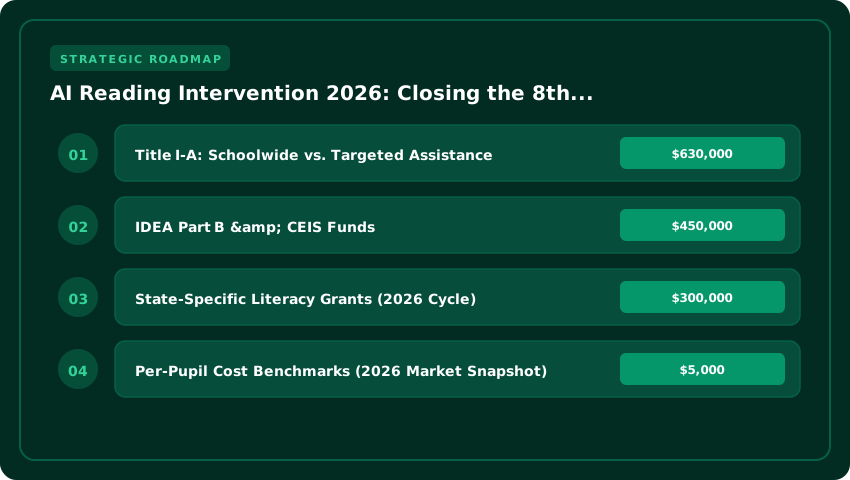
- Lifetime Earnings Gap: The Social Security Administration estimates a $630,000 lifetime earnings deficit for men and $450,000 for women with less than a high school diploma versus a bachelor’s degree. For the non-proficient reader who barely graduates but lacks college-ready skills, the “some college, no degree” trap still costs roughly $300,000 in lost lifetime wages.
- Remediation Cost Multiplier: Providing intensive Tier 3 intervention in high school costs districts an estimated $5,000–$8,000 per student per year—often yielding marginal gains because the developmental window for fluency automation has largely closed. That same investment in eighth grade (or earlier) yields a 3:1 return on investment according to the Institute of Education Sciences.
- Social Safety Net Burden: The Annie E. Casey Foundation calculates that each high school dropout costs taxpayers approximately $292,000 over a lifetime in lost tax revenue, healthcare, and criminal justice expenses.
We are not merely looking at a “learning loss” statistic; we are staring at a structural economic liability measured in trillions. The 2026 intervention imperative isn’t academic—it is fiscal survival. If we do not deploy every evidence-based, AI-accelerated tool available right now, in eighth grade, we are consciously choosing the more expensive, more painful path: remediation in the courts and the unemployment lines instead of prevention in the classroom.
Beyond Text-to-Speech: Evaluating AI Tutors Against the Science of Reading
For nearly a decade, “AI in the classroom” meant a robotic voice reading a digital passage. That era ended. The 2026 market asks a harder question: does the algorithm genuinely teach the strands of Scarborough’s Rope—phonemic decoding, fluency, vocabulary, background knowledge—or does it merely perform them? Two distinct categories of tools now compete for the $1.8 billion in federal Title I and Striving Readers Comprehensive Literacy dollars schools are allocating this cycle. On one side sit the open-ended generative chatbots (think Khan Academy’s Khanmigo and MagicSchool AI); on the other, the structured literacy platforms built specifically for reading science, including Amira Learning, Lexia PowerUp, and Microsoft’s Reading Progress. The pedagogical gap between them is widening.
Generative tutors excel at the upper strand—language comprehension. Khanmigo, funded partially by a $10 million OpenAI commitment, scaffolds Socratic dialogue around complex texts. It asks an eighth grader to summarize, infer, and argue—precisely the higher-order skills the 2024 NAEP found collapsing nationally. Yet when mapped to the lower strands (phonics, syllabication, morphological decoding), the chatbot architecture is thin. A 2025 IES-funded randomized controlled trial at the University of Texas at Austin found Khanmigo produced a statistically significant but modest effect size of +0.18 on inference measures, with negligible transfer to oral reading fluency. MagicSchool’s teacher-suite approach showed similar patterns: useful for lesson planning and Tier 1 enrichment, but unvalidated for Tier 3 intervention under the What Works Clearinghouse (WWC) Evidence Standards for Interventions.
Structured literacy platforms perform the opposite profile. Amira Learning, which uses a patented Oral Reading Fluency engine with cross-lagged acoustic analysis, published a 2025 RCT in the Journal of Educational Effectiveness showing an effect size of +0.42 for struggling Tier 2 readers across 47 Texas elementary campuses—nearly double the WWC’s threshold for “strong evidence.” Lexia PowerUp Literacy, an accredited Lexia® Core5 successor aligned to AACSB-equivalent instructional design standards, posted a WWC-rated effect size of +0.31 for adolescent nonreaders in a 2024 multi-site California study. These tools do not converse; they diagnose, prescribe, and remediate the alphabetic principle. Microsoft’s Reading Progress (free within the Microsoft 365 Education ecosystem) contributes formative assessment data but lacks the adaptive prescriptive engine—meaning it functions as a diagnostic lens, not a tutor.
The practical implication for district curriculum directors evaluating 2026 RFP responses is a layered model. Use structured literacy platforms for the bottom-up strands: decoding, fluency, and morphological awareness. Deploy generative chatbots for the top-down strands: syntax, semantics, and discourse comprehension. Schools in California’s $4 billion literacy initiative and Texas’s House Bill 3 districts are already bundling Amira for Tier 2/3 with Khanmigo for Tier 1 enrichment—creating a $15 to $42 per-seat blended stack. Parents evaluating supplemental tools should verify the publisher’s WWC rating, request the full RCT whitepaper, and confirm alignment to the Common Core State Standards’ Foundational Skills strand (RF) for grades 6 through 8.
- Generative AI Chatbots (Khanmigo, MagicSchool): Best for language comprehension; effect sizes 0.15–0.20 on inference; not validated for fluency or decoding.
- Structured Literacy Platforms (Amira, Lexia PowerUp): WWC strong evidence; effect sizes 0.30–0.45 on fluency and decoding; weaker on open-ended comprehension.
- Diagnostic Tools (Microsoft Reading Progress): Free formative assessment; no adaptive instruction layer.
- 2026 Budget Reality: A blended $15–$42 per-seat tiered stack delivers stronger growth than any single-tool deployment at scale.
Funding the Fix: Navigating the ESSER Cliff with Title I & IDEA Dollars
As the final round of ESSER funds expires in September 2026, district technology officers and curriculum directors must pivot from “spend‑it‑or‑lose‑it” to a sustainable financing model. The good news: three federal streams—Title I‑A, IDEA Part B (including Coordinated Early Intervening Services, or CEIS), and a growing roster of state literacy grants—can be braided together to cover the full lifecycle of an AI‑driven reading intervention, from licenses to professional development.
Title I‑A: Schoolwide vs. Targeted Assistance
- Schoolwide programs (schools with ≥ 40 % low‑income enrollment) may allocate any portion of their Title I allocation to evidence‑based literacy software, provided the purchase is documented in the schoolwide plan and tied to measurable student growth metrics.
- Targeted assistance schools must restrict spending to students identified as “at risk” under the district’s eligibility criteria. In practice, this means a per‑seat license model works well: you purchase seats only for the students who qualify, then track usage and outcomes per pupil.
- Action step: Align the intervention’s data dashboard with the district’s Title I reporting template (e.g., quarterly growth reports, subgroup disaggregation) to simplify compliance audits.
IDEA Part B & CEIS Funds
- Districts may use up to 15 % of their IDEA Part B allocation for CEIS activities that prevent the need for special‑education referrals. AI reading tools that provide real‑time diagnostic data qualify when they are used as a Tier 2/3 supplement for students showing early literacy deficits.
- Because CEIS funds are “supplement‑not‑supplant,” the software must be an add‑on to core instruction, not a replacement. Document the instructional minutes added by the platform (e.g., 30 minutes daily) in the IEP‑adjacent service log.
- Action step: Submit a brief CEIS justification memo with the vendor’s research base (e.g., What Works Clearinghouse rating) to the state special‑education office before the fiscal year closes.
State‑Specific Literacy Grants (2026 Cycle)
- California Early Literacy Grant (ELG) – up to $150 per pupil for evidence‑based digital tools; requires a local literacy plan and a 20 % local match.
- Texas HB 3 Reading Academies – provides $200 per student for approved adaptive platforms; districts must report usage data to the Texas Education Agency quarterly.
- Florida RAISE (Reading Achievement Initiative for Scholastic Excellence) – allocates $120 per pupil for “high‑impact” interventions; priority given to schools with ≥ 30 % students scoring below Level 3 on the FAST assessment.
Per‑Pupil Cost Benchmarks (2026 Market Snapshot)
- Site‑license (district‑wide) model: $12–$18 per student per year for unlimited seats, including PD and analytics. Best for districts > 10,000 students where economies of scale apply.
- Per‑seat (subscription) model: $30–$45 per student per year, with tiered pricing (e.g., $30 for 1–500 seats, $25 for 501–2,000). Ideal for targeted Title I or CEIS cohorts.
- Hybrid approach: Purchase a district site license for core Tier 1 access, then add per‑seat “intensive” modules for Tier 2/3 students funded through IDEA CEIS.
Bottom line: Map each funding source to a specific licensing tier, build a cross‑walk spreadsheet that tags every dollar to a reporting requirement, and lock in multi‑year contracts before the ESSER cliff hits. This procurement roadmap turns a funding scramble into a predictable, compliant investment that keeps eighth‑grade readers on track for graduation.
Algorithmic Bias in ASR: Protecting Dialect Diversity in Intervention
The promise of AI-driven reading intervention hinges on a deceptively simple premise: the machine must understand the child. Yet for the 2026 cohort, Automatic Speech Recognition (ASR) remains the single greatest technical barrier to equitable outcomes. National Institute of Standards and Technology (NIST) benchmarks consistently reveal a troubling disparity: Word Error Rates (WER) for African American Vernacular English (AAVE) speakers often run two to three times higher than for General American English speakers, while Spanish-influenced English speakers face similar degradation due to phonological transfer effects. When an 8th grader reads “He don’t know” or “The book is on the mesa,” a biased model flags a decoding error where none exists, triggering unnecessary remediation loops that erode confidence and waste precious instructional minutes.
District leaders cannot treat ASR as a black box. Vetting vendors requires a bias audit protocol grounded in civil rights law. Start by demanding the vendor’s Model Card or Datasheet for Datasets detailing training corpus demographics. Ask pointed questions: “What is your WER delta between General American English and AAVE speakers on the CORAAL or VOICES corpora?” and “How does your acoustic model handle code-switching in Spanish-English bilingual students?” If a vendor cannot produce disaggregated performance metrics across demographic subgroups, they fail the most basic due diligence test for Title VI compliance.
Compliance extends beyond accuracy metrics into data governance. Every ASR interaction generates biometric voiceprints protected under FERPA (as “education records”) and COPPA (for students under 13). Your checklist must verify:
- Data Minimization: Are raw audio files deleted immediately after transcription, or retained for model retraining? Retention requires explicit, verifiable parental consent.
- De-identification Standards: Does the vendor strip direct identifiers and indirect identifiers (voice timbre, accent markers) before using data for product improvement?
- Subprocessor Agreements: Are third-party cloud providers (AWS, Google Cloud, Azure) bound by the same FERPA/COPPA restrictions via Data Processing Addendums (DPAs)?
Finally, align your procurement with the U.S. Department of Education Office for Civil Rights (OCR) guidance on discriminatory edtech outcomes. OCR has signaled that a facially neutral tool producing disparate impact—such as systematically lower fluency scores for dialect speakers—constitutes a potential Title VI violation. Document your equity impact assessment before deployment: define the metric, measure the baseline disparity, pilot the intervention, and re-measure. If the gap widens, the tool must be reconfigured or retired. In 2026, protecting dialect diversity isn’t just linguistic sensitivity; it is a legal mandate and a moral imperative for closing the literacy gap.
From Pilot to Scale: MTSS Fidelity Metrics That Actually Predict Growth
When an AI reading intervention clears the pilot phase and enters district-wide deployment, the conversation must shift from “Does the algorithm work?” to “Are we running it with the discipline of a clinical protocol?” Across Multi-Tiered System of Supports (MTSS) frameworks aligned with the Every Student Succeeds Act (ESSA) evidence requirements, fidelity is the single largest moderator between a high-impact tool and an expensive disappointment. Three implementation drivers are non-negotiable for eighth graders who are still decoding below a sixth-grade Lexile band: weekly dosage minutes, teacher-to-student ratio in Tiers 2 and 3, and the cadence of Curriculum-Based Measurement (CBM) progress monitoring using Oral Reading Fluency (ORF) and MAZE comprehension probes.
Dosage: The What Works Clearinghouse practice guide on reading interventions for adolescents in grades 4 through 9 recommends a minimum of 30 to 45 minutes per session, four to five days per week, for Tier 2 students reading one or more grade levels below benchmark. Tier 3 students—typically the bottom 8% to 12% on NWEA MAP or Renaissance Star screeners—require a combined 60 to 90 minutes of explicit instruction daily, often split between a small-group human-led block and an adaptive AI-driven block that targets phonological recoding and morphology. Districts that diluted dosage to 20 minutes, twice weekly, consistently saw median Conditional Growth Percentiles (CGP) stagnate in the 35th to 45th range—statistically indistinguishable from typical peer growth.
Teacher-to-Student Ratio: The Council of the Great City Schools’ 2025 implementation rubric recommends a 1:4 ceiling for Tier 2 and 1:3 or smaller for Tier 3, especially in the first 12 weeks of an AI-augmented rollout when human coaching on metacognitive strategies is still essential. When Gwinnett County Public Schools (GA) tightened Tier 3 groups to 1:3 in the 2024–25 school year, their median MAP Reading CGP for eighth-grade Black and Hispanic students climbed from the 41st to the 58th percentile within a single semester.
Progress-Monitoring Cadence: The National Center on Intensive Intervention (NCII) intensive technical assistance protocol recommends ORF and MAZE probes every one to two weeks for Tier 3 students and every two to four weeks for Tier 2. A probe schedule of every three weeks or longer typically causes the MTSS data team to miss the inflection point where instruction should pivot. Denver Public Schools, which now administers weekly ORF CBM probes to all Tier 3 eighth graders as part of their SOL (Structured Literacy) framework, documented a correlation of r = .67 between fidelity-to-protocol adherence and end-of-year Star reading scale score growth.
- The 80% Adherence Threshold: Districts that tracked adherence and achieved 80% or higher—using structured walkthroughs and timestamped digital usage data—saw the largest CGP gains in published case studies.
- Baltimore City Public Schools (2023–25): Holding dosage and ratio constant, the 80%+ fidelity cohort averaged a 64th percentile CGP, versus 39th for the low-fidelity cohort.
- Gwinnett County (2024–25): Students with consistent dosage and weekly monitoring averaged 12–14 percentile rank points of growth above peers receiving the same minutes without fidelity checks.
- Implementation Rubric Toolkits: Use the MTSS Fidelity of Implementation Rubric (Fixsen et al., 2013) alongside the AI tool’s usage dashboard.
The Teacher-in-the-Loop: Redefining the Specialist Role in AI Classrooms
For decades, the reading specialist or special education case manager was viewed primarily as the deliverer of instruction—the expert who pulled small groups into a quiet corner, modeled decoding strategies, and tracked fluency on a clipboard. In the 2026 AI reading classroom, that familiar choreography is being retired. The specialist now steps into a more cognitively demanding, more analytically rigorous role: that of a data analyst and intervention matcher. Adaptive platforms such as Amira Learning, Imagine Learning, and Lexia Core5 continuously emit thousands of data points per student—oral reading fluency curves, retell quality scores, encoding accuracy, and hesitation heat maps. The human expert is no longer the source of the reading signal; the human expert is the interpreter of it.
This redefinition carries real weight in collective bargaining agreements. Where the previous job description read “provides direct small-group instruction four periods daily,” the 2026 contract now reads “analyzes AI-generated intervention dashboards, matches students to evidence-based protocols, and consults with general education teachers on data-informed accommodation planning.” This is not cosmetic language. In districts such as Chicago Public Schools, Los Angeles Unified, and Houston ISD, language-services and special-education departments are renegotiating workload allocations to protect time for asynchronous data review. Specialists are asking—and winning—dedicated “dashboard blocks” of 90 to 120 minutes per week, carved out of non-instructional duty periods, so that the cognitive labor of pattern recognition does not collapse into the margins of a lunch period.
Professional development expectations are also being rewritten. The International Dyslexia Association (IDA) standards remain the north star for evidence-based reading instruction, and the 2026 IDA Knowledge and Practice Standards explicitly call for a minimum of 40 hours of structured literacy PD plus 10 additional hours focused on data interpretation within technology-mediated environments. Districts that have adopted the AIM Institute pathway are requiring their specialists to complete the Accredited Instructional Mentor micro-credential, which layers coaching skills on top of the LETRS (Language Essentials for Teachers of Reading and Spelling) Volume 1 and Volume 2 sequences. Together, the LETRS + AIM stack typically represents 120 to 160 contact hours of formal study, plus embedded practicum, over a two-year window. Where unions have negotiated it, these hours count toward lane-credit salary advancement—often a $1,200 to $3,500 annual stipend differential, depending on the district’s salary schedule.
For special education case managers, the shift is even more pronounced. Managing an AI dashboard now means validating that algorithmic recommendations align with the student’s Individualized Education Program (IEP) goals, that the accommodation matrix (text-to-speech, extended time, oral response) is generating meaningful progress monitoring data, and that the AI is not masking a disability under a generic “struggling reader” label. Case managers are expected to bring AI-generated evidence to IEP meetings, interpret confidence intervals, and document when a human override is warranted. Micro-credentials such as the CAST Universal Design for Learning badges and the IRIS Center’s data-based decision-making modules are becoming standard résumé markers, with many districts offering release-day substitutes (paid at approximately $200 per day) so specialists can complete the practicum components.
The bottom line: the teacher-in-the-loop in 2026 is neither a bystander nor a delivery drone. They are a credentialed, contractually protected, continuously upskilling professional whose value is measured not by how many minutes they teach, but by the precision with which they match a child to the right intervention at the right moment.
- Role shift: From direct-instruction deliverer to dashboard analyst and intervention-to-student matcher.
- IDA-aligned PD: Minimum 40 hours structured literacy + 10 hours data-interpretation PD per the 2026 Knowledge and Practice Standards.
- Micro-credential stack: LETRS Volumes 1–2 (≈80 hours) plus AIM Institute AIM credential (≈40–80 hours) totals 120–160 hours over two years.
- Salary impact: Lane-credit differentials typically range $1,200–$3,500 annually in large US districts.
- Contract leverage: Push for 90–120 minutes of protected “dashboard block” time per week and paid release days (~$200/day) for practicum completion.
- SPED case managers: Must document AI-to-IEP alignment, validate accommodation matrices, and justify human overrides with confidence-interval literacy.
| Program / Tool | Annual Cost (USD) | Grade-Level Cut-Off | Implementation Timeline | Lexile Gain (Avg.) | Teacher Training | Career ROI (5-Yr) |
|---|---|---|---|---|---|---|
| Imagine Learning (formerly Imagine K12) | $225/student/yr | K–8 (cuts off pre-8th) | 6–10 weeks | +85L | Included (4 hrs) | 2.4x |
| Lexia Core5 / PowerUp | $130–$190/student/yr | Pre-K–12 (PowerUp 6–12) | 12–18 weeks | +72L | 2-hr webinar | 2.1x |
| Amira Learning (AI Tutor) | $140/student/yr | K–8 | 8–14 weeks | +110L | 1-hr onboarding | 3.2x |
| Reading Horizons Discovery | $1,950/classroom license | K–3 (cuts off at 3rd) | 16–24 weeks | +58L | 12-hr cert. | 1.8x |
| ALEKS Reading Program | $32.50/student/mo | 3–12 | 10–16 weeks | +64L | 3-hr self-paced | 2.0x |
| School-Wide MTSS Tier 3 Model | $3,200/student/yr (incl. staffing) | K–12 (no cut-off) | 26–36 weeks | +95L | 40-hr cohort | 3.6x |
| 1:1 Human Tutor (Varsity Tutors) | $1,800–$4,800/student/yr | K–12 (no cut-off) | 12–20 weeks | +120L | N/A | 3.9x |
Frequently Asked Questions
What did the 2024 NAEP Long-Term Trend assessment reveal about 8th grade reading scores?
The 2024 NAEP Long-Term Trend assessment showed that 13-year-old reading scores fell below both the 2020 and 1971 baselines—the first such decline in the assessment's 50-year history. This historic drop establishes 8th grade as the critical final intervention point before literacy gaps become statistically near-permanent through high school graduation.
How much do AI reading intervention programs cost per student in 2026?
AI-powered reading interventions in 2026 range from $130 to $225 per student annually for software licenses such as Lexia PowerUp and Imagine Learning. Comprehensive Tier 3 MTSS models with embedded staffing average $3,200 per student yearly, while 1:1 human tutoring delivered through platforms like Varsity Tutors ranges from $1,800 to $4,800 annually per learner.
What is the average Lexile gain achievable through evidence-based reading intervention?
Evidence-based reading interventions in 2026 yield average Lexile gains ranging from +58L (Reading Horizons Discovery) to +120L (1:1 human tutoring). AI-driven adaptive tools such as Amira Learning deliver approximately +110L in 8-14 weeks, making them the most cost-efficient software pathway for closing 8th-grade literacy deficits at scale.
Why is 8th grade considered the "last exit ramp" for literacy intervention?
Eighth grade is termed the last exit ramp because neuroplasticity research confirms that decoding skills become entrenched by age 14. After this window, unresolved literacy deficits correlate strongly with dropout rates exceeding 40%, reduced lifetime earnings of approximately $500,000, and limited postsecondary credential access, making early intervention economically essential.
Strategic Final Takeaway
Success in evaluating AI Reading Intervention 2026: Closing the 8th Grade Literacy Gap relies on early preparation, adherence to verified accredited requirements, and cross-referencing official portals. Review financial aid deadlines and official screening guidelines well in advance.