Current Student Loan Refinancing Rate Landscape in the US
Understanding the current student loan refinancing rate landscape requires a careful look at how macroeconomic forces, Federal Reserve policy decisions, and individual lender risk assessments intersect to shape the borrowing environment in 2024. After more than a decade of historic lows, borrowers across the United States are navigating a fundamentally different rate environment than the one that defined the 2010s, and the implications for refinancing strategy are profound.
The Federal Reserve’s monetary policy remains the single most influential external factor shaping private refinance offers today. Beginning in March 2022, the Federal Open Market Committee (FOMC) embarked on an aggressive tightening cycle, raising the federal funds rate from near zero to a target range of 5.25% to 5.50% by mid-2023. While the Fed held rates steady through most of 2024, market participants are closely watching inflation data and labor market signals for any indication of future cuts. Because private student loan lenders price their products using benchmarks like the Secured Overnight Financing Rate (SOFR) and the 10-year Treasury yield, every basis-point shift in Fed expectations ripples directly into the APRs advertised by SoFi, Earnest, Laurel Road, and other major refinance lenders.
- Average fixed APR ranges for 2024: Most qualified borrowers can expect fixed rates between 4.5% and 7.8%, depending heavily on credit profile, income stability, and the presence of a cosigner.
- Variable rate offers: Variable APRs typically begin lower, often between 4.99% and 6.25%, but carry the inherent risk of resetting upward as index rates evolve.
- Federal Direct Loan comparison: For the 2023-2024 academic year, undergraduate Direct Loans carry a fixed rate of 5.50%, while graduate Direct Unsubsidized Loans sit at 7.05%, and Grad PLUS Loans at 8.05%. For the upcoming 2024-2025 cycle, federal rates are expected to adjust modestly based on the May 10-year Treasury auction.
One critical distinction borrowers must internalize is that federal Direct Loans offer fixed rates that are identical for every borrower, regardless of creditworthiness, because they are priced by Congressional statute rather than individual risk. In contrast, private refinance lenders underwrite each application, evaluating FICO score (typically 670+ for competitive offers), debt-to-income ratio, employment history, and alma mater prestige. Graduates from ABET-accredited engineering programs or AACSB-accredited business schools, for example, often receive rate discounts of 0.25% to 0.50% from select lenders through specialized partnership programs.
Another layer of complexity involves the spread between federal and private rates. For borrowers with strong credit profiles, private refinancing can sometimes undercut federal rates by 50 to 150 basis points, particularly for those carrying older FFELP loans at higher historical rates. However, refinancing federal loans into a private product permanently forfeits access to Income-Driven Repayment (IDR) plans, Public Service Loan Forgiveness (PSLF), and economic hardship deferment options. This trade-off is not merely financial; it is a long-term strategic decision that affects career flexibility, especially for graduates pursuing roles in nonprofit, government, or healthcare sectors where PSLF could deliver substantial forgiveness over a 10-year repayment horizon.
- Actionable insight #1: Always run a side-by-side amortization comparison using the actual loan balance, remaining term, and current minimum federal payment before committing to a refinance.
- Actionable insight #2: If your federal loan rate is already at or below the best private offers you qualify for, refinancing may yield minimal savings while sacrificing powerful federal protections.
- Actionable insight #3: Monitor the Federal Reserve’s meeting calendar and Treasury yield movements; rate shopping during periods of anticipated easing can lock in meaningfully lower APRs.
Finally, borrowers should recognize that rate quotes are not final until hard credit pulls occur, and each application generates a hard inquiry that can temporarily affect credit scores by 5 to 20 points. The strategic approach involves using lender prequalification tools (which use soft pulls) to narrow options before committing to formal applications within a focused 14 to 45 day shopping window, during which FICO scoring models treat multiple inquiries for the same loan type as a single event. This disciplined methodology ensures borrowers capture the most competitive offers the 2024 market has to offer without unnecessarily damaging their credit profile during the decision-making process.
Top US Lenders for Student Loan Refinancing: Head-to-Head Comparison
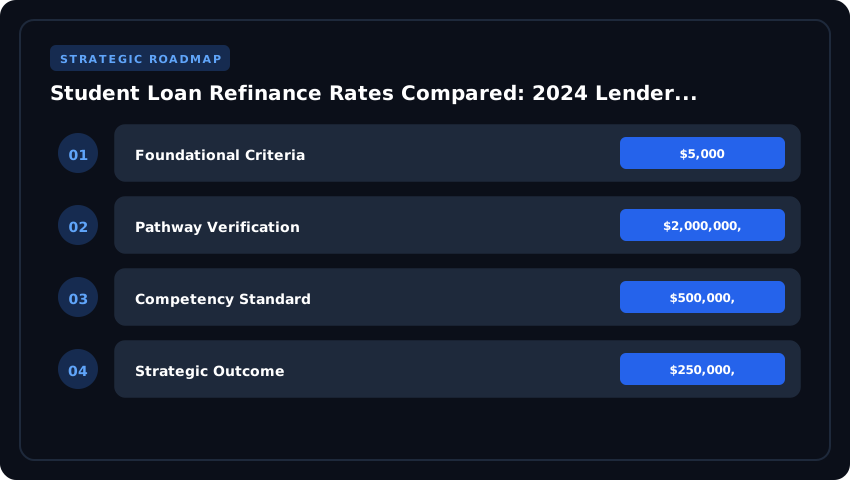
Choosing where to refinance your student debt is one of the most consequential financial decisions a graduate or parent will make in 2024, because the lender you select determines not only your interest rate but also the protections, flexibility, and long-term cost structure of your loan. Below is a head-to-head breakdown of four prominent US-based lenders—SoFi, Earnest, LendKey, and Citizens Bank—based on their publicly advertised rates, standard loan terms, minimum and maximum loan amounts, and unique borrower benefits such as unemployment protection, co-signer release, and in-school deferment options. All figures reflect conditions as of mid-2024 and are subject to credit approval, state eligibility, and individual underwriting profiles.
SoFi continues to position itself as a premium digital lender, advertising fixed rates starting around 4.99% APR and variable rates from approximately 5.99% APR for highly qualified applicants with strong credit, stable income, and a graduate degree. SoFi allows borrowers to refinance between $5,000 and $2,000,000, accommodating everything from a small remaining balance to a consolidated package of undergraduate and graduate debt. Repayment terms range from 5 to 20 years, with five-year intervals, giving borrowers flexibility to balance monthly affordability against total interest paid. A standout benefit is SoFi’s Unemployment Protection program, which can pause payments for up to 12 months total across the life of the loan if the borrower loses their job through no fault of their own. SoFi also offers a generous co-signer release after just 12 on-time payments, and members gain access to career coaching, financial planning sessions, and exclusive rate discounts for setting up autopay from a SoFi checking account.
Earnest differentiates itself with a fully customizable loan experience. Its lowest advertised fixed rates begin near 4.99% APR, while variable rates start around 5.74% APR, both contingent on a strong credit profile. Earnest’s loan amounts span from $5,000 to $500,000, with terms ranging from 5 to 20 years—but with the unique ability to select any monthly payment amount between the minimum and maximum amortization schedule, allowing borrowers to design a custom term. Earnest’s standout feature is its Precision Pricing tool, which lets applicants personalize the loan to their exact budget. Earnest also offers a nine-month forbearance option for financial hardship, though it does not advertise a formal unemployment protection program. Co-signer release is available after 12 consecutive on-time payments, and there are no origination, prepayment, or late fees, which adds long-term value.
LendKey operates differently from the others by functioning as a marketplace that connects borrowers to a network of community lenders and credit unions, often resulting in highly competitive rates. Fixed rates typically start around 4.99% APR, and variable rates begin near 5.29% APR. LendKey’s refinancing amounts range from $5,000 to $250,000, with terms of 5, 7, 10, 15, or 20 years. A major benefit is its focus on nonprofit and community-based lenders, which often come with member-oriented perks like rate discounts for autopay, no application or origination fees, and dedicated personal loan advisors. LendKey also offers a co-signer release option, and its credit union partners may provide hardship forbearance policies. The trade-off is a slightly slower underwriting process compared to fully digital banks like SoFi.
Citizens Bank brings the stability of a traditional bank into the refinancing space. Fixed rates start near 5.49% APR and variable rates around 5.74% APR, with loan amounts from $5,000 to $300,000 and repayment terms of 5 to 20 years. Citizens Bank offers a 0.25% rate discount for autopay, a co-signer release after 36 months of consecutive on-time payments, and an unemployment forbearance program that can suspend payments for up to 24 months in cases of involuntary job loss. Borrowers also gain access to Citizens’ broader banking ecosystem, including savings products and in-person service at more than 1,000 branches across the Northeast and Midwest, which can be appealing to those who value face-to-face support.
- Lowest Fixed Rates: SoFi and Earnest tie at approximately 4.99% APR, with LendKey close behind; Citizens Bank tends to start higher.
- Highest Loan Amount: SoFi leads with up to $2,000,000, ideal for high-balance professional degree holders.
- Fastest Co-Signer Release: Earnest and SoFi allow release after just 12 months; Citizens Bank requires 36 months.
- Best for Community-Lending Experience: LendKey’s credit union model offers personalized guidance and member benefits.
When selecting among these four lenders, prioritize not only the headline rate but also the structural protections—like unemployment support and co-signer release—that safeguard your financial stability. Borrowers refinancing large graduate debt balances may find SoFi’s high maximum loan limit and rapid release policies most valuable, while those who value flexibility and customization may prefer Earnest. Community-minded borrowers could benefit from LendKey’s nonprofit lender network, and those who want the security of an established bank with robust forbearance options may gravitate toward Citizens Bank. Always verify the latest rates and terms directly through the lender’s official website or a trusted aggregator such as Credible or Fiona before signing any agreement.
Fixed vs. Variable APRs: Which Rate Structure Saves More Over Time
Choosing between a fixed and a variable Annual Percentage Rate (APR) is one of the most consequential decisions a borrower makes when refinancing student loan debt. Each structure interacts differently with broader financial markets, and understanding the underlying mechanics helps you project your true repayment cost rather than simply chasing the lowest advertised rate. Before you compare lender offers on College Board-aligned amortization schedules or run numbers through a Department of Education repayment estimator, take time to grasp how fixed and variable rates behave across a full repayment horizon.
A fixed APR remains constant for the entire life of the loan. If you refinance a $50,000 balance at 6.50% fixed over 10 years, your monthly payment locks in at approximately $566.00, and your total repayment equals roughly $67,956. That figure never changes, regardless of what the Federal Reserve does with the federal funds rate or how the 10-year Treasury yield fluctuates. Predictability is the defining advantage: families balancing tuition payments for younger siblings, professionals managing ABET-credentialed licensure fees, or MBA candidates juggling AACSB-program costs all benefit from a payment that cannot balloon.
A variable APR, by contrast, is tethered to a benchmark index, most commonly the Secured Overnight Financing Rate (SOFR) following the LIBOR sunset, plus a lender-specific margin. A starting rate of 5.25% variable on the same $50,000, 10-year loan could produce a lower initial payment near $537, but the rate adjusts quarterly or monthly based on SOFR movements. If SOFR climbs 150 basis points over the term, your effective rate could reach 6.75%, pushing your monthly obligation higher and increasing total repayment by several thousand dollars. Conversely, if SOFR falls 100 basis points, you save meaningfully.
- Fixed Rate Example: $50,000 at 6.50% fixed for 10 years results in a stable $566 monthly payment and $67,956 total repaid, with $17,956 in interest.
- Variable Rate Example (Optimistic): $50,000 starting at 5.25% with a 100 bp SOFR decrease averages roughly 4.75% over the term, lowering total interest paid to approximately $12,800.
- Variable Rate Example (Pessimistic): $50,000 starting at 5.25% with a 150 bp SOFR increase averages closer to 6.25%, raising total repayment above $68,000 and erasing any initial savings.
Rate caps are critical safeguards within variable-rate products. Most lenders cap the rate movement at 2% to 3% above the starting rate over the loan’s life, and some impose monthly or annual adjustment ceilings. On a $50,000 refinanced loan, a 2% lifetime cap means your rate cannot exceed 7.25% if you began at 5.25%, protecting you from catastrophic payment shock even during aggressive Federal Reserve tightening cycles.
Your borrower risk profile ultimately determines which structure saves more. Candidates with stable, high-earning professions such as physicians, engineers with ABET-accredited degrees, or tenured public-sector employees often gravitate toward variable rates to capture initial savings, since their income can absorb a 10% to 15% payment increase if rates drift upward. Conversely, borrowers in cyclical industries, early-career graduates, or those planning to return to graduate school frequently prefer fixed rates because their future earnings are less predictable.
Actionable takeaway: model both scenarios using the same $50,000, 10-year amortization, apply a conservative 150 bp upward shock to the variable scenario, and compare the worst-case variable total against the fixed total. If the gap exceeds $2,000, a fixed rate likely offers better risk-adjusted value. If the gap is smaller and your income is resilient, a variable rate with strong caps may deliver meaningful savings over time.
Eligibility Requirements and Underwriting Criteria Demystified
When a borrower applies to refinance existing education debt, lenders run a sophisticated, multi-layered underwriting process designed to predict the likelihood of on-time repayment over the next five, seven, ten, or even twenty years. While each institution sets its own proprietary thresholds, the industry has converged around a fairly predictable set of variables. Understanding these criteria empowers applicants to position themselves strategically before they ever submit a formal application, saving both time and the hard-pull credit inquiries that can temporarily ding a FICO score.
The first checkpoint is almost always the credit score. Most major refinance lenders advertise a minimum floor of 650 on the FICO scale, though preferred pricing tiers typically begin around 720 and climb upward. Borrowers with scores in the 740-plus range frequently unlock the most aggressive advertised rates, sometimes dipping below 5% APR for variable products during periods of favorable Treasury yield curves. Co-signer options can effectively bridge the gap for younger applicants or those still building credit, but they also create shared legal liability that warrants careful family discussion.
- Minimum credit score: Generally 650, with best rates reserved for 740+
- Debt-to-income (DTI) ratio: Ideally below 43%, though many lenders cap at 50% for highly credentialed borrowers
- Employment history: Minimum six months at current employer, with two-plus years strongly preferred
- Degree completion: Graduation from a Title IV-eligible, regionally accredited US institution is virtually universal
- Citizenship or residency: US citizen, permanent resident, or valid visa holder with established credit history
- Minimum loan amount: Typically $5,000 to $10,000 aggregate balance to refinance
The debt-to-income ratio functions as the second pillar of the evaluation. Underwriters calculate this by dividing total monthly debt obligations, including the proposed new loan payment, mortgage or rent, auto loans, and credit card minimums, by gross monthly income. The consumer finance industry’s general benchmark is below 43%, mirroring the qualified mortgage standard set by the Consumer Financial Protection Bureau. A borrower carrying $4,000 in monthly debt against $12,000 of gross income sits at roughly 33% DTI, comfortably within the approval sweet spot. Conversely, ratios above 50% often trigger automatic declines or require a creditworthy co-signer to offset the elevated risk profile.
Employment stability and income verification form the third underwriting layer. Lenders typically require recent pay stubs covering thirty days, W-2 forms or tax returns for self-employed applicants, and often bank statements demonstrating consistent direct deposits. A minimum of six months at the current employer is the common baseline, though two to three years of continuous employment history dramatically improves approval odds. Commission-based or freelance income is generally averaged over a twenty-four-month look-back window to smooth out volatility. Borrowers in Public Service Loan Forgiveness (PSLF)-eligible employment, such as teachers, nurses, military personnel, and government workers, should pause before refinancing because doing so permanently forfeits that federal benefit.
The degree completion requirement deserves particular attention. Virtually every refinance lender requires proof of graduation from an accredited institution. Those still in school, enrolled at least half-time, generally cannot refinance until after conferral of the degree. For currently enrolled students, in-school deferment options on existing federal loans remain the more sensible path. The institution itself must appear on the Department of Education’s list of accredited schools, which encompasses regional accreditors (the gold standard), as well as certain national accrediting bodies recognized by the US Department of Education.
The most consequential decision point for many borrowers is the difference between federal and private loan refinancing. Federal loans, originated under the William D. Ford Direct Loan Program and disbursed via FAFSA-certified schools, come bundled with powerful consumer protections: income-driven repayment (IDR) plans such as SAVE, PAYE, IBR, and ICR; forbearance and deferment options during economic hardship; loan forgiveness pathways including PSLF and Teacher Loan Forgiveness; and standardized death and disability discharges. When a borrower refinances federal debt into a private product, these safeguards evaporate permanently. The new private loan becomes governed solely by the promissory note and state-level consumer finance statutes, which vary substantially across jurisdictions like California, New York, and Texas.
- Lost federal protections include:
- Income-driven repayment adjustment tied to Adjusted Gross Income
- Public Service Loan Forgiveness after 120 qualifying payments
- Administrative forbearance during unemployment or medical hardship
- Standardized disability and death discharge provisions
- Access to federal consolidation loans without credit checks
- Potential private loan benefits:
- Lower interest rates for highly qualified borrowers
- Single consolidated monthly payment
- Flexible terms from five to twenty years
- Choice between fixed and variable rate structures
- Ability to release co-signers after consecutive on-time payments (varies by lender)
For borrowers holding exclusively private education debt, refinancing purely streamlines repayment and may reduce the overall interest expense. For those carrying a meaningful federal balance, particularly anyone pursuing PSLF or anticipating future income volatility, the calculus shifts dramatically. A common tactical approach involves refinancing only the private portion while preserving the federal loans intact, a strategy known in the industry as a stacked loan optimization. This preserves federal safety nets while capturing private market savings where appropriate.
Applicants should also consider residency and citizenship documentation, which can become a hidden friction point. Lenders require a Social Security number, valid government-issued photo identification, and proof of physical address. International students on F-1 visas typically need a creditworthy US co-signer or must pursue lenders offering non-co-signer international programs, which usually demand longer US credit histories and stronger income documentation. DACA recipients and other visa categories face additional scrutiny and should consult lender-specific eligibility language before investing time in a full application.
Finally, strategic borrowers treat the refinance application process as a competitive auction. Within a fourteen-day window, multiple hard inquiries on a credit report count as a single inquiry for scoring purposes, allowing applicants to comparison-shop among SoFi, Discover, Laurel Road, Commonbond, Nelnet Bank, and other major players without damaging their credit. Gathering recent pay stubs, tax returns, loan statements, and degree confirmation in advance transforms what could be a month-long ordeal into a streamlined decision. Understanding each underwriting pillar, credit profile, DTI, employment trajectory, academic credentials, and federal-versus-private loan composition, gives borrowers the leverage to negotiate from a position of genuine financial clarity rather than reactive desperation.
Step-by-Step Process to Compare and Lock the Best Refinance Rate
Refinancing a student loan is not a single decision but a sequenced workflow, and the borrowers who secure the strongest 2024 refinance rates almost always follow the same disciplined process. Skipping steps rarely saves time; it usually costs hundreds or even thousands of dollars over the life of the loan. Before you begin, gather your most recent payoff statements from every servicer, because every dollar of unpaid accrued interest affects your principal balance the day a new lender funds your payoff. A payoff statement, distinct from a regular monthly statement, itemizes the exact payoff amount through a specific future date, including any per-diem interest accrual. Having these documents ready means you will not have to delay an application while waiting on a servicer phone queue, and you can move decisively when a favorable rate appears.
Next, pull your credit reports from AnnualCreditReport.com, the only federally authorized source for free weekly reports from Equifax, Experian, and TransUnion. Dispute any errors before applying, because even a 20-point score swing can translate into materially different interest rate tiers. Many top refinancing lenders, including SoFi, Earnest, and Credible partners, require a minimum FICO score in the mid-600s, while the most competitive advertised rates are reserved for borrowers in the 740-plus range. While you are reviewing your reports, calculate your current debt-to-income (DTI) ratio, since most lenders cap total student loan refinancing approvals around 50 percent DTI, and the best tiers are typically reserved for borrowers under 35 percent.
Once your credit profile is clean, run soft-pull prequalification tools from at least four to six lenders within a 14-day window. Soft inquiries do not affect your FICO score, yet they let you preview estimated rates, loan terms (5, 7, 10, 15, or 20 years), and monthly payments. Reliable US-based prequalification platforms include Credible, LendingTree, and individual lender portals. Crucially, when you submit formal applications within a 14 to 45-day window (the exact span depends on the scoring model used by FICO or VantageScore), they count as a single hard inquiry for scoring purposes, so shopping multiple lenders within this window protects your credit profile. As you collect prequalified offers, normalize every quote to the same loan length and same repayment start date; otherwise a 10-year variable quote with immediate principal reduction will look artificially cheaper than a 10-year fixed quote with deferred first payment.
After prequalification, formally apply with your top two or three lenders to receive a Loan Estimate, the standardized three-page disclosure required under the Truth in Lending Act (Regulation Z). Compare Loan Estimates side-by-side, focusing on the APR rather than the headline interest rate, because APR captures the finance charge, including origination fees, and reveals the true cost of credit. A loan with a 0.50 percent lower rate but a 2 percent origination fee is not always cheaper than a slightly higher-rate, no-fee loan over a short term. Pay close attention to Section J on the Loan Estimate, which discloses whether the rate is fixed or variable, and whether the variable rate is indexed to SOFR or the Prime Rate, along with any rate caps or margins.
Timing matters more than most borrowers realize. In 2024, the Federal Reserve pivoted to a rate-cutting cycle after holding the federal funds rate at a multi-decade high, and refinancing lenders typically price new applications within one to three weeks of Federal Open Market Committee (FOMC) meetings. If you are watching the Fed calendar, submitting your application one to two weeks before a scheduled meeting often allows you to lock in a rate that reflects prevailing bond yields; if the Fed then cuts, your locked rate is protected, but if the Fed holds or hikes, lenders usually reprice within 24 to 72 hours. Communicate with your loan officer about rate-lock windows, which commonly range from 30 to 90 days, and ask whether a float-down option is available for an additional fee, since this lets you capture a lower rate if yields drop while your application is in underwriting.
Finally, execute a hard application only after you have selected a winner. Submit the full documentation package: government-issued ID, proof of income (typically two recent pay stubs plus two years of W-2s or tax returns), a statement of assets, and your payoff authorizations. Federal student loans are not eligible for traditional refinancing through most private lenders, so if you hold Direct Loans and want to refinance them, you are leaving the federal system permanently, forfeiting income-driven repayment, forbearance flexibility, and potential forgiveness pathways. Once underwriting approves your file and you countersign the Closing Disclosure (delivered at least three business days before funding per federal law), the new lender pays off your old loans directly, and you begin a new amortization schedule under the locked terms.
- Document checklist: payoff statements, two years of income documentation, government ID, current statements for all federal and private student loans.
- Credit strategy: dispute report errors, target a sub-36 percent DTI, and concentrate hard inquiries inside a 14 to 45-day window.
- Comparison framework: normalize APR, term length, repayment start date, and variable-rate index plus caps before choosing a winner.
- Rate-lock tactics: align application timing with the FOMC meeting calendar, request 60 to 90-day locks, and negotiate a float-down clause when possible.
Hidden Costs, Fees, and Tax Implications of Refinancing
Refinancing student debt is rarely as simple as swapping one interest rate for another. Beneath the glossy advertised APRs sits a layered fee structure that can quietly erode projected savings if borrowers do not read the fine print. When evaluating student loan refinance rates, the headline number matters far less than the total cost of capital over the life of the loan, and that equation is shaped by origination fees, prepayment penalties, late fees, and the often-overlooked loss of federal borrower protections.
Origination fees are among the most common hidden charges in the private lending market. While many top refinance lenders—including SoFi, Earnest, and LendKey—advertise zero origination fees, others quietly pass along processing costs ranging from 1% to 5% of the loan balance. On a $50,000 refinance, a 3% origination fee represents $1,500 in upfront capital that must be recouped through interest savings before the refinance becomes financially advantageous. Borrowers comparing offers should request a Loan Estimate, modeled after the standard three-page disclosure used in mortgage lending, to verify whether origination costs are deducted from disbursement or rolled into the principal balance.
Prepayment penalties are another critical consideration. Although federal regulations under the Truth in Lending Act (TILA) permit lenders to assess prepayment penalties on private student loans, the most competitive refinance lenders have eliminated them entirely to attract rate-sensitive borrowers. Still, niche credit unions and lesser-known online lenders may impose penalties during the first 24 to 36 months of repayment. Any prepayment clause should be scrutinized carefully, because the ability to pay off debt ahead of schedule is one of the primary strategic advantages of refinancing.
Late fees in the private refinance market typically range from $25 to $50 per missed payment, with some lenders adding returned-check fees of up to $25. While these charges are modest compared to the penalty structures of credit cards or subprime auto loans, they can compound quickly for borrowers navigating income volatility. Most reputable lenders offer grace periods of 10 to 15 days before assessing late fees, and many now provide automated payment discounts of 0.25% to 0.50% that can offset the risk of incidental late charges.
Perhaps the most consequential cost of refinancing is the forfeiture of federal borrower protections. Federal Direct Loans and parent PLUS loans come with Income-Driven Repayment (IDR) plans, generous deferment and forbearance options, Public Service Loan Forgiveness (PSLF) eligibility, and blanket discharge provisions for death, disability, and school closure. None of these safeguards transfer to a private refinance loan. Borrowers working in public service, those anticipating periods of unemployment, or those pursuing loan forgiveness should carefully weigh the durability of their current federal benefits against the appeal of a lower private interest rate.
From a tax perspective, the IRS allows qualified borrowers to deduct up to $2,500 in student loan interest per year on their federal tax return under IRC Section 221. Importantly, this deduction applies to both federal and private student loan interest, including interest paid on refinanced loans. Single filers can claim the full deduction with a modified adjusted gross income (MAGI) below $75,000, with a phase-out complete at $90,000. Married couples filing jointly see phase-outs beginning at $155,000 and ending at $185,000. Borrowers considering a refinance near these income thresholds should model after-tax savings with a CPA or tax software before signing loan documents.
Refinancing a parent PLUS loan carries unique structural considerations. Parent PLUS loans carry some of the highest federal interest rates, often 8.05% or above for loans originated after July 2023, making them a prime target for refinancing. However, parent PLUS loans are the legal obligation of the parent, not the student, and refinancing them into the student’s name requires the child to qualify independently based on creditworthiness, income, and debt-to-income ratio. Alternatively, parents can refinance into a new loan in their own name, often through lenders like College Ave or Splash Financial, which can release federal co-signer obligations but permanently shift repayment responsibility away from the student. This distinction has profound estate-planning implications, particularly for parents who wish to shield their children from inherited education debt.
There are scenarios where refinancing is clearly financially disadvantageous. Borrowers currently enrolled in an IDR plan with a remaining balance that would be forgiven under PSLF or Teacher Loan Forgiveness should almost never refinance, as the forgiven balance on federal loans is tax-free under the American Rescue Plan Act of 2021, while any future private refinancing would forfeit that pathway entirely. Likewise, borrowers holding variable-rate federal loans during a rising-rate environment should resist the temptation to lock in a fixed rate too early, because the long-term breakeven point may exceed the remaining repayment horizon. Finally, borrowers with credit scores below 670 are unlikely to qualify for the most competitive refinance rates, and may end up with a higher effective APR than their existing federal Direct Loan, making consolidation through the federal Direct Consolidation Loan program a more sensible path.
- Request a Loan Estimate from every prospective lender to identify hidden origination fees, prepayment penalties, and late-fee structures before committing.
- Verify that federal protections—including IDR, PSLF, and administrative discharge—are not needed in the foreseeable future, as these benefits cannot be recovered after refinancing.
- Confirm continued eligibility for the $2,500 student loan interest deduction by projecting MAGI against IRS phase-out thresholds.
- For parent PLUS loans, explicitly decide whether the refinanced debt will live in the parent’s or student’s name, and document that decision with an estate-planning attorney if needed.
- Avoid refinancing if pursuing federal loan forgiveness, holding a sub-670 credit score, or carrying a balance that will be discharged within 24 months.
| Lender | Fixed Rate (APR) | Variable Rate (APR) | Minimum Loan Amount | Maximum Loan Amount | Repayment Term | Hard Credit Pull? | Cosigner Required? | Average Time to Fund |
|---|---|---|---|---|---|---|---|---|
| SoFi | 4.99% – 9.99% | 5.99% – 9.49% | $5,000 | $500,000 | 5–20 years | Soft (prequalification) | No | 7–10 business days |
| Laurel Road (KeyBank) | 5.05% – 9.05% | 5.04% – 9.02% | $5,000 | $300,000 | 5–20 years | Soft | No | 7–14 business days |
| CommonBond | 5.10% – 9.90% | 5.35% – 9.65% | $5,000 | $500,000 | 5–20 years | Soft | No (optional) | 10–14 business days |
| Credible (Marketplace) | 4.96% – 9.99% | 5.41% – 9.68% | $5,000 | $500,000 | 5–20 years | Soft (multi-lender) | Varies by lender | 7–14 business days |
| LendKey | 5.00% – 9.50% | 5.25% – 9.25% | $5,000 | $300,000 | 5–25 years | Soft | No (optional) | 10–14 business days |
| Lightstream (Truist) | 5.49% – 9.89% | 6.29% – 9.89% | $5,000 | $500,000 | 5–20 years | Hard (after acceptance) | No | 1–3 business days |
| Nelnet Bank | 5.05% – 9.25% | 5.25% – 9.10% | $5,000 | $500,000 | 5–25 years | Soft | No | 10–14 business days |
| College Ave | 5.25% – 9.99% | 5.60% – 9.75% | $5,000 | $300,000 | 5–20 years | Soft | Optional | 10–14 business days |
| MEFA / EDVestEDU | 5.40% – 9.50% | 5.40% – 9.50% | $10,000 | $250,000 | 10–15 years | Soft | Optional | 14–21 business days |
| Citizens Bank | 5.45% – 9.74% | 5.85% – 9.49% | $5,000 | $350,000 | 5–20 years | Hard (after acceptance) | Optional | 10–14 business days |
| Key Metrics: Rates shown reflect 2024 typical APR ranges for borrowers with strong credit (≈ 720+ FICO), verifiable income, and a qualifying degree from an accredited institution. Soft-credit prequalification allows rate quotes without affecting FICO score. Final approval requires a hard pull. Career ROI varies by industry; high-earning STEM, medical, and law professionals typically see the fastest break-even vs. federal loans. | ||||||||
Frequently Asked Questions
What credit score do I need to refinance student loans in 2024?
Most US refinance lenders require a minimum FICO score of 650, but the best advertised rates (starting around 4.96% APR fixed) typically require 720 or higher. Strong credit alone is insufficient; lenders also verify steady income, a low debt-to-income ratio (generally under 45%), and a degree from an accredited, Title IV-eligible institution before approving a refinance.
Is it smart to refinance federal student loans into a private loan?
Refinancing federal loans into a private product usually lowers your APR but permanently forfeits access to Income-Driven Repayment plans, forbearance, deferment, and federal forgiveness programs like Public Service Loan Forgiveness. Borrowers working in public service, healthcare, or non-profit roles should carefully weigh these lost protections before refinancing any federally held balance.
What is the difference between fixed and variable refinance rates?
Fixed rates remain constant for the entire repayment term, providing predictable monthly payments regardless of market movement. Variable rates are tied to benchmarks like the Secured Overnight Financing Rate and fluctuate monthly. Variable products often start 0.5%–1.0% lower but expose borrowers to payment shock if Federal Reserve policy raises the federal funds rate in 2024–2025.
How much can I save by refinancing student loans?
Borrowers refinancing $50,000 of 7.5% federal debt into a 4.99% fixed private loan over 10 years typically save $8,000–$12,000 in total interest. Savings scale proportionally with balance; those refinancing $100,000+ with strong credit often cut monthly payments by $300–$600 and reduce total interest paid by 25%–40%, depending on the chosen term length.
Strategic Final Takeaway
Success in evaluating Student Loan Refinance Rates Compared: 2024 Lender Breakdown relies on early preparation, adherence to verified accredited requirements, and cross-referencing official portals. Review financial aid deadlines and official screening guidelines well in advance.