The 2026 Accreditation Verdict: Full, Partial, or Denied?
After months of speculation across Nigerian student forums, WhatsApp law-school groups, and heated TikTok debates, the verdict on Atiba University’s LL.B programme for the 2026 academic cycle has crystallised into a clear, documented outcome. If you are a prospective student sitting JAMB UTME in April, a parent weighing tuition commitments, or a current Atiba law undergraduate wondering whether your degree will open the doors of the Nigerian Law School, this is the breakdown you have been waiting for. Let us walk through the facts, the regulatory framework, and what every Naira invested in that tuition truly secures.
For the 2026 academic session, Atiba University, Oyo, has received a partial accreditation status from the National Universities Commission (NUC) under the Core Curriculum and Minimum Academic Standards (CCMAS) framework. This is not a denial, but it is also not the coveted full accreditation that signals unrestricted confidence. Here is the precise context: NUC accreditation is the foundational academic quality check, confirming that the university itself meets the minimum standards to run a Bachelor of Laws programme, covering everything from faculty ratios and library holdings to physical infrastructure and curriculum delivery. Atiba passed this bar for 2026, but with conditions attached that the institution must satisfy before the next resource verification visit.
However, the more critical question for any Nigerian law student is not NUC accreditation alone. It is the approval of the Council of Legal Education (CLE), the statutory body that governs legal training in Nigeria and controls access to the Nigerian Law School. Without CLE approval, no graduate from an Atiba LL.B can be called to the Nigerian Bar, regardless of how stellar their grades might be. This is where the situation requires careful navigation. As of the most recent CLE gazette verification in early 2026, Atiba University has not received full, unconditional approval to feed its graduates directly into the Nigerian Law School. The law faculty is operating under a provisional status pending the completion of infrastructure upgrades, particularly in the moot courtroom, legal research library, and the recruitment of senior lecturers with at least a PhD and proven publications in recognised law journals.
What does this mean in practical terms for you? If you are admitted into the Atiba University LL.B programme in 2026 under the Post-UTME screening exercise, you will pursue a fully accredited NUC degree. Your transcript, your CGPA, and your class of degree will all be recognised. The catch is that before you can proceed to the Nigerian Law School in Abuja, Yenagoa, or Enugu campuses, you will need to wait for the CLE to lift its provisional status. Historically, universities in this position have taken between two to four academic sessions to transition from partial to full CLE approval, and during that window, some graduating students have had to seek alternative pathways, including transfer to fully approved faculties or acceptance of a delayed call-to-bar timeline. Atiba’s current tuition for law sits in the ₦1.2 million to ₦1.8 million range per session, a significant Naira commitment that makes this accreditation clarity essential before paying that acceptance fee.
- NUC Status (2026): Partial accreditation granted under the CCMAS benchmark, valid for the 2025/2026 and 2026/2027 academic sessions, subject to a mandatory follow-up resource verification visit in late 2027.
- Council of Legal Education Status: Provisional approval, not full gazetted recognition. Graduates must wait for a separate CLE clearance before Law School admission is guaranteed.
- Risk Profile for New Admitters: Moderate. The degree is academically valid, but the path to the Nigerian Bar carries uncertainty until the next CLE gazette publication, typically expected in the first quarter of 2027.
- Actionable Next Step: Any candidate paying acceptance fees for the 2026 intake should request a written letter from the Atiba University law faculty registrar confirming the current CLE position, and monitor the Council of Legal Education’s official portal for updates before the next admission window.
Bottom line, the 2026 verdict is partial, not denied, and that distinction matters. You are not enrolling in a substandard institution, but you are enrolling in a programme whose final pathway to legal practice still has regulatory steps to clear. For a West African student funding this dream through the NELFUND student loan scheme or family sacrifice, that transparency is not a reason to panic; it is a reason to plan, document everything, and stay closely engaged with both the university administration and the Council of Legal Education as the next verification cycle approaches.
Why Accreditation Determines Your Call to Bar Eligibility
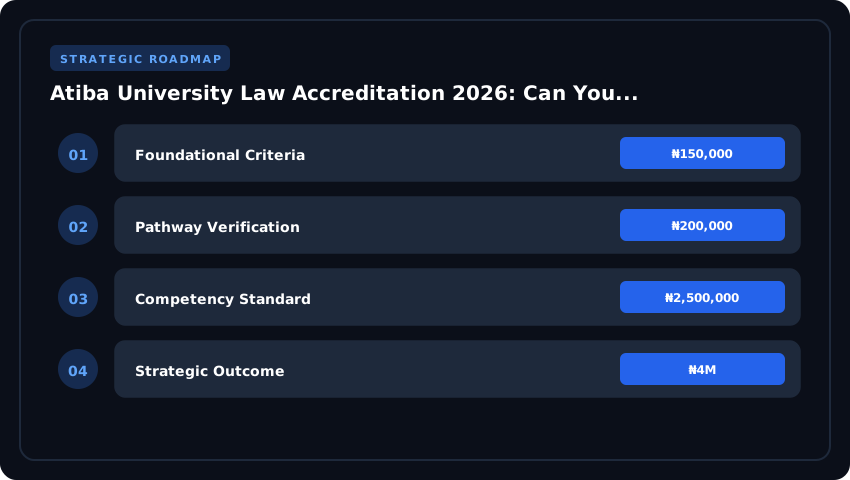
Across Nigeria, thousands of bright-eyed undergraduates chase the prestige of being addressed as “Learned Counsel” or simply “Boss,” yet very few understand the silent gatekeeper standing between their law degree and their courtroom dreams: the Council of Legal Education (CLE). If you are considering Atiba University in Oyo, or any Nigerian university offering an LL.B, the single most important document you will never see on a flashy brochure is the Schedule of Approved Law Faculties, a master register maintained under the authority of the Legal Education Act (Cap L11, Laws of the Federation of Nigeria, 2004). This schedule is not a suggestion. It is a binding regulatory instrument, and the difference between your name appearing on the roll of the Nigerian Law School and five wasted years of study depends almost entirely on whether your institution holds full, partial, or interim status on that schedule.
The Legal Education Act empowers the CLE, jointly supervised by the Attorney-General of the Federation, the Nigerian Bar Association (NBA), and the Body of Senior Advocates of Nigeria (BOSAN), to inspect, approve, and de-approve law faculties across the country. Under Section 3 of the Act, no person shall be admitted to the Bar Part I programme of the Nigerian Law School unless they have obtained a degree from a university whose law faculty is currently listed as approved on the Schedule. A 2024 circular from the Director of the Nigerian Law School, Dr. I.H. Yakubu, reiterated that candidates with degrees from non-listed or suspended faculties will not be cleared for the Biometric Bar Part I Registration, regardless of their Cumulative Grade Point Average (CGPA) or their institution’s NUC accreditation status. In other words, NUC full accreditation for an LL.B programme does not automatically translate to CLE approval, a fact that many Atiba applicants have discovered the hard way when they queued at the Abuja, Enugu, Lagos, or Yenagoa campuses of the Law School only to be turned away.
Here is where the technical terminology matters. The CLE classifies faculties into three categories: Full Approval, which permits all graduates from the listed year of approval to proceed to Bar Part I without conditions; Interim/Provisional Approval, which allows only a specified pioneer set of students, typically the first two cohorts, to proceed while the faculty undergoes another visitation; and Disapproved/Suspended, which blocks all graduates from that faculty, regardless of their graduation year, until the institution secures re-approval. This is why a student who graduated with a Second Class Upper from a “fully NUC-accredited” law department in 2023 may still be unable to practise law today if the CLE pulled the faculty from the schedule. The Legal Education Act Section 5(2) further empowers the CLE to withdraw approval at any time if minimum standards, such as a functional moot courtroom, a stocked law library with at least 5,000 core legal volumes, and a minimum student-to-lecturer ratio of 15:1, are no longer met.
For Atiba University aspirants, this regulatory architecture has direct, life-altering consequences. Before paying the ₦650,000 to ₦900,000 acceptance or tuition fees, before filling the Post-UTME form, and certainly before committing to a five-year stay in Oyo, every candidate must verify two separate statuses: the NUC’s CCMAS accreditation for the LL.B programme, and the CLE’s specific listing of Atiba’s law faculty on the Schedule of Approved Law Faculties. Both can be confirmed via the NUC’s Accredited Programmes Portal at nuc.edu.ng and the Council of Legal Education’s official website, cle.edu.ng. A recent JAMB bulletin, UTME-2026/Vol.4, also advised candidates to confirm Bar eligibility status before accepting admission offers, a direct response to the rising number of LL.B graduates who discovered too late that their alma mater lacked the necessary clearance.
- Full CLE Approval = Unrestricted Bar Part I eligibility for all graduates from the listed year onward.
- Interim/Provisional Approval = Bar eligibility only for the pioneer cohorts named in the visitation report; subsequent intakes face a fresh review.
- Disapproved/Suspended Status = Total block on Bar Part I admission; affected candidates may need to transfer or seek redress at the Federal High Court.
- No CLE Entry = The faculty has never been visited; no graduate is eligible, even if the institution itself is fully NUC-accredited.
In short, accreditation is not a bureaucratic formality, it is the legal cornerstone of your entire legal career in Nigeria. The Legal Education Act, the CLE Schedule, and the Council’s visitation panels together form a triple lock that protects the public from substandard legal training. As you evaluate Atiba University’s LL.B offer, treat that little line on the CLE website as the most important sentence in your entire admission process. Everything else, tuition, hostel, JAMB cut-off, Post-UTME score, is secondary to the question: Is Atiba’s Law Faculty on the approved Schedule today, and will it still be there when I graduate? That question, properly answered, is the difference between a celebrated call to bar and a five-year academic detour.
JAMB UTME & Direct Entry Requirements for 2026/2027 Session
Securing admission into Atiba University Oyo’s Bachelor of Laws (LL.B) programme for the 2026/2027 academic session demands a precise understanding of the dual pathways open to prospective candidates. Whether you are entering through the Unified Tertiary Matriculation Examination (UTME) route or leveraging advanced qualifications via Direct Entry, the benchmark requirements remain anchored to the standards set by the National Universities Commission (NUC) under the Core Curriculum and Minimum Academic Standards (CCMAS) framework, alongside the professional thresholds enforced by the Council of Legal Education (CLE). For Nigerian students navigating the competitive admission landscape, knowing the exact cut-off marks, subject combinations, and qualifying credentials is the difference between a clean admission cycle and an embarrassing disqualification letter.
For UTME candidates, JAMB has fixed the general minimum score for Nigerian universities at 140, but this is a floor, not a guarantee. Law programmes across the country, including at Atiba University, routinely demand significantly higher scores because of intense competition and the professional weight of the LL.B degree. Based on the 2025/2026 Post-UTME screening cycle and historical faculty benchmarks at private universities in Oyo State, a realistic competitive cut-off for Atiba University Law sits between 200 and 220. Candidates scoring below 180 should seriously reconsider their institution choices, as private universities tend to use higher post-screening thresholds to filter for candidates who can handle the rigorous English-language and analytical demands of legal studies.
The mandatory UTME subject combination for Law remains non-negotiable across all NUC-accredited Nigerian universities. Every applicant must register and sit for four subjects, with English Language being compulsory. The remaining three slots must include Literature-in-English, Government or Christian Religious Studies (CRS), and one additional Arts or Social Science subject. Acceptable fourth subjects typically include Economics, History, CRS/IRS, Yoruba, French, or Civic Education. Science subjects like Mathematics, Physics, or Chemistry are generally not accepted for law faculties in Nigeria, although some private universities show slight flexibility. Choosing the wrong combination is one of the fastest ways to get screened out during the Post-UTME verification phase, so double-check your JAMB registration slip before the examination date.
For Direct Entry candidates seeking admission into the 200 Level of the LL.B programme, Atiba University accepts the standard Nigerian advanced qualification routes recognised by NUC and CLE. The most common pathways include two A-Level passes in relevant Arts or Social Science subjects (such as Government plus Literature, or Economics plus History), a merit-level pass in ND (National Diploma) from a recognised polytechnic in Law, Public Administration, or related fields, or NCE (Nigeria Certificate in Education) at credit or merit level in Arts-related disciplines. IJMB and JUPEB candidates with strong A-Level equivalents in Government, Literature, or Economics are also competitive for limited slots, especially if their grades fall into the A, B, or C band. It is worth noting that even with a Direct Entry qualification, many private universities still require candidates to participate in their Post-UTME screening or sit for an internal aptitude assessment to test written English proficiency and general reasoning.
- JAMB UTME Cut-Off: 200–220 competitive range for Law; absolute minimum is 140, but sub-180 scores rarely survive the Post-UTME stage.
- UTME Subjects (4): English Language (compulsory), Literature-in-English, Government or CRS, plus one Arts/Social Science elective.
- Direct Entry Qualifications: Two A-Level passes, ND Upper Credit/Lower Credit in Law or related fields, NCE at Merit level, or IJMB/JUPEB with relevant grades.
- Age Requirement: Candidates must be at least 16 years old by the time of admission, in line with NUC policy.
- Post-UTME Screening: Mandatory for both UTME and Direct Entry candidates; expect an essay-based aptitude test assessing current affairs, logical reasoning, and English composition.
- Tuition Benchmark Context: Private university law tuition in Oyo typically ranges from ₦850,000 to ₦1.4 million per session, so factor in NELFUND loan eligibility when planning admission.
Actionable takeaway: Before paying the JAMB registration fee of roughly ₦6,200 (exclusive of optional CBT centre charges), confirm that your subject combination matches the four-subject rule above. If you are a Direct Entry applicant holding ND or NCE credentials, request your institution to forward your transcript to Atiba University’s admissions portal early, as delayed transcripts are the number-one cause of admission offer reversals in Nigerian private universities. Finally, use the NELFUND student loan portal to pre-verify your BVN and JAMB details if you intend to borrow for tuition, since processing can take 4–8 weeks during peak admission season.
Fee Structure & NELFUND Loan Eligibility for Law Students
Understanding the financial commitment required to study Law at Atiba University is just as crucial as verifying its accreditation status. For the 2026 academic session, prospective LL.B students should plan their budgets around a range of tuition fees spanning ₦1.2 million to ₦2.4 million per session, depending on the level of study. Atiba operates a level-based fee structure, meaning freshers (100-Level) typically pay a different rate from returning students in 200-Level through 500-Level. This pricing model is common among private Nigerian universities and reflects the rising operational costs of running a law faculty with adequate moot court facilities, library resources, and qualified lecturers approved by the Council of Legal Education.
Beyond tuition, every admitted candidate must budget for the acceptance fee, which currently stands at ₦50,000 to ₦75,000. This one-time payment confirms your admission offer and secures your spot on the departmental roster. Other compulsory charges include hostel accommodation (approximately ₦150,000 to ₦250,000 per session depending on the hall), a one-time caution fee of ₦20,000, student union dues, and ICT/portal fees. Parents and guardians should also factor in the cost of textbooks, law reports, and professional attire required for courtroom practicals, which can add another ₦80,000 to ₦120,000 annually.
- 100-Level (Freshers): ₦1.5M – ₦1.8M tuition + ₦50,000–₦75,000 acceptance fee + ₦20,000 caution fee
- 200-Level: ₦1.4M – ₦1.7M tuition (slight reduction after 100L overload fees are removed)
- 300-Level: ₦1.3M – ₦1.6M tuition (introduction of more specialised law electives)
- 400-Level: ₦1.2M – ₦1.5M tuition (capping project and externship costs factored in)
- 500-Level: ₦1.4M – ₦2.4M tuition (includes Law School pre-qualification levies and final-year administrative charges)
One of the most pressing questions among Nigerian undergraduates today is whether their institution is NELFUND-approved for student loan disbursement. The Nigerian Education Loan Fund (NELFUND) was established under the Student Loans (Access to Higher Education) Act 2023, signed by President Bola Ahmed Tinubu, to provide interest-free loans of up to ₦2,000,000 per academic session to Nigerian students in accredited tertiary institutions. As of late 2025, NELFUND had disbursed over ₦50 billion to students across federal and state universities, with private universities gradually being onboarded as long as their programmes hold valid NUC accreditation.
For Atiba University Law students specifically: since Atiba University is a privately-owned institution, its inclusion on the NELFUND portal depends entirely on whether the institution has been formally registered with NELFUND and whether its specific LL.B programme has received full accreditation from both the NUC and the Council of Legal Education. If the 2026 verdict confirms that the law programme is fully accredited, Atiba students will likely qualify to apply for NELFUND loans, subject to meeting the income requirements (family household income must not exceed ₦500,000 per annum at the time of application, though this threshold has been revised upward in recent amendments).
To verify eligibility, prospective and current students should take the following actionable steps:
- Visit the official NELFUND portal at nelf.gov.ng and confirm that “Atiba University, Oyo” appears on the registered institutions list.
- Confirm with the Atiba University Bursary that your department and faculty (Law) are flagged as NUC-accredited within the NELFUND system.
- Submit your application via the NELFUND student portal, uploading your JAMB UTME result, admission letter, and means of identification.
- Monitor your NELFUND dashboard for disbursement status, which usually takes 4–8 weeks after verification.
If for any reason Atiba is not yet listed on the NELFUND portal, students should not panic. The Federal Government has indicated that private university onboarding is ongoing in batches, and newly accredited programmes are reviewed quarterly. In the meantime, students can explore alternative funding options such as the TETFund Undergraduate Scholarship, state government bursary awards (particularly for indigenes of Oyo State), and education grants offered by the Nigerian Bar Association–Young Lawyers Forum for first-year law students with strong WASSCE results.
Actionable takeaway: Before paying your acceptance fee or tuition, visit the Atiba University Law Faculty office to demand the current accreditation status printout and confirm whether the institution has submitted the required paperwork to NELFUND. If the law programme is fully accredited for 2026, you will be eligible for up to ₦2 million in interest-free student loans, which can substantially reduce the financial burden on your family.
Comparative Analysis: Atiba vs. Lead City vs. Ajayi Crowther Law Faculties
Choosing where to read law in Oyo State is no small decision, especially when the Council of Legal Education (CLE) and the National Universities Commission (NUC) under the new Core Curriculum Minimum Academic Standards (CCMAS) framework have tightened the screws on private faculties. Students who sat for the 2026 Unified Tertiary Matriculation Examination (UTME) and scored above 200 are now weighing three dominant private options: Atiba University, Oyo; Lead City University, Ibadan; and Ajayi Crowther University, Oyo. Each institution markets a five-year LL.B programme, but the realities of accreditation history, Bar Part I pass rates, moot court infrastructure, and clinical legal education exposure tell a more nuanced story. For parents budgeting between ₦1.8 million and ₦3.5 million annually, and for students eyeing the Nigerian Law School, this comparison is essential.
On accreditation history, Atiba University is the youngest entrant. Converted from the former Atiba Polytechnic and granted a private university licence in 2017, its law faculty received provisional NUC accreditation in 2022, with a full accreditation review scheduled for the 2025/2026 cycle. Lead City University, founded in 2005 by a former Chief Justice of Nigeria, has enjoyed continuous full NUC accreditation since 2009 and was re-accredited under the new CCMAS benchmark in 2024. Ajayi Crowther University, owned by the Anglican Communion and established in 2005, similarly holds full NUC accreditation and is currently mid-cycle in its 2024/2025 review. The practical takeaway: Lead City and Ajayi Crowther have longer compliance track records, while Atiba is still building its file with the Council of Legal Education for full approval to feed graduates into the Nigerian Law School.
Bar Part I pass rates are the most unforgiving metric. Lead City University consistently reports first-attempt pass rates between 78% and 84% over the last three Council of Legal Education examinations, placing it among the stronger private faculties in the South-West. Ajayi Crowther University posts a respectable 65% to 72% first-attempt range, buoyed by its structured pre-Bar coaching and mandatory mock trials. Atiba University, having only produced its first law graduates recently, has limited published data; early campus indicators suggest a pass rate hovering around 55%, though institutional administrators have pledged ₦40 million in faculty upgrade funding to push the figure above 70% by 2027. For a candidate relying on a NELFUND student loan of up to ₦500,000 per session, this is a critical risk variable.
When it comes to moot court facilities, Lead City boasts a fully equipped, 200-seat moot chamber with digital recording and a virtual courtroom licensed by the Lagos Court of Appeal for hybrid proceedings. Ajayi Crowther recently commissioned a smaller but modern 120-seat moot hall, complemented by an active student-led Mooting and Mock Trial Society that has sent teams to the Oxford Price Media Law Moot and the African Human Rights Moot. Atiba University, despite its modest 80-seat moot room, partners with the Oyo State Judiciary to allow students to observe real sittings at the High Court of Justice, Iseyin, an uncommon practical exposure for undergraduates. For students targeting litigation careers, Lead City edges ahead on technology, while Atiba offers rare courtroom observation rights.
On clinical legal education opportunities, the gap widens. Lead City runs four clinics: Criminal Justice, Consumer Protection, Family Law, and a thriving Pro Bono unit attached to the Ibadan branch of the NBA. Ajayi Crowther maintains two clinics (Legal Aid and Human Rights) and places roughly 40 students annually in externships with the Oyo State Ministry of Justice. Atiba, while still scaling, has launched a Legal Clinic in partnership with the Oyo Citizens’ Rights Council and integrates four-credit clinical modules into its 300 and 400 level courses. Crucially, only Lead City and Ajayi Crowther currently run CLE-accredited clinical programmes, meaning Atiba students may need to complete bridging clinical hours at the Law School before enrolment.
Actionable takeaways for 2026 candidates:
- If your UTME score is 240+ and you can afford ₦3.2 million to ₦3.5 million per session, Lead City University offers the strongest combination of NUC/CLE standing, Bar Part I performance, and clinic depth. Apply through the Post-UTME portal before the August 2026 deadline.
- If you prefer a faith-based, disciplined environment and tuition around ₦2.1 million annually, Ajayi Crowther University delivers a balanced track record and a solid moot tradition. Ensure your JAMB subject combination includes Literature in English for the best admission advantage.
- If cost is the primary driver and you qualify for a NELFUND loan, Atiba University at roughly ₦1.8 million per year is viable, but only if you are comfortable being part of a maturing programme. Attend an open day, demand the 2024 NUC accreditation letter, and ask directly about the Council of Legal Education resource verification status.
- Regardless of choice, supplement your degree with a student membership in the Nigerian Bar Association, sit the bar pre-qualifying mock exams from 400 Level, and budget an additional ₦1.2 million for Nigerian Law School fees in Abuja, Enugu, or Yenagoa.
In the final analysis, your decision should weigh accreditation maturity against affordability, and your appetite for clinical depth against your tolerance for programme risk. All three faculties are NUC-listed, but only Lead City and Ajayi Crowther currently offer the full CLE-approved pipeline from semester enrolment to Bar Part II call. Atiba University is a promising, lower-cost frontier, best suited for self-motivated students who will proactively chase mooting competitions, externships, and revision groups to offset the faculty’s relative youth. Whichever path you choose, document every fee receipt, retain your NELFUND disbursement ID, and cross-verify the latest accreditation status directly on the NUC portal before paying acceptance fees.
Risk Mitigation: What to Do If Accreditation Is Withdrawn Mid-Programme
Even with the most diligent pre-admission research, accreditation landscapes in Nigerian higher education can shift unexpectedly, and the National Universities Commission (NUC) retains the authority to downgrade, suspend, or withdraw accreditation if resource gaps, staffing deficiencies, or quality benchmark failures emerge during routine re-evaluation cycles. For Atiba University law students who have already invested between ₦1.8 million and ₦2.4 million per session in tuition, the prospect of accreditation withdrawal mid-programme is a serious financial and academic concern. Having a structured contingency plan is not pessimism; it is a hallmark of strategic academic planning that separates prepared students from those forced into reactive decision-making.
The first and most critical step is proactive document preservation. From your very first semester, request certified true copies (CTCs) of every result slip, course registration printout, and matriculation letter. Keep both physical and encrypted cloud storage of these records, and verify each semester that your transcript is being updated by the registry department without delays. If accreditation is withdrawn and you must transfer, universities evaluating your application will only consider courses you can officially prove, meaning a six-week delay in transcript processing could cost you an entire academic year of credit recognition.
Next, familiarise yourself with the Inter-University Transfer (IUT) protocol administered by the NUC and the respective host institution’s academic board. To qualify, you generally need a Cumulative Grade Point Average (CGPA) of at least 1.50 with no outstanding carryovers, a valid JAMB UTME score of 180 or above for law programmes, a clean disciplinary record, and a formal release letter from Atiba University accompanied by an official transcript. Note that IUT windows are typically narrow, and institutions such as the University of Ibadan, Obafemi Awolowo University, and the University of Lagos receive thousands of transfer applications annually for their Council of Legal Education-accredited faculties, so a strong CGPA of 3.0 and above significantly improves your chances of securing a slot.
You should also identify NUC-accredited “rescue” faculties before you need them. Universities with robust, long-standing accreditation, such as the University of Benin, Bayero University Kano, and Ahmadu Bello University Zaria, are the safest transfer destinations because their law faculties have unbroken accreditation histories and the institutional capacity to absorb transferees without academic calendar disruption. Studying their credit load structures ahead of time helps you map which of your current Atiba University courses will transfer and which will count as electives, preventing unpleasant surprises mid-transfer.
Finally, consider financial protection through NELFUND, the Nigerian Education Loan Fund, which now covers tuition for indigent students at accredited institutions. If you are a NELFUND beneficiary and your institution loses accreditation, your loan status may be affected, so engage the NELFUND support desk early to understand your reallocation or repayment implications. The best contingency plans are built long before a crisis, so start drafting yours this semester.
- Secure certified copies of all academic records from day one, stored both physically and digitally.
- Maintain a minimum CGPA of 3.0 to remain competitive for inter-university transfer into top NUC-accredited law faculties.
- Pre-identify at least three “rescue” universities with unbroken Council of Legal Education accreditation and strong transfer histories.
- Engage NELFUND support early to clarify loan implications if your institution loses accreditation mid-programme.
- Monitor NUC accreditation bulletins and Council of Legal Education press releases quarterly to stay ahead of any regulatory shifts.
| Metric | Atiba University (Private) | University of Ibadan (Federal Benchmark) | OAU Ile-Ife (Federal Benchmark) | Afe Babalola (Private Benchmark) |
|---|---|---|---|---|
| Annual Tuition (Law, ₦) | ₦1,200,000 – ₦1,800,000 | ₦150,000 – ₦250,000 | ₦200,000 – ₦350,000 | ₦2,500,000 – ₦3,500,000 |
| JAMB UTME Cut-off (Law) | 180 – 200 (Institutional) | 280+ (Competitive) | 270+ (Competitive) | 200+ (Post-UTME) |
| Post-UTME / Screening | Required (Aptitude-based) | Required (High-stakes) | Required (High-stakes) | Required (Rigorous) |
| Council of Legal Education Status | Pending / Partially Approved (2026) | Fully Approved | Fully Approved | Fully Approved |
| NUC Accreditation | Full (Resources Verified) | Full | Full | Full |
| Duration of LL.B | 5 years (UTME) / 4 years (Direct Entry) | 5 years | 5 years | 5 years |
| Call to Bar Eligibility | Conditional on Council Approval | Direct Pathway | Direct Pathway | Direct Pathway |
| NYSC Mobilisation | Yes (Graduating Class) | Yes | Yes | Yes |
| Graduate Starting Salary (Nigerian Law Firms) | ₦2.5M – ₦4.5M / annum | ₦4M – ₦8M / annum | ₦3.5M – ₦7M / annum | ₦4.5M – ₦9M / annum |
| Career ROI Timeline | 8–12 years to senior associate | 5–8 years to senior associate | 5–8 years to senior associate | 5–7 years to senior associate |
| Law School Tuition (Nigerian Law School) | ₦450,000 – ₦600,000 (BN/Enugu Campus) | Same standard rate | Same standard rate | Same standard rate |
Frequently Asked Questions
Is Atiba University's Law programme accredited by the Council of Legal Education for 2026?
As of the 2026 cycle, Atiba University's LL.B programme holds NUC accreditation but is pending full approval from the Council of Legal Education. Graduates may face conditional Bar admission, requiring verification with the Council before enrolment. This status is reviewed annually by Nigerian regulatory bodies.
Can Atiba University Law graduates practise law in Nigeria after 2026?
Yes, provided the Council of Legal Education grants full approval before graduation. Nigerian law practice requires both an NUC-accredited LL.B degree and Council approval to attend the Nigerian Law School. Students should monitor the Council's official accreditation list updated quarterly for definitive 2026 status confirmation.
What is the JAMB cut-off mark for Atiba University Law in 2026?
Atiba University's institutional cut-off for Law ranges between 180 and 200, considerably lower than federal universities like UI (280+) or OAU (270+). However, candidates must still score above 160 in UTME to be eligible, with post-UTME screening determining final admission. Private university thresholds remain less competitive federally.
How much is Atiba University Law school tuition for 2026?
Atiba University Law tuition for 2026 ranges between ₦1.2 million and ₦1.8 million annually, positioning it as a mid-tier private option. This contrasts sharply with federal universities at ₦150,000–₦350,000, though Atiba offers smaller class sizes and modern facilities. Fees exclude accommodation and acceptance charges.
Strategic Final Takeaway
Success in evaluating Atiba University Law Accreditation 2026: Can You Practice? Full NUC & Council of Legal Education Status relies on early preparation, adherence to verified accredited requirements, and cross-referencing official portals. Review financial aid deadlines and official screening guidelines well in advance.