
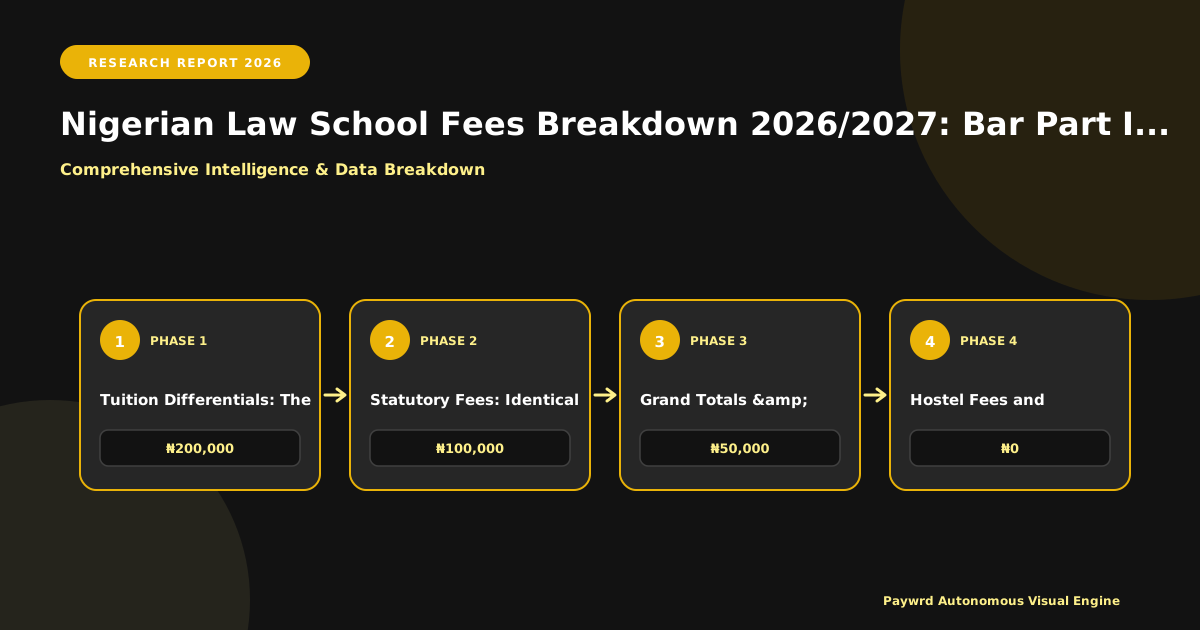
Official 2026/2027 Fee Schedule: Bar Part I vs Part II Comparison
The Council of Legal Education has maintained the fee structure established in recent sessions, but the total cash outlay differs sharply depending on whether you are a fresh Bar Part I intake or a returning Part II candidate. Understanding this differential is critical for budgeting before you even log into the payment portal.
Tuition Differentials: The Core Cost Driver
The single largest variance sits in the Tuition line. Bar Part I students are billed ₦295,000 for Tuition, reflecting the intensive first-year curriculum covering Criminal Litigation, Civil Litigation, Corporate Law, and Property Law. Bar Part II students pay a reduced Tuition of ₦120,000, as they are essentially completing the externship and final advocacy modules. This ₦175,000 gap explains why fresh intakes must plan significantly heavier capital deployment upfront.
Statutory Fees: Identical Across Both Streams
Beyond tuition, every student—regardless of Part—pays the same mandatory statutory charges. These are non-negotiable and cover central services across all Nigerian Law School campuses (Abuja, Lagos, Enugu, Kano, Yenagoa, Bwari). The 2026/2027 breakdown is as follows:
- Development Levy: ₦50,000 (Infrastructure maintenance across campuses)
- Library Fee: ₦20,000 (Access to physical and digital legal repositories)
- Identity Card: ₦5,000 (Mandatory for exam entry and campus security)
- Medical Services: ₦20,000 (Clinic access and NHIS enrollment facilitation)
- Sports & Recreation: ₦10,000
- Examination Fee: ₦30,000 (Covers Bar Finals administration)
- Caution Fee: ₦25,000 (Refundable; Part I only)
- Student Yearbook/Album: ₦10,000 (Part II only)
Grand Totals & Payment Deadlines
Crunching the numbers: Bar Part I Gross Total ≈ ₦476,000 (includes Caution Fee). Bar Part II Gross Total ≈ ₦296,000 (includes Yearbook, excludes Caution). Note that hostel accommodation (where available) is billed separately at roughly ₦30,000–₦50,000 per session via the campus bursary.
Payment is strictly via the Council of Legal Education Portal (cle.gov.ng) using Remita RRR generation. The portal typically opens in early January 2027 for the 2026/2027 session, with a hard deadline of four weeks post-resumption. Late payment attracts a ₦20,000 penalty and blocks access to the Law School Management System (LSMS), preventing course registration and Call-to-Bar mobilization. Generate your RRR, pay at any commercial bank or via USSD, and upload the evidence immediately—screenshots are not accepted; only the portal-verified receipt unlocks your dashboard.
Campus-Specific Cost Variations: Abuja, Lagos, Enugu, Kano, Yenagoa, Yola
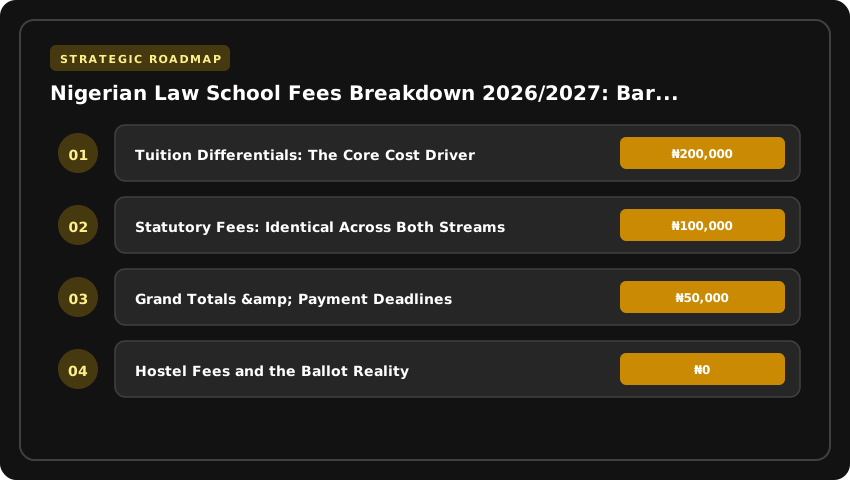
The Council of Legal Education sets a uniform tuition baseline, but your total cost of attendance swings wildly depending on which campus you are posted to. For the 2026/2027 session, the divergence is driven almost entirely by hostel availability and the local rental market. You cannot budget accurately using the national fee schedule alone; you must model costs for your specific deployment center.
Hostel Fees and the Ballot Reality
Official hostel fees remain standardized on paper at roughly ₦30,000 – ₦35,000 per session for a bed space, payable only after a successful ballot. However, the probability of securing that bed varies drastically. The Abuja (Bwari) and Lagos (Yaba) campuses are severely oversubscribed; historically, less than 15% of applicants secure on-campus housing. Enugu and Kano offer moderately better odds, while Yenagoa and Yola typically accommodate a higher percentage of applicants due to lower student density. If you lose the ballot—and statistically, most Abuja/Lagos intakes do—you enter the private rental market immediately.
Off-Campus Rental Averages (2026/2027 Estimates)
Rental markets have adjusted for inflation. Budget for a minimum of 12 months’ rent upfront (standard Nigerian practice) plus agency/legal fees (10–15%). Current averages for a decent self-contained or shared flat near campus:
- Abuja (Bwari/Kubwa): ₦600,000 – ₦1,000,000/year. Sharing a 2-bedroom flat (₦400k–₦600k each) is the survival standard.
- Lagos (Yaba/Surulere/Akoka): ₦700,000 – ₦1,300,000/year. “Face-me-I-face-you” rooms in safe compounds start at ₦350k; self-contained units rarely dip below ₦700k.
- Enugu (Agbani/Independence Layout): ₦350,000 – ₦600,000/year. Significantly cheaper; many students secure decent self-contained units for ₦400k.
- Kano (Bagauda): ₦250,000 – ₦450,000/year. The most affordable rental market of the six. Shared accommodation can be found under ₦200k.
- Yenagoa (Amarata/Epie): ₦300,000 – ₦550,000/year. Prices inflated by oil-sector demand; flood-risk areas are cheaper but not advised.
- Yola (Jalingo Road): ₦200,000 – ₦400,000/year. Lowest cost base, but factor in higher transport costs for inter-state travel.
Transport and Feeding Cost Estimates
Daily logistics eat into stipends fast. Abuja and Lagos students spend heavily on intra-city transit (Bolt/Uber/Keke NAPEP). Budget ₦2,500 – ₦4,000 daily for transport in Lagos/Abuja if living off-campus beyond walking distance. Enugu, Kano, and Yola average ₦1,000 – ₦1,800 daily due to cheaper tricycles (Keke) and shorter commutes. Yenagoa sits in the middle at ~₦1,500–₦2,500, complicated by boat/ferry needs for some lodges.
Feeding is non-negotiable. Campus canteens (where functional) offer meals at ₦800–₦1,200. Cooking yourself saves 30–40%. A realistic monthly feeding budget for 2026/2027 is ₦60,000 – ₦90,000 in Lagos/Abuja and ₦45,000 – ₦65,000 in Enugu, Kano, Yenagoa, and Yola.
Acceptance Fee and Ancillary Levies
Every campus charges a non-refundable Acceptance Fee (~₦20,000) and a Student Union/Development Levy (~₦5,000–₦10,000) payable immediately upon resumption. These are uniform but often overlooked in initial budgets. Factor in a ₦30,000 – ₦50,000 “resumption survival fund” for clearance, passport photos, printing, and immediate feeding before any stipend arrives.
NELFUND Student Loan Eligibility & Disbursement Timeline for Law School
The 2026/2027 academic session marks the second full cycle of the Nigerian Education Loan Fund (NELFUND) under the revised Student Loans (Access to Higher Education) Act, 2026. For Law School aspirants staring down a ₦476,000 obligation for Bar Part I or ₦296,000 for Part II, this scheme is no longer a theoretical safety net—it is a practical funding pillar. The critical difference this year is the explicit inclusion of professional postgraduate institutions like the Nigerian Law School under the “institutional fees” coverage bracket, provided the campus is captured on the NELFUND portal’s verified institution list.
Application Steps for the 2026/2027 Session
Do not wait for your admission letter to hit your email before moving. The portal opens for the 2026/2027 cycle typically in Q1 2026 (January–March), well ahead of the Law School’s usual October/November resumption. Here is the exact workflow:
- Verify Institutional Listing: Log into
nelf.gov.ngand confirm your specific Law School campus (Lagos, Abuja, Enugu, Kano, Yenagoa, Yola, Bwari) appears in the “Search Institution” dropdown. If it is absent, contact the Student Affairs Division immediately—unlisted campuses cannot receive disbursement. - Create Profile with NIN & BVN: Register using your National Identification Number (NIN) and Bank Verification Number (BVN). The system cross-references the National Identity Management Commission (NIMC) database; mismatched names or DOB will hard-block you at the KYC stage.
- Input Admission Details: Once you receive your Bar Part I or Part II admission letter, upload the PDF and input your Matriculation Number. The portal now requires the JAMB Registration Number used for your LL.B admission as a secondary validator.
- Select Loan Type: Choose “Institutional Fees” (paid directly to the Law School) and/or “Upkeep Allowance” (paid to your personal bank account). You can apply for both simultaneously.
- Submit & Track: After submission, monitor the “Application Status” dashboard. Approval typically moves from Pending Verification → Institution Confirmed → Disbursement Queued within 14–21 working days if documentation is clean.
Loan Coverage Limits: Tuition vs. Maintenance Allowance
This is where most applicants misunderstand the math. NELFUND does not hand you a blank cheque for the full ₦476,000. The Act caps Institutional Fees at the exact amount published on the Council of Legal Education’s official fee schedule—currently ₦295,000 for Bar Part I Tuition and ₦195,000 for Part II Tuition. The “Caution Fee,” “Library Fee,” “Identity Card,” and “Sports” levies (totaling roughly ₦181,000 for Part I) are classified as ancillary charges. As of the 2026 guidelines, NELFUND covers 100% of the Tuition component directly to the school’s TSA account.
For the Upkeep (Maintenance) Allowance, the 2026/2027 cap stands at ₦20,000 monthly (₦240,000 per annum), paid in quarterly tranches of ₦60,000 to your verified bank account. This is designed to cover rent, feeding, and the Law School’s mandatory “Call to Bar” incidentals (wig, gown, bib) which cost roughly ₦150,000–₦200,000 combined. Plan your cash flow: the first upkeep tranche often hits 2–3 weeks after resumption, so you need bridge funding for the initial clearance week.
Repayment Terms Trigger: NYSC Completion and Employment Threshold
The repayment structure is the most borrower-friendly feature of the 2026 Act, but you must know the triggers to avoid accidental default reporting to the Credit Bureau.
- The Trigger: Repayment begins exactly two years after completion of the National Youth Service Corps (NYSC). For a typical Bar Part I student graduating Law School in August 2027, serving NYSC 2027/2028 (Batch A/B/C), and passing out in mid-2028, the clock starts ticking July 2030.
- Income Threshold: Deduction (10% of gross salary) only activates when your monthly income exceeds ₦500,000. If you are earning ₦400,000 in a chambers or ₦350,000 in a corporate role in 2030, zero naira is deducted. The obligation pauses, but interest does not capitalize—the loan remains interest-free for life.
- Self-Employed / Unemployed: If you are in private practice without a structured payroll, you are required to self-assess and remit 10% of annual profit via the NELFUND self-service portal annually. Failure to file a “Nil Return” or “Income Declaration” for two consecutive years flags your BVN for recovery action.
- Beneficiary Death: The loan is written off upon presentation of a death certificate to NELFUND by next of kin—no estate liability.
Strategic Takeaway: Apply the moment the 2026 portal opens. Secure the Tuition coverage (₦295k/₦195k) to guarantee your seat, then use the Upkeep Allowance (₦240k/yr) to fund your Call-to-Bar kit and survival. The two-year post-NYSC grace period gives you a massive runway to establish your practice before a single kobo is deducted.
Mandatory Hidden Costs: Bar Finals Prep, Robes, Call-to-Bar & Induction
Paying the Council of Legal Education’s official invoice is merely the entry ticket. Every 2026/2027 Bar Part II student quickly discovers that the real financial gauntlet begins the moment lectures end and “Bar Finals” preparation starts. If you budgeted strictly for the ₦296,000 (returning) or ₦476,000 (fresh intake) tuition breakdown, you are already underfunded by roughly ₦600,000 to ₦900,000. These are not optional lifestyle upgrades; they are mandatory gatekeeping costs enforced by the Body of Benchers and the Nigerian Law School directorate.
Bar Finals Revision: The “Mock Exam” Economy
The Bar Finals is a beast of a different nature compared to university exams. The volume of material—Civil Procedure, Criminal Procedure, Corporate Law, Property Law, and Law in Practice—demands structured revision. Most students enroll in at least one major “Mock” or “Revision” programme (think Bar Prep, Lawyard, or campus-based tutorials). For the 2026 cycle, budget ₦80,000–₦150,000 per reputable programme, and many candidates take two. Add ₦30,000–₦50,000 for printing massive volumes of past questions, model answers, and the “Red Book” (Nigerian Law School Manuals) updates. Don’t forget data costs for online research and virtual classes—another ₦20,000–₦30,000 over the intensive three-month prep window.
Legal Regalia: Robes, Wig, Bib & Call-to-Bar Fees
You cannot be called to the Bar in a borrowed wig. The Body of Benchers mandates specific regalia standards, and prices have surged due to FX fluctuations affecting imported horsehair wigs and tailored gowns. As of early 2026, a standard horsehair wig alone costs ₦180,000–₦250,000 (synthetic is cheaper but often rejected at the Call ceremony). A complete barrister’s gown (robe) runs ₦60,000–₦90,000. The bib/bands and wing collar shirts add another ₦15,000–₦25,000. Then comes the Call-to-Bar ceremony fee payable to the Body of Benchers—currently ₦50,000—plus the Annual Practising Fee (APF) for the first year (₦10,000 for young lawyers) and NBA Branch dues (avg ₦5,000–₦15,000). Budget a hard floor of ₦320,000 here; realistically, aim for ₦400,000 for quality kit.
NYSC Mobilization & Induction Levies
The Call-to-Bar ceremony typically coincides with NYSC mobilization. You are not “done” until you are inducted. The Law School charges an Induction Programme Levy (often labelled “Dinner/Induction Fee”) of roughly ₦30,000–₦50,000 covering the formal dinner, certificate printing, and alumni registration. Simultaneously, you must process NYSC mobilization via the portal. While NYSC registration is technically free, the “business centre” costs for biometric capture, medical fitness certificates (mandatory for camp), and printing call-up letters average ₦15,000–₦25,000. If you are posted far from your base, factor in ₦50,000–₦100,000 for relocation logistics before your first allawee drops.
The Realistic 2026 “Total Cost to Call” Summary
- Official Tuition & Fees (Part II Returnee): ~₦296,000
- Bar Finals Prep (Mocks, Printing, Data): ~₦180,000
- Regalia (Wig, Gown, Bib, Shirts): ~₦350,000
- Body of Benchers Fees (Call Fee, APF, NBA): ~₦70,000
- Induction & NYSC Logistics: ~₦100,000
- Grand Total (Conservative Estimate): ~₦996,000
For a fresh Bar Part I starter in 2026, add the higher tuition differential (₦180,000) and an extra year of feeding/accommodation. The message is clear: secure your funding before you resume. Scrambling for wig money two weeks to Call is a rite of passage nobody enjoys.
Payment Protocols: Remita RRR Generation, Instalment Plans & Refund Policy
Paying your Nigerian Law School fees for the 2026/2027 session is not a “pay at the bank counter” affair anymore. The Council of Legal Education (CLE) mandates that every transaction—whether for Bar Part I tuition (~₦476,000) or Part II (~₦296,000)—flows through the Remita platform via the official CLE student portal. Miss a step, and you risk losing your admission slot or facing a “payment not verified” error during clearance. Here is the tactical walkthrough to get it right the first time.
Step-by-Step: Generating Your RRR on the CLE Portal
Do not walk into a bank or open your banking app hoping to “search” for Nigerian Law School. You must originate the invoice from the source.
- Log in to the CLE Portal: Visit
portal.nigerianlawschool.edu.ng(or the current official subdomain for 2026/2027) using your assigned Application Number and Password. New Bar Part I intakes use the credentials generated after the online registration phase. - Navigate to “Fees Payment”: On the dashboard sidebar, select Fees > Generate Invoice. The system auto-populates your specific schedule—Tuition, Caution, Library, Identity Card, etc.—based on your stream (Part I or Part II) and campus.
- Verify the Line Items: Cross-check the totals against the official schedule. For 2026/2027, Part I freshers should see the Caution Fee (₦50,000) and Tuition (₦250,000) lines clearly itemized. Part II students will not see the Caution Fee.
- Select “Remita” and Submit: Choose Remita as the payment gateway. Click Generate RRR. A unique Remita Retrieval Reference (RRR)—a 12-to-14 digit code—will display. Copy this code exactly. Do not close the tab until payment is confirmed.
- Execute Payment: Pay via your bank’s USSD (*737*50# for GTB, *901# for Access, etc.), Internet Banking (select “Pay FGN/State TSA” > “Nigerian Law School”), Mobile App, or any bank branch. Input the RRR when prompted. The system validates the amount automatically.
- Confirm & Print Receipt: Return to the CLE portal. Click Verify Payment or wait 10–15 minutes for auto-sync. Once the status flips to “Paid,” print your Official Receipt and Payment Confirmation Slip. You need physical copies for physical clearance at your campus.
Instalment Plans for 2026/2027: What Is Actually Allowed
Let us be clear: The Council of Legal Education does not officially advertise a semester-based instalment plan for the 2026/2027 session in its general fee circulars. The default requirement is full payment before the commencement of lectures/clearance. However, operational reality on specific campuses (Lagos, Abuja, Kano, Enugu, Yenagoa, Yola, Bwari) sometimes allows a two-tranche internal arrangement—typically 60% before resumption and 40% before the second semester exams—strictly at the discretion of the Deputy Director-General (DDG) or Campus Registrar.
If you cannot pay the lump sum (especially the ₦476k Part I hit), you must write a formal letter to the Campus Registrar through your Class Representative or Faculty Officer before the payment deadline. Verbal agreements with course mates or admin staff are worthless. Get a signed acknowledgment of any deferred payment schedule to avoid being barred from exams.
Refund Policy: Withdrawal & Campus Redeployment
Life happens. If you withdraw voluntarily or get redeployed, the CLE Financial Regulations govern refunds. The rules are strict:
- Tuition Fees: Refundable only if withdrawal occurs before the official commencement of lectures (usually Week 1). Once lectures start, tuition is deemed “earned” and non-refundable, regardless of attendance.
- Caution Fee (₦50,000 – Part I Only): This is a refundable deposit. It is returned upon successful completion of the Bar programme (Part II) or official withdrawal with clearance, minus deductions for damages, lost library books, or unreturned gowns. Processing takes 6–12 months post-call/withdrawal.
- Administrative Charges (ID Card, Library, Sports, Medical): Generally non-refundable once the portal generates the RRR and the items are provisioned (e.g., ID card printed, medical capitation paid to NHIS/NHIA).
- Campus Redeployment: If the CLE redeploys you (e.g., Lagos to Bwari), your payment follows you automatically—no refund needed, no new RRR required. Simply report to the new campus with your existing receipt. If you apply for a mutual swap with another student, ensure both parties update their portal profiles; fees do not move automatically in private swaps.
Pro Tip: Keep screenshots of the RRR generation page, the bank debit alert, and the final CLE portal “Verified” status. In the Nigerian system, your paper trail is your only defense against “system error” narratives during clearance week.
Foreign-Trained Graduates: Additional Verification & Clearance Fees 2026
If you earned your LL.B outside Nigeria, the standard Bar Part I tuition is only the starting line. The Council of Legal Education imposes a distinct verification and clearance regime before you can even sit for the Bar Part I examinations—or apply for exemption. For the 2026/2027 session, budgeting for these mandatory administrative costs is non-negotiable; missing a payment deadline here stalls your entire Call to Bar timeline.
Certificate Verification Fees by Jurisdiction
The Council engages third-party verification agents and direct institutional checks, and the cost varies significantly by country. As of the 2026 schedule, you should prepare the following estimates in Naira (subject to prevailing CBN exchange rates at the time of payment on the Council of Legal Education portal):
- United Kingdom: Approximately ₦120,000 – ₦150,000 (covers UK ENIC/NARIC checks and university direct confirmation).
- United States: Approximately ₦100,000 – ₦130,000 (includes LSAC/Credential Assembly Service coordination where applicable).
- Ghana: Approximately ₦60,000 – ₦80,000 (streamlined via West African Examinations Council and Ghana Legal Council liaison).
- Other Jurisdictions (Canada, Europe, Asia, etc.): Typically ₦90,000 – ₦140,000 depending on embassy legalization requirements and translation costs for non-English certificates.
These fees are paid directly into the Council’s designated verification account—never to individual agents. Always generate your payment RRR (Remita Retrieval Reference) from your applicant dashboard to ensure traceability.
Bar Part I Exemption Criteria & Processing Charges
Not every foreign graduate writes Bar Part I. You qualify for exemption only if your degree is from a Common Law jurisdiction on the Council’s approved list and you covered the seven core Nigerian law subjects (Constitutional, Criminal, Land, Equity, Company, Evidence, Commercial) during your LL.B. If eligible, you pay an Exemption Processing Fee of roughly ₦75,000 plus the standard verification fee. Do not assume exemption is automatic; the Council’s Academic Board reviews transcripts line-by-line. If a single core module is missing, you revert to full Bar Part I enrollment, incurring the full ₦476,000 gross obligation.
Clearance Timeline: The 2026/2027 Critical Path
Verification is not instant. For the 2026/2027 stream, the Council typically opens the verification portal in March 2026 for the October/November Bar Part I diet. Here is the hard reality:
- March – May 2026: Submit documents and pay verification fees. UK/US verifications often take 8–12 weeks; Ghana averages 4–6 weeks.
- June 2026: Council releases “Cleared List.” If your name is absent, you cannot register for Bar Part I exams.
- July – August 2026: Window for Bar Part I registration (via JAMB CAPS integration for new intakes) and payment of tuition.
- September 2026: Final clearance for Bar Part II registration (for those exempted or passing Part I).
Pro Tip: Initiate transcript requests from your foreign university now. Delays from alma maters are the number one reason candidates miss the 2026/2027 stream entirely. Keep digital copies of every payment receipt and RRR slip; the Council’s helpdesk in Bwari, Abuja, requires physical sighting during physical screening.
Budget Planner: Total Cost Scenarios (Hostel vs. Off-Campus vs. NELFUND)
The official fee schedule tells only half the story. Your actual cash requirement for the 2026/2027 session hinges entirely on where you sleep and how you eat. Below are three realistic financial models built on the current Council of Legal Education fee structure—₦476,000 gross for Bar Part I fresh intakes and ₦296,000 for Part II returnees—plus the living costs that determine whether you finish the year solvent or stranded.
Scenario A: Full Hostel Resident (Tuition + Accommodation + Feeding)
This is the “all-in” premium path. Hostel fees across campuses (Lagos, Abuja, Enugu, Kano, Yenagoa, Yola) average ₦30,000–₦50,000 per session for a bed space, but the real cost is feeding. The mandatory meal ticket system—where it operates—or reliance on campus canteens pushes daily food spend to ₦3,500–₦5,000. Over a 9-month academic cycle, budget ₦950,000–₦1.35M for feeding alone.
- Bar Part I Total: ₦1.45M – ₦1.85M (Tuition/Fees ₦476k + Hostel ₦50k + Feeding ₦950k–₦1.35M + Incidentals ₦100k).
- Bar Part II Total: ₦1.27M – ₦1.67M (Tuition/Fees ₦296k + Hostel ₦50k + Feeding ₦950k–₦1.35M + Incidentals ₦100k).
- Cash Flow Tip: Pay hostel fees immediately on the portal; bed spaces evaporate within 48 hours of allocation release.
Scenario B: Off-Campus Resident (Tuition + Rent + Commute + Feeding)
Going off-campus saves on hostel scarcity but introduces rent volatility and transport risk. In Bwari (Abuja) or Yaba (Lagos), a decent self-contained unit runs ₦600,000–₦1.2M annually, often demanding two years’ rent upfront. Add ₦150,000–₦300,000 for agent/legal fees. Daily commute via ride-hailing or BRT/Keke NAPEP averages ₦2,000–₦3,500 daily (₦360k–₦630k/session). Feeding remains similar to Scenario A unless you cook—budget ₦700k–₦1M if cooking.
- Bar Part I Total (Year 1 Cash Outlay): ₦2.3M – ₦3.5M (Includes 2-year rent advance ₦1.2M–₦2.4M + Agency ₦200k + Tuition ₦476k + Commute ₦500k + Feeding ₦800k).
- Bar Part II Total: ₦1.6M – ₦2.5M (Rent renewal ₦600k–₦1.2M + Tuition ₦296k + Commute ₦500k + Feeding ₦800k).
- Reality Check: Factor in generator fuel (₦50k–₦100k/month) and water truck costs; campus power is never guaranteed.
Scenario C: NELFUND Beneficiary Cashflow Gap Analysis
The Nigerian Education Loan Fund (NELFUND) covers only the institutional tuition component—currently ₦295,000 for Part I and ₦195,000 for Part II. It does not cover Caution fees, Bar Part I Development Levy, Student Union dues, accommodation, feeding, or the Call-to-Bar ceremony fees (₦80,000+). This leaves a massive “Gap” you must fund privately.
- Part I Gap: ₦181,000 (Compulsory Fees) + ₦950k–₦1.35M (Feeding) + Accommodation/Commute. Total Unfunded Need: ₦1.15M – ₦2.5M+.
- Part II Gap: ₦101,000 (Compulsory Fees) + ₦950k–₦1.35M (Feeding) + Accommodation/Commute + Call-to-Bar Fees (₦80k). Total Unfunded Need: ₦1.13M – ₦2.3M+.
- Strategy: Apply for NELFUND the moment the portal opens (usually May/June). Use the loan approval letter as leverage for parental support or targeted scholarships (e.g., NBA Branch schemes, PETROLEX, PTDF) to bridge the feeding/rent gap. Do not resume without a plan for the Gap; the Council does not allow installment payments for compulsory fees.
| Fee Component | Bar Part I (Fresh Intake) 2026/2027 | Bar Part II (Returning) 2026/2027 | Variance Note |
|---|---|---|---|
| Tuition Fee | ₦200,000 | ₦100,000 | Part I pays double; one-time charge for new entrants |
| Caution Fee | ₦50,000 | ₦0 | Refundable deposit paid only by fresh Part I students |
| Accommodation (Hostel) | ₦30,000 | ₦30,000 | Optional but standard; same rate for both streams |
| Feeding Allowance | ₦100,000 | ₦100,000 | Mandatory feeding deposit for the academic session |
| Library & Development Levy | ₦30,000 | ₦20,000 | Part I contributes higher infrastructure levy |
| Medical & Sports | ₦25,000 | ₦15,000 | Comprehensive health cover & sports facilities access |
| Identity Card & Registration | ₦15,000 | ₦5,000 | Fresh biometric capture & file opening for Part I |
| Examination & Verification | ₦16,000 | ₦16,000 | Bar Finals (Part II) & Bar Part I exam processing |
| Estimated Gross Total | ₦476,000 | ₦296,000 | Part I premium: ₦180,000 (Tuition + Caution) |
Frequently Asked Questions
What is the total cost for Nigerian Law School Bar Part I fees for the 2026/2027 session?
For the 2026/2027 session, Bar Part I fresh intakes face a total estimated gross obligation of ₦476,000. This sum covers Tuition (₦200,000), a one-time Caution Fee (₦50,000), Accommodation, Feeding, Library, Medical, and Registration levies. The higher tuition and caution fee drive the ₦180,000 premium over Part II costs.
How much does Bar Part II cost for returning students in the 2026/2027 academic year?
Returning Bar Part II students for the 2026/2027 session pay an estimated total of ₦296,000. This lower figure excludes the one-time Tuition differential (₦100,000 vs ₦200,000) and the Caution Fee (₦0). Costs cover reduced Tuition, Accommodation, Feeding, and standard examination processing fees for the Bar Finals.
Why are Bar Part I fees higher than Part II at the Nigerian Law School in 2026?
Bar Part I fees are ₦180,000 higher primarily due to two one-time charges absent in Part II: the full Tuition Fee of ₦200,000 (versus ₦100,000 for Part II) and a ₦50,000 refundable Caution Fee. Part II students are returning candidates who already paid these premiums during their initial intake year.
When is the payment deadline for Nigerian Law School 2026/2027 fees?
The Council of Legal Education typically mandates full fee payment before the commencement of the orientation course for the 2026/2027 session, usually scheduled for early January 2027. Students must complete remittance via the official Remita portal and present evidence of payment during physical registration to avoid forfeiture of admission.
Can Nigerian Law School fees for 2026/2027 be paid in installments?
No, the Council of Legal Education does not officially sanction installment payments for the 2026/2027 session. The fee schedule requires a single lump-sum remittance covering all components—Tuition, Feeding, Accommodation, and Levies—via the designated Remita platform before the registration deadline to validate studentship.
Strategic Final Takeaway
When evaluating Nigerian Law School Fees Breakdown 2026 2027 Session Bar Part I II in 2026 and beyond, base your decisions on accredited institutional standards, verified return on investment (ROI), and up-to-date official guidelines. Always verify specific dates and requirements through official regulatory portals.


