Breaking Down The Federal Government N10bn TETFund National Research Fund For 2026
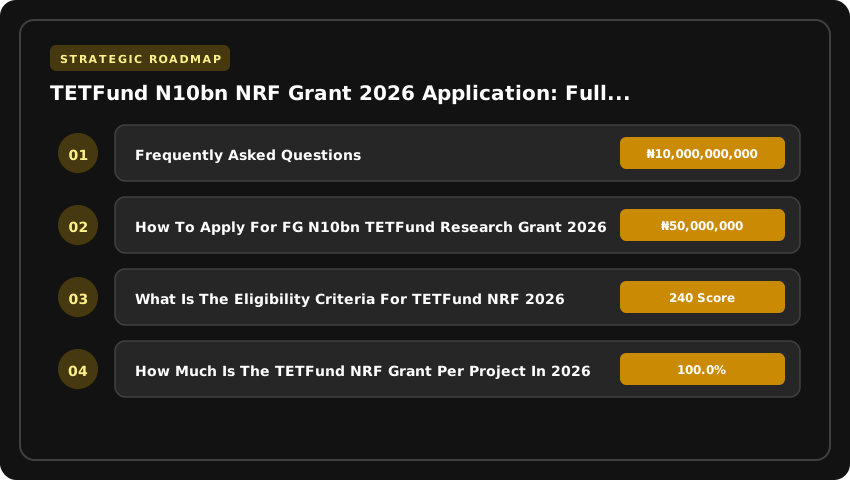
The Federal Government of Nigeria has officially earmarked a substantial ₦10,000,000,000 (Ten Billion Naira) allocation for the 2026 cycle of the Tertiary Education Trust Fund (TETFund) National Research Fund (NRF). This significant financial commitment represents one of the most aggressive pushes by the current administration to overhaul Nigeria’s research landscape, transitioning academic output from theoretical desk work into commercially viable, industry-ready solutions. The approval, which passed through rigorous审议 at the Federal Executive Council (FEC), is designed to bridge the long-standing gap between Nigerian public tertiary institutions and the demands of a modern, knowledge-driven economy.
To ensure that this massive injection of capital delivers measurable national impact, the ₦10bn envelope was approved and coordinated in alignment with key federal stakeholders, most notably the Federal Ministry of Education and the Federal Ministry of Innovation, Science and Technology. This inter-ministerial collaboration guarantees that the research themes selected under the 2026 cycle are not isolated academic exercises but are directly mapped to the administration’s broader Science, Technology, and Innovation (STI) Policy. By tying grant approvals to national STI priorities, TETFund is effectively creating a pipeline where taxpayer-funded research at universities, polytechnics, and colleges of education feeds directly into Nigeria’s food security, energy transition, digital economy, and public health strategies.
One of the most talked-about changes in the 2026 NRF cycle is the revised structure concerning maximum allowable grant ceilings, specifically distinguishing between individual Principal Investigators (PIs) and consortium-led proposals. In previous funding rounds, the disparity between what a lone researcher could apply for and what a multi-institutional consortium could secure was relatively narrow, which inadvertently discouraged the kind of large-scale, collaborative science required to solve complex national problems. For the 2026 cycle, TETFund has clearly widened this gap to actively incentivize teamwork, resource pooling, and interdisciplinary cooperation across public tertiary institutions.
For the 2026 application window, an individual Principal Investigator based at a single federal or state university can now apply for a maximum ceiling of ₦50,000,000 (Fifty Million Naira). This figure is calibrated to fund focused projects, such as a single-laboratory investigation, a targeted field survey, or a specialized prototype development, typically over a 24 to 36-month performance period. The documentation requirements for this tier remain rigorous, including a detailed budget breakdown, CVs of the research team, ethical clearance certificates, and a clear theory of change explaining how the project will contribute to Nigeria’s STI policy objectives.
Conversely, the consortium-led proposal track has received a substantial upward review. Research teams that demonstrate genuine collaboration across two or more public tertiary institutions, or those pairing an academic institution with a registered private-sector industry partner, can now bid for funding up to ₦250,000,000 (Two Hundred and Fifty Million Naira). This fivefold increase over the individual ceiling is a deliberate policy signal: the Federal Government and TETFund want Nigerian researchers to think bigger, pool expensive equipment, share specialized human capital, and co-create intellectual property that can be patented, licensed, and scaled. These consortium projects must designate a lead institution and a Principal Investigator who bears ultimate accountability for milestone delivery, financial reporting, and compliance with TETFund’s procurement guidelines.
What truly sets the 2026 cycle apart from earlier years is the explicit linkage between budget lines and the STI sectoral priority areas. Applicants are expected to frame their proposals around thematic clusters that have been pre-approved as nationally critical, including renewable energy, biotechnology and genomics, artificial intelligence, climate-smart agriculture, and advanced manufacturing. Proposals that fall outside these clusters, or that fail to demonstrate how their deliverables will be translated into products, services, or policy frameworks, face significantly lower chances of shortlisting. This strategic alignment is intended to ensure that the ₦10bn does not fragment into dozens of disconnected, low-impact studies, but rather concentrates firepower on projects capable of shifting Nigeria’s development trajectory.
Furthermore, the 2026 guidelines reinforce TETFund’s commitment to transparency and accountability. Every successful grantee, whether an individual PI or a consortium lead, will be required to publish mid-term progress reports, undergo independent technical audits, and submit verifiable receipts for all capital and recurrent expenditures. Failure to meet these benchmarks triggers an automatic recall of funds and blacklisting from future NRF cycles. This uncompromising posture sends a clear message to researchers across the country: the Federal Government is investing serious money, and the expectation of serious, measurable, and STI-aligned outcomes is non-negotiable.
- Total 2026 NRF Allocation: ₦10,000,000,000 approved by the Federal Executive Council for disbursement to public tertiary institutions.
- Coordinating Ministries: Federal Ministry of Education and the Federal Ministry of Innovation, Science and Technology.
- Policy Anchor: Aligned with Nigeria’s Science, Technology, and Innovation (STI) sectoral priorities.
- Individual PI Ceiling: Up to ₦50,000,000 for single-institution, investigator-led projects.
- Consortium Ceiling: Up to ₦250,000,000 for multi-institution or academia-industry collaborative proposals.
- Key Differentiator from Previous Years: A fivefold scaling of consortium funding to actively drive large-scale, cross-institutional research collaboration.
- Compliance Trigger: Automatic recall of funds and blacklisting for any PI or consortium that fails technical audits or financial reconciliation under the NRF framework.
Strict Eligibility Criteria For Nigerian Academic Researchers And Institutions
The Tertiary Education Trust Fund (TETFund) National Research Fund (NRF) is widely regarded as the most prestigious and competitive research grant cycle in the Nigerian academic ecosystem, and that prestige is reflected in the strictness of its gating criteria. Unlike many open international fellowships that welcome independent scholars, diaspora researchers, or affiliated consultants, the ₦10,000,000,000 (Ten Billion Naira) 2026 NRF allocation is reserved exclusively for active, verifiable members of Nigeria’s public tertiary education system. Before any proposal is read for its scientific merit, the application portal performs a hard validation against institutional and personnel records, meaning that even an exceptionally strong research idea will be instantly disqualified if the applicant cannot satisfy the baseline eligibility requirements outlined below.
Core Personnel Requirements for the Principal Investigator
- Confirmed Academic Appointment: The applicant must be a confirmed, full-time academic staff member currently on the payroll of a Nigerian federal or state university, a polytechnic, or a College of Education that is publicly owned and recognized by the National Universities Commission (NUC), the National Board for Technical Education (NBTE), or the National Commission for Colleges of Education (NCCE). Contract, adjunct, or visiting appointments are not eligible, and sabbatical staff must still maintain an active appointment letter from a public tertiary institution at the time of submission.
- Minimum Rank of Senior Lecturer or Equivalent: The applicant must hold a minimum academic rank of Senior Lecturer (or the equivalent grade level in a polytechnic, which is typically Senior Lecturer in the CONTEDISS or equivalent academic cadre). For researchers in the medical sciences or clinical tracks affiliated with a teaching hospital, the equivalent threshold is typically a Consultant or Senior Registrar rank with concurrent academic appointment. Junior Lecturers, Assistant Lecturers, Graduate Assistants, and Research Fellows without professorial alignment are categorically ineligible to serve as Principal Investigators.
- Valid TETFund Institutional ID: Every applicant must possess a verifiable, active TETFund identification number linked to their home institution. This ID is generated during the institution’s TETFund accreditation and annual budgeting cycle, and it is the same identifier used for accessing the TETFund Automated Project Monitoring System. Applicants must ensure their ID is active and mapped to their current staff record before the application window closes.
- Verifiable Track Record: While not explicitly a gating criterion, the TETFund Board of Trustees reserves the right to prioritize applicants with a demonstrable history of completed TETFund-backed research, publications in Scopus-indexed or Web of Science journals, and successful supervision of postgraduate students. First-time applicants should not be discouraged, but they should treat the proposal narrative as evidence of past research capacity.
Consortium Eligibility and Multi-Institutional Collaboration
Recognizing that transformative research in Nigeria often requires cross-institutional collaboration, the 2026 NRF Guidelines allow the formation of research consortia, but the conditions are tightly defined to prevent abuse of the funding structure. A consortium application may involve a Lead Institution and up to two collaborating institutions, and the principal investigator at the lead institution must still meet every one of the eligibility requirements listed above. Each co-principal investigator based at a collaborating public university, polytechnic, or College of Education must independently meet the same rank and TETFund ID requirements as the lead principal investigator. The consortium must submit a single, unified proposal with a single budget envelope, and the lead institution’s TETFund Desk Officer is responsible for signing off on the joint application. Crucially, the NRF expressly prohibits the use of consortium structures to circumvent the public-institution rule: any collaborating partner that is a private entity, a foreign university, or a standalone research institute may be listed only as a technical adviser or in-kind contributor, not as a budget line under the NRF grant.
Categories of Applicants That Are Strictly Ineligible
- Private Universities: Faculty members of private universities accredited by the NUC, NBTE, or NCCE are not eligible to apply, whether as principal investigators or as co-investigators. This includes faith-based, for-profit, and foundation-owned institutions.
- Standalone Research Institutes: Researchers employed solely by agencies such as the Nigerian Institute of Medical Research, the Nigerian Institute for Oil Palm Research, or any other non-university research outfit are not eligible to lead an NRF application, even if the research topic aligns with national priorities. Such researchers may only appear in a supporting advisory capacity within a public-institution-led consortium.
- Foreign-Based Nigerian Scholars: Academics in the diaspora, even those with active collaborations with Nigerian institutions, cannot serve as principal investigators under the 2026 NRF cycle.
- Administrators Without Active Teaching Loads: Vice-Chancellors, Rectors, Provosts, and senior administrators who no longer maintain an active teaching or research role within their institution are typically ineligible, although TETFund may exercise discretion for serving professors who hold administrative portfolios.
Actionable Takeaway for Prospective Applicants: Before drafting a single page of your proposal, confirm three things in writing: (1) that your appointment letter clearly states your current rank and that you are on a full-time academic cadre; (2) that your TETFund Institutional ID is active and that your name on the ID matches the name on your application and your ORCID profile; and (3) that every co-investigator on your consortium proposal meets the same rank, appointment, and ID requirements. Failing any of these three pre-checks is the single most common reason otherwise-strong Nigerian research applications are eliminated at the eligibility stage before reaching the Technical Review Panel.
Priority Research Areas, Grant Limits, And Approved Funding Bands For 2026
The 2026 cycle of the TETFund National Research Fund (NRF) has been carefully structured around six approved thematic clusters that directly align with Nigeria’s developmental priorities, the National University Commission (NUC) CCMAS benchmark standards, and the broader Renewed Hope Agenda of the Federal Government. These clusters represent the strategic research frontiers where Nigerian academics, polytechnic lecturers, and college of education researchers are expected to channel their intellectual capital. Understanding these thematic areas is the first step before approaching the application portal, as proposals that fall outside these clusters will be automatically disqualified during the initial screening phase.
The six priority research clusters for 2026 include Food Security and Sustainable Agriculture, Renewable Energy and Clean Technology, Artificial Intelligence and Digital Economy, Climate Adaptation and Environmental Resilience, Public Health and Pandemic Preparedness, and National Security and Emerging Technologies. Each cluster has been allocated a proportional share of the ₦10 billion purse, with funding bands calibrated according to the scope, complexity, and disciplinary depth of the proposed research. This tiered structure encourages both solo principal investigators and large-scale multidisciplinary consortiums to apply, ensuring that the fund accommodates a wide spectrum of Nigerian researchers.
For individual STEM research projects, the maximum disbursable amount has been capped at ₦50,000,000 (Fifty Million Naira). This cap applies to proposals in Agriculture, Engineering, Computer Science, and the core sciences. Projects in the humanities and education, however, are subject to a lower ceiling, reflecting the typical equipment and field-work costs associated with social science investigations. Multidisciplinary consortiums that bring together researchers from multiple Nigerian universities, polytechnics, or colleges of education can apply for funding up to the higher band, which allows for more ambitious, multi-site investigations with substantial laboratory, fieldwork, or technology acquisition components.
- Food Security and Sustainable Agriculture: Covers crop genetics, aquaculture, livestock improvement, post-harvest loss reduction, and soil fertility. Ideal for researchers affiliated with faculties of agriculture and veterinary medicine.
- Renewable Energy and Clean Technology: Includes solar mini-grid design, biomass conversion, energy storage systems, and green hydrogen feasibility studies for Nigeria’s energy transition.
- Artificial Intelligence and Digital Economy: Encompasses machine learning for local language processing, fintech security, agricultural AI tools, and ethical AI frameworks tailored to Nigerian socio-cultural contexts.
- Climate Adaptation and Environmental Resilience: Targets flood mitigation modelling, desertification control, carbon credit validation, and water resource management in vulnerable regions across West Africa.
- Public Health and Pandemic Preparedness: Focuses on epidemiology, antimicrobial resistance, neglected tropical diseases, maternal and child health interventions, and the local production of essential pharmaceuticals.
- National Security and Emerging Technologies: Covers cybersecurity architectures, counter-terrorism analytics, border surveillance systems, and forensic science innovations relevant to Nigeria’s security challenges.
A critical eligibility condition that applicants frequently overlook is the cross-sectoral collaboration requirement. To qualify for the higher multidisciplinary consortium funding band, your research team must include at least one collaborator who is currently affiliated with a Nigerian polytechnic or college of education. This stipulation is intentional. It is designed to bridge the long-noted divide between Nigerian universities and the broader tertiary education ecosystem, ensuring that the ₦10 billion research intervention strengthens research output across all categories of tertiary institutions, not just the conventional federal and state universities. Applicants whose consortiums consist exclusively of university-based researchers will only be eligible for the standard individual funding band, regardless of how many university partners are included.
For prospective applicants who also have dependents considering higher education, it is worth noting that the research grant is processed independently of any NEEUFUND student loan obligations. A researcher receiving a TETFund NRF grant does not affect the loan status of their children, though families are encouraged to explore the JAMB UTME admission window and monitor Post-UTME cutoffs alongside this funding cycle. Additionally, all disbursements are made directly to the host institution’s research account in tranches tied to verifiable milestones, and researchers are required to submit audited progress reports before subsequent tranches are approved.
When preparing your budget, ensure that every line item aligns with the approved funding band for your thematic cluster. Over-budget proposals will be returned for revision, while significantly under-budgeting may signal insufficient scope. The TETFund Secretariat has confirmed that grants under ₦10 million will not be processed for 2026, as the fund is calibrated to support impactful, mid-to-large scale investigations rather than small exploratory studies. Researchers should therefore design their proposals to demonstrate clear national impact, feasible timelines, and measurable deliverables within the 18-to-24-month project window.
Step-By-Step Documentation And Submission Process On The TETFund Portal
Submitting a winning Expression of Interest to the TETFund National Research Fund portal is not merely about having brilliant science; it is about packaging that science into a flawless, machine-readable, and reviewer-friendly dossier. The 2026 cycle has tightened its digital ingestion rules, and Nigerian researchers from Lagos State to Sokoto, from the University of Ibadan to the Federal University of Technology, Akure, must adhere strictly to the portal’s technical specifications. Let us walk through the documentation architecture, file naming conventions, and submission protocol with the precision it demands.
Begin by creating a dedicated folder on your computer, naming it “NRF_2026_Surname_FirstName_Discipline”. Every single PDF you generate must follow TETFund’s strict naming convention: NRF26_[PI_Surname]_[DocumentType]_ddmmyyyy.pdf. For example, a curriculum vitae uploaded by Dr. Amaka Okafor on 15 March 2026 must be saved as NRF26_Okafor_CV_15032026.pdf. This is non-negotiable; the portal’s backend parsing engine rejects any file deviating from this format. Avoid spaces, underscores are your friends, and never include version tags like “v2” or “final” within the filename itself. Maintain all files in PDF/A format only; legacy Word documents, JPEG images of text, or scanned copies of printed manuscripts will trigger automatic disqualification flags.
Typography and layout specifications carry equal weight. TETFund mandates Times New Roman, 12-point font for all narrative sections, while tables and budget templates may use 11-point Arial or Calibri. Line spacing must be set at exactly 1.5, with 2.5 cm margins on all sides of A4 paper. The Expression of Interest itself is capped at a hard limit of 15 pages, inclusive of references but exclusive of appendices. CVs, however, carry their own ceiling: a maximum of 4 pages. Anything longer will be truncated by the system. Every page must be numbered consecutively in the footer, accompanied by the Principal Investigator’s surname in the header for easy identification during blind review.
- Mandatory Upload 1 — Principal Investigator’s Detailed CV (4 pages max): Must include full publication history with Scopus Author ID and verified Google Scholar profile link. If your Scopus h-index is below 5 for STEM disciplines or below 3 for Humanities, attach a one-page justification explaining career-stage constraints. Include only peer-reviewed outputs from the last seven years.
- Mandatory Upload 2 — Ethical Clearance Certificate: Required for any study involving human subjects, animal trials, clinical interventions, or community-based participatory research. The certificate must be issued by your institution’s Health Research Ethics Committee (HREC) and bear a validity date extending beyond December 2026. For purely theoretical or computational research, upload a one-page declaration stating that no human or animal subjects are involved.
- Mandatory Upload 3 — Sworn Affidavit of Originality: Must be sworn before a Nigerian High Court, Federal High Court, or a Commissioner for Oaths. The affidavit must declare that the proposed research is original, has not received funding from any other federal intervention, and is not a duplicate of previously TETFund-funded work. The stamp duty of ₦500 applies, and the document must be dated within 30 days of submission.
- Mandatory Upload 4 — Budget Breakdown in TETFund 2026 Format: This is the most scrutinized document. TETFund’s 2026 financial regulations stipulate that personnel costs (excluding the Principal Investigator’s salary) must not exceed 15% of the total grant. Equipment purchases above ₦50 million require three competitive quotations. Travel is capped at ₦4 million for local conferences and ₦8 million for international dissemination. Overheads to the host institution must not surpass 10%. The budget must be signed by both the lead researcher and the institution’s Director of Finance.
- Mandatory Upload 5 — Gantt Chart Milestones: A visual timeline mapping 24 months of activity, aligned with quarterly deliverables. Use the official TETFund template embedded in the portal.
- Mandatory Upload 6 — Letter of Endorsement from Vice-Chancellor or Provost: On institutional letterhead, confirming that the research aligns with institutional priorities and that the PI will be granted protected research time.
Once your documentation folder is complete, proceed to the TETFund Research Portal and log in using your institutional credentials. Navigate to the “2026 NRF Call” dashboard and click “Initiate New Application”. The system will auto-generate a unique Application ID — copy this and paste it into your folder name for traceability. Upload documents one by one, watching for the green checkmark confirmation after each successful upload. Do not batch-upload; the portal sometimes times out on files exceeding 5MB. If your CV exceeds the size limit, compress it using Adobe Acrobat’s PDF optimizer rather than scanning at lower resolution, as this distorts your Scopus credentials.
Before clicking the final “Submit” button, conduct a dry run by downloading your own uploaded files and opening them on a separate device. Check that the affidavit stamp is legible, that budget figures reconcile with the cover summary, and that ethical approval dates are correctly entered. Once submitted, you will receive a confirmation email and an SMS to your registered Nigerian phone number within 15 minutes. Print the acknowledgment slip, sign it, and have your Deputy Vice-Chancellor (Academic) counter-sign before uploading the scanned copy within 48 hours. Missing this counter-signature is the single most common reason Nigerian researchers are disqualified at the administrative stage, so treat it with the seriousness it deserves.
Critical Deadlines, Review Timelines, And Disbursement Schedule For Approved Grants
Navigating the TETFund National Research Fund (NRF) calendar requires absolute precision, because every milestone from submission to fund disbursement is governed by strict institutional deadlines that are not typically extended without a formal public notice. For the 2026 cycle, the official submission window is expected to open on Monday, 15th September 2025 and close at 11:59 PM (WAT) on Friday, 5th December 2025. This roughly eleven-week application window gives research teams, Principal Investigators, and institutional grant officers adequate time to compile their concept notes, full proposals, budgets, and supporting documents. However, anyone who has worked with Nigerian federal grant cycles knows that technical hitches on the TETFund Research Management Portal, slow internal approvals at university level, or last-minute clarifications from the National Committee of Experts often push candidates dangerously close to the wire.
Because of these predictable friction points, TETFund traditionally allows a two-week (14-day) grace period after the official closing date. For the 2026 cycle, this grace window should be expected to run through Friday, 19th December 2025, but applicants should treat this as a contingency, not a strategy. Submitting on or before the 5th of December protects you from any last-minute portal crashes, network outages, or documentation errors that could compromise an otherwise strong proposal.
Once the portal closes, the three-stage review process begins, and understanding each stage is critical for setting expectations around feedback and timelines:
- Stage 1 — Departmental Screening (Mid-December 2025 to Mid-January 2026): Submitted proposals are first screened at the departmental and institutional level by each beneficiary institution’s Research Desk. This stage checks for completeness, eligibility of the Principal Investigator, alignment with TETFund’s priority research areas, and conformity with the budget template. Proposals that pass this stage are forwarded to the National Committee of Experts.
- Stage 2 — National Committee of Experts Review (Late January 2026 to April 2026): The independent panel of subject-matter experts, drawn from Nigerian universities, polytechnics, and approved research institutes, conducts a blind peer-review of the full proposals. They assess scientific merit, methodological rigor, potential for commercialisation, and the socio-economic impact of the research. Successful candidates from this stage are recommended to the TETFund Board.
- Stage 3 — TETFund Board Approval (May 2026): The TETFund Board of Trustees sits to ratify the recommendations of the National Committee of Experts. Once approval is granted, the list of successful applicants is forwarded for announcement.
The official announcement of successful applicants is expected to be published on the TETFund portal and in major Nigerian newspapers in late May or early June 2026. If you are an applicant, this is the moment to confirm your award status and immediately begin preparing for the acceptance window. From the date of publication, you will have exactly 30 calendar days to formally accept the grant offer, sign the award letter, and submit all counter-part documents. Missing this window without a valid written explanation can result in automatic forfeiture, and your slot will be offered to the next ranked candidate.
For those who successfully accept, the first tranche of funds is disbursed directly into the institutional account of the beneficiary university, polytechnic, or research centre typically within two to three weeks after the TETFund Board ratifies the signed award letters. In practical terms for the 2026 cycle, the first disbursement should hit institutional accounts by late June or early July 2026. The standard TETFund release structure is in three tranches — an initial mobilisation tranche, a mid-research disbursement tied to milestone reports, and a final tranche upon submission of the project’s completion report and audited financial statement.
Actionable Takeaway: Build your proposal around the 5th December 2025 deadline, not the 19th December grace period. Prepare your acceptance and counter-part documentation in advance so that you can sign and return within the 30-day window the moment the success list is published. Finally, brief your institution’s finance and research offices in advance so that, once the first tranche lands in the institutional account, internal disbursement to the project is not delayed by avoidable administrative bottlenecks.
How NELFUND Loans And TETFund Grants Intersect For Graduate Researchers
For graduate researchers navigating Nigeria’s evolving funding ecosystem in 2026, understanding how the Nelfund tuition support scheme and the TETFund National Research Fund (NRF) grant coexist is essential for building a sustainable academic career. The intersection of these two funding streams is not just a matter of finance but of strategic planning, compliance with federal regulations, and long-term positioning for international competitiveness.
First, it is important to clarify what each fund covers. Nelfund loans are designed primarily as student loan products aimed at covering tuition fees, accommodation charges, and basic living stipends for undergraduate and postgraduate students in accredited Nigerian tertiary institutions. These loans are interest-free during the study period and begin repayment only after the National Youth Service Corps (NYSC) or after gainful employment is secured, depending on the borrower’s programme pathway. On the other hand, the TETFund NRF grant is a research-specific award, typically disbursed through host universities, intended to support principal investigators in conducting publishable research, purchasing equipment, funding fieldwork, and covering conference attendance costs.
The good news for graduate research assistants (RAs) funded under the NRF is that, in principle, they can simultaneously hold Nelfund support for tuition while drawing an RA stipend from a TETFund research grant, provided that the award letters and institutional disbursement schedules do not duplicate the same cost line. For example, if your NRF sub-award covers a ₦150,000 monthly RA stipend, bench fees, and data collection costs, Nelfund can independently cover your school fees, hostel charges, and approved upkeep allowance. Universities typically require graduate students to disclose all concurrent support to the Graduate School and the Bursary to avoid double-dipping on tuition. Transparency is the cornerstone of compliance, and concealment of a parallel loan can lead to disqualification from either scheme.
- Cost-line separation: Ensure NRF funds cover research-specific expenses (stipends, equipment, travel) while Nelfund covers tuition and statutory institutional charges.
- Disclosure duty: Submit award letters to your Head of Department, Graduate School, and the Students Affairs Division upon receiving either funding.
- Disbursement timing: Coordinate with your institution’s account office so Nelfund tuition payments are not delayed by overlapping grant cycles.
On the question of tax implications, graduate researchers should understand that NRF grant funds disbursed as research grants are not classified as personal income in Nigeria. They are considered institutional research support, and as such, the funds are not subject to Personal Income Tax (PIT) in the hands of the beneficiary when spent on approved research line items. However, if the grant provides a stipend that is paid as personal allowance, the portion treated as personal emolument becomes taxable under the PIT Act, with the applicable tax bands depending on the consolidated annual income. Nelfund loans, by contrast, are structured as repayable loans and therefore are not taxable income. The loan principal remains tax-free, and only future interest waivers, if any, may carry nominal tax considerations depending on the federal gazette in force at the time of disbursement. Always retain your award letters, receipts, and institutional disbursement memos, as the Joint Tax Board and your institution’s audit unit may request these for verification.
For early-career academics, the strategic value of holding an NRF grant extends far beyond the immediate ₦10bn cycle. A successful NRF award signals to international funders that you can conceive, manage, and deliver a federally peer-reviewed research project. This credential becomes a launchpad for larger opportunities, including the new TETFund-branded AI Research Fellowship, which is expected to prioritise candidates with a verifiable track record of grant execution, peer-reviewed publications in Scopus or Web of Science indexed journals, and demonstrated capacity to supervise junior researchers. Graduate RAs who use NRF seed funding to produce three to five quality outputs within a 24-month window will be strongly positioned when these fellowship calls open.
- Build a publication pipeline: Target one first-author paper and two co-authored papers from your NRF work within the first year.
- Document impact: Track citations, policy uptake, and conference presentations, as these feed directly into future TETFund-branded fellowship evaluation rubrics.
- Network deliberately: Use NRF travel budgets to attend international conferences such as the Nigerian Academy of Science Forum and AI-focused summits to build global visibility.
In summary, Nigerian graduate researchers can lawfully leverage Nelfund loans for tuition and NRF grants for research simultaneously, provided the two streams cover distinct cost lines and full institutional disclosure is maintained. Understanding the tax treatment, maintaining transparent records, and using the NRF award as a publication-building platform are the keys to qualifying for prestigious future opportunities, including the emerging AI Research Fellowship backed by TETFund. With careful planning, the ₦10bn NRF allocation for 2026 can become the first major step in a long, internationally competitive research career anchored in Nigerian academia.
| Metric | TETFund NRF 2026 Details |
|---|---|
| Total Allocation | ₦10,000,000,000 (₦10bn) |
| Maximum Grant Per Project | ₦50,000,000 (₦50m) – subject to TETFund discretion |
| Applicant Category | Academic staff in Nigerian public tertiary institutions |
| Minimum Qualification | PhD holder with active academic appointment |
| Application Deadline | Typically 8–10 weeks after portal opens (Q1 2026 expected) |
| Portal URL | nrf.tetfund.gov.ng (anticipated 2026 cycle) |
| Research Areas | Science, Engineering, Health, Agriculture, ICT, Renewable Energy, Social Sciences |
| Funding Cycle | Annual (2026 cycle) |
| Disbursement Timeline | 6–12 months post-approval (tranches) |
| Required Documents | CV, research proposal, budget, ethics approval, institutional endorsement |
| Eligibility Check | Must be a confirmed staff of TETFund beneficiary institution |
| Career ROI | Professorship acceleration, promotion eligibility, global collaboration, IP commercialization |
Frequently Asked Questions
How To Apply For FG N10bn TETFund Research Grant 2026
Visit the official TETFund NRF portal at nrf.tetfund.gov.ng when the 2026 cycle opens, register with your institutional email, and complete the online application form. Upload your PhD certificate, research proposal, detailed budget, ethics approval, and institutional endorsement letter, then submit before the official deadline.
What Is The Eligibility Criteria For TETFund NRF 2026
Applicants must be confirmed academic staff holding a PhD at a TETFund-beneficiary public tertiary institution in Nigeria. Early-career researchers and senior lecturers with verifiable research outputs are eligible, while contract staff and private university employees are generally excluded from the National Research Fund scheme.
How Much Is The TETFund NRF Grant Per Project In 2026
TETFund's National Research Fund historically awards between ₦5 million and ₦50 million per approved project, depending on scope, discipline, and budget justification. The 2026 ₦10bn pool is expected to fund approximately 200–400 research proposals across priority sectors nationwide.
What Is The Deadline For TETFund NRF 2026 Application
TETFund has not officially announced the 2026 NRF deadline, but based on previous cycles, the call typically opens in January with an 8–10 week application window closing by March 2026. Candidates should monitor nrf.tetfund.gov.ng and TETFund's verified social media handles for updates.
Strategic Final Takeaway
Success in evaluating TETFund N10bn NRF Grant 2026 Application: Full Guide relies on early preparation, adherence to verified accredited requirements, and cross-referencing official portals. Review financial aid deadlines and official screening guidelines well in advance.