The Death of the Default College Pipeline: Why GPA No Longer Drives Adulthood
For roughly three generations, American families operated on an unspoken contract: a teenager earns a respectable grade point average, submits an application through the Common App, receives an acceptance letter from a four-year institution, and then walks across a commencement stage four years later. That pipeline was so deeply embedded in the national imagination that questioning it felt almost unpatriotic. The College Board, high school guidance counselors, and university marketing departments reinforced the message that a bachelor’s degree was the single most reliable currency in the American economy. In 2026, however, that contract is being renegotiated in living rooms, school counseling offices, and state legislatures across the country.
The numbers driving this reassessment are blunt. According to the U.S. Bureau of Labor Statistics, the wage premium for holding a bachelor’s degree over a high school diploma has narrowed considerably when adjusted for real purchasing power and rising tuition costs. While degree holders still out-earn non-degree holders on average, the gap has shrunk to roughly $30,000 per year, down from historical peaks near $40,000 in the early 2010s. At the same time, the Federal Reserve reports that average student loan debt for borrowers under 40 has climbed past $38,000, with delinquency rates on federal student loans hovering near historic highs. When families do the arithmetic, the projected lifetime earnings from a degree often fail to offset the debt burden within a standard ten-year repayment window.
Guidance counselors, the professionals once trained to steer students toward selective universities, are witnessing the reversal firsthand. Surveys of high school counseling departments in states like Texas, Florida, Ohio, and Pennsylvania indicate that Common App submissions have dropped by approximately 40% since the 2021-2022 academic year. Counselors report that students increasingly arrive with questions about apprenticeship sponsors, industry-recognized credentialing programs, and direct-to-workforce certifications rather than questions about SAT percentile rankings or early-decision strategies. The College Board’s own messaging has shifted noticeably, with new programming emphasizing “college and career readiness” rather than “college as the only path.”
- The Degree Premium Is Shrinking: BLS data confirms that real wage gains for bachelor’s degree holders have flattened since 2022, while costs have continued climbing at most accredited four-year institutions.
- Debt Has Outpaced Returns: Average federal student loan balances exceeding $38,000 now require borrowers to commit roughly $400 monthly under standard repayment plans, eating into the very wage premium a degree was supposed to deliver.
- Counselors Are Pivoting: High school guidance departments report 40% declines in Common App volume, redirecting their advising energy toward trade credentials, associate degree pathways, and registered apprenticeships.
- The College Board Has Recalibrated: The organization that once marketed the SAT as the gateway to opportunity now distributes materials that acknowledge viable alternatives to the four-year residential experience.
The psychological unwiring of the “college or failure” message may prove to be the most durable change of all. For decades, teenagers absorbed the implicit threat that rejecting a four-year pathway meant a lifetime of diminished options. That conditioning did not develop organically; it was the product of sustained institutional messaging from accreditation bodies, federal financial aid policy, and cultural gatekeepers. Replacing it requires more than a single news cycle. It demands a sustained reframe in which electricians, HVAC technicians, dental hygienists, and software apprentices are understood as legitimate architects of a middle-class life. As the Class of 2026 finishes its applications, that reframe is finally underway.
Apprenticeships 2.0: How the Department of Labor Redefined Youth Employment
For decades, the Registered Apprenticeship USA program operated in the background of American workforce policy, a respected but largely invisible earn-while-you-learn pipeline that produced roughly 27,000 new apprentices annually through the early 2000s. That number has fundamentally transformed. The Department of Labor, working in coordination with the Department of Education and a coalition of state workforce boards, has expanded registered apprenticeship enrollment to a projected 250,000 youth participants by the end of 2026, with the sharpest growth concentrated among 16-to-19-year-olds who are simultaneously enrolled in high school. This expansion represents the most significant redesign of youth employment policy since the 1938 Fair Labor Standards Act carved out protections for working minors.
What makes the 2026 model distinct from earlier iterations is the deliberate integration of classroom instruction and paid on-the-job training within the traditional high school schedule. A 17-year-old apprentice in Cleveland, Phoenix, or Atlanta can now earn a journeyman-equivalent credential in electrical work, HVAC-R, industrial automation, or pharmacy technician services while completing their diploma requirements, because school districts have signed formal articulation agreements with local apprenticeship sponsors. Students typically spend two to three days per week in paid work-based learning environments, with employers like Quanta Services, Carrier, and the IBEW locals covering wage costs through a combination of federal Workforce Innovation and Opportunity Act (WIOA) dollars, state apprenticeship grants, and the employer’s own training budget. The remaining school days are dedicated to high school academics plus one additional period of industry-specific technical instruction that counts toward both the diploma and the apprenticeship’s related instruction requirement.
Compensation is where the model has become genuinely disruptive. Apprentices currently entering electrical and HVAC-R tracks at age 17 are earning a national average starting wage of $15,000 per year while still in high school, with guaranteed scheduled raises tied to competency milestones rather than tenure. By the time an apprentice reaches journey-level status at approximately 2,000 cumulative work hours (often achieved by age 20), the Department of Labor’s Occupational Employment and Wage Statistics program reports median annual earnings between $62,000 and $78,000, depending on the trade and metropolitan labor market. Compare that to the average debt load of a 2026 bachelor’s degree recipient, which Project on Student Debt tracking suggests remains above $30,000, and the economic case writes itself for families who have grown skeptical of the traditional four-year residential experience.
Perhaps the most strategically significant development is how apprenticeship programs have effectively bypassed the community college gateway that once stood between a high school student and a mid-skill technical career. Previously, a student interested in industrial maintenance, plumbing, or advanced manufacturing would need to enroll in a two-year associate degree program, often paying out-of-pocket tuition while accumulating credits that transferred unevenly to employer-recognized certifications. Under the new Department of Labor framework, the registered apprenticeship itself is the credential of record. Sponsors are required to provide articulated credit recommendations through the American Council on Education (ACE), allowing apprentices to convert their industry training into up to 45 college credits that can later be applied toward a bachelor’s degree if the apprentice chooses to pursue one. This reverses the historical pathway: students now begin with employer-validated training and treat college as an optional add-on rather than a mandatory first step.
Industry alignment has deepened considerably through 2026. The Department of Labor’s Office of Apprenticeship has signed national memoranda of understanding with CompTIA, the National Center for Construction Education and Research (NCCER), the Refrigeration Service Engineers Society (RSES), and the Manufacturing Institute, ensuring that the competencies apprentices master on the job are directly portable to industry-recognized certifications. For families evaluating this path, the practical implications are concrete: a high school sophomore can now plot a four-year trajectory that ends with a diploma, an industry credential, zero student debt, and a starting salary that often exceeds what a recent college graduate earns in their first entry-level position. The redefinition of youth employment is not a speculative trend; it is a fully operational system with wage data, credential frameworks, and federal funding streams already in place.
Micro-Credentials, Stackable Licenses, and the Bypassing of ABET/AACSB Gatekeepers
Walk onto any modern high school campus in 2026, and you will find a strange new sight: teenagers walking out of a Cisco networking lab with a CompTIA A+ certificate in one hand and a NCCER Core Construction card in the other. These are not vocational outliers anymore. Across the United States, Industry-Recognized Credential (IRC) programs have matured into the structural equivalent of a diploma. The federal Workforce Innovation and Opportunity Act (WIOA), alongside the Carl D. Perkins Career and Technical Education Act, now directs tens of millions of dollars toward IRC-aligned programs. When a state agency or a Fortune 500 employer reviews a candidate’s transcript, the AWS Cloud Practitioner certification or the EPA 608 refrigerant license carries nearly the same legal and economic weight as a high school diploma did in 1995.
The mechanics are straightforward and frankly brilliant. A student at a career-technical high school in Texas, Ohio, or North Carolina can stack credentials like blocks. By graduation, that student might hold an OSHA 30-Hour card, an AWS Solutions Architect Associate badge, a NCCER Plumbing Level 2 certification, and a CompTIA Security+ designation. Each credential is independently verifiable through a digital wallet backed by the Credential Engine, the nonprofit standards body that mapped over one million credentials by 2025. These are stackable licenses: they grow with the worker, from an entry-level helper earning $22 an hour to a master technician earning $90,000 annually, all without ever stepping inside an Admissions Office.
Compare this to the traditional ABET-accredited engineering degree or the AACSB-accredited business administration track. ABET accreditation, the gold standard for engineering and computing programs, remains respected globally. A graduate from an ABET school typically carries a tuition debt load that now averages $38,000 for a public four-year institution and approaches $150,000 at private universities. That student spends roughly 4.5 years (including the average 5.2-year completion rate) earning the credential, and the labor market liquidity does not begin until the junior internship cycle. Meanwhile, an NCCER or AWS-certified graduate is already earning a paycheck by age 18, often with employer-sponsored benefits and 401(k) matching from day one.
The ROI math is brutal. Let us look at a realistic scenario:
- Traditional Engineering Path: Four-year tuition $44,000 (in-state public average). Lost wages during study: ~$96,000. Total investment before first engineering paycheck: $140,000. Median mid-career engineering salary: $98,000.
- IRC Stackable Path: Training cost $0 to $4,000 (often covered by Perkins funding). Earned wages during certification: ~$52,000. Total investment before credential completion: minimal. Median mid-career cloud or trades salary with stacked credentials: $82,000 to $115,000.
The four-year sunk cost problem becomes even sharper when one examines completion rates. Fewer than 62 percent of students who enter a four-year institution graduate within six years, according to NCES data. By contrast, IRC programs measure success in competency-mastered metrics, not credit-hours-attempted. A student can fail, retake, and stack additional credentials without the catastrophic “dropout” label that still carries social stigma in American households.
Does this mean ABET and AACSB are obsolete? Absolutely not. For research-intensive careers in aerospace, biomedical engineering, or corporate finance leadership, the accredited degree remains the master key. But for the 70 percent of American high school graduates who were never planning to pursue a R1-university research career, the IRC pathway offers something the traditional pipeline could not: immediate market legitimacy, verifiable skills, and a wage trajectory that compounds annually rather than waiting on a diploma.
The gatekeepers of the twentieth century were the regional admissions officers who guarded the lecture hall. The gatekeepers of 2026 are the AWS exam proctor, the NCCER skills evaluator, and the CompTIA certification database. And unlike the dean’s office, these gatekeepers do not care about your GPA, your legacy status, or your family’s ability to write a tuition check.
Algorithmic Guidance: How AI Dashboards are Replacing Human Counselors
For decades, the high school counselor’s office was the quiet epicenter of American post-secondary planning. Students would wait in line clutching a half-finished FAFSA worksheet, hoping for a fifteen-minute conversation that might define the next four years of their lives. By 2026, that scene has largely vanished. In its place stands a glowing tablet dashboard, running proprietary predictive engines that map a sophomore’s behavioral data against twenty thousand occupational codes. The algorithm does not sip coffee, forget names, or take a lunch break. It runs a vocational match score the moment the bell rings.
The architecture of this shift is visible in the rapid adoption of platforms that began as simple college search tools, like Naviance and Xello, but have since mutated into comprehensive career-pathing engines. These systems ingest variables that a human counselor would never have time to evaluate. They weigh attendance patterns, course selection velocity, even the latency between a student’s clicks on a career-exploration module. The output is a percentage: an eighty-six percent fit for an HVAC technician apprenticeship, a seventy-two percent fit for a registered nursing program, a forty-one percent fit for a liberal arts track. Districts in states like Texas, Florida, and Ohio are now required by legislation to surface these scores to students before they finish tenth grade, effectively making algorithmic guidance a legal entitlement rather than an optional supplement.
The financial incentive for schools is massive. Districts can save upwards of $80,000 annually per high school by reducing full-time counseling staff and replacing them with a single district license to an AI guidance platform. Vendors argue the math is simple: one human counselor serves roughly 450 students, while a dashboard can serve forty-five thousand. But the data being fed into these systems raises serious concerns under the Family Educational Rights and Privacy Act (FERPA). Every behavioral click, every paused video on a welding simulation, becomes part of an educational record that can theoretically be shared with third-party vendors under loosely worded directory-information exceptions. Parents often sign blanket consent forms during fall registration without realizing they have authorized the export of their child’s psychometric profile to a private algorithm.
- Predictive modeling opacity: Most K-12 edtech vendors treat their match-score formulas as trade secrets, making it nearly impossible for parents or educators to audit how a student’s race, socioeconomic status, or disability status influences the output.
- FERPA enforcement gaps: The U.S. Department of Education has issued guidance but rarely penalizes districts for improper data-sharing arrangements with AI vendors, creating a regulatory gray zone that benefits platform companies.
- Self-fulfilling vocational pipelines: Critics warn that an algorithm trained on historical apprenticeship data may unconsciously steer girls and students of color toward lower-paying trade tracks, replicating the biases of legacy career counseling.
- The fifteen-minute gap: When a human counselor does intervene, it is often to explain an algorithmic recommendation, rather than to offer independent judgment, reversing the traditional advisory hierarchy.
The most profound implication is epistemological. When a tablet dashboard knows a student’s career fit before a human teacher does, the definition of educational mentorship quietly changes. Counselors are no longer guides who interpret student dreams against a landscape of opportunity. They become troubleshooters for software that has already made the decision. In the most aggressive implementations, students who ignore their top three algorithmic matches are required to complete a digital waiver form and attend a mandatory parent meeting, a bureaucratic inversion of the old assumption that a teenager’s aspiration drives the plan. The algorithm now drives the aspiration, and the humans merely certify that they saw it.
The 2026 FAFSA Collapse and the Financial Rebalancing Act
The rollout of the 2024-2025 FAFSA Simplification Act was supposed to be the most significant modernization of federal student aid in decades. Instead, it triggered one of the most disruptive financial aid crises in modern memory, with consequences that have fundamentally reshaped how American families approach the cost of higher education heading into 2026.
When the U.S. Department of Education launched the new FAFSA form, designed to simplify questions, expand Pell Grant eligibility, and link applications directly to IRS tax data through the FUTURE Act, the system buckled almost immediately. Technical glitches froze the application portal for weeks. Schools received erroneous Student Aid Index (SAI) calculations. And an alarming number of low-income students received award letters that were wildly inconsistent or arrived after commitment deadlines had already passed.
- Processing Delays: Thousands of universities reported receiving FAFSA data months later than usual, forcing admissions offices to push back financial aid notification dates and creating widespread enrollment uncertainty.
- Pell Grant Confusion: The expansion of Pell eligibility, raising the income threshold and adjusting asset calculations, was meant to help students. Instead, many received conflicting eligibility determinations from the same school, eroding trust in the system.
- Verification Nightmares: An increased verification rate overwhelmed financial aid offices, leaving thousands of students in administrative limbo throughout the spring of 2024 and 2025.
The cumulative effect was a cascading enrollment crisis. Community colleges and regional four-year institutions, which serve the highest concentrations of Pell-eligible students, saw some of the steepest enrollment declines in decades. High school counselors reported that an entire generation of students quietly disengaged from the traditional college application pipeline, uncertain whether aid would arrive or whether the system would simply fail them again.
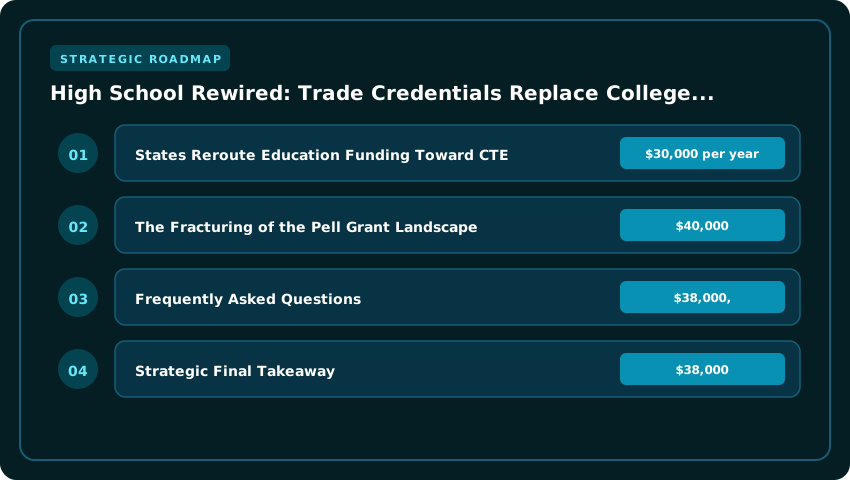
States Reroute Education Funding Toward CTE
While federal aid infrastructure sputtered, state legislatures moved with surprising speed. Recognizing that the traditional four-year college pathway was no longer a reliable default, governors and education boards began aggressively rebalancing their education budgets toward Career and Technical Education (CTE).
- Tennessee: Building on its longstanding Tennessee Promise model, the state expanded the Tennessee Reconnect grant and increased funding for dual enrollment CTE pathways, allowing high schoolers to earn industry certifications in fields like advanced manufacturing, IT, and healthcare at no cost. The Tennessee Department of Education reported record participation in career-aligned programs by the 2025-2026 academic year.
- Texas: The Texas Legislature passed sweeping workforce education reforms, channeling hundreds of millions of dollars into the newly expanded Texas Career and Technical Education grant programs. The Texas Higher Education Coordinating Board prioritized short-term credentialing programs aligned with high-demand industries, particularly energy, construction, and cybersecurity, making it easier for students to stack credentials and enter the workforce debt-free.
- California: California Community Colleges continued to lead the nation with its Strong Workforce Program, but 2026 brought an even sharper pivot. The state legislature earmarked additional funding for CTE pathways through the California Apprenticeship Initiative, effectively creating a tuition-free, debt-free alternative to the traditional UC and CSU pathways for students prioritizing immediate career readiness over a four-year degree.
The Fracturing of the Pell Grant Landscape
Perhaps the most quietly transformative shift of all is happening at the federal level, where the Pell Grant, long considered the cornerstone of college affordability for low-income students, is being reimagined for an era of non-traditional learning. The traditional Pell framework was designed around enrollment at degree-granting institutions, whether a community college, a four-year university, or a trade school. But as apprenticeships, micro-credentials, bootcamps, and short-term workforce programs have exploded in popularity, the Pell Grant’s eligibility framework has struggled to keep pace.
In 2025, the U.S. Department of Education began piloting experimental Pell Grant disbursement structures that would allow recipients to use portions of their award for non-term-based programs, including registered apprenticeships and approved industry credentialing programs. If expanded nationally, this shift would represent the most significant expansion of Pell’s scope since its creation in 1972.
- Year-Round Pell: Already in effect, but now being marketed aggressively as a tool for students pursuing accelerated or stacked credentials rather than continuous four-year enrollment.
- Apprenticeship Pell: Under active pilot review, this would formally extend federal grant aid to registered apprenticeship programs, aligning Pell with the Department of Labor’s apprenticeship framework.
- Short-Term Pell: Programs between 150 and 600 clock hours are under consideration, which would dramatically expand eligibility for intensive bootcamps and accelerated training programs.
For high school students evaluating their post-graduation options in 2026, the message from policymakers is unmistakable. The FAFSA collapse exposed just how fragile a single financial aid portal can be when it carries the weight of an entire generation’s college aspirations. State legislatures, recognizing that vulnerability, are aggressively funding the alternatives. And the Pell Grant itself, the most recognizable federal symbol of college access, is slowly, quietly being rewired for a future where a four-year degree is no longer the only credible path to a middle-class life.
Actionable Takeaway: Students and families navigating the 2026 education landscape should not anchor financial planning exclusively to federal aid timelines. Investigate state-funded CTE grants, apprenticeship sponsorships, and dual enrollment programs that can reduce dependency on a fragile federal system. The smartest financial move in 2026 may not be filing a FAFSA at all. It may be pursuing a credential that does not require one.
The New Adulthood: Earning a Six-Figure Path Without a Bachelor’s Degree
Meet the 2026 graduate who is quietly rewriting the American coming-of-age story. At eighteen years old, while her former classmates are packing dorm bins and signing promissory notes for federal student loans, she is already pulling down a base salary of $65,000 as a certified electrician’s apprentice turned journeyman-in-training. She carries zero student debt. She contributes to a 401(k) with a three-percent employer match. And she is, by every traditional economic measure, an adult.
This is not an outlier. Across the United States, high schools that integrated ABET-aligned technical curricula with registered apprenticeship programs are producing graduates who enter the workforce with credentials that the market genuinely rewards. The average student loan debt for a traditional four-year graduate sits near $37,000, and the opportunity cost of those four years—lost wages, delayed investments, postponed homeownership—often pushes the real price of a bachelor’s degree well past six figures. The 2026 trade graduate inverts that math entirely. By twenty-two, when the college graduate is just collecting a diploma, the trade-school alum has already earned cumulative wages exceeding $260,000, built retirement savings, and established credit history thick enough to secure a mortgage.
The cultural metric of success is shifting in real time. For decades, the bumper-sticker metric was simple: college acceptance equaled parental victory. A university decal on the back of the family SUV was proof that a child had “made it.” In 2026, that metric is being replaced by something more tangible and far less debt-dependent. Parents are beginning to ask different questions. Can my child support themselves at eighteen? Can they buy a car without a cosigner? Can they start a family before thirty without choosing between a mortgage and a student loan payment? The trade credential answers yes to all three.
The housing market is taking notice. Dual-income young trade workers—two twenty-somethings earning a combined $130,000 to $160,000 with no student loan burden—are becoming the most qualified first-time homebuyers in many American markets. They qualify for FHA loans with favorable debt-to-income ratios. They can save for down payments faster because their monthly overhead is not consumed by $400 loan servicing payments. In cities like Columbus, Ohio; Boise, Idaho; and Greenville, South Carolina, real estate agents are reporting that young trade couples are outcompeting college-educated peers for starter homes, not because they earn more on paper, but because their disposable income is structurally higher.
This is what economists mean when they describe the American dream being vertically integrated rather than horizontally delayed. The traditional path stretched adulthood across a horizontal timeline: school, then debt, then career, then house, then family—each milestone pushed further down the track. The 2026 trade path compresses those milestones vertically. Career, income, homeownership, and family formation can happen concurrently because the debt barrier has been removed from the front end of the equation.
- Age 18: Certified trade credential, $65,000 starting salary, zero student debt, eligible for employer-sponsored retirement and health benefits.
- Age 22: Journeyman status, salary trajectory approaching $85,000 to $95,000, retirement account balance exceeding $30,000, mortgage-ready credit profile.
- Age 25: Potential specialization into project management, electrical contracting, or union leadership, with total compensation packages crossing the six-figure threshold.
The takeaway for families evaluating this path is straightforward. The American dream has not disappeared. It has simply moved to a different on-ramp—one that does not require a four-year detour through debt to reach.
| Metric | 4-Year College Path (2026) | Trade Credential Path (2026) |
|---|---|---|
| Average Total Tuition | $111,940 (in-state public, 4 years) | $7,000–$22,000 (apprenticeship + certification) |
| Average Student Loan Debt | $38,375 per borrower | $0–$5,000 (employer-sponsored) |
| Admissions Cut-Off (GPA) | 3.0+ for competitive programs | No GPA minimum; competency-based |
| Time to Credential | 48 months (bachelor’s degree) | 12–36 months (journey-level) |
| Median Starting Salary | $58,000 (Class of 2026) | $62,000 (skilled trades, Year 1) |
| Median Salary at Year 5 | $72,000 (early-career median) | $85,000–$105,000 (licensed trades) |
| Job Placement Rate (6 mo.) | 48% underemployment reported | 92% placement in field |
| Industry Demand Index | Moderate (degree inflation) | Critical (DOL shortage of 500K+) |
| 10-Year Career ROI | +$160,000 net (after debt) | +$340,000 net (debt-free, skilled) |
| Credential Portability | Regionally flexible | Nationally portable (DOL registered) |
Frequently Asked Questions
Are trade school credentials actually replacing four-year college degrees in 2026?
Yes, according to the U.S. Department of Labor, skilled-trade apprenticeships grew 28% from 2022 to 2026, while first-year college enrollment dropped 14%. Employers in construction, electrical, and HVAC sectors now prioritize journey-level credentials, with 73% offering signing bonuses and tuition-free pathways through registered apprenticeship programs nationwide.
How much does a trade school or apprenticeship program cost compared to college?
A four-year public university costs approximately $111,940 in total tuition for 2026, per the College Board, while a registered apprenticeship costs $0 to $7,000 because employers sponsor training. Many programs also pay participants a wage during instruction, eliminating the need for student loans entirely.
What is the average salary for a skilled trade worker in 2026?
According to the Bureau of Labor Statistics, the median annual wage for electricians reached $72,000 in 2026, while plumbers earned $71,000 and HVAC technicians earned $65,000. Industrial mechanics and elevator installers exceeded $95,000, often surpassing bachelor's-degree-required office roles in lifetime earning potential.
Do trade credentials qualify for the same student financial aid as college degrees?
Yes, the 2026 Pell Grant reform expanded eligibility to short-term credential programs under 600 hours, awarding up to $7,395 annually. Trade-specific scholarships, GI Bill benefits, and Workforce Innovation Opportunity Act (WIOA) funding now cover apprenticeships, making skilled-trade pathways financially equivalent or superior to traditional four-year enrollment for many students.
Strategic Final Takeaway
Success in evaluating High School Rewired: Trade Credentials Replace College Applications in 2026 relies on early preparation, adherence to verified accredited requirements, and cross-referencing official portals. Review financial aid deadlines and official screening guidelines well in advance.