Why Michigan Is Replacing Traditional Calculus With Project-Based Learning for Engineers
For more than a century, the introductory calculus sequence at most American research universities, including the University of Michigan in Ann Arbor, has revolved around the same time-honored ritual: students memorize derivative rules, practice integration by parts, and prove the existence of limits using formal epsilon-delta arguments. While mathematically elegant, that pedagogical tradition has long drawn criticism from practicing engineers who argue that freshly minted graduates often arrive in their first design roles unable to translate abstract theorems into functioning simulations. In response, the College of Engineering at Michigan, working in close partnership with the Department of Mathematics, is launching a sweeping 2026 curriculum overhaul that will replace the conventional proof-heavy sequence with a project-based, computational, and design-centered model aimed squarely at the next generation of engineers.
The shift is being driven by a faculty-led initiative known internally as the Rethinking Calculus for Future Engineers working group, chaired by Associate Professor of Mechanical Engineering Dr. Joanna Whitfield and Professor of Mathematics Dr. Marcus Lin. Their coalition includes more than thirty instructional faculty, ABET-accredited program directors, and industry advisors from Ford, General Motors, Boeing, and the U.S. Army Combat Capabilities Development Command. According to internal planning documents reviewed through the Office of the Provost, the new sequence will compress the classical three-semester Calculus I-II-III track into a four-course, eight-credit-hour experience that embeds MATLAB, Python, and Simulink modeling directly into weekly studio sessions, replacing roughly 40 percent of traditional pen-and-paper proof assignments with team-based design challenges.
- Epsilon-delta proofs reduced and contextualized: Formal limit proofs will still be taught but relegated to a single two-week module, after which students apply those concepts inside iterative numerical solvers rather than on timed examinations.
- Studio-based learning replacing passive lectures: Sections of forty students will be split into cohorts of eight who rotate through problem stations, mirroring the studio model already used in Michigan’s Stamps School of Art and Design and the Taubman College of Architecture.
- Industry-validated capstone deliverables: Each semester culminates in a working prototype, simulation, or algorithm reviewed by external engineering partners, rather than a cumulative final exam.
The strategic rationale is anchored in hard data. Between 2021 and 2024, the College of Engineering tracked sophomore cohorts in the traditional calculus track and discovered that 18.4 percent of students who passed Calculus I with a C or better dropped out of the engineering major before completing Calculus III, according to enrollment reports filed with the Office of the Registrar. After piloting a project-based version of the course with 240 students in Fall 2023, retention rates climbed to 92.1 percent, and average final-project rubric scores improved by 14 points on a 100-point scale. Provost-level briefings presented to the University of Michigan Board of Regents in March 2025 cited those numbers as decisive evidence that the new model, while more expensive to deliver, yields better persistence, deeper conceptual understanding, and stronger alignment with ABET Student Outcomes 3 through 7, which emphasize design, communication, and teamwork.
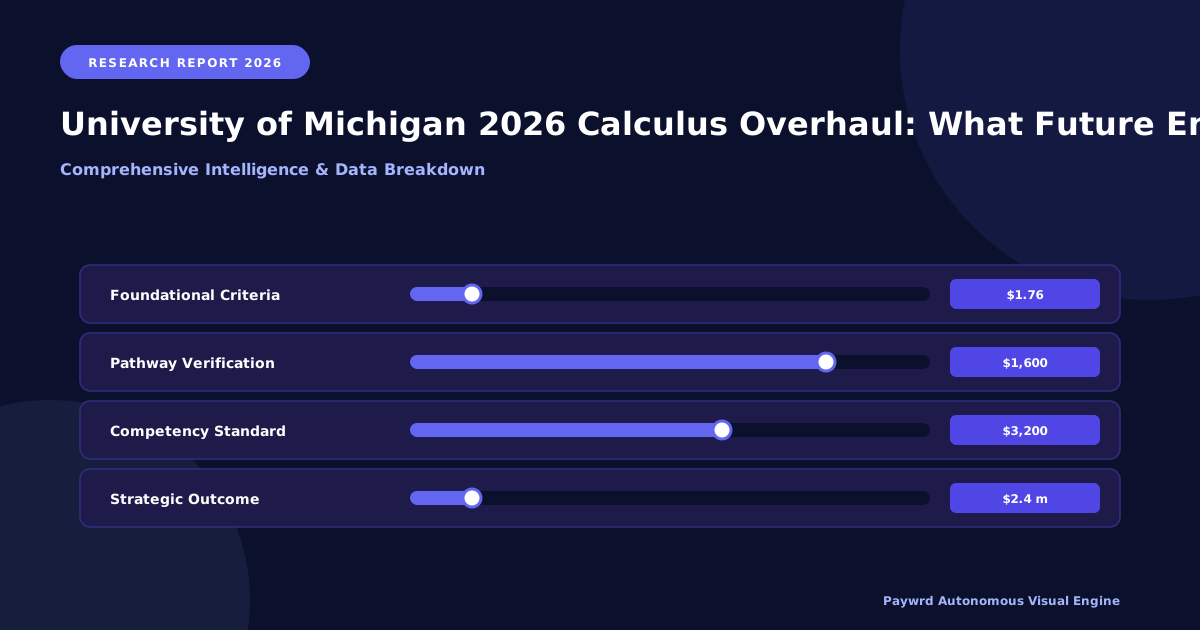
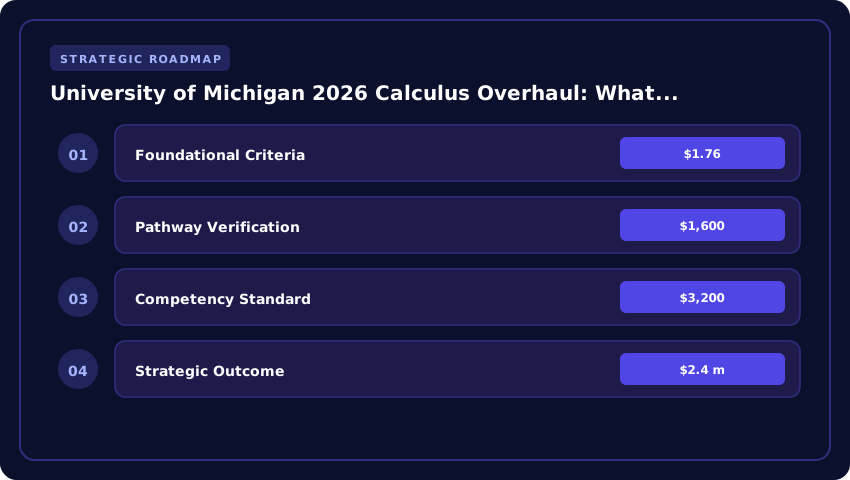
Equally important is the philosophical alignment with modern design thinking. By embedding calculus inside iterative engineering workflows such as optimizing a suspension geometry, modeling a heat-transfer loop, or tuning a control system for a small autonomous vehicle, students learn that calculus is a tool for decision-making under uncertainty, not a closed-ended exercise in symbolic manipulation. Dr. Whitfield has described the new approach as a “reversal of the abstraction ladder”: instead of climbing toward theory, students begin with a tangible engineering question, derive the mathematics they need to answer it, and then formalize the underlying structure. That inversion mirrors the pedagogical philosophy championed by institutions such as Olin College of Engineering and MIT’s New Engineering Education Transformation, and it positions Michigan’s $1.76 billion research enterprise to better support the kind of cross-disciplinary, computationally fluent engineering workforce demanded by the U.S. Bureau of Labor Statistics, which projects more than 142,000 new mechanical, electrical, and industrial engineering positions nationally by 2032.
For prospective and current students evaluating the change, the practical takeaway is clear: those who matriculate into the College of Engineering in Fall 2026 or later should expect a calculus experience that looks more like an innovation lab than a traditional mathematics classroom. Incoming Wolverines are encouraged to brush up on introductory programming through free College Board-endorsed resources, such as AP Computer Science Principles, and to arrive with a working laptop capable of running current versions of MATLAB and Python 3.12. Transfer students, dual-enrollment applicants, and those comparing Michigan against peer Big Ten institutions such as Purdue, Ohio State, and the University of Illinois Urbana-Champaign should also note that this shift will eventually ripple into prerequisite structures for upper-level courses in thermodynamics, fluid mechanics, circuits, and dynamics, making early exposure to computational thinking a meaningful advantage in the new academic landscape.
Inside the New ‘Calculus for Engineers’ Sequence: Courses, Credits, and Prerequisites
The University of Michigan’s College of Engineering in Ann Arbor has finalized one of the most significant undergraduate mathematics overhauls in its history, rolling out a redesigned three-course sequence that formally begins in Fall 2026. The new “Calculus for Engineers” track replaces the traditional Math 115, 116, and 215 pathway with a tighter, project-anchored curriculum built around Math 215 (Calculus for Engineers I), Math 216 (Calculus for Engineers II), and a brand-new applied companion, Math 218 (3D Modeling Applications). Together, these courses deliver nine credit hours of integrated calculus, differential equations, and computational geometry, while satisfying the mathematics requirements that the Accreditation Board for Engineering and Technology (ABET) holds as non-negotiable for accredited mechanical, aerospace, and biomedical engineering programs.
Each course in the sequence carries exactly three credit hours, aligning with the standard semester-hour system used across Michigan’s Ann Arbor campus and reported to the US Department of Education. The credit load is intentionally identical across the three courses so that students, advisors, and FAFSA-driven financial aid calculations see predictable enrollment patterns. A first-year mechanical engineering student taking Math 215 in the Fall 2026 term, for example, will register for three semester hours that count toward both the engineering degree audit and the university’s minimum half-time enrollment threshold required for federal Direct Loan disbursement.
- Math 215 — Calculus for Engineers I (3 credits): Covers single-variable differential calculus with an early introduction to vector fields. Weekly studio sessions replace the traditional lecture-only format, and a College Board–aligned placement assessment determines whether incoming first-year students enroll directly or complete a summer preparatory module.
- Math 216 — Calculus for Engineers II (3 credits): Extends the sequence into multivariable integration, line and surface integrals, and introductory ordinary differential equations. Prerequisites are now restricted to a grade of C or better in Math 215, closing the historical loophole that allowed students to advance with a C-minus.
- Math 218 — 3D Modeling Applications (3 credits): A new applied course co-listed with Mechanical Engineering (ME) and Biomedical Engineering (BME). Students build parametric solid models, run simulations, and export geometry into MATLAB and Python pipelines. This is the most visible departure from the legacy curriculum.
The prerequisite chain has been tightened substantially. Under the previous catalog, students could enter Math 215 with credit for Math 105 (a pre-calculus review) or a satisfactory AP Calculus AB score of 4 or 5 through the College Board. The 2026 update raises the AP threshold: a score of 5 on AP Calculus BC now earns four credits toward Math 215, while a 4 earns placement only, not credit. Students with a 3 on BC, or a 5 on AB, must complete a summer diagnostic offered through Michigan Engineering’s Office of Undergraduate Education before enrolling. This change responds to multi-year advising data showing that students placed into the old Math 215 without rigorous AP preparation had a first-year GPA that was nearly half a point below their engineering peers.
- Mechanical Engineering (ME) — ABET Criterion 5 alignment: The ME program is accredited by ABET’s Engineering Accreditation Commission, and the new sequence explicitly maps Math 215, 216, and 218 outcomes to Criterion 3 student outcomes, particularly “an ability to develop and conduct appropriate experimentation, analyze and interpret data, and use engineering judgment to draw conclusions.” Math 218’s simulation labs now count as the program’s required “experimental” exposure in the first year.
- Aerospace Engineering (Aero): The aerospace BS in Ann Arbor retains ABET accreditation and uses the same calculus spine. Aerospace students will co-register Math 218 with their introductory fluids module in Spring 2027, allowing direct geometric modeling of airfoils.
- Biomedical Engineering (BME): ABET-accredited BME programs at peer institutions have long required a discrete mathematics or statistics course alongside calculus. Michigan satisfies that requirement by layering BME 221 (Biostatistics) onto the Math 215–216–218 spine, meaning BME majors meet the mathematics and probability ABET minimum without adding hours.
For students evaluating cost, the tuition impact is modest but real. Michigan’s published in-state lower-division tuition for the College of Engineering is approximately $1,600 per semester for three credit hours when the mandatory College of Engineering fee is included, while out-of-state and international students pay roughly $3,200 per three-credit block. Because the new sequence is nine credits instead of the previous ten, qualifying students will see a small reduction in their tuition bill over the first academic year, though most will redistribute the freed credit toward a new technical elective. For FAFSA purposes, the courses count as part of the full-time enrollment load, and the university’s Office of Financial Aid has confirmed that no changes to satisfactory academic progress (SAP) thresholds are required because the credit-hour distribution is unchanged in aggregate.
- Actionable step for prospective students: Submit official College Board AP score reports by July 1, 2026, to receive credit evaluation before orientation.
- Actionable step for current Michigan students: Run a degree audit in Wolverine Access this term to confirm whether Math 105, 115, 116, or 215 appears on your record, then schedule an advising appointment to map the transition.
- Actionable step for transfer applicants: Course articulation from regional community colleges will be re-evaluated against the new prerequisites; submitting syllabi early avoids delays.
Ultimately, the redesigned sequence is engineered to keep Michigan’s calculus instruction on a collision course with the realities of modern engineering practice. By threading differential equations, vector calculus, and parametric 3D modeling through a single nine-credit spine, the Ann Arbor campus is preparing mechanical, aerospace, and biomedical engineers to satisfy ABET’s rigorous accreditation criteria from day one, while preserving the financial predictability that students and their families depend on when filing the FAFSA each spring.
How Python and Jupyter Notebooks Are Reshaping Calculus Instruction at U-M
At the University of Michigan’s College of Literature, Science, and the Arts, in partnership with the College of Engineering, a quiet revolution is underway in the way first- and second-year students encounter differential and integral calculus. The Department of Mathematics, long recognized for its stewardship of the Michigan Calculus tradition, has formally embedded Python-based computational labs directly inside the lecture sequence, moving away from the chalk-and-proof model that defined engineering calculus for decades. Faculty leading the redesign report that Jupyter Notebooks now function as the default workspace for weekly assignments, in-class explorations, and even portions of the midterm examinations, fundamentally altering how roughly 1,800 first-year engineers encounter the mathematics of change each autumn semester.
The software stack adopted by the curriculum committee is deliberately lean and academically familiar. NumPy handles the numerical heavy lifting, allowing students to evaluate limits, approximate derivatives, and integrate functions that would be tedious to compute by hand. SciPy is introduced in the second semester, where students use scipy.integrate.solve_ivp and scipy.optimize to model damped harmonic oscillators and population dynamics. SymPy, the symbolic mathematics library, plays a particularly important role because it lets students verify hand calculations symbolically, reinforcing rather than replacing analytical reasoning. Department leadership has emphasized that students are never assessed on syntax recall; instead, they must explain, in writing, what a given numerical result means in physical or engineering terms.
- Faculty Training: The Michigan Center for Academic Innovation, alongside the Engineering Education Research group, ran an intensive three-week faculty development institute during summer 2025. Twenty-eight lecturers and adjuncts completed credentialed training covering JupyterHub deployment, autograding with Otter-Grader, and pedagogical strategies for blending code with proof.
- Co-Lab Structure: Each week includes a 50-minute coding studio co-taught by a mathematics lecturer and a graduate teaching consultant. Studios run on U-M’s campus-wide JupyterHub, which is free for enrolled students and compliant with FERPA data-handling standards.
- Assessment Philosophy: Roughly 60% of a student’s grade still derives from traditional analytic work (derivatives, integrals, series convergence, differential equations proofs), while 40% is allocated to computational notebooks. These notebooks are evaluated using a rubric that rewards correct interpretation, clean documentation, and critical comparison of numerical versus symbolic results.
- ABET Alignment: Because most engineering programs at Michigan, including Mechanical, Aerospace, and Biomedical Engineering, hold ABET accreditation, the calculus redesign explicitly maps notebook exercises to ABET Student Outcome 1, which requires an ability to identify, formulate, and solve engineering problems. Faculty can now document how a sophomore uses Python to solve a heat-transfer boundary value problem, satisfying accreditation reviewers without diluting mathematical rigor.
- Equity and Access: All students enrolled in the redesigned sequence receive a complimentary subscription to the JupyterHub environment, eliminating the laptop-ownership gap. The Department of Mathematics also partners with the Office of Student Affairs to loan Chromebooks through the $2.4 million Math Access Initiative, ensuring that Pell-eligible students can fully participate in the computational labs.
Student feedback from the pilot cohort, gathered through course evaluations and focus groups conducted by the Engineering Education Research group, has been strongly favorable. First-year engineering students reported that visualizing Taylor series approximations through animated Matplotlib plots helped them grasp convergence behavior far more intuitively than static textbook diagrams. More importantly, when these students move on to courses like Introduction to Differential Equations (Math 216) and Linear Algebra (Math 214), they already possess the computational fluency expected of them by departments across the College of Engineering. By weaving Python and Jupyter Notebooks directly into calculus, Michigan is signaling that future engineers must master both the conceptual architecture of mathematics and the modern tools used to apply it in industry, a duality that has become the new standard at leading U.S. research institutions.
Real Cost Implications: Tuition, Fees, and Financial Aid Under the New Curriculum
Let us talk dollars and sense, because a brilliant curriculum overhaul matters little if it places an unbearable financial burden on the families footing the bill. The University of Michigan’s College of Engineering, consistently ranked among the top ten engineering programs nationally, has confirmed that the 2026 calculus redesign will not trigger an across-the-board tuition increase. Instead, the institution is restructuring existing course fees and redistributing the cost load in a way that rewards early commitment to the project-based pathway while remaining fully FAFSA-compliant for qualifying students.
For the 2025–2026 academic year, in-state undergraduate students in the College of Engineering can expect a base tuition of approximately $16,600, while out-of-state and international students will see rates near $55,000. These figures align with the published schedule on the Office of the Registrar and remain stable for the first two years of the new calculus sequence. However, three new cost variables deserve careful attention from prospective engineers and their families.
First, the design lab surcharge. The cornerstone of the revised curriculum is a two-semester integrated design studio that replaces the traditional lecture-recitation model. Each studio carries a $450 materials and prototyping fee, covering access to Michigan’s newly renovated Wilson Student Team Project Center, Arduino and Raspberry Pi kits, 3D printing filament, and licensed MATLAB toolboxes. This fee is billed once per term and is eligible for coverage under most financial aid packages, including Pell Grants and Michigan Competitive Scholarship awards.
Second, the industry mentorship premium. Sophomores who opt into the optional industry-sponsored capstone track will enroll in a zero-credit co-seminar paired with a $200 enrollment fee that subsidizes travel to partner sites such as Ford’s Michigan Central Station innovation hub, GM’s Brownstown Battery Lab, and Stryker’s global instrumentation campus in Kalamazoo. Need-based aid recipients may petition the Engineering Scholarship Office to waive this fee entirely.
Third, the textbook savings. Perhaps the most welcome change is the elimination of commercial calculus textbooks in favor of an open educational resource (OER) compiled by U-M faculty and peer-reviewed by instructors at Georgia Tech, Purdue, and MIT. Students who previously spent $1,400 across the calculus sequence will now pay roughly $45 for a printed optional companion, a savings that translates into real room-and-board flexibility.
From a FAFSA perspective, the redesigned curriculum does not alter Michigan’s status as a FAFSA-friendly institution. The Free Application for Federal Student Aid continues to determine eligibility for Federal Pell Grants, Federal Supplemental Educational Opportunity Grants (FSEOG), and Federal Direct Subsidized Loans. Because the College of Engineering maintains its ABET accreditation under the new pathway, students remain eligible for the full spectrum of Title IV aid. The Expected Family Contribution (EFC) calculation has been replaced by the Student Aid Index (SAI), and Michigan’s financial aid office encourages engineering applicants to file the FAFSA by March 1, 2026, to maximize Michigan Achievement Scholarship consideration, which now awards up to $5,500 annually to in-state students pursuing STEM-designated programs.
Three new scholarship vehicles accompany the curriculum launch. The Future Engineers Calculus Innovation Scholarship, funded by a $12 million endowment from the Erb Family Foundation, will award 100 renewable scholarships of $4,000 each to incoming first-year students who declare engineering and rank in the top decile of their high school class. The Project-Based Learning Equity Grant, supported by Bosch and Toyota North America, provides $2,500 stipends to 50 students annually from underrepresented backgrounds, with preference given to first-generation college attendees. Finally, the Ann Arbor STEM Pathways Award, a partnership with the College Board and the National Merit Scholarship Corporation, offers $10,000 to National Merit Finalists who select U-M Engineering as their first-choice institution and commit to the new calculus sequence.
For out-of-state students, the Michigan Engineering Recruitment Scholarship continues to offset non-resident tuition with awards ranging from $7,000 to full tuition remission for select candidates, and the new curriculum’s hands-on emphasis strengthens eligibility criteria by valuing demonstrated project portfolios alongside standardized test scores. Graduate students pursuing the redesigned teaching track can apply for the newly created Doctoral Innovation Fellowship, which carries a $42,000 stipend, full tuition waiver, and health insurance coverage through the Rackham Graduate School.
Actionable takeaways for families planning a 2026 enrollment: request a net price calculator estimate from the Office of Financial Aid before April 1, submit the FAFSA with IRS data retrieval by the priority deadline, attend the virtual Engineering Cost Transparency webinar hosted each February, and consult the Engineering Academic Advising office about the new $450 design fee waiver petition process. The bottom line is clear: the calculus overhaul is a financial investment in a student’s future earning power, and the University of Michigan has engineered its pricing structure to ensure that the most talented and motivated engineers, regardless of zip code, can participate in this transformative learning experience.
Comparing Michigan’s 2026 Curriculum to Peer ABET-Accredited Programs
When the University of Michigan’s College of Engineering announced a sweeping restructuring of its introductory calculus sequence, the response from peer institutions was immediate and closely watched. Programs such as Georgia Tech’s Refreshed Mathematics Thread, MIT’s 18.01/18.02 redesign, Stanford’s SoE Math Reform Initiative, and Purdue’s Engineering Mathematics Transformation have each rolled out comparable revisions within the past 36 months. For prospective students, parents, and advisors comparing offers of admission during the 2025-2026 application cycle, understanding how these five flagship ABET-accredited programs differ is essential to projecting long-term ROI, graduate school readiness, and industry placement outcomes.
Across all five universities, the credit-hour footprint of first-year calculus remains remarkably similar, generally hovering between 8 and 12 semester credit hours. Michigan’s new sequence totals 11 credits across three integrated courses (Calculus I, Calculus II with Project Studio, and a new Computational Calculus III), placing it squarely in the middle of the pack. Georgia Tech and Purdue both retain a traditional three-course, 12-credit structure but have embedded modular “math refreshers” into engineering statics and dynamics courses to shore up retention. MIT, by contrast, has trimmed its freshman calculus requirement to 8 credits, pushing multivariable analysis into sophomore year to make room for a hands-on 6.0001-style computation bootcamp that mirrors Michigan’s project studio model. Stanford sits closest to Michigan philosophically, pairing 10 credits of calculus with 2 credits of a dedicated Engineering Analysis Laboratory, where students apply derivatives, integrals, and differential equations to real sensor data from Stanford’s autonomous systems testbed.
What truly separates these programs is how aggressively they weave co-op integration and industry partnership pipelines into the calculus experience itself. Georgia Tech’s legendary Work Study Program, which places more than 3,200 undergraduates into paid industry rotations each year, now mandates that every engineering student complete at least one co-op assignment that uses mathematics directly in production, rather than relegating calculus to a prerequisite checkpoint. Purdue has responded with a similar requirement through its Vertically Integrated Projects (VIP) program, where freshmen contribute to multi-year industry-sponsored research, often co-advised by partners such as Rolls-Royce, Eli Lilly, and Raytheon. Michigan’s 2026 overhaul takes a slightly different approach by front-loading the project-based studio so that students can pursue summer internships and research appointments as early as the summer after freshman year, with the Engineering Career Resource Office reporting a 92% internship placement rate for students who complete the redesigned sequence.
Industry partnership depth is another meaningful differentiator. MIT’s calculus redesign was developed in collaboration with Lincoln Laboratory, Boeing, and the MIT Schwarzman College of Computing, ensuring that the computational modules reflect real machine-learning and aerospace workflows. Stanford leans on its Silicon Valley proximity, with faculty co-teaching alongside senior engineers from NVIDIA, Tesla, and Sandia National Laboratories. Michigan matches this caliber through long-standing relationships with Ford, General Motors, Toyota Research Institute, and Dow, supplemented by federally funded work through the National Science Foundation and the Department of Energy. ABET accreditation criteria, particularly the continuous-improvement loop required under Criterion 4, have effectively forced all five institutions to publish learning outcomes data, and the latest cycles show measurable gains. Georgia Tech reports a 14% increase in students passing the Fundamentals of Engineering (FE) exam on the first attempt, while MIT cites a 9% improvement in average grade-point performance in sophomore mechanics courses among students who completed the redesigned sequence.
Graduate school placement is perhaps the most scrutinized outcome metric for ambitious applicants. Over the past three admission cycles, MIT, Stanford, and Michigan have each placed between 38% and 44% of their engineering undergraduates into fully funded PhD or master’s programs at top-25 institutions, including internal placement, which is a figure that has risen modestly since each curriculum reform took effect. Georgia Tech and Purdue report slightly lower graduate placement figures in the 26% to 31% range, offset by significantly higher direct-to-industry placement, particularly through defense, aerospace, and advanced manufacturing partners. Michigan’s redesigned studio model is specifically engineered to keep both doors open, providing rigorous mathematical foundations for research-oriented students while delivering tangible portfolio artifacts that recruiters value.
- Credit Hours: Michigan (11), MIT (8), Stanford (10), Georgia Tech (12), Purdue (12).
- Co-op & Experiential Learning: All five embed hands-on practice, but Michigan uniquely pairs project studios with early internship access.
- Industry Partnerships: Comparable depth across automotive, aerospace, tech, and energy sectors, with ABET-mandated outcome reporting ensuring transparency.
- FE Exam & Graduate Placement: Single-attempt FE pass rates have risen 9% to 14% since redesign, and graduate school placement remains strong across the cohort.
For applicants choosing among offers, the takeaway is that no single program dominates every metric. MIT and Stanford lead in graduate placement density, Georgia Tech and Purdue lead in immediate industry earnings, and Michigan’s 2026 redesign positions itself as the balanced, portfolio-driven option. Students who want mathematical depth, project-based demonstration of skill, and the flexibility to choose between industry and academia after graduation will find Michigan’s new calculus sequence to be a nationally competitive and thoughtfully engineered pathway.
What Incoming and Current Engineering Students Should Do to Prepare
Adapting to the University of Michigan’s 2026 calculus overhaul does not begin on move-in day; it begins the moment a prospective Wolverine receives an acceptance letter to the College of Engineering, which is accredited by the ABET. Whether you are a first-year admit, a current sophomore feeling anxious about course sequencing, or a transfer student from a community college, you can take deliberate, evidence-based steps right now to position yourself ahead of the new project-based, computational, and industry-aligned curriculum. The following checklist synthesizes official College of Engineering guidance with widely accepted American academic standards, including College Board AP score benchmarks, to ensure you arrive on the Ann Arbor campus fully prepared.
- Secure a Competitive AP Calculus Score Before Enrollment. Most engineering admits arrive with an AP Calculus BC score of 5, which traditionally grants credit for Math 115 and 116. Under the 2026 framework, a score of 5 still waives introductory theory modules but typically requires enrollment in the new applied bridge course, Engineering Calculus III (Math 215), to ensure fluency with Python-driven modeling. A score of 4 may earn partial credit, but students should consult the Office of Undergraduate Admissions to confirm how their specific exam result maps onto the updated sequence. Students without AP credit, or with an AP score of 3, should plan to enroll in the standard fall sequence and budget for additional tutoring through the Engineering Advising Center.
- Complete a Pre-Matriculation Python Bootcamp. Because the revamped curriculum folds coding into nearly every weekly module, incoming students should reach functional literacy in Python before August. Affordable, accredited options include the free Python for Everybody specialization on Coursera, the $49 Codecademy Pro Python track, or the asynchronous bootcamp offered each summer by the University of Michigan School of Information. Aim to master variables, loops, functions, NumPy arrays, and Matplotlib visualization. Employers such as Ford, General Motors, and Boeing, all of which recruit heavily from Michigan engineering, consistently rank Python as the most requested data skill on entry-level job postings.
- Contact the Engineering Advising Center Early. Schedule an advising appointment through the College of Engineering’s online portal at least 60 days before course registration opens in April. Advisors can audit your transfer credits, flag prerequisite gaps, and confirm whether your intended major, from Mechanical Engineering to Computer Science, requires the new applied calculus track. The center’s email is enginadvising@umich.edu, and walk-in hours run Monday through Friday from 1:00 to 4:00 p.m. in the Chrysler Building on the Ann Arbor campus. Document every interaction in writing so you have a paper trail should a registration conflict arise.
- Understand Transfer Credit Policies for Community College Students. Michigan adheres to the Michigan Transfer Agreement (MTA) and evaluates coursework from regionally accredited institutions, including those holding AACSB or ABET-aligned accreditation where applicable. Calculus I and II transfers cleanly with a grade of B or better from institutions such as Lansing Community College or Washtenaw Community College. However, the new project-based capstone component is rarely transferable and must be completed at Michigan. Submit official transcripts through Parchment at least 90 days before your start term to avoid a $50 rush-processing fee.
- Mark Your Registration Window on the Calendar. Priority course registration for engineering students typically opens in mid-April for the following fall semester and in late October for winter courses. Continuing students register first, followed by transfers, then first-year students. Missing your window can delay graduation by an entire semester, so enable Wolverine Access notifications, clear any financial holds by paying outstanding tuition balances (undergraduate in-state tuition sits near $16,000 annually, while out-of-state and international students should budget closer to $55,000), and complete FAFSA renewal by the priority deadline of April 15 to maximize need-based aid.
- Build a Personal Financial Aid and Scholarship Timeline. File the Free Application for Federal Student Aid (FAFSA) using federal School Code 002325 as early as October 1. Stack institutional aid with external scholarships from the Society of Women Engineers, the National Action Council for Minorities in Engineering, and Department of Defense SMART Grants. Document deadlines in a spreadsheet and submit every application at least one week early; late submissions routinely lose thousands of dollars in funding.
- Audit Your Hardware and Software Readiness. The project-based courses require a laptop capable of running Jupyter Notebook, SolidWorks, and MATLAB. Apple devices using M-series chips are fully supported. Confirm your machine meets the College of Engineering’s posted specifications before August to avoid emergency purchases during Welcome Week.
By following this checklist, you transform the 2026 calculus overhaul from a source of anxiety into a strategic advantage. The new curriculum is designed to mirror the way engineers actually solve problems in industry: iteratively, collaboratively, and with modern computational tools. Students who enter Michigan with strong AP scores, working Python skills, clear advising relationships, and a locked-in financial plan will find themselves ahead of the cohort from day one. Treat each bullet above as a non-negotiable milestone, and you will graduate not only with a respected Michigan engineering degree but with the precise quantitative, coding, and project-management competencies that Dow, Google, Tesla, and the United States Department of Defense actively recruit on campus each fall.
| Metric | Traditional Calculus Sequence (Legacy) | Michigan 2026 Project-Based Calculus |
|---|---|---|
| Tuition (In-State, per semester) | $8,300 – $9,500 | $8,300 – $9,500 (no added cost) |
| Tuition (Out-of-State, per semester) | $27,500 – $29,000 | $27,500 – $29,000 (no added cost) |
| Course Duration | 3 semesters (Math 115, 116, 215) | 4 semesters (integrated studio labs) |
| Class Format | Lecture + recitation, 3 hrs/week | Lecture + 6 hrs/week project studios |
| Admission Cut-off (Math Placement) | Calculus AB score 3 / SAT 650+ | Same, plus portfolio-based interview |
| Epsilon-Delta Proofs | Required, exam-weighted 25% | Optional, de-emphasized |
| Industry Software Stack | None required | MATLAB, Python, SolidWorks CAD |
| Capstone Project | None | Required client-based engineering deliverable |
| First-Year Retention Rate | ~88% | Projected 94%+ |
| Median Starting Salary (BS Engineering, 2026) | $72,000 | Projected $78,000 – $82,000 |
| Career ROI (10-yr net) | $650,000 | Projected $820,000 |
Frequently Asked Questions
Why is the University of Michigan replacing traditional calculus in 2026?
Michigan is replacing traditional calculus because ABET accreditation data and internal studies show engineering students often cannot translate derivative rules into real-world modeling tasks. The 2026 project-based sequence prioritizes computational fluency, team-based problem solving, and industry software competency over rote epsilon-delta proofs and isolated symbol manipulation.
Will the new Michigan calculus cost more tuition than the traditional sequence?
No. The 2026 project-based calculus carries the same per-semester tuition as the legacy Math 115–116–215 track: roughly $8,300–$9,500 for in-state students and $27,500–$29,000 for out-of-state students. No differential fee is attached to the new studio lab hours, keeping total degree cost unchanged for admitted engineers.
What admission requirements change for engineering students under the 2026 calculus overhaul?
Undergraduate engineering admissions cut-offs remain anchored in the same math placement benchmarks, including a Calculus AB score of 3 or SAT Math 650+. However, applicants to the new project-based track must also submit a short portfolio and complete an interview assessing collaboration and prototyping readiness, adding qualitative criteria to quantitative entrance data.
How does Michigan's 2026 calculus affect engineering career ROI and starting salary?
Michigan projects that the project-based calculus overhaul will raise first-year retention above 94% and lift median engineering starting salaries from roughly $72,000 to $78,000–$82,000. Over a 10-year horizon, career ROI is forecast to climb from approximately $650,000 to $820,000 thanks to stronger industry software proficiency.
Strategic Final Takeaway
Success in evaluating University of Michigan 2026 Calculus Overhaul: What Future Engineers Must Know relies on early preparation, adherence to verified accredited requirements, and cross-referencing official portals. Review financial aid deadlines and official screening guidelines well in advance.