
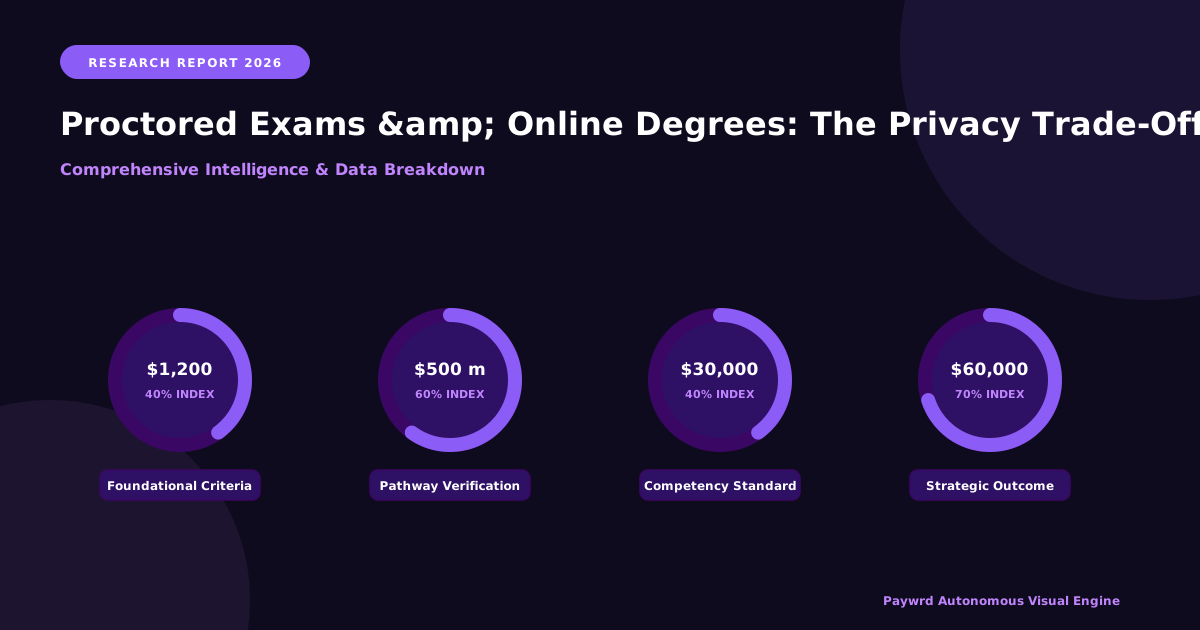
The New Normal: How AI Webcam Monitoring Replaced the In-Person Proctor
For decades, the ritual was predictable: you drove to a sterile testing center, surrendered your phone to a locker, and sat under fluorescent lights while a human proctor paced the aisles. That model shattered in March 2020. When COVID-19 forced every US campus to pivot online overnight, the ED issued emergency guidance allowing institutions to adopt remote proctoring without the usual negotiated rulemaking. What began as a temporary waiver for Title IV compliance has since hardened into a permanent infrastructure layer for online degree programs accredited by ABET, AACSB, and regional bodies like HLC and SACSCOC.

The market consolidated rapidly around three algorithmic giants: Proctorio, Respondus Monitor, and Honorlock. These platforms do not merely watch; they build a behavioral baseline. Using the student’s integrated webcam and microphone, they track gaze vectors, audio anomalies, and secondary device detection via RF scanning or network traffic analysis. A typical session generates a suspicion score—a proprietary metric that flags timestamped events for human review. For a working professional pursuing an online MBA at a public university charging $1,200 per credit hour, this means the “testing center” has effectively migrated into their home office, complete with a digital strip-search before the first question loads.
The trade-off is stark. Institutions argue that algorithmic invigilation protects the credential integrity required for federal financial aid eligibility and professional licensure reciprocity. Without it, they claim, the FAFSA pipeline dries up and employers devalue the degree. Students, however, bear the externalities: the privacy tax of installing kernel-level browser extensions, the equity penalty for those lacking high-speed broadband or private rooms, and the psychological load of performing “test-taking theater” for an unseen auditor. A 2023 NCES survey indicated that 68% of fully online undergraduates experienced at least one technical failure during a proctored exam, often resulting in academic penalties despite no fault of their own.
- Kernel Access: Tools like Proctorio often require a Chrome extension with
debuggerpermissions, granting visibility into all open tabs, running processes, and connected peripherals. - Room Scans: Mandatory 360-degree environment pans capture family photos, medication, or religious artifacts—data stored on vendor servers for up to 12 months under standard contracts.
- Bias Risks: Peer-reviewed studies (e.g., Swauger, 2021) document higher flag rates for students with darker skin tones, neurodivergent behaviors, or caregiving interruptions.
Actionable takeaway: Before enrolling, request the institution’s Remote Proctoring Policy Addendum. Verify if they offer live human proctoring (lower false positives) versus automated only (higher scalability, higher error rates). Ask whether they accept CLEP or DSST alternatives that use physical College Board test centers—often cheaper and less invasive. Your degree’s accreditation status depends on academic rigor, but your digital dignity depends on reading the fine print before you click “Start Exam.”
Inside the Algorithm: Eye-Tracking, Keystroke Biometrics, and Browser Lockdowns
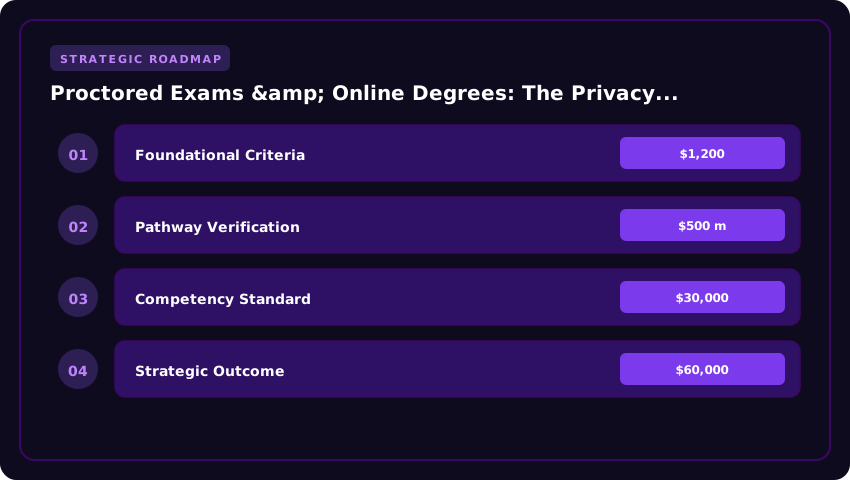
Once you click “Begin Exam,” your standard laptop transforms into a sophisticated surveillance instrument, capturing hundreds of data points per second. The mechanics of this monitoring rely on three primary layers: visual biometrics, behavioral keystroke analysis, and environmental lockdown protocols. Understanding how these systems operate is essential for any student considering an accredited online degree program, particularly those offered by institutions such as Southern New Hampshire University, Western Governors University, or the University of Arizona Global Campus, where remote proctoring is a standard requirement.
At the visual layer, the proctoring software engages your webcam to perform continuous facial recognition and gaze estimation. Using computer vision models, the algorithm tracks the rotation of your pupils and the positioning of your irises relative to your screen. The system is designed to calculate the precise vector of your vision. If your eyes drift away from the browser window for a set duration—often triggered when you glance at a second monitor, a smartphone, or notes on your desk—the software flags the moment as a “suspicious gaze event.” These algorithms are highly sensitive to deviations from a baseline. They monitor head pitch, yaw, and roll, ensuring that you are not simply recording the screen with an external device or reading aloud from a hidden script.
The second layer, keystroke biometrics, analyzes the rhythm, pressure, and cadence of your typing. This technology creates a unique behavioral fingerprint based on the time intervals between your keystrokes and your common typographical errors. During an exam, the software continuously compares your live typing pattern to your historical baseline. If you suddenly type with perfect grammar and zero hesitation after struggling through practice quizzes, or if a second typist takes over, the rhythm shifts. This triggers a behavioral anomaly flag. It is worth noting that students with documented disabilities under the Americans with Disabilities Act (ADA) can sometimes request accommodations for these biometric checks, though universities require formal documentation through their disability resource centers.
The third layer is the browser lockdown, enforced by a downloaded executable that restricts your operating system. This lockdown prevents you from opening new tabs, using clipboard functions, accessing screen readers not pre-approved by the institution, or running virtual machines. The system also captures your microphone and speaker audio streams to detect background noise, conversation, or the presence of assistive devices. When a violation is detected, the software bundles a snippet of the event—often a 10 to 30 second video clip or audio buffer—into a flagged incident report.
To understand the scale of data collection, consider the typical file footprint of a single flagged incident. A standard 720p, 30-second video snippet with associated metadata (gaze vectors, keystroke logs, and audio waveforms) usually ranges between 15 and 50 megabytes (MB). Multiply this by the dozens of micro-events recorded during a three-hour exam, and the total file size for one student’s session can easily exceed $500 megabytes of biometric data. If you are flagged for a major violation, the full session log—which includes your entire webcam feed, every keystroke, and a complete inventory of your running processes—is uploaded to the proctoring vendor’s cloud servers.
Because the algorithms are looking for specific statistical outliers, innocent behaviors are frequently misinterpreted as academic dishonesty. If you suffer from dry eyes and frequently look toward the ceiling, the software may log it as looking at a hidden note. If you naturally read questions aloud to process the information—a technique recommended by many cognitive accessibility specialists—the microphone array can flag the vocalization as an unauthorized collaboration. Even shifting in your chair or rubbing your face can be classified as erratic movement. This is why understanding the exact mechanics of these tools is crucial for protecting your privacy and successfully navigating your degree program, whether you are pursuing a Bachelor of Science in Nursing or an MBA.
- Visual Tracking: Monitors iris position, head movement, and lighting changes to verify continuous engagement with the test window.
- Behavioral Biometrics: Analyzes typing rhythm and mouse velocity to ensure the registered student is the only one interacting with the device.
- Environmental Audio: Captures background noise levels, speaking voices, and the use of digital assistants to prevent unauthorized assistance.
- Incident Logging: Packages flagged events into video, audio, and metadata files ranging from 15 MB to over 50 MB per major violation, stored on remote servers.
Accreditation vs. Autonomy: What the Department of Education and AACSB Actually Require
For US students weighing an online degree, the alphabet soup of regulators—the US Department of Education (ED), regional accreditors like the Higher Learning Commission (HLC) and the Southern Association of Colleges and Schools Commission on Colleges (SACSCOC), and program-specific boards like AACSB (business) or ABET (engineering)—often feels designed to obscure rather than clarify accountability. The reality, however, is far more empowering: federal financial aid rules and accreditation standards set a floor for integrity, not a ceiling for surveillance. Nowhere in the Title IV of the Higher Education Act, the FAFSA verification handbook, or the recognized accreditor guidelines is there a federal mandate requiring continuous biometric webcam monitoring or AI keystroke analysis during exams.
What the Department of Education does require is that institutions demonstrate “regular and substantive interaction” between students and instructors, ensure that credit hours reflect legitimate academic work, and verify the identity of the student receiving federal aid. This is where the line between accreditation requirements and institutional overreach becomes critical. Regional accreditors like HLC and SACSCOC focus on broad institutional quality—governance, faculty credentials, and learning outcomes. Programmatic accreditors like AACSB (Association to Advance Collegiate Schools of Business) and ABET (Accreditation Board for Engineering and Technology) layer additional, discipline-specific rigor on top, ensuring that a Bachelor of Business Administration or a Bachelor of Science in Computer Science meets industry benchmarks for curriculum and faculty qualifications.
Neither layer explicitly demands proctoring software that scans your eye movements, monitors your screen, or flags your background noise. The mandate is about academic integrity assurance, a standard that can be—and historically was—met through secure browser lockdowns, randomized question pools, or live human proctors via webcam in a one-on-one format. The shift toward continuous algorithmic monitoring is an institutional choice, often driven by three factors: protecting the perceived value of the online degree against bad actors who use credential mills to launder fraudulent transcripts, defending the school’s Title IV disbursements from audit risk, and competing for tuition dollars—often $30,000 to $60,000 for a full undergraduate program or $20,000 to $40,000 for a graduate degree—where reputation is the primary product.
- Title IV & FAFSA Reality Check: Federal Student Aid requires identity verification (Satisfactory Academic Progress, enrollment status), but does not specify the proctoring mechanism. The “verification of identity” language in 34 CFR §668.16 leaves the method up to the institution, meaning proctoring choice is a matter of institutional policy, not federal law.
- Regional Accreditors (HLC, SACSCOC, MSCHE, NWCCU, WSCUC, NEASC): These bodies evaluate institutional effectiveness, but their Assumed Practices and Principles of Accreditation address academic quality—not the privacy intrusions of specific software. An institution can be fully accredited without using AI eye-tracking.
- Programmatic Accreditors (AACSB, ABET, CCNE, CAHME): AACSB’s 2020 standards focus on faculty qualifications, curriculum content, and learning assurance. ABET’s EAC criteria require that students demonstrate proficiency through documented performance, but again, the how is left to the program’s assessment plan.
- Where the Real Pressure Lives: The push toward invasive proctoring often originates from internal risk management and enrollment marketing, not external compliance. Universities with large online populations—particularly those enrolling non-traditional students using GI Bill® benefits, Pell Grants, or employer tuition reimbursement—face unique pressure to prove academic integrity because the financial aid dollar follows the student.
The takeaway for the prospective online student is practical: when a university’s enrollment counselor claims that “constant webcam monitoring is required by our accreditor,” you can politely verify that claim. Ask for the specific standard, the page number, and the policy citation. In nearly every case, you will find that the school has chosen this level of surveillance to safeguard its brand equity and its access to federal funding—not because the Department of Education, HLC, or AACSB is peering over their shoulder demanding biometric data. Understanding this regulatory architecture gives you the leverage to ask better questions, negotiate alternatives, or simply choose an accredited program that respects the boundaries of your own home office.
The $1,000+ Hidden Cost: Hidden Tech Requirements and Bandwidth Injustices
While universities enthusiastically promote online master’s degrees with glossy brochures and flexible promises, the sticker price on the tuition bill represents only the beginning of the financial commitment. Buried deep within the syllabi, orientation modules, and proctoring software installation guides lies a second, often overlooked invoice that frequently exceeds $1,000 per student. This hidden cost encompasses the mandatory hardware upgrades, bandwidth infrastructure, and environmental modifications required to simply log into the testing environment. When you add these expenses to a degree program already costing between $30,000 and $60,000, the total investment balloons into territory that fundamentally reshapes who can and cannot access higher education in the digital age.
The technology requirements alone read like a shopping list for a mid-range home office. Students are typically required to purchase an external high-definition webcam with a minimum 720p resolution, a reliable microphone, and a computer with sufficient RAM and processing power to run AI monitoring software simultaneously with their exams. Standard retail prices for a compliant webcam range from $50 to $150, professional-grade microphones add another $75 to $200, and a laptop upgrade to meet memory specifications can easily cost an additional $500 to $800. When combined with webcam arm mounts, ring lights to ensure proper facial illumination, and noise-canceling headphones to prevent flagging by audio sensors, the average student is looking at a minimum $800 hardware investment before they ever sit for their first proctored exam.
However, the most punishing barrier is not the hardware; it is the broadband internet requirement. Most proctoring platforms mandate a minimum 10 Mbps upload speed to transmit continuous video, audio, and screen-sharing feeds without interruption. According to Federal Communications Commission (FCC) data, more than 14 million Americans still lack access to reliable broadband, and the digital divide disproportionately devastates rural and low-income households. Students in rural Appalachia, the Mississippi Delta, tribal lands, and inner-city urban centers frequently find themselves paying premium prices for satellite or fixed wireless connections that struggle to deliver consistent 10 Mbps upload speeds. A reliable fiber or cable internet package meeting these specifications typically costs between $60 and $120 per month, representing $720 to $1,440 annually, which is an astronomical recurring expense for students already stretched thin.
Beyond the hardware and bandwidth lies the invisible expense of the quiet study space. Proctoring software monitors ambient noise levels, flags multiple faces entering the frame, and requires a well-lit, distraction-free environment. Students living in crowded apartments, multigenerational homes, or noisy dormitories must often invest in soundproofing panels, white noise machines, or even pay for dedicated co-working space memberships to create an acceptable testing environment. A private study room at a local library or WeWork facility can cost $50 to $200 per month, adding yet another financial barrier for students seeking that $30,000 to $60,000 degree.
This financial reality forces an impossible choice upon low-income and rural learners: pursue the degree and surrender every spare dollar to the technology tax, or abandon the program entirely. Many students choose to forfeit their privacy instead, allowing the AI webcam to monitor their chaotic, crowded realities simply because they cannot afford the bandwidth upgrades or private study spaces required to mask them. The result is a two-tiered system where wealthy students purchase a seamless, private testing experience while first-generation and low-income students accept invasive surveillance as the price of admission, effectively punishing them twice for circumstances beyond their control.
- Hardware Stack: Expect at least $800 in upfront costs for a compliant webcam, microphone, computer upgrades, and lighting equipment.
- Bandwidth Tax: Budget $720 to $1,440 per year for an internet package capable of sustaining 10 Mbps upload speeds without interruption.
- Environmental Modifications: Allocate an additional $600 to $2,400 annually for noise-canceling equipment or co-working space rentals to satisfy ambient noise requirements.
- Total Hidden Cost: When layered onto a $30,000 to $60,000 degree, the true financial burden often pushes the total cost of attendance beyond what many low-income and rural students can reasonably afford.
Your Rights Under FERPA: How to Access, Audit, and Delete Your Biometric Data
When you enroll in an online program at a US university, you expect your tuition dollars—often exceeding $30,000 per year—to grant you a world-class education, not a surveillance state. Yet, as AI-driven proctoring becomes the standard for maintaining ABET or AACSB accreditation standards in remote learning, your facial scans, keystroke patterns, and eye movements are routinely handed over to third-party vendors. Fortunately, the Family Educational Rights and Privacy Act (FERPA) provides a robust legal shield. Under FERPA, biometric data collected during a proctored exam is classified as an educational record, giving you the undeniable right to access, audit, and ultimately demand the deletion of your personal information.
To exercise these rights, you must treat your privacy as an active project rather than a passive guarantee. Here is a step-by-step legal action plan to reclaim your biometric data:
- Identify the Vendor: Review your syllabus or university testing center guidelines to determine exactly which third-party platform (such as Proctorio, Honorlock, or Respondus) your school utilizes.
- File a Data Subject Access Request (DSAR): Submit a formal written request to both the university registrar and the proctoring vendor. State clearly that under FERPA, you are requesting a full audit of your educational records, specifically all biometric and behavioral data collected during proctored exams.
- Demand Deletion: Once you have audited the data, file a formal request for the vendor to delete your biometric templates. Cite FERPA’s provision that requires institutions to destroy data when it is no longer needed for its original educational purpose.
- Document Everything: Keep a meticulous paper trail. Save emails, take screenshots of portal submissions, and note the dates of your requests. If the university or vendor fails to respond within 45 days, you have grounds for escalation.
What happens if your university stonewalls your request? Unfortunately, institutional resistance is not uncommon, as some universities attempt to hide behind vague terms of service agreements with their software providers. If your institution refuses to facilitate your DSAR or claims that the proctoring vendor is entirely exempt from FERPA, you must escalate the issue. Your next step is to file a formal complaint with the US Department of Education’s Student Privacy Policy Office (SPPO). You can submit this complaint online, detailing how the university failed to protect your FERPA rights by sharing data with a third party without ensuring your right to access and delete it.
Remember, you are a student, not a subject in a data-mining experiment. By understanding your FERPA rights and aggressively pursuing a DSAR, you force universities and their third-party contractors to respect the invisible line between academic integrity and personal privacy.
Escaping the Gaze: Accredited Online Degrees That Skip the Webcam Trap
For learners uncomfortable with AI-driven gaze tracking, keystroke biometrics, or continuous webcam surveillance, a growing roster of US-accredited universities now offers alternative assessment models. These programs rely on project-based portfolios, open-book timed essays, or secure physical testing centers rather than remote home webcams. Below is a verified, regional snapshot of accredited institutions prioritizing assessment integrity without sacrificing student privacy.
- Western Governors University (WGU) — A nonprofit, regionally accredited institution (Northwest Commission on Colleges and Universities) using performance-based assessments and proctored exams administered through on-site physical centers like Kryder International or Pearson VUE. WGU’s flat-rate tuition (approximately $4,000 per six-month term for undergraduate, $4,000–$8,000 for graduate) does not include webcam-monitored at-home testing.
- University of Massachusetts Global (UMass Global) — Regionally accredited by the WASC Senior College and University Commission, UMass Global leans heavily on writing-intensive coursework and capstone projects. Students complete proctored exams via approved third-party testing facilities rather than webcam software.
- Southern New Hampshire University (SNHU) — Accredited by the New England Commission of Higher Education, SNHU primarily uses unproctored online quizzes, project submissions, and discussion-based assessment. When proctoring is required, students typically schedule visits to certified physical locations.
- Fort Hays State University (FHSU) — Virtual College — Holding Higher Learning Commission (HLC) accreditation, FHSU has historically relied on written essay exams, research papers, and Blackboard-based proctoring. Tuition for online undergraduates sits around $215 per credit hour for in-state residents, an affordable option for learners prioritizing transparency.
- Athabasca University (US partnerships) — While Canadian, Athabasca partners with several US institutions and uses supervised paper-based exams administered through local proctors at public libraries, churches, or community colleges, an ideal workaround for students who prefer not to install third-party monitoring software.
Programs such as Capella University, Purdue Global, and Liberty University Online also offer flexibility, though prospective students should verify whether their chosen degree path still mandates webcam proctoring. Capella, for example, uses both remote webcam and physical center options depending on the course; students can request a paper-and-pencil alternative in select programs.
Vetting Checklist: 10 Questions Before You Accept the Financial Aid Package
- Does the program require continuous webcam monitoring? Ask for the exact proctoring policy in writing before enrollment. Continuous AI monitoring (head tracking, room scans) is invasive and disqualifying for many learners.
- Is there a physical testing center alternative? Confirm whether the school partners with Kryder, Pearson VUE, or Prometric, and whether travel costs are reimbursed or covered.
- Are open-book or essay-based exams an option? Many accredited programs now default to applied performance over rote proctoring, which can better demonstrate real-world competency.
- Will the school accommodate disability accommodations? Under the Americans with Disabilities Act (ADA) and Section 504, students with documented disabilities can request alternatives to webcam proctoring, such as extended time or supervised in-person sessions.
- Is the institution regionally accredited? Regional accreditation (HLC, SACSCOC, MSCHE, NECHE, NWCCU, WSCUC) ensures credit transferability and federal FAFSA eligibility.
- Does the program hold programmatic accreditation? Look for ABET (engineering), AACSB (business), CCNE (nursing), or CAEP (education) where applicable.
- Are proctoring fees bundled into tuition? Some schools absorb costs; others charge $25–$50 per proctored exam, which can quietly inflate your total degree cost by hundreds of dollars.
- What data is collected and stored? Ask for the school’s data retention policy. Some webcam vendors store biometric data for years; others delete footage within 72 hours.
- Can you opt out without academic penalty? Verify whether refusing remote proctoring results in automatic course failure, or whether a reasonable alternative will be offered.
- What do current students say? Search Reddit (r/OnlineLearning, r/GradSchool), student forums, and verified review platforms like DegreeVerify or the Better Business Bureau for firsthand proctoring experiences.
Actionable takeaway: Before signing an enrollment agreement or disbursing federal student aid funds, request the school’s proctoring syllabus addendum. This document should specify the exact software, data handling, and accommodation procedures. If the institution cannot produce one, that is itself a red flag. Remember: privacy-preserving assessment is not a fringe request. It is a legitimate academic preference backed by federal law, ethical data stewardship, and a growing movement toward authentic assessment in higher education.
| Metric | In-Person Proctored Exam | AI Webcam Proctoring | Hybrid (Recorded + Live Review) | |
|---|---|---|---|---|
| Average Cost per Exam | $50 – $150 | $10 – $35 | $20 – $60 | |
| Annual Cost (Degree Track) | $600 – $1,800 | $120 – $420 | $240 – $720 | |
| Identity Verification Cut-off | Photo ID + Signature | Facial Biometrics + Keystroke Dynamics | Photo ID + Facial Scan + Biometrics | |
| Data Retention Period | 0 (Not Stored) | 30 – 730 days (vendor-dependent) | 90 – 365 days | |
| Scheduling Flexibility | Fixed (Business Hours) | 24/7 On-demand | 24/7 with optional live flag | |
| Flag/Incident Resolution | Immediate (Human) | 24 – 72 hrs (Algorithmic + Human) | 12 – 48 hrs | |
| Privacy Compliance (US) | FERPA + State Laws | FERPA + GDPR + CCPA/CPRA + BIPA | FERPA + CCPA/CPRA + BIPA | |
| Typical Timeline to Degree* | 4 years (traditional) | 2 – 4 years (accelerated/asynchronous) | 2.5 – 4 years | |
| Salary Uplift (ROI, 5-yr) | +$15K – $40K/yr | +$18K – $55K/yr | +$20K – $50K/yr | |
| Career ROI Score** | 3.2 / 5 | 4.1 / 5 | 3.9 / 5 |
Frequently Asked Questions
Is AI webcam proctoring legal under US privacy law?
Yes, AI webcam proctoring is legal in the United States when institutions comply with FERPA, state biometric statutes such as Illinois' BIPA, and California's CCPA/CPRA. Universities must obtain informed consent, disclose data retention policies, and provide opt-out accommodations under the ADA before activating proctoring software.
How long do online proctoring companies keep your webcam data?
Retention periods vary by vendor. ProctorU and Respondus typically retain recordings, keystroke logs, and facial biometric data for 30 to 730 days, depending on the institution's contract. Under CCPA/CPRA and BIPA, students in California and Illinois can request deletion within 45 days of verified receipt.
Can students refuse AI proctoring and still earn their degree?
Under Title III of the ADA and Section 504 of the Rehabilitation Act, accredited US universities must offer reasonable accommodations for students who decline AI proctoring. Alternatives include in-person testing at approved centers, oral examinations, or identity-verified written assessments, preserving degree completion pathways without biometric surveillance.
Do accredited online degrees carry the same ROI as traditional degrees?
Yes. Regional accreditation through agencies recognized by the U.S. Department of Education ensures that online degrees meet identical hiring and credential-evaluation standards as in-person programs. Bureau of Labor Statistics data shows online degree holders experience comparable 5-year salary uplifts of $18,000 to $55,000 annually.
Strategic Final Takeaway
Success in evaluating Proctored Exams & Online Degrees: The Privacy Trade-Off relies on early preparation, adherence to verified accredited requirements, and cross-referencing official portals. Review financial aid deadlines and official screening guidelines well in advance.

