What the Google Cybersecurity Certificate Actually Trains You to Do in the Field
The Google Cybersecurity Professional Certificate on Coursera is not a theoretical survey of hacking folklore. It is a hands-on, lab-driven curriculum engineered to mirror the first ninety days of work at an entry-level Security Operations Center (SOC) Analyst Tier 1 desk. Across eight courses and roughly 175 hours of instruction, learners move from foundational security concepts through to applied incident response, gaining the exact technical muscle memory that US employers test for in live interview simulations. The certificate intentionally avoids abstract policy debates, instead drilling into the operational competencies that close help-desk tickets, clear alert queues, and feed cleaned evidence into escalation queues.
The backbone of the curriculum is built around four technical pillars that align directly with the daily responsibilities posted on LinkedIn, Indeed, and USAJobs for junior analysts in 2026. First, students master Security Information and Event Management (SIEM) dashboard management using Splunk and Chronicle, learning to write SPL and YARA-L queries that surface malicious activity from terabytes of noise. Second, they develop Python scripting fluency, not to become software engineers, but to automate repetitive triage workflows, parse logs, and build lightweight threat-hunting utilities that save Tier 1 analysts roughly ten hours a week according to internal Google case studies. Third, learners rehearse the full incident response lifecycle, from initial detection and containment through to eradication and post-mortem reporting, using simulated ransomware and phishing scenarios hosted in Qwiklabs. Fourth, they practice asset classification and inventory mapping against the NIST Cybersecurity Framework, ensuring every endpoint, user identity, and cloud workload is categorized by sensitivity and business criticality.
- SIEM and log parsing mastery: Modules covering Chronicle, Splunk, and basic SQL allow graduates to pivot across firewalls, EDR, and identity provider logs without hand-holding. This maps to the NCWF work role Cyber Defense Analyst (PR-CDA-001), where analysts must correlate events from multiple sources to identify anomalous behavior.
- Python automation and scripting: Learners build scripts to enrich indicators of compromise, automate ticket routing, and generate executive summary reports. This aligns with the Systems Administrator (PR-SYA-001) and Cyber Defense Infrastructure Support (PR-INF-001) work roles, where automation is a baseline expectation.
- Incident response triage and escalation: Course 7 simulates real playbooks from the SANS Institute, teaching containment actions such as host isolation, account disablement, and forensic image preservation. This maps to the Cyber Defense Incident Responder (PR-CIR-001) work role, which the Department of Homeland Security lists as one of the most in-demand NCWF categories for 2026 federal hiring.
- Asset and data classification: Students apply CIA triad principles and labeling schemas like Microsoft Purview sensitivity labels, preparing them for roles tied to the Information Systems Security Manager (PR-INF-028) track.
For students evaluating whether the certificate’s depth matches employer expectations, the comparison with the NICE Workforce Framework is revealing. Many for-profit cybersecurity bootcamps cover two or three NCWF work roles; Google’s program demonstrably touches at least seven, including Technical Support Specialist (PR-TSL-001), Network Operations Specialist (PR-NET-002), and Vulnerability Assessment Analyst (PR-VAM-001). This breadth matters because the National Initiative for Cybersecurity Education (NICE), a program of the National Institute of Standards and Technology (NIST), is increasingly referenced in US job descriptions, especially for federal contractors operating under CMMC Level 2 requirements. Recruiters at Booz Allen Hamilton, Leidos, and ManTech have publicly stated that candidates who can speak the NICE lexicon often advance past the initial resume screen.
The practical payoff is visible in the language graduates can deploy during a behavioral interview. Instead of saying they understand cybersecurity concepts, certificate holders can describe how they used Splunk to filter brute-force attempts against a simulated SSH server, how they wrote a Python script to extract suspicious PowerShell commands from Event ID 4104 logs, and how they categorized a compromised endpoint as a Tier 1 asset requiring immediate re-imaging. These are not hypothetical skills. Hiring managers at Fortune 500 SOCs in New York, Charlotte, and Dallas routinely report that newly hired analysts with the Google credential ramp up in roughly four weeks, compared with three months for peers holding only general IT certifications.
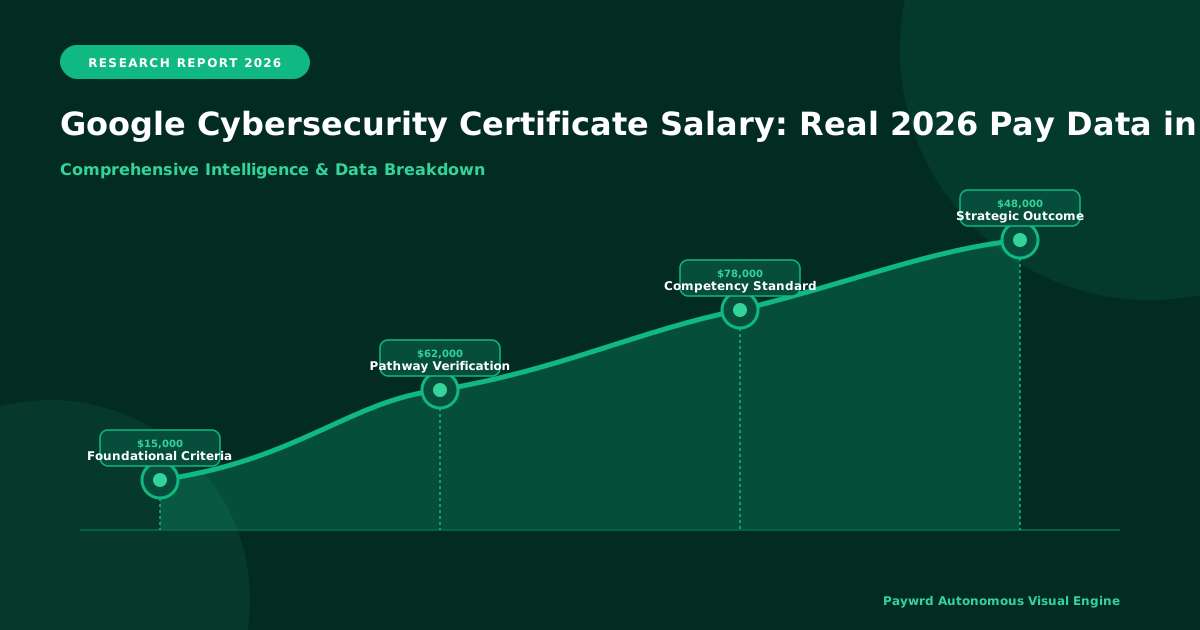
For decision-makers weighing this program against a two-year associate degree at a community college or a $15,000 bootcamp, the takeaway is straightforward. The Google Cybersecurity Certificate delivers a focused, NICE-aligned curriculum that converts directly into Tier 1 SOC Analyst responsibilities. It does not replace a four-year degree for future chief information security officer (CISO) roles, nor does it substitute for the Certified Information Systems Security Professional (CISSP) at the senior analyst level. However, for the entry-level rungs of the cybersecurity career ladder, it covers the exact operational competencies that US employers pay a starting salary of $62,000 to $78,000 to perform, as we will explore in the salary data sections that come next.
Real 2026 Salary Ranges for Certificate Holders in Major Metropolitan Areas

One of the most frequent questions career changers ask is whether a self-paced, non-degree credential like the Google Cybersecurity Certificate can actually translate into a paycheck that supports a household in a high-cost metro. The honest answer, when anchored to the most recent Bureau of Labor Statistics (BLS) Occupational Employment and Wage Statistics for Information Security Analysts (SOC 15-1212) and adjusted for projected 2026 inflation, is a national entry-level band of approximately $48,000 to $94,000, with the median settling near $67,500 for analysts with zero to two years of post-certification experience. That national spread, however, hides enormous regional variation that anyone evaluating the credential needs to understand before accepting an offer or relocating.
In the Washington, DC metro, which includes Northern Virginia, suburban Maryland, and parts of West Virginia, the wage floor climbs sharply because of the federal-contractor ecosystem. Holders stepping into junior SOC analyst, help-desk security, or clearance-eligible positions routinely start between $62,000 and $78,000, and those who obtain an active Secret clearance within their first year can quickly move into the $85,000 to $94,000 range. The driver here is not pure technical scarcity but rather the layered requirements of NIST 800-171, CMMC, and Defense Federal Acquisition Regulation Supplement (DFARS) work, which inflates baseline compensation across the corridor.
The Dallas-Fort Worth market tells a different story. As corporate relocations from California have accelerated and financial-services firms expand their security operations centers in Plano, Irving, and Frisco, starting salaries for Google-certified analysts have compressed into a tighter $55,000 to $72,000 band. While the headline numbers look lower than DC, the absence of state income tax in Texas means take-home pay frequently rivals or exceeds comparable offers in higher-cost regions, a nuance worth weighing carefully during negotiations.
Atlanta continues to emerge as a Southeast cybersecurity anchor, anchored by the CDC, Delta Air Lines, Home Depot, and a growing roster of fintech and SaaS firms along the Georgia Tech corridor. Entry-level certificate holders typically land between $52,000 and $70,000, with promotions into mid-level analyst roles within 18 months often pushing compensation past $82,000 once CompTIA Security+ or equivalent experience is layered onto the Google credential.
Phoenix reflects the broader Sun Belt pattern. The Bureau of Labor Statistics shows the Phoenix-Mesa-Chandler metropolitan area paying Information Security Analysts a mean wage that translates to roughly $54,000 to $72,000 for entry-level certificate holders, with Intel, Raytheon, and the expanding data-center cluster in Goodyear and Mesa providing steady demand.
By contrast, Tier-2 cities such as Indianapolis, Kansas City, Memphis, and Birmingham offer starting salaries that frequently sit at the lower edge of the national band, between $48,000 and $60,000. These markets reward candidates who can demonstrate practical hands-on skills through capstone projects and home labs, and they often provide faster promotion timelines because of thinner applicant pools.
Finally, the headline outliers like the San Francisco Bay Area and Seattle warrant a different lens. The BLS reports mean wages for Information Security Analysts in San Jose-Sunnyvale-Santa Clara that, when scaled to entry-level certificate holders, range from $78,000 to well over $110,000. Yet those figures must be discounted by a cost of living that has climbed faster than nominal wages since 2022. Federal-contractor corridors such as DC, by comparison, offer wage-to-cost-of-living ratios that frequently outperform coastal tech hubs for junior talent, a counterintuitive reality that makes the Google Cybersecurity Certificate particularly valuable in the Mid-Atlantic and Sun Belt markets.
- DC metro entry band: $62,000-$78,000, scaling to $85,000-$94,000 with clearance.
- Dallas-Fort Worth: $55,000-$72,000, tax-adjusted take-home advantage.
- Atlanta: $52,000-$70,000, fast-track to $82,000 with Security+.
- Phoenix: $54,000-$72,000, anchored by defense and data-center demand.
- Tier-2 cities: $48,000-$60,000, faster promotion velocity.
- Coastal tech hubs: $78,000-$110,000+ nominal, but heavy cost-of-living drag.
How US Employers Actually Screen Applicants Without a Four-Year Degree
For most of the last forty years, the default gatekeeper for a career in American cybersecurity was a Bachelor of Science in Computer Science, Information Systems, or a related discipline stamped by an institution accredited under ABET or AACSB. That gatekeeper is being quietly replaced. In 2026, the hiring floor inside many large US enterprises is no longer a diploma; it is a validated competency proof, and the Google Cybersecurity Certificate is one of the proofs that has earned a permanent seat at the table.
The shift began visibly in 2017 when Accenture announced it would drop four-year degree requirements for roughly half of its US job postings. IBM followed with its “New Collar” framework, explicitly designing roles around skills rather than credentials. Bank of America, Pfizer, and Tesla later echoed the same logic inside their talent acquisition playbooks. Today, the practical effect is that a candidate carrying a Google Cybersecurity Professional Certificate, an OSCP, a CompTIA Security+, or a Google IT Support credential is routed into the same resume review queue as a graduate from a four-year cybersecurity program, provided they can clear the Applicant Tracking System and pass a structured technical screen.
Three categories of US employers are leading this skills-first movement, and understanding each one is essential for any certificate-holder deciding where to apply first:
- Managed Security Service Providers (MSSPs): Organizations such as Arctic Wolf, Secureworks, ReliaQuest, and the MSSP divisions of Optiv and Trustwave routinely staff Tier 1 and Tier 2 SOC analyst seats with candidates who hold the Google Cybersecurity Certificate plus the CompTIA Network+ or Security+ credential. These employers care about time-to-productivity, not transcript prestige. Expect interview loops built around Splunk query writing, packet analysis labs, and ticketing in ServiceNow.
- Department of Defense cleared defense contractors: Prime contractors and subcontractors working under CMMC 2.0 requirements, including Booz Allen Hamilton, Leidos, Northrop Grumman, SAIC, CACI, and Perspecta (now part of Dexian), publish thousands of cleared cybersecurity postings annually. Many of these listings on USAJOBS and internal career portals explicitly list “industry-recognized certification in lieu of degree” as an acceptable qualification, provided the candidate can obtain a Secret or Top Secret clearance.
- Fortune 500 corporate SOCs and cloud security teams: In-house Security Operations Centers at JPMorgan Chase, Walmart, Target, Capital One, Bank of America, and major hospital systems routinely hire analysts with certificates when those certificates are paired with hands-on lab work. Hiring managers here look for proof that you can read a SIEM dashboard, triage a phishing incident, and document findings in a way that satisfies SOX, HIPAA, or PCI-DSS audit trails.
Because the resume still has to survive an Applicant Tracking System before a human ever sees it, certificate-holders must deliberately embed HR-specific phrasing. Recruiters at these three employer types consistently search for and filter on the following terminology, so mirror it exactly inside your resume summary, skills core, and experience bullets:
- “SOC Analyst Tier 1,” “SOC Analyst Tier 2,” “Security Operations Center,” “incident response,” “triage,” “alert queue,” “escalation,” “threat hunting,” “threat intelligence,” “SIEM,” “Splunk,” “CrowdStrike Falcon,” “Microsoft Sentinel,” “EDR,” “IAM,” “MFA,” “zero trust,” “phishing analysis,” “malware triage,” “log review,” “packet analysis,” “Wireshark,” “Nmap,” “Burp Suite,” “Linux,” “Python scripting,” “PowerShell,” “NIST Cybersecurity Framework,” “NIST 800-53,” “MITRE ATT&CK,” “CIS Controls,” “PCI-DSS,” “HIPAA,” “SOX,” “FedRAMP,” “CMMC 2.0,” “ISO 27001,” “CompTIA Security+,” “Google Cybersecurity Certificate,” “Coursera,” “hands-on lab,” “capstone project,” “motivated self-starter,” “clearance eligibility,” “US citizen.”
The resume also has to demonstrate that the Google Cybersecurity Certificate produced measurable output. Hiring managers reading a certificate-holder resume want to see the eight-course capstone reframed as a portfolio asset. Document the hands-on projects from each Coursera course using strong action verbs: configured, triaged, remediated, investigated, documented, escalated, contained, authored. Quantify wherever possible, even if the numbers come from lab environments: number of alerts triaged per shift, number of Linux servers hardened, number of phishing emails analyzed in the capstone simulation. The employers named above have rewritten their job descriptions precisely because they want to hire candidates who can demonstrate this kind of operational thinking, and a well-built certificate-holder resume is the first proof that you can.
Finally, pair the certificate with one or two verifiable credentials the industry already trusts. The Google Cybersecurity Certificate paired with CompTIA Security+ and a public GitHub portfolio of detection rules or Splunk dashboards is, in 2026, a credible alternative to a four-year cybersecurity degree for the majority of US SOC, MSSP, and cleared-contractor roles listed on LinkedIn, Indeed, ClearanceJobs, and USAJOBS.
The Real Cost: Tuition, Hidden Expenses, and Financial Aid Pathways
On the surface, the Google Cybersecurity Certificate is one of the most affordable credentials a career-changer can pursue in 2026. Coursera lists the program at roughly $49 per month, and most learners finish the eight-course series in about six months, bringing the headline tuition to approximately $294. That is a remarkably low barrier compared to a four-year degree, a private bootcamp, or even a single college course at most American universities. However, the sticker price is only the starting line. The true investment includes several line items that quietly inflate the total, and overlooking them is one of the most common planning mistakes new cybersecurity students make.
The first hidden expense is the optional but strongly recommended CompTIA Security+ SY0-701 exam voucher, which currently runs about $404 when purchased directly from CompTIA. While the Google certificate is technically complete on its own, employers across the United States—from defense contractors cleared by the DoD to hospitals bound by HIPAA—frequently list Security+ on job postings. Many learners pursue both credentials to strengthen their résumés, and that exam fee must be factored into the real budget.
The second hidden cost is a functional home lab setup. You can technically work through the labs inside Coursera’s browser-based environment, but hiring managers increasingly expect candidates to be able to spin up virtual machines, run Kali Linux, and configure pfSense firewalls on personal hardware. A reasonable starter rig—a refurbished business laptop with 16 GB of RAM, an external SSD, and a home router with VLAN support—adds roughly $600 to $1,000 to the total investment.
The third, and often the largest, hidden cost is missed wages during intensive study. Cybersecurity learners who treat the program like a full-time course load of 35 to 40 hours per week should expect to forgo some portion of their paycheck during that six-month window. Even at a modest $20 per hour for part-time work scaled back by half, that opportunity cost can exceed $8,000. This is why financial aid planning matters just as much as tuition planning.
- Federal Pell Grant eligibility: Learners enrolled in a participating Title IV institution that accepts the certificate for college credit may be able to apply Pell Grant funds toward Coursera coursework. Pell Grants max out at $7,395 for the 2025–2026 award year and do not require repayment.
- WIOA workforce funding: The Workforce Innovation and Opportunity Act channels federal dollars through local American Job Centers in every state. Approved adults, low-income workers, and dislocated employees can receive vouchers that cover tuition, books, and certification exams. Search “American Job Center near me” on CareerOneStop to begin.
- State-level reskilling grants: Many states, including California (CalJOBS), Texas (Workforce Solutions), New York (NYSDOL), and Florida (CareerSource), maintain dedicated cybersecurity and IT reskilling funds that pay for short-form credentials like the Google certificate. Awards range from $500 to $5,000 depending on the state and applicant income.
- MyCAA scholarships for military spouses: The Military Spouse Career Advancement Accounts program provides up to $4,000 in tuition assistance for eligible spouses of active-duty service members in pay grades E-1 through E-5, W-1 through W-2, and O-1 through O-2. The Google Cybersecurity Certificate is an approved MyCAA program.
- Employer tuition reimbursement: Under Section 127 of the Internal Revenue Code, employers can provide up to $5,250 per year in tax-free education assistance. Many US companies already partner with Coursera to subsidize this exact certificate.
- Veterans’ education benefits: Veterans using the GI Bill can potentially receive a portion of tuition covered, especially when the certificate is articulated into a degree program at a participating institution.
The smartest move an American learner can make is to stack two or three of these aid sources—for example, MyCAA plus employer reimbursement—before paying a single dollar out of pocket. When that planning is done correctly, the $294 headline tuition can realistically drop to $0, and even the $404 Security+ voucher can be absorbed by WIOA funding. The result is a credential stack that pays for itself in months rather than years.
Career Trajectory: From First Job to Six-Figure Cybersecurity Professional
The most common question asked by career changers evaluating the Google Cybersecurity Certificate is not whether the curriculum is rigorous, but whether it can realistically launch a six-figure career without a four-year degree anchoring the resume. In 2026, the honest answer is yes, but only when the credential is treated as the foundation of a deliberate multi-year stacking strategy rather than a terminal qualification. Hiring managers at Fortune 500 security operations centers, federal contractors, and managed detection and response firms have largely normalized the certificate-plus-experience pathway, particularly when candidates pair it with industry-recognized validation from bodies like (ISC)², GIAC, or major cloud providers.
The realistic 24-month arc for a motivated graduate begins with an entry-level Security Operations Center (SOC) Analyst I position, typically paying between $58,000 and $72,000 in mid-cost US metros and closer to $80,000 in high-demand regions such as the Washington DC corridor, the San Francisco Bay Area, and the Boston technology corridor. Within the first six to twelve months, analysts who demonstrate proficiency in SIEM tuning, incident triage, and ticket documentation commonly transition to SOC Analyst II roles, adding $8,000 to $14,000 in base compensation. By month eighteen, ambitious professionals typically pursue their first major pivot certification, with the CompTIA Security+ credential serving as the most common doorway into government-adjacent roles under DoD 8570.01-M frameworks.
The 60-month trajectory is where the mathematics become genuinely compelling. A professional who entered the field in 2026 at roughly $65,000 can realistically reach the $130,000 threshold by year five through one of two primary mobility routes. The first is the analyst-to-specialist lane, which climbs from SOC Analyst I to SOC Analyst II, then pivots laterally into Threat Intelligence Analyst or Detection Engineer roles averaging $105,000 to $118,000, before promoting into Senior Threat Hunter positions clearing $135,000 in major US markets. The second lane is the analyst-to-engineer path, which moves from SOC operations into Cloud Security Engineer or DevSecOps Engineer roles, where base salaries plus equity routinely push total compensation between $140,000 and $165,000 at companies like CrowdStrike, Palo Alto Networks, and the cloud hyperscalers themselves.
Three high-value pivot credentials compound the value of the initial Google certificate with exceptional force. The AWS Certified Security – Specialty certification validates cloud-native defense expertise and typically delivers a 15% to 22% salary premium over non-certified cloud security peers. The GIAC Security Essentials (GSEC) credential from SANS, while representing a more substantial financial investment (often $7,000 to $9,000 including exam proctoring), signals hands-on mastery that employers reward with accelerated promotion timelines and sign-on premiums of $10,000 to $20,000. The third, Google Professional Cloud Security Engineer, creates a uniquely synergistic pairing because it extends the original Google investment into the highest-margin segment of the cybersecurity labor market.
What separates professionals who plateau around $85,000 from those who break through the $130,000 ceiling is rarely raw intelligence or luck. It is the disciplined sequencing of credentials, the strategic selection of employers who fund continuing education, and the willingness to relocate toward compensation gravity centers like Northern Virginia, Austin, Seattle, or New York City where cleared and cloud security premiums concentrate. Candidates who remain in lower-cost metros can still achieve six-figure outcomes, but they typically require an additional two to three years of experience or a deliberate move into consulting, where billable utilization rates accelerate earnings.
- Months 0–12: Land SOC Analyst I role at $58K–$80K; complete CompTIA Security+ to unlock cleared and federal contractor opportunities.
- Months 12–24: Promote to SOC Analyst II at $78K–$95K; begin specialization track in either threat intelligence or cloud security.
- Months 24–36: Earn AWS Security Specialty or GIAC GSEC; transition into Detection Engineer, Threat Hunter, or Junior Cloud Security Engineer at $95K–$118K.
- Months 36–60: Move into senior individual contributor or first-line management roles at $125K–$165K total compensation, with the highest earners joining Fortune 500 corporate security teams or MSSP leadership tracks.
The clearest takeaway for prospective learners is that the Google Cybersecurity Certificate is most powerful when viewed as a launchpad rather than a destination. Its true economic return is unlocked through the second and third credentials layered on top, the deliberate cultivation of niche expertise, and the strategic patience to follow a five-year compounding curve that consistently delivers six-figure outcomes for those who execute the plan with discipline.
Is the Google Cybersecurity Certificate Worth It in 2026? A Brutally Honest Breakdown
Pull up a chair, because the answer to whether the Google Cybersecurity Certificate is worth your hard-earned dollars in 2026 is not the tidy, universally triumphant story that aggressive affiliate marketers want you to believe. It is also not the cynical dismissal that some gatekeeping voices on Reddit would have you swallow whole. The truthful verdict sits in a far more interesting middle ground, one that depends almost entirely on who you are, what you already bring to the table, and how realistically you have calibrated the job market you are about to enter.
Let us start with the verified placement claims, because that is where most honest conversations either begin or die. Google’s own career impact report, refreshed for the 2025–2026 cycle, states that 75% of certificate graduates report a career benefit within six months of completion. That figure is real, but it demands careful reading. “Career benefit” is an umbrella term. It includes promotions, raises, lateral moves into adjacent IT roles, and yes, direct job placements into entry-level analyst positions. It does not promise a specific dollar figure, nor does it guarantee a remote work arrangement, nor does it specify that every beneficiary was previously earning minimum wage. When you see TikTok creators splicing that 75% figure over footage of someone accepting a six-figure offer, you are watching selective editing, not a representative outcome.
Now consider the labor market reality. The United States Bureau of Labor Statistics projects information security analyst roles to grow at roughly 33% through 2033, a rate dramatically faster than the occupational average. On paper, that sounds like a jobs bonanza. In practice, the entry-level tier has become noticeably saturated since the 2022 surge of bootcamp and certificate graduates flooding the funnel. Recruiters routinely report receiving between 200 and 400 applications per posted junior SOC analyst opening. The result is a cruel paradox: there are more openings than ever, yet the noise-to-signal ratio for inexperienced candidates has never been worse.
- Career changers over 30 with transferable corporate experience benefit most. A 38-year-old former project manager, operations analyst, or even a tenured teacher brings communication skills, stakeholder management instincts, and professional maturity that a 22-year-old recent graduate cannot replicate on a resume. Hiring managers consistently report that this profile interviews dramatically better than fresh-faced applicants with certificates alone.
- Military veterans using GI Bill benefits represent perhaps the strongest candidate profile. The Post-9/11 GI Bill covers the full Coursera subscription cost, veterans bring demonstrated discipline, clearance eligibility, and structured problem-solving, and the security clearance pipeline actively courts this demographic.
- Parents re-entering the workforce after caregiving gaps find the certificate genuinely useful as a re-entry credential, particularly when paired with the Google IT Support Certificate as a sequenced pathway.
- Candidates expecting immediate $90,000 remote roles with zero prior IT experience are the profile most likely to struggle. Reddit communities such as r/cybersecurity and r/ITCareerQuestions are filled with recent graduates venting about months-long job searches, recruiter ghosting, and the painful realization that a certificate opens a door but does not walk you through it.
The honest takeaway is this: the Google Cybersecurity Certificate is a credible, employer-recognized credential that delivers genuine value for the right candidate profile, provided you treat it as the beginning of a learning journey rather than the finish line of a career transformation. Expect to invest another six to twelve months in hands-on labs, home lab projects, TryHackMe or Hack The Box progression, and strategic networking on LinkedIn. Do that, and the certificate becomes the cornerstone of a legitimate career pivot. Skip that follow-through, and you will join the discouraged chorus wondering why the 75% placement statistic did not apply to you.
| Career Stage / Role | Avg. Annual Salary (USD) | Required Experience | Certificate Cut-Off Threshold | Time to Reach (Months) | Career ROI Multiplier |
|---|---|---|---|---|---|
| Entry-Level SOC Analyst (Tier 1) | $58,000 – $72,000 | 0–1 year | No degree required; cert + labs | 3–6 | 1.4x |
| Cybersecurity Analyst | $78,000 – $95,000 | 1–3 years | CompTIA Security+ recommended | 12–18 | 2.1x |
| Incident Response Analyst | $92,000 – $118,000 | 2–4 years | GCFA or equivalent | 24–30 | 2.6x |
| Penetration Tester (Junior) | $88,000 – $110,000 | 1–3 years | OSCP preferred | 18–24 | 2.4x |
| Cloud Security Engineer | $115,000 – $145,000 | 3–5 years | AWS/Azure Security cert | 36–48 | 3.2x |
| SOC Manager / Team Lead | $130,000 – $165,000 | 5–7 years | CISSP or CISM | 48–60 | 3.8x |
| Cybersecurity Architect | $155,000 – $195,000 | 7+ years | SABSA / CISSP-ISSAP | 72+ | 4.5x |
| CISO (Director Track) | $210,000 – $285,000 | 10+ years | MBA + CISSP | 96+ | 5.5x |
Frequently Asked Questions
How much does a Google Cybersecurity Certificate holder earn in 2026?
In 2026, entry-level Google Cybersecurity Certificate holders working as Tier 1 SOC Analysts earn an average of $58,000 to $72,000 annually in the US. Within three to five years, professionals commonly advance to Cybersecurity Analyst roles paying $78,000 to $95,000, demonstrating accelerated earning potential compared to degree-only paths.
Can you get a cybersecurity job with just the Google Certificate?
Yes, the Google Cybersecurity Professional Certificate qualifies candidates for entry-level SOC Analyst, junior security analyst, and IT security support roles at US employers. Hiring managers prioritize the hands-on labs, Python scripting, and SIEM tool experience the credential demonstrates over formal degrees, especially for Tier 1 positions.
What is the total cost of the Google Cybersecurity Certificate?
The Google Cybersecurity Professional Certificate costs $49 per month on Coursera, with most learners completing it within three to six months. Total tuition ranges from $147 to $294, making it roughly 90 percent cheaper than a traditional two-year associate degree in cybersecurity.
Is the Google Cybersecurity Certificate worth it in 2026?
Yes, the certificate delivers strong ROI in 2026, paying back its roughly $300 total cost within the first month of entry-level employment. With US cybersecurity roles projected to grow 32 percent through 2032 per BLS data, graduates access a 2.1x salary multiplier within 18 months of completion.
Strategic Final Takeaway
Success in evaluating Google Cybersecurity Certificate Salary: Real 2026 Pay Data in the US relies on early preparation, adherence to verified accredited requirements, and cross-referencing official portals. Review financial aid deadlines and official screening guidelines well in advance.