
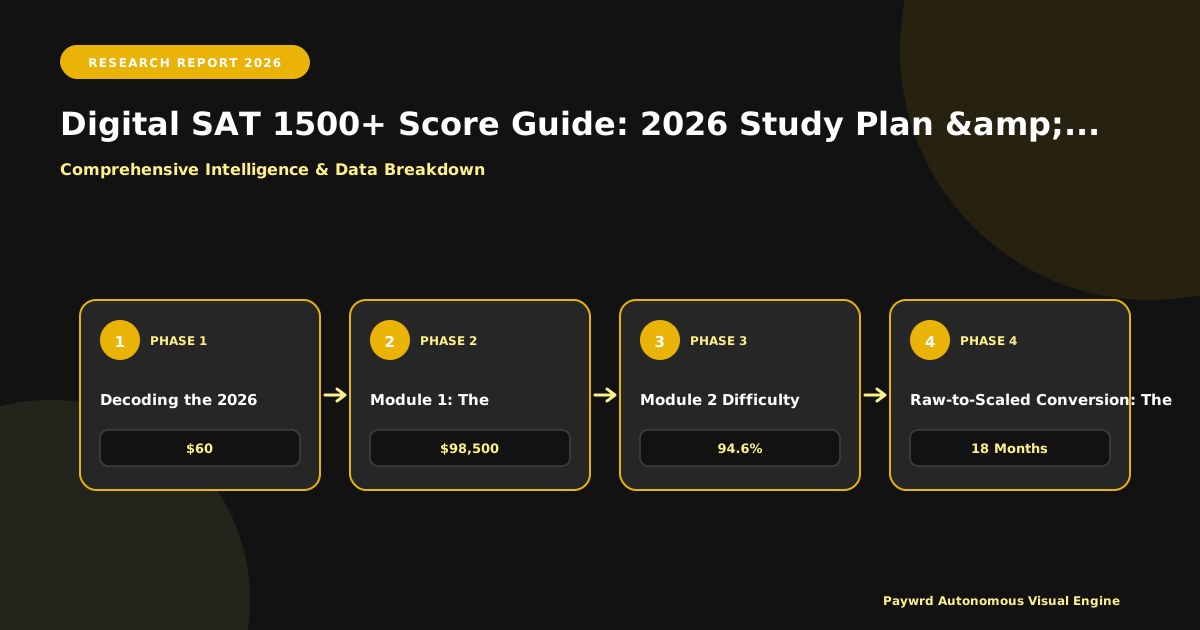
Decoding the 2026 Adaptive Scoring Algorithm
The Digital SAT’s multistage adaptive design fundamentally changes the “points per question” calculus that defined the paper era. The test splits each section—Reading & Writing (RW) and Math—into two modules. Your raw score on Module 1 determines which version of Module 2 you receive: a higher-difficulty tier or a lower-difficulty tier. This routing decision is the single most critical mechanical factor for a 1500+ aspirant.
Module 1: The Gatekeeper
Module 1 presents a broad mix of easy, medium, and hard questions. The algorithm uses this performance to estimate your ability level. Data from the College Board’s 2026 technical manual indicates that to unlock the higher-difficulty Module 2 in either section, you generally need a Module 1 raw score of approximately 20 to 22 correct answers out of 27 (the 25 operational questions plus 2 pretest). Dropping below this threshold—roughly 7 to 8 misses—routes you to the easier Module 2. Once there, the scoring ceiling drops precipitously; even a perfect Module 2 raw score on the easier tier typically scales to only a 640–660 section score. For a 1500 composite (750+ per section), the higher tier is non-negotiable.
Module 2 Difficulty Tiers & Scaling Mechanics
The higher-difficulty Module 2 contains a denser concentration of hard questions. Crucially, the scaling is not linear. On the harder tier, the curve is more forgiving at the top end but steeper in the middle. To hit a 750+ section score (half of a 1500), you typically need a total section raw score of 52–54 out of 54 (combining both modules). This translates to roughly 21–22 correct on Module 1 plus 27–28 correct on the harder Module 2. You can afford almost zero unforced errors. On the easier Module 2, the maximum scaled score caps near 650, rendering a 1500 mathematically unreachable.

Raw-to-Scaled Conversion: The 750+ Threshold
- Reading & Writing (750+): Requires ~53/54 Raw. Miss 1–2 questions total across both modules.
- Math (750+): Requires ~52–53/54 Raw. Miss 1–2 questions total.
- The “Cliff Effect”: On the harder Module 2, missing 4 questions might drop you to 720; missing 6 drops you to 690. Precision outweighs speed.
Question-Level Weighting vs. Paper SAT
On the paper SAT, every question carried equal raw weight (1 point), and the curve was applied post-hoc across the whole test. The Digital SAT uses Item Response Theory (IRT). Questions carry different weights based on difficulty parameters (discrimination, difficulty, guessing). A hard question answered correctly yields significantly more “ability estimate” points than an easy question. Conversely, missing an easy question on Module 1 penalizes your routing estimate far more severely than missing a hard one. This means accuracy on easy/medium Module 1 questions is the highest-leverage activity for a 1500+ score—it buys you access to the scoring ceiling where hard questions actually live.
Official Bluebook App Practice Test Protocol

You have exactly four full-length adaptive tests inside the College Board’s Bluebook app. That is the entire universe of official material. Treating them like infinite quiz banks is the single fastest way to cap your score below 1400. For a 1500+ target in 2026, you need a deployment protocol that extracts maximum diagnostic value from every module.
Test 1: The Cold Baseline (Week 1)
Take this cold. No prep, no Khan Academy warm-up, no formula sheet review. Replicate the exact 2026 administration window: start at 8:00 AM local time, use only the built-in Desmos calculator, and honor the 10-minute break between sections. Put your phone in another room. This establishes your true Module 1 entry threshold. If you miss more than seven questions in Reading & Writing Module 1 or Math Module 1, you have identified your “gate” problem immediately—you are being routed to the easier second module, capping your section score near 650. Score the test, but do not review explanations yet. Log the raw miss count per module.
Tests 2 & 3: The Surgical Strikes (Weeks 4 & 8)
These are not “practice runs.” They are verification checkpoints for specific weaknesses identified in your baseline and Khan Academy diagnostic quizzes. Before Test 2, spend two weeks drilling only your bottom-three question types (e.g., “Words in Context: Advanced,” “Nonlinear Systems,” “Rhetorical Synthesis”). Use Khan Academy’s diagnostic quizzes to confirm mastery at the “Hard” difficulty tier. Take Test 2 under strict conditions. If your Module 1 miss count hasn’t dropped by at least 40%, your remediation strategy is failing—adjust before Test 3. Treat Test 3 as your final dress rehearsal: same wake-up time, same breakfast, same scratch paper.
Test 4: The Insurance Policy (Week 12 / Final Week)
Lock this away until the week of your actual administration. Do not touch it. This is your psychological anchor. If Test 3 went well, Test 4 builds confidence. If Test 3 was a disaster, Test 4 is your last chance to recalibrate pacing without burning out. Take it three days before the real SAT—no later.
Khan Academy Integration Protocol
Do not just “do Khan.” Use the Official Digital SAT Prep course’s unit tests as surgical tools.
- Diagnostic Quizzes: Run the 15-question “Course Challenge” for Reading & Writing and Math separately every two weeks. Filter results by “Hard” difficulty. Any skill below 70% accuracy on Hard questions becomes your drill target for the next two-week block.
- Desmos Fluency: Dedicate one 30-minute session per week exclusively to Desmos workflows: regression modeling, systems of equations intersection, and function notation evaluation. Speed here buys you 3–4 minutes per Math module for the brutal “Student-Produced Response” questions.
- Review Loop: After every Bluebook test, import your missed questions into a spreadsheet. Tag them by Khan Academy skill name. Your next Khan session must clear those specific tags.
Test-Day Simulation Non-Negotiables
- Hardware Parity: Practice on the exact device you will test on (school-managed Chromebook, personal MacBook, iPad with external keyboard). Bluebook behaves differently across OS versions; discover lag or keyboard shortcut conflicts now.
- Break Discipline: Stand up. Leave the room. Drink water. Eat a banana or granola bar. Do not scroll social media. Train your autonomic nervous system to reset in 10 minutes.
- Annotation Protocol: Use the app’s highlighter and strikethrough tools aggressively on Reading & Writing. Practice the “Flag for Review” feature—but never flag more than three questions per module, or you will run out of review time.
Four tests. Four data points. Zero waste. That is how you protect the Module 1 gate and keep a 1500 composite in play.
Section-Level Target Setting: Reading/Writing vs Math
Translating a 1500 composite into module-specific accuracy targets is the single highest-ROI planning exercise you will perform. Because the Digital SAT’s multistage adaptive design weights Module 1 performance as a gatekeeper, you cannot simply “make up points” in Module 2. For the 2026 testing cycle, the data indicates a hard split: you need roughly 750 in Reading & Writing (RW) and 750 in Math to hit 1500 comfortably, though a 760/740 split works if your verbal ceiling is higher. The error budget below assumes you secure the harder Module 2 in both sections.
Achieving 750+ RW: Command of Evidence & Words in Context Tactics
The RW section compresses reading and grammar into 54 questions across two 32-minute modules. To clear 750, you can afford a maximum of 6–7 total errors across both modules (roughly 3 per module). Missing more than 7 in Module 1 forces the easier Module 2, capping your section score near 650 regardless of a perfect second module.
- Command of Evidence (Quantitative & Textual): These 12–14 questions are your highest ROI. Drill “Data Interpretation” sets where a graph contradicts a passage claim. The correct answer is almost always the option that directly cites the specific data point resolving the tension. Eliminate answers using “broadly supports” or “generally suggests” language.
- Words in Context (Advanced Vocabulary): Stop memorizing obscure lists. The 2026 blueprint tests Tier-2 academic verbs in situ (e.g., “underscore,” “precipitate,” “qualify”). Practice “fill-the-blank” logic: generate your own word for the blank before looking at choices. If two answers are synonyms, both are wrong—the test rewards precision, not synonymy.
- Transition & Rhetorical Synthesis: Master the “Digital SAT Transition Taxonomy” (Continuation, Contrast, Cause/Effect, Example). On Module 2 hard versions, the distractor is often a grammatically perfect transition that logically contradicts the preceding sentence’s claim.
Achieving 750+ Math: Algebra Mastery & Desmos Graphing Shortcuts
The Math section allows slightly more margin: 8–9 total errors across both modules (approx. 4 per module) typically yields 750+. However, the Module 1 gate is stricter conceptually. Missing 8+ questions in Module 1—often due to careless algebra arithmetic—triggers the easier Module 2.
- Linear Algebra Dominance: 35% of the section is “Heart of Algebra.” You must solve systems of equations, linear inequalities, and “linear model building” word problems in under 60 seconds each. Drill converting word problems directly into
y = mx + borAx + By = Cwithout intermediate steps. - Desmos as a Calculator, Not a Crutch: For any “solve for x,” “find intersection,” or “vertex of parabola” question, type the equation into Desmos immediately. Use the keypad shortcut
a=to create sliders for parameter questions (e.g., “For what value of k does the system have no solution?”). This turns 3-minute algebra problems into 30-second visual checks. - Geometry & Trig “Free Points”: The reference sheet provides every formula. Do not memorize; practice identifying which variable is missing. On circle/angle questions, draw the radius to the point of tangency—it creates a right angle 90% of the time.
Error Allowance Calculator per Module for 1500 Threshold
Use this matrix to allocate study hours. If your diagnostic shows you missing 5 questions on Math Module 1 but 10 on RW Module 1, every study hour goes to RW until Module 1 errors drop below 7.
- Module 1 Gate (Both Sections): Target ≤ 7 errors (Raw ~20/27). This unlocks Hard Module 2.
- Module 2 Hard Target (RW): Target ≤ 3 errors (Raw ~24/27) → ~750–760.
- Module 2 Hard Target (Math): Target ≤ 4 errors (Raw ~23/27) → ~750–760.
- Total Error Budget: 13–15 mistakes across the entire 98-question exam.
Track these numbers weekly using Bluebook practice tests. If you are consistently clearing the Module 1 gate but bleeding errors in Module 2, shift from “content review” to “hard-set timed drills” using official College Board linear practice PDFs printed on paper to simulate the adaptive jump difficulty.
12-Week 2026 Study Calendar: Phased Mastery Plan
Because the Digital SAT’s adaptive engine punishes early errors so severely, your preparation must front-load accuracy before you ever worry about speed. This 12-week blueprint aligns with the 2026–27 testing calendar—targeting the October, November, or March administrations—so you peak when the registration deadlines hit. Treat each phase as a prerequisite for the next; skipping ahead to practice tests before sealing content gaps is the fastest way to plateau at 1350.
Weeks 1–4: Content Gap Closure (The “Zero Surprises” Phase)
Dedicate the first month exclusively to Khan Academy’s official Digital SAT units and the College Board’s Official Digital SAT Study Guide. Do not take timed sections yet. Work through every math topic—Heart of Algebra, Problem Solving & Data Analysis, Passport to Advanced Math, and Geometry/Trig—until you can explain the concept to a peer. For Reading & Writing, drill the four question domains (Craft & Structure, Information & Ideas, Standard English Conventions, Expression of Ideas) using the “untimed mastery” mode. Your metric: 90%+ accuracy on every skill tag before Week 5. Log every missed question in a spreadsheet tagged by domain and error type (careless, knowledge gap, trap answer).
Weeks 5–8: Adaptive Drill Sets & Timing Calibration
Now you introduce the clock and the module-switching logic. Use Bluebook’s “Question Bank” feature to build custom 27-question Reading & Writing sets and 22-question Math sets that mirror the real module length. Run these at 1.25x standard time (roughly 64 seconds per R&W question, 95 seconds per Math question) to build a speed buffer. After each set, simulate the adaptive jump: if you miss ≤ 3, force the next set to “Hard” difficulty; if you miss ≥ 7, drop to “Easy” and diagnose why Module 1 gatekeeping failed you. Spend Sunday reviewing the error log—rewrite every missed question from memory without notes. This phase is where you convert knowledge into the reflexive pattern recognition the algorithm rewards.
Weeks 9–12: Full-Length Bluebook Tests & Review Cycles
Take one full-length, adaptive Bluebook practice test per weekend (Tests 4–6 are freshest for 2026). Replicate test-day conditions: same desk, same device, same breakfast, phone in another room. Monday through Wednesday, conduct a “forensic review”: re-solve every missed and guessed question untimed, then categorize the root cause. Thursday, do a 45-minute targeted drill on your weakest domain. Friday, rest. Saturday, test again. In the final week, taper volume—two light drills max—and lock in your pacing strategy for the Module 1 gate. Walk into the center knowing exactly how many questions you can afford to skip and still hit the Hard second module.
- Registration Anchor: October 2026 test registration closes ~September 20; November closes ~October 18. Work backward from your target date.
- Bluebook Updates: College Board pushes adaptive logic tweaks quarterly; update the app every Sunday night.
- Score Target: By Week 10 you want consecutive 740+ section scores on official practice—anything lower signals a Module 1 leak.
Superscore Strategy & 2027 Admission Percentile Targets
A 1500 on the Digital SAT sits at the 98th percentile nationally, but for the Class of 2027, the real benchmark is the middle-50% range of your target institutions. At Ivy League schools, the mid-50% SAT band for the incoming 2027 class clusters between 1480 and 1570. Harvard, Yale, and Princeton typically report ranges starting at 1490–1510; a 1500 places you at the lower boundary of the “competitive” zone, meaning you need exceptional grades, essays, or hooks to offset the score. Public Ivies like UVA, UNC-Chapel Hill, and Michigan generally sit slightly lower, with mid-50% ranges of 1380–1510. Here, a 1500 comfortably clears the median, often triggering automatic merit consideration.
Flagship State Superscore Policies & Scholarship Cutoffs
Most flagship public universities superscore—combining your highest Reading & Writing and Math section scores across dates—which directly shapes your retake strategy. The University of California system remains test-blind for 2027 admission, but flagship campuses in the Big Ten, SEC, and ACC heavily weight superscores for both admission and merit aid. For example, the University of Florida (Benacquisto Scholarship) and University of Alabama (Presidential Scholarship) often set hard superscore cutoffs at 1420–1450 for full-tuition awards, with enhanced stipends kicking in at 1500+. Georgia Tech and Purdue Engineering programs frequently report admitted student averages above 1500 for competitive majors like Computer Science. Verify each portal: some schools, like MIT and Georgetown, require all scores, making a low first attempt risky.
Optimal 2026 Test Date Sequence
To maximize superscore potential for Early Action/Decision deadlines (typically November 1, 2026), structure your calendar around three sittings:
- March 2026 (Primary Baseline): Take your first official attempt. This establishes a baseline early enough to order the Question-and-Answer Service (QAS) for detailed review. Scores release in ~2 weeks.
- May 2026 (Superscore Push): Target section-specific improvement. If March Math was 740 but R&W was 700, dedicate April prep to verbal. May scores arrive before summer, allowing a strategic pivot.
- August 2026 (Final Polish): The last “safe” date for Early deadlines. Scores return by early September, giving you buffer time for the October fallback.
- October 2026 (Safety Net): Use only if you missed August or need a specific section bump for a scholarship cutoff. Scores arrive late October—cutting it close for Nov 1 deadlines but viable for Regular Decision.
Register for March and May immediately; seats at desirable centers fill by January. Avoid the December 2026 date—it arrives too late for Early Action and adds unnecessary pressure during finals. Treat the March–May–August arc as your strategic window; a 1500 earned across two dates (e.g., 760RW March + 740M May) carries identical weight to a single-sitting 1500 at every superscoring institution.
Test Day Logistics: Digital Interface & Desmos Mastery
To secure a 1500+ score in 2026, your technical execution must be as precise as your content knowledge. Technical friction—fumbling with the interface or manually solving a problem that a calculator could handle in seconds—is the primary cause of avoidable point loss. Mastering the Bluebook app allows you to recover 20 to 30 points simply by optimizing your speed and accuracy.
Navigating the Bluebook Interface
The Bluebook app is not just a delivery system; it is a strategic tool. High scorers treat the interface as an extension of their workflow to maintain a strict pace across the adaptive modules.
- The Flagging System: Do not linger on “time-sink” questions. Use the flag tool immediately when a problem requires more than 60 seconds of thought. This ensures you capture all “easy” points first before returning to complex problems.
- Annotation Tool: In the Reading & Writing section, use the highlighter to isolate the claim and the evidence. This prevents the “re-reading loop” that kills time during the harder Module 2.
- The Countdown Timer: The timer is discreet. Check it every five questions to ensure you are hitting your benchmarks. If you are behind, pivot to flagging and skipping to protect your remaining time.
Desmos Mastery: The 1500+ Secret Weapon
The integrated Desmos calculator is the single greatest advantage for the 2026 Digital SAT. Many students use it as a basic calculator, but elite scorers use it as a problem-solving engine to bypass complex algebra.
- Regression Analysis: For data-fit questions, use the
y1 ~ mx1 + bsyntax to find the line of best fit instantly, eliminating manual slope calculations. - Systems of Equations: Instead of substitution or elimination, type both equations directly into Desmos. The solution is the precise coordinate of the intersection point.
- Graph Matching: When asked to identify a function’s graph, plot the given equation and compare the intercepts and asymptotes to the provided choices in real-time.
Device Readiness & Technical Requirements
A technical glitch during the exam can derail months of preparation. Ensure your hardware meets the College Board’s 2026 specifications well before test morning.
- OS Updates: Ensure your laptop or tablet is running the latest stable OS version. Outdated software can cause Bluebook to crash during the transition between modules.
- Power Management: Bring a certified power adapter. While most devices last the duration, the stress of a 10% battery warning can induce panic and lead to careless errors.
- Connectivity: Confirm your device is registered and the Bluebook app is updated. If using a school-issued device, verify that the firewall does not block the College Board’s secure testing servers.
Post-Test Analysis & Retake Decision Framework
Receiving your official score report from the College Board is not the end of the process; it is the beginning of a data-driven audit. To hit a 1500+, you must move beyond the composite score and analyze the Knowledge and Skills breakdown. This report categorizes your performance into domains—such as Standard English Conventions or Algebra—allowing you to pinpoint whether your score plateau is a result of conceptual gaps or timing inefficiencies in the adaptive modules.
The Question-Level Review Workflow
Because the 2026 Digital SAT is adaptive, not all mistakes are created equal. To optimize your study plan, categorize every missed question using this specific workflow:
- Module 1 “Gatekeeper” Errors: Analyze any misses in the first module. Since Module 1 determines your path to the harder Module 2, errors here are the most costly. If you missed “Easy” or “Medium” rated questions, your priority is foundational accuracy.
- Module 2 “Ceiling” Errors: If you reached the harder module but struggled with “Hard” rated questions, you are likely facing a ceiling in advanced synthesis or complex data interpretation. This requires targeted drill work rather than general review.
- Process vs. Knowledge: Distinguish between a “silly mistake” (misreading the prompt) and a “knowledge gap” (not knowing the geometric theorem). Knowledge gaps require a return to the textbook; process errors require more timed practice tests.
The October 2026 Retake: Cost-Benefit Analysis
For students targeting 2027 Early Action (EA) or Early Decision (ED) deadlines, the October 2026 test is the final strategic window. Deciding whether to retake requires a cold calculation of ROI (Return on Investment).
A retake is mathematically justified if your current score is within 30-50 points of your target and your analysis shows the errors were “process-based” rather than “conceptual.” If you are currently at a 1420 and your errors were primarily timing-related in Module 2, a 1500+ is highly probable with three weeks of focused refinement.
Conversely, if your score is stagnant despite multiple attempts, shifting your energy toward the Common App essay or enhancing your extracurricular portfolio provides a higher marginal utility for Ivy League or top-tier public university admissions. Remember, the cost of the exam (roughly $60 plus optional fees) is negligible, but the opportunity cost of neglecting your personal statement during the peak application window is significant.
| Decision Criteria | Standard Path (Target 1200) | Elite Path (Target 1500+) | 2026/2027 Impact |
|---|---|---|---|
| Module 1 Error Margin | 8-12 Questions | < 7 Questions | Critical gate for adaptive routing |
| Module 2 Difficulty | Lower Tier (Easier) | Higher Tier (Harder) | Determines score ceiling |
| Daily Study Volume | 1-2 Hours | 3-5 Hours | Required for high-tier mastery |
| Practice Test Frequency | Monthly | Bi-Weekly | Essential for adaptive pacing |
| Score Ceiling | ~650 per section | 800 per section | Mathematical cap if routed low |
Frequently Asked Questions
How does the 2026 Digital SAT adaptive scoring work for 1500+ scores?
In 2026, the Digital SAT uses a multistage adaptive algorithm where Module 1 performance dictates Module 2 difficulty. To achieve a 1500+, students must limit Module 1 errors to under seven per section. This unlocks the 'Hard' Module 2, which is the only path to scoring above 650 per section.
What is the maximum score if I get routed to the easier Module 2 in 2026?
If a student is routed to the lower-difficulty Module 2 in 2026, their section score is mathematically capped, typically near 650. Even with a perfect score in the easier second module, the algorithm prevents a 1500+ composite score because the lower-weight questions provide fewer scaling points.
What is the best 2026 study plan for a 1500+ Digital SAT score?
A 2026 elite study plan focuses on 'hard-tier' question banks and bi-weekly full-length adaptive practice tests. Priority is placed on Module 1 precision to ensure routing into the harder Module 2. Students should target a 95% accuracy rate on medium-difficulty questions to secure the high-scoring path.
How many questions can I miss in Module 1 to still get a 1500 in 2026?
To remain eligible for a 1500+ composite score in 2026, you should miss no more than 6-7 questions in Module 1 of both the Reading & Writing and Math sections. Exceeding this threshold typically triggers the easier Module 2, effectively capping your potential score regardless of subsequent performance.
Strategic Final Takeaway
When evaluating How To Score 1500 On Digital SAT 2026 2026 Study Plan And Practice Tests in 2026 and beyond, base your decisions on accredited institutional standards, verified return on investment (ROI), and up-to-date official guidelines. Always verify specific dates and requirements through official regulatory portals.

