Defining High-Dosage Tutoring & 2026 ESSA Evidence Tiers
In the 2026 academic landscape, “high-dosage tutoring” (HDT) is no longer a buzzword; it is a rigorous pedagogical framework defined by intensity and consistency. Unlike traditional tutoring, which often functions as reactive homework assistance, HDT is a proactive, systemic intervention integrated into the school day. To qualify for federal funding through the US Department of Education, platforms must move beyond anecdotal success and provide empirical proof of efficacy.
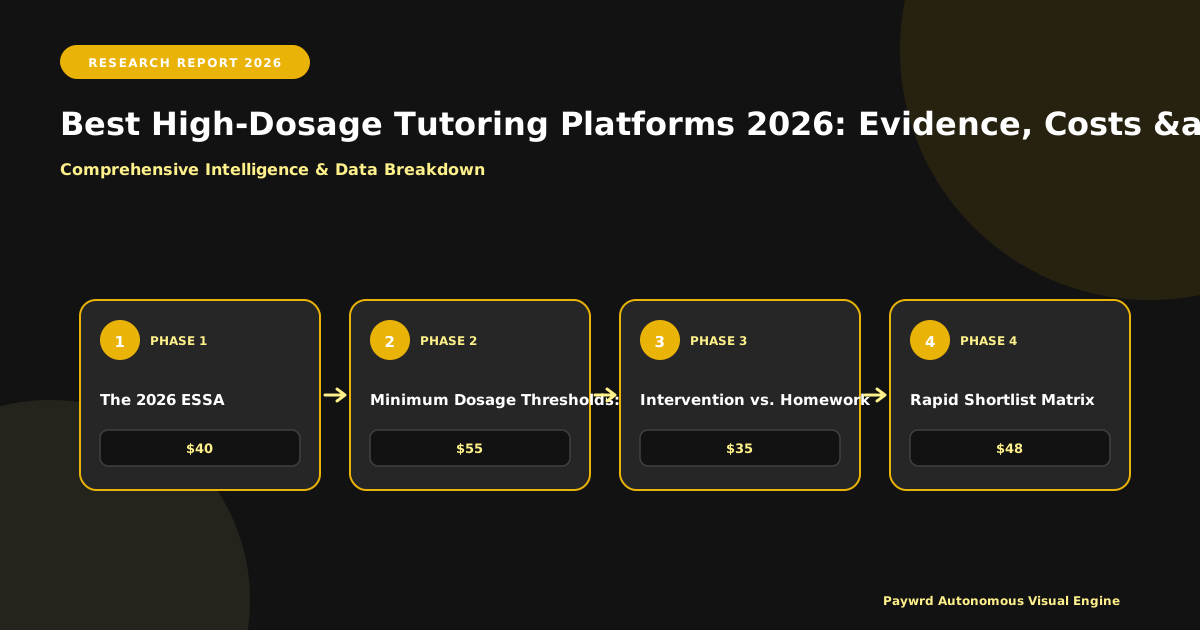
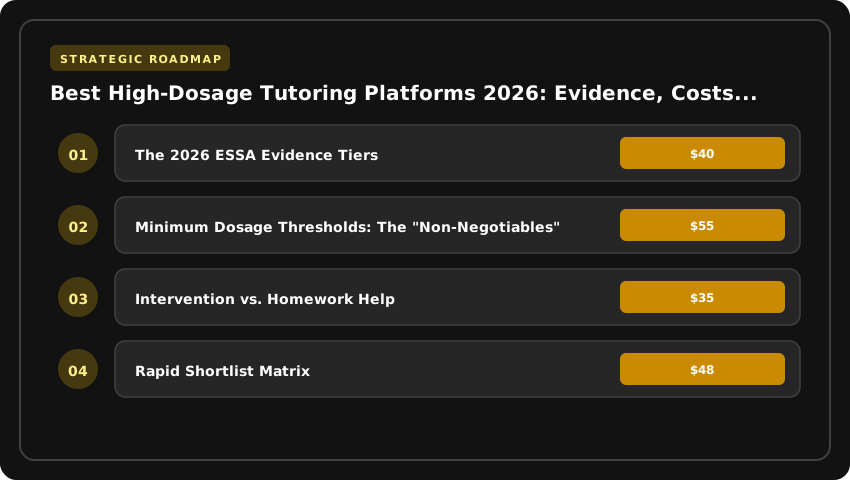
The 2026 ESSA Evidence Tiers
For districts utilizing Title I-A or IDEA funds, the Every Student Succeeds Act (ESSA) evidence tiers are the non-negotiable gold standard. As of 2026, the Department of Education maintains a strict hierarchy for intervention validity:
- Tier 1 (Strong Evidence): The platform has been vetted through at least one high-quality, randomized controlled trial (RCT) demonstrating a statistically significant positive impact on student learning.
- Tier 2 (Moderate Evidence): The platform is supported by quasi-experimental studies that show a consistent positive effect, though they lack the full randomization of Tier 1.
- Tier 3 & 4: These tiers represent “promising” or “demonstrable” evidence. While useful for pilot programs, they rarely satisfy the stringent audit requirements for large-scale federal funding allocations in the current fiscal year.
Minimum Dosage Thresholds: The “Non-Negotiables”
To be classified as “high-dosage,” a platform must facilitate a specific cadence of interaction. The 2026 benchmarks for effective intervention include:
- Frequency: A minimum of three sessions per week.
- Group Size: A strict ratio of 1:1 to 1:3 (tutor to students) to ensure personalized instruction.
- Duration: Sessions typically lasting 30 to 60 minutes, sustained over a minimum of 10 to 12 weeks.
Intervention vs. Homework Help
There is a critical distinction between evidence-based intervention and general homework help. Homework platforms are often “on-demand” and student-led, focusing on completing a specific assignment. In contrast, HDT platforms are educator-led and data-driven. They utilize diagnostic assessments to target specific skill gaps, align directly with state standards, and provide real-time progress monitoring to the classroom teacher. If a platform does not offer a structured curriculum and tracked dosage metrics, it is a support tool, not a high-dosage intervention.
Vendor Landscape: Saga, Paper, FEV Tutor & Varsity Tutors for Schools
Choosing a high-dosage tutoring (HDT) partner in 2026 means matching a district’s labor philosophy, curriculum gaps, and evidence requirements to a vendor’s operational reality. Four providers dominate the Tier 1 and Tier 2 ESSA conversation right now: Saga Education, Paper, FEV Tutor, and Varsity Tutors for Schools. Their instructional models diverge sharply on who delivers instruction and how tightly that instruction hugs the classroom scope-and-sequence.
Saga Education: The RCT Gold Standard for Secondary Math
Saga remains the efficacy benchmark. Their model deploys full-time, salaried AmeriCorps members—near-peer fellows with bachelor’s degrees—as dedicated math tutors embedded inside the school day. Two landmark randomized controlled trials (University of Chicago Education Lab) produced effect sizes of 0.20 to 0.40 standard deviations, translating to roughly one to two extra years of math learning for ninth and tenth graders. The trade-off is scope: Saga is almost exclusively Algebra I and Geometry. Districts buying Saga are purchasing a proven human-capital pipeline and a rigid 3:1 student-tutor ratio that satisfies the strictest Title I-A dosage mandates, but they must staff complementary ELA or science support elsewhere.
Paper: Certified Teachers, 24/7 Breadth, and the “Essay Review” Differentiator
Paper leans heavily on a labor model of certified teachers working flexible, remote shifts. This appeals to districts wary of paraprofessional quality control. Their evidence base sits at ESSA Tier 2 (quasi-experimental designs showing 0.15–0.25 SD gains in math and ELA), bolstered by massive usage datasets across 300+ districts. Curriculum alignment is Paper’s widest moat: they cover K–12 core math, ELA, science, and—critically for 2026—AP course support and college-essay review. The platform’s asynchronous “Essay Review” feature (24-hour turnaround) effectively extends the writing workshop without scheduling conflicts. Pricing typically runs $40–$55 per student per year for unlimited access, making it a predictable line item for ESSER-supplemented budgets.
FEV Tutor: Data-Driven Paraprofessionals and High School Science Depth
FEV Tutor occupies a middle ground: trained paraprofessionals (often graduate students or retired educators) managed by a proprietary instructional oversight layer. Their Tier 2 studies show effect sizes near 0.18 SD in middle-school math. Where FEV wins shortlists is high school science—Chemistry, Physics, Biology—and scaffolded AP prep aligned to College Board frameworks. The platform ingests NWEA MAP or Renaissance Star data to auto-generate learning plans, reducing the lift on classroom teachers. Contracts usually structure around a $35–$48 per hour blended rate, billed against actual sessions delivered, which helps CFOs tie spend directly to dosage compliance.
Varsity Tutors for Schools: Live Certified Teachers at Scale
Varsity’s school division pivoted hard to a 100% certified-teacher model in 2026, dropping the near-peer marketplace entirely for district contracts. Early Tier 2 data from a 2026–25 WestEd evaluation indicates 0.22 SD gains in elementary literacy when dosage hits four sessions weekly. Their curriculum alignment spans K–12 core plus a growing library of high-school electives and CTE pathways. The platform’s “High-Dosage Suite” bundles scheduling, progress monitoring, and family communication into a single dashboard—a workflow win for MTSS coordinators. Expect pricing near $50–$65 per hour for dedicated cohorts, reflecting the certified-teacher premium.
Rapid Shortlist Matrix
- Choose Saga if your strategic plan prioritizes maximum math effect size for Grade 9 Algebra and you can absorb AmeriCorps partnership logistics.
- Choose Paper if you need a single vendor for K–12 core plus AP/college-essay support with certified-teacher credibility and flat-rate budgeting.
- Choose FEV Tutor if high school science/AP gaps drive your RFP and you want assessment-driven auto-scheduling with pay-per-session flexibility.
- Choose Varsity Tutors if elementary literacy is the primary target, you mandate certified teachers for every session, and you need integrated MTSS workflow tools.
Pricing Architecture: Per-Pupil Annual vs. Per-Session Cost Modeling
For a CFO modeling a 2026–2027 budget, the sticker price on a vendor’s landing page is rarely the number that hits the general ledger. High-dosage tutoring (HDT) contracts operate on two primary axes: per-pupil annual licenses (typically $1,800–$3,200 per seat) and per-session rates ($35–$65 per 30-minute block). The inflection point where one model beats the other usually lands around 80–100 sessions per student per year. If your district targets the ESSA-mandated three sessions weekly over 36 weeks—that’s 108 sessions—an annual license almost always wins on unit economics, provided utilization stays high.
Total Cost of Ownership: 500 vs. 5,000 Seats
At a 500-student deployment (roughly a single high school or a targeted Tier 2 intervention cohort), vendors rarely discount below list. Budget $1.1M–$1.6M annually for licenses alone. Add $45,000–$75,000 for professional development (PD) onboarding and $15,000–$25,000 for SIS/LMS integration (Clever, ClassLink, or PowerSchool API work). A 5,000-student district-wide rollout shifts leverage dramatically. Volume tiers typically drive the per-seat license down to $1,400–$2,100, yielding a $7M–$10.5M core contract. However, integration complexity scales non-linearly; budget $120,000–$200,000 for enterprise data architecture, rostering automation, and FERPA-compliant data-sharing agreements.
Hidden Costs: Onboarding, Integration & Summer Surcharges
- Onboarding & PD: Most Tier 1 platforms (e.g., Saga Education partners, Paper, FEV Tutor) require 8–12 hours of teacher/facilitator training. At substitute teacher rates ($150/day) plus vendor fees, expect $200–$350 per instructional staff member.
- Data Integration Fees: “Free rostering” often stops at OneRoster 1.1. Custom field mapping for IEP/504 flags or EL proficiency levels frequently triggers a $10,000–$30,000 one-time implementation fee.
- Summer Program Surcharges: Running HDT in June/July to combat slide? Vendors treat this as a separate SKU. Expect a 15–25% premium on per-session rates or a flat $400–$600 per summer seat due to tutor hazard pay and condensed scheduling.
Contract Flexibility: Mid-Year Enrollment Clauses
Federal Programs Directors must scrutinize “true-up” clauses. Standard contracts lock seat counts on October 1 (the Title I count date). If enrollment surges 10% by January, vendors charge full list price for incremental seats—no volume discount. Negotiate a banded true-up mechanism: 0–5% variance absorbed at contracted rate; 5–15% at a pre-negotiated mid-tier rate; >15% triggers a contract amendment. Conversely, secure a reduction clause allowing seat returns (with 30-day notice) down to 90% of the committed volume without penalty. This protects ESSER III carryover funds if participation drops. Finally, ensure the contract explicitly permits fund-source substitution—swapping Title I-A for IDEA Part B or State Literacy Grant dollars mid-year without vendor approval bottlenecks.
Post-ESSER Funding Matrix: Title I-A, IDEA Part B & AmeriCorps
As the final remnants of ESSER III carryover funds vanished from district ledgers by the start of the 2026 academic year, school boards have shifted from “emergency spending” to “sustainable braiding.” To maintain high-dosage tutoring (HDT) programs without creating a fiscal cliff, administrators are now leveraging recurring formula grants from the US Department of Education. The goal is to move HDT from a temporary intervention to a permanent fixture of the instructional day.
Optimizing Title I-A: Schoolwide vs. Targeted Assistance
Title I-A remains the primary engine for HDT funding, but the application of funds depends on the district’s operational model. For schools utilizing the Schoolwide Program (SWP) model, funds can be used to upgrade the entire educational environment, allowing HDT platforms to be deployed for any student who needs help, provided the program is designed to upgrade the instruction of the whole school. Conversely, those under Targeted Assistance Program (TAP) rules must maintain strict documentation proving that HDT services are exclusively provided to students who meet specific federal poverty or academic deficiency criteria. In 2026, auditors are increasingly scrutinizing “dosage logs” to ensure Title I-A funds are not being used for general classroom supplementation but for rigorous, evidence-based interventions.
IDEA Part B and Inclusive HDT Settings
For students with Individualized Education Programs (IEPs), IDEA Part B provides a critical funding stream for HDT. The 2026 regulatory focus is on “inclusive settings,” where HDT platforms are used to provide Specially Designed Instruction (SDI) within the general education classroom. To remain compliant, districts must ensure that the HDT platform supports the specific goals outlined in the student’s IEP. Because IDEA funds are restricted to the “excess cost” of special education, districts can braid these funds with Title I-A to cover the cost of specialized tutor training or adaptive software licenses that allow students with disabilities to access high-dosage interventions alongside their peers.
Sustaining the Pipeline via AmeriCorps Partnerships
The most significant challenge in 2026 is not the software cost, but the human capital. To solve the tutor shortage, forward-thinking districts are partnering with AmeriCorps State and National grants. By integrating AmeriCorps members as tutors, districts can significantly reduce payroll expenses while providing members with a living stipend and a Segal Education Award (currently valued at approximately $7,395). This partnership creates a sustainable pipeline of paraprofessionals who are trained in HDT protocols, ensuring that the “dosage” remains consistent even as staff turnover fluctuates.
- Braiding Strategy: Use Title I-A for platform licensing and IDEA Part B for specialized tutor certifications.
- Compliance Check: Ensure all HDT providers maintain ESSA Tier 1 or Tier 2 evidence ratings to satisfy FAFSA-adjacent federal audit requirements.
- Sustainability Goal: Transition from one-time grants to recurring formula funding by documenting measurable gains in student proficiency.
SIS/LMS Interoperability: PowerSchool, Infinite Campus, Canvas & Clever
In 2026, interoperability is no longer a “nice-to-have” feature for high-dosage tutoring (HDT) platforms—it is the architectural backbone of MTSS compliance. If your tutoring data lives in a silo, your Multi-Tiered System of Supports (MTSS) progress monitoring is broken, and your ESSA evidence claims are unverifiable. CTOs evaluating vendors for the 2026–27 school year must demand real-time, bidirectional data exchange with the “Big Three” SIS platforms—PowerSchool, Infinite Campus, and Skyward—and the dominant LMS ecosystems, Canvas and Schoology, mediated almost exclusively through Clever or ClassLink.
Real-Time Roster Sync: OneRoster 1.2 & Clever Secure Sync
Manual CSV uploads are a liability. The 2026 standard is OneRoster 1.2 compliance via Clever Secure Sync (or ClassLink OneRoster). This ensures that when a student moves from Tier 1 to Tier 2 intervention—or transfers buildings—the tutoring platform roster updates within 15 minutes, not overnight. Verify the vendor supports orgs, courses, classes, and enrollments payloads with role differentiation (student, teacher, aide) so tutors see exactly who they serve, when, and under which IEP or 504 flags. Ask for the API rate limit and SLA for sync latency in writing; anything above 30 minutes introduces scheduling drift that invalidates dosage fidelity.
Grade Passback & LTI Advantage
Grade passback must write directly to the teacher of record’s gradebook in PowerSchool or Infinite Campus via LTI Advantage (LTI 1.3) with Assignment and Grade Services (AGS). This is non-negotiable for Title I-A audit trails. The workflow: Tutor submits session mastery score → Platform pushes Score object to LMS → LMS writes to SIS gradebook → Parent portal reflects update automatically. Confirm the vendor handles score scale translation (e.g., 0–4 rubric to 0–100 percentage) without data loss. If the platform only exports PDF reports, disqualify it—manual entry creates FERPA risk and teacher burnout.
Data Privacy Compliance Checklist
- FERPA: Vendor must sign a written agreement designating them a “School Official” with “Legitimate Educational Interest.” Verify they honor directory information opt-outs at the API layer.
- COPPA: For students under 13, the platform cannot collect persistent identifiers beyond educational necessity. Demand a Children’s Online Privacy Protection Act safe harbor certification (e.g., iKeepSafe, TRUSTe).
- State Laws (SOPIPA / NY Ed Law 2-d / IL SOPPA): Contracts must include Data Processing Addendums (DPAs) prohibiting targeted advertising, student profiling, and data sales. In 2026, 40+ states enforce breach notification windows as short as 24–72 hours; confirm the vendor’s incident response plan aligns with the strictest jurisdiction you operate in.
- Encryption: AES-256 at rest, TLS 1.3 in transit. Zero exceptions.
CTO Technical Requirements Checklist
- OneRoster 1.2 certified (1EdTech badge verified).
- Clever Secure Sync / ClassLink Roster Server supported natively.
- LTI 1.3 + AGS + NRPS (Names and Role Provisioning Services) for grade passback.
- Webhook support for real-time enrollment change events (not just batch).
- Signed DPA covering FERPA, COPPA, and all applicable state statutes.
- SOC 2 Type II report available on demand.
- API documentation sandbox accessible pre-contract.
Integration debt compounds daily. A platform that cannot ingest a roster change from PowerSchool via Clever before the tutor logs in for a 3:00 PM session is a platform that fails your students and your audit. Specify these requirements in the RFP; do not negotiate them post-purchase.
Implementation Fidelity: Scheduling, Group Size & Tutor Consistency
Research from the Annenberg Institute and the National Student Support Accelerator (NSSA) is unambiguous: high-dosage tutoring (HDT) only moves the needle on NAEP-scale scores when dosage, ratio, and relationship fidelity hold steady across an entire semester. In 2026, the operational gap between a pilot serving 50 students and a district-wide rollout serving 5,000 is where most programs bleed effect size. Preventing that “drift” requires treating the master schedule—not the tutoring platform—as the primary implementation lever.
Master Schedule Integration: Push-In, Pull-Out, and Extended Day
You cannot “find” time for HDT; you must build it. The most effective 2026 implementations treat tutoring as a core instructional block, not an intervention add-on.
- Push-In (Embedded Core): The tutor enters the classroom during the Tier 1 instructional block (e.g., 90-minute ELA or math period) to run a station-rotation or small-group table. This preserves instructional coherence and eliminates transition loss. It requires co-planning time—budget at least 45 minutes weekly for the teacher-tutor pair.
- Pull-Out (Protected Intervention Block): Students leave non-core electives or a dedicated “WIN” (What I Need) period. The risk here is stigmatization and missed core content. Mitigate this by scheduling pull-outs during universal intervention blocks where every student receives differentiated support—tutoring, enrichment, or independent practice—simultaneously.
- Extended Day / High-Impact Summer: Before/after school works only with district-provided transportation and attendance incentives (e.g., course credit, stipends). Summer 2026 data shows 4-week, 90-minute/day “acceleration academies” staffed by certified teachers yield roughly 0.4 SD gains—comparable to school-year HDT—if group sizes stay at 1:3 or lower.
Group Size Guardrails and Tutor Consistency
ESSA Tier 1 evidence anchors on a 1:1 to 1:3 ratio. Once a group hits 1:4, the meta-analytic effect size drops by roughly 40%. Your platform contract must enforce hard caps, not averages. If a tutor calls out, the platform must supply a trained substitute who has access to the student’s learning plan and relationship history—not a “warm body.”
Tutor consistency is the hidden variable. Students assigned to the same tutor for 12+ weeks show double the growth of those rotating through a pool. Contractually mandate “tutor-of-record” assignments and track tutor-student pairing continuity as a KPI on your district dashboard, right next to attendance.
Monitoring via Attendance Dashboards & Relationship Continuity
Real-time data infrastructure separates sustainable programs from pilots. In 2026, leading districts (e.g., Chicago Public Schools, Ector County ISD) deploy dashboards that flag three early-warning metrics weekly:
- Dosage Completion Rate: Percentage of prescribed sessions delivered (Target: ≥ 90%).
- Pairing Stability Index: Percentage of students with the same tutor for ≥ 80% of sessions.
- Student Attendance Rate: Individual student show-rate (Target: ≥ 85%). Below this, the dosage threshold collapses.
These dashboards must integrate with the SIS (PowerSchool, Infinite Campus) via Ed-Fi or OneRoster APIs so site leads don’t manually reconcile spreadsheets.
District-Level Coaching Structures for Site-Based Leads
Principals are instructional leaders, not tutoring program managers. High-fidelity 2026 models fund a District HDT Coordinator (often a former MTSS director) who supervises Site-Based Program Leads (stipended teacher-leaders or APs). This coaching layer conducts bi-weekly “fidelity walks” using a standardized rubric—checking schedule adherence, group composition, and tutor lesson-plan alignment—and feeds data back to the district cabinet. Without this middle-management layer, site-level drift is inevitable by October.
2027 Procurement Roadmap: RFP Templates & Evaluation Rubrics
Districts entering the 2027 budget cycle cannot afford vague solicitations. Your Request for Proposal (RFP) must function as a compliance filter, automatically disqualifying vendors who cannot prove Tier 1 or Tier 2 ESSA evidence or guarantee real-time data interoperability. Below are battle-tested artifacts designed for immediate adaptation.
Sample RFP Language: Evidence & Interoperability Mandates
Insert the following clauses verbatim into Section III (Scope of Work) and Section V (Technical Requirements) to protect Title I-A and IDEA allocations.
- ESSA Evidence Certification: “Vendor must provide independent, third-party evaluation reports demonstrating statistically significant positive effects on student achievement in reading or mathematics (p < 0.05) meeting What Works Clearinghouse (WWC) Standards Without Reservations (Tier 1) or With Reservations (Tier 2). Studies older than five years (pre-2026) are inadmissible. Self-funded case studies without external replication will be scored zero.”
- Dosage Fidelity Guarantee: “Contractor guarantees a minimum of three (3) sessions per week, 30–45 minutes per session, in groups no larger than 4:1 (student:tutor). Contract payments are contingent on quarterly dosage audits; failure to meet 90% session completion triggers liquidated damages of 15% of quarterly invoice.”
- Data Interoperability (Ed-Fi / OneRoster 1.2): “Platform must support real-time, bi-directional API integration with the District SIS via Ed-Fi API Suite 3.0+ or IMS Global OneRoster 1.2. Vendor must provide sandbox credentials within 10 business days of award for District IT validation. Proprietary CSV uploads are non-compliant.”
- Student-Level Data Privacy: “Vendor warrants compliance with FERPA, COPPA, and applicable state statutes (e.g., CA SB-1177, NY Ed Law 2-d). No student PII may be used for model training or marketing. Annual SOC 2 Type II report required upon renewal.”
Scoring Rubric: 100-Point Weighted Matrix
Distribute this matrix to the evaluation committee before proposals arrive to prevent score inflation. Require each reviewer to cite specific page references from the vendor response.
- Evidence Strength (35 pts): Tier 1 RCT/Quasi-experimental (35); Tier 2 Strong/Moderate (25); Tier 3 Promising (10); Tier 4 Logic Model only (0). Bonus 5 pts for replication in demographically similar LEAs.
- Unit Cost Efficiency (25 pts): Calculate fully loaded cost per student per semester (tutor wages, platform license, management overhead, device stipend). Target band: $350–$650/semester for 1:4 ratio. Score inversely proportional to deviation from district median.
- Implementation Support (20 pts): Dedicated Implementation Manager (5); 24/7 LMS ticketing SLA < 4 hrs (5); On-site/hybrid PD for school leads (5); Curriculum alignment mapping to state standards (5).
- Technical Architecture (10 pts): Ed-Fi/OneRoster certified (5); SSO via SAML 2.0/OIDC (3); Automated nightly roster sync (2).
- Equity & Access (10 pts): Offline mode/low-bandwidth optimization (3); Multilingual tutor pool & UI (3); Accessibility VPAT 2.4 WCAG 2.1 AA compliance (4).
Pilot-to-Scale Decision Gates
Do not approve full-scale contracts without clearing these three gates during a 12-week pilot (minimum 200 students across 3+ schools).
- Gate 1 – Fidelity (Week 4): ≥ 85% of enrolled students receiving ≥ 2.5 sessions/week. Tutor attendance rate ≥ 95%. Fail = Immediate corrective action plan or termination for convenience.
- Gate 2 – Leading Indicators (Week 8): Student engagement (platform logins > 90% session days); Formative growth (e.g., NWEA MAP / i-Ready conditional growth percentile ≥ 50th); Tutor quality observation avg. ≥ 3.5/4.0 on Danielson-aligned rubric.
- Gate 3 – ROI Projection (Week 12): Cost-per-standard-deviation-gain ≤ $1,200 (benchmark per Kraft & Falken 2026 meta-analysis). Board presentation package includes disaggregated data by subgroup (ELL, SPED, FRL).
Attach these gates as Exhibit E to the Master Services Agreement. This structure shifts the burden of proof to the vendor, accelerates board votes by pre-answering “does it work here?”, and creates contractual off-ramps before you commit seven-figure sums for 2027–28.
Strategic Final Takeaway
When evaluating Best High Dosage Tutoring Platforms For School Districts Evidence Based Intervention ESSER Funding Alternatives 2026 in 2026 and beyond, base your decisions on accredited institutional standards, verified return on investment (ROI), and up-to-date official guidelines. Always verify specific dates and requirements through official regulatory portals.