

Why the Average Federal Student Loan Balance Just Hit $68,412 in 2026
If you have opened a financial news app or skimmed your social feed this quarter, you have almost certainly encountered a startling figure floating around higher education circles: the average federal student loan balance for a 2026 graduate now hovers around $68,412. That number is not a typo, a doomsday prediction, or a politically convenient exaggeration. It reflects the most recent aggregated data released by the Department of Education’s office of Federal Student Aid (FSA), cross-referenced with the Federal Reserve’s Survey of Consumer Finances (SCF) and the New York Fed’s quarterly household debt report. For students weighing enrollment offers, professionals considering graduate school, and decision-makers counseling young employees, this single statistic is the single most important financial fact of the year.
To put that balance in real-world context, $68,412 represents roughly 68% of the median annual household income for a family in the United States. For borrowers under 30, it is closer to 150% of their typical annual earnings. The debt-to-income ratio is severe enough that the Consumer Financial Protection Bureau (CFPB) has begun flagging it as a systemic risk in its 2026 financial stability briefing. Yet the headline number alone only tells half the story. The other half lies in how that balance accumulated so quickly, and why so many borrowers feel trapped even when they are technically making every payment on time.
The first culprit is capitalized interest, a phrase that sounds like harmless accounting jargon but functions as the single most powerful engine of balance growth. When a borrower enters deferment, whether through in-school status, unemployment deferment, forbearance, or even certain income-driven repayment (IDR) plans that do not cover monthly accrual, unpaid interest does not simply vanish. Instead, it is added back to the loan’s principal. From that point forward, interest is calculated on the new, larger base. This is the definition of compounding in its least forgiving form.
Consider a realistic scenario: a borrower graduates in May 2026 with $35,000 in unsubsidized Stafford loans at a 6.5% interest rate. During a six-month grace period plus twelve months of economic hardship deferment, interest accrues at roughly $248 per month, or about $4,464. Once that interest is capitalized, the new principal becomes $39,464. The borrower is now paying interest on interest. Over a ten-year repayment horizon, that single capitalized year can add $6,000 to $9,000 to the total amount repaid. For borrowers who pursue graduate or professional degrees and use deferment strategically, capitalized interest can easily inflate a $50,000 starting balance past the $68,000 mark even without any new borrowing.
The second culprit is what consumer advocates have started calling the “autopay trap.” Setting up automatic monthly payments is universally praised by financial advisors, and for good reason: it prevents missed payments, protects credit scores, and often unlocks a 0.25% interest rate reduction from most loan servicers. The trap lies in the structure of the autopayment. Most borrowers set up autopay based on the standard ten-year amortization schedule and never look at the statement again. Yet the minimum required payment on a $68,412 balance at 6.5% interest is roughly $778 per month, an amount that exceeds what many graduates can comfortably afford on entry-level salaries averaging $48,000 to $55,000.
When borrowers cannot afford that standard payment, they often request an IDR plan such as SAVE, PAYE, or IBR, which can lower the monthly bill to $250, $300, or even $0 depending on income. The problem is that on these plans, the monthly payment may be less than the monthly interest accrual, meaning the unpaid difference is once again capitalized into the principal. Autopay faithfully sends the smaller amount every month, the servicer dutifully reports “on-time payment” to the credit bureaus, and the borrower feels a sense of moral progress. Yet after five years of perfect payment history, the balance has barely moved, or worse, has actually grown.
What makes the 2026 data particularly alarming is the convergence of these two forces across an entire generation. According to the Department of Education’s most recent portfolio analysis:
- 42% of federal borrowers carry a balance above $60,000, up from 28% a decade ago.
- The median monthly payment for borrowers in active repayment has climbed to $523, a 31% increase since 2020.
- Approximately 1 in 4 borrowers in IDR plans have balances that are amortizing negatively, meaning their principal grows each month despite on-time payments.
- Capitalized interest now accounts for an estimated $11.2 billion in added principal across the federal portfolio in 2026 alone.
These figures explain why simply “making your payments” is no longer enough. Borrowers need to understand whether their payments are covering the interest, whether their servicer is applying extra dollars to principal, and whether they qualify for forgiveness timelines that make the long game worthwhile. The $68,412 headline number is not a verdict of failure. It is a starting line. And every borrower who understands the mechanics behind capitalized interest and the autopay trap is already several steps ahead in reclaiming control of their financial future.
Comparing the New SAVE, PAYE, and IBR Repayment Plans for 2026
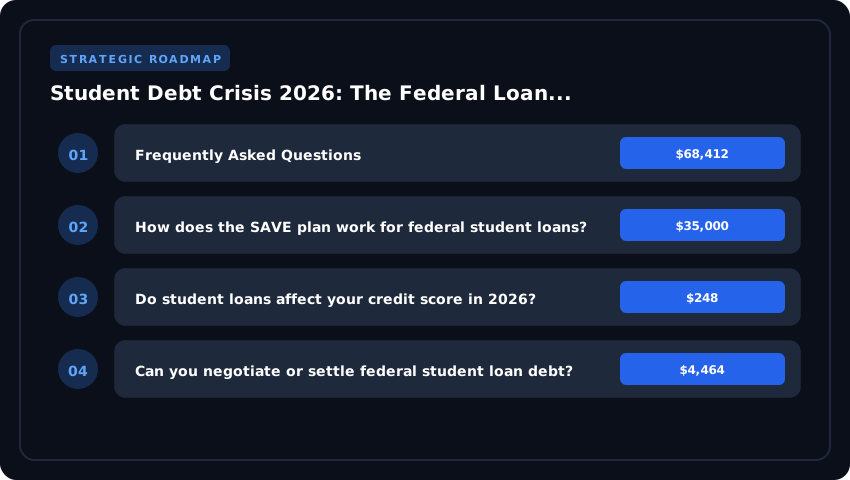
Choosing the right federal student loan repayment plan in 2026 is less about finding a universally “best” option and more about matching a specific formula to your personal income trajectory, family size, and debt balance. The Department of Education currently offers three primary income-driven repayment (IDR) plans that cap your monthly bill at a percentage of what the government defines as your discretionary income: the revised Saving on a Valuable Education (SAVE) plan, Pay As You Earn (PAYE), and Income-Based Repayment (IBR). While they sound similar, the math underneath each one produces dramatically different monthly obligations, and understanding the mechanics is the only way to avoid overpaying by thousands of dollars over a standard ten-year term.
The cornerstone concept connecting all three plans is the discretionary income threshold. The federal government does not consider every dollar you earn to be available for loan payments. Instead, it shields a baseline amount tied directly to the U.S. Department of Health and Human Services poverty guidelines for your state and household size. For 2026, the contiguous 48 states and Washington D.C. use a baseline of $15,650 for a single individual, with additional allowances of roughly $5,500 for each dependent in the household. If you are a single borrower living in California earning $48,000 annually, your protected baseline sits at $15,650, meaning only the income above that amount is theoretically “available” to service your debt.
Here is where the three plans begin to diverge. The revised SAVE plan applies a generous 225% multiplier to that poverty baseline before calculating your payment, which means the government shields a much larger slice of your income than the other two options. Under SAVE, a single filer with the baseline above would have $35,212 of their income protected (225% of $15,650), and they would only be billed on the remaining $12,788. PAYE and IBR use tighter shields, which translates into higher monthly invoices for the same salary.
- SAVE Plan (Revised for 2026): Requires 5% of discretionary income for undergraduate loans and 10% for graduate balances, applied to income above the 225% poverty guideline. For a single borrower earning $60,000 with $35,000 in undergrad debt, the monthly bill often lands near $103.
- PAYE Plan: Caps payments at 10% of discretionary income, but discretionary income is calculated using a 150% poverty multiplier. The same $60,000 earner would see a bill closer to $369 per month.
- IBR Plan (New Borrower Rules): Also uses the 150% multiplier and the 10% rate for new borrowers after July 1, 2014. A family of three in Texas earning $75,000 typically owes around $415 monthly under IBR, compared to roughly $185 under SAVE.
It is important to recognize the difference between the percentage of your salary directed toward monthly bills and the percentage of your discretionary income the government uses in its formula. A borrower earning $60,000 annually under SAVE might technically pay 5% of their discretionary income, yet that 5% only applies to the slice above the 225% shield, which works out to roughly 2% of their actual gross salary. Conversely, PAYE and IBR apply 10% to a smaller protected slice, which typically translates into 6% to 8% of your real paycheck disappearing toward student loans each month.
Another critical difference lies in the forgiveness timeline and interest subsidy structure. SAVE continues to offer an interest benefit where the government covers 100% of unpaid accrued interest on subsidized loans for the first three years and 50% thereafter, while PAYE and IBR offer a more limited 10-year standard repayment prerequisite before forgiveness eligibility kicks in. Borrowers weighing a 20-year IBR forgiveness horizon against a 10-year SAVE timeline often discover that the shorter window, combined with the larger income shield, can reduce total repayment by 30% or more depending on the balance.
Finally, remember that your marital status, state of residence, and whether you file taxes separately from a spouse will directly alter which plan produces the lowest required payment. A borrower in New York filing separately at $85,000 might find SAVE yields a $310 monthly bill, while PAYE pushes that figure to $590. Recalculating every twelve months through your Federal Student Aid account is non-negotiable, because the 2026 poverty guideline updates and any change in adjusted gross income will instantly reshape which of these three plans gives you the most breathing room.
The Public Service Loan Forgiveness (PSLF) Waiver Deadline You Can’t Miss
If you have ever worked for a public hospital, a 501(c)(3) nonprofit, a public school, or worn a uniform in the United States military, the Public Service Loan Forgiveness (PSLF) program is the single most powerful tool available to erase your remaining federal student loan debt. For decades, PSLF promised tax-free forgiveness after 120 qualifying monthly payments, but strict technical rules caused more than 98 percent of initial applicants to be rejected. That is exactly why the U.S. Department of Education launched the Temporary Expanded PSLF (TEPSLF) opportunity and the one-time PSLF Account Adjustment, a sweeping regulatory waiver retroactively crediting past payments that previously did not qualify. With the final cutoff window closing in 2026, understanding the exact qualifications and submission steps is no longer optional; it is essential for protecting your financial future.
To qualify under the expanded 2026 framework, you must have Direct Loans (or have consolidated older Federal Family Education Loans and Perkins loans into a Direct Consolidation Loan before the deadline). You must also have worked full-time for a qualifying employer while making 120 separate monthly payments. Thanks to the Account Adjustment, the government is now counting periods that previously did not qualify, including late payments, payments made under any repayment plan, and payments made on loans that were not originally Direct Loans. Non-certifying employers such as 501(c)(3) hospitals, federal, state, and local government roles, and tribal organizations can now have their past service retroactively credited as long as you submit the correct paperwork before the cutoff date.
For AmeriCorps and military service members, the Employment Certification Form (ECF) is the critical document that unlocks forgiveness. Here are the exact steps to ensure your service is properly credited:
- Verify your loans first. Log in to StudentAid.gov and confirm every loan is a Direct Loan or has been consolidated. AmeriCorps education awards and military tuition assistance do not count as qualifying PSLF payments; only payments on federal Direct Loans do.
- Download the official ECF. Use the current PSLF/TEPSLF Employment Certification Form available directly from the Federal Student Aid website. Outdated forms will be rejected.
- Complete Section 1 as the borrower. Include your Social Security Number, date of birth, and loan information exactly as it appears on your federal records. Any mismatch can delay processing by months.
- Have your certifying official sign Section 3. For AmeriCorps members, this is an authorized program representative. For active-duty military, National Guard, and reservists, this is typically your commanding officer or a designated human resources representative. Note: AmeriCorps service alone does not qualify as PSLF employment; you must be employed by AmeriCorps directly or work concurrently for another qualifying employer.
- Submit annually and again for forgiveness. Submit the ECF every twelve months and a final time when you reach 120 payments or the 2026 cutoff, whichever comes first.
- Track your qualifying payment count. Monitor the PSLF tracker on StudentAid.gov to confirm your employer and payment counts are being applied correctly under the Account Adjustment.
The deadline pressure is real. The Department of Education has signaled that the one-time Account Adjustment has a finite processing window, and submitting your ECF and consolidation paperwork now is the only way to guarantee that every month of past public service counts toward your 120-payment requirement. Missing these steps means leaving tens of thousands of dollars of tax-free forgiveness on the table. Submit your forms, confirm your qualifying employment, and take control of your federal student loan repayment strategy before this once-in-a-generation waiver closes permanently.
Maximizing the Updated FAFSA Simplification Act and Pell Grants
The Free Application for Federal Student Aid (FAFSA) underwent the most significant structural overhaul in its nearly sixty-year history with the rollout of the FAFSA Simplification Act, and the 2026–2027 award year represents the first fully stabilized cycle of this new framework. For the first time since the 1990s, the Department of Education has retired the Expected Family Contribution (EFC) and replaced it with a far more transparent metric: the Student Aid Index (SAI). Understanding the SAI is now the single most important financial literacy skill an American college-bound student can develop, because this number literally determines whether you qualify for a Pell Grant, whether your state grant kicks in, and whether your chosen institution will package you with federal subsidized loans, work-study dollars, or institutional scholarships.
The most consequential change for middle-class families is the expansion of Pell Grant eligibility. Under the updated formula, students from households earning under $75,000 in adjusted gross income now qualify for at least a minimum Pell award, with the maximum grant (projected at $7,395 for 2026–2027) reserved for families earning under approximately $45,000. Previously, the Pell cutoff hovered around the $50,000 mark, so this roughly $25,000 expansion represents an enormous windfall for working-class and lower-middle-class households. To qualify, your institution must participate in Title IV programs and be accredited by a recognized body such as the Higher Learning Commission (regional accreditation) or a programmatic accreditor like ABET for engineering or AACSB for business. Always confirm accreditation status through the Department of Education’s Database of Accredited Postsecondary Institutions and Programs (DAPIP) before accepting any aid offer.
Two demographic groups that were historically shut out of federal aid have finally gained access. Incarcerated students enrolled in approved prison education programs (PEPs) can now receive federal Pell Grants and, in many cases, Federal Supplemental Educational Opportunity Grants (FSEOG). This reinstatement of access under the FAFSA Simplification Act recognizes that correctional education reduces recidivism by roughly 43 percent, according to the RAND Corporation. Similarly, DACA recipients (Deferred Action for Childhood Arrivals) with valid employment authorization documents are now eligible for Title IV aid, a monumental policy shift that opens doors at public universities like the University of California system, the City University of New York, and dozens of state flagship campuses. If you fall into either category, mark your application as an eligible non-citizen and submit your Employment Authorization Document (EAD) through the new FAFSA submission portal.
The mechanics of filing have also changed. The legacy IRS Data Retrieval Tool (DRT) has been replaced by the IRS FADDx (Federal Application Data Exchange), which performs real-time identity verification and automatic tax transcript pulls. In practice, this means roughly 92 percent of filers will see their financial data populate instantly, eliminating the notorious verification delays that plagued prior cycles. However, the remaining 8 percent will face a FAFSA rejection — and here is the playbook for correcting it:
- Step 1 – Identify the reject code. Log into StudentAid.gov within 72 hours of submission and review the Institutional Student Information Record (ISIR) for codes beginning with “R” (rejects) versus “C” (corrections). Common 2026 codes include R-14 (SSN/Name mismatch with SSA), R-21 (FADDx data retrieval conflict), and R-32 (DACA EAD not validated).
- Step 2 – Re-attempt FADDx. If R-21 appears, simply retry the IRS link from your dashboard; transient IRS outages often resolve within 24 hours.
- Step 3 – Use the IRS Tax Return Transcript (TRDBV) manually. If FADDx continues to fail — typically because of amended returns (Form 1040-X), identity theft flags, or recent marriage — request a Tax Return Transcript via irs.gov/transcript or by calling 1-800-908-9946, then submit it to your school’s financial aid office.
- Step 4 – Submit a “Reasonable Professional Judgment” appeal. If a divorce, job loss, or medical hardship occurred after your tax filing date, submit a Professional Judgment Request to your financial aid administrator with supporting documentation (termination letter, medical bills, court decree). Schools have broad discretionary authority under HEA Section 479A to adjust your SAI downward.
- Step 5 – Track your state deadline. Many state grants (Cal Grant, NY TAP, Illinois MAP) require FAFSA submission by March 1, 2026, or earlier. Federal corrections do not always auto-sync to state systems, so file a state correction if your SAI changes after March.
Actionable takeaway: File your FAFSA no later than February 15, 2026, even if your taxes are incomplete. Use the FADDx tool the moment your return is processed, screenshot your confirmation page, and immediately contact your school’s financial aid office with any reject codes. Treat the SAI number — not your family’s gut instinct about affordability — as the starting point for every scholarship negotiation and tuition appeal conversation.
State-Based Tuition Assistance and Forgivable Loan Programs by Region
Before a prospective student signs a single Master Promissory Note for a federal Direct Loan, it is worth pausing to evaluate the often-overlooked layer of financial aid administered by individual state agencies. These programs are frequently the most generous, least burdensome form of educational funding available, and they can dramatically reduce the principal balance that ultimately enters repayment. Unlike federal student loans, which generally follow a single set of rules under Title IV of the Higher Education Act, state-based assistance is fragmented across fifty different agencies, each with its own eligibility matrix, award ceilings, and renewal criteria. For the 2026 academic year, several flagship programs stand out for their scale, accessibility, and the favorable tax treatment applied to any debt that is eventually forgiven under their authority.
The New York Excelsior Scholarship continues to be one of the most impactful tuition assistance programs in the United States. For the 2026 award cycle, Excelsior covers the remaining tuition balance after federal Pell Grants and the state’s Tuition Assistance Program (TAP) are applied, allowing qualifying residents to attend a SUNY or CUNY institution on a near-tuition-free basis. The current adjusted gross income ceiling for eligibility sits at $125,000 for single filers and $250,000 for joint filers, with a planned phase-up to $150,000 and $300,000 respectively slated for the 2027 cycle. Excelsior carries a strict post-award residency obligation: recipients must live and work in New York State for a period equal to the number of years they received the benefit. Failing this requirement triggers a conversion clause that transforms the scholarship into an interest-bearing loan, a critical distinction that students must understand before enrolling.
In the South, two programs deserve particular attention. The Florida Bright Futures Scholarship remains a gold standard for merit-based state aid, awarding the Florida Academic Scholars (FAS) tier up to $5,400 annually for in-state public universities, with the Medallion tier offering slightly less. Bright Futures does not require repayment, and because it is funded by the Florida Lottery, it sits outside the federal financial aid packaging rules, meaning it does not reduce a student’s Pell Grant eligibility. Texas counters with the Tuition Equalization Grant (TEG), a need-based award of up to $5,400 per year for residents attending private, non-profit Texas institutions. TEG is notable because it is one of the few state programs that effectively subsidizes private college tuition, making institutions like Rice, Baylor, and Trinity more affordable for middle-income families who do not qualify for federal need-based aid but cannot easily absorb a $60,000 annual price tag.
California operates several complementary programs through the California Student Aid Commission (CSAC), including the Cal Grant A, which covers full systemwide tuition at public universities, and Cal Grant B, which provides a living stipend alongside tuition coverage. Both programs are awarded based on a combination of GPA, financial need, and submission of the FAFSA or California Dream Act Application. The Golden State also recently expanded the Middle Class Scholarship, which now supplements tuition costs for families earning up to $217,000, though award amounts are scaled downward as income rises. Across the Midwest, states like Minnesota (with the North Star Promise Scholarship) and Indiana (with the Frank O’C’Bannon Grant) offer similar tuition-reduction pathways, each with its own merit and need components.
From a tax perspective, borrowers who receive forgiveness through these state programs should understand the interaction between state-administered loan discharge and the American Rescue Plan Act (ARPA) provisions codified in Section 9675 of the Internal Revenue Code. Under ARPA, student loan forgiveness occurring between January 1, 2021, and December 31, 2025, is excluded from federal taxable income, regardless of the loan’s origin. This protection applies uniformly to state-forgiven balances, whether the discharge arises from an Excelsior Scholarship residency breach, a Teacher Loan Repayment Program in Oklahoma, or a healthcare service commitment fulfilled through a state-administered incentive. Borrowers in 2026, however, should be aware that Congress has not yet extended ARPA’s tax-free treatment beyond 2025, meaning that future state-program discharges could revert to taxable-event status unless new legislation is passed.
Maximizing the value of state aid requires careful layering with federal benefits. The most effective strategy is to file the FAFSA as early as possible, ideally by October 1 of the year preceding enrollment, because many state grant programs use FAFSA data as their primary eligibility filter. Once federal Pell and Federal Supplemental Educational Opportunity Grants (FSEOG) are packaged, state awards typically cover the residual tuition gap, freeing up federal Direct Loan eligibility for living expenses rather than tuition. Students who qualify for Federal Work-Study (FWS) should accept the offer even if the gross dollar figure appears modest; the earnings are exempt from subsequent FAFSA calculations under the simplified needs test, creating a compounding benefit for renewal years. Borrowers who exhaust state, federal grant, and work-study options before taking loans will enter repayment with a smaller principal balance, fewer accrued interest dollars, and a significantly shorter timeline to debt freedom.
- Verify income ceilings early: Programs like Excelsior and Cal Grant use prior-prior year data, so a 2024 tax return can determine 2026 eligibility.
- Mind the residency-to-loan conversion: Several merit scholarships quietly convert into loans if the post-graduation work requirement is not met.
- File the FAFSA before state deadlines: Texas TEG and Florida Bright Futures have separate cutoffs that are often earlier than federal dates.
- Combine work-study with state aid: Earned income from FWS does not reduce subsequent state grant renewals, allowing effective stacking.
- Document forgiven balances carefully: Retain all award letters and discharge notices in case the IRS issues future guidance on ARPA extensions.
Employer Student Loan Match Programs and the SECURE 2.0 Tax Exemption
If you have ever stared at your student loan statement and wondered whether anyone other than the Department of Education actually wanted to help you pay it down, the answer in 2026 is a resounding yes. Under the landmark SECURE 2.0 Act of 2022, employers gained a powerful new recruiting and retention tool, and you can capture it whether you are signing an offer letter next month or renegotiating your compensation package at your annual review. Specifically, Section 127 of the Internal Revenue Code now permits companies to contribute up to $5,250 per employee, per calendar year toward qualified student loan repayments, and that contribution arrives completely free of federal income tax, Social Security tax, Medicare tax, and, in most states, state income tax as well.
To put that $5,250 ceiling in real-world terms, imagine you owe $68,412 at a 6.5% weighted average interest rate. A tax-free employer match applied monthly would wipe out roughly $2,100 of principal and interest in the first year alone, savings that would otherwise vanish into payroll deductions. Because the benefit is exempt from federal withholding, the effective value is closer to $7,000 in pre-tax salary for most W-2 earners in the higher brackets. For a couple filing jointly with combined federal student debt north of $130,000, that single workplace perk may be the difference between a 25-year repayment horizon and loan freedom before your youngest child starts kindergarten.
The 2026 IRS guidance, anchored in Notice 2022-45 and clarified by subsequent Revenue Procedures, treats these employer payments as a nontaxable fringe benefit so long as the loan was used to pay for higher education expenses at an accredited institution. That means the program covers federal Direct Loans, many private refinanced loans, and even Parent PLUS obligations if a parent is the employee receiving the match. The contribution can be made directly to the loan servicer or routed through payroll as an after-tax reimbursement that the employer then grosses up to cover the tax liability, a common structure at large Fortune 500 employers.
Now the part of the playbook your HR department probably hopes you skip: the top 100 Fortune 500 employers that have leaned into this benefit and are actively recruiting talent with it. Leading the pack are household names such as Amazon, Walmart, Target, Apple, Microsoft, Google (Alphabet), Meta, JPMorgan Chase, Bank of America, Goldman Sachs, Morgan Stanley, Wells Fargo, Pfizer, Johnson & Johnson, Procter & Gamble, PepsiCo, Coca-Cola, Starbucks, Chipotle, McDonald’s, Disney, Netflix, Nvidia, Intel, IBM, Oracle, Salesforce, Adobe, Dell, Hewlett Packard Enterprise, Cisco, Comcast, Verizon, AT&T, T-Mobile, Ford, General Motors, Stellantis, Boeing, Lockheed Martin, Northrop Grumman, Raytheon (RTX), General Dynamics, Caterpillar, Deere, ExxonMobil, Chevron, ConocoPhillips, Marathon Petroleum, Phillips 66, Valero, Home Depot, Lowe’s, Costco, Kroger, Albertsons, Walgreens, CVS Health, UnitedHealth Group, Elevance Health (Anthem), Cigna, Humana, Centene, HCA Healthcare, Cardinal Health, McKesson, AmerisourceBergen, MetLife, Prudential, New York Life, Nationwide, Allstate, Progressive, GE, 3M, Honeywell, Emerson Electric, Eaton, Parker Hannifin, Illinois Tool Works, Dow, DuPont, LyondellBasell, Archer Daniels Midland, Cargill, Tyson Foods, General Mills, Kraft Heinz, Mondelez, Abbott Laboratories, Baxter International, Medtronic, Stryker, Becton Dickinson, Thermo Fisher Scientific, Danaher, Merck, Bristol Myers Squibb, Eli Lilly, AbbVie, Amgen, Gilead Sciences, Regeneron, Biogen, Vertex Pharmaceuticals, Schlumberger (SLB), Halliburton, Baker Hughes, Freeport-McMoRan, Newmont, Southern Company, Duke Energy, NextEra Energy, Dominion Energy, American Electric Power, and Exelon.
Notice that this is not a niche perk for tech workers anymore. From the c-suite to the manufacturing floor, from hospital systems to hedge funds, the student loan match has gone fully mainstream. If you are evaluating a job offer, you should treat the match exactly like you would a traditional 401(k) match: compare the percentage, the vesting schedule, and the cap. Some employers match dollar-for-dollar up to the full $5,250 IRS maximum, while others contribute a flat $100 or $200 per month regardless of your debt balance. A few, such as Fidelity and Fidelity Investments (technically not on the Fortune 500 but worth mentioning for finance professionals), have even built proprietary student debt dashboards inside their 401(k) portals.
Finally, the negotiation itself. Walk into your offer conversation or annual review with three prepared asks. First, request that the employer apply the $5,250 match prospectively from your start date, not after a 12-month waiting period. Second, ask whether the company will treat the benefit as a signing bonus substitute, meaning the $5,250 is paid in your first 30 to 90 days rather than spread across the year, which can be enormously helpful for newly minted graduates entering repayment in November or December. Third, propose a matching structure where the employer pays $0.50 on the dollar for any voluntary after-tax contributions you make above the $5,250 ceiling. This creates a virtual 401(k) match for your student debt and effectively unlocks an additional several thousand dollars in annual retirement savings once the loans are paid off.
One last tactical note: because the SECURE 2.0 exemption is scheduled to sunset after December 31, 2025 under the original statute, there is genuine legislative uncertainty around whether the $5,250 cap will be extended, indexed for inflation, or converted into a permanent feature of the tax-free fringe benefit landscape. If you have the opportunity to lock in this benefit during open enrollment or a new hire onboarding window in 2026, do not wait for Congress to act. The paper you sign today is the one that pays down your loans tomorrow.
| Repayment Plan | Monthly Payment (Est.) | Repayment Term | Interest Rate (2026) | Total Cost on $40K Debt | PSLF Eligibility | Best For |
|---|---|---|---|---|---|---|
| Standard Repayment | $444 (fixed) | 10 years | 6.53% | $53,280 | Yes (if qualifying employer) | Borrowers seeking fastest payoff |
| Graduated Repayment | $312–$666 | 10 years | 6.53% | $58,200 | Yes (if qualifying employer) | Borrowers expecting income growth |
| Extended (Fixed) | $304 | 25 years | 7.03% | $91,200 | Yes (if qualifying employer) | Borrowers needing lower monthly bills |
| Extended (Graduated) | $208–$503 | 25 years | 7.03% | $96,500 | Yes (if qualifying employer) | Long-term cash flow flexibility |
| SAVE (Saving on a Valuable Education) | $204 (or $0 if income < $32,805) | 20–25 years (forgiveness) | 5.50% (undergrad) | ~$62,400 (with forgiveness) | No (separate track) | Low-to-middle income borrowers |
| Income-Based Repayment (IBR) | $246 (typical) | 20–25 years | 5.50%–7.03% | ~$70,000 (with forgiveness) | Partial (after 10 years) | Borrowers with high debt-to-income |
| Pay As You Earn (PAYE) | $220 (typical) | 20 years | 5.50% | ~$66,000 (with forgiveness) | Partial (after 10 years) | New borrowers after Oct. 2007 |
| Income-Contingent Repayment (ICR) | $309 (typical) | 25 years | 6.53% or 1-month LIBOR | ~$78,000 (with forgiveness) | Partial (after 10 years) | Parent PLUS loan holders |
| Deferment (In-School) | $0 (subsidized) / interest accrues (unsubsidized) | Up to 3 years | Capitalizes later | +18–25% added cost | Paused (does not count) | Active students, fellowship recipients |
| Forbearance (Economic Hardship) | $0 (temporary) | Up to 3 years (cumulative) | Capitalizes | +22–30% added cost | Paused (does not count) | Short-term financial emergencies |
Frequently Asked Questions
What is the average federal student loan balance in 2026?
The average federal student loan balance for a 2026 graduate now hovers around $68,412, according to Education Department data. This figure reflects cumulative borrowing across undergraduate and graduate programs, driven by tuition inflation of 4–6% annually and expanded graduate enrollment. Borrowers in professional programs often carry balances exceeding $150,000.
How does the SAVE plan work for federal student loans?
The SAVE plan caps monthly payments at 5% of discretionary income for undergraduate loans (10% for graduate), and forgives remaining balances after 20–25 years. Borrowers earning less than $32,805 annually typically qualify for $0 payments. Interest accrual is also reduced so balances cannot grow beyond 100% of original principal under the new SAVE formula.
Do student loans affect your credit score in 2026?
Federal student loans in deferment or forbearance do not directly impact credit scores because no payment is reported. Once you enter repayment, on-time payments build credit history, while missed payments after 90 days can drop scores 60–110 points. Defaulted loans can remain on credit reports for up to seven years.
Can you negotiate or settle federal student loan debt?
Federal student loans cannot be settled or negotiated below the balance owed like private debt. However, borrowers can pursue loan forgiveness programs such as PSLF (Public Service Loan Forgiveness), Teacher Loan Forgiveness, or income-driven forgiveness after 20–25 years of qualifying payments through SAVE, IBR, PAYE, or ICR plans.
Strategic Final Takeaway
Success in evaluating Student Debt Crisis 2026: The Federal Loan Repayment Playbook relies on early preparation, adherence to verified accredited requirements, and cross-referencing official portals. Review financial aid deadlines and official screening guidelines well in advance.


