Navigating the 2026 AI Landscape for District Operations
For years, the conversation surrounding Artificial Intelligence in K-12 education was dominated by the fear of academic dishonesty and the struggle to integrate LLMs into lesson plans. However, as we move through 2026, a strategic shift has occurred. Forward-thinking superintendents and district leaders are moving the goalposts, shifting their focus from classroom-facing AI to the “back office.” By prioritizing administrative automation, districts are reclaiming thousands of hours previously lost to bureaucratic friction.
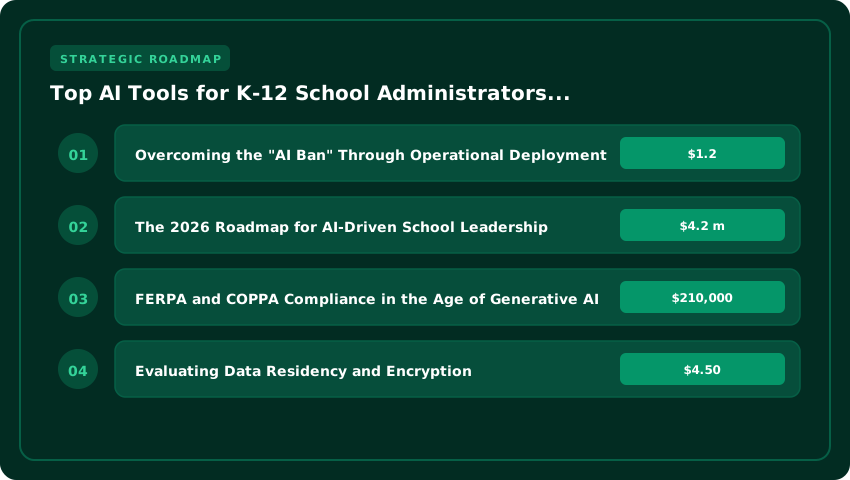
Overcoming the “AI Ban” Through Operational Deployment
Many districts still maintain strict bans on student AI usage to protect learning outcomes and adhere to evolving US Department of Education guidelines. However, these bans often inadvertently stifle the productivity of the central office. The emerging trend for 2026 is the “Operational-Only Deployment” model. This approach creates a firewall between pedagogical tools and administrative utilities.
By deploying AI specifically for non-instructional tasks, districts can achieve rapid wins without triggering parental or board concerns regarding curriculum. Key operational applications include:

- Automated Compliance Reporting: Using AI to synthesize data for FAFSA-related outreach and state funding audits.
- Resource Allocation: Leveraging predictive analytics to optimize bus routing and facility maintenance schedules.
- HR Streamlining: Automating the initial screening of teacher certifications and credentialing to fill vacancies faster.
The 2026 Roadmap for AI-Driven School Leadership
Looking toward 2027, the roadmap for school leadership is no longer about “if” AI should be used, but how it can be governed. The focus has shifted toward data sovereignty and the integration of AI with existing Student Information Systems (SIS). Leadership is now measured by the ability to analyze district-wide trends in real-time rather than relying on quarterly reports.
To stay competitive, administrators are pursuing professional development focused on AI governance. Many are looking toward certifications from bodies like the Project Management Institute (PMI) to manage these digital transformations. The goal is a lean, AI-augmented district office where human leaders spend less time on spreadsheets and more time on student wellness and community engagement. As we enter the latter half of 2026, the divide is clear: districts that treat AI as a purely pedagogical threat will fall behind those that embrace it as an operational powerhouse.
FERPA and COPPA Compliance in the Age of Generative AI
As we navigate 2026, the integration of generative AI into district operations introduces significant legal vulnerabilities. For K-12 administrators, the primary risk is no longer just “data leaks,” but the unauthorized training of Large Language Models (LLMs) on Protected Health Information (PHI) or Personally Identifiable Information (PII). To avoid costly litigation and US Department of Education sanctions, administrators must treat AI procurement as a legal audit rather than a software purchase.
Evaluating Data Residency and Encryption
Compliance begins with where the data lives. Under FERPA, student records must be handled with strict confidentiality. When vetting AI tools, ensure the vendor provides a “Zero-Retention” policy or a dedicated private cloud instance. Generic consumer-grade AI tools often store prompts to improve future iterations; this is a non-starter for US school districts.
- Data Residency: Confirm that all data is hosted on servers physically located within the United States to ensure jurisdiction under US federal law.
- Encryption Standards: Demand AES-256 encryption for data at rest and TLS 1.3 for data in transit.
- De-identification: Verify that the tool employs automated PII scrubbing before any data reaches the AI processing layer.
Vetting AI Vendors for Federal Adherence
COPPA (Children’s Online Privacy Protection Act) remains the gold standard for students under 13. In 2026, “click-wrap” agreements are insufficient. Administrators must secure signed Data Privacy Agreements (DPAs) that explicitly forbid the sale of student data to third parties or the use of student inputs for model training.
- Audit Rights: Ensure the contract allows the district to conduct annual privacy audits or requires a SOC 2 Type II report.
- Consent Workflows: For tools interacting with students, verify that the vendor provides a mechanism for verifiable parental consent as mandated by COPPA.
- Liability Clauses: Include indemnification clauses that protect the district if the vendor suffers a breach due to negligence.
Creating an AI Governance Framework
To secure school board approval and mitigate liability, districts need a formalized AI Governance Framework. This document should move beyond “guidelines” and establish a strict policy for tool adoption. A robust framework includes a tiered approval system: “Approved for PII,” “Approved for Anonymized Data Only,” and “Prohibited.” By aligning this framework with state-level privacy laws and federal mandates, administrators can scale efficiency while maintaining an airtight legal shield for the 2027 academic year and beyond.
Automating High-Volume Administrative Workflows
The primary drain on a district leader’s time isn’t pedagogical oversight—it is the crushing weight of repetitive operational logistics. In 2026, the goal is to eliminate “friction points” where human error and manual entry slow down school functions. By deploying specialized AI agents, administrators can shift from reactive firefighting to proactive strategic planning.
Solving the Master Calendar Puzzle
Creating a K-12 master calendar is traditionally a logistical nightmare involving conflicting gym schedules, faculty certifications, and district-wide events. Modern AI-powered scheduling tools now utilize constraint-based algorithms to automate this process. Instead of manual spreadsheets, administrators input parameters—such as teacher availability and room capacities—and the AI generates an optimized schedule in seconds. This reduces the planning cycle from weeks to hours, ensuring that specialized resources are allocated efficiently across the campus.
Bridging the Parent-School Communication Gap
Effective community engagement often fails due to language barriers and the sheer volume of notifications. AI-driven communication hubs now offer real-time, nuanced translation that goes beyond basic word-for-word conversion, maintaining the professional tone required for school-to-home correspondence. These tools allow administrators to:
- Deploy multi-language newsletters that automatically adapt to the primary language of each household.
- Utilize AI chatbots to handle 80% of routine parent inquiries regarding bus routes, lunch menus, and school hours.
- Analyze sentiment in parent feedback to identify district-wide concerns before they escalate into board meeting conflicts.
Streamlining Enrollment and Financial Aid Documentation
For high school administrators, the transition from enrollment to post-secondary planning is a high-stakes bottleneck. The integration of AI into the enrollment pipeline has revolutionized how districts handle documentation. Specifically, AI agents now assist students and families in navigating the FAFSA (Free Application for Federal Student Aid) process by scanning documents for errors and providing personalized reminders based on US Department of Education deadlines.
By automating the verification of residency and immunization records, districts have seen a significant drop in manual data entry errors. This efficiency is critical as schools compete for enrollment in an era of increased school choice. When the administrative burden is lifted, counselors can spend more time on high-value activities, such as guiding students toward ABET-accredited engineering programs or AACSB-certified business schools, rather than chasing missing paperwork.
Quantifying ROI: Time-Saving Metrics for US Principals
To secure budget approval from superintendents and school boards in 2026, principals must move beyond qualitative “ease of use” arguments and present hard ROI data. The primary currency of school administration is time. When AI is deployed for operational workflows, the return on investment is measured in reclaimed hours that can be redirected toward instructional leadership and student mental health initiatives.
Reclaiming the Work Week: AI Reporting vs. Manual Synthesis
Traditional reporting cycles—such as synthesizing quarterly academic progress or analyzing behavioral trends—historically consumed 8 to 12 hours of a principal’s week. By leveraging AI-driven analytics tools that integrate directly with Student Information Systems (SIS), administrators are seeing a drastic reduction in synthesis time. Current 2026 benchmarks indicate that AI reporting tools reclaim an average of 6 to 9 hours per week per administrator.
- Data Aggregation: Reduction from 4 hours to 15 minutes for cross-referencing attendance and grade fluctuations.
- Communication Drafting: AI-assisted parent newsletters and district updates have reduced drafting time by approximately 70%.
- Meeting Synthesis: Automated transcription and action-item extraction from faculty meetings save an average of 2 hours of manual note-taking and distribution weekly.
Streamlining State-Mandated Compliance Audits
Compliance is the most significant administrative burden in the US education system. Whether preparing for US Department of Education audits or meeting state-specific mandates, manual data entry is a high-risk, low-value activity. AI-enhanced compliance modules now automate the mapping of school data to state reporting frameworks, virtually eliminating manual entry errors.
For a mid-sized US high school, the transition from manual spreadsheets to AI-automated compliance tracking has reduced the “audit preparation window” from three weeks of overtime to roughly four business days. This shift minimizes the risk of funding losses associated with reporting inaccuracies and reduces the burnout rate among front-office staff.
Comparative Analysis: Administrative Cycles
The delta between traditional and AI-enhanced administrative cycles is stark. In a traditional 2026-era cycle, a principal spent roughly 60% of their time on “managerial maintenance” and 40% on “instructional leadership.” In 2026, AI-integrated schools have flipped this ratio.
- Traditional Cycle: Manual scheduling, hand-coded compliance reports, and individual email threads for staff coordination.
- AI-Enhanced Cycle: Algorithmic master scheduling, automated compliance flagging, and centralized AI-coordinated communication hubs.
By quantifying these metrics, principals can demonstrate that the cost of AI software licenses is offset by the recovery of high-value leadership hours, effectively increasing the operational capacity of the school without increasing headcount.
Case Studies: AI Implementation in US Public School Districts
The transition from theoretical AI adoption to operational reality is now evident across diverse American landscapes. By 2026, the focus has shifted from generative chatbots to specialized agentic workflows that solve chronic administrative bottlenecks. The following case studies illustrate how districts of varying sizes are leveraging AI to reclaim thousands of labor hours.
Urban Scale: Eliminating Payroll Leakage in Large Districts
A major urban district in the Northeast, managing an annual budget exceeding $1.2 billion, implemented an AI-driven auditing system to oversee its complex payroll and benefits administration. Previously, manual audits of stipends and overtime led to a 3% error rate, resulting in millions of dollars in overpayments or delayed disbursements.
- The Solution: Integration of an AI auditing layer that cross-references time-clock data with union contracts and US Dept of Education compliance mandates in real-time.
- The Result: The district reduced payroll errors by 85% within the first two quarters of 2026, recovering approximately $4.2 million in misallocated funds.
- Impact: Administrative staff shifted from reactive error-correction to proactive financial planning.
Rural Efficiency: Optimizing Transportation and Logistics
In a sprawling rural district in the Midwest, where bus routes cover hundreds of square miles, the transportation department struggled with rising fuel costs and driver shortages. By deploying an AI-powered routing engine, the district moved beyond static maps to dynamic, demand-responsive scheduling.
- The Solution: An AI system that analyzes real-time traffic patterns, student enrollment shifts, and vehicle maintenance logs to optimize routes daily.
- The Result: A 14% reduction in total fleet mileage and a 20% decrease in average student commute times.
- Impact: These efficiencies allowed the district to reallocate $210,000 from the fuel budget toward classroom technology upgrades.
2026 Strategic Insights: Lessons from Tier-1 State Adopters
Early adopters in states like Texas, California, and New York have provided a blueprint for sustainable AI integration. As we look toward 2027, three critical lessons have emerged from these Tier-1 implementations:
- Data Governance First: Success is predicated on cleaning legacy data before feeding it into AI models to avoid “garbage in, garbage out” scenarios.
- Human-in-the-Loop (HITL): The most effective districts maintain a strict HITL requirement for any AI output affecting personnel pay or student placement.
- FAFSA and Funding Alignment: Leading districts are using AI to analyze FAFSA trends and Title I eligibility, ensuring that federal funding is maximized and distributed with surgical precision.
Selecting Your 2027 AI Tech Stack for School Management
As you plan your infrastructure for the 2027 academic year, the goal is to move beyond fragmented “point solutions” and toward a cohesive AI ecosystem. A disjointed stack creates data silos that hinder decision-making. To avoid technical debt, your primary focus must be interoperability. Any AI tool you procure must offer seamless integration with your existing Student Information Systems (SIS), such as PowerSchool or Infinite Campus. Ensure your vendors adhere to strict API standards and data privacy regulations mandated by the US Department of Education to ensure that student records flow securely between automation layers without manual reentry.
Scalability and District Growth
Infrastructure that works for a single campus often collapses under the weight of a growing district. When evaluating your 2027 stack, analyze the tool’s ability to scale horizontally. As enrollment numbers fluctuate, your AI tools should handle increased loads without latency or exponential price hikes. Prioritize cloud-native platforms that offer tiered licensing models, allowing you to add modules as your administrative needs evolve—whether that means expanding from basic scheduling automation to complex predictive analytics for student retention.
Budgeting Within Public Funding Constraints
Budgeting for AI in the US public sector requires a strategic approach to funding. With the 2026-2027 fiscal cycles, administrators should look beyond general funds and leverage specific grants and federal allocations. Consider the following financial strategies:
- FAFSA & Title I Integration: Align AI procurement with Title I funding by demonstrating how automation reduces administrative burdens, allowing more resources to reach disadvantaged students.
- Subscription vs. Perpetual Licensing: While SaaS models are standard, negotiate multi-year enterprise agreements to lock in 2026 pricing and avoid the “subscription creep” that often plagues district budgets.
- ROI Analysis: Document the man-hours saved through AI automation. If a tool reduces the time spent on state reporting by 40%, that reclaimed labor cost justifies the annual subscription fee.
- Consolidated Vendor Bundles: Reduce overhead by selecting vendors that offer a suite of tools (e.g., attendance, grading, and communication) rather than paying for five separate niche subscriptions.
By focusing on interoperability, scalability, and disciplined budgeting, you ensure that your 2027 tech stack is not just a temporary trend, but a sustainable foundation for district-wide operational excellence.
| AI Tool Category | Leading 2026 Platform | Primary Admin Function | Est. Annual Cost (USD) | Implementation Timeline | Data Privacy Compliance | Avg. Time Saved/Week |
|---|---|---|---|---|---|---|
| Student Information Systems (SIS) Automation | PowerSchool PowerBuddy | Scheduling, enrollment forecasting, state reporting | $4.50 – $7.00 per student | 6-8 Weeks (Cloud) | FERPA, COPPA, SOC 2 Type II | 15-20 Hours |
| HR & Talent Management | Frontline Education (w/ AI Insights) | Recruitment screening, certification tracking, sub management | $3.00 – $5.50 per employee | 4-6 Weeks | FERPA, HIPAA (health data), SOC 2 | 10-12 Hours |
| Communications & Community Engagement | ParentSquare Smart Sites | Multilingual messaging, sentiment analysis, auto-newsletters | $2.00 – $3.50 per student | 2-4 Weeks | FERPA, COPPA, ADA/WCAG 2.1 AA | 8-10 Hours |
| Finance & Procurement | Tyler Technologies Munis AI | Invoice processing, budget forecasting, grant compliance | $15,000 – $50,000+ base | 8-12 Weeks | GAAP, SOC 1/2, State Audit Standards | 12-18 Hours |
| IT Service Management (ITSM) | Incident IQ w/ AI Assist | Ticket triage, asset lifecycle, 1:1 device management | $1.50 – $2.50 per device | 3-5 Weeks | FERPA, NIST 800-53, CSPC | 20-25 Hours |
Frequently Asked Questions
What is the average cost of AI administrative tools for a mid-sized US school district in 2026?
In 2026, a mid-sized US district (5,000-10,000 students) typically budgets $150,000-$350,000 annually for a full administrative AI suite. Per-student costs range from $2.00 for communications tools to $7.00 for SIS automation, with finance platforms requiring separate base fees of $15,000+.
Which AI tools for school administrators are fully FERPA and COPPA compliant in 2026?
As of 2026, PowerSchool PowerBuddy, Frontline Education, ParentSquare, and Incident IQ maintain explicit FERPA and COPPA compliance certifications. Districts must verify the vendor's Data Processing Addendum (DPA) covers the specific AI model training data policies before deployment.
How long does it take to implement AI scheduling automation in a K-12 district for the 2026-2027 school year?
Cloud-based AI scheduling tools like PowerBuddy require 6-8 weeks for full implementation, including data migration and staff training. Districts targeting the 2026-2027 master schedule must initiate contracts by March 2026 to ensure go-live before the summer scheduling window closes.
What measurable efficiency gains do US districts report from administrative AI in 2026?
2026 benchmarks show districts reclaiming 50-75 administrative hours per week per building. IT departments report 20-25 hours saved via automated ticket triage; registrars save 15-20 hours on enrollment; HR teams cut recruitment screening time by 40% using AI parsing.
Can 2026 AI tools automate state reporting compliance for K-12 administrators?
Yes, 2026 SIS-integrated AI tools (PowerSchool, Infinite Campus) now auto-populate 80-90% of required state reporting fields (attendance, discipline, staff credentials) using real-time data validation. Final sign-off remains a human requirement per 2026 state audit mandates.
Strategic Final Takeaway
When evaluating Best AI Tools For K-12 School Administrators To Improve Operational Efficiency in 2026 and beyond, base your decisions on accredited institutional standards, verified return on investment (ROI), and up-to-date official guidelines. Always verify specific dates and requirements through official regulatory portals.