2026 Price Breakdown: NAPTIN vs REA Programs vs Private Academies
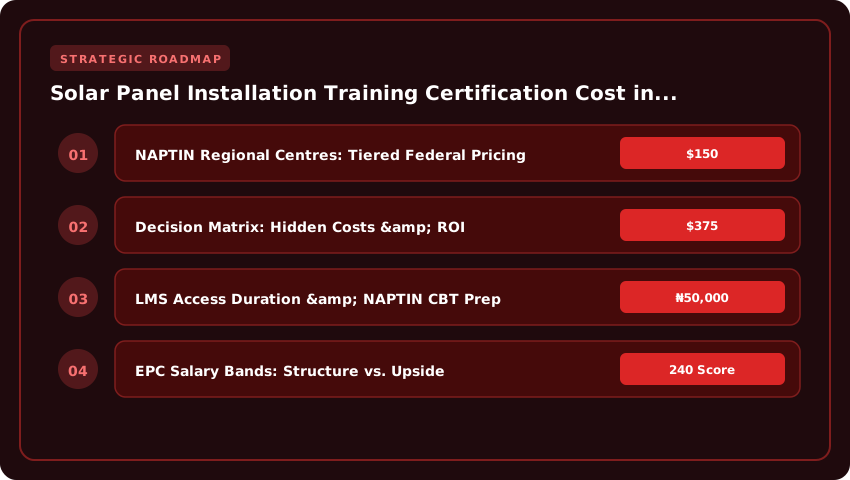
NAPTIN Regional Centres: Tiered Federal Pricing
The National Power Training Institute of Nigeria (NAPTIN) remains the gold standard for grid-code compliance. For the 2026 academic sessions, tuition is stratified by module complexity and centre location. The foundational Off-Grid Solar PV Design & Installation module (typically 2–3 weeks) ranges from ₦75,000 to ₦95,000 at centres in Abuja, Lagos (Ijora), and Kaduna. The advanced Grid-Tie/Grid-Interactive Systems module, which covers inverter configuration and Discos interconnection standards, commands a premium of ₦110,000 to ₦130,000. Note that these fees cover tuition and certification processing only; trainees must budget separately for personal safety boots (₦15k–₦25k) and basic hand tools, as NAPTIN centres provide shared lab equipment but not personal kits.
REA Energizing Education Programme (EEP): Subsidized Pathways
The Rural Electrification Agency (REA) offers the most cost-efficient route via the Energizing Education Programme (EEP) and the Solar Power Naija workforce workstream. For 2026, successful applicants access heavily subsidized slots—often ₦30,000 to ₦50,000 administrative commitment fees—covering full tuition, accommodation at designated polytechnics, and a starter toolkit. Eligibility is strict: applicants must be Nigerian youths aged 18–35, possess a minimum of O’Level credits in Mathematics, English, and Physics/Technical Drawing, and pass the REA CBT aptitude test hosted on the REA portal. Priority is given to candidates from underserved communities and female applicants under the gender-mainstreaming quota. Slots are non-transferable and tied to specific deployment zones upon graduation.
Private Academies: The All-Inclusive Premium (₦150k–₦450k)
Private providers—such as Solar Energy Nigeria, Asteven Renewable Energy Academy, and Blue Camel Energy—dominate the market for professionals needing flexible schedules and guaranteed COREN/NABCEP-aligned certification. The 2026 fee bands break down as follows:
- Entry Tier (₦150,000 – ₦220,000): 5-day intensive covering sizing, battery management, and safety. Includes a branded toolkit (multimeter, crimping tool, wire strippers) and PPE (helmet, gloves, harness).
- Professional Tier (₦250,000 – ₦350,000): 2-week hybrid (online theory + physical practicals). Adds advanced inverter programming (Victron, Growatt, Schneider), site survey drones demo, and a 1-month mentorship.
- Master Installer Tier (₦380,000 – ₦450,000): Includes NABCEP PV Associate exam prep fees, business development module (quoting, contracts, NERC mini-grid regulations), and a premium toolkit with thermal camera access.
Decision Matrix: Hidden Costs & ROI
When comparing 2026 figures, factor in opportunity cost. NAPTIN/REA require 2–4 weeks off-grid with uncertain intake dates (often quarterly), whereas private academies run monthly cohorts. However, REA/NAPTIN certificates carry weight for NERC licensing and federal contract bidding (e.g., World Bank DARES projects). Private certs are widely accepted for commercial EPC contracts but verify the academy’s COREN accreditation status before paying. Always confirm if the quoted fee includes the NABCEP Associate exam voucher (approx. $150/₦230k separately) if international portability is your goal.
Accreditation Hierarchy: COREN, NIEEE & NAPTIN Certification Weight
In the 2026 Nigerian renewable energy labour market, not all certificates carry equal legal weight. The hierarchy determines whether you are legally permitted to sign off on a 500kW mini-grid project for the Rural Electrification Agency (REA), bid on a corporate EPC contract for a Lagos industrial park, or simply wire a 5kVA inverter for a residential client in Ibadan. Understanding this pecking order saves you from spending ₦300,000 on a private academy diploma that a federal procurement officer will reject at the technical evaluation stage.
NAPTIN Certificate of Competence vs. COREN Technician Registration
The NAPTIN Certificate of Competence is a training completion credential. It proves you passed the practical modules at a Regional Training Centre (RTC) — covering grid-code compliance, protection coordination, and battery bank sizing. However, it is not a license to practice independently on utility-scale infrastructure. For that, you need the Council for the Regulation of Engineering in Nigeria (COREN) registration.
- NAPTIN Certificate: Mandatory prerequisite for COREN Technician registration in the Power sector. Valid for life, but does not confer legal signing authority on single-line diagrams submitted to the Nigerian Electricity Regulatory Commission (NERC).
- COREN Engineering Technician (EngTech) Registration: The legal gateway. Under the COREN Act 2026 (Amendment), only registered Engineering Technicians can supervise installation works on projects exceeding 50kW connected to the national grid or mini-grids licensed by NERC. The 2026 registration fee sits at approximately ₦45,000 (including stamp duty), plus mandatory Continuing Professional Development (CPD) logs.
If your goal is federal contracts — REA Solar Power Naija, World Bank-funded Nigeria Electrification Project (NEP) sites, or Federal Ministry of Power jobs — you need the COREN seal. NAPTIN gets you the interview; COREN gets you the contract award letter.
NIEEE Solar PV Professional Grade: The Corporate EPC Key
The Nigerian Institute of Electrical and Electronic Engineers (NIEEE) runs the Solar PV Professional Grade certification, distinct from COREN’s statutory mandate. In 2026, major EPC contractors — think Sterling & Wilson, Bredenoord, or local giants like GVE Projects — list “NIEEE Solar PV Professional Member” as a mandatory HR filter for Project Engineer and Site Supervisor roles.
- Requirements: Minimum HND/B.Eng in Electrical/Electronic Engineering, 3 years verifiable post-NYSC experience in PV design (PVsyst/Helioscope proficiency tested), and a successful oral defense before the NIEEE Power Division panel.
- Cost: Application ₦25,000; Assessment ₦75,000; Annual Subs ₦15,000.
- Unlock: Corporate EPC payroll (₦400k–₦800k/month entry), eligibility to stamp “As-Built” drawings for private commercial/industrial (C&I) projects under 1MW where COREN sign-off is not statutorily mandated but client specs demand it.
International Recognition: NABCEP Equivalency & IEC 62446 Alignment
For freelancers targeting the diaspora remote-design market or NGOs deploying to West African Sahel regions, the North American Board of Certified Energy Practitioners (NABCEP) PV Installation Professional (PVIP) credential remains the global gold standard. NAPTIN’s 2026 curriculum is now mapped to IEC 62446 (Grid-connected PV system inspection/testing) and IEC 62548 (Design requirements), creating a direct knowledge bridge.
- Pathway: NAPTIN Advanced Grid-Tied Module (₦120k) + 2 years documented field logs → NABCEP PVIP Exam Eligibility (US$375 exam fee + US$150 application).
- Freelance Permit Reality: For residential/off-grid installs (<20kW) in Nigeria, a NAPTIN Cert + Company Registration (CAC) + NERC Permit Category D (for mini-grid developers) is the practical legal stack. NABCEP adds zero legal weight locally but commands 30–50% premium on Upwork/LinkedIn international design gigs.
Bottom line: Federal work demands COREN. Corporate EPC demands NIEEE. International remote work demands NABCEP. Private residential installs demand a CAC certificate, a NAPTIN cert for credibility, and a solid warranty structure. Stack them in that order as your budget allows.
Curriculum Scope: Inverter Sizing, Battery Chemistry & Grid Code Compliance
The difference between a technician who merely mounts panels and an engineer who designs bankable hybrid systems lives in the curriculum. In 2026, Nigerian employers and EPC contractors are filtering for specific competencies: can you size a 15kVA inverter for a Lagos duplex running three inverter ACs and a borehole pump? Can you program a BMS for a 20kWh Lithium-Ion bank without bricking the cells? If your training centre skips these, your certificate is just wallpaper.
Hands-On Lab Hours: Lithium-Ion vs Lead-Acid Bank Configuration & BMS Programming
Lead-acid is still king in the budget market, but Lithium-Ion (LiFePO4) dominates new installs above 5kVA. A 2026 curriculum worth its salt dedicates minimum 40% of contact hours to lab work. You need physical reps configuring 48V strings—series-paralleling 200Ah tubulars versus addressing 16-cell LiFePO4 packs with active balancers. Critical modules must cover:
- BMS Programming: Setting charge/discharge cut-offs (typically 3.65V/2.5V per cell), temperature derating curves for Nigerian ambient heat, and CAN/RS485 communication with hybrid inverters (Deye, Growatt, Victron).
- Fault Injection Drills: Simulating cell imbalance, over-current events, and thermal runaway mitigation—skills you cannot learn from YouTube.
- Bank Sizing Math: Real-world derating for Depth of Discharge (DoD): 50% for AGM/Gel vs 80-90% for Lithium, plus Peukert’s exponent calculations for lead-acid under high surge loads.
Ask for the lab equipment list before paying. If they don’t have a programmable DC load bank and a thermal camera, walk away.
Nigerian Grid Code (NGC) Compliance Training for Net-Metering Applications
This is the gatekeeper for utility-scale and commercial & industrial (C&I) work. The Nigerian Electricity Regulatory Commission (NERC) Mini-Grid Regulations 2026 and the Nigerian Grid Code (Distribution Code) mandate specific anti-islanding protection (IEEE 1547/UL 1741 SA), voltage ride-through (LVRT/HVRT), and power factor control (0.95 lag/lead). Your course must drill:
- Protection Coordination: Setting relay curves (ANSI 27/59, 81O/U) on the inverter to satisfy DisCo interconnection agreements.
- Net-Metering Paperwork: Drafting the Single Line Diagram (SLD), protection study report, and commissioning test sheets required by AEDC, IKEDC, or EEDC for bi-directional meter installation.
- Export Limitation: Configuring zero-export or soft-export controllers (CT/Meter integration) where DisCos reject reverse power flow.
NAPTIN and REA-aligned centres usually embed NERC-certified facilitators for this; private academies often bring in consultants from firms like GVE or Rensource. Verify the facilitator’s track record with actual interconnection approvals.
PVSyst/Helioscope Design Software Proficiency Modules Included in Fees
Paper calculations don’t win ₦50M+ EPC bids. The 2026 standard requires proficiency in PVSyst (industry standard for bankable yield reports) and Helioscope (speed for preliminary design). These modules must be included in the tuition—no “optional add-on” upsells. You should leave capable of:
- Importing TMY3/NASA POWER data for specific Nigerian coordinates (e.g., Minna vs Port Harcourt irradiance variance).
- Modeling near-shading with 3D scene imports (SketchUp/Google Earth) for dense Lagos rooftops.
- Generating the P50/P90 yield reports and loss diagrams (soiling, thermal, wiring, inverter clipping) that banks and DFIs (AfDB, World Bank) demand for project finance.
If the syllabus lists “Basic Excel sizing” as the design module, the programme is obsolete. You are paying for the software licence access and the instructor’s licence to teach it—confirm both are current.
Funding Mechanisms: NELFUND Skills Loan, BoI & State Scholarship Boards
Securing admission is only half the battle; financing the certification without draining personal savings requires navigating Nigeria’s 2026 federal and state funding windows. The landscape has shifted significantly since the Student Loans (Access to Higher Education) Act amendments, and smart technicians are tapping into these specific channels before paying out of pocket.
NELFUND 2026 Guidelines for Vocational STEM Short Courses
The Nigerian Education Loan Fund (NELFUND) portal now explicitly covers accredited vocational programmes under the “Skills Development” vertical, not just degree programmes. For 2026, the fund disburses tuition directly to the training provider—NAPTIN, REA-accredited centres, or NABTEB-approved private academies—while a maintenance stipend of ₦20,000 monthly hits the applicant’s verified BVN-linked account. The critical eligibility gate is institutional accreditation: the centre must appear on the NELFUND “Approved Institutions” list accessible via the dashboard at nelf.gov.ng. Applicants must have a valid NIN, BVN, and proof of admission (admission letter with course duration and cost breakdown). The loan carries zero interest and repayment begins two years after completion or upon securing employment earning above ₦30,000 monthly, whichever comes first. Pro tip: apply immediately after receiving your provisional admission letter; the 2026 budget cycle processes vocational batches quarterly (January, April, July, October).
Bank of Industry (BoI) Artisan Loan Scheme Workflow for Solar Techs
The BoI Artisan Loan Scheme remains the most robust non-academic capital source for solar technicians in 2026, offering up to ₦2,000,000 at 5% per annum for equipment acquisition and working capital post-certification. The workflow is distinct from standard SME loans:
- Step 1 – Certification Proof: Upload your NAPTIN/REA/NABTEB certificate and a detailed business plan showing projected installation contracts.
- Step 2 – Cluster/Association Endorsement: You must belong to a registered cooperative or trade association (e.g., Renewable Energy Association of Nigeria – REAN cluster groups). The association chairman signs the guarantee letter.
- Step 3 – Asset Quotation: Submit proforma invoices for tools (multimeters, clamp meters, crimping tools, safety gear) from BoI-approved vendors.
- Step 4 – Disbursement: Funds are paid directly to vendors; zero cash touches your hand, eliminating diversion risk.
Processing takes 4–6 weeks if your association paperwork is current. Lagos and Abuja applicants often experience faster turnaround due to dedicated BoI desk officers at the Enterprise Development Centres.
Lagos, Ogun & Delta State Scholarship Board Partnerships
State boards have moved beyond generic bursaries into direct training partnerships with accredited centres for 2026. The Lagos State Scholarship Board (LSSB) runs the “Green Energy Youth Empowerment” track: full tuition coverage at partner academies like Asteven Energy Institute or competent private centres in Ikeja and Ikorodu, plus a ₦50,000 toolkit grant upon completion. Application is strictly via the LSSB portal (scholarship.lagosstate.gov.ng) with LASRRA ID and LGA origin proof.
Ogun State’s Bureau of Technical Education partners with the Abeokuta and Ijebu-Ode NAPTIN centres for 50% tuition vouchers targeting indigenes in STEM trades. Delta State’s Scholarship Board (DSSB) focuses on the “Solar for Health” initiative, sponsoring trainees who commit to a one-year internship at Primary Health Centres (PHCs) solarizing cold-chain equipment. These state windows rarely advertise widely; join the official WhatsApp/Telegram channels of the respective State Ministries of Education or Technical Education Boards for real-time 2026/2027 session announcements.
Training Logistics: Weekend Bootcamps, Residential Intensives & Hybrid LMS
Choosing between a stretched weekend schedule and a compressed residential block is not just about calendar management—it directly impacts your retention rate for the NAPTIN Computer-Based Test (CBT) and your total cash outlay. In 2026, the federal training centres (Abuja, Kaduna, Sapele) run two distinct delivery modes for the Solar PV Installation & Maintenance certification, and the hidden costs of each format often catch artisans off guard.
4-Weekend Bootcamp vs. 10-Day Residential: The Trade-Offs
The 4-Weekend Bootcamp (typically Saturday–Sunday, 8:00 am–5:00 pm) targets working technicians in Lagos, Port Harcourt, or Kano who cannot afford ten consecutive days off-site. You keep your weekly income flowing, but the fragmented schedule forces you to re-contextualize NEC Article 690 and battery sizing calculations every seven days. Fatigue sets in by Weekend Three, and absenteeism risk is high—miss one Sunday practical on inverter configuration, and you cannot sit the final CBT without a make-up session that centres rarely schedule.
The 10-Day Residential Intensive at NAPTIN Abuja (Idu), Kaduna, or Sapele compresses 80 contact hours into a single immersion. You eat, sleep, and troubleshoot string inverters on the same campus. The pedagogical advantage is massive: muscle memory for MC4 crimping and isolation testing builds daily without decay. However, you forfeit ten working days of revenue—roughly ₦150,000–₦300,000 for a mid-level artisan—and you must front-load accommodation and feeding costs.
LMS Access Duration & NAPTIN CBT Prep
Every 2026 enrollee receives credentials for the NAPTIN Moodle LMS. The critical detail: access expires 90 days after your cohort’s closing ceremony. This window is your only official runway for CBT past-question drills, video replays of fault-finding labs, and the updated Grid Code Compliance module released in Q1 2026. Private academies often sell “lifetime access” as an upsell (₦15,000–₦25,000), but the federal portal locks you out strictly at Day 91. Schedule your CBT attempt within Week 6 post-training; the question bank rotates quarterly, and the 2026 syllabus now weights battery management systems (BMS) configuration at 22% of the score.
Accommodation & Feeding Add-Ons at Federal Campuses
Tuition (₦50,000–₦120,000) covers instruction only. Budget separately for residency:
- NAPTIN Abuja (Idu): Hostel bed-space ₦3,500/night (₦35,000 for 10 nights). Cafeteria meal ticket ₦2,200/day (₦22,000 total). Expect shared 6-bunk rooms; power supply is stable but water runs on a roster.
- NAPTIN Kaduna: Slightly cheaper hostel at ₦2,800/night (₦28,000). Meals average ₦1,800/day if you eat at the mess; local “buka” options outside the gate drop this to ₦1,200/day but add 15 minutes walk each way.
- NAPTIN Sapele: Most economical—₦2,000/night hostel (₦20,000) and ₦1,500/day meals (₦15,000). However, factor in higher transport fares from Lagos or Abuja (₦35,000–₦55,000 return by road/flight combo in 2026 fuel climate).
Pro tip: If you choose the residential route, book the hostel the moment you receive the admission SMS—slots vanish 72 hours after the merit list drops. For weekend bootcampers, negotiate a corporate rate at a nearby hotel (₦8,000–₦12,000/night) and claim it as a business expense; the LMS access remains identical regardless of format.
ROI Timeline: Freelance Day Rates, EPC Salary Bands & Maintenance Contracts
Let’s talk numbers—because that ₦150,000 to ₦450,000 you dropped on certification needs to earn its keep. In 2026, the Nigerian solar market is splitting sharply between high-volume residential installs in Lagos/Abuja and heavy commercial/industrial (C&I) projects in Port Harcourt and the industrial corridors. Your payback period hinges entirely on which lane you pick.
Freelance Day Rates: The Lagos–Abuja–Port Harcourt Spread
If you’re gunning for the contractor life, your daily rate is your leverage. In Lagos (Lekki, Ikeja, Victoria Island), certified installers with COREN/NAPTIN paperwork are commanding ₦25,000–₦35,000 per day for residential rooftop mounts (3kW–10kW). Abuja (Maitama, Gwarinpa, Kubwa) tracks slightly lower at ₦20,000–₦30,000/day but offers steadier volume from estate developers. Port Harcourt is the outlier—rates hit ₦30,000–₦40,000/day because oil & gas facilities and hospitals demand hazardous-area competence (ATEX/Ex-rated enclosures) that many Lagos hands lack. At 15 billable days a month, a Lagos pro clears ~₦450k/month; a PH specialist clears ~₦550k. That puts full ROI on a ₦350k private academy fee at 3–4 months.
EPC Salary Bands: Structure vs. Upside
Prefer a payslip? The 2026 EPC ladder looks like this:
- Entry-Level (0–2 Years): ₦120,000–₦180,000/month gross. Firms like Arnergy, Rensource, and Daystar Power slot fresh NAPTIN grads here for site supervision and BoM verification.
- Mid-Level (3–5 Years, COREN Registered): ₦220,000–₦350,000/month + 13th-month bonus + HMO. You’re running 50kW–200kW hybrid sites, managing subcontractors, and signing off on single-line diagrams.
- Lead Installer / Site Engineer (5+ Years): ₦400,000–₦650,000/month package (basic + housing + transport + performance bonus). At this tier, you own the commissioning checklist and the client handover.
Salaried route ROI is slower—10–14 months to recoup training costs—but you buy stability, pension contributions, and a clear path to Project Manager roles (₦800k+).
Annual Maintenance Contract (AMC) Modeling: The Recurring Revenue Engine
This is where the smart money compounds. A standard AMC in 2026 charges 1.5%–2.5% of system CAPEX annually for quarterly inspections, thermal imaging, firmware updates, and battery health checks.
- 50kW Commercial Site (₦35M CAPEX): AMC @ 2% = ₦700,000/year. One technician covers 4–5 of these on a quarterly circuit.
- 200kW Mini-Grid / Factory (₦140M CAPEX): AMC @ 1.8% = ₦2.5M/year. Requires dedicated O&M crew but yields 35% gross margin after labor/logistics.
- 500kW Industrial Cluster (₦350M CAPEX): AMC @ 1.5% = ₦5.25M/year. Usually bid as a 3-year frame agreement with SLAs (99.5% uptime).
If you secure just two 50kW AMCs post-certification, you generate ₦1.4M/year recurring—paying off your training in under 90 days while keeping your weekends free for installs. The certification isn’t a cost; it’s the key to the contract clause that demands “COREN-certified O&M personnel.” Without it, you’re locked out of the recurring revenue tier entirely.
Enrollment Checklist: Prerequisites, Tool Procurement & Post-Cert Licensing
Before you wire a single naira to any training centre, verify your entry route. The standard academic gateway demands five O’Level credits (WAEC, NECO, or NABTEB) at not more than two sittings, including Mathematics, Physics, and English Language. If you hold a National Diploma (ND) in Electrical/Electronic Engineering or a relevant trade test certificate, you can bypass the SSCE bottleneck via the Recognition of Prior Learning (RPL) pathway. NAPTIN and REA-accredited centres typically require a formal RPL assessment—expect a practical interview and a portfolio review of past projects. Private academies are more flexible but always confirm their specific RPL policy in writing before assuming eligibility.
Personal Toolkit: Non-Negotiable Specs
Federal programmes (NAPTIN/REA) usually issue a shared toolkit for the duration of the course, but you cannot rely on borrowed gear for field work. Budget ₦85,000–₦150,000 for a personal kit that meets COREN site-inspection standards. Your minimum viable kit must include:
- True-RMS Digital Multimeter: Fluke 117/323 or equivalent (CAT III 600V minimum) for safe DC/AC verification on live arrays.
- MC4 Crimping Tool: Ratchet-type (e.g., Rennsteig or IWISS) with interchangeable dies for 2.5mm², 4mm², and 6mm² solar cables—cheap plastic crimpers fail pull-out tests.
- Torque Wrench (Preset or Adjustable): Range 2–12 Nm for MC4 connectors and 10–30 Nm for M8/M10 structural bolts on mounting rails.
- Insulation Resistance Tester (Megger): 500V/1000V DC for string insulation checks per NERC Mini-Grid Regulation 2026.
- Cable Cutters/Strippers: Ratchet cutters for 16mm²+ DC cables and automatic strippers for PV1-F cable.
Private academies advertising “free toolkits” often supply entry-level brands; verify the model numbers against this list before enrolling.
Post-Certification: The Legal Operating Triad
Passing the practical exam is only step one. To legally sign off designs, invoice clients, and bid for REA/World Bank mini-grid contracts in 2026, you must activate three compliance pillars immediately:
- COREN Engineering Training Logbook: Register as a Graduate Engineering Technician/Technologist. Your 6-month supervised experience log starts after certification. No logbook sign-off by a COREN-registered mentor = no future Professional registration.
- NIEEE Membership (Solar Energy Division): Apply for Associate Membership (₦15,000–₦20,000 annual dues). This grants access to the NIEEE stamp required for single-line diagram approvals by Discos and state ministries of energy.
- TIN & CAC Business Name Registration: Secure your Tax Identification Number (FIRS) and register a Business Name (₦10,000–₦15,000 via CAC portal) or Limited Liability Company. Without a TIN, you cannot generate valid e-invoices for corporate clients or access the NELFUND/BOI intervention loans for solar SMEs.
Treat this checklist as your critical path. Missing any item stalls your revenue generation by months.
| Training Provider | 2026 Tuition Range (₦) | Program Duration | Admission Selectivity | Certification Authority | Toolkit & PPE Inclusion | Best For |
|---|---|---|---|---|---|---|
| NAPTIN Regional Centres (Abuja, Lagos, Kaduna) | ₦75,000 – ₦120,000 | 2 – 4 Weeks (Module-based) | High (Merit/Entrance Exam) | NAPTIN / Federal Ministry of Power | No (Separate purchase required) | Grid-code compliance & Discos interconnection roles |
| REA / NESP Supported Programs | ₦50,000 – ₦100,000 (Often Subsidized) | 1 – 3 Weeks (Intensive Bootcamps) | Moderate (Application & Screening) | REA / International Partners (GIZ, USAID) | Yes (Basic tools often provided) | Rural electrification & mini-grid deployment careers |
| Private Academies (e.g., ASTEVEN, SolarKobo, Blue Camel) | ₦150,000 – ₦450,000 | 2 – 6 Weeks (Flexible Schedules) | Low (First-come, First-served) | In-house / COREN Aligned / NABCEP Prep | Yes (Full toolkit, PPE, Software licenses) | Immediate start, entrepreneurship & private sector EPC |
Frequently Asked Questions
How much does solar installation training cost in Nigeria in 2026?
In 2026, solar training costs range from ₦50,000 for subsidized REA programs to ₦450,000 for premium private academies. Federal NAPTIN centres charge ₦75,000–₦120,000 for certified modules. Private institutes include toolkits and PPE in higher fees, while federal programs require separate equipment purchases.
Which solar certification is most recognized by Nigerian employers in 2026?
NAPTIN certification remains the 2026 gold standard for grid-tie roles and Discos compliance due to Federal Ministry of Power backing. REA certificates dominate mini-grid and rural electrification hiring. Private academy certificates are widely accepted for EPC contracts but may require COREN alignment for engineering sign-off authority.
Can I get free solar panel installation training in Nigeria in 2026?
Fully free training is rare in 2026, but REA/NESP bootcamps often offer near-zero tuition (₦0–₦20,000 admin fees) for selected youths. NAPTIN and private academies charge mandatory tuition. Scholarships exist via state energy boards or NGO partnerships like GIZ, requiring competitive applications months before 2027 cohorts.
What is the difference between NAPTIN and private solar training in Nigeria 2026?
NAPTIN offers lower fees (₦75k–₦120k) and grid-code authority but has competitive entry and no toolkits. Private academies charge ₦150k–₦450k for immediate enrollment, flexible schedules, and inclusive toolkits/PPE. NAPTIN suits Discos employment; private suits fast-track entrepreneurship and international certifications like NABCEP prep.
How long does it take to become a certified solar installer in Nigeria 2026?
Certification timelines in 2026 vary: NAPTIN modular courses take 2–4 weeks per level (Off-Grid then Grid-Tie). REA intensive bootcamps compress basics into 5–10 days. Private academies offer 2–6 week comprehensive tracks. COREN registration for engineers adds 6–12 months post-training experience verification.
Strategic Final Takeaway
When evaluating Solar Panel Installation Training Certification Cost In Nigeria 2026 in 2026 and beyond, base your decisions on accredited institutional standards, verified return on investment (ROI), and up-to-date official guidelines. Always verify specific dates and requirements through official regulatory portals.