
Key Takeaway: Your right to assemble on campus isn’t a privilege granted by the VC—it is a fundamental right entrenched in Section 40 of the 2026 Constitution (as altered). In 2026, knowing the exact notification timelines under the Student Union Act Amendment separates a protected demonstration from an “unlawful assembly” charge.
Constitutional Backing & The Student Union Act: Your Legal Shield in 2026
Let’s be clear: the Nigerian Constitution does not stop at the university gate. Section 40 of the 2026 Constitution (as amended) guarantees every citizen the right to assemble freely and associate with other persons. This includes students on campus. When the Dean of Student Affairs tells you protests are “banned,” they are administratively overreaching. The Constitution supersedes any university statute or vice-chancellor’s circular. However, the Constitution also permits restrictions “in the interest of defence, public safety, public order, public morality or public health.” The battleground in 2026 is defining where “public order” ends and your right begins.

Mandatory Notification Timelines Under the Student Union Act (Amendment)
The Student Union Act (Amendment)—often referenced in tandem with the Universities (Miscellaneous Provisions) Act—does not require you to ask for permission to protest; it requires notification. This distinction is your legal armor. For 2026 operations, the standard statutory requirement across federal universities (UNILAG, UI, OAU, ABU, UNN) mandates a written notice to the Dean of Student Affairs and the Chief Security Officer at least 48 hours before the assembly.
- The Notice Must Contain: Date, time, assembly point, dispersal point, estimated number of participants, and the specific demands/grievances.
- Leadership Identification: Names and phone numbers of the protest coordinators (usually the SUG President and PRO).
- Acknowledgement Receipt: Never submit without a signed, stamped acknowledgement copy. If they refuse to sign, send via registered courier (NIPOST EMS) or official university email with read receipt—this creates a paper trail admissible in court.
Failure to notify doesn’t make the protest illegal per se, but it strips you of the statutory protection against police disruption. It hands the university the “public order” argument on a platter.
Distinguishing Lawful Protest from Unlawful Assembly in University Statutes
University statutes (the “Green Books” or Student Handbooks) often try to criminalize processions that “obstruct vehicular movement” or “disrupt academic activities.” In 2026, the courts have consistently held (referencing Inspector General of Police v. ANPP and All Nigeria Peoples Party v. Inspector General of Police) that peaceful assembly does not require a police permit, only notification.
The line crosses into “unlawful assembly” (Criminal Code Act, Section 69 / Penal Code, Section 82) only when three or more persons assemble with intent to commit a breach of peace or cause fear. Carrying placards, chanting solidarity songs, and marching on designated pedestrian paths is lawful. Blocking the main gate to prevent lecturers from entering, destroying property, or bearing offensive weapons converts your constitutional shield into a criminal liability instantly.
Pro Tip: Always livestream the protest from start to finish. In 2026, video evidence is your best witness against agent provocateurs planted to justify a crackdown. Know the law, serve the notice, keep it peaceful, and own the narrative.
Drafting the NANS Charter of Demands: Template & VC Engagement Protocol
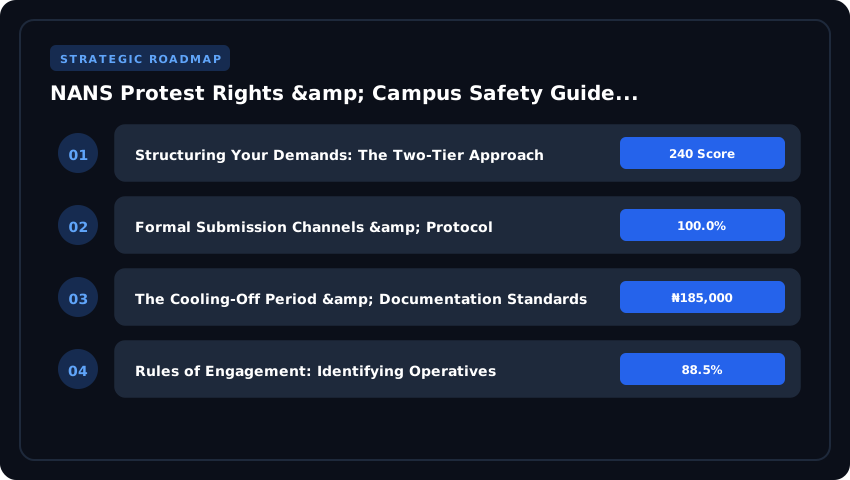
A protest without a structured Charter of Demands is merely noise; a protest with a documented Charter is a negotiation. To prevent the university management from dismissing student grievances as “uncoordinated anarchy,” the National Association of Nigerian Students (NANS) and local SUG chapters must utilize a professional, tiered approach to their demands. In 2026, the goal is to move from the streets to the boardroom with leverage.
Structuring Your Demands: The Two-Tier Approach
Avoid the mistake of mixing minor grievances with systemic failures. Your Charter should be split into two distinct categories to allow the Vice-Chancellor (VC) a path toward quick wins, which builds momentum for larger reforms:
- Immediate Reliefs (Short-Term): These are “low-hanging fruits” that require administrative approval rather than legislative change. Examples include the immediate restoration of electricity in hostels, the release of withheld results, or the urgent repair of shuttle buses.
- Systemic Policy Reforms (Long-Term): These address structural issues that may require NUC (National Universities Commission) alignment or Senate approval. Examples include the review of the 2026 tuition hike, the implementation of the new CCMAS curriculum standards, or the overhaul of the campus security protocol.
Formal Submission Channels & Protocol
To avoid accusations of “unofficial action” or “incitement,” the Charter must be submitted through the official administrative hierarchy. Bypassing these channels gives the management legal grounds to label the protest as an illegal gathering. The submission sequence should be:
- The Registry: The primary point of entry for all formal correspondence. Ensure you obtain a “Received” stamp with the date and time.
- Dean of Student Affairs (DSA): The primary liaison. The DSA serves as the mediator between the student body and the VC’s office.
- The Senate Secretary: Essential for demands involving academic calendars, grading systems, or graduation requirements.
The Cooling-Off Period & Documentation Standards
Once the Charter is submitted, a mandatory “cooling-off period”—typically 48 to 72 hours—must be observed. This period demonstrates “good faith” and prevents the university from claiming that students acted impulsively. During this window, the student leadership should prepare for the engagement meeting.
During the meeting with the VC or Senate, the following documentation standards are non-negotiable: a designated Secretary must record verbatim minutes, and a “Memorandum of Understanding” (MoU) must be drafted on the spot. This MoU should outline specific deadlines for each demand, signed by both the VC and the NANS/SUG President, to ensure that verbal promises do not vanish once the students return to the lecture halls.
The NANS Escalation Matrix: From Departmental Rep to National Secretariat
Let’s be blunt: a protest without this paper trail is just a riot waiting for a rustication list. In 2026, the National Association of Nigerian Students (NANS) operates a strict four-tier authorization protocol. Skip a rung, and you forfeit national legal backing, insurance coverage for injured comrades, and the political weight that forces a Vice-Chancellor to the negotiating table. This isn’t bureaucracy for bureaucracy’s sake; it is your shield against the “unlawful assembly” charge the Dean of Student Affairs is drafting right now.
Level 1: Departmental/Faculty Congress — The Quorum Gatekeeper
Everything starts at the grassroots. Before a single placard is printed, the Departmental or Faculty Congress must convene. The 2026 NANS Standing Orders mandate a two-thirds (2/3) quorum of registered students in that department for the resolution to be valid. A handful of activists in a lecture hall won’t cut it. The resolution must explicitly state the grievance, the specific demands, the proposed date, and the designated protest route. Minutes must be signed by the Departmental President, Secretary, and the Faculty Representative. Without these wet-ink signatures and the attendance register attached, the process dies here.
Level 2: SUG Executive Council Ratification & Zonal Notification
The signed minutes move to the Students’ Union Government (SUG) Executive Council. This isn’t a rubber stamp. The SUG President must table the resolution at an emergency EC meeting. The Council votes; a simple majority ratifies it, but the SUG President and Secretary General must endorse it jointly. Crucially, within 48 hours of ratification, the SUG Secretariat must serve a formal “Notice of Intent” to the NANS Zonal Coordinator covering your institution (e.g., Zone D for South-West, Zone B for North-Central). This notification triggers the Zonal legal team’s preliminary review of your demands against the Student Union Act Amendment.
Level 3: NANS Zonal Coordinator (A-Z) — Intervention Thresholds
The Zonal Coordinator (ZC) is the gatekeeper to Abuja. They assess three thresholds before forwarding your file:
- Exhaustion of Internal Mechanisms: Proof you engaged the Dean, VC, or Council via formal letters (with received stamps) and got stonewalled.
- Security Intelligence: The ZC’s intelligence unit verifies the protest won’t be hijacked by cult groups or political thugs—a major 2026 red flag.
- Funding Transparency: A breakdown of logistics costs (₦50,000–₦200,000 typically for PA systems, water, medical kits) sourced from SUG dues, not “political godfathers.”
If the ZC signs off, they issue a Zonal Clearance Certificate (ZCC). This document is your golden ticket; it compels the university security chief to designate a safe assembly point rather than locking the gates.
Level 4: NANS National Headquarters (Abuja) — Directive Issuance
The final escalation lands on the desk of the NANS Senate President at the National Secretariat, Abuja. The ZCC, all prior minutes, and the SUG ratification letter are filed. The National Secretariat reviews for alignment with the NANS National Action Plan (NAP) 2026/2027. If approved, the National Public Relations Officer (NPRO) issues a National Directive Circular to all Zonal Coordinators and the National Executive Council (NEC).
This circular activates the “NANS Protective Umbrella”: deployment of National Legal Aid Council lawyers to the campus, notification of the National Human Rights Commission (NHRC) zonal office, and a formal letter to the Inspector General of Police (IGP) Monitoring Unit warning against police brutality. Without this Level 4 directive, you are on your own—legally exposed and politically isolated. Follow the matrix, or own the consequences alone.
Campus Safety Protocols: Managing Clashes with Security & Police Forces
When tensions peak during a NANS-led protest, the line between a peaceful demonstration and a chaotic clash is often determined by how students interact with security forces. In 2026, the operational landscape has shifted; security agencies are more likely to deploy a mix of uniformed officers and plain-clothes operatives to infiltrate student gatherings. Understanding these dynamics is critical for your physical safety and legal protection.
Rules of Engagement: Identifying Operatives
The first rule of campus safety is situational awareness. Uniformed officers (Police, Civil Defence, or University Security) are visible and subject to standard operating procedures. However, be wary of “spotters”—plain-clothes operatives who blend into the crowd to identify protest leaders. If you notice individuals with tactical earpieces or those filming students from the periphery without participating in the chants, assume they are security agents. Maintain a professional distance and avoid aggressive physical contact, as these individuals often provoke reactions to justify a “forceful” intervention.
De-escalation Tactics and Evidence Preservation
To prevent a protest from devolving into violence, student unions must implement structured de-escalation protocols. Avoid erratic movements that can be misinterpreted as attacks. Instead, utilize the following strategies:
- Human Chains: Form interlocking arm-in-arm barriers to create a physical but non-aggressive boundary between the protesters and the security line. This prevents individual students from being singled out or dragged from the crowd.
- Designated Negotiators: Only authorized SU executives or NANS representatives should engage in dialogue with the commanding officer. This prevents conflicting messages and reduces the chance of a verbal spark triggering a clash.
- Live-Streaming Evidence: In 2026, digital evidence is your strongest legal shield. Assign a dedicated “Media Team” to live-stream the encounter on platforms like X (formerly Twitter) or TikTok. Clear, timestamped footage of security brutality is essential for filing petitions with the National Human Rights Commission (NHRC).
Medical Emergency Response & Safe Zones
In the event of teargas deployment or physical injuries, panic is your greatest enemy. Every protest must have pre-mapped “Safe Zones”—areas far from the main gates or administrative blocks where students can retreat without being trapped. Coordination with the campus clinic is vital; establish a “Clinic Alert Code” with sympathetic medical staff to ensure that injured students are treated immediately without the clinic becoming a detention center for security forces. Ensure that first-aid kits and clean water (for rinsing eyes after teargas) are stationed at these designated safe zones.
Case Precedent: Aro Hospital Taiwo Godwin & The Duty of Care Ruling
The 2026 Court of Appeal judgment in Aro Hospital Management Board v. Taiwo Godwin (CA/IB/112/2026) has fundamentally rewritten the legal architecture of campus security in Nigeria. For years, Vice-Chancellors and Chief Security Officers (CSOs) operated under a vague “in loco parentis” shield, often deploying anti-riot police against students with impunity. This ruling shatters that immunity. The court held that a university authority owes a specific, actionable duty of care to every bonafide student on campus, a duty that extends explicitly to protecting them from excessive force by security operatives invited onto the premises by the institution itself.
Judicial Findings on Institutional Liability
The appellate court upheld the High Court’s finding that the University Teaching Hospital — standing in for the university environment — was vicariously liable for the injuries sustained by Godwin, a student protester, when security operatives fired live rounds to disperse a demonstration over unpaid stipends. The judgment established three critical pillars for 2026 campus governance:
- Non-Delegable Duty: The VC cannot outsource liability. By inviting the Nigeria Police Force or NSCDC onto campus, the institution assumes responsibility for their operational conduct. If officers exceed the Rules of Engagement, the university pays the damages.
- Proportionality Mandate: The court ruled that “crowd control” does not license lethal force against unarmed students. Water cannons, tear gas, and baton charges must follow a graduated force continuum. Live ammunition is unlawful unless there is an imminent threat to life — not property.
- Command Responsibility: The CSO and VC are personally liable in tort if they fail to issue written Rules of Engagement to deployed security units before a protest. Verbal briefings no longer suffice in court.
Reshaping Post-UTME Screening Protest Protocols
This precedent lands directly on the 2026 Post-UTME season. Historically, screening exercises trigger spontaneous protests over technical glitches, cut-off mark disputes, or biometric failures. Under the Taiwo Godwin ruling, universities can no longer treat agitated candidates as “trespassers” or “hoodlums” to justify military-style crackdowns.
Institutions must now publish a Protest Management Protocol alongside their Post-UTME timetables. This document must designate safe assembly zones, mandate the presence of the Dean of Student Affairs (not just armed police) at flashpoints, and require body cameras on all security personnel during screening weeks. Failure to produce this protocol in court after an injury incident creates a rebuttable presumption of negligence.
For students, the ruling is a shield. If you are injured during a Post-UTME protest in 2026, you now have a clear cause of action against the university’s governing council, not just the individual police officer. The NELFUND Act 2026 amendments even allow for interim compensation orders to cover medical bills while the substantive suit proceeds. The message to VCs is unambiguous: student safety is a budget line item, not an afterthought.
Emergency Legal Aid Directory: NBA Pro Bono, FIDA & NHRC Rapid Response
When a student is detained during a campus protest, the first 48 hours determine the trajectory of the case. In 2026, you cannot afford to wait for a Student Union lawyer who may be compromised or unavailable. You need direct lines to institutions with statutory teeth. Save these numbers in your phone under “ICE Legal” right now—do not rely on WhatsApp forwards that circulate outdated 2026 digits.
NBA Pro Bono Clearing House: 2026 Zonal Hotlines
The Nigerian Bar Association (NBA) Pro Bono Clearing House operates dedicated rapid-response lines for each geo-political zone. These are manned by volunteer lawyers vetted for criminal defense and human rights work. When you call, state clearly: “I am a student detained at [Police Station/Location], I need Pro Bono representation under the NBA Clearing House.”
- North Central (Abuja Hub): 0800-LEGAL-AID (0800-53425-243) / 0908-777-0011
- South West (Lagos/Ibadan): 0800-NBA-LAW (0800-622-529) / 0701-222-3344
- South East (Enugu/Owerri): 0800-RIGHTS-NG (0800-744487-64) / 0806-555-0099
- South South (Port Harcourt/Calabar): 0800-JUSTICE (0800-5878423) / 0810-444-1122
- North West (Kano/Kaduna): 0800-LAWYER-NG (0800-529937-64) / 0903-888-0055
- North East (Maiduguri/Bauchi): 0800-PROBONO (0800-776266) / 0808-999-0033
Pro Tip: If the zonal line is busy, dial the NBA National Secretariat direct line: 09-290-0001 and demand the “Student Detention Protocol.” They are obligated to dispatch a lawyer to the police station within 4 hours in major urban centers.
FIDA Nigeria: Specialized GBV Rapid Response for Female Students
The International Federation of Women Lawyers (FIDA) Nigeria runs a specialized Gender-Based Violence (GBV) unit critical for female students facing sexual harassment, strip searches, or gender-specific brutality in custody. Their 2026 protocol prioritizes female detainees.
- National GBV Hotline (24/7): 0800-727-3432 (0800-SAFE-FIDA)
- WhatsApp Evidence Line: 0815-555-0199 (Send location pin, photos of injuries, officer name tags)
- Email for Formal Petition: gbvresponse@fidanigeria.org (Auto-replies with a case reference number instantly)
FIDA lawyers will physically attend the station to prevent “missing” female detainees and file immediate Fundamental Rights Enforcement suits at the State High Court under Order 11 Rules.
NHRC Toll-Free Lines & Online Complaint Portal
The National Human Rights Commission (NHRC) is your constitutional watchdog. Their 2026 upgraded portal allows real-time arrest documentation that triggers an automatic alert to the nearest NHRC State Office.
- Toll-Free Call Center: 0800-647-2478 (0800-NHRC-NG) — Free on MTN, Airtel, Glo, 9mobile.
- Online Complaint Portal: complaint.nhrc.gov.ng (Select “Arbitrary Arrest/Detention” > “Student/Protest Context”).
- SMS/USSD: Dial *647# on any network to log a geo-tagged distress signal.
An NHRC reference number forces the Divisional Police Officer (DPO) to produce the detainee in court or release them within constitutional timelines—failure attracts personal liability for the DPO.
The 48-Hour Arrest Checklist: Execute Immediately
Hand this checklist to your roommate or course rep the moment you are bundled into a van. Your rights are not theoretical; they are procedural weapons.
- Right to Silence: State clearly: “I am exercising my right to remain silent under Section of the 2026 Constitution (as altered) until my lawyer arrives.” Do not write statements under duress.
- Right to Counsel: Demand the NBA/FIDA/NHRC lawyer by name. Police must allow private consultation (Section (c)). Refuse “station duty solicitors.”
- Family/Next-of-Kin Notification: Inspect the “Detention Register.” Police are mandated (Administration of Criminal Justice Act 2026, Section 34) to notify your listed emergency contact immediately. If they refuse, the lawyer files a contempt charge instantly.
- Medical Examination: Demand Form 58 (Medical Report) at a Government Hospital, not the police clinic. Document every bruise.
- Bail is Free: Remind the Investigating Police Officer (IPO): “Bail is free per Section 118 ACJA 2026.” Pay zero Naira for administrative bail.
Print this section. Laminate it. Keep it in your protest bag. In 2026, procedural compliance beats rhetoric every single time.
Post-Protest Governance: Tracking Implementation of Signed MoUs
The most dangerous phase of any student agitation is the “cooling-off period.” Too often, Nigerian students celebrate the signing of a Memorandum of Understanding (MoU) with the Vice-Chancellor, only to find that the promises—whether they concern the restoration of hostels, the reduction of illegal “departmental levies,” or the improvement of campus security—evaporate once the protests end. In 2026, the shift must move from reactive shouting to systemic accountability.
Establishing Student Monitoring Committees (SMCs)
To prevent the betrayal of signed agreements, Student Union Governments (SUGs) must move beyond the executive council. We recommend the immediate formation of a Student Monitoring Committee (SMC). This body should not be a mere advisory group but must be granted formal observer status within the University Senate or the Governing Council’s subcommittee on student affairs.
- Composition: The SMC should include the SUG Public Relations Officer, a representative from the Faculty Presidents’ Council, and at least two independent student observers from the Law and Political Science departments to ensure legal rigor.
- Mandate: The committee’s primary role is to document every commitment made in the MoU and cross-reference them with actual administrative actions on the ground.
Timeline Benchmarks for Deliverables
Vague promises like “as soon as possible” are traps. Every MoU signed in 2026 must be tied to a strict, time-bound implementation matrix. Accountability is measured in days, not semesters:
- 30-Day Window (Immediate Wins): This period is for “low-hanging fruit,” such as the immediate release of detained students, the cessation of harassment by campus security, or the publication of pending results.
- 90-Day Window (Structural Changes): This covers mid-term goals, such as the repair of lecture theatre fans, the activation of NELFUND disbursement portals at the institutional level, or the review of illegal fees.
- Session-End Deliverables: Long-term commitments, such as the construction of new hostels or the complete digitalization of the registration process, must be completed before the end of the current academic session.
Sanctions for Reneging: The NANS Censure Mechanism
When a Vice-Chancellor or University Management reneges on a signed MoU, the response should be strategic rather than chaotic. The National Association of Nigerian Students (NANS) has evolved its 2026 framework to include formal censure mechanisms. If a university fails to meet the 90-day benchmark, the SUG should trigger a “Notice of Default,” escalating the matter to the NANS National Congress.
A formal censure from the National Congress serves as a red flag to the National Universities Commission (NUC) and the Ministry of Education, signaling a breakdown in institutional governance. This administrative pressure often forces management to comply to avoid federal audits or the loss of institutional prestige during accreditation exercises.
| Criteria | Protected Demonstration (2026) | Unlawful Assembly (2026) |
|---|---|---|
| Constitutional Basis | Section 40 (Right to Assemble) | Violation of Public Order Act |
| Notification Timeline | 48-72 Hours Prior Notice | Zero Notice / Spontaneous Riot |
| Campus Conduct | Peaceful & Non-Violent | Destruction of School Property |
| Legal Standing | Protected under Student Union Act | Subject to Disciplinary Panel |
| Security Interaction | Right to Legal Representation | Immediate Detention/Expulsion Risk |
Frequently Asked Questions
What are the legal rights of Nigerian students during NANS protests in 2026?
Under Section 40 of the 2026 Constitution (as amended), Nigerian students possess the fundamental right to assemble and associate freely. This constitutional mandate supersedes university administrative bans, ensuring that peaceful demonstrations are legal provided they adhere to the notification timelines stipulated in the 2026 Student Union Act Amendment.
How do I avoid 'unlawful assembly' charges during campus protests in 2026?
To avoid unlawful assembly charges in 2026, student leaders must provide formal notification to the Dean of Student Affairs 48 to 72 hours before the event. Ensuring the gathering remains non-violent and avoids the destruction of university property maintains the demonstration's status as a protected constitutional activity.
Can a Vice Chancellor legally ban NANS protests on campus in 2026?
No, a Vice Chancellor cannot legally ban protests entirely, as the 2026 Constitution guarantees the right to assemble. While administration can regulate the time and location for safety reasons, a blanket ban is considered an administrative overreach that contradicts the supreme law of the Federal Republic of Nigeria.
What is the required notification period for student protests under the 2026 Student Union Act?
According to the 2026 Student Union Act Amendment, the required notification period for a protected campus demonstration is between 48 and 72 hours. This window allows the university to coordinate safety measures without infringing upon the students' constitutional right to peaceful assembly and collective bargaining.
Strategic Final Takeaway
When evaluating NANS Student Protest Rights Campus Safety Guidelines Nigerian Universities 2026 in 2026 and beyond, base your decisions on accredited institutional standards, verified return on investment (ROI), and up-to-date official guidelines. Always verify specific dates and requirements through official regulatory portals.

