
<div class="paywrd-highlight-box" Key Takeaway: The 2026 WAEC GCE Second Series operates on a rigid calendar—registration typically closes by late July, the final timetable PDF drops in early August, and the exams run through September to October. Missing the standard registration window triggers a steep penalty fee, and walk-in entries are strictly prohibited at accredited centres.
WAEC GCE 2026 Nov/Dec: Timetable, Syllabus & Registration Portal Guide
Official WAEC GCE 2026 November/December Examination Timeline
Planning for the 2026 West African Senior School Certificate Examination (WASSCE) for Private Candidates—popularly known as WAEC GCE Nov/Dec—requires treating the official timeline as non-negotiable. Unlike the school-based May/June diet, this series places the entire administrative burden on you, the candidate. The West African Examinations Council (WAEC) Nigeria typically opens the registration portal for the Second Series in mid-May 2026. You should target the first week of availability to avoid the inevitable portal congestion that crashes the system in the final days.
Registration Windows and Financial Deadlines
The standard registration window runs for approximately 8 to 10 weeks, historically closing in late July 2026 (often around the 25th to 31st). For the 2026 cycle, budget ₦27,000 – ₦30,000 for the standard registration fee (covering 7–9 subjects), payable via Remita/USSD or bank deposit generated through the WAEC Nigeria Registration Portal. This fee includes the cost of the e-PIN and the compulsory biometric data capture at accredited centres.
If you miss the standard deadline, WAEC usually grants a Late Registration window of two weeks extending into early August 2026. This grace period attracts a penalty surcharge—historically ₦10,000 – ₦15,000 on top of the base fee—bringing your total outlay to roughly ₦40,000+. Do not bank on a further extension; once the late window shuts, the portal locks completely for the year.
Timetable Release and Examination Proper
The Final Timetable PDF is the most critical document for your revision calendar. WAEC Nigeria traditionally releases the definitive, downloadable PDF on their official website and the WAEC Timetable Portal by the first week of August 2026. Do not rely on draft versions circulating on social media; only the stamped PDF from the domain waecnigeria.org is valid for centre verification.
- Exam Commencement: Theory papers typically kick off in early September 2026 (first or second Monday).
- Practicals Window: Science, Technical, and Vocational practicals (Physics, Chemistry, Biology, Foods & Nutrition, Data Processing) are scheduled between late August and mid-September 2026—often before the main theory papers begin.
- Exam Conclusion: The final papers usually wrap up by mid-to-late October 2026.
Walk-In Policy and Centre Logistics
Let me be unequivocal: There is no walk-in registration policy for WAEC GCE. You cannot show up at a centre on exam day with cash. Every candidate must possess a valid Photo Card printed from the portal after successful biometric capture (fingerprint and facial image) at an accredited centre during the registration window. Centres are capped; once a centre hits its capacity quota on the portal, it disappears from the selection list. Secure your preferred centre—ideally one with a strong track record of supervision integrity—immediately upon portal opening in May 2026.
Direct Access: WAEC GCE 2026 Registration Portal Walkthrough
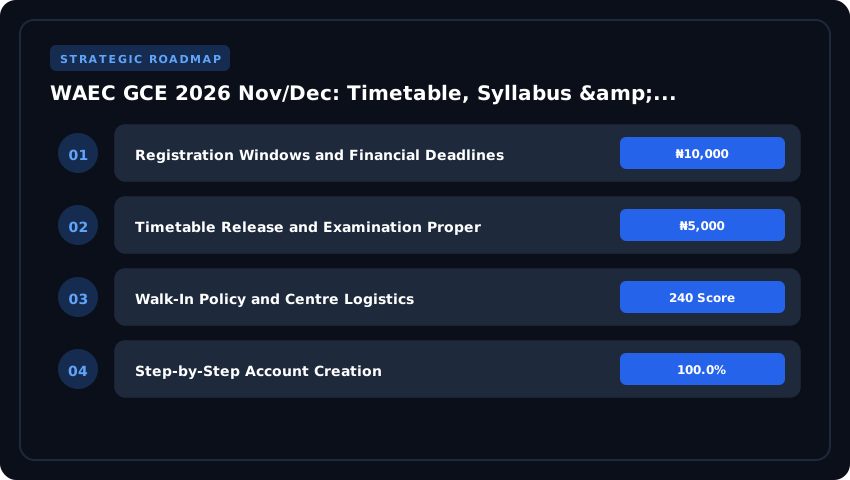
The WAEC Request Management System (RMS) is the single gateway for the 2026 Nov/Dec diet. There are no third-party shortcuts; any site asking for your credentials outside waec.gov.ng or the dedicated RMS subdomain is a phishing trap. Start by clearing your browser cache—Chrome or Firefox latest builds work best—then head straight to the “WAEC GCE Registration” tile on the homepage. If the portal throws a 503 error during peak hours (usually 10 AM–2 PM), wait five minutes and refresh; the load balancer typically clears the queue.
Step-by-Step Account Creation
- Phone & Email Verification: Input an active Nigerian phone number (+234 format) and a recoverable email. WAEC sends a 6-digit OTP to both channels simultaneously. Enter the codes within 10 minutes or the session expires.
- Bio-Data Entry: Fill surname, first name, other names, date of birth, gender, and state of origin exactly as they appear on your NIN slip. Mismatches here cascade into certificate errors later.
- Subject Selection: Pick a minimum of seven and maximum of nine subjects. English Language and Mathematics are auto-locked as compulsory. Cross-check your combination against the 2026 Syllabus before saving.
- Centre Choice: Select three accredited centres in order of preference. The system filters by LGA; if your first choice is full, it auto-suggests the nearest alternative with biometric capacity.
Biometric Fingerprint Capture Requirements
You cannot complete registration remotely. After online submission, the portal generates a “Biometric Capture Slip” with a QR code. Print this—soft copies on phone screens often fail the centre’s scanner. Visit your chosen centre within 14 days (the slip expires after that). The centre administrator will capture all ten fingerprints using a WAEC-certified SecuGen or DigitalPersona scanner. Critical: Ensure fingers are clean, dry, and free of henna, ink, or recent cuts. Failed captures require a centre revisit and a ₦1,000 re-capture fee paid directly to the centre, not the portal.
Troubleshooting ‘Invalid PIN’ and Payment Gateway Errors
The “Invalid PIN” error usually stems from two sources: purchasing a 2026/2027 e-PIN voucher (check the vintage year on the scratch card) or mistaking the letter ‘O’ for zero ‘0’. Always buy fresh 2026 PINs from WAEC zonal offices, NIPOST, or approved banks (Access, Zenith, First Bank, UBA) for ₦23,000 (subject to 2026 review). If the Remita/InterSwitch gateway hangs at “Processing,” do not click “Pay Again.” Close the tab, log back into RMS, and check “Transaction History.” If the status reads “Pending,” wait 30 minutes; the callback URL often lags behind the bank’s confirmation. For “Failed” status, the funds typically reverse to your bank within 24–48 hours. If the debit sticks but the portal shows no payment, raise a ticket via the “Support” tab with your RRR, RRN, and a screenshot of the bank alert—WAEC ICT resolves these in 48 hours during the registration window.
WAEC GCE 2026 Fee Structure & Naira Payment Channels
Understanding the exact cost and authorized payment channels for the 2026 WAEC GCE (Nov/Dec) is your first line of defense against registration fraud. For the 2026 diet, the West African Examinations Council (WAEC) Nigeria has maintained a standardized fee structure, but candidates must verify amounts on the official WAEC Nigeria website before initiating any transaction, as bank charges and VAT apply on top of the base fee.
Official 2026 Registration Fee Breakdown
The base registration fee for the 2026 WASSCE for Private Candidates (Second Series) covers a minimum of seven (7) and a maximum of nine (9) subjects. As of the 2026 registration window, the approved base fee stands at ₦27,000. This amount covers the examination entry and the issuance of the photo card. However, the total payable at the point of payment is higher due to mandatory bank commissions and the 7.5% VAT imposed on financial services.
- Base WAEC Fee (7–9 Subjects): ₦27,000
- Bank Commission / Processing Fee: Approx. ₦500 – ₦1,000 (varies by bank)
- VAT (7.5% on Commission): Approx. ₦38 – ₦75
- Estimated Total Payable: ₦27,600 – ₦28,100
Candidates registering for fewer than seven subjects are not accommodated; the fee is a flat rate for the 7–9 subject band. Any centre or agent quoting significantly lower or higher figures (e.g., ₦35,000+ without clear breakdown) is likely inflating costs for “special centre” arrangements, which WAEC does not officially endorse for the GCE diet.
Approved Payment Channels: Remita, Banks & USSD
WAEC Nigeria mandates that all payments flow through the Remita platform to ensure traceability. You can pay via three verified channels:
- Bank Branch (Over-the-Counter): Walk into any branch of approved commercial banks (Access, Zenith, UBA, First Bank, GTBank, Polaris, Sterling, Union, Wema, etc.). Request “WAEC GCE 2026 Registration” on the Remita platform. The teller generates an RRR (Remita Retrieval Reference) instantly. Collect the printed receipt containing your RRR.
- Remita Online Portal (Card/Transfer): Visit remita.net, select “Pay a Federal Government Agency,” search “WAEC,” choose “WASSCE Private Candidates 2026,” fill in your details, and pay via Debit Card, Bank Transfer, or Internet Banking. Save the RRR receipt PDF.
- USSD (Mobile Banking): Dial your bank’s USSD code (e.g., *901# for Access, *737# for GTB, *919# for UBA, *966# for Zenith). Navigate to “Bill Payments” > “Remita” or “WAEC.” Enter the RRR generated from the WAEC registration portal or generate a new one via the USSD menu. Confirm with your PIN. The RRR is delivered via SMS.
Critical Security Note: Never pay into personal accounts, POS agents claiming “direct WAEC connection,” or third-party “miracle centres.” The RRR must be generated in your name (or the candidate’s name) and linked to the WAEC database.
Refund Policy for Withdrawn Candidates
WAEC operates a strict no-refund policy once registration closes and the candidate’s data has been processed onto the nominal roll. If a candidate withdraws before the registration portal closes (typically mid-September 2026 for the Nov/Dec diet), a refund request may be entertained, but it is subject to a heavy administrative deduction (often 50% or more of the base fee) and lengthy bureaucratic processing through the WAEC Zonal Office. In practice, refunds are extremely rare and not guaranteed. Candidates are advised to treat the payment as final upon successful RRR generation and photo card printing. If you are unsure of sitting, do not pay.
Subject-Specific Syllabus Updates for 2026 Nov/Dec Diet
WAEC does not overhaul the entire curriculum every year, but the 2026 Nov/Dec diet carries specific adjustments that separate serious candidates from those recycling 2026 notes. If you are registering through the WAEC GCE registration portal, you must align your preparation with the current syllabus codes—specifically the WAEC Syllabus 2026/2027 booklet released earlier this year. Studying outdated material is the fastest route to a resit.
Core Mathematics & English Language: Structural Shifts
In General Mathematics, the 2026 syllabus places heavier weighting on Data Analysis & Probability and Vectors in Three Dimensions. Questions on logarithmic equations now frequently require graphical interpretation rather than pure algebraic manipulation. For English Language, the Continuous Writing section (Paper 2, Section A) has updated its marking grid: Mechanical Accuracy now carries 15 marks (up from 10), penalizing concord errors and punctuation faults more severely. The Comprehension passages have shifted toward technical and scientific texts—expect passages on renewable energy or AI ethics rather than purely narrative prose. Oral English (Paper 3) retains its focus on stress and intonation patterns, but the 2026 specimen includes more minimal-pair contrasts involving Nigerian English phonemes.
Science Practicals: Specimen Lists You Cannot Ignore
The Practical papers (Alternative B) are where candidates lose easy marks. WAEC released the 2026 Confidential Instructions to schools in August; private candidates must source the Specimen List from accredited tutorial centers or the WAEC e-learning portal. Key highlights:
- Physics: The Mechanics experiment focuses on Verification of the Principle of Moments using a non-uniform meter rule. Optics requires a rectangular glass prism for minimum deviation measurements—ensure you practice reading the vernier caliper to 0.01 cm.
- Chemistry: Qualitative Analysis (Volumetric) centers on a redox titration: Potassium Manganate(VII) vs Iron(II) Salt. Inorganic qualitative analysis tests for Anions: SO₃²⁻, S²⁻, NO₂⁻ and Cations: Fe³⁺, Al³⁺, Zn²⁺. Memorize the confirmatory tests for Sulphite and Nitrite; they are high-yield differentiators.
- Biology: Specimens include Mammalian heart (longitudinal section), Germinating bean seeds, and Freshwater pond water for microscopy. Drawing magnification calculations (x10, x40) are mandatory. Know the starch test (iodine) and reducing sugar test (Fehling’s/Benedict’s) procedures cold.
Literature-in-English: 2026 Prescribed Texts
This is non-negotiable. The 2026 Nov/Dec examination tests only the texts listed below. Do not read the 2026 list.
- African Drama: The Lion and the Jewel – Wole Soyinka.
- Non-African Drama: Look Back in Anger – John Osborne.
- African Prose: Second Class Citizen – Buchi Emecheta.
- Non-African Prose: Wuthering Heights – Emily Brontë.
- African Poetry: “The Dining Table” (Gbanabom Hallowell), “The Panic of Growing Older” (Lenrie Peters), “The Anvil and the Hammer” (Kofi Awoonor).
- Non-African Poetry: “The Pulley” (George Herbert), “The School Boy” (William Blake), “Crossing the Bar” (Alfred Lord Tennyson).
Download the official WAEC Literature Syllabus 2026 PDF from the council’s website to verify page references for the Unseen Prose/Poetry section. Your timetable is tight; every hour must target these exact boundaries.
Downloading & Interpreting the 2026 Timetable (PDF/Excel)
Start by grabbing the official master file directly from the WAEC Nigeria website (waecnigeria.org) or the verified WAEC e-Registration portal. Avoid third-party blogs that often circulate outdated 2026 versions with wrong dates. The council typically releases two formats: a print-ready PDF for quick viewing and an Excel (.xlsx) sheet for power users who want to build custom filters. Download both; the PDF is your wall chart, the Excel is your planning engine.
Filtering for Your Subject Combination (Art, Science, Commercial)
Open the Excel file and apply a filter row on the Subject Name or Subject Code column. If you are a Science candidate, isolate codes like 502 (Biology), 503 (Chemistry), 504 (Physics), and 511 (Further Mathematics). Art students should filter for 102 (Literature-in-English), 114 (Government), 115 (History), 118 (CRS/IRS), and 302 (Visual Art). Commercial candidates need 202 (Economics), 203 (Commerce), 204 (Financial Accounting), and 210 (Business Management). Pro tip: Create a new tab named “My 2026 Calendar,” paste your filtered rows there, and sort by Date then Session (Morning/Afternoon). This instantly reveals your personal exam rhythm without the noise of 60+ irrelevant subjects.
Clash Resolution Protocol for Overlapping Papers
WAEC builds the master timetable to minimize clashes, but they happen—especially between elective papers like Foods & Nutrition (308) and Technical Drawing (312), or between Arabic (112) and a Science practical. The rule is non-negotiable: the subject with the higher candidate population nationally usually retains the prime slot. Check the “Remarks” column in the Excel sheet; WAEC often annotates clashes with instructions like “Candidates for Subject A sit 1st session; Subject B sits 2nd session same day under supervision.” If you spot a conflict not marked, email timetable@waecnigeria.org immediately with your centre number and candidate details. Do not assume you can just walk into the second paper; you require a formal Clash Arrangement Letter from the Council to the centre supervisor before exam week.
Morning vs. Afternoon Session Reporting Times & Duration
Discipline at the gate determines your entry. For Morning Sessions, the standard reporting time is 8:30 AM for a 9:00 AM start. Gates often lock at 9:30 AM—latecomers write at the supervisor’s discretion, usually with zero extra time. Afternoon Sessions typically commence at 1:00 PM or 2:00 PM depending on the paper length; report by 12:30 PM sharp. Practical papers (Chemistry 503/3, Physics 504/3, Biology 502/3) often run 2 hours 30 minutes to 3 hours, while objectives/essay combos (e.g., Mathematics 501, English 101) run 2 hours 45 minutes to 3 hours 30 minutes. Block these exact durations in your Google Calendar or Notion workspace, adding 30-minute buffers for travel and biometric verification. Treat the timetable not as a schedule, but as a binding contract with the Council.
Accredited CBT Centres & Exam Day Logistics for 2026
WAEC does not publish a static, downloadable PDF list of GCE centres because the roster changes every diet based on facility audits and capacity checks. For the 2026 November/December diet, the only verified source is your registration photocard. When you print that slip from the WAEC Request Management System, the centre name, address, and your assigned seat number are locked in. Do not show up at a centre because a friend wrote there last year; centre codes rotate, and showing up at the wrong venue means automatic disqualification. If you need to confirm a centre’s accreditation status before registration closes, visit the WAEC Zonal or Branch office covering your state—Lagos, Abuja, Ibadan, Port Harcourt, Enugu, Kano, and others—to cross-reference the official master list.
Biometric Verification: The Fallback Protocol
Biometric capture is non-negotiable at the exam hall entrance. If the scanner rejects your fingerprint—common with dry skin, henna stains, or minor cuts—the supervisor will escalate to the Manual Verification Protocol. You will be asked to present your original photocard and a valid government-issued ID (NIN slip, International Passport, or Driver’s Licence). The supervisor matches your face to the photocard photo, signs the attendance register manually, and logs the exception in the Centre Incident Report. This adds 10–15 minutes to your check-in, so arrive by 8:00 AM for a 9:00 AM paper. No biometric match and no valid ID? You will not sit the exam. There are no exceptions for “forgotten” IDs in 2026.
Prohibited Items & Storage Rules
The 2026 invigilation guidelines are stricter on wearable tech. The following are banned from the exam hall—not just the desk, but the room entirely:
- Smartwatches & Fitness Bands: Any device with Bluetooth, storage, or a screen. Analog wristwatches are permitted but must be placed on the desk face-up for inspection.
- Programmable Calculators: Only non-programmable, silent scientific calculators (e.g., Casio fx-82/991 series) are allowed. Graphing calculators (fx-CG50, TI-84) will be confiscated.
- Mobile Phones: Switch off before the gate. Most centres provide labelled poly bags or envelopes at the entrance; you drop the phone in, seal it, and collect it after the paper. Centres without bags often use a “phone box” manned by a non-invigilating staff member. Never leave a phone in your bag outside the hall—theft is rampant, and WAEC accepts zero liability.
Wallets, car keys, and medication (with a doctor’s note) are the only personal items typically allowed at the desk. Water bottles must be transparent with labels removed. Plan to travel light; the less you carry, the faster you clear the gate and settle into your paper.
Post-Registration: Checking Photocard, Results & Certificate Collection
Registration is only the first mile; the finish line is that certificate in your hand. For the 2026 Nov/Dec diet, the timeline moves fast once the portal closes. Treat every deadline here as non-negotiable—WAEC does not run on “Nigerian time.”
Photocard Printing: Your Exam Passport
The examination photocard typically goes live on the WAEC portal two to three weeks before the first paper in November 2026. Log in to the WAEC Direct Result Checker/Registration portal using your registration number and the PIN/Voucher details from your initial payment. Do not wait for an SMS prompt; network delays are real. Print two copies in colour—one for the exam hall, one for your file. Verify the centre name, subject list, and your passport photograph immediately. Any discrepancy (misspelt name, wrong subject code, blurred photo) must be reported to the Zonal Office in your state before the exams start. Walking into the hall with a defective photocard is an automatic disqualification risk.
Accessing 2026 GCE Results: The WAEC Direct Channel
Results for the Nov/Dec diet historically drop between late January and mid-February 2027. Ignore third-party “result checker” sites peddling fake links. The only authoritative source is the WAEC Result Checker Portal (waecdirect.org) or the official WAEC Nigeria mobile app. You will need the Smart Identity Card (the scratch card) issued during registration or a purchased e-PIN (approx. ₦3,650–₦4,000 at current rates) if you misplaced the original. Enter your 10-digit WAEC Examination Number (Year + Centre Number + Seat Number), the Card Serial Number, and PIN. Pro tip: Check at off-peak hours (early morning or late night) to avoid the portal crash traffic. Download and print the Statement of Result immediately—it serves as your provisional certificate for admission processing (JAMB CAPS, Direct Entry, NELFUND applications) while you wait for the physical document.
Certificate Collection: The 2027 Timeline & Attestation
Physical certificates for the 2026 Nov/Dec diet typically arrive at designated WAEC Zonal/State Offices between October and December 2027—roughly 10 to 12 months post-exams. WAEC does not courier certificates to candidates. You must collect in person or via a properly authorized proxy. Requirements for collection:
- Original Photocard (the one used during exams).
- Valid Photo ID (NIN Slip, International Passport, Driver’s Licence, or Voter’s Card).
- Attestation Letter (if collecting by proxy): A signed letter from you, the candidate, authorizing the proxy, accompanied by the proxy’s valid ID and a passport photograph of the candidate attached.
If you lose the certificate before collection, you apply for a Certification of Result (Attestation) via the WAEC portal or at the Zonal Office. This attracts a fee (currently approx. ₦15,000–₦20,000 plus bank charges) and takes 2–4 weeks. Guard that photocard; it is the single most critical document bridging the gap between the exam hall and your certified future.
| Criteria | WAEC GCE Nov/Dec 2026 (Private Candidates) | WAEC SSCE May/Jun 2027 (School Candidates) |
|---|---|---|
| Registration Window | July – September 2026 (Late entry Oct, penalty applies) | October 2026 – February 2027 (School coordinated) |
| Examination Period | Late October – December 2026 | May – June 2027 |
| Registration Fee (Est.) | ₦27,000 – ₦30,000 (Includes biometric) | ₦23,000 – ₦25,000 (Subsidized by schools) |
| Late Registration Penalty | ₦10,000 – ₦15,000 extra | ₦5,000 – ₦10,000 extra |
| Syllabus Coverage | Full Senior Secondary Curriculum (SS1-SS3) | Full Senior Secondary Curriculum (SS1-SS3) |
| Result Release Target | January – February 2027 | August – September 2027 |
| Admission Utility | Valid for 2027/2028 JAMB Direct Entry & UTME | Valid for 2027/2028 JAMB UTME (Primary intake) |
| Registration Portal | waec.ng / gce.waec.org.ng (Self-service) | School Portal / Offline Center Admin |
Frequently Asked Questions
When does WAEC GCE 2026 Nov/Dec registration close?
WAEC GCE 2026 Nov/Dec standard registration closes in September 2026. A late registration window extends into October 2026 with a penalty fee of approximately ₦10,000–₦15,000. Candidates must complete biometric capture at accredited centers before the final deadline to avoid disqualification.
How much is WAEC GCE 2026 registration fee in Nigeria?
The WAEC GCE 2026 Nov/Dec registration fee is estimated between ₦27,000 and ₦30,000. This covers the examination fee, biometric data capture, and administrative charges. Payment is made via the official WAEC portal (waec.ng) using Remita, card, or bank transfer; center agents may charge separate service fees.
Where can I download the WAEC GCE 2026 Nov/Dec timetable?
The official WAEC GCE 2026 Nov/Dec timetable is published on the WAEC Nigeria website (waec.ng) and the candidate portal (gce.waec.org.ng) by September 2026. Candidates should download the PDF version and cross-check subject codes; the exam typically runs from late October through December 2026.
Can I use WAEC GCE 2026 results for 2027 JAMB Direct Entry?
Yes, WAEC GCE 2026 Nov/Dec results released by January/February 2027 are valid for the 2027 JAMB Direct Entry (DE) registration. Candidates must obtain a minimum of five (5) credits including English and Mathematics at not more than two sittings to qualify for DE admission into 200 Level.
What is the WAEC GCE 2026 syllabus for private candidates?
The WAEC GCE 2026 syllabus covers the complete Senior Secondary School curriculum (SS1–SS3) for all subjects. It is identical to the May/June school candidate syllabus. Candidates should download subject-specific syllabi from waec.ng or the WAEC e-learning portal to guide 2026 preparation effectively.
Strategic Topic Exploration
Strategic Final Takeaway
When evaluating WAEC GCE 2026 November December Timetable Syllabus And Registration Portal in 2026 and beyond, base your decisions on accredited institutional standards, verified return on investment (ROI), and up-to-date official guidelines. Always verify specific dates and requirements through official regulatory portals.


