2026 WAEC GCE Registration Deadlines, Fees, and Penalty Windows
When it comes to the West African Examinations Council (WAEC) General Certificate Examination (GCE), timing is everything, and understanding the exact registration windows for the 2026 diet could be the difference between smooth entry and a stressful, penalty-laden experience. Based on WAEC’s established release patterns over the last decade, the normal registration window typically opens in mid-July for the First Series and closes quietly around late August or early September. For candidates eyeing the 2026 WAEC GCE, expect the portal to go live sometime in the third week of July 2026, with a hard shutdown on the standard registration phase usually landing between August 28 and September 5. Missing this primary window automatically shifts you into the late registration category, where fees climb significantly and administrative headaches multiply.
The fee structure is deliberately tiered to reward early action. A standard WAEC GCE registration for Nigerian candidates currently sits in the range of ₦27,000 to ₦31,000, depending on whether you opt for four, seven, or nine subjects. However, the moment the normal window closes, WAEC activates its late registration surcharge, which historically adds between ₦15,000 and ₦25,000 in penalty fees, pushing the total cost well above ₦50,000 for some candidates. Walk-in candidates, who appear at designated centers without prior online registration, face the steepest penalties, often paying ₦20,000 to ₦30,000 in additional surcharges on top of the late registration fee. This tiered pricing is intentional; it offsets the logistical strain of processing paper candidates, manual biodata entry, and last-minute timetable adjustments on the council’s end.
- Normal Registration Window: Mid-July to late August/early September (exact date announced via the WAEC Nigeria official portal)
- Late Registration Penalty: Additional ₦15,000–₦25,000 surcharge per candidate
- Walk-in Candidate Surcharge: Extra ₦20,000–₦30,000 on top of late registration fees
- Timetable Release Pattern: WAEC typically publishes the official examination timetable 6–8 weeks before the first paper, so expect it to drop by mid-October 2026 for the First Series
Speaking of timetables, here is a crucial insider detail many candidates overlook: WAEC’s timetable release follows a predictable cadence, but the examination date itself is only fixed once you complete your registration and print your Photo Card. Many first-time candidates assume they can register, pay, and revisit the portal later to adjust subjects, but this is a costly misconception. Once your Photo Card is generated through the portal, the registration becomes non-refundable and non-modifiable. This policy is rooted in WAEC’s database locking system, which finalizes your subject combination, center allocation, and examination slot the instant your Photo Card is printed. If you later discover you registered for the wrong subject or a clash you didn’t anticipate, the only remedy is to register afresh during a future diet, essentially paying double.
For Nigerian students, especially those balancing JAMB UTME preparation, Post-UTME screenings, or awaiting NELFUND student loan disbursements, this non-refundable rule demands meticulous double-checking before you hit the print button. Verify your name spelling, date of birth, subject selection, and uploaded passport photograph with surgical precision. Any mismatch between your Photo Card and your National Identification Number (NIN) or other official documents will trigger verification flags at the exam center, potentially leading to disqualification.
- Photo Card Generation: Non-refundable once printed; doubles as your exam slip and center pass
- Subject Modification Window: Closed after Photo Card download; changes require fresh registration in next diet
- Verification Trigger: NIN, passport photo, and biodata mismatch can invalidate your candidacy
- Penalty-Free Zone: Only the normal registration period carries zero surcharge
To avoid the penalty windows entirely, set a personal deadline at least 72 hours before WAEC’s official closing date. This buffer protects you from portal congestion, failed payment verifications on platforms like Remita, and unexpected network downtime. Candidates using NELFUND loans should also factor in disbursement timelines, as loan approvals can take 2–4 weeks, meaning you must apply early enough to have funds cleared before late registration kicks in.
Fixing the WAEC GCE Portal Errors Nigerians Actually Face
If you have ever tried to register for WAEC GCE at 11:47 PM, with one hand on your debit card and the other refreshing the portal, you already know that the real exam starts long before any multiple-choice question. It starts at the payment gateway. Across Nigeria, candidates burn through two, three, sometimes four nights wrestling with the same handful of technical failures. The good news is that almost every one of them has a tested workaround. The bad news is that if you ignore them, you could be staring at a “Transaction Failed” screen when the deadline closes.
The first monster most candidates meet is NIN verification timeout. The portal pulls your National Identification Number from the NIMC database, and when that handshake fails, you get the dreaded “Service Unavailable” or a blank slip upload field. This usually happens because of network congestion between WAEC’s servers, Interswitch, and NIMC, especially between 8 PM and midnight. Before you panic, confirm that the 11 digits you typed actually match what is on your NIN slip, down to the last number. Then log out completely, wait at least thirty minutes, and try again during off-peak hours, ideally between 6 AM and 9 AM or 1 PM and 3 PM. If it still fails, the workaround many successful 2025 candidates swear by is switching from mobile data to a stable Wi-Fi connection, because MTN and Airtel 4G often drop encrypted packets during heavy NIN pulls.
The second major hurdle is Interswitch transaction declines. You typed your card details, got the OTP, saw the green loading bar, and then watched it flip to “Payment Not Completed” without your money being deducted. Or worse, the money vanished from your account and your portal still says “unpaid.” This is the most financially painful error, and it almost always comes down to bank-side security blocks, not WAEC’s fault. Nigerian banks now routinely flag unfamiliar merchant payments above ₦15,000 to ₦27,000, which is exactly the WAEC GCE fee range. Before retrying, dial your bank’s USSD code to enable the transaction. For GTBank, dial *737*737*51#; for Access, *901*9#; for Zenith, *966*7#. Better still, use the dedicated USSD channel your bank provides for merchant payments, because it bypasses the web3 secure layer where most declines originate.
The third frustration is the silent killer: browser session expirations. You fill out Page 2 of the form, upload your passport, hit “Next,” and the portal boots you back to the login screen. WAEC’s registration portal is notorious for aggressive session timeouts, especially on Firefox, Safari, and the built-in browsers on Tecno and Infinix phones. The fix is simple but non-negotiable: use desktop Google Chrome on a laptop, with all extensions disabled, especially ad blockers and VPNs. Before you start, go to Settings > Privacy and Security > Clear Browsing Data, and wipe cached images and cookies. Then open an Incognito window so no old WAEC cookies from a previous failed attempt interfere with your new session. If you must use a phone, Chrome on Samsung or iPhone is more stable than Opera Mini or UC Browser.
Finally, there is the OTP SMS delay that makes candidates think the portal has frozen. When you pay, the system triggers a One-Time Password sent via SMS to the phone number linked to your NIN. On MTN, this usually arrives in under fifteen seconds. On Glo and 9mobile, it can take up to five minutes during peak periods, and Airtel sits somewhere in between. If the OTP has not arrived after three minutes, do not click “Resend” five times, because that triggers a security lockout. Instead, toggle airplane mode on and off to force your SIM to reconnect to a different cell tower, then wait. If you are on Glo and consistently failing, the workaround candidates in Lagos, Ibadan, and Abuja have adopted is to temporarily swap the SIM into an older 3G phone, because Glo’s OTP routing struggles with certain 4G VoLTE devices.
- For NIN timeouts: Try between 6–9 AM, switch to broadband Wi-Fi, and double-check all 11 NIN digits.
- For Interswitch declines: Enable merchant payments via your bank’s USSD code before retrying, and keep your transaction receipt screenshot.
- For session expirations: Always use desktop Chrome in Incognito mode with extensions disabled.
- For OTP delays: Wait three full minutes, toggle airplane mode, and avoid rapid “Resend” clicks.
- Universal backup plan: Keep a second debit card from a different bank ready, because Interswitch failures are often issuer-specific, not network-wide.
One last rule that seasoned candidates follow: never start your registration less than 72 hours before the WAEC GCE deadline. If your first attempt fails, you need time to escalate through your bank’s customer care, recover a “double debited” transaction, and re-attempt NIN verification. With these workarounds in your back pocket, you move from being a frustrated victim of Nigerian payment infrastructure to a candidate who actually gets to sit the exam.
NIN Linking and Biometric Capture: What WAEC Will Not Tell You
If you think having a National Identification Number (NIN) slip printed in 2019 is your golden ticket to a seamless WAEC GCE 2026 registration, you are walking into a trap. The council’s backend infrastructure has tightened significantly, and the “silent rejections” happening at CBT centres across Lagos, Abuja, and Port Harcourt are rarely announced on the official bulletin. For fresh candidates, the process is straightforward on paper: generate a Virtual NIN (VNIN) using the *346*3*YourNIN*AgentCode# USSD code or the NIMC Mobile ID app, using the WAEC specific Agent Code (usually 100001 or the current year’s designated code). However, the devil lives in the details of that VNIN generation.
For candidates upgrading results from previous years—say, a 2021 or 2023 GCE attempt—you cannot simply reuse the old NIN data stored in the WAEC database. The system now demands a fresh biometric re-validation at an approved registration centre. This is where the “mismatched phone number” nightmare begins. If the phone number currently active on your NIN record (at NIMC) differs from the one you used during your previous WAEC registration, the portal will hard-stop your application. You will not get an error message explaining why; you will simply see “Invalid NIN Data” or “Biometric Mismatch.” The fix requires a trip to a NIMC enrolment centre to update your phone number before you even approach a WAEC centre, followed by a 24-to-48-hour sync window.
- Virtual NIN vs. Physical Slip: Do not walk into a centre with just your paper NIN slip. Centres are mandated to verify via the VNIN workflow. If the NIMC server is down—which happens frequently during peak registration weeks—your registration halts. Generate the VNIN on your phone before leaving home and screenshot the token.
- The Facial Capture Quality Trap: WAEC uses facial recognition for identity verification on exam day. If the webcam at the registration centre captures a blurry, overexposed, or shadowed image (common with cheap webcams in makeshift centres), your photo passes the upload check but fails the exam hall verification algorithm months later. Insist on a well-lit environment and a high-resolution camera; ask to see the preview before the operator clicks “Submit.”
- Fingerprint Fatigue: Candidates with dry, rough, or henna-stained fingertips (common among artisans or those who just finished manual labour) often fail the biometric capture. The system allows limited retries. If you lock out, you are referred to NIMC for “Biometric Update,” a process that can take weeks. Moisturize your hands days before registration; avoid ink, dye, or heavy labour 48 hours prior.
The most actionable advice? Treat your NIN profile as a live document. Log into the NIMC Self-Service Portal (selfservice.nimc.gov.ng) today. Confirm your phone number, email, and address match exactly what you intend to use for WAEC. If you are upgrading, print your previous WAEC photocard and cross-check every single character—middle name spelling, date of birth format—against your NIN slip. A single character discrepancy (e.g., “Mohammed” vs “Muhammad”) triggers a manual resolution loop that will not resolve before the late registration penalty window closes. Be proactive, not reactive.
Subject Combinations, Paper Codes, and 2026 Curriculum Changes
One of the costliest mistakes a candidate can make is registering for a paper that does not align with their JAMB UTME subject combination or the revised 2026 WAEC syllabus. The Council has implemented subtle but critical shifts under the new CCMAS-aligned framework, and ignoring them could invalidate your admission profile before you even sit for the exam. Let us break down exactly what has changed so you can register with surgical precision.
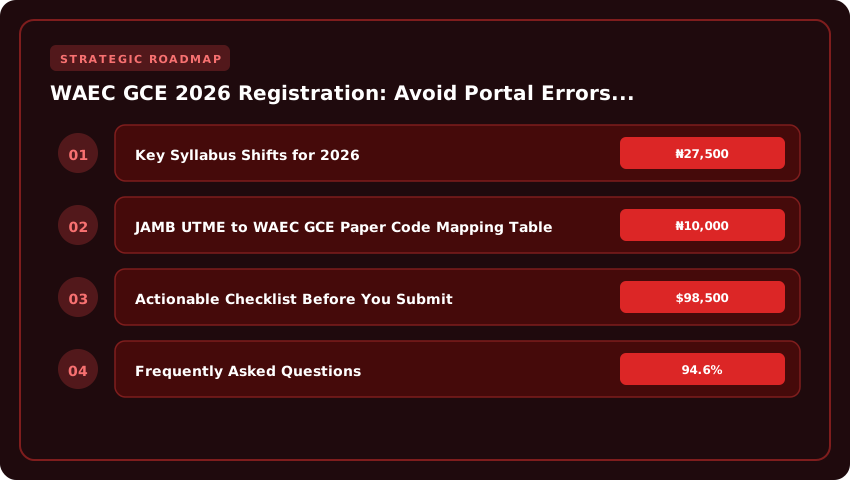
Key Syllabus Shifts for 2026
The most impactful updates live in Computer Studies (Paper Code: 834) and Civic Education (Paper Code: 141). For Computer Studies, the curriculum has formally retired the legacy “Computer Science” theoretical heavy-lifting in favour of a Data Processing competency model. You will now be examined heavily on cloud computing fundamentals, spreadsheet modelling for business intelligence, and introductory Python scripting for data cleaning. The practical paper (Paper 3) now carries 40% of the total weight; if your tutorial centre is still teaching only MS Word and CorelDraw, you are preparing for the 2020 exam, not 2026.
In Civic Education, the thematic focus has pivoted from rote memorisation of government structures to active citizenship and digital ethics. New modules cover cybersecurity awareness, electoral integrity in the digital age, and the National Values Charter. Essay questions will demand case-study analysis of recent Nigerian civic events—think the 2023 election tribunal processes or the NIMC data protection guidelines—rather than generic definitions.
JAMB UTME to WAEC GCE Paper Code Mapping Table
Use the table below to cross-reference your intended course requirements. Registering for “Commerce” (Paper 121) when your course requires “Economics” (Paper 111) is a classic error that triggers JAMB admission rejection during screening.
| JAMB UTME Subject | WAEC GCE Paper Name | WAEC Paper Code | Critical 2026 Note |
|---|---|---|---|
| Use of English | English Language | 101 | Compulsory; Oral English (Paper 3) now includes podcast comprehension. |
| Mathematics | General Mathematics | 111 | Compulsory; Statistics & Probability weighting increased to 25%. |
| Physics | Physics | 511 | Practical (Paper 3) requires familiarity with digital oscilloscopes. |
| Chemistry | Chemistry | 512 | Qualitative analysis now includes environmental chemistry ions. |
| Biology | Biology | 513 | Genetics & Biotechnology section expanded; practical uses digital microscopy slides. |
| Economics | Economics | 111 | Do not confuse with Commerce (121). New module on CBN monetary policy tools. |
| Government | Government | 141 | Syllabus now includes INEC Act 2022 amendments. |
| Literature in English | Literature in English | 121 | Set texts rotated; verify 2026 list (African & Non-African drama/prose/poetry). |
| Computer Science / IT | Computer Studies | 834 | Major Shift: Now Data Processing focused. Python & Cloud basics mandatory. |
| Civic Education | Civic Education | 141 | Compulsory for all candidates. Digital citizenship & National Values Charter tested. |
| Geography | Geography | 221 | Map reading (Paper 3) now integrates GIS coordinate interpretation. |
| Accounting / Fin. Acc. | Financial Accounting | 131 | IFRS standards updated; Computerised Accounting practical section added. |
Actionable Checklist Before You Submit
- Verify your course requirements on the JAMB IBASS portal or the university’s website—do not rely on hearsay.
- Confirm the Paper Code with your cybercafe operator; a typo (e.g., 511 vs 512) registers you for the wrong exam.
- Download the 2026 Syllabus PDF from the official WAEC website for every elective. Compare the “Aims and Objectives” section against your lesson notes.
- Flag Civic Education & Computer Studies as high-priority revision areas due to the curriculum overhaul.
Aligning your registration here saves you the ₦15,000–₦20,000 “Change of Subject” penalty later—and more importantly, it protects your admission ticket.
How GCE 2026 Results Affect JAMB Admission and NELFUND Eligibility
For thousands of Nigerian candidates sitting the 2026 WAEC GCE, the examination is far more than a standalone academic milestone. In practical terms, your GCE result card is now a multi-purpose document that simultaneously determines your eligibility for JAMB Direct Entry (DE) admission, influences your standing under the NUC Core Curriculum and Minimum Academic Standards (CCMAS), and increasingly serves as a financial gatekeeper for the NELFUND student loan programme. Understanding how these three systems intersect can be the difference between securing a coveted university slot and watching your academic future stall at the admissions office.
First, let us address the JAMB Direct Entry pathway. Candidates who already hold an A-Level qualification, a National Diploma (ND), a NCE certificate, or even those relying on their GCE results combined with IJMB or JPEB programmes, must meet the minimum requirement of five credit passes, including English Language and Mathematics. This is the non-negotiable baseline. The 2026 GCE result is therefore not just a transcript; it is the document JAMB uses to verify your DE eligibility. If a candidate presents four credits with a pass in Mathematics, that candidate is automatically disqualified for DE admission into most Nigerian universities, irrespective of their JAMB score. The Federal University of Lagos (UNILAG), the University of Ibadan, and the Federal University of Technology, Minna have all published 2026 DE brochures reaffirming this baseline.
This is where the NUC CCMAS benchmarks become significant. The new Core Curriculum and Minimum Academic Standards framework, fully implemented across Nigerian tertiary institutions, requires universities to align their departmental cut-off marks with both JAMB scores and O-Level/DE credit combinations. For competitive courses such as Medicine, Law, Engineering, and Nursing, institutions are now mandated to screen for combinations like Mathematics plus two relevant science subjects at credit level before forwarding any candidate to the next stage. A candidate relying on GCE 2026 results for DE into the Faculty of Engineering at Obafemi Awolowo University, for example, must ensure that Mathematics, Physics, and Chemistry are all obtained at a single sitting, otherwise their admission status becomes “ineligible” on the JAMB CAPS portal even if they selected the institution first.
Now, let us turn to the financial dimension that has reshaped the entire admissions ecosystem: NELFUND. The Nigerian Education Loan Fund, backed by the Federal Government and operationalised in 2024, has progressively tightened its verification framework. As of 2026, transcript verification is no longer a procedural afterthought. NELFUND now conducts a comprehensive background check that cross-references candidates’ academic claims against WAEC, NECO, and NABTEB records before any disbursement is made to the beneficiary institution. If your GCE 2026 result carries a discrepancy, whether a wrong name spelling, a missing credit, or a mismatch in date of birth, the NELFUND portal will flag your application and delay disbursement. We have seen cases where institutional bursary departments withheld admission letters simply because the student’s NELFUND loan was stuck in “verification pending” for over three weeks.
For applicants targeting private universities such as Afe Babalola University, Pan-Atlantic University, or Igbinedion University, the stakes are even higher. These institutions often charge tuition between ₦1.2 million and ₦3.5 million per session, making NELFUND loan approval a financial lifeline. A single GCE result error, whether a clerical slip on the candidate’s part during registration or a postal delay, can translate into a denied loan, a deferred admission, and in the worst cases, a lost academic year. This is why we strongly recommend that every GCE 2026 candidate cross-checks their name, date of birth, and subject combinations immediately after the release of results, ideally within the first 72 hours.
The interplay between these three systems also means that candidates who combine GCE results with IJMB or JPEB must be especially vigilant. IJMB programmes typically require candidates to score a minimum of five credit passes including English before proceeding, and NELFUND now mandates that candidates upload both their IJMB transcript and their GCE result during the loan application. Universities, on their part, are required by NUC CCMAS to retain digital copies of these transcripts for at least five years after graduation.
Let us also consider the practical timeline. Most Nigerian universities commence Direct Entry screening between October and December 2026. By that time, your GCE result must already have been verified on the JAMB CAPS portal and uploaded for NELFUND evaluation. Any candidate still struggling with result errors at that stage risks being caught in the penalty window that WAEC typically opens for late result corrections, which often costs an additional ₦15,000 to ₦25,000 per subject and may take up to four weeks to process.
In summary, your 2026 GCE result is not merely an academic certificate. It is your admission ticket, your loan guarantee, and your compliance document. Treat the registration process with the seriousness it deserves, double-check every entry on the portal, and ensure that your name appears identically across your JAMB profile, your WAEC record, and your NELFUND application. Doing so will save you from the avoidable frustrations that derail otherwise brilliant candidates every admission cycle.
- Secure at least five credit passes including English and Mathematics to remain DE-eligible.
- Verify your GCE result against NUC CCMAS departmental requirements before selecting a course.
- Ensure your name, date of birth, and subjects match exactly across WAEC, JAMB CAPS, and NELFUND records.
- Upload GCE results and IJMB transcripts before screening windows open in October 2026.
- Budget ₦15,000 to ₦25,000 per subject for late result corrections if needed.
Post-Registration Checklist: Photo Card Printing and Centre Selection
You have made the payment, and the receipt is sitting safely in your email or printed in your folder. Take a breath, but do not relax just yet. The most critical phase begins now: verification and finalization. Many candidates assume the process ends at the bank or on the Remita dashboard, but WAEC treats the registration as incomplete until you physically hold a valid Photo Card and lock in a confirmed centre. Missing this step is the silent killer of examination dreams—candidates show up on exam day only to discover their names are absent from the attendance register because they never finalized the centre selection.
Log in to your dashboard on waecdirect.org immediately. Do not use a cybercafé operator’s saved link, a WhatsApp forward, or a third-party “agent” portal. The official domain is your only guarantee that the data you see matches what the Council’s servers hold. Once inside, navigate to the Print Photo Card section. Check every single character: your name spelling, date of birth, gender, and subject combination. A single typo in “Mathematics” versus “Further Mathematics” or a swapped surname can invalidate your scripts. If you spot an error, use the Correction Window immediately—this window typically slams shut two weeks before the examination commences, and WAEC rarely grants extensions.
Next, tackle the centre selection with strategic intent. You are presented with two distinct modes: Paper-Based Test (PBT) and Computer-Based Test (CBT). For the 2026 diet, WAEC has expanded CBT centres significantly across major towns like Lagos, Abuja, Port Harcourt, Ibadan, and Kano. CBT offers faster result release and eliminates the risk of missing scripts, but it demands digital literacy—comfort with a mouse, keyboard, and on-screen calculator. If you have never sat a CBT exam, do not gamble on the big day; stick to a PBT centre where you can write with a pen. Conversely, if you are tech-savvy, CBT centres often have smaller crowds and better infrastructure. Choose based on your competence, not just proximity.
When selecting your examination town, verify the centre capacity. Popular centres in Lagos (e.g., Ikeja, Yaba) or Abuja (e.g., Garki, Wuse) fill up within hours of the portal opening. If your first choice is full, have a backup town ready—perhaps a neighbouring state capital with reliable transport links. Confirm the centre address on Google Maps; some “centres” listed are actually holding schools kilometres away from the main town.
- Print two copies of the Photo Card: one for the exam hall, one for your file. Laminate the exam copy if possible; rain and sweat are real enemies.
- Save the PDF to your phone and cloud storage (Google Drive/Email). A lost physical card days before the exam is a panic you do not need.
- Ignore “Slot Sellers.” Unofficial agents on Facebook, Telegram, and WhatsApp claim to “upgrade” centres or sell “special slots” for ₦15,000–₦30,000 above the official fee. These are scams. WAEC does not allocate premium slots. Every candidate accesses the same portal.
- Cross-check your subjects against the WAEC Syllabus booklet. Ensure you didn’t accidentally select “Commerce” instead of “Financial Accounting” due to a dropdown slip.
Finally, treat the editing window deadline as sacred. Mark it on your calendar with a red pen. Once that portal locks, your data is frozen. No amount of pleading at the WAEC zonal office will change a centre or correct a date of birth after the fact. Your seat is only truly secured when the Photo Card is printed, the centre is confirmed, and the PDF is backed up. Everything else is noise.
| Metric | First Series (Jan/Feb Diet) | Second Series (Aug/Nov Diet) | Strategic Insight |
|---|---|---|---|
| Registration Fee (Projected 2026) | ₦27,500 – ₦30,000 | ₦27,500 – ₦30,000 | Fee uniform across diets; includes biometric capture. Budget ₦32,000 to cover bank/VAT charges. |
| Late Registration Penalty | ₦10,000 – ₦15,000 extra | ₦10,000 – ₦15,000 extra | Penalty window typically opens 2 weeks after standard deadline. Avoid via early PIN purchase. |
| Standard Registration Window | Oct 2025 – Jan 2026 | May 2026 – Jul 2026 | First Series opens previous year. Second Series mid-year. Portal closes 1 week before exams. |
| Exam Commencement Timeline | Late Jan – Feb 2026 | Aug – Oct 2026 | First Series: ~4 weeks. Second Series: ~6 weeks. Practical papers start earlier than theory. |
| Result Release Timeline | April – May 2026 | Dec 2026 – Jan 2027 | First Series results ready for 2026/2027 admission cycle. Second Series misses early admission windows. |
| Career ROI & Certificate Validity | Lifetime validity; accepted for JAMB DE, employment, foreign eval. | Lifetime validity; accepted for JAMB DE, employment, foreign eval. | First Series aligns with 2026 university admission. Second Series suits 2027 entry or result upgrade. |
| Subject Combination Flexibility | Min 7, Max 9 subjects (Eng & Maths compulsory) | Min 7, Max 9 subjects (Eng & Maths compulsory) | Select trade/entrepreneurship subjects for vocational certification boost. |
| Portal Error Risk Period | High: Last 72 hours before deadline | High: Last 72 hours before deadline | Complete biometric capture 48hrs post-PIN purchase. Use Chrome/Firefox; avoid mobile browsers. |
Frequently Asked Questions
What is the official deadline for WAEC GCE 2026 First Series registration?
The WAEC GCE 2026 First Series registration typically closes in mid-January 2026, roughly two weeks before examinations commence in late January. WAEC historically opens the portal in October 2025. Candidates must complete biometric capture at accredited centers before the portal auto-locks to avoid the ₦15,000 late penalty fee.
How much does WAEC GCE 2026 registration cost including bank charges?
The projected WAEC GCE 2026 registration fee is ₦27,500 to ₦30,000. Candidates should budget ₦32,000 to cover mandatory bank commissions (₦500–₦1,000), VAT, and potential cybercafé service fees. Payment generates a PIN/voucher used for online registration at the official WAEC portal (www.waec.gov.ng).
Can I combine WAEC GCE 2026 results with WASSCE for university admission?
Yes, Nigerian universities and JAMB accept combined results from WAEC GCE (Private Candidate) and WASSCE (School Candidate) for admission, provided both sittings meet the required five credits including English and Mathematics. Ensure the 'Combination of Results' option is selected correctly during JAMB DE/UTME registration.
How do I fix 'Invalid PIN' or 'Biometric Mismatch' errors on the WAEC portal?
For 'Invalid PIN', verify the PIN serial matches the purchased voucher and clear browser cache. For 'Biometric Mismatch', revisit the accredited registration center for re-capture; the system rejects blurred fingerprints. Always register using a desktop browser (Chrome/Firefox), disable VPNs, and ensure pop-ups are allowed for the payment gateway redirect.
Strategic Final Takeaway
Success in evaluating WAEC GCE 2026 Registration: Avoid Portal Errors Before Deadline relies on early preparation, adherence to verified accredited requirements, and cross-referencing official portals. Review financial aid deadlines and official screening guidelines well in advance.