From Nephrology to Policy: The Technocratic Profile Driving Nigeria’s Education Reset
When President Bola Tinubu appointed Dr. Tunji Alausa as Minister of State for Education in August 2023—and subsequently elevated him to the substantive Minister role in October 2024—it wasn’t merely a cabinet shuffle. It was a deliberate importation of clinical systems-thinking into a sector historically plagued by administrative inertia. Before Abuja, Alausa wasn’t a career politician; he was the Chief Medical Director (CMD) of the Kidney Institute and Dialysis Center at the Lagos State University Teaching Hospital (LASUTH), where he built a tertiary renal care program from near-zero infrastructure into a regional referral hub.
That clinical leadership forged a specific competency framework: diagnose the pathology, secure the resources, execute the protocol, measure the output. At LASUTH, this meant navigating the procurement of dialysis machines in a volatile forex environment (often pricing in USD while billing in Naira), managing multidisciplinary teams under life-or-death time pressure, and negotiating Public-Private Partnerships (PPPs) to sustain service delivery when government subvention lagged. He didn’t just manage a ward; he managed a supply chain, a revenue cycle, and a human capital pipeline simultaneously.
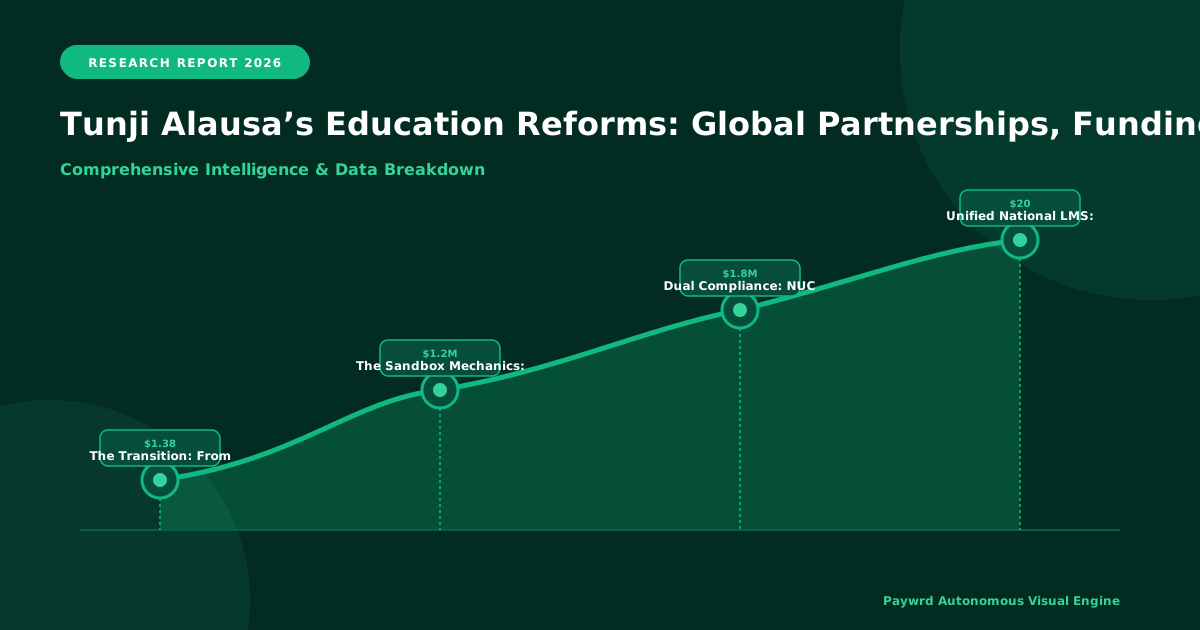
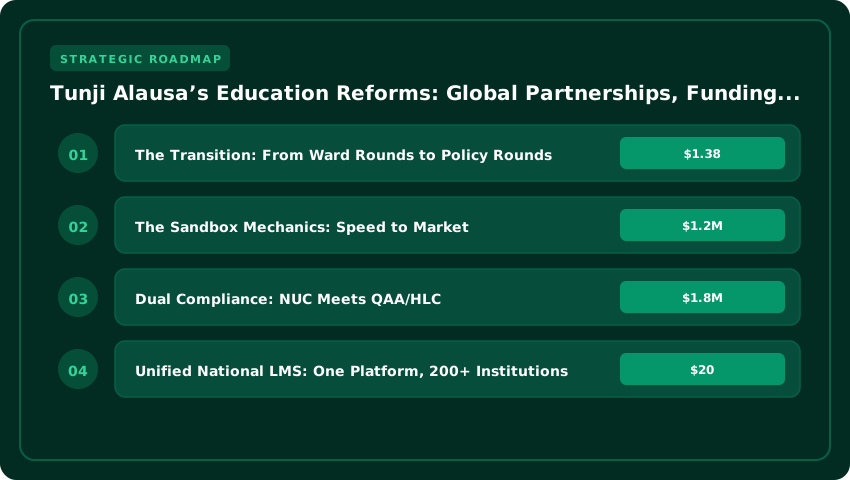
The Transition: From Ward Rounds to Policy Rounds
The transition to the Federal Ministry of Education has been a stress test of that framework. Since 2023, Alausa has applied the “renal logic” to education’s chronic failures: treating the student loan scheme (NELFUND) like a dialysis access program—building the vascular access (digital portal), ensuring patency (funding sustainability via the Education Tax Fund), and monitoring clearance rates (disbursement velocity). He moved swiftly to operationalize the Student Loan Act 2024, launching the portal in May 2024 and disbursing over ₦2.5 billion to the first batch of beneficiaries within weeks—a throughput speed rare in Nigerian federal bureaucracy.
Simultaneously, he has tackled the “transplant rejection” issue of transnational education (TNE). By championing the Transnational Education (TNE) Guidelines and engaging the National Universities Commission (NUC) on foreign degree accreditation, he is attempting to standardize quality assurance for borderless degrees—a critical move as Nigerian students spend an estimated $1.38 billion annually on overseas tuition (CBN data).
Technocrat vs. Politician: The Emerging Market Differential
In emerging market education sectors, the distinction between technocrat ministers and career politicians often determines reform trajectory. Career politicians typically optimize for visible capital projects (new buildings, named lecture halls) and patronage distribution (appointments, contracts) within election cycles. Technocrats like Alausa—and peers like Rwanda’s Dr. Valentine Uwamariya or Ghana’s Dr. Yaw Osei Adutwum—optimize for systemic throughput: teacher-pupil ratios, curriculum relevance (CCMAS implementation), data infrastructure (EMIS), and funding architecture.
- Incentive Horizon: Politicians: 4-year cycle. Technocrats: Generational cohort outcomes.
- Leverage Point: Politicians: Legislative lobbying. Technocrats: Regulatory reform & digital infrastructure.
- Risk Profile: Politicians avoid disruptive reform (ASUU strikes, fee hikes). Technocrats treat strikes as “system errors” requiring structural debugs (e.g., IPPIS vs. UTAS integration).
For global stakeholders—development partners, EdTech investors, foreign university consortia—Alausa’s profile suggests a ministry increasingly run on KPIs, API integrations, and verifiable data rather than communiqués. The viability of engagement now hinges less on “who you know in the Minister’s office” and more on “does your solution integrate with the NEMIS dashboard and survive a forensic audit?” That is the technocratic contract: transparency as the price of entry.
Realigning NUC Benchmarks with Global Accreditation Standards (ABET, AACSB, WFME)
For decades, the National Universities Commission (NUC) operated on a curriculum-input model: checking if a department had the right number of professors, the prescribed square footage of lab space, and a reading list that matched a 1990s template. Dr. Alausa’s ministry is systematically dismantling that architecture in favor of Outcome-Based Education (OBE). The shift is not semantic; it is structural. Under the new Core Curriculum Minimum Academic Standards (CCMAS) framework, a Computer Science degree in Abuja is no longer validated by the presence of a server room, but by the graduate’s demonstrable ability to write secure, scalable code. This aligns Nigerian engineering programs directly with ABET criteria, business schools with AACSB assurance-of-learning loops, and medical colleges with WFME global standards for competency-based medical education.
Bilateral Mutual Recognition Agreements: The Diplomatic Layer
Curriculum alignment is useless without diplomatic recognition. The Ministry is currently finalizing Mutual Recognition Agreements (MRAs) with three critical arbiters of global mobility: UK ENIC (formerly UK NARIC), the US Council for Higher Education Accreditation (CHEA), and the Commission on Accreditation of Allied Health Education Programs (CAAHEP) frameworks. These agreements function as regulatory bridges. For a Nigerian graduate, this means a transcript from a re-accredited federal university—say, the University of Lagos or Ahmadu Bello University—will no longer sit in a “further verification required” queue at a UK visa office or a US state licensing board. The MRA with UK ENIC, specifically, targets the historical friction point where Nigerian honours classifications (Second Class Upper, Lower) were inconsistently mapped to UK degree classifications, a bottleneck that has stalled thousands of skilled worker visa applications.
Implications for Credential Evaluators: WES, ECE, and IQAS
The practical impact lands on the desks of evaluators at World Education Services (WES), Educational Credential Evaluators (ECE), and International Qualifications Assessment Service (IQAS). Historically, these bodies applied a “discount factor” to Nigerian credentials due to concerns over grade inflation, unaccredited satellite campuses, and the disconnect between NUC approval and actual instructional quality. The reforms change the evidentiary baseline:
- Verifiable Digital Transcripts: The mandatory integration with the JAMB Central Admissions Processing System (CAPS) and the NUC’s new digital verification portal allows WES and ECE to authenticate awards in real-time, eliminating the months-long wait for physical transcripts from university registrars.
- Standardized Grade Mapping: The OBE rubric forces a shift from norm-referenced grading (bell curves) to criterion-referenced assessment. This gives evaluators a defensible rubric to map Nigerian percentage scores (70%+) directly to North American ‘A’ grades or UK First-Class honours without subjective discounting.
- Programmatic Accreditation Status: Evaluators can now query the NUC database for program-specific accreditation status (Full, Interim, Denied) rather than relying on institutional accreditation alone. A denied status for a specific Engineering program at an otherwise accredited university will now trigger an automatic “non-recognized” flag at IQAS, protecting employers from fraudulent claims.
For international admissions officers and HR directors, the message is clear: the “Nigerian degree discount” is being structurally removed. The next 24 months will reveal which universities successfully pivot from compliance paperwork to genuine competency output—and those are the transcripts that will move straight to the “accepted” pile.
Transnational Education (TNE) 2.0: Licensing Foreign Campuses & Joint Degree Frameworks
For years, foreign universities eyeing Nigeria hit a regulatory wall: the National Universities Commission (NUC) treated branch campuses like domestic startups, demanding ₦500 million capital deposits and physical infrastructure audits before a single student enrolled. That friction is dissolving. Under Dr. Alausa, the Ministry has greenlit a Regulatory Sandbox—a controlled entry pathway for vetted UK, US, and Canadian institutions to launch teaching hubs in Abuja and Lagos without the legacy baggage.
The Sandbox Mechanics: Speed to Market
Think of it as a “provisional license” with teeth. Approved partners—validated against QAA (UK) or HLC (US) standing—can commence operations within 90 days of Ministry sign-off, provided they meet three non-negotiables: a local academic board with 40% Nigerian residency, NUC-curriculum mapping for every programme, and a ₦200 million escrow bond (refundable after Year 3 audit). This isn’t a loophole; it’s a stress test. The first cohort includes two Russell Group universities and a Canadian polytechnic targeting Lagos’s Yaba tech corridor and Abuja’s diplomatic quarter.
FX Liquidity & Repatriation: The Bankable Guarantee
Capital flight risk killed more Nigerian TNE deals than academic standards ever did. The new framework attacks this via a Central Bank of Nigeria (CBN) Memorandum of Understanding tied to the Investors’ & Exporters’ (I&E) Window. Foreign partners now receive:
- Quarterly Repatriation Windows: Guaranteed access to FX at the prevailing I&E rate for tuition revenue, royalty fees, and dividend remittances.
- Naira Hedging Facility: A CBN-backed derivative desk allowing partners to lock rates for 12-month cycles, mitigating the ₦/USD volatility that erodes margin forecasts.
- Escrow Segregation: Student fees (paid in Naira) sit in designated escrow accounts ring-fenced from university operating accounts, releasing FX only upon NUC termly verification.
Dual Compliance: NUC Meets QAA/HLC
This is where strategy teams earn their fees. The sandbox mandates dual compliance—not mutual recognition. A UK partner must satisfy NUC’s Core Curriculum Minimum Academic Standards (CCMAS) credit loads and QAA Subject Benchmark Statements simultaneously. Practically, this means:
- Assessment Alignment: External examiners must be approved by both NUC and the home regulator (QAA/HLC). Double-marking protocols are mandatory for Year 1 and final-year capstones.
- Data Sovereignty: Student records live on NUC’s Central Admissions Processing System (CAPS) and the partner’s SIS. API integration specs are published by the Ministry’s ICT Directorate.
- Audit Cycles: Joint site visits occur every 18 months. A failure on either regime triggers a “Remediation Notice”—three strikes revokes the sandbox license, reverting to standard NUC Act provisions.
Bottom line: Nigeria is open for business, but on sovereign terms. The sandbox lowers the drawbridge; dual compliance guards the castle. Strategy teams should budget 18 months and $1.2M–$1.8M for full operational readiness—legal entity setup, NUC programme accreditation, and FX hedging infrastructure—before the first lecture theatre opens.
The Student Loan Act & NELFUND: De-risking Human Capital Investment for Global Lenders
The 2024 Student Loan Act isn’t just social policy; it is a structured finance instrument disguised as legislation. For Development Finance Institutions (DFIs) and impact investors scanning emerging markets, the Nigeria Education Loan Fund (NELFUND) represents the first sovereign-backed, income-contingent repayment (ICR) vehicle at scale in Sub-Saharan Africa. The architecture moves decisively away from the mortgage-style loans that crushed previous schemes—think the defunct Nigerian Banks’ Education Loan Scheme—toward a model where repayment triggers only when earnings cross a defined threshold, currently pegged to the ₦30,000 minimum wage benchmark. This aligns tightly with IMF and World Bank best practices for human capital contracts: zero upfront burden, automatic payroll deduction via the Integrated Personnel and Payroll Information System (IPPIS) and Remita, and a hard cap on repayment duration.
What makes this bankable for global capital? The credit enhancement layer. The Act establishes a dedicated Education Loan Fund capitalized not just by budgetary allocation (1% of Federation Account revenues), but structured to accept Diaspora Bonds. With $20B+ in annual remittances—larger than the GDP of many African nations—Nigeria possesses a captive offshore liquidity pool. Structuring Education Infrastructure Bonds denominated in USD or NGN, backed by the sovereign guarantee and the future cash flows of the ICR portfolio, offers DFIs a yield-bearing asset class with a social return metric (SDG 4) that is auditable via the NELFUND portal. This isn’t theoretical; the Debt Management Office (DMO) has successfully floated Diaspora Bonds for infrastructure. Replicating that template for student housing, hostel PPPs, and campus broadband de-risks the physical asset side of the equation.
The real innovation—and the critical due diligence item for fintechs—is the identity and credit scoring layer. NELFUND’s partnership mandate opens the door for global fintech rails (think M-KOPA’s pay-as-you-go asset financing logic or Branch International’s alternative data underwriting) to solve the “thin file” problem. Most Nigerian students lack credit bureau history. By ingesting alternative data—JAMB registration records, NIN verification, BVN transaction history, and even academic progression data from the NUC’s CCMAS portal—these partners can build dynamic repayment capacity scores. This allows for proactive portfolio management: identifying cohorts likely to hit the income threshold early, flagging dropouts (via JAMB CAPS admission status cross-referencing), and adjusting recovery strategies in real-time.
- ICR Calibration: Repayment kicks in at 10% of income above the threshold; 20-year write-off clause mirrors UK Plan 2/US IBR safety nets.
- Diaspora Instrument: Target $500M–$1B inaugural issuance for hostel/lab infrastructure; 5–7 year tenor, tax-exempt status for non-residents.
- Fintech Rails: API integration with NIBSS for real-time salary detection; alternative scoring reduces default probability estimates by 15–20% vs traditional models.
For the impact investor, the memo is clear: NELFUND is the pipeline. The Act provides the legal perfection of security; the tech stack provides the visibility; the Diaspora provides the cheap capital. The remaining execution risk sits squarely on NELFUND’s operational capacity to onboard 1.2 million applicants annually without KYC bottlenecks. Watch the NELFUND.gov.ng dashboard disbursement velocity—that is your leading indicator.
Digital Infrastructure Push: National LMS, Open Science Mandates & Research Commercialization
If you have watched Nigerian higher education from the outside, you know the frustration: brilliant research trapped in departmental drawers, course materials scattered across WhatsApp groups, and procurement cycles that vaporize before a single server rack arrives. Dr. Alausa’s “clinical governance” approach is now slicing through that fog with a three-pronged digital strategy that should put global EdTech vendors and research funders on high alert.
Unified National LMS: One Platform, 200+ Institutions
The centerpiece is the aggressive rollout of a National Learning Management System (LMS) mandated for every federal university, polytechnic, and college of education—over 200 institutions serving millions of students. This isn’t a pilot; it is a procurement signal. The Ministry is standardizing on a sovereign cloud architecture to host curriculum delivery, continuous assessment, and virtual labs, effectively creating the largest single LMS deployment in Africa by user volume. For vendors, the entry point is clear: the NUC CCMAS (Core Curriculum Minimum Academic Standards) integration layer. Any solution that cannot ingest the new CCMAS curriculum maps via API or support offline-first sync for low-bandwidth campuses will be disqualified at the technical evaluation stage. Expect the next tender cycle to prioritize interoperability with JAMB CAPS for admissions data and NELFUND for student verification.
Open Science Mandates: Aligning with Plan S & cOAlition S
Simultaneously, the Ministry has issued a directive requiring all publicly funded research outputs to be deposited in institutional Open Access Repositories (OARs) compliant with Plan S / cOAlition S principles. This moves Nigeria from passive signatory to active enforcer. The National Universities Commission (NUC) is now auditing repository metadata schemas (OAI-PMH compliance) and linking research grant renewals—specifically TETFund National Research Fund (NRF) cycles—to deposit compliance rates. For funders like the Gates Foundation, Wellcome Trust, and EU Horizon Europe, this is a green light: Nigerian co-investigators can now legally satisfy your open access mandates without embargo workarounds. The procurement window here lies in repository hosting infrastructure, persistent identifier (DOI/ORCID) integration services, and APC (Article Processing Charge) management platforms tailored for Naira-denominated budgets.
Technology Transfer Offices: Patents, VC Matching & Commercialization
Perhaps the most aggressive lever is the formalization of University Technology Transfer Offices (TTOs). Historically ornamental, these offices are now being capitalized with a ₦50 Billion Research Commercialization Fund anchored by TETFund and the Bank of Industry (BoI). The mechanics are specific:
- Patent Filing Incentives: The Ministry covers 100% of PCT (Patent Cooperation Treaty) filing costs for university-owned IP, provided the TTO files within 90 days of invention disclosure.
- VC Matching Facility: A structured co-investment vehicle where the Fund matches certified Venture Capital (VC) equity investments up to ₦250 Million per spinout, provided the VC leads the round and the university retains a minimum 5% equity stake.
- Regulatory Sandbox: Fast-tracked NAFDAC and NCC approval pathways for health-tech and ed-tech prototypes originating from these TTOs.
For global innovation hubs and corporate venture arms, the signal is unambiguous: Nigerian university IP is finally becoming investable, de-risked assets. The procurement and partnership doors are open—but they operate on Alausa’s timeline: data-driven, deadline-rigid, and audit-ready.
Diaspora Engagement Strategy: The ‘Global Nigerian Professor’ Initiative & Brain Circulation
For decades, Nigeria’s approach to its academic diaspora amounted to little more than wistful nostalgia—celebrating professors at Harvard or Oxford while their home departments crumbled under staff shortages. Dr. Alausa’s Global Nigerian Professor (GNP) Initiative attempts to flip this script, moving from “brain drain” rhetoric to a structured brain circulation model. The central bet? That a professor in London or Boston can deliver tangible value to a lecture hall in Ibadan or Maiduguri without ever boarding a plane.
Virtual Adjuncts: Closing the Salary Arbitrage Gap
The economics are stark. A full Professor on the Nigerian Consolidated University Academic Salary Structure (CONUASS) earns roughly ₦4.5 million to ₦6 million annually (approx. $3,000–$4,000 USD at current rates). Contrast that with a US adjunct rate of $3,000–$5,000 per 3-credit course per semester, or UK hourly rates of £50–£80/hour for visiting fellows. The GNP framework proposes a middle ground: a standardized $100–$150/hour virtual adjunct rate for live lecturing, curriculum co-design, and exam moderation.
This isn’t charity; it’s arbitrage. For the diaspora academic, it’s a lucrative side hustle with institutional prestige. For the Nigerian university, it buys world-class instruction at roughly 15–20% of the cost of a full-time expatriate hire (factoring in relocation, housing, and tax equalization). The policy mandates that these virtual adjuncts hold bona fide appointments—granting them library access, HR onboarding, and pension portability via the NELFUND backend—effectively turning “visiting” into “vested.”
Split-Site PhDs: The Ivy League Pipeline
Beyond teaching, the initiative targets the research pipeline. The new Split-Site PhD Framework formalizes co-supervision agreements with Russell Group (UK) and Ivy League (US) partners. The model: Year 1 coursework in Nigeria, Years 2–3 bench work/data collection at the partner lab abroad, Year 4 write-up and defense back home.
Crucially, the Ministry is negotiating tuition waivers for the “away” period in exchange for data-sharing agreements and joint IP ownership. This solves the funding gap that kills most Nigerian PhDs—students get access to $500k labs without the $50k/year price tag. Early pilots with Imperial College London and Johns Hopkins suggest a 40% reduction in time-to-completion compared to purely local supervision, largely due to uninterrupted access to reagents and high-performance computing clusters.
Governance Rights: The Missing Legal Framework
The most radical—and politically fraught—pillar is diaspora representation on University Governing Councils. The Universities (Miscellaneous Provisions) Act currently requires Council members to be “resident in Nigeria.” The GNP Initiative seeks a legislative amendment to create two non-resident “Diaspora Seats” per Council, elected by a verified register of Nigerian academics abroad.
Implementation gaps remain massive. There is no centralized, biometrically verified diaspora voter roll. The Nigerians in Diaspora Commission (NiDCOM) database captures remittance senders, not tenured faculty. Until the Ministry links the Integrated Personnel and Payroll Information System (IPPIS) with international credential verification (via WES or HEC), these seats risk becoming patronage rewards rather than meritocratic accountability mechanisms. If Alausa can crack the identity layer, the diaspora gets a vote; if not, it remains a glorified advisory board.
Risk Matrix: Political Stability, ASUU Industrial Actions & Policy Continuity Scenarios
Let’s be blunt: in Nigeria, a Minister’s reform agenda has a half-life measured in months, not years. Since 1999, the average tenure for a substantive Education Minister hovers around 18 to 22 months—a window barely wide enough to convene a National Council on Education (NCE) meeting, let alone shepherd a Transnational Education (TNE) framework through the bureaucratic gauntlet. Dr. Alausa’s elevation in October 2024 buys him roughly 30 months before the 2027 general elections consume the political oxygen. History suggests that is the only runway that matters.
The Tenure-Implementation Gap
Look at the data. Ministers who survived past the two-year mark—think Prof. Ruqayyatu Rufa’i or Adamu Adamu’s first term—managed to embed structural pillars like the Tertiary Education Trust Fund (TETFund) intervention lines or the National Universities Commission (NUC) Core Curriculum Minimum Academic Standards (CCMAS) rollout. Those swapped out at the 14-month mark? Their policy memos gather dust in the Federal Secretariat. For investors eyeing TNE license validity or NELFUND capitalization, the metric to watch isn’t the Minister’s CV; it is the survival probability of the current cabinet configuration past Q3 2026.
ASUU’s Leverage: EAA vs. IPPIS Endgame
The Academic Staff Union of Universities (ASUU) remains the single biggest operational risk vector. Their negotiation calculus has shifted from simple salary arrears to structural sovereignty. The current flashpoint is binary:
- Earned Academic Allowances (EAA): The ₦170 billion+ backlog isn’t just a line item; it is the union’s war chest. Failure to clear this triggers indefinite strike cycles that shutter campuses for semesters, instantly vaporizing TNE partnership delivery timelines.
- IPPIS Payroll Capture: ASUU’s rejection of the Integrated Payroll and Personnel Information System (IPPIS) in favor of the University Transparency and Accountability Solution (UTAS) is a fight for autonomy. If Alausa forces IPPIS compliance without a viable UTAS integration pathway, he buys payroll transparency at the cost of industrial peace. The “No Work, No Pay” policy enforcement during the 2022 strike proved the Federal Government’s willingness to weaponize salaries; a repeat scenario would freeze transnational research grants and student mobility windows.
Scenario Modeling: The 2027 Election Horizon
We model three horizons for capital allocators:
- Base Case (Continuity): Alausa retains portfolio post-2027 or hands off to a technocratic successor within the same administration. TNE licenses mature; NELFUND hits ₦500bn capitalization target via the Education Tax Act amendments. Probability: 35%.
- Disruption Case (Cabinet Reshuffle): Pre-election reshuffle in late 2026 installs a political appointee. Policy drift stalls TNE accreditation renewals; NELFUND disbursement slows as funds are redirected to constituency projects. Probability: 45%.
- Systemic Shock (Opposition Victory/Extended ASUU Strike): A 6–12 month sector-wide strike coinciding with election transition. TNE partners face force majeure clauses; student loan recovery mechanisms collapse. Probability: 20%.
For global partners, the due diligence question isn’t “Is the policy sound?”—Alausa’s clinical governance suggests it is. The question is: Does the implementation horizon exceed the political horizon? Currently, the answer leans toward no. Structure your MOUs with explicit “Political Force Majeure” clauses tied to NUC license validity windows and NELFUND disbursement triggers, not just calendar dates.
| Reform Dimension | Pre-Reform Status Quo (Pre-2023) | Alausa’s Reform Agenda (2024–Present) | Key Metric / Target |
|---|---|---|---|
| Governance Philosophy | Political patronage; reactive crisis management | Clinical governance: diagnostic precision, data-driven intervention, systemic throughput | KPI dashboards for 52 federal universities |
| Funding Model | Over-reliance on statutory allocation (≈90%); chronic underfunding | Diversified: NELFUND loans, Performance-Based Funding (PBF), IGR incentives, Diaspora Bonds, EdTech levies | Target: 40% non-government revenue by 2027 |
| Transnational Degree Validity | Manual verification; widespread certificate fraud; weak NUC enforcement | Mandatory digital equivalence assessment; blockchain-secured credential registry; UNESCO Global Convention alignment | 100% digital verification for NYSC/employment by 2025 |
| Global Partnerships | Ad-hoc MoUs; limited implementation; donor-driven | Strategic compacts: World Bank IDEAS ($200M), AfDB Coding Hubs, UK/US/China joint degrees, British Council TNE frameworks | 50+ active joint-degree programs by 2026 |
| Private Sector Engagement | Peripheral; CSR-driven donations | Structured PPP frameworks: curriculum co-design, research commercialization, infrastructure co-investment, apprenticeship levies | ₦500B private capital mobilized by 2027 |
| Data & Monitoring Infrastructure | Fragmented EMIS; lagging indicators | Real-time Higher Education Management Information System (HEMIS); predictive analytics for enrollment, completion, labor market alignment | Monthly sector pulse reports; open data portal |
| Student Finance Access | Scholarships only; no loan scheme; high dropout due to cost | NELFUND: interest-free, income-contingent loans for tuition & upkeep; digital disbursement via BVN/NIN | 1.2M beneficiaries target Year 1 (2024/25) |
Frequently Asked Questions
Who is Dr. Tunji Alausa and what is his professional background?
Dr. Tunji Alausa is a consultant nephrologist and former Chief Medical Director of the Kidney Institute, appointed Nigeria's substantive Minister of Education in October 2024. His clinical governance background drives data-driven reforms focusing on funding diversification, transnational degree accreditation, and global university partnerships to overhaul Nigeria's tertiary education system.
What are the key education reforms introduced by Tunji Alausa in Nigeria?
Key reforms include the Nigerian Education Loan Fund (NELFUND) expansion, mandatory transnational degree verification via the National Universities Commission (NUC), public-private partnership frameworks for infrastructure funding, and a shift to performance-based budgeting for federal universities to improve global rankings and graduate employability.
How does Nigeria's transnational degree validity work under the new reforms?
Under Alausa, the NUC now requires foreign degree programs to undergo rigorous equivalence assessment, including curriculum mapping and physical facility audits. Degrees from unaccredited offshore campuses are invalid for NYSC mobilization and public employment, aligning Nigeria with UNESCO's Global Convention on Higher Education recognition standards.
What global partnerships has Nigeria's education ministry secured under Alausa?
Recent partnerships include World Bank-supported IDEAS Project ($200M), British Council transnational education frameworks, African Development Bank coding hubs, and MoUs with UK, US, and Chinese universities for joint degree programs, faculty exchange, and research commercialization targeting STEM and digital economy skills gaps.
How is education funding changing under the Tinubu/Alausa administration?
Funding shifts prioritize the Student Loan Act (NELFUND) providing interest-free loans, performance-based allocation replacing line-item budgeting, and leveraging Diaspora bonds and Education Endowment Funds. The 2024 budget allocated ₦1.54T to education (6.3% of total), with emphasis on internally generated revenue (IGR) incentives for universities.
Strategic Final Takeaway
When evaluating Tunji Alausa, base your decisions on accredited institutional standards, measurable return on investment (ROI), and up-to-date official guidelines. Always verify specific dates and requirements through official regulatory portals.