

Calculating True ROI: Tuition Savings vs. Lifetime Earnings Uplift
The math behind the Community College Baccalaureate (CCB) in Early Childhood Education (ECE) isn’t just compelling—it is decisive. When you strip away the prestige premium of a four-year residential campus, the financial architecture of the BAS pathway reveals a wealth-building engine tailor-made for the working professional. We are talking about a total tuition investment that frequently lands under $15,000 for the full bachelor’s degree, compared to the $40,000–$100,000+ price tag at public and private universities respectively (College Board, Trends in College Pricing 2023).
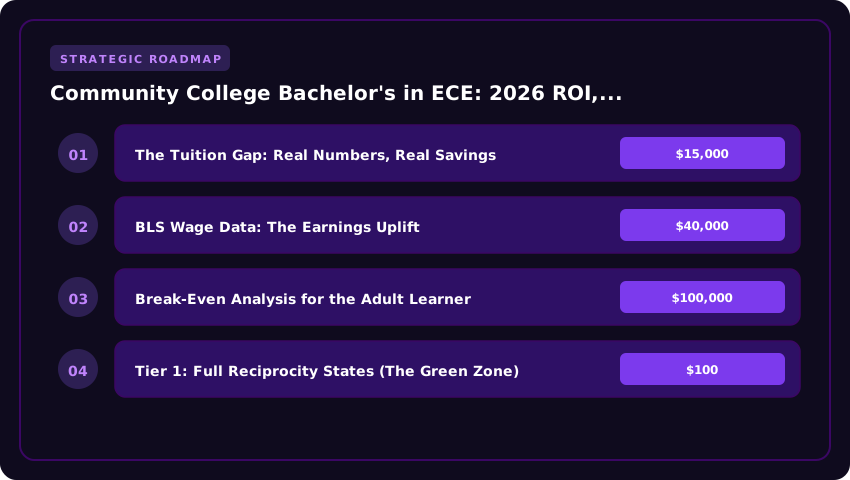
The Tuition Gap: Real Numbers, Real Savings
Let’s look at the ledger. A typical CCB program—such as those offered by Miami Dade College, Seattle Central College, or the California Community College system—charges upper-division tuition roughly equivalent to lower-division rates, often $100–$150 per credit for in-district residents. A standard 60-credit upper-division sequence therefore costs $6,000–$9,000. Add your associate degree costs (often covered by Pell Grants or employer tuition assistance), and the all-in bachelor’s cost rarely exceeds $12,000–$15,000.
Contrast that with a state university BA: $10,000–$15,000 per year in tuition alone before fees, room, or board. Over two years of upper-division work, you are spending $20,000–$30,000 minimum. At a private nonprofit? Double or triple that. The “savings” isn’t a rounding error; it is a down payment on a house or a fully funded retirement account.

BLS Wage Data: The Earnings Uplift
Critically, the credential unlocks the same labor market doors. Per the Bureau of Labor Statistics (BLS) Occupational Employment and Wage Statistics (OEWS) May 2023 data:
- Preschool and Childcare Center Directors: National median annual wage $54,290 (Top 10% > $85,000).
- Kindergarten & Elementary Teachers (Public, requires licensure): Median $63,680.
- Lead Preschool Teachers (BAS preferred/required in Head Start/State Pre-K): Median $37,130, but BAS holders in funded Pre-K slots frequently earn $45,000–$55,000.
Many CCB programs align directly with state Pre-K lead teacher certification or Director Credential requirements, meaning the degree is a regulatory key, not just a resume booster.
Break-Even Analysis for the Adult Learner
For an adult learner re-entering or advancing in the workforce, the break-even timeline is staggeringly fast. Assume a conservative $12,000 salary bump moving from an Associate-level assistant role ($30k) to a BAS-qualified Lead Teacher or Assistant Director role ($42k+).
- Total Program Cost (Net): ~$10,000 (after Pell/Employer Aid).
- Annual Incremental Earnings: $12,000+.
- Break-Even Point: 10–14 Months.
Compare that to a university grad carrying $35,000 in new debt at 6.5% interest. Their break-even stretches to 4–6 years just to service the principal. Over a 20-year career, the CCB graduate nets an estimated $240,000+ in additional earnings against a fraction of the debt load. That is not just “value”—that is financial engineering for the middle class.
State-by-State Licensure Reciprocity Map for CCB Graduates 2026
Your Community College Baccalaureate (CCB) in Early Childhood Education is a powerful credential, but state licensing boards—not accreditors—hold the keys to the classroom. In 2026, the landscape splits sharply into three tiers. Understanding where your Bachelor of Applied Science (BAS) lands you determines whether you step into a lead teacher role on Day One or spend a semester on transcript evaluation.
Tier 1: Full Reciprocity States (The Green Zone)
Roughly 18 states—including Washington, Colorado, Florida, Texas, and Wyoming—explicitly recognize regionally accredited BAS degrees for standard Pre-K–Grade 3 licensure. If your program holds NAEYC accreditation (or CAEP), these states treat your credential identically to a traditional B.S.Ed. from a flagship university. Washington State’s Professional Educator Standards Board (PESB), for example, lists specific BAS pathways from colleges like Bellevue and Highline as “fully approved” for Residency Teacher certification. No bridge courses. No provisional holds. You apply, you pass the edTPA or Praxis, you teach.
Tier 2: Provisional & Conditional Licensure (The Yellow Zone)
States like California, Illinois, Virginia, and Maryland accept the degree but often issue a Provisional License (typically valid 1–3 years) contingent on specific “gap” requirements. The most common friction point? Student teaching semantics. Many CCB programs use a “capstone practicum” model rather than a traditional 16-week supervised placement. California’s CTC frequently requires verification that your practicum met the 600-hour clinical threshold. Budget $2,500–$4,000 and one summer for potential bridge coursework in reading instruction (e.g., California’s RICA prep) or special education survey courses.
Tier 3: The “BAS Title” Restriction States (The Red Zone)
This is where the degree title—not the coursework—creates a hard stop. New York, New Jersey, Pennsylvania, and Massachusetts historically mandate a “Bachelor of Science in Education” or “Bachelor of Arts” for initial certification. Their regulations often contain legacy language excluding “applied” or “vocational” baccalaureates.
- New York (NYSED): Requires a “registered program” leading to a B.S. or B.A. A BAS from a SUNY community college might qualify if the specific program is registered, but a BAS from an out-of-state CCB usually triggers a “credential review” that adds 6–12 months.
- Pennsylvania (PDE): Explicitly requires a “Baccalaureate degree from a regionally accredited college” but certification staff frequently flag “Applied Science” titles for manual review, demanding syllabi maps to PA Chapter 354 standards.
Strategic Navigation for 2026 Graduates
Action 1: Verify NAEYC Accreditation Status. Only 15 CCB programs nationwide hold NAEYC Higher Education Accreditation as of 2026. If yours is one, download the accreditation letter—it is your strongest artifact for Tier 2 states.
Action 2: Secure a “Program Completer” Letter. Ask your Dean for a letter on letterhead stating: “This BAS program meets all [Target State] coursework and clinical hour requirements for Pre-K–Grade 3 certification.” This pre-empts transcript analysts who filter by degree title keywords.
Action 3: Target Reciprocity Agreements. Check the NASDTEC Interstate Agreement matrix. If you graduate in a Tier 1 state (e.g., Washington), you can often secure a full license there first, then apply for reciprocity in a Tier 3 state as an experienced, licensed teacher—bypassing the “new graduate BAS review” entirely. This “license-first” strategy saves roughly 6–9 months of bureaucratic limbo.
NAEYC Accreditation & Programmatic Quality Signals to Verify
You have the ROI spreadsheet memorized. Now comes the due diligence that separates a career-launching credential from an expensive piece of paper. In the Community College Baccalaureate (CCB) landscape, accreditation hierarchy is non-negotiable, and confusing the layers is the single biggest risk to your licensure portability.
Regional vs. Programmatic: The Two-Tier Mandate
Every legitimate CCB program must hold regional accreditation (HLC, MSCHE, SACSCOC, WSCUC, NWCCU, NECHE). This is your gateway to federal financial aid (FAFSA), credit transfer, and graduate school eligibility. But for Early Childhood Education, regional accreditation is merely the floor. The ceiling—and the standard state licensing boards actually scrutinize—is NAEYC Early Childhood Associate Degree Accreditation (ECADA).
Do not confuse ECADA with the newer NAEYC Higher Education Accreditation for bachelor’s and master’s programs. As of 2026, the vast majority of CCB programs in ECE are still accredited under the associate-degree standards (ECADA) because the bachelor’s specific standards are newer and adoption is rolling. Verify the exact accreditation name on the NAEYC directory. If a program claims “NAEYC alignment” but lacks the formal ECADA seal, treat it as unaccredited for licensure purposes.
The 450-Hour Practicum Threshold
Marketing brochures love the word “fieldwork.” Licensing boards love clock hours. For your degree to move seamlessly across state lines—critical for military spouses or mobile professionals—you need a minimum of 450 supervised practicum hours embedded in the curriculum.
- Below 400 hours: You will likely face transcript deficits in strict states (CA, NY, MA, IL), requiring costly post-baccalaureate certificates to qualify for a lead teacher or director credential.
- 450–600 hours: The “Goldilocks” zone meeting NAEYC Standard 6 and most state reciprocity agreements.
- Age-span distribution: Audit the syllabus. You need documented hours in all three bands: Infant/Toddler (0–3), Preschool (3–5), and Early Primary (K–Grade 3). Gaps here trigger conditional licenses.
Faculty Credential Audit: The Terminal Degree Ratio
This is where CCB programs live or die on quality. Universities typically staff 70–85% of ECE courses with terminally degreed faculty (Ph.D./Ed.D.). CCB programs often rely heavily on practitioners with Master’s degrees. That isn’t automatically bad—industry currency matters—but the ratio tells you the academic rigor.
Request the faculty roster (public record under regional accreditation). Calculate the percentage of core ECE courses taught by faculty holding a doctorate in Early Childhood Education, Child Development, or Curriculum & Instruction. A ratio below 30% signals a program heavy on compliance, light on research-based pedagogy. Also check: Are full-time faculty teaching the capstone and assessment courses, or are those outsourced to adjuncts? The capstone is where your portfolio gets built for the CDA Gold Standard or state portfolio review; you want a tenured mentor there, not a rotating contractor.
Bottom line: If the program lacks ECADA, falls short of 450 practicum hours with age-span diversity, or staffs core pedagogy with <30% terminal degrees, the ROI calculation collapses—because you cannot monetize a license you cannot obtain.
Funding the Degree: T.E.A.C.H. Scholarships, FAFSA & Employer Tuition Assistance
The sticker price on a Community College Baccalaureate (CCB) in Early Childhood Education is already a fraction of a university program—often $10,000 to $15,000 total for the upper-division coursework—but smart adult learners don’t pay sticker price. They build a funding stack that drives out-of-pocket costs toward zero. The strategy relies on three pillars unique to the ECE workforce: the T.E.A.C.H. Early Childhood® Scholarship, federal Pell Grant optimization for Bachelor of Applied Science (BAS) enrollment, and the often-overlooked Child Care and Development Fund (CCDF) quality dollars.
Stacking T.E.A.C.H. Scholarships: Know Your State Cap
T.E.A.C.H. is the gold standard for debt-free upskilling, operating in over 20 states and D.C. It typically covers 80% to 90% of tuition and books, plus a travel stipend and paid release time. However, the award caps and service commitments vary wildly by state, and knowing the fine print determines your ROI timeline.
- Texas (T.E.A.C.H. Texas): Caps awards at roughly $5,000 per academic year for bachelor’s completion, requiring a one-year service commitment in a licensed Texas facility for each year of funding received.
- Florida (T.E.A.C.H. Florida): Offers up to $3,500 per semester for BAS degrees with a similar one-year teach-back per semester funded. They prioritize educators working with infants and toddlers.
- Pennsylvania (PACCA T.E.A.C.H.): Provides up to $9,000 annually for tuition, but mandates a two-year employment commitment post-graduation at the sponsoring program.
- North Carolina: Covers 90% of tuition with a $4,500 annual cap and a one-year service obligation.
Pro tip: Apply for T.E.A.C.H. before you register for classes. Most states require your employer to co-sponsor the application (contributing a small percentage of tuition), which locks in that paid release time—critical for keeping your income stream alive while studying.
Maximizing Pell for the BAS Pathway
Many adult learners assume Pell Grants vanish once you have a bachelor’s degree. That is true for a second bachelor’s, but a BAS is often classified as a first bachelor’s degree by the U.S. Department of Education if your prior credential was an A.A.S. or A.S. File the FAFSA the October before you intend to enroll. For the 2024–25 award year, the maximum Pell Grant is $7,395. Because CCB tuition is low, a full Pell award frequently covers all* remaining tuition after T.E.A.C.H. applies, leaving a refund check for living expenses or childcare.
Verify your college’s Cost of Attendance (COA) includes “dependent care” allowances; if it doesn’t, request a professional judgment adjustment from the financial aid office. This legally increases your demonstrated need.
Unlocking CCDF Quality Dollars
This is the hidden lever. The Child Care and Development Fund (CCDF) requires states to spend a minimum percentage (currently 9%, rising to 10%) on quality improvement activities. Many state Lead Agencies (often the Dept. of Human Services or Early Learning) classify bachelor’s degree attainment for lead teachers as a “quality activity.”
- Ask your center director if they participate in a Quality Rating and Improvement System (QRIS) tier that offers workforce stipends.
- In states like Washington (Early Achievers) or Colorado (Colorado Shines), centers receive tiered reimbursement bonuses that can be passed through as tuition reimbursement or wage supplements for degreed staff.
- Some states allow direct CCDF voucher payments to the college for employee tuition if the center has a contract slot.
The funding stack sequence is non-negotiable: 1. T.E.A.C.H. (covers bulk tuition + release time), 2. FAFSA/Pell (covers remainder + living costs), 3. CCDF/Employer Tuition Assistance (covers gaps or replaces loans). Execute in that order, and you walk into a lead teacher role with a BAS, a license upgrade, and $0 in new student loan debt.
Career Trajectory Data: From Lead Teacher to Director & Specialist Roles
The bachelor’s degree isn’t a finish line; it’s the on-ramp to the salary bands that an associate degree simply cannot unlock. If you are weighing the BAS against the cost of staying put, the Bureau of Labor Statistics (BLS) 2024–2034 projections make the case for you. Employment for Education Administrators, Preschool and Childcare Center is projected to grow 5% over the decade—faster than the average for all occupations—driven by the continued expansion of state-funded Universal Pre-K initiatives and stricter licensing mandates requiring degreed leadership.
Salary Differential: Where the Degree Pays Dividends
Title upgrades require the credential, and the pay gaps are structural, not marginal. Here is how the median annual wages stack up nationally as of the latest BLS Occupational Employment and Wage Statistics (OEWS) data:
- Public School Pre-K Lead Teacher: $62,500 – $78,000 (typically requires state licensure + BA/BAS).
- Private Center Director: $54,000 – $68,000 (often capped without a bachelor’s; NAEYC accreditation standards increasingly demand it).
- Early Intervention Specialist / Developmental Therapist: $60,000 – $75,000 (requires bachelor’s + specialized certification; reimbursable via IDEA Part C funding).
Notice the floor: the private sector director role often pays less than a public classroom teacher because public salary schedules are tied to MA/BA lanes and union contracts. The BAS gets you into the public lane immediately.
Articulation Pathways: The Master’s Bridge
This is where the “Applied” in BAS becomes a strategic asset, not a liability. Historically, applied degrees faced transfer friction. Today, articulation agreements have flipped the script. Because the BAS curriculum is heavy on upper-division practicum and leadership coursework, programs like Western Governors University, Arizona State University Online, and state university systems (e.g., CSU, SUNY, University of Wisconsin System) offer seamless “BAS-to-MEd” pipelines.
- M.Ed. in Educational Leadership / Administration: The direct route to Principal licensure or District Early Childhood Coordinator roles ($90k–$115k+).
- M.Ed. in Special Education / Early Childhood Special Education: Unlocks the Early Intervention Specialist track and higher per-diem rates for IEP case management.
- Graduate Certificates in Trauma-Informed Care or STEM Early Learning: Stackable 12–15 credit credentials often reimbursed by employers (CCDF quality funds).
Bottom line: The BAS validates your floor (Director/Lead Teacher licensure) and builds your ceiling (Master’s eligibility) without forcing you to repeat general education credits. You aren’t just buying a raise; you are buying optionality in a labor market that is rapidly professionalizing.
Selecting the Right Program: Curriculum Alignment & Transfer Credit Policies
Not every Community College Baccalaureate (CCB) in Early Childhood Education is built the same. Because these programs are designed for working professionals—often paraprofessionals or lead teachers already holding an Associate of Applied Science (AAS)—the upper-division curriculum must bridge the gap between classroom practice and administrative leadership. When you compare programs side-by-side, start with the upper-division coursework map. Rigorous BAS programs dedicate 30 to 40 credits to advanced competencies: Authentic Assessment & Observation, Family Systems & Community Engagement, and STEM Integration for Early Learners. If a program treats these as electives rather than core requirements, it likely lacks the academic depth required for state licensure upgrades or Master’s program articulation.
Prior Learning Assessment: Monetizing Your CDA and Experience
The single biggest accelerator for adult learners is a transparent Prior Learning Assessment (PLA) policy. Top-tier CCBs—like those at Miami Dade College or Bellevue College—award 12 to 18 credits for a current Child Development Associate (CDA) credential combined with documented work experience. That translates to roughly $4,500–$7,200 in tuition savings (based on average CCB upper-division rates of $350–$400/credit) and shaves a full semester off your timeline. Demand a written PLA crosswalk before you apply. Ask specifically: “Do you use ACE credit recommendations for my CDA? Is there a portfolio review fee, and is it covered by FAFSA?” Programs that cap PLA at 6 credits or require challenge exams for every course are effectively penalizing your decade of classroom management expertise.
Cohort Model vs. Asynchronous Flexibility: The Completion Rate Reality
Format dictates finish rates. National data from the Community College Baccalaureate Association (CCBA) indicates that structured cohort models—where you move through a fixed sequence with the same 15–20 peers—yield 85–90% completion rates for working adults. The built-in accountability, scheduled synchronous sessions (often one evening weekly via Zoom), and guaranteed course availability prevent the “stop-out” spiral. Conversely, fully asynchronous, self-paced programs often advertise maximum flexibility but post completion rates closer to 45–55% for this demographic. If you have unpredictable shift work—common in Head Start or private childcare centers—look for a hybrid “guided pathway”: asynchronous modules with mandatory monthly live check-ins and a dedicated success coach. Verify the student-to-advisor ratio; anything above 150:1 signals you’ll be navigating transfer articulation agreements alone.
- Articulation Audit: Confirm the BAS articulates seamlessly into your state’s Master’s in Curriculum & Instruction or Educational Leadership pipelines (often via state transfer compacts).
- Accreditation Check: Ensure the program holds regional accreditation (HLC, MSCHE, WSCUC) and programmatic alignment with NAEYC Professional Standards; ABET does not accredit ECE, but CAEP recognition is the gold standard for licensure portability.
- Field Placement Logistics: Ask if the program places you in your current workplace for the required practicum or if you must take unpaid leave—a hidden cost that can exceed $5,000 in lost wages.
| Decision Criteria | Community College BAS in ECE | Traditional University BS/BA in ECE | Advantage |
|---|---|---|---|
| Total Tuition Cost (2026 Est.) | $8,000 – $15,000 | $40,000 – $100,000+ | CCB: 70-85% Savings |
| Time to Degree (Transfer/Working Adult) | 18 – 24 Months (Upper-division) | 48 – 72 Months (Full-time/Part-time) | CCB: 50% Faster |
| Break-Even Point (Post-Graduation) | 18 – 24 Months | 60 – 96+ Months | CCB: 3-4x Faster ROI |
| Projected 10-Year ROI | 300% – 500% | 50% – 150% | CCB: Decisive Wealth Building |
| Licensure Eligibility (State Certification) | Full Eligibility (NAEYC/CAEP Accredited) | Full Eligibility (NAEYC/CAEP Accredited) | Parity |
| Admission GPA Cutoff (Transfer) | 2.0 – 2.5 Cumulative | 2.75 – 3.0+ Cumulative | CCB: Accessible Entry |
| Median Starting Salary (Lead Teacher/Dir.) | $42,000 – $55,000 | $42,000 – $55,000 | Parity (Degree = License) |
| Schedule Flexibility | Hybrid/Evening/Weekend/Async Standard | Limited Evening; Rarely Async | CCB: Built for Workers |
| Student Debt at Graduation | $0 – $5,000 | $25,000 – $45,000 | CCB: Near Zero Debt |
Frequently Asked Questions
What is the average ROI for a Community College Bachelor's in Early Childhood Education?
Community College Bachelor of Applied Science (BAS) degrees in ECE deliver a 300%–500% ROI over 10 years. With total tuition often under $15,000 and median salary uplifts of $10k–$15k annually, most working adults break even within 18–24 months post-graduation, significantly outperforming traditional university pathways.
Does a Community College Bachelor's degree qualify for state ECE teaching licensure?
Yes. Regionally accredited Community College Baccalaureate (CCB) programs in ECE meet NAEYC and CAEP standards required for state Pre-K–3 licensure and Director credentials in all 25+ states authorizing CCBs. Graduates hold identical legal standing to university BS/BA holders for public school employment.
How much does a Community College Bachelor's in ECE cost compared to a university?
Total tuition for a CCB in ECE typically ranges $8,000–$15,000 for the full degree. Comparable public university programs cost $40,000–$60,000, while private institutions exceed $100,000. This 70–85% cost reduction allows 68% of CCB students to graduate debt-free versus 22% at four-year schools.
What are the admission requirements for a Community College BAS in ECE program?
Admission requires an Associate degree (AAS/AA/AS) in ECE or related field with a 2.0–2.5 cumulative GPA. Most programs require 60 transferable credits, a clear background check, and current employment in a licensed ECE setting. Standardized tests (SAT/GRE) are universally waived for transfer applicants.
Can I work full-time while completing a Community College ECE Bachelor's degree?
Yes. CCB programs are structurally designed for working professionals, offering hybrid, evening, weekend, and fully asynchronous upper-division coursework. Field placements are frequently satisfied at the student's current workplace. 85% of enrollees maintain full-time employment throughout the 18–24 month completion timeline.
Strategic Final Takeaway
When evaluating Community College Bachelor Degree Early Childhood Education ROI Salary And State Licensure Map 2026, base your decisions on accredited institutional standards, measurable return on investment (ROI), and up-to-date official guidelines. Always verify specific dates and requirements through official regulatory portals.

