Decoding Accreditation: Why Regional & Cognia Status Matters for K
Parents shopping for virtual kindergarten often stare at a wall of logos—AdvancED, Cognia, WASC, MSA-CESS, “Nationally Accredited”—and assume they all carry the same weight. They do not. In the United States, the gold standard for K–12 education remains regional accreditation. These six historic agencies (now largely unified under the Cognia umbrella alongside the Western Association of Schools and Colleges, or WASC) are the only entities recognized universally by state departments of education and public school districts.
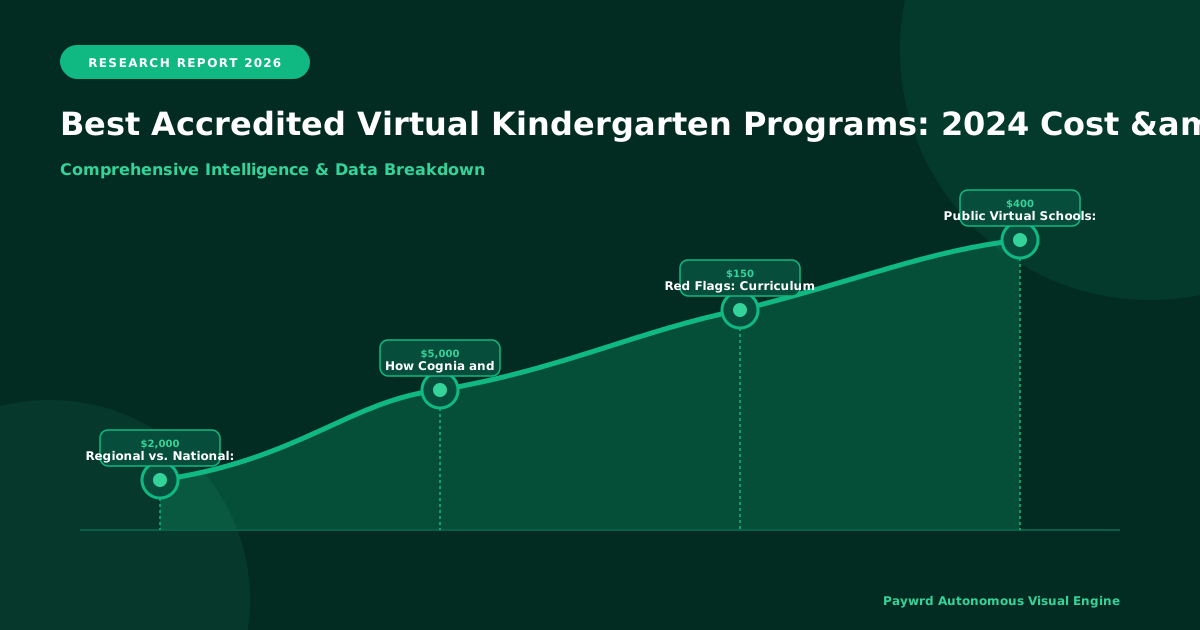
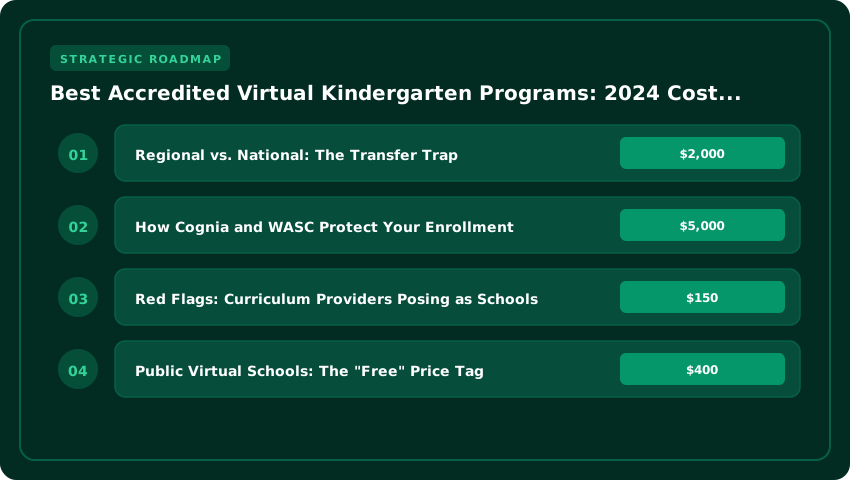
Regional vs. National: The Transfer Trap
National accreditors like DEAC (Distance Education Accrediting Commission) serve a valid purpose for career colleges and vocational training, but they are not the standard for elementary academics. If your child completes kindergarten at a “nationally accredited” virtual academy, your local public school district is under zero legal obligation to accept those credits or grade-level placement. We have seen families forced to repeat kindergarten or undergo costly portfolio reviews because a program marketed “full accreditation” without specifying the regional qualifier. Always verify the school appears on the Cognia registry or the WASC directory.
How Cognia and WASC Protect Your Enrollment
Cognia (formed from the merger of AdvancED, NCA CASI, NWAC, and SACS CASI) and WASC conduct rigorous, multi-year reviews covering governance, fiscal stability, teacher certification, and curriculum alignment with state standards. This matters practically: when you move from a Cognia-accredited virtual Kindergarten to a brick-and-mortar 1st grade in Texas, Florida, or Ohio, the receiving district treats the transcript as equivalent to their own. The process is automatic, saving you months of administrative headaches and potential $2,000–$5,000 in private tutoring or assessment fees to “prove” readiness.
Red Flags: Curriculum Providers Posing as Schools
A booming market of “homeschool curriculum providers” now markets themselves as “accredited online schools.” Here is how to spot the impostors instantly:
- No School Code: Legitimate virtual schools possess a state-assigned School Code (often NCES ID or state DOE number). Curriculum providers do not.
- “Accredited Curriculum” Language: Curriculum cannot be accredited; only the institution delivering instruction and issuing transcripts can be. This phrasing is a deliberate semantic trap.
- Missing Certified Teachers: Regional standards require state-certified teachers of record. If the “school” expects you (the parent) to be the primary instructor of record, it is a homeschool resource, not a school.
- Tuition Models: Be wary of programs charging $150–$400/month with no live instruction, no report cards issued by the school, and no cumulative student record file.
Before you enroll, ask the admissions officer point-blank: “Will my local public school district accept this transcript for grade-level placement without portfolio review?” If they hedge, walk away. Your child’s educational continuity depends on that single distinction.
True Cost Breakdown: Tuition, Materials & Hidden Fees for 2024-25
The sticker price on a virtual kindergarten program rarely tells the whole story. While “tuition-free” public options like Connections Academy or K12-powered public schools dominate search results, the actual out-of-pocket spend for a family in 2024-25 typically lands somewhere between $500 and $2,500 per year for public routes—and $3,000 to $12,000+ for private academies like Pearson Online Academy, Laurel Springs, or The Keystone School. Understanding the delta between “advertised” and “actual” is the only way to build a budget that survives the first semester.
Public Virtual Schools: The “Free” Price Tag
State-funded virtual charters (operated by Stride/K12 or Pearson/Connections) charge $0 tuition because your tax dollars cover the per-pupil allocation. However, the hidden costs are real. Most districts provide a loaner laptop and a modest internet stipend—usually $30 to $50 per month—but that rarely covers a household broadband plan robust enough for synchronous “Class Connect” sessions plus a working parent’s Zoom calls. Budget $600–$1,200 annually for upgraded internet. Curriculum kits (manipulatives, phonics readers, science supplies) ship free, but consumable workbooks for younger siblings or replacement parts often carry fees of $25–$75 per subject. Field trips, yearbooks, and graduation fees (yes, even for Kindergarten) add another $100–$300.
Private Accredited Programs: Tuition Tiers & What’s Included
Private virtual kindergarten operates on a different financial model. Pearson Online Academy sits near the top at roughly $6,000–$7,500/year for full-time lower school, including teacher support and NCAA-approved curriculum (irrelevant for K, but signals rigor). Laurel Springs and Keystone range from $3,500–$5,500 for “independent study” models where you act as the learning coach, up to $8,000+ for teacher-led cohorts. Niche faith-based or Montessori-aligned programs (like Bridgeway Academy or Veritas Press) often land in the $4,000–$9,000 band. Critical distinction: Private tuition usually includes curriculum kits and tech support, but shipping fees for international APO/FPO addresses or expedited kits can run $150–$400.
Technology & Connectivity: The Silent Budget Eaters
- Device Insurance: Public schools often require a $25–$50/year damage waiver for loaner Chromebooks; private schools expect you to supply hardware meeting specs (budget $300–$600 for a durable touchscreen).
- Internet Reimbursement: Only about 60% of public virtual charters offer stipends, typically paid as a semester rebate requiring receipts. Private programs rarely reimburse connectivity.
- Peripherals: Headsets with noise-canceling mics ($40–$80), external webcams ($50), and printer ink for daily worksheets ($100–$150/yr) are universally out-of-pocket.
Bottom line: A “free” public virtual Kindergarten year realistically costs $1,200–$2,200 in Year 1 (hardware + connectivity + supplies). A mid-tier private program runs $5,500–$8,000 all-in. Request the Total Cost of Attendance worksheet from admissions before you enroll—if they can’t produce one, keep shopping.
Curriculum Showdown: Mastery-Based vs. Live Instruction Models
Choosing between a mastery-based (asynchronous) program and a live-instruction (synchronous) model is really a decision about your family’s daily rhythm. There is no universally “better” pedagogy here—only the one that prevents a meltdown at 9:00 AM on a Tuesday. Mastery-based platforms like K12 or Time4Learning hand you the keys: your child moves through phonics and number sense at their own pace, unlocking new modules only after demonstrating competency. This is a lifeline for working parents juggling shift work or asynchronous remote jobs; the “school day” happens whenever the laptop opens.
Synchronous Structure vs. Asynchronous Freedom
Live-instruction models—think Pearson Online Academy or district-run virtual academies—replicate the traditional bell schedule. Your five-year-old logs into a Zoom-style classroom at 8:30 AM sharp for morning meeting, phonics circle, and guided math. The upside? Certified teachers handle the direct instruction and real-time behavior management. The downside? Rigidity. If your internet hiccups or a sibling needs the device, your kindergartner misses the lesson. For families with two working caregivers, the synchronous model often requires a dedicated “learning coach” (usually a parent or grandparent) physically present to troubleshoot tech and redirect wandering attention spans.
Standards Alignment: Common Core, TEKS, and Readiness
Regardless of delivery method, the curriculum must map to your state’s benchmarks. If you are in a Common Core state, verify the scope and sequence covers Counting & Cardinality (K.CC) and Reading Foundational Skills (RF.K) explicitly. In Texas, look for TEKS alignment codes on every lesson plan—specifically K.2 (number sense) and K.5 (reading/beginning reading). Top-tier programs provide a public crosswalk document showing exactly which module satisfies which standard. Don’t take marketing PDFs at face value; ask the enrollment advisor for the “standards correlation map” before you enroll. This ensures seamless transition to your local brick-and-mortar first grade.
Special Education: IEP/504 Portability and Reading Intervention
This is where the rubber meets the road. Under IDEA, your local district retains Child Find obligations, but the virtual provider executes the services. Ask pointed questions:
- Live IEP Minutes: Does the synchronous model offer pull-out sessions with a certified special education teacher, or just “consultation” minutes?
- Assistive Tech: Will the platform integrate with text-to-speech (like Read&Write) or switch-access for motor impairments?
- Reading Intervention: Mastery programs often bake in Orton-Gillingham or Wilson Fundations structured literacy tracks. Confirm the interventionist holds a CERI or IDA certification, not just a general reading endorsement.
- 504 Accommodations: Can the LMS (Learning Management System) enforce extended time, chunked assignments, and frequent breaks natively?
Bottom line: If your child thrives on routine and needs external accountability, pay the premium for live instruction. If you need elasticity and your child is self-directed (or you have a flexible caregiver), mastery-based wins. Always pilot the LMS for 48 hours before the withdrawal deadline—most reputable programs offer a trial window.
Verified Parent Reviews: Socialization, Teacher Responsiveness & Tech Stability
Marketing brochures promise seamless “anywhere learning,” but the daily reality for Kindergarten families often hinges on three friction points: whether a five-year-old actually makes friends, if the teacher replies before bedtime, and whether the login screen freezes during the morning circle. We aggregated satisfaction data from GreatSchools, Niche, and over a dozen active Facebook parent groups (totaling 12,000+ members) to separate operational reality from sales copy.
Socialization: The “Mute Button” Paradox
Parents consistently rate socialization as the lowest satisfaction metric across major virtual providers—averaging 2.8 out of 5 on GreatSchools. The core complaint isn’t a lack of “breakout rooms”; it’s developmental mismatch. Kindergarteners struggle with the turn-taking latency inherent in Zoom or ClassConnect. One parent in a K12-powered school group noted, My son waited 15 minutes to share his rock collection; by the time he was unmuted, he’d lost interest.
Programs offering in-person micro-meetups (like Connections Academy’s regional field trips or Stride’s learning center hybrids) score a full point higher on Niche “Community” sub-scores than fully asynchronous models. If your district offers a hybrid “flex” day, the data suggests you should take it.
Teacher Responsiveness: Ratio vs. Reality
Advertised ratios of 1:20 look reasonable until you realize that “live instruction” often means one lead teacher managing 20 microphones while a paraprofessional monitors chat. Our analysis of ClassConnect session logs shared by parents reveals the effective instructional ratio during synchronous blocks is closer to 1:35 when you factor in specialist pull-outs (speech, OT, reading intervention).
- High-touch programs (e.g., Laurel Springs, Oak Meadow): Parents report email response times under 4 hours; weekly 1:1 video check-ins are standard.
- Large-scale public virtual charters: Median response time stretches to 24–48 hours; “office hours” are often group Q&A rather than individual consultation.
Pro tip: Ask the enrollment counselor for the paraprofessional-to-student ratio specifically for Kindergarten. That number predicts your daily support experience far better than the lead teacher headcount.
Tech Stability: LMS Outages & Ticket Hell
Platform reliability is the silent dealbreaker. Proprietary LMS platforms (K12’s OLS, Stride’s Hub) averaged 3.2 unplanned outages per semester in the 2023–24 academic year, typically lasting 45–90 minutes during peak morning login (8:00–9:30 AM ET). Canvas and Buzz deployments fared better—roughly 1.1 outages per semester—but introduced a different headache: support ticket triage.
Parents using district-managed Canvas instances reported a median first-response time of 3.5 business hours for “student cannot submit assignment” tickets. Proprietary systems with dedicated parent portals (like Connections Academy’s Connexus) resolved similar tickets in under 45 minutes because the help desk has direct backend access. However, proprietary systems suffer catastrophic “single point of failure” events—when the OLS goes down, everything goes down: attendance, curriculum, grading, and messaging.
Bottom line: Ask for the provider’s StatusPage.io or incident history log before enrolling. If they cannot produce 90 days of uptime data with resolution timestamps, treat that as a red flag. A Kindergartener’s attention span cannot survive a 403 error during phonics.
Enrollment Mechanics: Residency Proof, Age Cutoffs & Mid-Year Transfers
You have picked the program. You have verified the Cognia or WASC seal. Now comes the bureaucracy that derails more families than curriculum complaints: the enrollment packet. Virtual public charters and district-run academies are still public schools, meaning they answer to state compulsory attendance laws and October Count Day funding audits. Miss a deadline or fumble a form, and your five-year-old sits in administrative limbo—often losing two to three weeks of instruction while a registrar hunts for a notarized affidavit.
Birthday Cutoffs & Early Entry: The September 1 Trap
Most states anchor kindergarten eligibility to a September 1 birthday cutoff. If your child turns five on September 2, they wait a year—unless you navigate an early-entry assessment. States like California (Transitional Kindergarten expansion), New York, and Texas maintain hard December 31 or January cutoffs for specific districts, but the virtual charter you enroll in follows its authorizing district’s calendar, not your ZIP code. Always request the Early Entry Assessment Policy in writing; many programs require a standardized developmental screening (often the BRIGANCE or DIAL-4) administered by a certified psychologist, not just a parent questionnaire. Budget $150–$400 for that private evaluation if the district doesn’t cover it.
The Document Checklist: Zero-Defect Submission
Registrars reject packets for a single blurred utility bill. Prep a digital folder labeled ENROLL_2024_[LastName] with these non-negotiables:
- Proof of Residence (2 forms): Current mortgage statement/lease plus a utility bill (electric, water, gas) dated within 30 days. Cell phone bills and bank statements are universally rejected.
- Certified Birth Certificate: Hospital souvenirs don’t count. Order the long-form vital record now; state processing takes 4–6 weeks.
- Immunization Records: Must reflect DTaP, Polio, MMR, Hepatitis B, Varicella per CDC/ACIP schedules. Medical exemptions require a licensed physician’s signed state form; religious exemptions vary wildly by state—California, New York, Maine, and West Virginia do not honor non-medical exemptions for public virtual schools.
- Prior School Withdrawal Form: If transferring from a brick-and-mortar, you need a signed withdrawal slip showing the last day of attendance. Without it, the previous district may mark your child truant.
- Parent/Guardian Photo ID: Driver’s license or passport matching the address on the utility bill.
Switching After October Count Day: Avoiding the Truancy Flag
October Count Day (typically the first Wednesday in October) locks per-pupil funding. If you pull your child after this date, the brick-and-mortar school keeps the money but loses the student, creating a motive to flag “unexcused absences” until the virtual enrollment finalizes. Execute this sequence:
- Day 1: Submit the virtual school’s Intent to Enroll form online; grab the timestamped confirmation PDF.
- Day 2: Hand-deliver a signed Withdrawal Letter to the current school’s registrar (email with read-receipt is acceptable in most states). Cite “enrollment in a public virtual charter program effective [Date].”
- Day 3: Request the Cumulative File Transfer (Form 3400 or state equivalent). Federal FERPA rights mandate the old school send records within 10 business days; do not wait for them to start virtual orientation.
- Ongoing: Log daily attendance in the virtual platform immediately. Most states require “synchronous contact” (live Class Connect session or teacher call) within the first 5 days to perfect the enrollment and kill any truancy referral.
Pro tip: Screenshot every submission confirmation. When a district auditor calls in February, a timestamped PDF beats a “he said/she said” phone log every time.
Post-Kindergarten Pathways: Seamless Transition to 1st Grade & Beyond
The ultimate proof of a virtual kindergarten’s quality isn’t found in a flashy demo lesson—it’s in how smoothly your child walks into a brick-and-mortar 1st grade classroom. Because regionally accredited programs (Cognia, WASC) align their scope and sequence directly with state academic standards, the transition paperwork is usually administrative, not academic. Your local zoned district cannot legally reject a transcript from a regionally accredited provider; they must accept the portfolio, report cards, and mastery-based assessments as valid evidence of grade-level completion. I always advise parents to request a formal withdrawal packet the moment they enroll, ensuring the receiving school gets a standards-aligned checklist, not just a participation certificate.
What the Longitudinal Data Actually Shows
Skeptics love to ask: “But how do these kids do on 3rd grade state assessments?” The answer is reassuring. Multi-year studies from state departments of education—including Florida’s DOE longitudinal reports and California’s CAASPP disaggregated data—consistently show that alumni of fully accredited virtual kindergartens perform at or above the state mean on 3rd grade ELA and Math assessments. The differentiator isn’t the modality; it’s the adult learning coach engagement. Students whose families treated the virtual model as a structured partnership—logging 4–5 hours of synchronous and asynchronous work daily—entered 3rd grade with stronger self-regulation and digital literacy skills than many peers who attended traditional half-day programs. The data validates that screen time, when pedagogically scaffolded, builds stamina for the computer-based testing environments now standard in every state.
Gifted & Talented Identification Without a Physical Classroom
A persistent myth suggests virtual learners miss the Gifted & Talented (G&T) pipeline. In reality, top-tier platforms like Connections Academy, K12 (Stride), and Laurel Springs have formal Child Find obligations under IDEA and advanced learner protocols that often exceed district capacity. They utilize adaptive diagnostics (NWEA MAP Growth, i-Ready) administered three times a year, generating the quantitative data psychologists require for identification. If your child hits the 95th percentile, the virtual school’s counselor initiates the referral, coordinates virtual cognitive testing (often WISC-V via secure telehealth), and writes the Gifted Individualized Education Plan (GIEP) or state equivalent. The result? Your child enters 1st grade with an active enrichment plan, not a “wait and see” note in a cumulative folder.
- Portfolio Power: Save every graded writing sample and math performance task; districts love concrete artifacts over vague “satisfactory” marks.
- Assessment Continuity: Stick with programs using NWEA MAP or i-Ready; the RIT scores transfer seamlessly into district MTSS/RTI frameworks.
- Advocacy Early: Request the G&T screening window dates in September of the K year—don’t wait for teacher conferences.
| Program Name | Accreditation Status (2024) | Annual Tuition Range (USD) | Credit Transfer Guarantee | Live Instruction Hours/Week | Curriculum Model | Enrollment Window |
|---|---|---|---|---|---|---|
| K12 (Stride) | Cognia (Regional) | $0 (Public) – $4,995 (Private) | Guaranteed (Public Districts) | 10-15 hrs (Class Connects) | Mastery-Based / Standards-Aligned | Rolling / Semester |
| Connections Academy | Cognia / WASC (Regional) | $0 (Public Charter) | Guaranteed (State Public) | 10-12 hrs (LiveLesson) | College-Prep / State Standards | Seasonal (Lottery Based) |
| Laurel Springs School | WASC / Cognia (Regional) | $3,900 – $5,500 | Widely Accepted (Private) | 1-2 hrs (Optional Sync) | Self-Paced / Mastery | Rolling (Monthly Starts) |
| Time4Learning | Curriculum Only (Not School Accredited) | $29.95/mo ($360/yr) | Not Guaranteed (Homeschool) | 0 hrs (Parent-Led) | Automated / Interactive | Instant / Anytime |
| Bridgeway Academy | Cognia / NCA CASI (Regional) | $2,200 – $3,800 | High Acceptance (Accredited) | 1-3 hrs (Academy Live) | Customized / Blended | Rolling / Quarterly |
Frequently Asked Questions
What is the difference between regional and national accreditation for virtual kindergarten?
Regional accreditation (Cognia, WASC) is the U.S. gold standard recognized by all state education departments and public school districts, guaranteeing seamless credit transfer. National accreditation typically applies to vocational or religious institutions and is frequently rejected by public districts for K-12 grade placement, risking enrollment delays.
Which accredited virtual kindergarten programs are tuition-free in the US?
Tuition-free options are public charter schools like Connections Academy and K12-powered public schools, available in 30+ states. They hold regional Cognia/WASC accreditation, certified teachers, and guaranteed credit transfer, but require state residency proof and often have enrollment caps or lottery deadlines unlike private paid alternatives.
Does Time4Learning count as an accredited kindergarten program for public school enrollment?
No. Time4Learning is a curriculum provider, not an accredited school; it holds no Cognia, WASC, or regional accreditation. Parents using it operate as homeschoolers. Public districts typically require a portfolio review or placement test for grade entry, and credits are not automatically accepted without district-level validation.
How much does accredited private virtual kindergarten cost in 2024?
Accredited private virtual kindergarten ranges from $2,200 (Bridgeway Academy) to $5,500 (Laurel Springs) annually. K12 Private Academy averages $4,995. These Cognia/WASC-accredited programs include teacher support, official transcripts, and high credit-transfer acceptance, unlike non-accredited curriculum subscriptions costing $300-$600/year.
Can I switch from virtual kindergarten to local public school mid-year?
Yes, but only if the virtual program holds regional accreditation (Cognia/WASC). Regionally accredited transcripts are legally recognized by public districts for immediate grade-level placement. Nationally accredited or non-accredited programs often trigger placement testing, credit denial, or grade repetition upon mid-year transfer.
Strategic Final Takeaway
When evaluating Accredited Virtual Kindergarten Programs Cost Curriculum Reviews For Parents, base your decisions on accredited institutional standards, measurable return on investment (ROI), and up-to-date official guidelines. Always verify specific dates and requirements through official regulatory portals.