
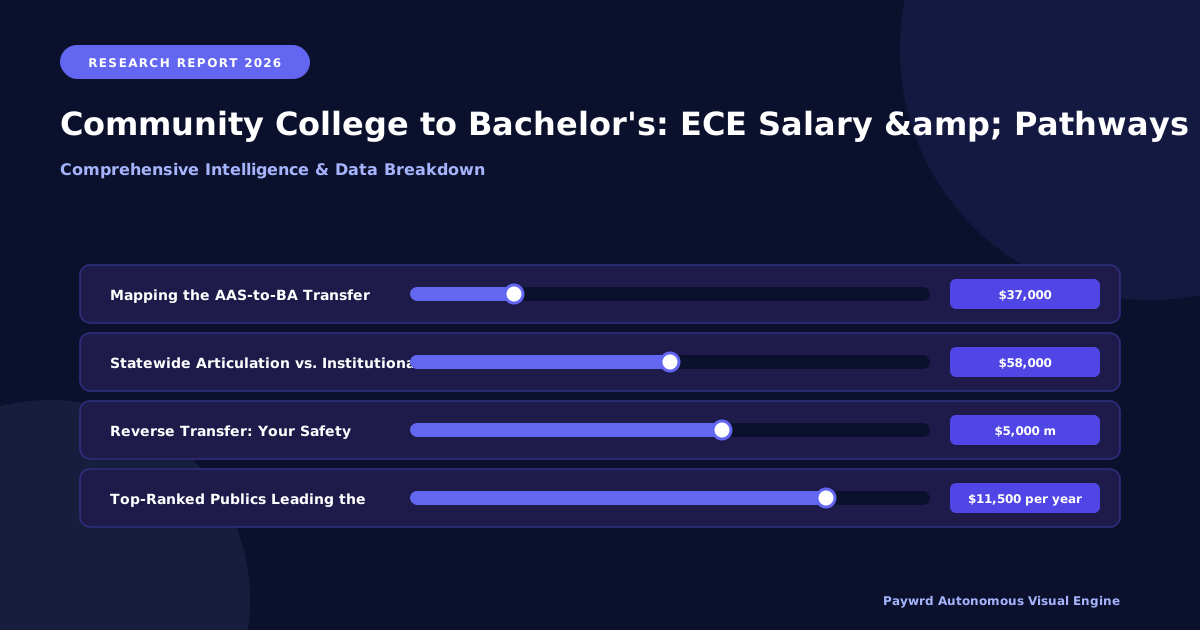
Mapping the AAS-to-BA Transfer Landscape for 2026
The jump from an Associate of Applied Science in Early Childhood Education (ECE) to a Bachelor of Arts is the highest-ROI move in the field, lifting median earnings from roughly $37,000 to $58,000 annually per Bureau of Labor Statistics data. Yet thousands of students lose a semester or more because they assume “accredited” means “transferable.” It does not. Your 2026 roadmap starts with distinguishing between systemic guarantees and bilateral handshakes.

Statewide Articulation vs. Institutional MOUs
Roughly 30 states—including Florida, Texas, and Washington—now enforce statewide articulation agreements that legally bind public four-year institutions to accept the entire AAS block (typically 60 credits) as junior-standing admission. If you are in a “guaranteed transfer” state, the community college advisor must provide a degree audit mapping every course to the receiving university’s general education core. Conversely, states relying on Memoranda of Understanding (MOUs) require you to negotiate credit-by-course equivalencies. In an MOU environment, a “Child Development” course at College A might satisfy a major requirement at University B but count only as elective credit at University C. Always request the current articulation matrix PDF—if it is older than 2023, treat it as obsolete.
Accreditation Gatekeepers: CAEP and NAEYC
Accreditation is your quality filter. The Council for the Accreditation of Educator Preparation (CAEP) is the gold standard for licensure-track BA programs; graduating from a non-CAEP provider can block state teaching licensure. Simultaneously, the National Association for the Education of Young Children (NAEYC) accredits associate programs specifically for professional preparation standards. The sweet spot? An NAEYC-accredited AAS feeding into a CAEP-accredited BA. This dual-accreditation pipeline signals to employers—and state licensing boards—that your clinical hours and coursework meet rigorous national benchmarks. Cross-reference the CAEP provider directory and NAEYC accredited program search before paying a single application fee.
Reverse Transfer: Your Safety Net
Life interrupts degrees. Reverse transfer policies allow credits earned at the four-year institution to flow backward, retroactively awarding the associate degree if you stop out before the BA. As of 2026, 22 states mandate reverse transfer for public institutions; private colleges often honor it voluntarily. This protects your credential floor: you leave with an AAS (worth ~$5,000 more annually than a high school diploma) rather than “some college, no degree.” Confirm the receiving university’s registrar participates in the National Student Clearinghouse Reverse Transfer service—it automates the transcript swap without paperwork chasing.
- Action Item: Download your state’s 2025–2026 Articulation Agreement PDF from the Higher Education Coordinating Board website.
- Action Item: Verify both the community college (NAEYC) and target university (CAEP) accreditation statuses are active.
- Action Item: Ask the four-year admissions office: “Does your reverse transfer policy require a formal request, or is it automated via the Clearinghouse?”
Online & Hybrid Bachelor’s Completion Programs for Working Teachers
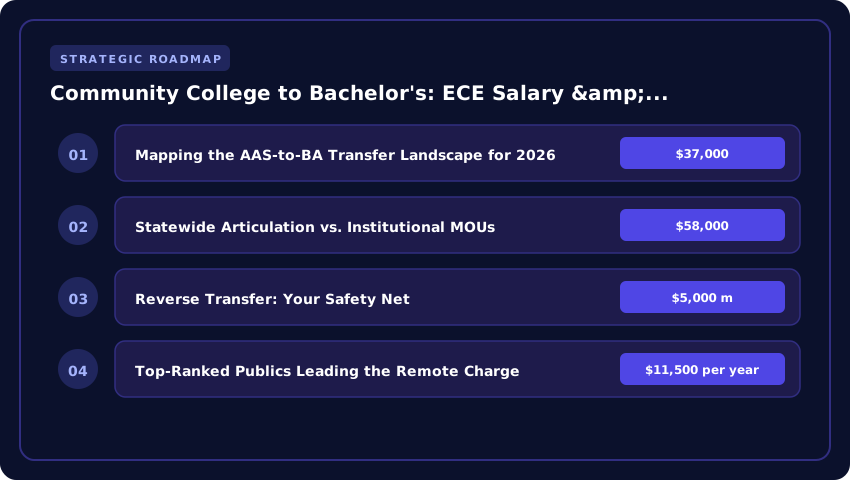
You have the associate degree. You have the classroom experience. Now you need a bachelor’s completion program that respects the fact that you’re teaching full-time, not sitting in a lecture hall at 10 a.m. on a Tuesday. The market has shifted dramatically since 2020; top-tier public universities have stopped treating online ECE degrees as cash cows and started building them as legitimate pathways to licensure and salary bumps. The trick is filtering for programs built around your schedule, not the registrar’s.
Top-Ranked Publics Leading the Remote Charge
If you want name recognition on your transcript without the private-school price tag, look at the big state systems that have invested heavily in instructional design. University of Washington (Seattle) offers a fully online BA in Early Care and Education designed specifically for transfer students—tuition runs roughly $11,500 per year for residents, a fraction of the $40,000+ private alternatives. Arizona State University (ASU Online) remains the 800-pound gorilla here; their BS in Educational Studies with an ECE focus accepts up to 75 transfer credits and operates on a $654 per credit hour flat rate regardless of residency. University of Colorado Denver rounds out the elite tier with a BA in Education and Human Development that leads directly to Colorado Director Qualification credentials, critical if you’re eyeing center leadership roles paying $55,000–$65,000 annually per BLS data.
Turning Your CDA and Classroom Hours into Credit
Don’t leave money on the table. Prior Learning Assessment (PLA) is the single fastest way to shave a semester—or two—off your timeline. Most competitive completion programs now standardize credit awards for the Child Development Associate (CDA) credential:
- CDA Credential: Typically translates to 6–9 semester credits (often covering Health/Safety/Nutrition and Curriculum electives).
- Verified Work Experience: Portfolios documenting 1,000+ hours of lead teaching can yield another 3–6 credits via faculty-reviewed portfolio assessment (fees usually $150–$300 per portfolio).
- State Credentials: Hold a state Infant/Toddler or Director credential? Schools like Northern Arizona University and Florida International University map these directly to upper-division requirements.
Pro tip: Ask admissions for a preliminary transfer evaluation before you apply. If they can’t tell you exactly how your AAS courses and CDA map to their degree audit, keep looking.
Scheduling Models: 7-Week Sprints vs. Traditional Semesters
This is where retention lives or dies. Traditional 15-week semesters force you to juggle three concurrent courses for four months—brutal during parent-teacher conference week or state testing windows. The modern standard for working educators is the 7- or 8-week accelerated term.
- Model A (Accelerated): Take one course at a time, back-to-back. You focus on “Curriculum Design” for seven weeks, finish, then start “Assessment & Observation.” ASU, UW, and Purdue Global use this. It keeps your cognitive load manageable and financial aid eligibility simple (you’re always “half-time” or better).
- Model B (Traditional): Two to three courses over 15 weeks. University of Massachusetts Global and some Cal State campuses still prefer this. It offers deeper peer discussion boards but demands serious time-blocking discipline.
Run the math on your specific district calendar. If you have summers “off” (unpaid), a traditional semester lets you front-load credits in June/July. If you work year-round at a Head Start center, the 7-week sprint model prevents the November burnout spiral. Fill out the FAFSA early—completion students often qualify for Pell Grants (up to $7,395 for 2024–25) and TEACH Grants ($4,000/year) if you commit to high-need fields, making the ROI on these flexible formats nearly immediate.
2026 Salary Projections: Associate vs. Bachelor’s vs. State Certification
Let’s talk brass tacks. You’re weighing the cost of two more years of tuition against a lifetime of earnings, and in 2026, the spread between an Associate of Applied Science (AAS) and a Bachelor of Arts (BA) in Early Childhood Education (ECE) is wider than most prospective students realize. According to the Bureau of Labor Statistics (BLS) Occupational Employment and Wage Statistics (OEWS) data projected forward with standard inflation adjustments, the median annual wage for Preschool Teachers (typically the ceiling for AAS holders in private centers) sits around $38,500. Contrast that with Kindergarten and Elementary School Teachers—roles requiring a BA and state licensure—where the 2026 median projection exceeds $64,200. That is a $25,700 annual gap that compounds to over a quarter-million dollars in the first decade alone, before you factor in public-sector pension vesting.
Where the Money Lives: Sector Breakdown
The credential you hold dictates the sector you can access, and the sector dictates the paycheck. Here is how the 2026 landscape shakes out:
- Private Childcare Centers (AAS Standard): Median ~$36,800. High turnover, rarely offers employer-sponsored retirement matching, and almost never provides paid summer breaks.
- Head Start / Early Head Start (BA Increasingly Mandatory): Median ~$48,500. The 2007 Head Start Reauthorization Act pushed a 50% BA teacher requirement; most grantees now prefer 100%. These roles include federal benefits (FEHB, TSP) and loan forgiveness eligibility via Public Service Loan Forgiveness (PSLF).
- State-Funded Public Pre-K (BA + License Required): Median ~$56,000–$62,000. These are essentially public school salaries on a 10-month contract. In states like New Jersey (Abbott districts), Oklahoma, and Georgia, lead teachers start at the K–12 step scale.
- Public Kindergarten/Elementary (BA + License): Median ~$64,200+. Full union representation, defined-benefit pensions, and salary schedules that reward graduate credits.
Geographic Arbitrage: Metros vs. Shortage Zones
Geography acts as a multiplier. In high-cost metros—San Jose-Sunnyvale-Santa Clara, CA; New York-Newark-Jersey City, NY-NJ-PA; and Washington-Arlington-Alexandria, DC-VA-MD-WV—public Pre-K and Kindergarten teachers frequently clear $85,000 to $95,000 by year five. However, an AAS holder in those same metros often earns only $42,000–$45,000, crushed by rent.
The strategic play? Target rural shortage areas with “Grow Your Own” pipeline grants. States like Mississippi, West Virginia, and New Mexico offer signing bonuses ($5,000–$15,000), housing stipends, and full tuition reimbursement for BA completion if you commit to teaching in a high-need district for three years. A BA graduate in a Mississippi Delta district might start at $48,000 with zero debt and a low cost of living, yielding a higher real wage than a private-center AAS teacher in Brooklyn.
Bottom line: The AAS gets you in the building. The BA + State Certification gets you on the public pay scale. In 2026, that distinction is the difference between a gig and a career.
Navigating State Licensure: From CDA to Initial Teaching License
Earning your Bachelor’s degree is the academic finish line, but state licensure is the regulatory gatekeeper that unlocks the public school salary schedule. Miss a single requirement—whether it is a specific Praxis cut score or a mandated reading course—and you remain stuck on the paraprofessional pay scale, often $15,000 to $25,000 below a licensed lead teacher’s starting wage. Understanding this landscape in 2026 means distinguishing between the credential you hold and the license the state actually requires.
The Bachelor’s Degree Mandate for Public Pre-K
If your goal is a lead teacher role in a state-funded pre-K program housed in a public elementary school, a Bachelor’s degree is non-negotiable in the vast majority of states. Per the National Institute for Early Education Research (NIEER), 33 of 44 states with public pre-K programs now require lead teachers to hold a BA with specialized ECE coursework. States like New Jersey, Oklahoma, and West Virginia enforce this strictly; you cannot be the teacher of record on an Associate degree or a Child Development Associate (CDA) alone. The CDA remains a vital stepping stone—often satisfying the 120-hour training requirement for a CDA Credential—but it functions as an entry-level qualification for assistant roles or private center compliance, not a public school license.
Alternative Certification: The Career Changer’s Fast Track
For professionals pivoting from unrelated bachelor’s degrees—say, a BA in Business or Biology—traditional four-year programs are inefficient. Every state now offers an Alternative Route to Licensure, typically structured as a residency or post-baccalaureate certificate. These programs allow you to teach under a provisional or intern license while completing pedagogy coursework (usually 18–24 credits) in the evenings.
- Teach For America and TNTP Teaching Fellows operate in high-need districts across 20+ states, often covering tuition in exchange for a multi-year commitment.
- State-specific examples: Texas’ Alternative Certification Programs (ACPs) can be completed in 12 months; California’s Intern Credential requires 120 hours of pre-service prep before you step into the classroom.
- Verify that your chosen program is CAEP-accredited or state-approved; unapproved providers will not lead to a standard license.
Praxis Exams: The Score That Sticks
Coursework gets you eligible; the Praxis gets you licensed. Most states require a passing score on the Praxis Core Academic Skills for Educators (Reading, Writing, Math) for program entry, followed by the Praxis Subject Assessments for certification. The benchmark varies wildly:
- Praxis 5025 (Early Childhood Education): Passing scores range from 156 in Kentucky to 165 in Virginia and 166 in Connecticut.
- Praxis 5205 (Teaching Reading: Elementary): Increasingly mandated by Reading Science legislation; passing scores typically sit between 159 and 162.
- EdTPA/PPAT: Roughly 20 states now require a performance assessment portfolio (scored 37–42 out of 75 depending on state) during student teaching or residency.
Pro Tip: Before registering, check your state’s Department of Education website for the exact test codes and cut scores for 2025–2026. ETS updates tests annually; studying for a retired version is a costly error. Once you hold that Initial License, you step onto Step 1, Lane 1 of the district salary schedule—often starting near $48,000–$55,000 base pay—with immediate eligibility for loan forgiveness programs like Teacher Loan Forgiveness or PSLF.
Funding the Final Two Years: FAFSA, T.E.A.C.H., & Employer Tuition
You have mapped your transfer pathway; now you need to fund it without drowning in debt. The bachelor’s completion phase—typically 60 credits at a four-year institution—carries a sticker price averaging $11,260 per year for in-state public tuition (College Board, 2024), before fees and living expenses. The strategy isn’t finding a single “golden ticket”; it is stacking three distinct funding pillars: federal entitlement, sector-specific scholarships, and employer investment.
Maximizing Pell Grant Lifetime Eligibility
The Federal Pell Grant remains the bedrock of transfer funding, offering up to $7,395 annually (2024–25 award year) that never requires repayment. However, the Lifetime Eligibility Used (LEU) cap—600%, or the equivalent of 12 full-time semesters—catches many transfer students off guard. If you attended community college full-time for four semesters, you have consumed roughly 200% of your LEU. You still have 400% remaining—enough for four more full-time semesters at the bachelor’s level.
Pro move: File your FAFSA the moment it opens (typically October 1 for the following academic year). List your target four-year schools immediately. If your Expected Family Contribution (EFC) — now replaced by the Student Aid Index (SAI) — is zero or negative, you qualify for the maximum. Do not assume you are “too old” or “make too much”; the SAI formula shelters significant income for independent students with dependents. Verify your LEU percentage on StudentAid.gov before committing to a program timeline; stretching to part-time enrollment preserves Pell eligibility across more terms.
T.E.A.C.H. Early Childhood Scholarships: The Sector’s Best Kept Secret
The Teacher Education and Compensation Helps (T.E.A.C.H.) Early Childhood Scholarship Program operates in over 20 states and D.C., funded through a blend of state CCDF allocations and private philanthropy. Unlike generic scholarships, T.E.A.C.H. is a comprehensive contract: it typically covers 80–90% of tuition and books, provides a travel stipend (often $80–$120 per semester), and—critically—includes a compensation bonus (usually $300–$600) or a raise upon contract completion.
- Eligibility: You must work 30+ hours/week in a licensed child care center or family child care home participating in the state’s QRIS (Quality Rating and Improvement System).
- The Commitment: Most contracts require a one-year service obligation to your current employer for every year of scholarship support.
- State Variance: In North Carolina and Pennsylvania, T.E.A.C.H. covers associate through master’s degrees. In Florida and Texas, funding prioritizes bachelor’s completion for directors and lead teachers. Check your state’s Child Care Services Association or AEYC affiliate for the 2026 application cycle deadlines—often March 1 or July 1.
Unlocking CCDF Quality Dollars & Employer Tuition Assistance
The Child Care and Development Fund (CCDF) mandates that states spend a minimum of 9% of allocations on quality activities (rising to 12% by FY2025). A significant slice of this “quality set-aside” flows directly to workforce development. Ask your center director or HR office specifically about CCDF-funded tuition vouchers or “Quality Improvement Grants” that can be applied to your bachelor’s program. These are often administered by local Child Care Resource & Referral (CCR&R) agencies and do not always require a T.E.A.C.H. application.
Simultaneously, deploy Employer Tuition Assistance (Section 127). Under IRS code, employers can provide up to $5,250 per year tax-free for undergraduate or graduate courses. Many large providers (Bright Horizons, Learning Care Group, KinderCare) and Head Start grantees have formal partnerships with universities like Walden, Capella, or local state colleges offering 10–20% tuition discounts. Stacking rule: Apply Pell first, then T.E.A.C.H./CCDF vouchers, then Employer Assistance last. This order ensures you maximize “free” money before touching the employer’s tax-free cap, leaving $5,250 in your pocket for living expenses or remaining balances.
Career Trajectory: Lead Teacher, Director, & Specialist Roles Post-Graduation
The associate degree gets you into the classroom, but the bachelor’s degree unlocks the career ladder. In 2026, the divergence in long-term earning potential between a terminal AAS and a BA in Early Childhood Education isn’t marginal—it’s structural. Most states now gatekeep lead teacher licensure, director credentials, and specialist certifications behind a four-year degree, creating a hard ceiling for associate holders that no amount of experience can fully shatter.
Director Credentials and Administrative Salary Bands
If your goal is to run a center, the math is unforgiving. The National Association for the Education of Young Children (NAEYC) accreditation standards—and most state Quality Rating and Improvement Systems (QRIS)—require center directors to hold a bachelor’s degree with specific administrative coursework (often 9–12 credits in leadership, finance, and law). An AAS holder typically maxes out as an Assistant Director. According to the Bureau of Labor Statistics (BLS), Education and Childcare Administrators, Preschool and Daycare earned a median annual wage of $54,290 in May 2023, but the top 10%—almost exclusively bachelor’s-prepared leaders in corporate chains or large non-profits—pulled in over $92,000. Without the BA, you are structurally locked out of that upper band.
Early Intervention and Curriculum Specialist Pipelines
The highest-growth niches—Early Intervention (Part C of IDEA) and Curriculum/Instructional Coaching—are effectively closed to associate-degree holders. These roles require state teaching licensure or specialist endorsements (e.g., Early Childhood Special Education or Reading Specialist), which mandate a regionally accredited bachelor’s as the entry floor. Early Interventionists often work for regional educational service agencies or school districts where starting salaries align with the K–12 pay scale—frequently $48,000–$55,000 base plus summer stipends—compared to the $35,000–$40,000 typical for lead teachers in private childcare centers. The BA isn’t just a credential here; it’s the prerequisite for the graduate coursework these specializations demand.
Union Representation and Tenure in Public Pre-K
This is where the financial compounding becomes undeniable. In states with universal Pre-K (like New Jersey’s Abbott districts, Oklahoma, or West Virginia), Pre-K teachers are placed on the public school salary schedule and covered by collective bargaining agreements (NEA/AFT affiliates). A first-year BA-holder on a step-and-lane schedule often starts at $50,000+ with health benefits, a defined-benefit pension, and a clear path to tenure—job security that simply does not exist in the private sector. An AAS holder in the same building is classified as a “paraprofessional” or “assistant,” earning $25,000–$32,000 with no tenure track. Over a 25-year career, that gap exceeds $750,000 in base wages alone, before calculating pension vesting.
- The Ceiling: AAS caps you at Senior Teacher/Assistant Director (~$40K–$45K ceiling).
- The Floor: BA opens Public Pre-K ($50K+ start), Administration ($55K+), and Specialist roles ($50K+).
- The Multiplier: Union tenure tracks add pension value worth 20–30% of salary annually.
Bottom line: The associate degree is a vocational entry point. The bachelor’s degree is the professional license. If you stop at the AAS, you are choosing a job; finishing the BA buys you a career.
| Decision Criteria | AAS in ECE (Terminal) | AAS → BA via Statewide Articulation | AAS → BA via Institutional MOU (Patchwork) |
|---|---|---|---|
| Median Annual Salary (2026 BLS Est.) | $37,000 | $58,000 | $58,000 (if completed) |
| Transfer Credit Guarantee | N/A | Full 60 credits (Junior standing) | Variable (30–60 credits); high risk of loss |
| Time to Bachelor’s Completion | N/A | 2 years (60 credits remaining) | 2.5–3+ years (remediation likely) |
| Total Tuition Cost (Est. Public In-State) | ~$10,000 (Associate only) | ~$25,000–$30,000 (Total 4-yr path) | ~$30,000–$40,000+ (Excess credits) |
| Licensure Eligibility (Public Pre-K/K) | Assistant Teacher / Paraprofessional | Lead Teacher / State License Eligible | Lead Teacher (if degree finished) |
| Admission Screening Cutoff (GPA) | Open Access (HS Diploma/GED) | Typically 2.5–2.75 Cumulative | Typically 2.75–3.0 + Course-by-course eval |
| ROI (5-Year Net Earnings Gain vs. AAS) | Baseline | ~$85,000+ Net Gain | ~$60,000–$75,000 (Delayed entry cost) |
Frequently Asked Questions
Does an AAS in Early Childhood Education transfer to a bachelor's degree in 2026?
An AAS transfers fully only in states with guaranteed statewide articulation agreements (e.g., NJ, WA, CO), granting junior standing. In states relying on institutional MOUs, credits transfer case-by-case, often forcing students to repeat 30+ credits. Always verify your target university’s specific agreement before enrolling.
What is the salary difference between an AAS and a Bachelor's in ECE for 2026?
BLS data projects a median annual wage of $37,000 for associate-level roles (assistant teachers) versus $58,000 for bachelor’s-level roles (lead teachers, public Pre-K). This $21,000 gap represents the highest ROI leap in the education sector, yielding roughly $105,000 in additional earnings over five years.
Which states have guaranteed AAS to BA articulation for Early Childhood Education?
As of 2026, states like New Jersey, Washington, Colorado, and Tennessee operate legislated statewide articulation agreements guaranteeing 60-credit transfer for AAS-ECE degrees. Most Southern and Midwestern states rely on voluntary institutional MOUs, creating inconsistent credit acceptance. Check your state’s Higher Education Coordinating Board for current maps.
What GPA is required to transfer from a community college AAS to a BA in ECE?
Statewide articulation agreements typically require a minimum 2.5–2.75 cumulative GPA for guaranteed admission. Patchwork MOU pathways often demand a 2.75–3.0 GPA plus specific prerequisite grades (C or better in practicum and child development). Competitive public universities may enforce higher departmental thresholds.
How much does it cost to complete a Bachelor's in ECE after an AAS in 2026?
Completing a BA via a guaranteed statewide pathway costs approximately $25,000–$30,000 total (Associate + Bachelor’s) at public in-state rates. Patchwork transfers average $30,000–$40,000+ due to lost credits requiring retaking courses. Federal Pell Grants and TEACH Grants significantly reduce out-of-pocket costs for eligible students.
Strategic Final Takeaway
When evaluating Community College Pathways For Early Childhood Educators To Earn Bachelor's Degree And Salary Outlook US 2026, base your decisions on accredited institutional standards, measurable return on investment (ROI), and up-to-date official guidelines. Always verify specific dates and requirements through official regulatory portals.


