

How Perkins V Funding Shapes 2026 Credential Availability
The Strengthening Career and Technical Education for the 21st Century Act (Perkins V) doesn’t just write checks; it writes the rules for which industry-recognized credentials (IRCs) appear on a high school transcript at zero cost to families. For the 2026 cycle, the U.S. Department of Education has tightened the screws on the “Program of Study” framework. States must now demonstrate a non-duplicative sequence of coursework that transitions vertically from secondary standards into postsecondary certificates, associate degrees, or registered apprenticeships. If a certification—say, an entry-level AWS Cloud Practitioner or a Certified Nursing Assistant (CNA) license—doesn’t map to a credit-bearing pathway at a local community college or four-year institution, it risks losing Perkins eligibility.
State-Level Allocation Differences: The “Approved List” Reality
Perkins V sends roughly $1.4 billion annually to states via formula grants, but the purchasing power for a student in Texas looks vastly different from one in Massachusetts. Each State Education Agency (SEA) publishes a “Promising Credential” or “Approved Credential” list, often developed in partnership with the state Workforce Development Board. In 2026, these lists are heavily influenced by the Workforce Innovation and Opportunity Act (WIOA) alignment requirements.
- High-Alignment States (e.g., Colorado, Tennessee): Credentials are pre-vetted against real-time labor market data (LMI). If the state projects 15% growth in advanced manufacturing, the NIMS Machining Level I credential is likely fully funded, including exam fees and consumables.
- Local Control States (e.g., California, New York): Districts (LEAs) have more discretion but bear the burden of proof. A CTE director in Los Angeles must submit a local labor market justification to use Perkins dollars for a Google IT Support Professional Certificate, whereas a peer in Denver simply checks a box on the state master list.
- Funding Caps: Watch for per-pupil expenditure limits. Some states cap credential spending at $150–$300 per student annually, covering the exam but not necessarily the required practice tests or safety gear (PPE).
New ‘Programs of Study’ Requirements: The Secondary-to-Postsecondary Bridge
The most significant 2026 shift is the enforcement of the “Program of Study” definition under Section 134(c)(2). It is no longer sufficient for a high school to offer a standalone “Certification Prep” elective. The course sequence must now include:
- Articulation Agreements: Formal MOUs with postsecondary partners guaranteeing credit transfer (e.g., CompTIA A+ = 3 credits toward an A.A.S. in Cybersecurity at the local community college).
- Dual/Concurrent Enrollment: At least one opportunity for students to earn transcripted college credit before graduation.
- Work-Based Learning (WBL): A continuum from career awareness to paid internships or pre-apprenticeships aligned specifically to the credential’s occupational code (SOC).
Practically, this means the OSHA 10-Hour card—ubiquitous but often taught in isolation—may only be funded if embedded within a Construction Technology Program of Study that leads to an NCCER credential and college credit. For families planning 2026 schedules, the action item is simple: ask the CTE director for the district’s “Perkins Approved Program of Study Crosswalk.” If the desired certification isn’t on that map, prepare for out-of-pocket costs or advocate for its inclusion during the next local application cycle.
Top 10 High-ROI Certifications by Labor Market Demand
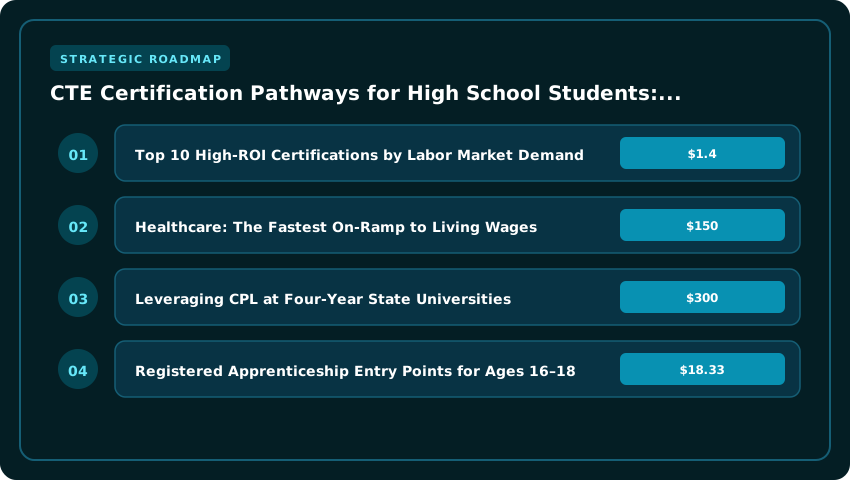
Not all credentials carry the same weight in the labor market. For the 2026 cohort, we have cross-referenced Bureau of Labor Statistics (BLS) 2023–2033 employment projections with state-level wage records from the Occupational Employment and Wage Statistics (OEWS) program to rank the ten certifications delivering the highest immediate return on investment for high school graduates. These are not “nice-to-have” badges; they are licensed or nationally recognized credentials that unlock median entry wages significantly above the federal minimum wage, often with tuition covered by Perkins V or state CTE funds.
Healthcare: The Fastest On-Ramp to Living Wages
Healthcare support roles dominate the top of the list because demographic demand is structural, not cyclical. The Certified Nursing Assistant (CNA) remains the gold standard for immediate employability. BLS projects 4% growth, but state wage data shows median hourly earnings of $18.33 ($38,130 annually) with virtually zero unemployment in long-term care facilities. Phlebotomy Technician (PBT) certification—typically a 12-week add-on—pushes median entry to $19.50 hourly ($40,580), while EKG Technician credentials average $20.12 ($41,850) in outpatient cardiac clinics. All three sit on every state’s approved Perkins V crosswalk, meaning districts can often cover the $1,200–$2,500 exam and material costs via federal allocation.
Advanced Manufacturing: Micro-Credentials Stacking to Six Figures
The manufacturing renaissance is real, but the entry ticket has shifted from generic “shop class” to stackable micro-credentials. OSHA 30-Hour General Industry is now a non-negotiable baseline; employers treat it as a proxy for safety maturity, and it correlates with a $2.50–$3.00 hourly premium over uncredentialed peers. CNC Operator/Programmer certs (NIMS Level 1) command median entry wages of $22.40 ($46,590), with overtime pathways pushing first-year W-2s past $55,000. The rising star is the Smart Automation Certification Alliance (SACA) Silver/Gold micro-credentials. These validate Industry 4.0 competencies—PLCs, IIoT networking, data analytics—and BLS “Installation, Maintenance, and Repair” occupational clusters show 13% growth through 2033. SACA holders entering apprenticeships frequently start at $24.00+ hourly.
IT & Cybersecurity: The Degree-Alternative Powerhouses
For students bypassing a four-year CS degree, the CompTIA stack remains the HR filter standard. CompTIA A+ (Core 1 & 2) validates help-desk readiness; median entry for Computer Support Specialists sits at $23.15 ($48,150). CompTIA Security+ is the force multiplier—DoD 8570 compliance makes it mandatory for federal contracting, lifting median entry to $30.50 ($63,440) for Junior SOC Analyst roles. Rounding out the top ten, the Google IT Support Professional Certificate (hosted on Coursera, ACE-recommended for 12 college credits) offers the lowest friction entry: $49/month subscription, self-paced, and recognized by employers like Walmart, Bank of America, and the federal government for GS-5/7 IT Specialist roles starting at $42,000–$52,000.
- Action Item: Verify each certification appears on your state’s Perkins V Eligible Credential List before committing seat time.
- Stacking Strategy: Pair OSHA 30 + SACA Silver + CNC for manufacturing; CNA + Phlebotomy + EKG for healthcare; A+ + Security+ + Google IT for tech.
Stackable Credential Architecture: From Diploma to Associate Degree
The real power of a 2026 high school CTE credential isn’t the certificate itself—it’s the articulated credit value locked inside it. Thanks to Perkins V’s “Program of Study” mandates, states have been forced to build transparent crosswalks mapping specific industry certifications (like CompTIA A+, AWS Cloud Practitioner, or ASE Entry-Level) directly to community college course equivalents. If a student graduates with a Concentrator status—typically two or more courses in a single CTE pathway—they aren’t just “college ready”; they are often 9 to 15 credit hours into an Associate of Applied Science (AAS) degree before they even fill out a FAFSA.
How Articulation Agreements Translate to Tuition Savings
Most major state systems—think the California Community Colleges Chancellor’s Office, the Texas Higher Education Coordinating Board, or the SUNY/CUNY networks—maintain searchable articulation databases. A 2026 graduate holding an Autodesk Certified User credential in Fusion 360, for example, can often petition for direct credit in DFTG 1309: Basic Computer-Aided Drafting at a partner college. At the national average community college tuition of roughly $3,990 per year (College Board, 2024 trends), bypassing a single 3-credit-hour course saves approximately $450 to $600 in tuition and fees alone, not counting textbook costs or time-to-degree acceleration.
However, the mechanism matters. Students must distinguish between:
- Statewide Articulation Agreements: Guaranteed credit transfer for specific certifications across all public two-year colleges in that state (common in Florida, Washington, and Ohio).
- Local Bilateral Agreements: Negotiated between a specific high school district and a nearby community college. These are narrower but often cover niche credentials like FANUC Robotics or local healthcare partner certifications.
- Credit for Prior Learning (CPL) Portfolios: Required when no formal agreement exists. The student pays a transcription fee (often $50–$150 per credit hour) to have faculty assess the certification against course learning outcomes.
Leveraging CPL at Four-Year State Universities
The stack doesn’t stop at the Associate degree. Major university systems—Arizona State University, University of Maryland Global Campus, Western Governors University, and the Pennsylvania State System of Higher Education (PASSHE)—have aggressive Credit for Prior Learning (CPL) policies that honor those same high school certifications, provided they sit on the state’s approved crosswalk. ASU’s “Earned Admission” pathway or UMGC’s “Prior Learning Assessment Network” (PLAN) can apply an entry-level PMI Certified Associate in Project Management (CAPM) or a Google IT Support Professional Certificate toward lower-division elective or major requirements in a Bachelor of Applied Science (BAS) or BS in Information Technology.
Strategically, a 2026 senior should request a “Degree Audit Preview” from the target community college before graduation. Present the certification transcript and ask the registrar to run a “what-if” audit for the target AAS major. This confirms exactly which credits articulate, which satisfy general education cores (like Quantitative Reasoning or Technical Writing), and which remain as elective overflow. That single conversation can save a family $2,000–$5,000 in redundant coursework and shave a full semester off the degree timeline.
Navigating State-Specific Graduation Seals & Endorsements
Because Perkins V delegates credential approval to the states, a certification that earns a diploma seal in Austin might count for nothing in Columbus. For the 2026 graduating class, counselors must treat each state’s “approved crosswalk” as the single source of truth—if the credential isn’t on that list, the district cannot legally apply federal dollars toward exam fees, and the student’s transcript may miss the designation entirely.
Texas: The CTE Endorsement & Program of Study Alignment
Texas remains the gold standard for transparency. Under the Foundation High School Program, students earn a CTE Endorsement by completing a coherent sequence of four or more credits within a single career cluster, culminating in an Industry-Based Certification (IBC) from the TEA’s annually updated IBC list. For 2026, the critical compliance checkpoint is the Program of Study (POS) framework. A student pursuing a CompTIA Security+ credential, for example, must be enrolled in the Cybersecurity POS; simply passing the exam in a generic “Computer Science” elective will not trigger the endorsement. Counselors should verify the student’s four-year plan against the TEA Crosswalk every semester—course codes (PEIMS numbers) must match the POS exactly, or the seal is forfeited.
Ohio: The Industry-Recognized Credential Seal & Point Thresholds
Ohio takes a points-based approach. The Industry-Recognized Credential Seal requires students to earn 12 points within a single career field using credentials from the Ohio Department of Education and Workforce (DEW) approved list. A 12-point credential like the AWS Certified Welder or STNA satisfies the seal instantly. However, “stackable” lower-point credentials (e.g., a 6-point OSHA 30 + a 6-point CPR/First Aid) only count if they sit inside the same career field pathway. The 2026 trap: Ohio’s “Graduation Seals” legislation now requires students to earn two seals total (one state-defined, one locally defined). Families should confirm the CTE seal counts as the “state-defined” option early in junior year to avoid a senior-year scramble for a Citizenship or Fine Arts seal.
California: Golden State Pathways Program (GSPP) Integration
California’s Golden State Pathways Program (funded at $500 million in the 2023–24 budget) shifts the goalposts for 2026. GSPP grants require districts to integrate dual enrollment, A–G completion, and work-based learning into a single pathway. A certification alone—say, an Autodesk Certified User—does not generate a standalone “state seal” on the diploma. Instead, the credential must be embedded in a GSPP-approved pathway that articulates to a community college certificate or associate degree. Counselors must audit master schedules to ensure the CTE course is coded as CCAP (College and Career Access Pathways) dual enrollment. Without that coding, the student gets the cert, but the district loses GSPP funding and the transcript lacks the “College & Career Ready” indicator that UC/CSU admissions officers now prioritize.
- Compliance Checklist: Download the 2025–26 approved credential list from your SEA website (TEA, Ohio DEW, CDE) before scheduling exams.
- Crosswalk Verification: Match the student’s course code (PEIMS in TX, EMIS in OH, CALPADS in CA) to the specific Program of Study.
- Funding Gate: Confirm the district has budgeted Perkins V or state grant funds (GSPP in CA) for the specific exam voucher—unfunded mandates are common.
- Transcript Coding: Ensure the registrar uses the correct state seal code (e.g., Texas
E-CTE, OhioSEAL-IND, CACCR-IND).
Work-Based Learning Integration: Apprenticeships vs. Internships
Let’s be clear: not all work-based learning (WBL) is created equal, and confusing a semester-long internship with a Registered Apprenticeship Program (RAP) can cost a student years of earning potential. For the 2026 academic year, the distinction is sharper than ever. A traditional internship—often unpaid, rarely structured, and frequently treated as a “capstone” elective—typically yields high school credit but zero portable industry credentials. A RAP, governed by the U.S. Department of Labor or a recognized State Apprenticeship Agency, is a federally registered “earn-and-learn” model. It combines paid, on-the-job training (OJT) with related technical instruction (RTI) that articulates directly into nationally recognized credentials, college credit, and journeyworker status.
Registered Apprenticeship Entry Points for Ages 16–18
Contrary to persistent myth, students do not need a high school diploma to start a RAP. Under the Youth Apprenticeship framework, 16-year-olds can legally enter high-skill occupations—advanced manufacturing, cybersecurity, healthcare, and construction—provided the program meets Federal Child Labor Law exemptions for hazardous occupations (HO) under 29 CFR 570.50(b). In 2026, over 30 states operate formal “Pre-Apprenticeship to RAP” pipelines aligned with Perkins V Programs of Study. These aren’t shadowing gigs; they are employment relationships. The apprentice is a W-2 employee from day one, earning a progressive wage schedule (often starting at $15–$22/hour depending on the sector and state minimum wage laws) that scales with competency mastery. Critically, the Related Technical Instruction often counts toward high school graduation requirements and postsecondary credit simultaneously, eliminating the “dual enrollment vs. work” false choice.
WIOA Youth Funding: The Financial Engine for Paid Experience
Here is where the rubber meets the road for equity. The Workforce Innovation and Opportunity Act (WIOA) Youth Program provides the funding backbone for paid work experiences for eligible youth ages 14–24. For 2026, Local Workforce Development Boards (LWDBs) have roughly $3.2 billion nationally allocated for youth services, with a statutory requirement that at least 75% of funds serve out-of-school youth and 20% specifically fund paid work experiences.
- Eligibility: Low-income individuals (including those receiving SNAP/TANF), foster youth, homeless youth, justice-involved youth, English language learners, and those with disabilities. “Low-income” is defined by the Higher Education Act or 70% of the Lower Living Standard Income Level (LLSIL).
- Allowable Costs: WIOA can subsidize the apprentice’s wages (often 50–100% for the first 6–12 months), cover the cost of RTI tuition, textbooks, industry certification exam fees (e.g., CompTIA Security+, AWS Certified Welder), and even supportive services like transportation, tools, and childcare.
- The Strategy: High school CTE coordinators must formalize a Memorandum of Understanding (MOU) with their local American Job Center before the semester starts. This unlocks WIOA funding to pay the student’s wage during the RAP, effectively de-risking the hire for the employer.
The bottom line: An internship builds a resume line; a Registered Apprenticeship builds a career trajectory with federal wage protections, portable credentials, and a guaranteed wage progression. For 2026, districts serious about “immediate employability” are shifting resources from coordinating unpaid capstones to brokering RAP slots backed by WIOA youth dollars.
Emerging 2026 Pathways: Green Energy, AI, and Drone Technology
As we move toward the 2025-2026 academic cycle, state CTE catalogs are shifting away from traditional trade silos toward “hybrid-tech” clusters. These new pathways aren’t just about learning a skill; they are designed to align with the US Department of Education’s push for high-wage, high-demand careers. For students, this means the ability to graduate high school with industry-recognized credentials that traditionally required a two-year associate degree.
The Green Energy Surge: NABCEP Integration
Solar energy is no longer a niche elective. We are seeing a massive integration of NABCEP (North American Board of Certified Energy Practitioners) Associate credentials into high school electrical and construction programs. By aligning curriculum with NABCEP standards, districts are preparing students for a sector where the BLS projects significant growth in wind turbine and solar installer roles. While traditional trade school tuition can range from $5,000 to $15,000 per year, students accessing these via FAFSA-eligible dual-enrollment pathways can enter the workforce with a median salary often exceeding $50,000 for entry-level certified technicians.
Aerial Intelligence: FAA Part 107 in STEM
Drone technology has migrated from the “robotics club” to a formal certification pathway. The FAA Part 107 Remote Pilot Certification is now being embedded directly into STEM clusters. This isn’t just about flying; it’s about data acquisition for precision agriculture, infrastructure inspection, and emergency response. Because this is a federal license, it carries immense weight across state lines, providing a portable credential that transforms a hobby into a professional career in geospatial analysis or civil engineering.
The AI Frontier: Prompt Engineering and Ethics
Perhaps the most radical shift for 2026 is the introduction of AI micro-credentials. Rather than waiting for four-year universities to catch up, CTE programs are partnering with major vendors (such as Microsoft, Google, and AWS) to offer certifications in Prompt Engineering and AI Ethics. These credentials focus on the “human-in-the-loop” necessity—teaching students how to analyze AI output for bias and optimize LLM queries for corporate productivity. These skills are becoming prerequisite “soft-tech” requirements for roles in marketing, project management (PMI standards), and business administration (AACSB-aligned programs).
- Green Tech: NABCEP Associate credentials provide a direct pipeline to the renewable energy sector.
- Aviation: FAA Part 107 certification legitimizes drone operations for commercial use.
- Artificial Intelligence: Vendor-backed micro-credentials in prompt engineering future-proof students against automation.
Equity Access: Removing Barriers for Special Populations
Federal civil rights law doesn’t pause at the CTE classroom door. If your district uses Perkins V dollars—and virtually every district does—you are legally bound by the Individuals with Disabilities Education Act (IDEA), Section 504 of the Rehabilitation Act, and Title VI of the Civil Rights Act. For the 2026 compliance cycle, the Office for Civil Rights (OCR) is sharpening its focus on whether “special populations” (students with disabilities, English learners, economically disadvantaged, and single parents) have actual access to industry-recognized credentials, not just theoretical enrollment.
Testing Accommodations: IDEA and Section 504 in the Certification Lab
Here is where good intentions often crash into hard reality. A student’s IEP or 504 Plan governs classroom instruction, but certification exams—whether CompTIA, ASE, or NHA—are administered by third-party vendors (Pearson VUE, PSI, Certiport) with their own accommodation request pipelines. The district remains the “responsible entity” for ensuring the accommodation request is filed, documented, and approved before test day.
- Start at enrollment, not exam week. Flag certification-bound students in your SIS during scheduling. The Case Manager must initiate the vendor’s accommodation request portal (often a 6–8 week review cycle) the moment the Program of Study is locked.
- Match the accommodation to the construct. Extended time (typically 1.5x or 2.0x) is standard, but “read-aloud” via screen reader requires vendor compatibility checks. If the exam platform locks down the OS, the student needs a practice session on that exact lockdown browser with their assistive tech (JAWS, NVDA, Dragon) weeks prior.
- Document the “interactive process.” OCR audits look for a paper trail: the district’s formal request, the vendor’s determination letter, and the proctor’s sign-off on test day. Missing one piece exposes the district to a finding of discrimination.
Perkins Reserve Funds: Solving the “Last Mile” Logistics
States set aside up to 15% of their Perkins allocation for Reserve Funds, specifically targeting equity gaps. In 2026, savvy coordinators are writing these dollars into the local application to cover the hidden costs that derail special populations.
- Transportation stipends. If the only testing center for a high-welding credential is 40 miles away, a $150 gas card or contracted van service for the cohort removes a structural barrier for low-income and rural students.
- Technology equity. Reserve funds can purchase dedicated laptops with pre-loaded assistive software for the testing window, ensuring English Learners (ELs) and students with disabilities aren’t testing on mismatched library machines.
- Wrap-around supports. Some states now allow Reserve Funds to cover childcare vouchers for parenting students on exam Saturdays—a direct retention lever for a population with historically low completion rates.
English Learner Scaffolding: Technical Vocabulary as a Civil Right
Title VI requires meaningful access. Handing an EL student a 300-page CompTIA Security+ study guide in English is not meaningful access. For 2026, embed “Content-Based Language Instruction” directly into the CTE curriculum map.
- Pre-teach Tier 3 vocabulary. Before the networking unit, the ESL specialist and CTE teacher co-plan a 3-day “Language of the Lab” module covering terms like latency, throughput, handshake protocol—using bilingual glossaries and visual schematics.
- Leverage vendor EL supports. Certiport and Pearson VUE offer exams in Spanish, Japanese, and Simplified Chinese for select credentials. If the credential is on your state’s approved crosswalk, verify if a translated version exists and budget for it.
- Performance-based alternatives. Where the industry allows (e.g., NOCTI performance assessments), advocate for hands-on demonstration of competency to supplement written scores, reducing the linguistic load without lowering the technical bar.
Bottom line for compliance officers: Run an “Equity Audit” on every Program of Study this fall. Cross-reference your certification roster against IEP/504/EL rosters. If a subgroup’s pass rate lags the cohort by >15%, you have a finding waiting to happen—and a Perkins Reserve Fund solution ready to write.
| Pathway Type | Funding Source | Cost to Student | Credential Requirement | ROI Potential |
|---|---|---|---|---|
| Perkins V Approved | Federal/State Grants | $0 (Fully Funded) | Must be on State Crosswalk | High (Direct College Credit) |
| District-Funded | Local Tax Levies | $0 – Low | District Board Approved | Moderate (Local Employment) |
| Private/Third-Party | Out-of-Pocket | $100 – $1,500 | Industry Standard | Variable (Skill-Based) |
| Dual Enrollment | Hybrid State/Local | Low to None | Academic Prerequisites | Very High (Degree Acceleration) |
Frequently Asked Questions
What is the Perkins V Program of Study for high school certifications?
The Perkins V Program of Study is a federally mandated framework requiring a non-duplicative sequence of courses that bridge high school CTE programs to postsecondary education. For 2026, certifications must align with state-approved crosswalks to qualify for federal funding, ensuring students gain industry-recognized credentials that translate directly into college credits or employment.
How do I know if a CTE certification is funded by Perkins V in 2026?
To determine if a certification is funded, students and parents should consult their state's Department of Education 'approved crosswalk' list. If a credential is not listed within a defined Program of Study for the 2026 cycle, school districts generally cannot use federal Perkins V dollars to cover the examination or training costs.
What are Industry-Recognized Credentials (IRCs) in high school CTE?
Industry-Recognized Credentials (IRCs) are certifications validated by a third-party industry body that attest to a student's proficiency in a specific skill set. Under 2026 guidelines, these must be integrated into a structured academic pathway to be eligible for federal funding, providing students with competitive advantages in the US labor market.
Will CTE certifications in 2026 provide college credit?
Yes, when certifications are part of a Perkins V-aligned Program of Study, they are specifically designed to provide articulated college credit. This reduces the overall cost of a degree by allowing students to bypass introductory technical courses, provided the credential is recognized by the receiving postsecondary institution's accreditation board.
Strategic Final Takeaway
When evaluating Career And Technical Education CTE Certification Pathways For High School Students 2026, base your decisions on accredited institutional standards, measurable return on investment (ROI), and up-to-date official guidelines. Always verify specific dates and requirements through official regulatory portals.


