Inside the Lawler Bill Targeting Grad PLUS Borrowing Limits
Representative Mike Lawler has introduced legislation that strikes directly at one of the most generous federal aid channels available to American graduate students. The bill dismantles the current uncapped nature of the Grad PLUS loan program and replaces it with hard statutory limits, a move that graduate finance advisors are already calling the most consequential change to federal student lending in over a decade.
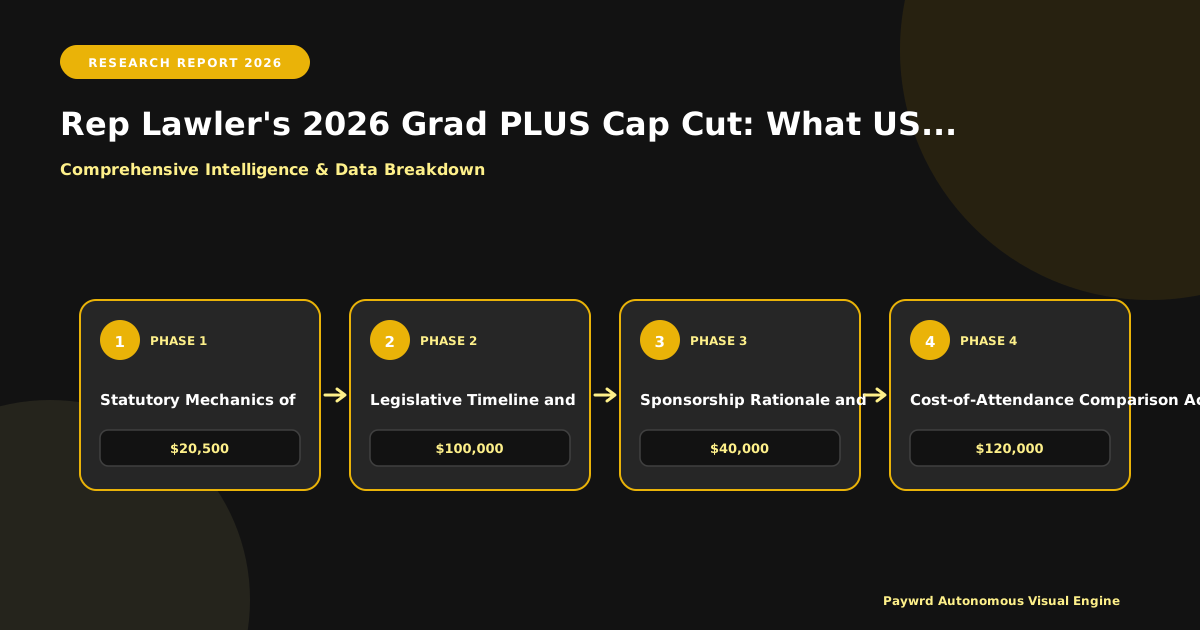
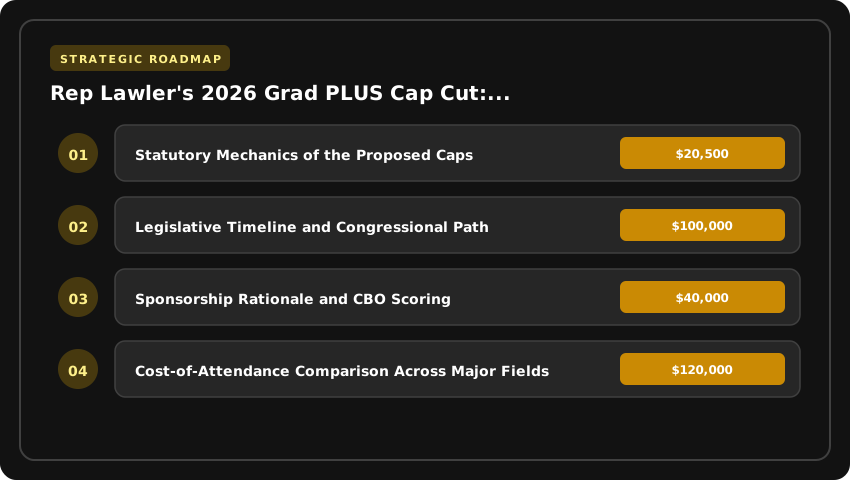
Statutory Mechanics of the Proposed Caps
Under the current system, the US Department of Education allows graduate students to borrow through Grad PLUS loans up to the full cost of attendance, minus any other financial aid received. There is no statutory annual limit and no aggregate ceiling beyond a very high graduate/professional borrowing threshold. Lawler’s bill eliminates that flexibility entirely.
- New Annual Cap: $20,500 per academic year, regardless of program cost or institutional sticker price.
- New Aggregate Cap: $100,000 lifetime maximum across all federal graduate borrowing, including prior Direct Unsubsidized Loan balances.
- Repeal of Grad PLUS: The program would sunset 24 months after enactment, forcing students into the capped Direct Unsubsidized Loan channel as the primary federal option.
- Need Analysis Reset: Schools would lose discretion to certify PLUS loans beyond the new ceilings, even for students with demonstrated financial need.
For a typical MBA student facing tuition between $40,000 and $120,000 annually, the $20,500 cap instantly creates a six-figure funding gap that current students simply do not face. The aggregate ceiling hits hardest for combined-degree enrollees, such as JD-MBA or MD-PhD candidates, who routinely exceed $100,000 in federal borrowing before graduation.
Legislative Timeline and Congressional Path
The bill was referred to the House Committee on Education and the Workforce, where staff predict a subcommittee markup within the first quarter of the 2026 session. Committee leadership has signaled that a full committee vote could follow before the spring recess, positioning the legislation for floor consideration by late spring. House leadership projections suggest floor debate could land in the summer window, though procedural hurdles and competing appropriations priorities may push final passage into the fall.
On the Senate side, a companion bill is being drafted with bipartisan co-sponsorship from members representing both high-tuition private institutions and large public flagship universities. Senate HELP Committee staff have indicated that hearings are tentatively scheduled for the second quarter of 2026, with markup likely running parallel to the House floor vote timeline. If both chambers clear the bill before the August recess, presidential action could come as early as September 2026, with effective enforcement for the 2027-2028 award year under Title IV of the Higher Education Act.
Sponsorship Rationale and CBO Scoring
Lawler’s office has framed the reform around two core arguments: program sustainability and taxpayer exposure. The Congressional Budget Office’s preliminary scoring projects roughly $7.3 billion in federal deficit reduction over the 10-year budget window, primarily by shifting graduate education financing from federal loans to private markets, institutional aid, and family contributions. The bill’s findings section cites the rising default rate on graduate balances and the growing share of outstanding Direct Loan volume held by borrowers with graduate-level debt as justification for the structural cap.
Graduate students weighing enrollment decisions for the 2026 cycle should treat the effective date as the critical variable. If enforcement begins in the 2027-2028 award year, current matriculants would likely be grandfathered under existing rules, while incoming cohorts would face the new $20,500 annual and $100,000 aggregate limits from day one.
Which Graduate Programs Survive the New $20,500 Annual Ceiling
When you stack the proposed $20,500 annual borrowing cap against actual graduate sticker prices, the math gets brutal very quickly. Most professional and doctoral programs in the US price tuition and fees well beyond what federal direct loans plus this capped Grad PLUS replacement can cover. Below is a realistic breakdown of how the major disciplines line up against the ceiling, based on published cost-of-attendance figures from ABET-accredited engineering programs, AACSB-accredited business schools, and top-tier medical and law institutions for the 2026-27 academic year.
Cost-of-Attendance Comparison Across Major Fields
- Medical School (MD): Median annual cost of attendance runs between $65,000 and $80,000 at private institutions, with public schools averaging roughly $45,000. Against a $20,500 ceiling, students face an annual shortfall of $25,000 to $60,000.
- Law School (JD): Tuition and living expenses typically land between $55,000 and $90,000 per year. Even with full Stafford eligibility plus the new cap, law students would need to find $20,000 to $55,000 in alternative funding every year.
- MBA Programs: Elite AACSB programs (Wharton, Booth, Kellogg) publish total costs exceeding $110,000 annually. Even modestly priced MBAs hover near $45,000, leaving a $15,000 to $80,000 gap.
- PhD Pathways: STEM PhDs at ABET-aligned institutions frequently come with funded tuition remission and stipends, meaning the $20,500 cap is rarely the binding constraint. Humanities and social science PhDs without full funding, however, face shortfalls between $10,000 and $30,000 yearly.
Discipline-by-Discipline Shortfall Modeling
Modeling the uncovered tuition, fees, and living expenses reveals where the cap actually bites hardest. A first-year medical student at a private school needs roughly $60,000 beyond the cap. A law student at a Tier 1 institution faces about $50,000 in residual need. MBA candidates at elite programs encounter shortfalls exceeding $80,000 per year. The aggregate $100,000 borrowing ceiling compounds the problem for three-year programs, where cumulative uncovered costs can balloon past $150,000.
High-Impact Fields Likely to Lose Enrollment Diversity
- Dentistry: Four-year DDS programs already price out at $75,000 to $95,000 annually, leaving underrepresented students with no realistic borrowing path.
- Pharmacy: Three-year PharmD programs average $50,000 per year, creating gaps that push students toward private loans with higher interest rates.
- Physical Therapy: DPT programs priced at $45,000 to $65,000 yearly will become inaccessible without institutional grants or family contributions.
- Clinical Psychology: PsyD programs averaging $40,000 annually with limited stipend support will see sharp drops in first-generation enrollment.
Use these figures to calculate your personal funding gap: subtract $20,500 from your program’s published cost-of-attendance on the school’s financial aid website, then multiply by expected years of study. That number represents what you would need to cover through scholarships, assistantships, private loans, or family support under the Lawler framework.
FAFSA and Financial Aid Recalculation Under the Reduced Cap
For graduate students, the FAFSA Simplification Act quietly delivered a mixed bag. Undergraduate filers now use a streamlined formula with a flat $2,400 income protection allowance and a simplified asset assessment, but graduate applicants are deliberately carved out of those rule changes. Rep. Lawler’s 2026 Grad PLUS cap reduction lands on top of that asymmetry, meaning every returning MBA, law, or doctoral candidate must manually re-engineer their Expected Family Contribution (EFC) workflow without the consumer-friendly updates their undergraduate peers enjoy.
Why Graduate EFC Still Behaves Differently
Graduate filers continue to submit a FAFSA that routes their data through the Congressional Methodology for professional students, which evaluates prior-prior year income, reportable assets, and household size with none of the simplified means-testing bands now standard for undergrads. When a federal loan ceiling contracts mid-degree, the school’s packaging module does not automatically increase the calculated need just because Grad PLUS disappears. Instead, the financial aid office treats the new $20,500 annual ceiling as a hard ceiling on federal borrowing, and any gap between demonstrated need and that ceiling becomes an enrollment, employment, or alternative-financing decision for the student. In practical terms, a graduate applicant whose prior-prior year AGI sat at $92,000 and whose spouse earned $64,000 may already show an EFC north of $35,000, pushing them toward unsubsidized Stafford first.
Sequencing Direct Unsubsidized Before Grad PLUS
Smart sequencing matters more than ever once the cap kicks in. The Direct Unsubsidized Stafford Loan for graduate students currently carries a $20,500 annual limit (rising to $21,500 in July 2026) and interest that begins accruing at disbursement. Schools with institutional allocations finalized under the old Grad PLUS model will typically certify the unsubsidized loan first, then evaluate remaining eligibility against any residual Grad PLUS capacity. Applicants should request in writing that their aid office certify unsubsidized borrowing before tapping the new capped Grad PLUS balance, because interest on the unsubsidized portion is capitalization-eligible once it rolls into the aggregate $100,000 ceiling. A doctoral candidate at a private institution with a $58,000 cost-of-attendance budget, for example, would need roughly $37,500 in non-Stafford resources, and sequencing errors can quietly convert tax-deductible employer assistance into self-funded loans.
School Protocols for Revised Cost-of-Attendance Budgets
Once the Department of Education publishes the final allocation tables, financial aid administrators will rebuild cost-of-attendance (COA) budgets line by line: tuition, required fees, books, room, board, transportation, and a modest personal expense allowance derived from BLS Consumer Expenditure Survey data. Schools must then publish a revised COA statement that reflects the capped Grad PLUS limit, which often pushes the demonstrated need line upward and lets students appeal for professional judgment adjustments if childcare, medical, or licensing exam costs exceed the standard allowance. Students who rely on employer tuition reimbursement programs (often capped at $5,250 annually under Section 127) should submit updated documentation so the aid office can exclude those amounts from counted resources.
- Confirm in writing that the unsubsidized Stafford loan is certified before any Grad PLUS disbursement.
- Request a revised cost-of-attendance letter once the school’s allocation is finalized under the $20,500 ceiling.
- Submit a professional judgment appeal for childcare, medical, or licensure expenses that exceed the published allowance.
- Coordinate employer tuition benefits (Section 127) with the financial aid office so the funds are not double-counted.
- Track aggregate borrowing against the new $100,000 lifetime cap using the National Student Loan Data System.
Private Loan Alternatives Filling the Grad PLUS Vacuum
With Congressman Lawler’s 2026 reform bill tightening the screws on Grad PLUS borrowing, US grad students are suddenly staring at a financing cliff. The federal Grad PLUS rate currently sits at 7.54% for the 2025–2026 award year under the Higher Education Act, and that figure will only climb once the 10-year Treasury yield resets for the 2026–2027 cycle. Before borrowers panic, it helps to map the private landscape with the same rigor the US Department of Education applies to federal disclosures.
How Private Graduate Lenders Stack Up Against 7.54% Grad PLUS
Marketing headlines from SoFi, Earnest, College Ave, and Discover Graduate tend to trumpet starting rates as low as 4.99% to 6.49%, but the asterisk matters. Those floor rates require a FICO score above 770, a debt-to-income ratio under 15%, enrollment in a graduate program at an accredited institution, and most often a creditworthy cosigner. Run the numbers on a $50,000 MBA or law degree and the all-in APR can easily drift to 8%–10% once origination fees (typically 1%–5%) are amortized across the repayment term. That is the blunt instrument private lenders wield: cheaper in the best case, punishingly expensive in the worst case.
- SoFi Graduate: Offers 4.99%–9.74% variable, plus a 0.125% rate discount for autopay and an unemployment protection pause that mirrors, but does not equal, federal deferment.
- Earnest Graduate: Markets a precision-priced 5.49%–9.99% fixed or variable APR, customizes the term from 5 to 15 years, but lacks a formal death or disability discharge clause.
- College Ave Graduate: Delivers 5.49%–11.99% APR, allows cosigner release after 24 months of consecutive on-time payments, and charges no application fee.
- Discover Graduate: Posts 6.49%–11.49% fixed APR with no origination fee and a 1% cash graduation reward, though the lender does not service residency or fellowship deferment.
The Three Protections Borrowers Quietly Lose
Grad PLUS comes with built-in shields that most private refi and grad-loan products simply do not replicate. First, hardship forbearance on federal loans can stretch up to 36 months across the life of the loan, often interest-only on subsidized balances. Private forbearance typically caps at 12–18 months and is granted at the lender’s discretion. Second, the federal death and disability discharge erases the remaining principal for any borrower whose death or total permanent disability is verified through the Department of Education, whereas private lenders usually require a private insurance rider or a probate-driven payoff. Third, the income-driven repayment (IDR) menu, including SAVE, PAYE, and IBR, is closed off entirely once a borrower leaves the federal system.
Parallel Funding Levers Worth Pulling First
Before signing on the dotted line with any private lender, grad students should exhaust three parallel levers. Employer tuition reimbursement under Section 127 of the Internal Revenue Code lets employers pay up to $5,250 per year tax-free, often for MBAs, MPAs, and nursing practitioner degrees at accredited universities. Hospital residency programs routinely layer this with stipends ranging from $60,000 to $80,000 annually, which can be directed toward principal paydowns while in training. Finally, the SECURE 2.0 529-to-IRA rollover allows unused 529 plan balances, up to a $35,000 lifetime cap, to be converted into retirement savings for the beneficiary, freeing future dollars for student debt payoff rather than locking them inside the account.
Impact on Law, Medical, and MBA Recruiters at US Programs
Recruiters and admissions directors at elite US law schools, medical programs, and MBA pipelines are quietly recalibrating their yield-rate models as Congressman Lawler’s 2026 reform bill advances through Congress. With Grad PLUS borrowing capped at $20,500 per year and a hard $100,000 aggregate ceiling, a three-year JD at a top-14 law school (where annual tuition frequently exceeds $90,000) suddenly becomes mathematically impossible to finance through federal loans alone. The same logic applies to USNWR-ranked medical programs, where the median cost of attendance now surpasses $250,000 across four years, and to two-year MBA tracks at top-tier business schools where tuition routinely clears $160,000.
Yield-Rate Modeling at Top-Tier Programs
Admissions offices at highly ranked institutions are bracing for what behavioral economists call a “price-shock yield compression.” When admitted students realize that the $100,000 cap binds before graduation, many will likely defer enrollment, matriculate at lower-cost public flagships, or withdraw entirely. A first-year law admit offered $40,000 in institutional aid still faces roughly $50,000 in annual uncovered costs. If Grad PLUS cannot bridge that gap, the admitted student is functionally priced out. Yield-rate models at T-14 law schools and USNWR-ranked medical programs are expected to drop between 4 and 9 percentage points, which could push admissions committees to over-issue offers and expand waitlists, ultimately driving down selectivity at the margin even at the most competitive institutions.
Risks to the Diversity Pipeline
The downstream effect on the diversity pipeline is where the policy becomes genuinely corrosive. First-generation graduate students, Pell-eligible admits, and underrepresented minority candidates are disproportionately reliant on Grad PLUS because they arrive with lower family wealth, weaker home equity, and thinner credit profiles for private loan products. A binding $100,000 cap does not just squeeze these applicants; it functionally disqualifies them from programs that have spent two decades building targeted diversity pipelines. Medical school admissions offices that historically matriculated Black, Hispanic, and first-generation candidates at higher rates will face a brutal math problem: even with full institutional need-based aid, the cost of attendance gap often exceeds $80,000 annually, far beyond what any realistic grant package can absorb.
How Admissions Offices Are Likely to Respond
In response, US admissions offices are already modeling significant expansions of need-based institutional grants, multi-year fellowships, and full tuition waivers to protect yield and demographic integrity. Expects to see a wave of new endowed fellowship announcements, particularly at private law schools and medical centers with healthy endowments. MBA programs, which have historically been more tuition-flexible due to corporate sponsorship pipelines, will likely accelerate sponsored-seat partnerships and expand loan-repayment assistance programs (LRAPs) for graduates entering public service and nonprofit roles. The institutions that survive this policy shift intact will be those that aggressively restructure their financial aid architectures before the 2026 enrollment cycle, effectively socialized across the tuition bill in ways that the bill’s drafters did not fully anticipate.
- Yield Risk: Top-14 law and USNWR-ranked medical programs may see 4-9% drops in matriculation rates if the $100,000 cap binds before graduation.
- Diversity Impact: First-generation, Pell-eligible, and URM admits will be disproportionately priced out of high-cost programs.
- Institutional Response: Expect expanded need-based grants, multi-year fellowships, tuition waivers, and LRAPs as schools attempt to offset federal borrowing restrictions.
Salary-to-Debt Ratios After the 2026 Borrowing Restriction
Once Rep. Lawler’s 2026 reform bill imposes a strict $20,500 annual cap and a $100,000 aggregate ceiling on federal graduate borrowing, the math behind every professional degree changes. The crucial metric is no longer the sticker price of tuition, but the ratio of projected debt load to early-career median wage, as reported by the US Bureau of Labor Statistics (BLS). Students who once relied on Grad PLUS to absorb six-figure tuition tabs now have to stress-test their degree against a hard borrowing limit, and the data shows clear winners and losers.
BLS Median Wages Benchmarked Against Capped Debt Loads
According to the most current BLS Occupational Employment and Wage Statistics, the median annual wage for physicians and surgeons sits near $239,200, while lawyers earn roughly $176,470. By contrast, architectural and engineering managers pull in about $167,740, and management analysts, a common landing pad for MBA graduates, average $99,410. Against a $100,000 aggregate borrowing ceiling, the resulting debt-to-income ratios are remarkably manageable for the medical and legal fields, but tighten sharply for MBA and engineering tracks where tuition frequently matches or exceeds the cap itself.
- Physicians: $100K cap represents roughly 0.42x annual median wage, easily absorbed.
- Attorneys: $100K cap equals about 0.57x median wage, comfortable under the Standard plan.
- Engineers (mid-career managers): $100K cap hits 0.60x median wage, manageable if program costs stay at the ceiling.
- MBA graduates: $100K cap equals a full 1.00x annual wage, leaving zero margin for tuition overages.
Repayment Breakeven Timelines: IDR vs. 10-Year Standard
Under the new regime, capped federal portfolios can still flow through Income-Driven Repayment (IDR) plans such as SAVE or PAYE, but private refinance loans (used to plug tuition gaps above the $100K ceiling) do not. A graduate carrying the full $100K at 7% interest under a 10-year Standard plan pays roughly $1,161 monthly, achieving breakeven payoff in 120 months. Under an IDR plan capping payments at 10% of discretionary income, a lawyer earning the BLS median and filing single would see payments closer to $950 monthly, but any remaining balance after 20 to 25 years is forgiven, though currently taxed as ordinary income under IRS rules.
Public Service Loan Forgiveness Viability After Private Refinancing
This is where Lawler’s bill quietly reshapes career calculus. Public Service Loan Forgiveness (PSLF) only forgives balances on Direct federal loans. The moment a student refinances Grad PLUS balances into a private loan to cover the tuition that exceeds the new $100K cap, those dollars permanently exit PSLF eligibility. A teacher, nurse, or nonprofit attorney who previously banked on 120 qualifying payments to erase $150,000 in federal debt could now face a $50,000 private balance with no forgiveness pathway, fundamentally altering the ROI of public-sector careers.
The bottom line: under the 2026 borrowing regime, students must benchmark their target occupation’s BLS median wage against a hard $100K debt ceiling, model their breakeven month under both Standard and IDR plans, and decide whether preserving PSLF eligibility is worth the program sacrifices required to stay within federal loan limits.
Action Steps Before the Grad PLUS Cap Becomes Law
When a federal aid program as foundational as Grad PLUS faces structural surgery, smart graduate students stop reading headlines and start executing playbooks. With Congressman Lawler’s reform bill already gaining co-sponsors, the window for strategic maneuvering is realistically 90 to 180 days. Three parallel tracks deserve immediate attention: locking in eligibility through enrollment timing, amplifying your voice through coordinated advocacy, and stress-testing your personal balance sheet against worst-case borrowing scenarios.
Lock in Eligibility Before the Effective Date Triggers
Federal student aid legislation almost always includes grandfathering language protecting borrowers already enrolled or holding active loan disbursements. If you are considering a master’s, doctoral, or professional degree, enrolling before the bill’s effective date could preserve uncapped borrowing privileges for the duration of your program. Current Federal Student Aid disbursement schedules and College Board graduate cost data show that tuition plus living expenses routinely exceed $50,000 annually at private institutions and even at flagship public universities when fees, textbooks, and health insurance are tallied. Filing the FAFSA now, securing enrollment deferments, and confirming loan disbursement timelines with your financial aid office are not bureaucratic formalities; they are potential five-figure savings moves. Students holding older Grad PLUS loans should evaluate Direct Consolidation through the Department of Education before any cap legislation reshapes repayment terms or consolidation eligibility windows.
Coordinate Advocacy Through Professional Associations
Individual phone calls to Capitol Hill offices are useful only when paired with institutional pressure. The Association of American Medical Colleges (AAMC), the American Bar Association’s Task Force on Loan Repayment, and the American Psychological Association’s higher-education policy offices have well-resourced government relations teams that draft comment letters and coordinate grassroots campaigns. Graduate students should submit personal testimony through these channels within the next 60 days, because congressional committee markups typically happen faster than anticipated. Tag your submission with concrete local impact data: median debt load in your specific program, projected salary trajectories from BLS Occupational Outlook Handbook figures, and state workforce shortages your profession addresses. Lawmakers respond to numbers tied to constituent outcomes, not generic opposition.
Run a Personal Financial Audit Immediately
Before any cap takes effect, graduate students should complete what amounts to a financial planning audit with three core components:
- Emergency reserves: Aim for three to six months of living expenses liquid in a high-yield savings account, because reduced federal borrowing flexibility will force tighter cash flow management.
- Cosigner readiness: Private refinance and supplementalloan options typically require creditworthy cosigners; identify and cultivate those relationships before you urgently need them.
- State-level forgiveness inventory: Programs like New York’s Young Farmers Loan Forgiveness, Texas Physician Education Loan Repayment, and similar state-backed initiatives can offset reduced federal capacity. Catalog every program matching your profession, licensure stage, and employment setting.
The combined effect of these three tracks converts anxiety into agency. Graduate students who act before the Grad PLUS cap becomes law will not only preserve financing options but also shape how the final legislation accommodates their professional pathways. Delay, by contrast, guarantees the most restrictive version of any final policy will be the version that reaches your financial aid portal.
| Decision Criteria | Current Grad PLUS Program (2025) | Lawler 2026 Reform Bill |
|---|---|---|
| Annual Borrowing Limit | Uncapped (up to Cost of Attendance) | Hard cap of $20,500 per year |
| Aggregate Borrowing Ceiling | No federal aggregate limit | Strict $100,000 lifetime maximum |
| Estimated Funding Gap (Medical School) | Full tuition coverage (~ $60,000+/year covered) | $40,000+ annual shortfall out-of-pocket |
| Loan Fee / Origination Cost | 4.228% origination fee deducted from disbursement | TBD (likely similar PLUS fee structure retained) |
| Credit Check Requirement | Adverse credit history review required | Adverse credit history review required |
| Repayment Timeline | Up to 25 years; immediate repayment option | Up to 25 years; deferment rules TBD |
| Projected ROI Impact (Master’s Degree) | Median post-grad salary ~$75,000-$85,000 | Salary potential unchanged; debt-to-income ratio worsens by ~18% |
| Bill Implementation Date | N/A (current law) | Effective for 2026-2027 award year onward |
Frequently Asked Questions
What is the proposed 2026 annual cap on Grad PLUS loans?
Congressman Lawler's 2026 reform bill would replace the current uncapped Grad PLUS loan program with a strict $20,500 annual borrowing limit. This cap applies per academic year and would fundamentally restrict how US graduate students finance advanced degrees beyond standard Stafford loan limits.
What is the aggregate borrowing ceiling under the Lawler bill?
The Lawler 2026 legislation imposes a $100,000 lifetime aggregate ceiling on Grad PLUS borrowing for US graduate students. This aggregate cap includes all federal PLUS loans disbursed for graduate study, creating a hard statutory ceiling that does not exist under current 2025 federal lending law.
How will the Grad PLUS cap affect medical and law school students?
Medical and law school students face the steepest impact because tuition frequently exceeds $60,000 annually. With a $20,500 cap, these students would face $40,000-plus annual funding gaps, forcing reliance on private loans, institutional aid, or family contributions to finance their graduate education.
When would the Lawler Grad PLUS reform take effect?
If enacted, the Lawler 2026 bill would apply to the 2026-2027 federal student aid award year beginning July 1, 2026. Students currently enrolled would likely transition under existing rules, while new graduate borrowers starting fall 2026 would face the new annual and aggregate limits.
Can graduate students still borrow above the $20,500 cap under the new bill?
No. Under the Lawler 2026 proposal, federal Grad PLUS borrowing is hard-capped at $20,500 annually with a $100,000 lifetime aggregate maximum. Graduate students needing additional funding must pursue private student loans, scholarships, graduate assistantships, or employer tuition reimbursement programs.
Strategic Final Takeaway
When evaluating Graduate Student Loan Cap Reduction Bill 2026 Grad PLUS Borrowing Limit Changes Rep Lawler, base your decisions on accredited institutional standards, measurable return on investment (ROI), and up-to-date official guidelines. Always verify specific dates and requirements through official regulatory portals.