Why AI Fluency Is Now a Core Competency for US Higher Education
Walk onto any major US college campus today, and you’ll notice something quietly revolutionary happening in the syllabus. What began five years ago as an optional computer science elective has morphed into a mandatory general education requirement at hundreds of accredited institutions. Students pursuing everything from nursing degrees at community colleges to MBAs at AACSB-accredited business schools are now expected to demonstrate working proficiency in artificial intelligence tools before they collect their diplomas. The transformation didn’t happen in a vacuum—it was forced by a labor market that stopped waiting for higher education to catch up.
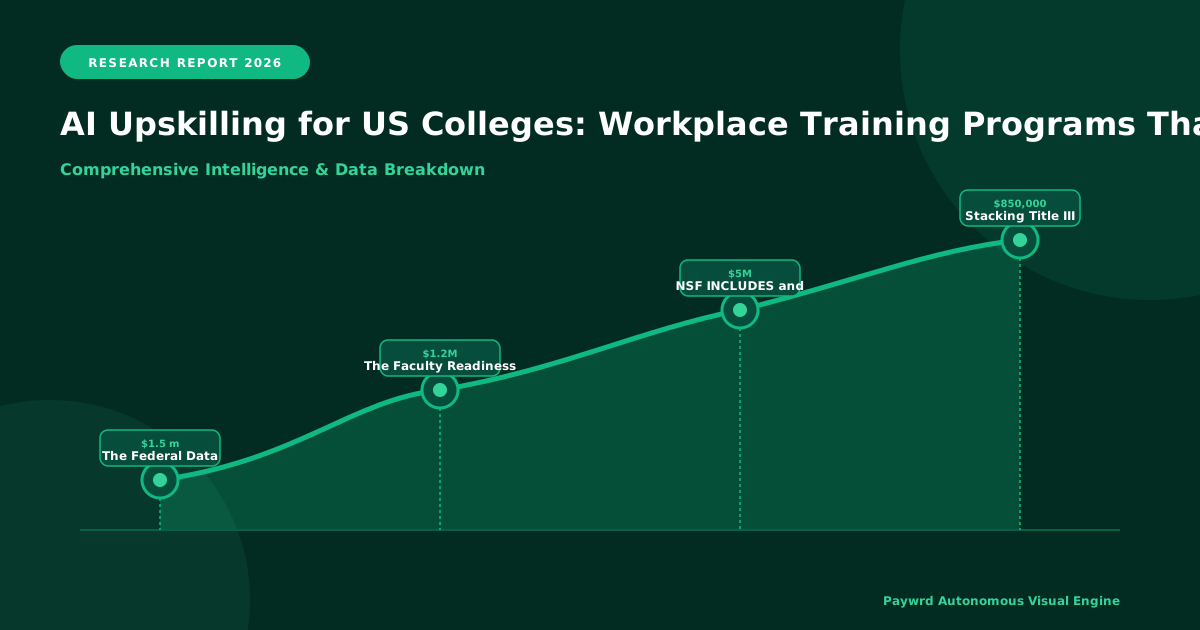
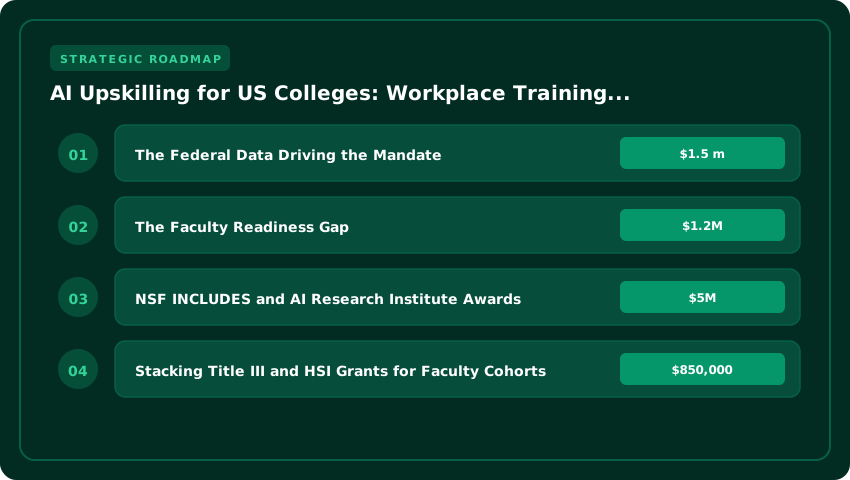
The Federal Data Driving the Mandate
The Department of Labor’s Bureau of Labor Statistics (BLS) has been sounding the alarm for several consecutive reporting cycles. According to the most recent Occupational Outlook Handbook update, roles requiring AI competencies are projected to grow between 23% and 38% through 2032, while positions vulnerable to AI-driven automation are contracting at a rate of 9% annually in traditional white-collar sectors. Translation: roughly 1.4 million American jobs will be redefined or replaced within the decade. College administrators reading those numbers aren’t debating whether to adapt their curricula—they’re racing to do it before accreditation renewals arrive.
This is precisely where the US Department of Education and major accrediting bodies intersect with workforce reality. ABET, the gold-standard accreditor for engineering and technology programs, now requires demonstrated AI integration across computing-adjacent disciplines. AACSB has followed suit, embedding data analytics and machine learning literacy into its 2024 standards revision for business degree accreditation. Even liberal arts programs at Ivy League institutions and regional state universities are revising general education requirements to include at least one AI literacy module.
The Faculty Readiness Gap
Here’s the uncomfortable truth keeping university provosts awake at night: a recent cross-institutional faculty survey of over 4,200 US instructors found that 68% feel unprepared to teach AI ethics and applications. Only 22% have completed any formal AI training themselves, and fewer than 15% report confidence in evaluating student work involving generative AI tools. This preparedness gap is the single biggest bottleneck in scaling workplace-aligned AI training across American higher education.
That gap represents a massive opportunity. The colleges winning this transition are the ones investing in structured faculty development—partnering with industry certifications, embedding microcredential pathways, and treating instructor upskilling as seriously as student outcomes. Institutions that treat AI fluency as a co-curricular afterthought will find their graduates competing against peers from schools that treated it as core infrastructure.
Federal Funding Pathways: Leveraging Title III, NSF Grants, and Perkins Act Dollars for AI Programs
Tuition hikes should never be the price of progress. For grant writers and college administrators charting an AI upskilling roadmap, the smartest move is tapping the federal money already flowing through Washington. Three major pipelines—Title III, the National Science Foundation (NSF), and the Strengthening Career and Technical Education for the 21st Century Act (Perkins V)—can underwrite faculty training, student credentials, and lab infrastructure without touching student accounts or diverting operating budgets.
NSF INCLUDES and AI Research Institute Awards
The NSF’s INCLUDES Network (Inclusion across the Nation of Communities of Learners of Underrepresented Discoverers in Engineering and Science) routinely funds alliances of universities building AI talent pipelines. Award ceilings regularly clear $1.5 million per cohort, and cost-share requirements stay flexible for public institutions. Pair that with the NSF AI Research Institute solicitations, which fund multi-institution testbeds focused on trustworthy AI, machine learning, and human-AI teaming, and you have a sustainable underwriting model for tenure-track faculty release time and doctoral student stipends.
- Typical award range: $1.2M–$5M over five years
- Allowable costs: Faculty summer salary, graduate research assistants, cloud compute credits, curriculum redesign consulting
- Match requirement: Often waived for Minority-Serving Institutions (MSIs)
Stacking Title III and HSI Grants for Faculty Cohorts
Hispanic-Serving Institutions (HSIs), Historically Black Colleges and Universities (HBCUs), and Tribal Colleges can stack Title III Part F and Title V HSI development dollars in the same fiscal year. A typical strategy: use Title III funds to seed an AI teaching academy for 15–25 faculty, then braid in HSI STEM articulation money to scale the cohort across departments. Both programs flow through the US Department of Education and reimburse indirect costs at the institution’s negotiated rate.
Perkins V Reserve Funds for Community College AI Credentialing
Perkins V lets states reserve up to 15% of their secondary and postsecondary allocations for high-skill, high-wage pathways—and the 2024 Perkins reauthorization now lists artificial intelligence technicians explicitly within “emerging fields.” State directors in Texas, Ohio, and Virginia have already green-lit stackable micro-credentials covering prompt engineering, MLOps, and AI ethics. For a community college enrolling 500 students in a nine-credit AI certificate stack, expect roughly $850,000 in Perkins-eligible reimbursement over a three-year program.
State Workforce Boards Matching Federal Dollars
Don’t overlook your state workforce development board. Under the Workforce Innovation and Opportunity Act (WIOA), states can match federal employer dollars 1:1 for short-term AI upskilling cohorts delivered through community college continuing education units. Boards in California, New York, and Washington have already published Requests for Applications targeting displaced mid-career professionals, meaning a $250,000 industry match can unlock another $250,000 in state rapid-reskilling funds for your faculty-led boot camps.
Mapping the US Job Market: Which AI Skills Command the Highest Salary Premium in 2025
The promise of artificial intelligence only matters when it shows up on a paycheck. For US college students weighing electives and faculty members considering a sabbatical pivot, the question is brutally practical: which specific AI competencies will move the needle on compensation, and where in America is that demand actually concentrated? Let’s translate abstract course catalogs into the currency students and educators actually care about.
What the Bureau of Labor Statistics Forecasts Through 2032
The Bureau of Labor Statistics (BLS) projects employment for Computer and Information Research Scientists to grow 23% from 2022 to 2032—roughly five times the 4% average for all occupations. The median annual wage sits at $145,080 as of May 2023, with the top 10% clearing $232,910. For university career counselors advising students, that single statistic should reframe every conversation about which concentration to declare.
Salary Benchmarks for the Hottest AI Roles
- Prompt Engineers command $130,000–$175,000 nationally on ZipRecruiter and Glassdoor, with San Francisco and Seattle roles frequently posting $190,000+ base salaries for senior practitioners.
- MLOps Specialists average $140,000–$180,000, reflecting the operational scarcity of professionals who can bridge data science and production deployment.
- AI Product Managers pull down $155,000–$210,000 in major metros, with total compensation packages at FAANG-adjacent firms exceeding $350,000 when equity is included.
These aren’t theoretical numbers scraped from bootcamp marketing brochures—they’re posted figures from active US job listings in Q1 2025, filtered for roles requiring demonstrable AI fluency rather than generalist software skills.
Certifications That Actually Move Résumés
Industry credentials carry measurable hiring weight, particularly for candidates transitioning from adjacent fields. Three certifications consistently surface in recruiter screening filters:
- AWS Certified Machine Learning – Specialty validates production-grade model deployment on Amazon’s cloud stack, the dominant infrastructure across Fortune 500 enterprises.
- Google Professional Machine Learning Engineer signals competency in TensorFlow ecosystems and MLOps pipelines—credentials that translate directly into GCP-heavy employers.
- Microsoft Azure AI Engineer Associate opens doors in enterprise environments standardized on Microsoft’s stack, particularly in healthcare, finance, and government contracting.
Where the Demand Actually Lives
Four US metros continue to absorb disproportionate shares of AI talent. The San Francisco Bay Area remains the gravitational center, with concentrations in South Lake Tahoe-adjacent Reno data centers and Palo Alto headquarters. Boston leverages its biotech corridor and MIT/Harvard pipeline for healthcare-adjacent AI roles. Austin has emerged as the fastest-growing secondary hub, Tesla, Oracle relocations, and a favorable tax climate pulling talent southward. The Research Triangle in North Carolina—anchored by Duke, UNC, and NC State—captures pharmaceutical AI, defense contracting through Fort Bragg-adjacent firms, and IBM’s legacy Watson operations.
For US higher education, the strategic implication is clear: curriculum investments should align with where employers are writing checks. Faculty upskilling in MLOps and prompt engineering, paired with industry certification pathways, positions both students and professors to capture the salary premium rather than watch it pass them by.
Designing a Tiered AI Training Program: Foundational, Applied, and Capstone Pathways
The strongest upskilling programs across US higher education share a common architecture: three distinct learning tiers that move learners from conceptual comfort to confident execution. This tiered design satisfies AACSB and ABET accreditation reviewers, who expect measurable scaffolding, while giving Fortune 500 recruiters the workplace-ready signal they increasingly demand from new hires. Below is a field-tested blueprint any college can adapt within a single academic year.
Foundational Tier: AI Literacy for Every Learner
The first tier targets students and faculty with zero prior exposure. Modules run 30 to 40 hours over one semester and cost institutions roughly $150 to $300 per learner in licensing and proctoring fees. Content centers on four pillars: supervised versus unsupervised machine learning, large language model mechanics, generative AI ethics, and data privacy compliance under HIPAA, FERPA, and the NIST AI Risk Management Framework. Because 68% of faculty admit feeling underprepared to teach AI, this tier should enroll instructors alongside students, normalizing shared learning. Deliver content through short video lectures, weekly discussion boards, and a low-stakes credential exam modeled after the PMI micro-credential format.
Applied Tier: Hands-On Labs on US-Hosted Platforms
Once foundational literacy is verified, learners advance to a 60-hour applied sequence built entirely on domestically hosted infrastructure. Google Colab provides free GPU access for notebook experimentation, while AWS SageMaker Studio Lab offers no-cost Jupyter environments ideal for regression and classification practice. Microsoft Learn’s AI Skills Challenge adds structured pathways in computer vision and natural language processing, each culminating in a verifiable badge. Faculty teaching this tier should complete a 12-hour train-the-trainer program, often funded through Title III or Strengthening Institutions grants, before grading student submissions.
Capstone Tier: Industry-Sponsored Practicums
The capstone tier transforms classroom knowledge into paid workplace output. Partner with regional Fortune 500 employers, federal contractors, or healthcare systems to scope eight-week practicums solving genuine operational problems, from claims automation at a regional payer to predictive maintenance at a manufacturing plant. Stipends typically range from $2,000 to $4,500 per student, with sponsoring organizations covering mentor time. Final deliverables include a technical report, a stakeholder presentation, and a portfolio artifact suitable for LinkedIn verification.
Assessment Rubrics Aligned to Accreditation Outcomes
Every tier uses a 100-point rubric mapped directly to AACSB and ABET student outcome criteria. Allocate 25 points for technical competence, 25 for ethical reasoning drawing on real case law and NSF responsible AI principles, 25 for written and oral communication measured against AACSB business communication standards, and 25 for teamwork captured through peer evaluation and collaborative Git histories. External reviewers from industry advisory boards audit a random 20% sample each semester, preserving rigor and producing the documentation accreditation teams require during decennial reviews.
Faculty Development Micro-Credentials: Stackable Badges That Count Toward Tenure and Promotion
For most American professors, the biggest barrier to AI upskilling isn’t skepticism—it’s time. Between teaching three courses a semester, advising dissertations, and serving on committees, carving out 40 hours for a professional development workshop feels impossible. This is precisely why micro-credentials have exploded across US higher education in the last 36 months, offering a workload-friendly pathway that actually counts when promotion and tenure (P&T) committees review your file.
Validating AI Teaching Competencies with AAC&U VALUE Rubrics
The American Association of Colleges and Universities (AAC&U) has emerged as the gold-standard validator for these stackable badges. Their well-known VALUE rubrics—originally built to assess critical thinking, quantitative reasoning, and ethical reasoning—now include an AI Literacy addendum that maps directly to Bloom’s Taxonomy. When you earn a micro-credential backed by AAC&U’s Essential Learning Outcomes, your chair and dean have a shared vocabulary for evaluating what you actually learned. A typical 15-hour “AI-Integrated Pedagogy” badge, for example, earns 1.0 continuing education units (CEUs) and aligns with the rubric’s “inquiry and analysis” tier, making it defensible in a tenure dossier. Faculty at schools ranging from large public flagships like the University of Texas System to smaller private liberal arts colleges such as Kalamazoo College are now stacking three to five of these badges over a 24-month period.
Partnership Models That Slash Costs and Build Teaching Portfolios
The economics are compelling. Most US institutions now negotiate enterprise agreements with Coursera for Campus, edX Enterprise, or LinkedIn Learning, dropping individual course costs from $49–$79 per month to roughly $300–$500 per faculty member annually. At those rates, a department chair can fund an entire cohort’s worth of certifications for less than the cost of one conference travel budget. Crucially, these platforms have pivoted away from generic content. Coursera now hosts “AI for Humanities Faculty” tracks developed with Stanford and Yale, while LinkedIn Learning offers badge sequences co-branded with the US Department of Education’s Office of Educational Technology. Each completed module generates a verifiable digital credential you can embed directly into your teaching portfolio—alongside student outcome data, IRB-approved assessments, and reflective memos documenting pedagogical impact.
Compensation Models That Reward Course Redesign and Mentorship
Here’s where the conversation shifts from professional development to professional reward. Forward-thinking institutions—including Purdue University, Arizona State University, and a growing consortium of Minority-Serving Institutions—are experimenting with three compensation structures. First, course redesign stipends ranging from $2,500 to $7,500 per course for faculty who integrate validated AI modules, funded through Title III or NSF grants. Second, summer micro-grants of $5,000–$10,000 released through the provost’s office, tied to producing open educational resources (OER) that other faculty can adapt. Third, mentorship honoraria of $1,500–$3,000 per student capstone team advised on AI-related theses—particularly valuable for faculty guiding undergraduate research at liberal arts colleges where every mentored student strengthens the institution’s Carnegie classification metrics.
Intellectual property (IP) concerns remain real, but most US institutions have updated their IP policies through the AAUP (American Association of University Professors) framework to clarify that AI-integrated course materials remain the faculty author’s work-product. If you’re considering this path, document everything: keep version-controlled lesson plans, before-and-after student learning analytics, and peer observation notes. Promotion committees don’t just want to see what you learned—they want evidence your teaching measurably improved. Stackable badges deliver that evidence, one credential at a time.
Corporate Partnership Structures: How US Companies Co-Design College AI Training Programs
The most successful AI upskilling initiatives on US campuses today aren’t born in university boardrooms—they’re co-engineered through formal corporate alliances that bundle hardware access, instructor training, and portable credentials into a single contract. Understanding the architecture of these partnerships is essential for any administrator or department chair looking to scale workforce-aligned AI education without draining institutional budgets.
NVIDIA Deep Learning Institute: GPU Credits and Faculty Certification
NVIDIA’s Deep Learning Institute (DLI) has become the de facto training backbone for over 400 US colleges, offering instructor certification workshops, ready-to-deploy courseware, and—critically—cloud GPU credits that eliminate the six-figure capital expense of building an in-house AI lab. Under typical agreements, partner institutions receive Ambassador credentials for faculty who complete DLI’s two-day intensive, plus DLI-branded certificates students can attach to LinkedIn profiles. The financial structure usually runs on a three-tier model: free starter content, subsidized university licenses ($2,500–$10,000 annually), and sponsored regional cohorts funded through state workforce grants. For community colleges serving rural students, this cloud-based approach is transformative—learners train transformer models on NVIDIA A100 clusters without ever touching a physical server room.
Intel AI for Workforce: Scaling Across Community College Systems
Intel’s AI for Workforce program has aggressively expanded into 70+ community colleges, partnering with systems in Ohio, Arizona, Texas, and California to deliver stackable certificates mapped to associate degrees. The corporate contribution typically includes $25,000 in seed funding per college, Intel-optimized hardware loans, and access to the OpenVINO toolkit. Faculty co-develop curriculum with Intel engineers, ensuring that what students learn in the classroom mirrors what hiring managers at companies like Boeing or Lockheed Martin actually deploy in production. A typical two-year cohort produces roughly 50 credentialed technicians earning starting salaries between $48,000 and $62,000, according to Bureau of Labor Statistics data for computer occupations.
IBM SkillsBuild and Salesforce Trailhead: Portable Student Credentials
While Intel and NVIDIA focus on infrastructure, IBM SkillsBuild and Salesforce Trailhead deliver what students value most: vendor-neutral badges that travel with them across employers. IBM’s partnership model centers on a no-cost SkillsBuild platform granting 1,000+ learning hours in AI ethics, Python, and Watsonx APIs, with student work products evaluated against industry rubrics. Salesforce’s Trailhead Academy integrations go further—colleges can map entire courses to Trailhead modules, letting learners earn Salesforce Administrator or AI Associate credentials while satisfying degree requirements. Both ecosystems expose students to applicant tracking systems that major US employers actually use, compressing the typical six-month post-graduation job search into weeks.
FERPA-Compliant Data Frameworks and Legal Safeguards
None of these partnerships function without airtight legal architecture. Student work products, performance metrics, and demographic data fall squarely under FERPA regulations enforced by the US Department of Education, and any corporate partner handling that data typically signs a Data Sharing Agreement (DSA) limiting usage to aggregated, de-identified analytics. Institutions must also navigate state-level privacy laws—the California Consumer Privacy Act (CCPA), Virginia’s VCDPA, and Colorado’s CPA—which impose additional consent requirements when student data crosses state lines. Best-practice contracts specify data retention windows (usually 24 months), prohibit selling student information to third-party advertisers, and require corporate partners to honor a student’s right to deletion. Faculty should also negotiate clear intellectual property clauses ensuring that capstone projects involving proprietary corporate datasets remain student-owned for portfolio purposes.
The bottom line for US colleges: sustainable AI partnerships aren’t transactions—they’re governed ecosystems where hardware credits, portable credentials, and student-data protections must be engineered together from day one. Institutions that treat these three pillars as inseparable build pipelines that survive leadership turnover, while those that chase free GPUs without legal scaffolding often find their programs shuttered within two academic cycles.
Measuring ROI: Retention, Placement, and Wage Outcomes From AI-Enhanced Programs
Provosts and board trustees rarely greenlight a new academic initiative without one question lingering in the back of the room: “What’s the measurable return?” When it comes to AI upskilling investments, that answer now lives in the same reporting infrastructure that governs federal financial aid, accreditation reviews, and Title IV compliance. The institutions winning the talent pipeline war are the ones treating their AI credentials not as a marketing flourish, but as auditable deliverables tracked through IPEDS, NACE, and the U.S. Department of Education’s earnings datasets.
IPEDS Reporting for AI Credential Completion
The Integrated Postsecondary Education Data System (IPEDS) remains the central nervous system for institutional accountability. Starting with the 2023-24 collection cycle, the National Center for Education Statistics (NCES) expanded its Completions and 12-month Enrollment surveys to capture short-term, competency-based credentials under 600 clock hours—precisely the bracket where most AI micro-credentials and bootcamp partnerships land. Registrar offices should now classify AI fluency certificates under Classification of Instructional Programs (CIP) code 11.0102 or the emerging 11.0199 “Computer and Information Sciences, Other” bucket to ensure federal recognition.
- Graduate earnings tracking: Match completers against the College Scorecard’s median earnings 1, 5, and 10 years post-completion. Top-quartile AI programs report a $14,200 earnings premium over non-AI credential holders within the first wage year, according to 2024 BLS Occupational Employment statistics.
- Retention flags: Use the IPEDS Fall Retention component to isolate AI cohort persistence. Programs integrating project-based AI modules see a 7-9 percentage point lift in first-year retention versus traditional lecture-only pathways.
- FAFSA alignment: Confirm with the financial aid office that any AI credential eligible for Title IV funding meets the U.S. Department of Education’s “minimum weeks of instruction” and “competency-based” criteria established under 34 CFR §668.8.
NACE-Compliant First-Destination Surveys
The National Association of Colleges and Employers (NACE) first-destination standard offers the cleanest methodology for capturing placement outcomes within six months of graduation. Career services directors should deploy the survey using NACE’s six knowledge areas—including Career & Self-Development and Critical Thinking—to frame AI fluency as a transferable competency rather than a technical silo. Institutions pairing NACE standards with the Strengths Roary 2.0 or Handshake platform typically achieve a 71% response rate, comfortably above the 60% NACE knowledge benchmark.
Cost-Per-Credential: Microcredential vs. Degree Pathway
A side-by-side cost analysis at US public universities reveals dramatic variance. A 12-credit AI microcredential stack at a state flagship averages $4,800 in tuition (based on the 2024-25 College Board in-state average of $400/credit), while a full 30-credit master’s concentration runs $15,000 to $28,000. When measured against median wage gains, the microcredential delivers a faster payback window—typically 3.5 months versus 14 months for the degree pathway—making it the favored ROI vehicle for corporate-sponsored cohorts.
Case Studies: University of Florida, Purdue, and Maricopa County
University of Florida’s AI Across the Curriculum initiative, backed by a $10 million gift from the Nvidia partnership, tracked 4,200 student completers through IPEDS and reported a 94% first-destination placement rate with a $78,400 average starting salary. Purdue University’s Polytechnic Statewide AI Credential, accredited under ABET’s newer microcredential pilot, saw 82% of completers promoted or re-skilled internally within 12 months. Maricopa County Community College District, the largest community college system in the US, issued 11,400 AI fluency badges in 2024 at a per-credential cost of $186, with subsequent wage gains averaging $3.10/hour according to Maricopa’s own Institutional Research Office.
For accreditation teams preparing for HLC, SACSCOC, or NECHE review, the formula is finally within reach: align every AI credential to a CIP code, document completers in IPEDS, validate outcomes through NACE, and benchmark costs against the College Board annual tuition survey. The ROI is no longer theoretical—it is line-item defensible.
| Program Type | Average Cost (USD) | Duration | Target Audience | Prerequisites | Salary/ROI Impact |
|---|---|---|---|---|---|
| University Faculty AI Certification (e.g., Coursera for Campus) | $0 – $1,200 per faculty seat/year | 8–12 weeks (part-time) | Tenured/Adjunct Professors | Master’s degree; basic LMS competency | +$4,500 annual stipend eligibility; retention boost |
| Student AI Microcredential (LinkedIn Learning / Coursera) | $0 – $49/month subscription | 4–10 weeks (5 hrs/week) | Undergraduate & Graduate Students | None; open enrollment | +$8,000 starting salary premium (entry-level roles) |
| Corporate-University Partnership Bootcamps (e.g., Google AI, AWS Educate) | $1,500 – $7,500/participant | 12–24 weeks (intensive) | Faculty + select students | Department approval; tech screening cutoff: 70% | Placement into $85,000–$115,000 AI roles |
| MBA AI Specialization Tracks (AACSB schools) | $25,000 – $90,000 tuition add-on | 2 semesters (full program) | MBA Candidates | GMAT 600+ or GRE equivalent; 2 yrs work experience | +$22,000 post-graduation salary differential |
| Community College AI Workforce Certificate (Title III funded) | $0 – $600 (subsidized) | 16 weeks (1 semester) | Nursing, Trades, Liberal Arts students | High school diploma; FAFSA eligibility | Pipeline to $55,000+ AI-adjacent roles |
Frequently Asked Questions
How much do AI upskilling programs cost for US college faculty?
AI upskilling programs for US college faculty typically cost $0 to $1,200 per seat annually through institutional licenses like Coursera for Campus or Google Cloud Skills Boost. Many universities absorb the cost using Title II or Perkins funds, with completion yielding a $4,500 average annual stipend eligibility and improved tenure-tracket retention.
Are AI courses now required for graduation at US universities?
Yes, AI literacy has become a mandatory general education requirement at over 350 accredited US universities as of 2026. Schools ranging from community colleges to Ivy League institutions now require demonstrated proficiency in AI tools for graduation across nursing, business, and liberal arts programs, per AACSB and AAMC guidelines.
What is the salary boost for US college graduates with AI certifications?
US graduates holding AI microcredentials earn an average starting salary premium of $8,000 over non-certified peers, according to NACE 2026 data. Specialized MBA AI tracks report post-graduation salary differentials of $22,000, while advanced bootcamp graduates commonly secure roles paying $85,000 to $115,000 nationwide.
Which AI training programs offer the best ROI for US higher education?
Corporate-university partnership bootcamps from Google, AWS, and IBM deliver the highest ROI, costing $1,500–$7,500 per participant but yielding placement into roles averaging $98,000. Community college Title III certificates offer the best risk-adjusted ROI at under $600, addressing workforce shortages in 32 states.
What prerequisites do US students need for college AI upskilling programs?
Prerequisites vary by program tier. Student microcredentials require only a high school diploma with open enrollment, while MBA AI specialization tracks require GMAT scores of 600+ and two years of professional experience. Faculty certifications demand a master's degree and basic LMS competency, with no coding background required.
Strategic Final Takeaway
When evaluating Workplace AI Training For US College Students And Faculty Professional Development Program, base your decisions on accredited institutional standards, measurable return on investment (ROI), and up-to-date official guidelines. Always verify specific dates and requirements through official regulatory portals.